It is sometimes said that were we truly to realize to the depth of our soul precisely the awesome what and the tremendous WHO the Blessed Sacrament is, we might never be able to get our faces up from off the floor except that out love and His grace would give us the joyful strength.
If a single glimpse in the Host is an encounter with the One who is mysterium tremendum et fascinans, how much more Holy Communion?
Go to confession!
That said, I am looking at a new book from the great people at TAN by Fr. J. Francis Sophie, OP:
Martyrs of the Eucharist: Stories to Inspire Eucharistic Amazement.
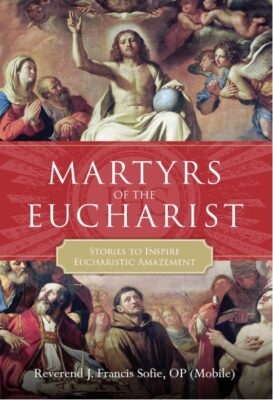
In the intro we read:
This book treats the Martyrs of the Eucharist in four divisions. Part One relates the heroic stories of priests who were killed for celebrating the Holy Sacrifice of the Mass or the laity who were killed while attending the Mass. Part Two considers those men and women who fearlessly died defending or protecting the Eucharist. Part Three recounts the remarkable stories of persons who risked their lives for the Eucharist, though they were not actually killed. And Part Four describes the remarkable stories of those who died because of some intimate connection to the Eucharist.
Celebrating, protecting, risking, dying.
As I write, I look up from my keyboard at the bell tower of the chapel of the Venerable English College in Rome. Off to the side there is another, smaller and decrepit campanile with a lever to the bell attached to a cable that descends through the terracotta tiles to the chapel below. This is the bell that was rung when news of a English martyr arrived.
I look down at my screen now and see the stories of saints in the first part of the book from Pope Sixtus II (+258) to Fr. Jacques Hamel (+2016) and I feel both small and massively increased in the same moment.
On my screen is the account of how priest-hunter Richard Topcliffe as Elizabeth I’s “interrogator” sought out priests and recusants for torture and horrific execution. Many were hanged, drawn and quartered.
As I contemplate the storm barreling down on Florida, sure to pass of St. Augustine, the place of the 1st Mass in N. America, there is the tale of a 15-year old indigenous boy Manuel (+1700) the first to be recommended to enter the seminary there. He was made sacristan of their chapel Our Lady of Candelaria. The village was attacked by Creek Indians and British troops who fired the chapel to draw out the priest so they could torture him. Manuel tried to save the chapel but they beat him ferociously and forced him to watch the flames. When all was burned they drowned him in the horse trough. His cause for beatification is being considered.
Across the Ponte Sisto here in Rome, the bridge to Trastevere linking the street that runs along side The Parish and in front of the little church were St. Vincent Pallotti is buried, we find Santa Maria della Scala. In that Carmelite church there is a shrine to Ven. Francis-Xavier Nguyen Van Thuan (+2002). A bishop for 22 years, he was taken by the Communists to a “re-education camp”… for 13 years. He found ways to have wine and tiny broken hosts smuggled in and celebrated Mass, then giving Communion to others.
“I will never be able to express the joy that was mine: each day,
with three drops of wine, a drop of water in the palm of my hand, I celebrated my Mass.
See what I mean?
I think all priests should have at least one Mass formulary memorized along with the Ordinary. I know you know why.
Would you consider giving this book to your parish priests? Their spiritual lives could be enriched as they then approach the altar of Sacrifice.
This is just about priests and religious, of course. I also think that it would be a good gift for a fallen away Catholic or someone wavering. In the ancient Church, during the “Gesimas”, prospective converts were instructed about the possibilities of suffering. It would be a great book for convert classes, too. A select chapter at a time.



 Maura on Summorum Pontificum Pilgrimage 2026… *sigh*… Vatican Bars Annual TLM Pilgrimage from ENTERING St. Peter’s Basilica: “And their language…The Vatican will BAR…nice strong language which shows how they truly feel. It’s a different level of opposition…”




























