
Hard to believe, but the Rector of the Basilica in Chattanooga in the Diocese of Knoxville (where the Bishop crushed the people who desire the TLM) has issued a THIRD homily about stitching together a gussied-up Novus Ordo Mass which is supposed to satisfy those who desire the Vetus Ordo (Usus Antiquior).
Fr. Carter’s strives to sound pastoral and sincere, to acknowledge the inflicted pain over the transition from the Traditional Latin Mass to the Novus Ordo. Yet his core argument, that continuity is preserved if the reformed liturgy is “done well”, rests on assertion rather than proof. By blaming rupture on poor implementation, he overlooks structural discontinuities within the reform itself. His proposed “hermeneutic of continuity” Mass, a personalized blend of old and new elements, ironically imposes subjectivism, making worship depend on the celebrant’s discretion rather than liturgical law. Absurd claims, such as that the 1962 Missale leaves “no place” for the faithful, misrepresent the nature of participation and the priest’s mediating role. Though he tried to sound compassionate, his tone condescending, reducing attachment to the TLM to emotion rather than conviction. Ultimately, the homily seems to offer sympathy but not resolution. It promises harmony where unresolved theological and ritual fractures remain.
As one of my correspondents quipped…
“A conclusion wandering in search of an argument…”
In what follows, my emphases and comments.
I find this task disagreeable.
Transition of the Latin Mass: Sympathy and Hope Homily given October 26, 2025 Very Rev. J. David Carter, JCL, JV, Pastor & Rector The Basilica of Saints Peter and Paul
Two weeks ago, I announced the transition of the celebration of this Mass to using the current liturgical books of the Roman rite. Last week I gave an explanation of the discernment leading to that decision. This week I would like to acknowledge the feelings that many are having, to express sympathy with the emotions that are swirling around it, and then to give reasons to hope that might help those who are struggling to understand what to expect.
First, I would like to ask forgiveness from anyone who felt hurt by the way this was presented. I never intended to offend or wound anyone, and I know that is certainly true for the bishop. But I do know the dangers out there for the flock, dangers learned from personal experience, from people who used to attend this parish, but have opted to rupture communion over things like this. [Let the blame game begin!] These are things that will inevitably cause an emotional reaction in the hearts of those who love the ancient forms of worship and so I beg your mercy for any unintended feeling of offense. I love you. I want what is good for you. I do not wish you harm, but I acknowledge that many parishioners are feeling wounded and hurt. Especially for you, I would like to invite you to a listening session (for 11:30 Mass parishioners) on Wednesday, November 5 at 6pm in Varallo Parish Hall, along with a potluck dinner. I invite you to come with your questions and observations.
[The opening frames the issue chiefly as managing emotions in view of an already-taken decision. This pre-emptively narrows the discussion to “feelings” rather than first principles (lex orandi, ecclesial law, juridical authority, morality of the decisions). It assumes the conclusion (transition) and moves the burden onto the hearers to adapt. The apology focuses on “how this was presented,” not on whether the decision itself could be prudentially or theologically faulty. The logic shifts harm from an act (suppression/transition) to a reaction (“emotional response”), which can read as non-accountability.]
I especially want to hear from you about what the ancient ways have meant to you. What do you feel you will be losing in this transition? What do you fear in celebrating the reformed order of Mass? [Is there any thought involved or is this about feelings?]
Second, know that I have wrestled with this for some time. Know that I share the struggle in understanding what this change will mean for us, and I don’t have it all figured out. I am seeking understanding of this direction the leaders of the Church have asked of us. [And yet what none of us know is what Leo XIV thinks in full. We have seen him welcome celebration of a Pontifical Mass by Card. Burke in St. Peter’s. That’s something, but not enough to have a clear indication of what he might do. In the meantime, bishops (at the behest of the Nuncio? Prefect? sua sponte?) have chosen to get active and stomp all over the faithful.] I have sympathy in this moment. I want you to know that I am on your side, even though some may think I am not. [Is that so? This is why you speak of the pre-Conciliar form as you do?] I understand well the feeling of betrayal and resentment for what was lost. [Thank you for acknowledging that it was “betrayal”.] I felt this myself when I discovered the richness of our Catholic liturgical tradition. I discovered this while in the seminary, long before Summorum Pontificum was issued. When I read books like The Spirit of the Liturgy by Cardinal Ratzinger and Turning towards the Lord by Fr. Lang and The Reform of the Roman Liturgy by Msgr. Klaus Gamber, it was as if a light was turned on. [These very authors raise principled critiques of the “reform”’s structure. Merely sharing appreciation for tradition doesn’t add much weight for the speaker’s claims.] I recall the immense joy I experienced in learning about the sacred traditions of the liturgy: orientation, language, gestures, and especially sacred music. I also recall the sense that these holy and beautiful things had been stolen and hidden from me. So, I can sympathize with what you may be feeling in this moment. I share your feeling of betrayal by those who told us traditional things were bad or harmful.
Know that I am not saying traditional things are bad. I lament with you when I see the most holy thing we do reduced to cheap entertainment and turned into a folk gathering or an informal coffee clatch. I cringe just like you when I hear banal music with theologically deficient texts sung to tunes meant for a lounge or a stage being sung at the most solemn moments of divine worship. Like you, I found a treasure trove of truth, beauty, and goodness in those things [I’m curious. Which “things”? This is of the essence, I think. Was it, as stated above: “orientation, language, gestures, and especially sacred music”?] that a certain generation rashly and imprudently jettisoned in their zeal to implement the reform. In this, we can recognize that in many places, the reform surely went beyond what was called for. In fact, these past few weeks I have been reading through the documents on the liturgy since Vatican II, and I see a consistent effort by the Church to correct these errors and liturgical abuses and call us all back to authentic reform.
I share your longing and desire for the recovery of the sacred. But here is the part that perhaps you may find surprising. I found these things we love defended and promoted even in the documents of the reform. Gregorian chant holds pride of place. The Latin language is to be preserved. The people are to know their parts in Latin. Versum populum worship was not ordered by the council, and ad orientem is still assumed in the rubrics of the current Roman Missal. Communion on the hand was only a concession to disobedient pastors, not a universal directive. Extraordinary ministers were not supposed to become so ordinary. The rules for offering Holy Communion under both species are still there, even if they are brazenly unenforced in most places. Look around you at this parish and what we have accomplished together over the years. We were celebrating the recovery of these holy and good things here even before the weekly celebration of the 1962 Missal, because we were following the already existing defense of tradition found in the documents, rubrics, and directives following the reform. We want the fullness of the Catholic faith. We want the traditions. Especially among the young, this clear call for continuity and valuing ancient things is being heard. But we also want these things in communion with the pope and the bishops. [Abuses, not reform. He posits overreach and “consistent correction” (in the paragraph above). This is assertion without warrant. If corrections exist, why are abuses endemic decades on? The inference “therefore the reform is fine” is a non sequitur. At the same time, if locally abuses have been checked, and just at that Basilica, that’s a good thing.]
I understand the desire to retreat into the security and stability of the older form. It is in no way wrong to appreciate, value, and desire what is good. We aren’t wrong for seeing and appreciating goodness in the pre-conciliar rites. For a time, I, too, took refuge in the stabilitas formae of the vetus ordo. [He concedes older rite’s stability, then subtly recodes it as “refuge” which is “retreat.” This is an equivocation: stability is not withdrawal.]
I share your fear of the spirit of rupture that has seemingly overtaken the reform in many quarters. I share your frustration with bishops and pastors who do not permit what is allowed universally, while allowing abhorrent abuses to continue without a word. It is disheartening to see many bishops seek to impose the rigidity of their own versions of the reform even when they have been proven to be unfruitful. [Never mind what is happening here.] I have been just as angry as you when I hear about bishops denying communion to those who simply want to kneel to receive our precious Lord in the Eucharist. I, too, have been upset when I hear of bishops imposing a myopic view of the liturgy that comes from the ‘beige’ period of Catholicism. We pastors can be real boneheads at times, for sure. But notice how the Church universal came to our rescue and gave us a correction with a reiteration of the legitimate posture of kneeling and receiving Communion on the tongue. [He might be referring to Redemptionis Sacramentum.] We do it freely here. I truly believe a similar reiteration will come about ad orientem. The orientation of our Eucharistic prayer ad Deum can never been denied, [And yet it is.] and the church has reiterated it in documents that clarify the words used in the rubrics. [And yet they are ignored.] I lament with you the horizontalization of our prayer as if the Eucharistic prayer is prayed towards the people. I’ve heard from many laity that they don’t want the priest to put on a performance for us as if he were on stage to entertain us. I’ve watched as priests speak words to the Father but look into the eyes of the faithful, as if they were supposed to be making some personal connection with the people at that transcendent moment. No wonder there is a mistaken ecclesiology and theology that has developed in some places. [Indeed.] But that is a defect of the implementation, not of the reform itself. For sure, there is a lot of malformation and misinformation out there about who we are and what we are doing. It needs to be corrected. But we who have read the documents and appreciate the gift of our sacred tradition know that the Holy Sacrifice of the Mass is not a celebration of ourselves in a closed circle of affirmation; it is the Church’s worship of the Divine. It is one of the reasons I truly believe we need to recover the proper orientation of prayer through things like the ad orientem posture at the Eucharistic Prayer. It is the very thing discerned by millennia of Christian praxis in both East and West. It cannot be denied that it is a legitimate direction in prayer. [“Implementation, not the reform.” He attributes the problems to execution, not design, but doesn’t engage the fact that versus populum, and other options (not to mention didactic verbosity) are designed features of the Novus Ordo. These are issues of structure, not merely abuse or implementation.]
However, I am anxious that many have abandoned the reform and fighting the good fight for tradition [He is using “tradition” here equivocally.] in favor of a withdrawal, [Here we go again with the “fear” and the “refuge/retreat” theme.] preferring to form a ghetto of isolation, [And here we go with a nasty stab.] rather than any attempt at reform, because there have been setbacks. This is where I see the wound that needs to be healed. And this is where we may disagree. That is ok. [But all those people are, I suppose, blinkered…what… cowards? Because they have run away from the good fight and cower in their ghettos? What came to mind is the image of Russian soldiers in WWII whose officers stood behind them, driving them forward or shooting them if they stopped. In the meantime, I might ask… who is it who truly “ghettoized” people who want traditional worship? Honestly, who did what to whom? Did they do it to themselves?]
Those opposed to these sacred traditions want you on the margins. [What the heck is this?] I want you squarely in the heart of the Church. They want you where you can’t influence others with your desire for the sacred traditions. I want you out front and visible with your love of sacred things. A city set on a hill cannot be hidden. A lamp is not meant to be hidden. Many priests have reached out to me with hope these past couple of weeks about what we are moving to here. Traditional things in many places have been relegated to off-site locations since Traditionis Custodes. They see in this option the opportunity to expand more widely the traditional things their own people are asking for in the heart of the Church. [Again, the implicit claim is that there really isn’t much difference between the TLM and the Novus Ordo wrapped up in traditional looking and sounding elements and celebrated according to the options that make it more like the TLM. There is no effort to address the differences of content of the orations, for example, or elements of the ordo missae.]
We are listening. We feel with you. The Church loves you. The Pope loves you. The Bishop loves you.
I love you. I want what is good for you. You have a voice, and it is being heard, even if it is not precisely in the way you may desire.
[*eye roll* Again with the condescension, as if he is talking to a tear-streaked little girl who had a nightmare about a monster under the bed.]
Some of that listening has already begun, and I would like to speak to you with answers as best I can. But know that I don’t have all the answers, and I couldn’t possibly give them all here, even if I did. Yes, some things will be different and there are some things we will miss. That happens with any change. But nothing essential will be lost – this is the act of faith I ask of you. What we will gain is an attempt at realizing the reform the universal Church called for. To quote G.K. Chesterton, “if a thing is worth doing, it is worth doing badly.” Thus, the benefit for us is to at least try, and I am sure it is going to be good, even if it isn’t perfect. [Chesterton also said that it you want to tear down a fence, you should know why it was put there in the first place.]
Will this transition mean the end of a traditional understanding of the Mass? The short answer is no. The Doctrine on the Mass has not changed, nor could it ever. We can very clearly still see the four ends of the Mass of adoration, thanksgiving, expiation, and petition being fulfilled even in the current Mass. There may be certain emphasis on things like the actual participation of the faithful along with the priest at Mass, [a red herring] but there was no doctrinal change in the fundamental understanding of the Holy Sacrifice. You have heard me preach numerous times about the primacy of interior participation as the heart of actual participation. And I quote modern popes in doing so.
Will this transition mean a reduction of the understanding of the sacrificial nature of the Mass? The short answer is no. The Doctrine still stands that the Mass is the Holy Sacrifice of Christ on Calvary and His eternal offering of that sacrifice to the Father made present to us. The argument is sometimes made that the new Mass is more about the Lord’s Supper than about the Sacrifice of Christ. However, what is going on in the reform is a recovery of the importance of the reception of Holy Communion, and not just by the priest. His reception may be the minimum for the completion of the offering of Mass, but it does not and should not preclude the participation of the faithful in this Holy Communion either. Did you know that the rite for Communion of the faithful is in not present in the 1962 order of Mass? It is only an extra ritual inserted, from the front of the book, that you enjoy when you are invited to Holy Communion. The old order of Mass doesn’t ordinarily include a place for you. Your communion is only as a secondary consideration in the rubrics as they were received in 1962. [In fact, there is a specific rubric in the 1962 which directs the priest, before his purifies the chalice, to give Communion if there are people there who would receive. So that isn’t quite correct.] In the Novus Ordo Missae, the Communion of the faithful is written straight in the order of Mass. 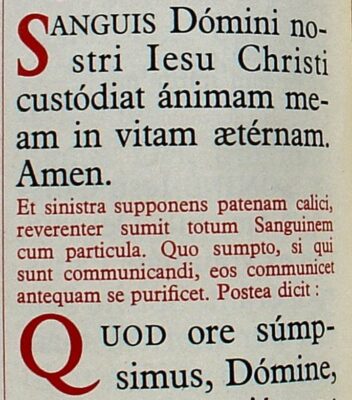 [It’s in the 1962 Missale too. I’ll insert an image to the right of the rubric in a 1962 Missale.] The recovery of the fact that the reception of Holy Communion by the faithful is an integral part of the Mass is a very good acknowledgement that the people matter, and the people are part of the Mass. Does it take away from the sacrifice of the Mass that the faithful are invited to sup with our Lord at Holy Communion? We are not losing the sacrifice; we are gaining a richer understanding that Holy Communion of the faithful is a part of the Mass.
Will this transition mean a reduction of the understanding of the sacrificial nature of the priesthood? The short answer is no. The Doctrine on the Priesthood has not changed, nor could it ever. [Is that so. While I believe that the Church will stick officially to her definitions, one wonders what is happening when the “Synod of BISHOPS” is packed with laypeople who vote? What is going on when a lay person can be appointed as head of a dicastery? Praxis and altered prayers lead the way….] While the importance of the faithful and their role in the Mass is clarified, it has been reiterated multiple times by popes and official documents that this is not a clericalization of the laity or a laicization of the clergy. [Alas, when something needs to be “reiterated multiple times”, is that a demonstration that the reiterations aren’t working?] It doesn’t mean an army of laity should now take over the sanctuary. It simply means owning the part that rightly belongs to the people at Mass. The parts that the servers say are your parts. They just happen to do them for you because they are in the Latin language. But you are invited to do them, too! Did you know that already in the text of the old Mass, the Orate, fratres, speaks about meum ac vestrum sacrificium – your sacrifice? You may not have realized it, because the rubrics had the priest say it quietly, and only the servers would respond. Now, the priest will say it out loud, and you will be asked to respond. Nothing changes about the theology. All that is changing is that you are asked to own what is yours. [How condescending. I respond saying, “Father may not have realized it, but people in the pews have books to follow and if they have been there more than a couple times, they known this.]
Will this transition mean the end of pious traditions like the Ember Days and Septuagesima and the various other penitential practices throughout the year? The short answer is no. We were emphasizing these beautiful traditions even before our weekly celebration of the 1962 Missal. They continue to form a part of our heritage and tradition and can benefit us still, even if they will not have a formal liturgical space for them. What prevents us from continuing to honor them as devotional practices? [Nothing prevents that… but don’t pretend it is the same. Another way to put it might be “don’t (relieve yourself) on my boots and tell it it’s raining”.]
Again, I would recall that long before we were celebrating a weekly Mass in the vetus ordo, we were already celebrating the joy of our Catholic tradition here. Now we will have the benefit of bringing even more from the storehouse of sacred tradition with us. [Hamlet 3.2.254]
With joy, I would like to share a few ways that will be taking shape in the transition. We will keep in devotion many things that before were done by ritual. The priest will continue praying the vesting prayers in the sacristy; [oh boy!] they are already there in the current Missal. [What about the maniple prayer? Will you use a maniple, I wonder. Probably not, because it was “reformed” out even though the Novus Ordo is silent and qui tacit consentire videtur.] We will be praying the prayers known as the Prayers at the Foot of the Altar together with the servers before Mass begins. [That’s not in the newer Mass.] I invite you to do the same from your pews. We will be offering the traditional Asperges rite as a pre-Mass devotional. We are not pretending it is part of the new order, but neither are we denying it has goodness by itself. [There IS an Asperges in the newer Mass.] What I hope can come about is that rather than fearing the traditional elements will somehow overshadow the reform, we can now embrace them fully without fear, even as we receive the legitimate fruits of the reform. As Pope St. John Paul II often said, “Do not be afraid!” [Appropriate John Paul II, now, will ya!] Do not be afraid of our tradition, and do not be afraid of the call to reform. [How many accusations of “fear” have we reached?]
[The next part might be subtitled “Wherein Father creates his own personalized Rite of Mass. Dr. K referred to it as the Ritus Carteriensis. At the foundation of this subjectively constructed Rite is the porting in of elements from the Vetus Ordo, never mind that early on in the “reform”, a response was given to a dubium about that which said, “Nope! Can’t do that!” Cf. the infamous Notitiae 14 of 1978.]
In the Mass we will transition to, wherever there is an option, the one that conforms most with the hermeneutic of continuity will always be chosen. All of the propers and ordinary for the Mass will be sung using the Graduale Romanum and Kyriale. [The Novus Ordo Graduale includes the Kyriale.] These books were adapted and issued after the Second Vatican Council and are the official books of sacred music for the Church. The full Gradual will be sung. Our sacred music will continue to make use of polyphony and traditional choral pieces written for the Holy Mass. The Confiteor [the changed Confiteor] and absolution will be done at every Mass, something that many of you only read, but now you will able to participate by saying it. [Never mind participating in it by receiving the absolution.] The Roman Canon will be used and said out loud, but the microphone will be off. Thus, we will fulfill the requirement of saying it vox clara, but also respect the tradition of silence during the Canon. [So, it’s a dodge.] The priest will continue to face ad orientem, that is, towards the altar, during the Eucharistic Sacrifice. He will turn to the faithful at the appropriate times as indicated in the rubrics already in the current Missal. We will still bow our heads at the name of Jesus and the mention of our Lady and our patronal saints. The servers will continue to ring the bells, swing the thurible, hold the candles, and even lift the hem of the chasuble and many other things that add to the elevation of the most holy moments of the Mass. There is no reason to omit good things simply because they are not prescribed. If the faithful in many places choose to hold hands at the Our Father as a devotion, there is nothing to prevent continued devotion to traditional practices, especially if they will be used as aids to assist us who are wary of the excesses of the reform to embrace its authentic expression. The Creed will still be sung, and no one will stop you if you genuflect at the Incarnation; it is in fact called for by the rubrics of the new Mass at certain times of the year. No one is going to stop you if you repeat the Domine, non sum dignus, three times. No one is going to stop you from receiving our Eucharistic Lord kneeling and on the tongue at our beautiful altar rail. We will still have space for the St. Michael Prayer and the Marian antiphon after the Ite Missa Est. [First, no one really can stop people from doing those things. Next, and more serious, these graftings onto the Novus Ordo (Prayers at the Foot, etc.) is liturgy by bricolage: creating a para-1962 envelope around the Novus Ordo. It tacitly admits a perceived deficit within the reformed Ordo. Mixing rites collides with the long-standing Roman instinct (and official guidance) against hybridization. The menu of options (Graduale, Roman Canon with the mic off, ad orientem, rail, triple Domine non sum dignus, etc.), smack of stitching up a bespoke “continuity” which itself dead ends in subjectivism. The faithful are to depend on the pastor’s policy (tastes) to experience elements most of which the old rites guaranteed. That undermines the homily’s appeal to stability and universality. What if Father leaves or is away and Fr. Joe Bagofdonuts decides otherwise?]
With these and many more things like it, I hope at least some of the questions you have in your hearts have been addressed. This is not a black and white situation. It is not a duality, as some would suppose, between tradition and modernity. There are no clown Masses being offered here. [Damning with faint praise.] Only that which stands in fidelity to the universal call to reform made at the Second Vatican Council [Appeal to the Council remains weak. What the Fathers of the Council mandate is decidedly not what we got.] and offered with the hermeneutic of continuity as our guide. This is reason to hope!
I invite you to ask for the spirit of peace and patience in these confusing times. I ask that as we follow the path of transition you do so with serenity, and trust in Divine Providence that He hears the cry of the poor and that we can always hope in the Lord.
I could spend a lot more time picking on this, but this is enough.
Dr. K also examined it: HERE































I agree with you that there are aspects of this proposed implementation that are wrong. One example, for brevity:
Father said, “We will be praying the prayers known as the Prayers at the Foot of the Altar together with the servers before Mass begins. I invite you to do the same from your pews. We will be offering the traditional Asperges rite as a pre-Mass devotional. We are not pretending it is part of the new order, but neither are we denying it has goodness by itself.”
That’s wrong. That is, as you put it, liturgy by bricolage. The integrity and identity of the reformed Mass are not being respected when such things are proposed or done adjacent to the liturgy.
If I were in charge, here is a basic, not complete, outline of what I would do:
1. Entrance to the chanted introit from the Graduale Romanum with incensing of the altar.
2. Chanted dialogues, ordinary, and orations throughout Mass (vernacular or Latin, or combination)
3. Blessing of water and sprinkling with chanted Asperges me or Vidi aquam (seasonal)
4. Chanted Confiteor, Kyrie, Gloria (seasonal), chanted Collect
5. Chanted Liturgy of the Word
6. Chanted Credo
7. Chanted dialogue before the preface, then chanted preface (ad orientem, if desired)
8. Chanted Sanctus
9. Spoken or chanted Eucharistic Prayer I (ad orientem, if desired)
10. Chanted Pater Noster and Agnus Dei
11. Chanted Communio from the Graduale Romanum with verses during Communion
12. Silence during the purification of vessels
13. Chanted prayer after Communion
14. Chanted dismissal
15. Either no music, instrumental organ postlude, or the sung seasonal Marian antiphon
You get the idea. My stance is that the reformed Mass should be celebrated in continuity with the Church’s liturgical tradition. That is the liturgical mind of the Church, correctly understood as expressed in her liturgical norms and teachings. The videos of Masses you posted in the entry below this one are decidedly contrary to the mind of the Church regarding liturgical ars celebrandi.
Some of the rector’s proposals would result in incoherent liturgy, I believe. Let the reformed Mass be the reformed Mass, but celebrate it with an ars celebrandi that is in harmony with the preconciliar liturgical tradition.
Okay, so if we’re fine going with mere feelings, and picking up those things from the “old days” that we like and importing them into the Novus Ordo: in the old days my Mom and Dad would put $1 in the collection and consider their duty done. Do we “feel” that’s okay?
Fr. Carter asks “What do you fear in celebrating the reformed order of Mass?” I would like to know what he fears about the TLM.
[I suspect that he doesn’t fear the TLM and that he would gladly celebrate it. However, I also suspect that he is such a … “company man”… I hope that isn’t unfair… that if he was told to sell ice-cream during Mass he would seek a way to justify it rather than just say “no” and risk his position. But this doesn’t really get us anywhere. At root is a deeply tangled question: when laws/commands are unjust, should they be followed? Traditionis custodes raises this very question.]
Fr. Carter needs prayers. Compromising in this way and trying to convince himself and his parishioners it’s all good will eat away at him. How can he sustain himself spiritually as a priest being that weak? He has to look in the mirror sometimes.
FrZ says …Again, I would recall that long before we were celebrating a weekly Mass in the vetus ordo, we were already celebrating the joy of our Catholic tradition here. Now we will have the benefit of bringing even more from the storehouse of sacred tradition with us. [Hamlet 3.2.254]…
Had to look it up!
254 the croaking raven doth bellow for revenge.
—
Annotation: 254. the croaking raven doth bellow for revenge: Hamlet is mocking the melodramatic language of old revenge tragedies.
It seems the Bishop is in a sticky “damned if you do damned if you don’t” situation. I know for a fact that he had received a letter from the Vatican (I’m assuming Roche) about his non-implementation of TC. +Bp. Beckman is truly not a vindictive person, and he seems to be trying to be as sensitive as possible.
Me thinks he protesteth too much…and with far too many words in trying to make the argument that the so-called reformed Mass of Paul VI and Bugnini is just dandy and wonderful and not much different anyway. Except for the loss of the deposit of the faith, the loss of doctrinal instruction, the loss of great reverence and true teaching of the faith. Oh, you can have Latin! It is not so much about the Latin but about all those other things that are taken away such that the faithful who do still come to the Novus Ordo Sunday Mass for the great part are not very knowledgeable about the teachings of the faith and can vote Democrat and favor a number of things that cry out to Heaven for vengeance.
That the liturgical “alteration” after fifty-five years still requires this amount of verbiage is its own definitive verdict. Desperation has a certain sent. The defensiveness is all too apparent. It doesn’t cut the mustard.
In business, if you need 3 cracks at a problem, you’re not very good at your job.
Some of the best homilies I have ever heard were a total of two minutes long – point, theological reference (biblical or saintly), application.
Too many words = desperation, or even worse – incompetence.
I hope this priest’s Novus Ordo Mass didn’t include the “most beautiful and reverent” Mystery of Faith “by this bread and wine…” because if so…. well then nothing matters, does it.
Get a grip. How can some people be so blind and incompetent?
The faithful want the Traditional Mass the priests should attend to their spiritual needs. The priests have to act as far as I know a priest doesn’t take a vow of obedience to the bishop. What’s stopping them…???
[Diocesan priests make promises of obedience to the bishop and his successors. They are enjoined to obey in what pertains to ministry.]
It’s all lipstick on a pig. There was this reform, you see. And we all got stuck with a pig. Now, you can dress up that pig to your hearts content, but you just have to have a pig. And I want you to feel happy with that dressed up pig, because the bishop and I are happy with it. The end.
[Just a reminder that pigs produce BACON. So, respect is due!]
After reading this one wonders why Fr. Carter ever celebrated the Vetus Ordo in the first place. Seems like he is trying to convince his parishioners as well as himself of something that he knows is not true.
[I believe he did happily celebrate the Vetus Ordo and I’m sure that he did so well!]
Imagine a beautiful city built over centuries by its inhabitants who love it and care for it. Eventually, it reaches a stage where it is difficult to improve further.
Then, suddenly, one day a giant asteroid falls upon the city, nearly obliterating it. But the powers that be now say not only that the embedded asteroid is the new normal but also that trying to rebuild the city as it was in all its beauty is foolishly nostalgic, divisive, and forbidden.
It seems very rash to put the kibosh on the 1962 Missal at that basilica, knowingly causing harm.
It is not just a matter of subjective pain and disappointment over the sudden loss of something they personally liked, as if that were not bad enough. The standard politician’s non-apology evades responsibility by saying, roughly, “I’m sorry you feel that way.” And objections to a specific change are weirdly attributed to a “fear of change” in general.
However, if this homily were given at a typical parish that had never sung Gregorian chant, nor celebrated Mass ad orientem in 55 years, I think most of us would be shouting our approval. Who knew that the Creed can be sung in the rubrics of the Novus Ordo? Who knew about the Graduale Romano in the Novus Ordo? Who even knew there were Proper Antiphons for every Mass, rather than an arbitrary hymn picked out of the missalette?
For the overwhelming majority of Catholics who have only attended the Novus Ordo Mass since 1970, these would be wholesome improvements and corrections, of practices mostly not foreseen or willed by the bishops at Vatican II.
Aside from one or two items, like the prayers before the altar, recited as a devotion, before the actual beginning of the Mass, this program is fully in accord with the Novus Ordo rubrics. Imagine this becoming the norm for parishes in general.
I wonder if the other Masses at the Basilica are celebrated this way.
He’d have been better off just admitting: what the bishop commanded is unjust and forces you into a lesser ordo. Sorry. I can’t change that. I’m going to do the best I can while being obedient, and pray to God for relief.
The Novus Ordo doesn’t become the better mass because the bishop (or the pope, for that matter) commands them to use it. That way lies madness. We are not required to believe the new mass is the better mass, even Francis didn’t command that. So he should stop pretending there are arguments that can put lipstick on the bishop’s unjust commands that turn it into the better mass. It’s not as good, but that’s what the bishop commands, so that’s the end of it. Tough luck for all of us, but we can still pray for God to change things. Or you can vote with your feet and go to a different diocese for mass, of course. Kinda hard, but it’s allowed.
Why must otherwise intelligent priests try to sugar-coat bad bishops’ decisions by pretending “this is really good, if you look at it the right way”, and then twist themselves into knots by describing the “right way”? It isn’t TRUE that “the reform” that actually took place was the reform the Council itself described, and insisting on the Novus Ordo as being “the Council’s reform” is just equivocation.
And while 95% of the non-written abuses that took place after the Council were not “the reform” that was printed in the text of the Novus Ordo, they were virtually universally accepted by the bishops and Vatican, (often later legislatively approved with no reason OTHER than “because lots of priests are doing it”, e.g. communion in the hand) and usually touted as “the reform”, so NOW distinguishing them as “abuses, not reform” is to make a meaningless separation. Sure, back in 1971 you could have done a Novus Ordo mass that felt about 80% like the 1962 mass just with lay responses added in, (though that alone is a non-trivial issue), but IN FACT that’s not what happened in 99% of the Church – and the bishops and popes went along with that: the de facto reform included abuses galore.
Ok Fr. Rector: will you have girl altar boys? Pope St. JPII said they weren’t required and that pastors were not only free to not use them, but that they SHOULD foster boy-only server cadres.
It’s interesting to rewrite such letters substituting “Spanish Language Mass” for TLM, and see how cringe it sounds. Most wouldn’t dare take away an ethnic niche Mass, and be called a bigot. Let’s see…
I’m taking away your Spanish Mass so you don’t “form a ghetto of isolation” and to create unity with the Pope, and you can still come attend with a Hispanic mind, and make your Hispanic gestures, even I’ve enjoyed a taco, I’ll listen to your whining at a special session, but your Mass is caput! I mean, es termino!
As I was reading the homily the famous “Peanuts” gag of Lucy holding the football and trying to convince Charlie Brown to trust her once again kept running though my mind. And so I had to laugh out loud when I read Dr. Kwasniewski’s commentary and he mentioned the same gag.
They are pretending that they misunderstand what people want, and that it’s about some rubrics, and Latin, and that the problem can be fixed with a few minor adjustments to the Mass and rearranging the furniture, but that’s not the problem. The problem is I want my Church back, and they know it. They’ve known it since Archbishop Lefebvre started the SSPX. And they are saying no, and instead they keep trying to sell me a product I do not want or need, like a fast-taking car salesmen who pretends to interpret my reason for not wanting the car he’s selling is because of the color, and not because of the car itself. And at this point, after 60 years of this, such a homily is beyond insulting.
What will tempt people to leave the Church more than losing the TLM is the constant psychological abuse of the faithful by priests (like the one here) who insist that this is good for them and they are wrong for being upset.
I don’t begrudge a priest for not disobeying his bishop, but he should have the courage to be honest with the faithful about why the old rite is being taken away from them. It’s not the us who are the problem, it’s the small souled bureaucrats who have temporarily seized control of Christ’s Church.
A couple of thoughts
What they are really against is not the old liturgy per se, but what goes with it. That there is no salvation outside of the Catholic Church. That we are sinners and must seek the narrow path. Frequent confession and not receiving unless in a state of grace. Fasting and abstinence (i.e. more than twice a year). Feast days, Ember Days, novenas. In other words authentic Catholicism.
It seems every explanation of why we supposedly need the new mass involves a misunderstanding of what “active participation” means. They seem to be unable to understand how being quiet and just taking in the mass or even praying a rosary during it can be truly participating, sometimes more than just reflexively parroting responses that on the surface looks like participation when it may not actually be, as you can be responding out of habit while thinking about whether Waffle House or IHOP would be better for the after Mass breakfast.
So we’re going to take the real thing and turn it into a mediocre copy and here’s why I’m compelling you to like it.
I’m sure glad my surgeon doesnt think this way.
No professional communicator would recommend writing something this long as a way to reconcile what he described as a “rupture of communion.”
No one holds a listening meeting AFTER the decision has been taken.
However, could it be a response to rumblings of a big upswing of interest in the nearby SSPX chapel? We will, of course, never know.
It has begun to seem to me as if maybe God has willed this defective form of worship to have spread throughout the whole Church. That it is a form of liturgical exile that we Catholics brought on ourselves, sort of like his just punishment of the Israelites in the Old Testament. It still feels intolerable, as I imagine it must have to them.
And so, though this poor priest is doing his best to show his good will to his congregation, he comes off as pretending that somehow it isn’t exile at all but just like home, and in some ways better.
I think the best thing to be done is to beg for God to have mercy on the Church and to show our pastors what worship He himself desires, once again.
The letter is absurdly long and reads like it’s coming from someone unable or unwilling to question the Pauline missal, as though if he does so he’ll be “dissenting from Vatican II.” It just ain’t so.
I think the elephant in the room is that MANY of those who attended the TLM have left for places elsewhere that still offer the TLM.
Along with that loss is the weekly contributions that said parishioners were contributing. I am guessing there was a fairly sizeable drop in weekly donations. This has resulted in somewhat of a panic from the rector. Said rector has “lashed out” at those who remain. I would be willing to bet that those who stayed are of lesser means (families who can’t travel easily, the old or infirm who can’t easily travel, etc.). This group of people tend to not have a lot of surplus to give weekly.
We see this in the Bishop’s missive to NOT donate any money to the support the upkeep or improvement of the “Little Church in the Woods.”
Bishops who act in this manner, and the priests who tow the same line, show their true colors and how they “REALLY” feel about Catholics who want only what the past 1500 years of Catholics had as their basic missal.
Is it any wonder that all of the traditional orders are still growing. Despite all of the attempts of those in the Vatican to stamp it out, it is still growing.
So many of us who have had to live as the early Christian’s, hiding in a basement, a gym, an old building somewhere remote or where we won’t be seen celebrating Mass and the sacraments in the way Grandma and Grandpa did. It really feels like we are living in the twilight zone.
Many, many of us have heard all of these this before. We have sat through lectures about how we hate Vatican II before any diocesean TLM is offered, etc. The thing is, we don’t hate Vatican II. Most of use don’t hate the Novus Ordo. We, at least me, find it deficient and unfulfilling for my soul. So I don’t attend it unless there is zero other option within two hours driving distance (one way).
Bishops who tell us by example they don’t want us, and then chide us as if we are children, don’t engender us to want to “follow them.” Donating money to someone who seems to not want you does not seem at all logical to me.
How I so miss Bishop Morlino. He is the only Bishop I have met in my very limited life who I truly feel was taken much too early from this life.
This is getting absurd. If you’re going to make all these changes to the Novus Ordo to make it look, sound, and feel like the TLM, then just keep the TLM.
My diocese was the first in the country to cancel the TLM—the bishop did it immediately. He said it was because he was new bishop and didn’t know what else to do. One of the priests who starting to offer the TLM now offers a NO. The TLM was packing in 500 or more from across the diocese. The The FrankenOrdo averses about 30 people.
To be fair, I guess the bishop knows nothing about media: he stays off the internet to such an extent that he told his priests not to read something as anodyne as The Pillar because he heard from somebody in the diocesan Curia that it is a radical right website. The Pillar…laugh or cry?