
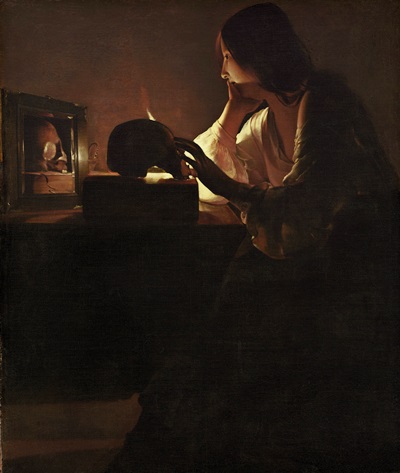
I saw this painting a few years ago in the Prado as part of a great exhibit of Georges de La Tour. 31 of his 40 known paintings were together.
In 2016, the Congregation for Divine Worship and Discipline of the Sacraments, headed by the great Robert Card. Sarah, issued a decree making – for the Novus Ordo, mind you – what was the Memorial of St. Mary Magdalene into a Feast.
In the Novus Ordo, 22 July is now the Feast of St. Mary Magdalene.
She also now gets her own Preface.
In an explanatory article, the then-Secretary of the then-CDW, Archbp. Arthur Roche, (gulp, now Prefect) says that Francis expressly desired the elevation of this to a Feast.
In the decree we find some of the reasons.
I’m sure you can puzzle this out.
Nostris vero temporibus cum Ecclesia vocata sit ad impensius consulendum de mulieris dignitate, de nova Evangelizatione ac de amplitudine mysterii divinae misericordiae bonum visum est ut etiam exemplum Sanctae Mariae Magdalenae aptius fidelibus proponatur. Haec enim mulier agnita ut dilectrix Christi et a Christo plurimum dilecta, “testis divinae misericordiae” a Sancto Gregorio Magno, et “apostolorum apostola” a Sancto Thoma de Aquino appellata, a christifidelibus huius temporis deprehendi potest ut paradigma ministerii mulierum in Ecclesia.
English release of the same: “Given that in our time the Church is called to reflect in a more profound way on the dignity of Woman, on the New Evangelisation and on the greatness of the Mystery of Divine Mercy, it seemed right that the example of Saint Mary Magdalene might also fittingly be proposed to the faithful. In fact this woman, known as the one who loved Christ and who was greatly loved by Christ, and was called a “witness of Divine Mercy” by Saint Gregory the Great and an “apostle of the apostles” by Saint Thomas Aquinas, can now rightly be taken by the faithful as a model of women’s role in the Church.”
Here is the Preface:
Vere dignum et iustum est,
æquum et salutáre,
nos te, Pater omnípotens,
cuius non minor est misericórdia quam potéstas,
in ómnibus prædicáre per Christum Dóminum nostrum.Qui in hortu [sic … horto!!!] maniféstus appáruit Maríæ Magdalénæ,
quippe quae eum diléxerat vivéntem,
in cruce víderat moriéntem,
quæsíerat in sepúlcro iacéntem,
ac prima adoráverat a mórtuis resurgéntem,
et eam apostolátus offício coram apóstolis honorávit
ut bonum novæ vitæ núntium
ad mundi fines perveníret.Unde et nos, Dómine, cum Angelis et Sanctis univérsis
tibi confitémur, in exsultatióne dicéntes:
Sanctus, Sanctus, Sanctus Dóminus Deus Sábaoth…
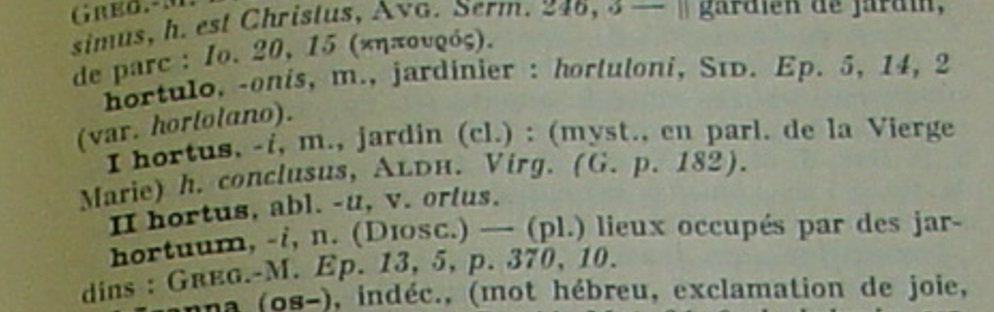
It’s hortus, -i not -us. Good grief.
Note that quippe a conjunction, when paired with a pronoun, quae gives us a reason or a cause. We thus say something like, “as one in fact who” or “inasmuch as she”. Usually you see this with subjunctive.. but… well…. Apostolatus is 4th, so its genitive is apostolatûs. That manifestus seems repetitive, since we have apparuit right away. But manifestus, can mean, along with “evident” and so forth, “palpable”. Manifestus is formed from manus and fendo, and as such indicates that one hits something with the hand. That’s why something is “palpable, evident, clear, manifest”.
I thought it might be an adverbial use, but it probably isn’t. There’s a perfectly good manifeste available in Latin. Augustine of Hippo in Contra epistulam Parmeniani 4,8 wrote: Quem proptera saepe nomino, quia ita manifestus apparuit, ut ubicumque fuerit nominatus nullus se ignorare respondeat. Leo the Great in tr. 71 wrote: Et licet reuolutio lapidis, euacuatio monumenti, depositio linteorum, et totius facti angeli narratores copiose ueritatem dominicae resurrectionis adstruerent, et mulierum tamen uisui, et apostolorum oculis frequenter manifestus apparuit, non solum conloquens cum eis, sed etiam habitans atque conuescens, et pertractari se diligenti curioso que contactu ab eis quos dubitatio perstringebat admittens. The phrase manifestus apparuit also happens to appear manifestly in old Prefaces in versions of the Gelasian Sacramentary, such as in the Liber sacramentorum Augustodunensis: Vd. <per Christum dominum nostrum>. qui post resurrectionem suam omnibus discipulis suis manifestus apparuit. et ipsis cernentibus est elevatus in caelum. ut nos diuinitatis suae tribueret esse participes: Et ideo cum angelis. In any event, the construction is well attested. If we go farther afield and look for manifeste, manifestius, etc., with forms of appareo we get lots of occasions from Classical writers such as Quintillian, Pliny Elder. In Latin Fathers we find it in Cyprian of Carthage, Novatian, Augustine of course, often, It’s a commonplace.
Back to the Preface.
The decree states that conferences will have to work out their translations of the preface.
MY LITERAL ATTEMPT:
Truly is it worthy and just, advantageous and salutary, that in all things we proclaim You, Father Almighty, whose mercy is not less than (Your) power, through Christ our Lord – Who, manifest, appeared in the garden to Mary Magdalene, for indeed she loved Him while he was living, saw Him on the Cross dying, in the sepulcher sought Him lying, and, being the first, adored Him from the dead rising, and He honored her with the duty of apostleship in the presence of the apostles, so that the good news of new life would reach unto the ends of the earth. Whence we also, O Lord, with Angels and Saints, profess to you, saying in exultation: Holy, Holy, Holy Lord God of Hosts….
Here is the “working translation” of the Preface:
Preface of the Apostle of the Apostles
It is truly right and just,
our duty and our salvation,
always and everywhere to give you thanks,
Lord, holy Father, almighty and eternal God,
whose mercy is no less than His power,
to preach the Gospel to everyone, through Christ, our Lord.
In the garden He appeared to Mary Magdalene,
who loved him in life,
who witnessed his death on the cross,
who sought him as he lay in the tomb,
who was the first to adore him when he rose from the dead,
and whose apostolic duty was honored by the apostles,
that the good news of life might reach the ends of the earth.
And so Lord, with all the Angels and Saints,
we, too, give you thanks, as in exultation we acclaim:
Holy, holy, holy Lord, God of power and might …
Roche explained in his article that this act in the present ecclesial context, and thus it responds to the desire to reflect more deeply on the dignity of women and the new evangelization, and the mystery of divine mercy. I admit that all of those are mysterious, but I digress. Roche includes some nifty quotes about Mary Magdalene, too. I’m sure the English of that article will soon be available. I’m not going to translate it here, for lack of time.
There is something weird in Roche’s explanation, however.
At the end, after trotting out some Thomas Aquinas about Mary Magdalene as “apostolorum apostola“, he writes:
Perciò è giusto che la celebrazione liturgica di questa donna abbia il medesimo grado di festa dato alla celebrazione degli apostoli nel Calendario Romano Generale e che risalti la speciale missione di questa donna, che è esempio e modello per ogni donna nella Chiesa.
Therefore it is just that the liturgical celebration of this woman should have the same level of feast given to the celebration of the Apostles in the General Roman Calendar and that it underscore the special mission of this woman, who is an example and model for every woman in the Church.
That’s odd. Mary Magdalene has been a favorite saint of mine ever since, well…. ever. The Church’s tradition, particularly Gregory the Great, mostly identified as the same person, Mary Magdalene, the woman with the jar of nard, and the sister of Lazarus and Martha. Certainly she was at the foot of the Cross and at the tomb on the morning after the Resurrection. There’s no evidence that she was a prostitute or the adulteress brought to the Lord in John 7. In Mark 16:9 we read that the Lord had performed an exorcism for her: “But he rising early the first day of the week, appeared first to Mary Magdalene, out of whom he had cast seven devils.” This is also in Luke 8:2: “Mary who is called Magdalene, out of whom seven devils were gone forth”. Augustine thought these were perhaps the seven deadly sins or vices.
It may have been on this foundation, along with some ambiguity about various Marys in the Gospels, that she was conglomerated into also being a fallen woman who then repented.
At least from that tradition we got some really great paintings!
Also… and here is something for you who are interested in art history… some day when you have time, check out the strong similarity of paintings of “penitent Magdalene” and of dying Cleopatra with the asp at her breast. Warning: some of them can be a little spicy. But I digress.
In any event, in the Novus Ordo – Mary Magdalene now has a Feast, which happens also to be the same level as the celebrations of the Apostles.
That doesn’t put her on the level of the Apostles. Sorry, it just doesn’t. Watch how some libs and feminists will do just that.
His scriptis, this was overdue. I’m glad that – in the Novus Ordo – Mary Magdalene has her Feast.
Here is an interesting point dropped to me by a reader about how Mary Magdalene was honored in Holy Mass before the Council.
Before 1960 or so, Mary’s celebration merited a Creed! (For those of you who don’t know, in the older form of Holy Mass the Creed is said a lot more often.) Here’s a shot of her formulary from a Missal from 1947.
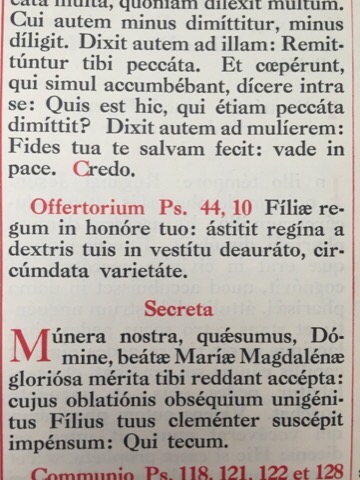
Here is her formulary from 1962. No Creed. Kind of a demotion.
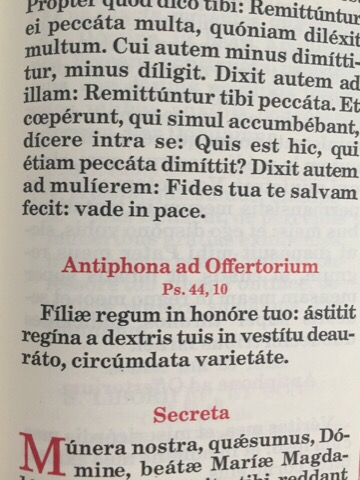
A rocky history, this feast.
Perhaps like the saint herself?
UPDATED:
From the Dictionnaire Latin-Français des Auteurs Chrétiens by Albert Blaise and redone by Henri Chirat.






























At exactly one month old, I was baptized on this date, 64 years ago, Sunday, July 22nd, 1962, into the one holy Catholic and apostolic Church.
81 days before THE COUNCIL convened.
Just under the wire. YAY!
St. Mary Magdalene, pray for us!
But in Eastern Catholicism and in Orthodoxy, she is given the title Equal to the Apostles. See today’s kontakia, troparia and readings from the Byzantine Catholic Church:
https://byzantinela.com/july-22-2022/
Of course, one could note that the title is given in the East morevthanninnthe West, but still.
I trust 1500 years of Catholic Tradition over recent enlightened bible scholars. I think Catherine of Siena believed Mary Magdalene and Mary, Martha’s sister were the same person. And that is good enough for me.
Father Z., you didn’t really state your opinion. What do you think?
Saying “there’s no evidence that St. Mary Magdalene is not the woman caught in the act of adultery” is not itself evidence to the contrary. We simply can’t know just from what Scripture makes explicit.
To me, it makes a lot of sense that the evangelists, some who were direct companions of St. Mary, would not have explicitly identified her with the adulteress (not necessarily a prostitute) for reasons of their friendship w/ her. Why might St. Mary have needed an exorcism? Would not adultery be a possible reason? It’s well known that Demons can enter into a person through immoral sexual acts.
It’s not proof of course, but I tend to prefer little “t” traditions when not directly contradicted.
“There’s no evidence that she was a prostitute or the adulteress brought to the Lord in John 7.”
To be clear, there is evidence that Mary Magdalene is the “woman of the town” who in Luke 7:36-8:3 washes Our Blessed Lord’s feet with her tears and dries them with her hair and anoints them with precious ointment from her alabaster jar. It is this woman who St. Gregory identifies as Mary Magdalene.
There is no evidence that she is the woman caught in adultery in John 7. In fact from St. Luke’s account, this is most likely impossible since she is accompanying Our Blessed Lord and His disciples. St. Gregory does not suggest that this woman is Mary Magdalene.
That Mary Magdalen is the sinful woman in Like 7 & 8 does have evidence.
4 pieces come to mind:
1 St. Gregory says she is Mary Magdalene.
2 Most importantly, St. Luke identifies her at the end of this pericope in the beginning of Chapter 8 (Remember that Chapter breaks are not part of the inspired text. And if this does not refer back to the woman just spoken of, it would be an odd insertion at this point in the text. Rather it forms a bridge to the accounts of Christ’s preaching in the next chapters)
It is Luke’s regular pattern, when he introduces an important character to his narrative to present them and then name them. (Cf Chapter 1:26-27 when he introduces Mary — ” in the sixth month, the angel Gabriel was sent from God into a city of Galilee, called Nazareth to a virgin espoused to a man whose name was Joseph of the House of David, and the virgin’s name was Mary.)
He identifies the pharisee as Simon only after the parable of forgiveness. and, if I am right, he identifies the sinful woman as Mary Magdalene only after He has forgiven her and driven the devil out of her in chapter 7.
3 a third piece of evidence lies in the long-standing liturgical practice of the Church. The Gospel appointed for the feast of St. Mary Magdalene is that of Luke 7 – the sinful woman mentioned above. If this is not Mary Magdalene, it would be a strange choice of text for the Gospel for her feast.
4 a fourth piece of evidence is more recently liturgical though it echoes a very long tradition. both the decree elevating this memorial to a feast (mentioned above) and the Preface composed for the occasion mention Mary Magdalene as the woman who loved the Lord much.
_Haec enim mulier agnita ut dilectrix Christi_
and
He appeared to Mary Magdalene, who loved him in life,
Now the only place in the Gospels that a woman is said to love Christ is in Luke 7:47 “Many sins are forgiven her for she has loved much.”
This 4th piece is actually an authoritative statement identifying her liturgically with the sinful woman in Like 7 even if the human author here did not understand it so.
Admittedly, this does raise a question: Notorious as she is, how does she come to be in the house of Simon the Pharisee? She is not said to enter the house, but simply to stand behind the Lord and weep over His Feet. If she is Simon’s sister, then no explanation is needed.
I don’t have any authoritative answer, but here is a possible one:
If Simon the Pharisee, living in Galilee in the first year of Our Blessed Lord’s public life, is the same man as Simon the Leper (Lazarus) living with his sisters in Bethany at the end of Our Blessed Lord’s public life, then Mary Magdalene is, indeed, his sister and would have access to his house in Galilee as well as in Bethany. This provides a certain symmetry as well: Here she gives Our Blessed Lord some of her precious ointment for His Feet. Later in Bethany, she breaks the jar and gives Him all.
This may seem to be a small matter to us at this remove, but it certainly was no small matter to Mary Magdalene.
The mention of the Gelasian Sacramentary is interesting. The Missale Romanum contains that quoted section as well (with the “manifestus apparuit”) in the Preface for the Ascension.