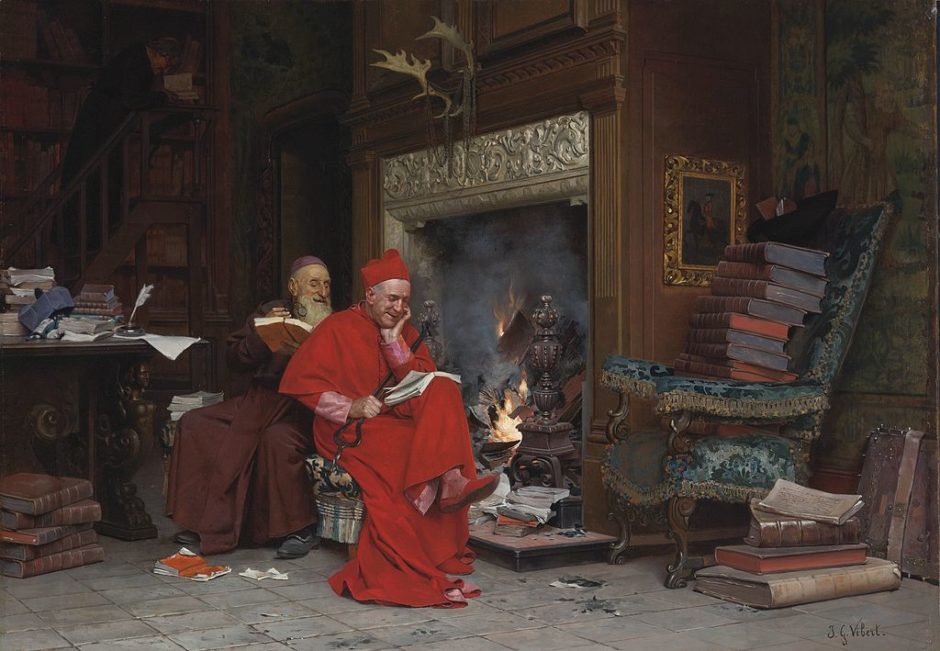
Russian Metropolitan Hilarion to Synod: Don’t be Protestants

… or like Pres. Obama.

GREETINGS BY METROPOLITAN HILARION OF VOLOKOLAMSK TO THE PARTICIPANTS OF THE FOURTEENTH ORDINARY GENERAL ASSEMBLY OF THE SYNOD OF BISHOPS OF THE CATHOLIC CHURCH ON THE “VOCATION AND MISSION OF THE FAMILY IN THE CHURCH AND IN THE CONTEMPORARY WORLD” (THE VATICAN. 20TH OCTOBER 2015)

Your Holiness!
Your Beatitudes, Eminences and Excellencies!

On behalf of His Holiness Patriarch Kirill of Moscow and All Rus I extend fraternal greetings to you on the occasion of the Fourteenth Ordinary General Assembly of the Synod of Bishops of the Catholic Church on the theme of the family.

In our restless and disturbing world the human person needs a firm and unshakeable foundation upon which he can rest and upon which he can build his life with confidence. At the same time, secular society, aimed primarily at the gratification of individual needs, is incapable of giving the human person clear moral direction. The crisis of traditional values which we see in the consumer society leads to a contradiction between various preferences, including those in the realm of family relationships. Thus, feminism views motherhood as an obstacle to a woman’s self-realization, while by contrast having a baby is more often proclaimed as a right to be attained by all means possible. More often the family is viewed as a union of persons irrespective of their gender, and the human person can ‘choose’ his or her gender according to personal taste.

On the other hand, new problems are arising which have a direct impact on traditional family foundations. Armed conflicts in the contemporary world have brought about a mass exodus from areas gripped by war to more prosperous countries. Emigration often leads to a disruption of family ties, creating at the same time a new social environment in which unions of an inter-ethnic and inter-religious nature arise.

These challenges and threats are common to all the Christian Churches which seek out answers to them, proceeding from the mission that Christ has placed upon them – to bring humanity to salvation. Unfortunately, in the Christian milieu too we often hear voices calling for the ‘modernization’ of our ecclesial consciousness, for the rejection of the supposedly obsolete doctrine of the family. However, we ought never to forget the words of St. Paul addressed to the Christians of Rome: ‘And be not conformed to this world: but be ye transformed by the renewing of your mind, that ye may prove what is that good, and acceptable, and perfect, will of God’ (Rom. 12: 2).

The Church is called to be a luminary and beacon in the darkness of this age, and Christians to be the ‘salt of the earth’ and ‘light to the world’. We all ought to recall the Saviour’s warning: ‘If the salt have lost his savour, wherewith shall it be salted? It is thenceforth good for nothing, but to be cast out, and to be trodden under foot of men’ (Matt. 5: 13-14). The salt which has lost its savour are those Protestant communities which call themselves Christian, but which preach moral ideals incompatible with Christianity. If in this type of community a rite of blessing of same-sex unions is introduced, or a lesbian so called ‘bishop’ calls for the replacement of crosses from the churches with the Muslim crescent, can we speak of this community as a ‘church’? We are witnessing the betrayal of Christianity by those who are prepared to accommodate themselves to a secular, godless and churchless world.

The authorities of some European countries and America, in spite of numerous protests, including those by Catholics, continue to advocate policies aimed at the destruction of the very concept of the family. They not only on the legislative level equate of the status of the same-sex unions to that of marriage but also criminally persecute those who out of their Christian convictions refuse to register such unions. Immediately after the departure of Pope Francis from the USA, President Barack Obama openly declared that gay rights are more important than religious freedom. This clearly testifies to the intention of the secular authorities to continue their assault on those healthy forces in society which defend traditional family values. Catholics here are found at the forefront of the struggle, and it is against the Catholic Church that a campaign of discrediting and lies is waged. Therefore courage in vindicating Christian beliefs and fidelity to Church tradition are particularly necessary in our times.

Today, when the world ever more resembles that foolish man ‘which built his house on the sand’ (Matt. 7: 26) it is the Church’s duty to remind the society of its firm foundation of the family as a union between a man and woman created with the purpose of giving birth to and bringing up children. Only this type of family, as ordained by the Lord when he created the world, can forestall or at least halt temporarily modern-day society’s further descent into the abyss of moral relativism.

The Orthodox Church, like the Catholic Church, has always in her teaching followed Holy Scripture and Sacred Tradition in asserting the principle of the sanctity of marriage founded on the Saviour’s own words (Matt. 19: 6; Mk. 10: 9). In our time this position should be ever more strengthened and unanimous. We should defend it jointly both within the framework of dialogue with the legislative and executive branches of power of various countries, as well as in the forums of international organizations such as the UN and the Council of Europe. We ought not to confine ourselves to well-intentioned appeals but should by all means possible ensure that the family is legally protected.

Solidarity among the Churches and all people of good will is essential for guarding the family from the challenges of the secular world and thereby protecting our future. I hope that one of the fruits of the Assembly of the Synod will be the further development of Orthodox-Catholic co-operation in this direction.

I wish you peace, God’s blessing and success in your labours.

Posted in SESSIUNCULA | Tagged
40 Comments

Cool WOTD – “maril” (Tolkien connection!)

From the OED Online’s Word of the Day:

Your word for today is: maril, n.

Your word for today is: maril, n.

maril, n.
[‘ An ornamental binding material with a variegated grain, made from scraps of coloured leather mixed in a resin, compressed, and dried.’]
Pronunciation: Brit. /ma?r?l/, U.S. /m??r?l/
Etymology: < -maril (in Silmaril, any of three mystic jewels featuring in works by J. R. R. Tolkien (1892–1973)): see quot. 19741, although Smith notes elsewhere in the same work that it subsequently occurred to him that the word could also be analysed as < mar- (in marbled adj.) + i- (in inlaid adj.) + l- (in leather n.).
Bookbinding.
An ornamental binding material with a variegated grain, made from scraps of coloured leather mixed in a resin, compressed, and dried.
1974 P. Smith New Direct. in Bookbinding x. 59 The first book on which experiments with early maril were tried was a copy of The Lord of the Rings… A name had to be found to describe this material… I remembered the name Silmaril in The Lord of the Rings and thought that the word had the right ‘ring’ to it, especially the ‘maril’ part which was short.
1974 P. Smith New Direct. in Bookbinding x. 59 Each volume reveals one or other facet of feathered, sectioned and maril onlays.
1978 Book Collector Summer 176 When I first visited the binder’s studio in 1969, he was experimenting with planing flat sections of maril to make decorative boards, but this has not been developed due to..the possibility of achieving the same effect by onlaying.
1989 New Bookbinder 9 26/1 One of the most remarkable innovations was the making of maril, which opened up for book-artists the whole range of fluid and broken surfaces.

I had always thought that, were I to have my own proper space with some elbow room, I’d like to take up bookbinding.

On that note, I urge everyone to get a Kindle!  HERE


Posted in Just Too Cool | Tagged , , ,
2 Comments

My View For Awhile: Back to Rome

This afternoon I head to Rome.

I checked in and used some miles to upgrade.

The screen on this flight is a little different… hmmmm…

And there is a very odd fellow in the window seat.

Anyway, the day is underway.

More later.

(Honestly… what were the odds that I should turn on this particular movie, on the eve of my departure, right at that scene with the date?)

Meanwhile… back in Rome itself…. my friend the Great Roman Fabrizio sent photos as he entered S. Maria in Trivio to pray at the tomb of Saint Gaspar del Bufalo (+1837), “hammer of freemasons”.

I have been attached to him since my seminary days in Rome when I was assigned to help on Sundays at San Nicola in Carcere.  Saint Gaspar started a confraternity there.  There is a plaque and inscription about that in the apse, but it is now covered up by a painting.

Here is the saint.

As The Great Rome writes: “Napoleon’s police tried to tame him and Freemasons tried to kill him many times.  He triumphed.

His answer to the French commissar asking him to sign his submission to emperor should be the motto of every pope and bishop requested to yield to the world: ‘non posso, non debbo, non voglio!’  That’s how a Roman priest says ‘No’ when he wants to be talkative.”

“I can’t.  I musn’t.  I don’t want to.”

St. Gaspar, pray for us.

UPDATE:

This is more like it for these posts.


Flight delay ….

  
How I love rushing for a flight connection because of an unexplained delay.  I really like that.  These days I build a little extra time into my itinerary so I don’t have to rush.   At least the gates are fairly close.  there is a strong chance my bag will come with me to Rome.  

Meanwhile, no drama in the boarding process so far.   Hopefully we can make up time.  Departing froma small airport helps a lot.

  
I liked the announcement.  “No use of tobacco products and e-cigarettes is not a allowed.”

Where’s my snoose?!?


UPDATE:

We made up time and the taxi was short and the next gate was close.

  
Boarding soon.  This is when I start to crave a cheeseburger.

UPDATE:

As I said above, I used miles to upgrade.  It’s not a Delorean but it’s managable.


Once upon a time I flew business or first pretty often.  It’s been a loooong time and I have lots of miles.  Hopefully this will help my adjustment on arrival.  Eastward travel is a greater challenge for me and my sojourn is short.  I need to function when I hit the ground.

The music may make me slit my wrists.

Doors closed.

UPDATE:

I managed to write a column for the UKs best Catholic weekly, The Catholic Herald, eat something and then sleep for a few hours.  Breakfast time has us about an hour out.

 UPDATE:

Almost to my place.


Posted in On the road, What Fr. Z is up to | Tagged ,
16 Comments

Sam Gregg on “primacy of conscience”

Sam Gregg of Acton Institute has a great piece today at Crisis about the topic of “conscience”.  My emphases.

An Archbishop and the Catholic Conscience

Conscience is one of those subjects about which numerous Catholics today are, alas, sadly misinformed. Despite great Catholic minds such as Thomas Aquinas, Thomas More, and John Henry Newman discoursing at length on the question, some Catholics speak of it in ways that have little in common with the Church’s understanding of conscience.

The latest Catholic to be embroiled in controversy about conscience is Archbishop Blase Cupich of Chicago. While recently discussing the question of whether those who have (1) not repented of sin and/or (2) not resolved to go and sin no more may receive communion, Archbishop Cupich stated: “If people come to a decision in good conscience then our job is to help them move forward and to respect that. The conscience is inviolable and we have to respect that when they make decisions, and I’ve always done that.” Referring specifically to people with same-sex attraction, he noted that “my role as a pastor is to help them to discern what the will of God is by looking at the objective moral teaching of the Church and yet, at the same time, helping them through a period of discernment to understand what God is calling them to at that point.”

This isn’t the first time that Archbishop Cupich has raised eyebrows. Many will recall what some regard as the effective equivalence he made between Planned Parenthood’s selling of body-parts and problems like homelessness and hunger.

Then there was his more recent speech to the Chicago Federation of Labor. Alongside a defense of religious liberty, most of the Archbishop’s address simply reiterated Catholic social teaching about unions. Perhaps it wasn’t the occasion to say such things, but absent from Archbishop Cupich’s remarks was any reference to the numerous caveats stated by popes—such as those detailed by Blessed Paul VI (who no-one would describe as a gung-ho anti-union capitalist) in his 1971 apostolic letter Octogesima Adveniens(no.14) and Saint John Paul II’s 1981 encyclical Laborem Exercens (no.20)—concerning the very real limits upon what unions may do. Unfortunately, modern America is awash with examples of what happens when unions (in collusion with business executives who go along to get along) ignore those limits, as broken cities such as Detroit know all too well.

Aspects of Archbishop Cupich’s comments about conscience, however, will remind some of arguments made by various theologians in the 1970s and ’80s as part of their effort to legitimize dissent from Catholic moral teaching. Certainly, Archbishop Cupich stressed the importance of priests conveying the Church’s objective moral teaching to people who consider themselves marginalized by that teaching (presumably because it does not and cannot affirm some of their free choices). [NB] But a significant omission in the archbishop’s statements concerned why conscience is inviolable. As Vatican II stated in Gaudium et Spes, conscience draws its inviolability from its “obedience” to the truth, or what the Council called the “law written by God” (GS 16).

So where is this truth and law to be found? On one level, we discover it in the natural law. Saint Paul famously stated (Rm 2: 14-16) that this is knowable by everyone who possesses reason, including those who don’t know the Word of God revealed in the Hebrew and Christian Scriptures. For people, however, who also believe in Christ and accept that the fullest account of Christ’s life and teaching is to be found in the witness of the Catholic Church, the very same truths about morality are also expressed, confirmed, and enriched by that same Church’s moral teaching.

These simple points lead to profound conclusions. One is that conscience doesn’t create its own truth. Nor is it above truth. The oft-used phrase “primacy of conscience” makes no sense in Catholicism unless we accept that conscience’s authority is derived from every person’s responsibility to know and live in the truth encapsulated in the divine and natural law. In Newman’s words, “Conscience has rights because it has duties.”

It follows that conscience cannot be construed as a mandate for us to depart from the truth whenever it clashes with our desires. Catholicism has never held that conscience is somehow superior to the divine and natural law. To claim, therefore, that our conscience somehow authorizes us to act in ways that we know contradict what Christ’s Church teaches to be the truth about good and evil is, at a minimum, illogical from the Catholic standpoint.

[…]

Please do read the rest over there.

Posted in The Drill | Tagged ,
8 Comments

Before heading to Rome, noodles, differently.

Before I head to Rome (tomorrow, Wednesday – click the flag) I had to charge up with a different cuisine.

I was in my native place for a couple days.  I had, among other important appointments, a meeting of my literary group (founded 19 years ago!).  We read Francis Thompson.  Interesting guy!  Next time, probably some Browning.

Anyway, I had Chinese when I hit town.

Starting with soup dunplings.  Now demoted to the 2nd best xiao long bao I’ve had.

Noodles with veg.

Pork in garlic sauce.

My dining companion had orange beef, which he was kind enough to let me sample.

Finally, the platitude cookie.

The next day, after my morning appointment, I dashed into downtown Minneapolis for ramen.  Having had a couple visits to Tokyo now, I have sampled good ramen.  This place in MSP has good ramen!

First, gyoza. Wonderfully crunchy and spicy!  I don’t know what is in that sauce, but… wow.

Tonkotsu ramen.

So, now it is off to Rome and a whole different way to treat noodles.

Time to pack.

Go Cubs.


Posted in On the road, What Fr. Z is up to | Tagged , ,
9 Comments

Where does “reconcile” come from? UPDATES

Ernout MeilletI received a couple notes about where the word “reconciliation” comes from. Odd.

Anyway, rather than write it all out here is a page from a dictionary of Latin etymology, Ernout Meillet.

It derives from ancient words for “call”.

Look that voice (entry) for concilium to get to the roots beneath “reconcile”, etc.

Click for larger…

15_10_20_concilium

That page should take care of that question.  Yes, I know it’s in French, but just about anyone can see what’s going on.

Since the voice sends you to calo, I’ll take you to calo.

Click for larger…

15_10_20_concilium_02

15_10_20_concilium_03

English etymological dictionaries will take you back to Sanskrit and Indo-European forms meaning, in some way, “call”. HERE and HERE

UPDATE:

I get it now.  Chicago’s Archbishop Cupich (a member at the Synod this year) apparently opined that reconcile comes, somehow, from the Latin word cilia, which he said meant “eyelash”.

No.

First, cilia is plural of cilium, which means “eyelid”.  And, no, “reconcile” isn’t from cilium.  It has to do with being brought together by calling.

Anyway… on a hunch, with a raised eyebrow, I looked up concilium in St. Isidore of Seville’s Etymologies, VI, 16.11.

This is what I found.

15_10_20_concilium_05

LATIN HERE  “Unde et concilium a communi intentione dictum, quasi comcilium. Nam cilia oculorum sunt.”

So… I will cut His Excellency a break (on this, at least), for it seems he is living in the past!  Checking the insights of Isidore? Who died in AD 636?  The last great scholar of late antiquity?  Bridge figure to the Medieval period? I like it.

It’s still wrong, but it is fun!

BTW… do check the famous Internet Prayer, which I wrote many year ago now.  Isidore is mentioned.

HERE

Posted in The Drill | Tagged , , ,
11 Comments

ACTION ITEM! Support Our Lady of Hope Clinic!

I have an ACTION ITEM for you good readers. You have been generous to causes I have mentioned in the past.  Sometimes people have a hard time finding causes to support.  This is one of them that I admire.

RIGHT NOW… they have a “matching grant” going on.  Every donation to the clinic from now to the end of the year will be matched, so your donation does double duty.

I have written about Our Lady of Hope Clinic before.  This is one of the worthiest causes I have seen for a while and it could use your help, wherever you are.

Read more HERE and HERE

This could be a new model for health care in a rapidly changing – disintegrating – time.  The “Affordable” Care Act really… isn’t.  It is going to be harder in the future for people to get health care, not easier.  And for those without much bucks?

They have a DONATION page.

Tell them Fr. Z sent you.

Contact Julie Jensen, Director of Development, at Julie   -AT- ourladyofhopeclinic -DOT- org, or by calling (608) 957-1137.

I was recently in the clinic a couple times for … something.  It was like a meeting of the United Nations in there!  They said that whenever I mention them on the blog, they get donations from all over.

In the clinic you see a sign on the wall explaining that
20131104-083959.jpg
“Our Lady of Hope Clinic practices medicine consistent with the teachings of the Catholic Church”

Therefore, they will not refer for abortion, prescribe contraception, refer for sterilization, refer for in vitro fertilization, etc.

And…

“We will practice in complete accord with the teachings of the Roman Catholic Church.”

This is a worthy cause.

I suggest that it is a model that may be duplicated in other places, especially as the chaos really starts to begin in healthcare in these USA.

Posted in ACTION ITEM!, Our Catholic Identity, The Campus Telephone Pole | Tagged , , ,
2 Comments

Welcome Aboard New Registrants!

To participate in the combox here, you must be registered and approved (by me).

Since the blog is under constant attack by spammers and nefarious ne’er-do-wells, I use the “about you” field in particular to screen registrations.

Welcome aboard recent registrants! (I think I got everyone.)

sewatters
13xmama
Raghn Crow
Noz
xsmommy
1jacobo5
dianakatlanta
geohults
Nic Gibson
mickeydanny
mrspeterson
Classiclaw
shaferhund
Dr. Sirilla

Kcraye
entirelyuseless
Angelique72
Jpeterson
mj mielke
Joette
AndrewPaul
momsix
tattoohobbit85
Lastlaugh
Billobpb
MyFaithRunsDeep
waterside111@gmail.com
Matthew_D
BIRDSONG
Jeselynb
Phet Puthorn
obrady
stevelskojec
mamula
stlschu
Margaret O
Jalire
Semper Gumby
Venitemusic
Debfierro@gmail.com
martell
Daniel_Smith
Christel
Njodzeka
StephanieW
Gisele Roy Cyr
araustin02
Outreach308@aol
andrewo
ksamuels
SpanishCatholic

Posted in SESSIUNCULA |
Comments Off on Welcome Aboard New Registrants!

VIDEO: Wherein Card Arinze explains “conscience”

The mighty Francis Card. Arinze gave a video interview to LifeSite.  He reminds everyone of what real primacy of conscience is in the Church’s teaching.  He clarifies that we have the responsibility to have a properly formed conscience.

We cannot simply claim “conscience” as justification for sin.

He speaks of the responsibility of bishops and priests to form people’s consciences properly.

He explains (perhaps to Synod members along with everyone else) what “adultery” is.

Posted in The Drill | Tagged ,
6 Comments

Card. Urosa Savino of Caracas to the Synod: Can we contradict the teachings of the Lord, St. Paul, the Church?

From CNA a little ray of sunshine:

Strengthen marriage with truth and mercy, Venezuela’s Cardinal Urosa tells synod

Vatican City, Oct 20, 2015 / 06:01 am (CNA/EWTN News).- Both truth and mercy can be found in consistent Catholic teaching on marriage, Cardinal Jorge Urosa Savino of Caracas told the Synod of Bishops on Thursday.

“United to Christ, who has overcome the world, the Church is called to maintain the splendor of truth even in difficult situations,” he said in his Oct. 15 intervention. “Mercy invites the sinner and it becomes forgiveness when one repents and changes one’s life. The prodigal son was greeted with an embrace from his father only when he returned home.”

[…]He cited St. John Paul II’s 1981 post-synodal apostolic exhortation Familiaris consortio, the 1992 Catechism of the Catholic Church, Benedict XVI’s 2007 apostolic exhortation Sacramentum Caritatis, and the 2007 ‘Aparecida document’ of the Fifth Conference of Latin American and Caribbean Bishops. These all reaffirmed pastoral care for couples in an irregular situation, while acknowledging that they may not receive Communion.

The Aparecida document was approved by then-Cardinal Jorge Bergoglio, who would be elected as Pope Francis in 2013.

“Can we contradict those teachings?” Cardinal Urosa asked.

The full text of Cardinal Urosa’s Oct. 15 intervention at the synod with my emphases and comments.

The Proposal of Admission to the Eucharist for the Divorced and Remarried

I refer to numbers 121, 122, and 123 of the Instrumentum Laboris in which is considered the proposal for the acceptance to the table of the Eucharist – counting on certain conditions been met, among them a penitential journey – or the divorced and remarried, yet maintaining the conjugal life .

We are all driven by the desire to find a better solution to this painful situation. We must do it with the spirit of the Good Shepherd and the truth that sets us free. In the evangelical spirit of mercy, I think the penitential journey should conclude in conversion and the purpose of amendment and to live in continence, as taught in other words by Saint John Paul II in Familiaris consortio 84.  [He does not think that the Magisterium of St. JP2 is outdated.]

I wonder: Can we forget the words of the Lord in the Gospel, Matthew 19, and the teaching of Saint Paul (Rom 7:2-3; 1 Cor 7:10; Eph 5:31) and of the Church over the centuries? Can we dismiss the teachings of John Paul II in his 1981 apostolic exhortation Familiaris consortio? [Which is precisely what some people want.] This document, published a year after the 1980 Synod on the Family, seriously considered and consulted by the Pope over many months of study and reflection, in communication with experts from various theological disciplines, clearly rule out this possibility (FC 84) .

We also have the teachings of the Catechism of the Catholic Church in 1992 with the traditional doctrine on the conditions for access to Communion and the Church’s teachings on sexual morality. (CCC 1650) We also have the Letter of the Congregation for the Doctrine of the Faith of September 14, 1994, written specifically on this issue. Can we forget the concluding document of the Fifth Conference of Latin American and Caribbean Bishops in Aparecida, which asks us: “Accompany with care, prudence and compassionate love, following the guidelines of the magisterium, couples who live together out of wedlock, bearing in mind that those who are divorced and remarried may not receive communion.” (n. 437)  [BTW… centenary of the Aparecida event is coming up in 2017.  It is after that, I think, that Pope Francis will resign, if he really plans to do so according to certain hints that he made in respect to his 80th year. CELAM at Aparecida was important to him.  He’ll want to be at the centenary celebrations … as Pope.]

Can we contradict those teachings? Can we forget the very recent statement by Pope Benedict XVI in his 2007 apostolic exhortation on the Eucharist, Sacramentum Caritatis, reiterating the practice of the Church, rooted in Sacred Scripture (cf. Mk 10: 2-12) of not admitting to the sacraments the divorced and remarried, since their state and their condition of life objectively contradict that union of love between Christ and the Church which is signified and made present in the Eucharist? (n. 29)

United to Christ, who has overcome the world (cf. Jn 16:33),  [and did not cave in to it] the Church is called to maintain the splendor of truth even in difficult situations. Mercy invites the sinner and it becomes forgiveness when one repents and changes one’s life. The prodigal son was greeted with an embrace from his father only when he returned home.

This Synod, without a doubt in the light of the revealed truth and with eyes of mercy, is called to reflect very clearly the teaching of the Gospel and of the Church through the centuries about the nature and dignity of Christian marriage, on the greatness of the Eucharist and on the need of having the necessary dispositions to be in union with God to be able to receive Holy Communion; on the need for penance, repentance and the firm purpose of amendment for the repentant sinner to be able to receive Divine forgiveness; and the strength and continuity of both dogmatic and moral truth of the ordinary and extraordinary Magisterium of the Church. It provides as well lights inspired by mercy to assist more effectively those in irregular situations to alleviate their moral suffering and to better live their Catholic faith.

Furthermore, the Synod must indicate lines of action that strengthen marriage, making it more attractive to young people, and keeping it alive in the hearts of the spouses over time. In this matter it will provide Pope Francis with very important elements to promote an intense evangelization of the family, and a re-appreciation of the sacrament of marriage.

Fr. Z kudos to Card. Urosa Savino.

Posted in Fr. Z KUDOS, One Man & One Woman, Synod | Tagged ,
8 Comments




















