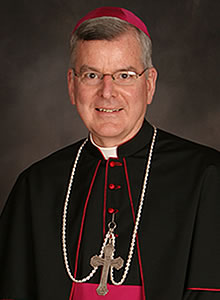
Bp. Morlino on beauty and worship: beauty is NOT just a matter of taste.

On the site of the Diocese of Madison’s paper, The Catholic Herald (not to be confused with The Catholic Herald in the UK), His Excellency Most Rev. Robert Morlino has some observations about liturgy which are worth a look.

My emphases and comments.

The beauty of our worship in the liturgy
Bishop’s Column
Thursday, Oct. 20, 2011

Dear Friends,

Clearly there has been much dialogue recently about our continuing liturgical renewal in the Diocese of Madison [E.g., his leadership on the issue of Communion under both kinds.  HERE.] — this awareness has even risen to the international level. [Gosh!  How did that happen?!?] There was, in fact, a recent blog in Spain about our local matter. It is very difficult for me to believe that the tale of a bishop, leading his diocese in fine-tuning the implementation of the correct interpretation of Vatican II, would rise to the level of an international news item.  But that says, indeed, a lot about the world in which we live, favoring as it does anarchic displays rather than a reasonable exercise of lawful authority.  [OOH-RAH!]

Be that all as it may, I myself have yet to mention in a very public way the consideration which essentially accompanies our realization of Christ’s true presence and our natural and supernatural response of reverence. The liturgy, as the worship which the Holy Spirit has given His Church, always requires beauty in its celebrations.

Since the frequently mistaken implementation of Vatican II (almost 50 years ago), [So many people getting so many things wrong for so many years.. its a miracle so many people still go to Mass…. but I digress…] many liturgies have taken place which are, at least, less than beautiful. To this statement, our country and our culture would respond immediately, “but beauty is in the eye of the beholder,” or, “everything is beautiful, in its own way.” Just as our culture has sought to relativize everything important to human nobility, asserting that it is human nature not to have a nature, so too is this the case with beauty itself.

Beauty: not simply in the ‘eye of the beholder[Do I hear an “Amen!”?]

Beauty is not, in fact, simply in the eye of the beholder, from the viewpoint of reason. For reason tells us that beautiful, good, true, and one are interchangeable; therefore, whatever is beautiful is also good and true, and expresses unity and harmony.

Beautiful can never be mistaken as an indicator of what pleases some majority of people somewhere. The fact that our parish likes to sing a particular song at the liturgy cannot, of itself, make that song beautiful. To be beautiful, indeed, is to be good and is to be true. As much as some people may enjoy the musical antics of Lady Gaga, these cannot honestly be described as beautiful. [Do I hear an “Amen!”?]

Beautiful means, in the first place, embodying the truth. Some of the songs that we sing at liturgy contain lyrics which clearly are not true — for example, the song “All Are Welcome.” As a matter of fact, the liturgy takes place mystically in the heavenly sanctuary. All are welcome at the liturgy who truly seek salvation in and through Jesus Christ, by following God’s Will, as spelled out through His Son’s very Body, the Church. People who have little interest in doing God’s Will don’t fit at the liturgy. [OOH-RAH!] And certainly, by their own choosing, the poor souls who suffer in Hell for all eternity are not welcome. [Do my eyes deceive me?  Must I pinch myself?  Did a Catholic bishop just suggest that hell exists and that there may be souls in hell?  Surely the Lord is about to return.] Those are simple, but true facts. Thus the song, “All Are Welcome,” gives an impression that the choice for the Will of Jesus Christ, as it comes to us through the Church, makes no difference; and nothing could be further from the truth. It could therefore be concluded that the song, “All are Welcome,” is not beautiful so as to be appropriate-for-liturgical-use. Being true is necessary before anything can be beautiful.

Ennobling the human person

But, it is equally important for something to be good so that it also might be judged beautiful. The truth, which is clothed by beauty, must be such as to ennoble the human person in terms of bringing out his or her very best, both of intellect and of will. The beautiful must embody that which is true, but also ennobling to our human nature as made in the image and likeness of God. Whatever is beautiful must fix our minds and our hearts on the things above, according to St. Paul (Phil 4).

When one realizes that to be authentically beautiful, something must be both true and ennobling of our human nature, that tells us a great deal about what exactly is appropriate at the liturgy. Because it is the source and the summit of our lives as followers of Christ, the liturgy must never be anything less than beautiful, beautiful in such wise as to evoke the correct sacramental attitude of reverence, beautiful as befitting our communion at the liturgy with all the angels and saints.  [In rhetorical terms the aptum and pulchrum.  This is about decorum.]

Thus, everything that we will be doing in the days, months, and years ahead, since it will be aimed at reverent Christ-centeredness in liturgical celebrations, must be nothing less than beautiful, reflecting the perfect beauty, unity, truth, and goodness of the object of our worship and adoration Themselves, the Father, the Son, and the Holy Spirit.

Thank you for reading this. God Bless each one of you! Praised be Jesus Christ!

I suspect a few parish music “ministers” are going to get their knickers in a twist about this one.

WDTPRS kudos to Bp. Morlino.  He is right about all this, of course.

When writing about music appropriate for liturgical worship I have all these years gone back to what the late, great Church musician (a real one) Msgr. Richard Schuler correctly asserted.  Since sacred liturgical music is NOT an add-on in worship, since it is actually an integrating part (pars integrans) of liturgical worship, since it is prayer, liturgical music must be both sacred and also art.  The texts must be sacred texts.  The idiom must be a sacred idiom, or at least not opposed to the sacred.  The music must be good, well-composed, of high artistic value.  It must be performed well.  It must be sacred and it must be art.  If the music chosen does not fulfill those criteria, it does not belong in the Mass.  The music itself becomes prayer within the liturgical setting.  People pray by listening to sacred liturgical music which is truly art and sacred.

We cannot ever go wrong when we stick to the texts actually assigned by the Church for each Mass or office.  We cannot ever go wrong when we use Gregorian chant and polyphony and the pipe organ, as the Fathers of the Second Vatican Council established as having the first place among all genres of music for sacred worship.

Posted in "How To..." - Practical Notes, Brick by Brick, Fr. Z KUDOS, Liturgy Science Theatre 3000, Our Catholic Identity | Tagged , , , , , ,
30 Comments

QUAERITUR: Care of altar linens and the first rinsing by a priest

From a reader:

Father, I am in a quandary and I wonder if you would offer any advice on how to resolve it?
A couple of months ago I was asked to help with the laundering of altar linens as one of the 2 women who had been doing this is elderly and in poor health. I agreed- partly because as a convert of only just over a year in a tiny parish I felt I should do any useful task when asked and partly in private reparation for my past feminism which would have derided such a task as “traditional women’s work”.
The last time I laundered and ironed these I realised I had become muddled about folding them so I went to my computer to see if I could find any guidance. I found an article in the Catholic Encyclopedia which was helpful but towards the end I came across this:

“Before soiled corporals, palls, and purificators are given to nuns or lay persons to be laundried, bleached, mended or ironed, they must be first washed, then rinsed twice by a person in sacred orders (Cong.
Sac. Rit., 12 September, 1857). “

Now, I know that this is not done. Father leaves them on top of the chest of drawers which holds the clean ones; we put them in the washing bag and take them home to launder. It may be that this directive is no longer the case. Although, now I have read it, I can can see why this is the rule but this seems to preclude its being changed.
I find it very hard to know how to go about raising my anxiety with either the other person who shares the task or with the Priest, who is a visiting Priest as we do not have our own parish Priest. In many ways (although thankfully not all ways) it is a “liberal” diocese and I think I am getting a reputation for being rather too orthodox?/traditional? Not sure quite what words they would use. And I am such a recent Catholic I shrink from seeming to question the way things are done.
On the other hand, now that the possibility of my acting sacrilegiously has been raised, it is not possible just to continue without checking it out.

I wrote a review of an extremely useful resource for people doing altar linens from Angelus Press. HERE.

I don’t recall having seen any directive since after the post-Conciliar reforms went into force about that first rinsing of the linens.  However, I believe it to be a good practice and one that ought to be restored where it is not observed.

I think that the people taking care of the linens should ask the priest to do the first rinsing of them.

  • It takes but a moment.
  • It is a good practice.
  • It could remind the priest to be grateful to those doing the linens.
  • It shows respect for what the linens are used for.
Posted in "How To..." - Practical Notes, ASK FATHER Question Box, Liturgy Science Theatre 3000, Our Catholic Identity | Tagged , ,
12 Comments

REVIEW: New editions of the Roman Missal SIDE BY SIDE

Yesterday I was at Leaflet Missal Company in St. Paul, Minnesota.  The Church goods section there, run by John, can provide priests with the best traditional stuff.

John of Church Goods put out all the US editions of the new, corrected Roman Missal so that anyone stopping in could kick the tires, as it were. BTW… John of Church Goods will meet or beat any price you call him about.

Also, John of Church Goods provided me with some notes about the missals written up by a local priest and friend nicknamed “The Liturginator”.

First, the Notes.  Then, some photos.

Notes of The Liturginator:

When cost is not a factor here are my rankings for the various U.S. Altar Editions:

1. MTF Regal Edition (Superior binding, excellent art, leather tabs of proper size, properly placed and not too many, easily a companion to the Evangelarium of the same publisher)
2. Magnificat (Excellent binding, excellent art though I prefer finished pieces to the pencil cartoons offered, “cartoon” here is offered in the sense of a fresco artist who makes a cartoon first before beginning the actual fresco – the most of all editions, tabs disappointing but not the worst – many must be self adhered)
3. JSP Deluxe edition (Binding sound – cover art not as bad as advertisements indicated, superior art but not as much, largest sized musical notation, appreciated that the Our Father version A based on the standard chant at least appeared in the appendix, good leather leaves, thought the first one for the Roman Canon should have started one page earlier and the communion rite section tabs should have continued ascending after EP 4)
4. Catholic Book Deluxe Edition (Binding much better than expected especially the spine, disappointing continuation of cover design though, good art for full page panels, the extraneous clip art within is a major disappointment as are the special characters, bad placement of art next to the Eucharistic Prayers, opposite page of Roman Canon should be a crucifixion scene and not the Last Supper, no noticeable improvement to tabs, same fonts as older editions so some priests will like this out of habit)
5. USCCB Edition (Standard binding, good art throughout, too many tabs)
6. Liturgical Press (Standard binding, the art is original, in my opinion it is better than the LTP edition, though let me say I still appreciate Matthew Alderman, but if they had drawn from the Beuronese School of art as found in many of the Benedictine Abbeys throughout the midwest they would have a much better product – the mosaics of the Benedictine Convent in Clyde, Missouri or the found at Conception or Richardton or some of the remaining images found in the Old St. John’s Abbey Church in Collegeville now known as the Great Hall would have made this book much more competitive with the art of the top tier editions, tabs were fair)
7. LTP Edition (Standard binding, Actual Cover Art ranks higher than all but two editions, the missal art seems too stylized for general consumption but I appreciate that it is original – worst placement of Crucifixion scene, there was no art next to the “Te” of the Roman Canon, the page was blank, and Crucifixion scene was placed next to EPII – I don’t have a problem with art next on the left side of EPII, but to not have it next to the Roman Canon is unforgiveable, the tabs were too big and too plastic) Overall I held out greater hope for this edition based on some of the previous advertising I had received, but after holding the book it was the biggest disappointment of all)

The omission of a Latin Ordo Missae with seasonal propers was a major disappointment overall and I first I thought it was the decision of some publishers, but I soon realized that this was not the case. I would like to see a fully Latin/English Edition, The Magnificat Edition began to use two columns on each page in its section containing the GIRM – using two columns in a similar manner for the rest of the Missal would make this possible without the book being too fat, for traveling and Masses at nursing homes, I will be purchase a large print hard bound Daily Roman Missal from MTF as I currently do since not only does it incorporate a great deal of latin, but the readings are included as well all in one book, for tabs I place in 3M sticky flags of the narrow kind. They work very well. For those who are adept at public speaking of the more complex English grammatical constructions there is no need for sense lines so more space is available per page. Based on the ICEL music website I thought there would be many more latin chant incipits for the Gloria)

Now my photos from my phone.

You should be able to keep straight which edition is which.  I tried to shoot a photo of the tag as I started looking at each different book.  I was told by John of Church Goods that if you find a better price on any volume, he will match or beat the price.  Use Leaflet Missal when you can.

If you want to see a larger version (adding the links would be a bit tedious) just open the image in a new window and add    “_lr”    after the number and before the “.jpg” For example, “11_10_22_missals_47.jpg” becomes “11_10_22_missals_47_lr.jpg”

LITURGICAL PRESS

MTF

MAGNIFICAT

CBPC

LITURGICAL PRESS

MAGNIFICAT

CBPC

LITURGICAL PRESS

PALUCH

MTF and USCCB

My choices.

Magnificat large edition for the altar, with the simpler ribbons or the Paluch.

He did not have yet the chapel edition from Magnificat, which I think is the one many priests are hoping soon to see. Fewer illustrations but smaller format.

Posted in "How To..." - Practical Notes, Classic Posts, REVIEWS, The Drill, What Fr. Z is up to | Tagged ,
22 Comments

Baldichin By Baldichin

The destruction inflicted on our churches in the name of Vatican II still makes the angels weep.

However, a restoration is slowly picking up momentum.

Here is a good example.

I like to visit the Cathedral if my native place, St Paul and Minneapolis. It is now also the National Shrine of Saint Paul. A grand building.

Today I noticed something new, which is something old, restored.

20111021-125423.jpg

See it over there on the Gospel side wall of the sanctuary?

Let us have a closer look.

20111021-125535.jpg

The rector found the baldichin for the Archbishop’s cathedra and had it reinstalled.

There is a suitable cloth of honor and the archiepiscopal coat-of-arms.

20111021-125810.jpg

I am delighted by this, especially because the Archbishop here is leading an effort in defense of marriage.

Minnesota is likely going to be ground zero for defense of marriage, it seems to me, and the bishops will be in the thick of it. Archbp. Nienstedt seems determined. He seems to have nailed his colors to the mast in the run up to the vote on the amendment in defense of marriage. Therefore, I take the restoration of the baldichin to be a small but important symbol that he means business.

Refreshing!

WDTPRS kudos to the Rector Fr. Johnson and Archbp. Nienstedt.

Posted in Brick by Brick, Fr. Z KUDOS, Just Too Cool, New Evangelization, Our Catholic Identity, The future and our choices | Tagged , , ,
23 Comments

Note to bishops: Summorum Pontificum replaced Ecclesia Dei adflicta. No… really… it did.

It defies reason, but sometimes we still find bishops who think that Summorum Pontificum and Universae Ecclesiae don’t exist and that they can still order matters concerning the older form of Mass according to the now superseded Ecclesia Dei adflicta.

Bishop William J. Wright of the Diocese of Maitland-Newcastle in NSW, Australia, apparently has not yet received the news that Summorum Pontificum, clarified by Universae Ecclesiae, provides law for the whole Latin Church, including the part in Australia, and that he, as diocesan bishop, does not have the authority to overturn those provisions or ignore them.

His Excellency recently responded by letter to a lay woman’s letter concerning celebrations of the Extraordinary Form of Holy Mass in that diocese. It seems that a priest from outside the diocese was celebrating Mass for a group. The group wants more. From what I can glean this is a stable group of the faithful in that diocese and they are requesting the Extraordinary Form.  Most of you know what Summorum Pontificum says, so I don’t have to go into too much detail here.

Some of the points from Bishop Wright’s letter.  I am not making this up.

NB: calls the provisions of Summorum Pontificum, clarified by Universae Ecclesiae, an “indult”:

“I would have no objection to your having Mass in that form more often, even weekly, provided it was not regularly on a Sunday.”

And also… try to figure out what this means.

“The Indult, as you know, is explicit that the request for the Latin (1962) Mass should come from a stable group of the Faithful in a given area who have a special affection for Mass in that form. Such a group is by definition, then, a particular group within the community. The Sunday Mass is, however, the whole community’s Mass. I could not sanction a Mass for a particular group frequently on Sundays, celebrated apart from the common worship of the parish.”

I read through that a several times and am still not sure what all that gobbledygook about groups “within the community” is supposed to mean and how “the community’s Mass” means that those people cannot have the Extraordinary Form on a Sunday.

It is too bad that His Excellency will now be forcing all the priests of that diocese to eliminate all regular Masses for special groups.  Too bad for them, right?

For example, too darn bad for the Polish community within the community of Newcastle, which apparently includes the Cathedral parish.  I noticed on their website that there is a Mass in POLISH on a SUNDAY!  Imagine such a thing! Oh no! Can’t have that.  That’s a community apart from the within-community and they can’t have a Mass apart from the community and be not within the community!   Can they?  They are a community apart and they now have to be forced to be within.

And what’s this I see? They have Sunday Masses in ITALIAN and SLOVENIAN too?

A detail from a screen shot.

Wait.  To be fair the Slovenians only get their Mass on the 5th Sunday of the month.  And we all know how often months have a 5th Sunday.

That’s still more Sundays than the Extraordinary Form gets in the Diocese of Maitland-Newcastle.

It is a good thing they never have Masses for young people on a Sunday.  That might make young people an apart-community instead of a non-apart community within the community.   It would be impossible to think about having a community of communities with the Catholic Church.

“But Father!  But Father!”, some of you are saying.  “You’ve got this all wrong, as usual.  It’s just the people who want the older form of Mass who have no standing there.  Got it?  They have to be forced back within the within community thing in spite of the Church’s laws.”

Gotchya.  It’s clearer now.

In any event, I just wanted to share this amazing letter with the whole wide world.

Posted in "But Father! But Father!", SUMMORUM PONTIFICUM, Universae Ecclesiae | Tagged , , ,
57 Comments

Pro-abortion catholics give support to Obama Administrations war on religious liberty

You might check out an article in the Washington Times about Catholic colleges/universities and the rapidly warming issue of religious liberty, abortion, etc.

Here is the first part of the piece, which gives you an idea of the parameters of the issues and some of the players:

REILLY: No choice for Catholic colleges
Obama wants to force faith institutions to provide birth-control services

Some pro-abortion advocates seem positively outraged that Catholic colleges would defend their constitutional liberty to teach and uphold Catholic values. In that, they reveal that God, reason and the rule of law are of little importance to their narrow agenda.

On Oct. 7, the president of Catholics for Choice, Jon O’Brien, publicly scolded his counterpart at the Catholic University of America (CUA) for interfering “in women’s capacity for moral decision making,” simply because the university wants the Obama administration to exempt Catholic colleges from morally offensive regulations.

Frances Kissling, founder of Catholics for Choice, also accused CUA of being “intolerant” and “politicizing some of the most sacred decisions people make about sexuality and reproduction.”

Why? Because in the warped view of the family-planning lobby, abortion rights and contraception are more “sacred” than the First Amendment right of Catholic institutions to be and act faithfully Catholic.

On Sept. 30, CUA president John Garvey called new Health and Human Services (HHS) regulations a “collective violation” of Catholic beliefs by the federal government. Despite the outcry from abortion proponents, Mr. Garvey has it exactly right. HHS has mandated that health insurance plans include coverage for sterilization, contraception and certain abortion-inducing drugs, even when offered by Catholic institutions, which consider such practices to be gravely immoral.

Although HHS does exempt some religious employers, attorneys advising the Cardinal Newman Society tell us that the “exemption” is so narrow that it likely would exclude religious charities, hospitals and colleges, which are not controlled directly by the church and which provide services such as education, medical treatment and food donations to non-Catholics as well as Catholics.

Mr. Garvey is not the only one defending his rights. Last month, 18 other Catholic colleges joined in an appeal to HHS coordinated by the Center for the Advancement of Catholic Higher Education, a division of the Cardinal Newman Society located at Mount St. Mary’s University in Emmitsburg, Md. Writing on their behalf, attorneys for the Alliance Defense Fund (ADF) argued that “federal law simply prohibits the federal government from violating the religious and moral beliefs” of any individual or institution.

“No federal rule has defined being ‘religious’ as narrowly and discriminatorily as the [HHS] mandate appears to do, and no regulation has ever so directly proposed to violate plain statutory and constitutional religious freedoms,” wrote ADF’s Kevin Theriot and Matthew S. Bowman.

While Catholic college leaders are understandably concerned about the mandate’s impact on employee health insurance, they are especially offended that they would be forced to help facilitate sexual activity among students. By refusing to exempt student insurance plans, HHS is ensuring that even Catholic girls attending Catholic colleges will be tempted by cost-free sterilization and contraception.

[…]

Posted in Emanations from Penumbras, Our Catholic Identity, The Drill, The future and our choices, The Last Acceptable Prejudice, Throwing a Nutty | Tagged , , , , , ,
11 Comments

A sermon given by Bishop Robert Finn of Kansas City – St. Joseph

You might take a few minutes and check out a sermon given by Bishop Robert Finn of Kansas City – St. Joseph posted over at The Catholic Key.

Posted in Mail from priests |
Comments Off on A sermon given by Bishop Robert Finn of Kansas City – St. Joseph

QUAERITUR: Priests keeping or turning over Mass stipends

From a priest:

As we know, a priest is only allowed to keep one Mass stipend per day, with those exceptions noted in Canon Law. However, when a
conference/bishop has named a “standard” offering for a Mass, can
local law require a priest to “turn in” any larger amount given as a
gift for the Mass offered? I have seen certain dioceses enacting this
as policy. {Please note that I am NOT speaking of binations, but only
of “generous” stipends. In the case of many priests, these are very
welcome subsidies for their income). I am looking for a canonical
opinion here.

I consulted a trustworthy canonist on this point. The first line of his response was:

Ugh, I hate questions about Mass stipends, because there are so many variables from diocese to diocese.

I base my response on his response to me so that I can stay on firm ground. I have my instincts about this, and I have talked to several canonists about this, but … here we go.

The universal law seems clear. The 1983 Code can. 952.1 explicitly states that the bishops of a province should issue a decree setting the normative offering to be given. If the bishops do not issue such a decree, can. 952.2 states that “the custom in force in the diocese is to be observed.” That canon adds that a priest is not to seek a larger sum.

“Nevertheless, he is permitted to accept for the application of a Mass a voluntary offering which is larger or even smaller than the one defined.”

A bishop cannot issue a particular law that is contrary to the rights given by a universal law.

Since this matter of stipends is a favorable thing granted to the priest, it is subject to a broad interpretation (cf can. 18 – It is a principle of interpretation of the law that laws which favor a person are to be interpreted as favorably as possible and laws that place a restriction on a person are to be interpreted as strictly as possible in order to protect the person’s favors/rights).

Since in this case there is no specific provision, a bishop could make a law requiring a priest to retain the smaller of the stipends he receives for one day, and turn the larger one over to the “purposes prescribed by the ordinary” spoken of in can. 951. That would be a petty and un-generous decree. Priests of such a diocese would be within their right to appeal to the Congregation for the Clergy to seek revocation of that decree, following the norms of administrative recourse.

That said, there are many dioceses – particularly in the U.S.A. and Canada, where the “praxis” has been that priests ordinarily do not receive or retain stipends in those places to which they have been assigned. The logic behind this is that they receive a salary from the parish and, therefore, they don’t need the stipend in order to live, that is, for the necessities of life or living expenses. All the stipends are thus to be turned over to the parish.

The law seems to be a bit murky. Practice varies from place to place. This isn’t exactly the third-rail, but it isn’t too terribly far from it either.

That said… dignus est operarius mercede sua and sacerdos ad altare et de altare vivit.

Posted in "How To..." - Practical Notes, ASK FATHER Question Box, The Drill | Tagged , ,
13 Comments

Prodigies apart, people are born simply to love and to be loved.

I have wondered from time to time whether or not how many prodigies the likes of Bach have been aborted, creative healers such as Salk or poets such as Eliot have been ended before their birth.  Leaving aside the prodigies, how about people simply made in God’s image, made to love and to be loved.

From The Catholic Spirit:

OCTOBER 13, 2011

ARCHBISHOP JOHN C. NIENSTEDT

October has been designated as Respect Life Month. As Pope Benedict XVI has so often reminded us, abortion is a violation of the social justice teaching of the Catholic Church — a lack of justice for the child who is killed; a lack of justice for the society deprived of that child’s contribution.

Here is a real story about a woman who respected life, and her choice made a difference in virtually every one of our lives:
In 1954, Joann Schiebel, a young, unmarried college student, discovered that she was pregnant. At the time, her options were very limited.  She could have had an abortion — but the procedure was both dangerous and illegal.
She could have gotten married, but she wasn’t ready and did not want to interrupt her education. Thus, Joann chose instead to give birth to the baby and put him up for adoption. And so it was that in 1955, a California couple named Paul and Clara Jobs adopted a baby boy, born out of wedlock, that they named Steven.
Yes, this is the same Steve Jobs who died on Oct. 5 from pancreatic cancer. He was, as a reporter from the Washington Post commented, “The brilliant, material co-founder of Apple, who introduced simple, elegantly designed computers for people who were more interested in what technology could do rather than how it was done.”
If you have an iPhone or an iPad or an iPod, or anything remotely resembling these, you can thank Steve Jobs. If you have had an Apple or Macintosh computer in the past, you can thank Steve Jobs.
But at the same time, you can also thank Joann Schiebel for giving the gift of life.
The theme of this year’s Respect Life program is, “I came so that all might have life and have it to the full” (John 10:10). Here, Jesus refers not only to the hope of eternal life, but life in this world as well.
Our culture and even our own government promote policies that are opposed to the true good of individuals and families (see my column of Sept. 15).
The media assist this agenda by promoting a distorted view of sexuality that is “free” of any commitment to the reproductive end of the act of sexual intercourse. In this view, contraceptives are promoted as being essential to a woman’s personal good, and abortion becomes a necessary back-up measure when those same contraceptives fail.
While the number of abortions in the State of Minnesota continues to fall, it has consistently risen at Planned Parenthood, which now performs 35 percent of all abortions in the state.
And, unfortunately, the greatest number of Hispanic abortions has regularly occurred there as well. It has been recorded that 41 percent of abortion clients at Planned Parenthood admitted to using contraceptives at the time of conception (see Prolife Action News, October 2011).  Yet, because of the Minnesota Supreme Court ruling of 1995, taxpayers like you and me continue to pay for elective abortions as well as the availability of contraceptives. [many abortifacients]
Some conscientious and courageous witnesses are making a difference in this area by joining in the 40 Days for Life campaign that began outside of Regions Hospital in St. Paul on Sept. 28 and will continue until Nov. 6. Various church groups will “Adopt-a-Day” to lead prayers and to keep vigil. I will be present for the closing hour of these 40 days on Nov. 6.
Of course, the respect we are called to show human life in the womb is the same respect we are called to show human life outside the womb.
October is also, “Bullying Awareness Month,” a time to remind ourselves and one another of the inherent dignity of each person as a son and daughter of God. We must not tolerate derogatory remarks or physical abuse of persons who are deemed “different from others.”
“Might” does not make “right” and teachers, parents as well as others in authority need to be vigilant to any signs that a young person may be bullied by another or by others.
The Catechism of the Catholic Church reminds us, “Every human life, from the moment of conception until death, is sacred because the human person has been willed for its own sake in the image and likeness of the living and holy God.”
That applies so appropriately to the person of Steve Jobs, now gone to God. Who could imagine our world today, if he had never been allowed to be born?
God bless you.

Posted in Emanations from Penumbras | Tagged , , , , , ,
24 Comments

Curiouser and curiouser!

A reader sent a link to a photo of the new Mars Rover, Curiosity, just as it was being sealed into its capsule for the ride to Mars!

Curiosity

Another great shot HERE.

For more, HERE.

Posted in Just Too Cool, Look! Up in the sky! |
8 Comments