Some discussion is arising in the Catholic blogosphere about, well, the Catholic blogosphere. This week, for example, the UK’s still best Catholic weekly, The Catholic Herald, has an opinion column: Bishops and bloggers: there is a way out of this impasse.
There is some tension. Okay, fine! Is this a surprise? When hasn’t there been tension? Answer: before the snake slithered into the tree.
Some ways to alleviate the tension are available, though all them will require patience and humility on both sides.
I’ve been thinking about this for a long time, since I have been at this for a long time, just about longer than anyone else out there, as a matter of fact, and on a wider scale to boot.
 I started at the top with a mention of The Catholic Herald. It is slightly ironic that I had an op-ed piece about this same matter in the same Catholic Herald back in November 2009.
What did I write then?
Let’s review:
In his 2002 Message on Social Communication our late Holy Father John Paul II wrote about the internet:
For the Church the new world of cyberspace is a summons to the great adventure of using its potential to proclaim the Gospel message. This challenge is at the heart of what it means at the beginning of the millennium to follow the Lord’s command to “put out into the deep”: Duc in altum! (Lk 5:4).
In all ages of the Church’s mission to preach the Good News, Catholics consistently made use of the best available tools of social communication. The Apostles wrote letters which were in turn read aloud and recopied for wider distribution. The Emperor Constantine let bishops use the imperial postal system and they so over-taxed it that it nearly collapsed. Monks copied manuscripts. When people learned to make thin soaring walls of stone, stained-glass illuminated the literate and unlettered alike with the mysteries of the faith. We made use of the printing press. We had one of the first significant radio stations. There was a Catholic-friendly film industry. For decades Servant of God Fulton Sheen’s broadcasts were vastly popular in the United States. A simple woman religious named Angelica built a global satellite network.
We are nearly a decade into this millennium. We have fumbled badly when it comes to the internet.
In late October Pope Benedict XVI, addressing the plenary meeting of the Pontifical Council for Social Communication, reoriented of the state of the question. He morphed the perennial image of “the public square” into a technologically current “digital continent”.
It is cliché to speak of the internet’s potential for evangelization and catechesis. But we must seriously examine what we have done and what we have failed to do in this regard. We are in a fight for our lives as Catholics in the public square. We must stop dithering.
Pope Benedict is trying to revitalize our Catholic identity so that we can have a positive influence in the world as Catholics. We have something indispensable to contribute in the public square, the digital continent. But we will have little to say, as Catholics, if we don’t know who we are and if we don’t communicate well. The burning social questions of our day require a Catholic response. Do we have something to contribute or not? How will we do it?
When I reflect on the burning questions of our day, I often approach them from the angles ad extra (considered from without) and ad intra (considered from within). The ad intra angle regards who we are as Catholics amongst ourselves, while the ad extra regards how we, as Catholics, shape the world around us and are influenced by it. Holy Church has a teaching office, given to her by Christ. Returning to our cliché, less cliché now perhaps, the internet indeed has potential for teaching ad intra (catechesis) and ad extra (evangelization).
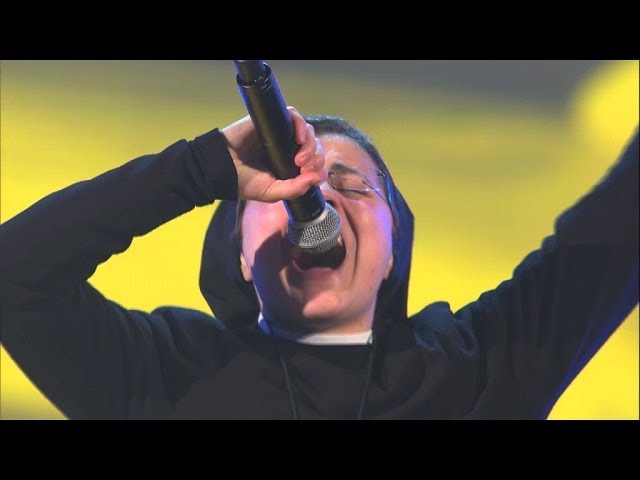
A growing number of people today like the interactive aspects of learning on the internet. Young people learn more willingly from screens, on desks and in their hands, than they do from books. Bishops must seize their opportunity and make up for their omission regarding cable/satellite TV. A poor nun with leg braces and crutches, without their power and resources, did what they couldn’t be bothered to do.
We must move with determination into cyberspace.
Every diocese ought to have a Vicar for Online Ministry and a plan.
Catholics intuitively look for leadership from priests, to be sure, but in a special way from diocesan bishops. I have met only a handful of bishops who actually grasp that there is an internet. Few take it seriously. On the live internet stream of the November meeting of the USCCB a bishop observed that, while he appreciated reducing paper consumption by giving him a CD-ROM disk, he didn’t know how to use it. I met a prelate in Rome, working in social communications, who didn’t know how to turn on his computer. An American Cardinal quizzed me about my footprint in cyberspace and mused, “More people read you in a day than read me in a week in our newspaper.” As a new generation of bishops emerges, episcopal savvy about modern tools of communication will improve. Nevertheless, bishops can’t themselves be the point men for a diocese’s online ministry.
Vicars for Online Ministry don’t have to exert control over the Catholic internet space – as if that were possible. Rather, they should take advantage of a natural desire on the part of Catholics for official leadership in all areas of communication and education.
Dioceses have to fill in the vacuum that now exists in terms of information channeling and interpretation. They do this usually, and not always well, through “official spokesmen”.
An alternative media has its important role, but bloggers are at risk to become the sole free flowing channel of news and information both about what is going on in the Church as well as what current events mean.
If anyone doubts the universal effects of Original Sin, let him watch an intersection with a four-way stop sign for a while, or read the combox of an interactive website. You Brits have those roundabouts … but I’ll bet the analogy holds.
Since the early 90’s I have been involved in online ministry. I often feel like the Sheriff of Deadwood. When I exert myself to exercise leadership, discussion can be focused and fruitful. When I fail in leadership or charity, the results can be chaotic and disappointing. Efforts for online ministry need guidance and support.
In same address I mentioned above, Pope Benedict cited John Paul II’s encyclical Redemptoris missio:
“… the very evangelization of modern culture depends to a great extent on the influence of the media.” He went on: “It is not enough to use the media simply to spread the Christian message and the Church’s authentic teaching. It is also necessary to integrate that message into the ‘new culture’ created by modern communications.”
I have used this example for years now: Our Lord asked to be let out on the water in a little boat at the end of a line so that He could address a much larger crowd on the shore. He thereby gave us the first example of “on-line ministry” (cf. Mark 4). He used technology to address a wider audience.
We must contribute not merely more of the same to the digital pulse of this age. We must find ways to adjust the very frequency of that digital pulse. We need what Pope Benedict called a “‘diaconate of culture’ on today’s ‘digital continent’”.
I chuckled at that “pulse” image at the end. Back when I wrote this I still had the domain “Catholic Pulse”. Someone else has it now and good luck to them.
Since I wrote that plenty of water has flowed under the you know what. I am now more scarred and a lot wearier than I was then. I stick to what I proposed.
I will add this codicil for the bishops who read this: Don’t wait to reach out to bloggers, especially your clerical bloggers. With the exception of the fringe, they are not your enemies. Give them a little water and sunlight and see what happens. Make a move.
And remember: The squishy middle is not your best course to tack, nor will its denizens be your allies.

 From a reader:


 In the last few days I electronically printed a couple posts (

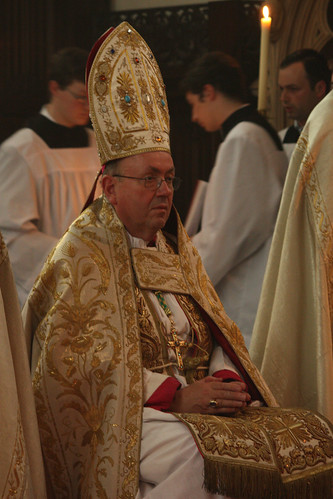 I note with approval the appointment of a new Archbishop of Liverpool.