
I am forever lamenting the sloppy, inaccurate term long used by many of the traditionalist camp, “the Latin Mass”, to describe older, pre-Conciliar form, Extraordinary Form, Usus Antiquior, “Tridentine” Mass, even Traditional Latin Mass or TLM.
The Latin Mass… ought to be the Novus Ordo, the Ordinary Form as well. Our liturgical language in the Latin Church is Latin and I don’t have to rehearse the why of that yet again.
I have long been concerned that the rise in the use of the older form, the TLM would drive the use of Latin out of the Ordinary Form entirely, would isolate the use of Latin in the ghetto of the traditionalists.
I read this in the Catholic Herald, the UK’s best Catholic weekly with my emphases and comments.
Why don’t we have more Novus Ordo Masses in Latin?
If you want a complete new rite Latin liturgy you have to go either to the very top or bottom of Britain
By Francis Phillips on Monday, 21 March 2011
A recent letter in the Catholic Herald has caught my eye. The writer, Susan Carson-Rowland, was raising the question of the new English translation of the Mass, which she described as a “true rendering of the definitive Latin text to replace the inaccurate version we have endured for 40 years”. [Let’s call it a “truer rendering”.] This situation has been lamented many times over during the last 40 years, both by traditionalists and those, like myself, who attend the Novus Ordo, and I have nothing new to add to the debate. What struck me about this letter was its author’s final question: “Why don’t we have Mass in Latin and avoid all this tiresome palaver?” [Do I hear an “Amen!”? Let there be more Latin. People can use the translation they prefer. A great solution to those who are whinging about the new, corrected translation.]
I only understood the full force of the question when I happened to attend an ordination to the diaconate at the Oxford Oratory last week. The Mass, sung in Latin according to the Novus Ordo, with the readings and rite of ordination in English, was celebrated magnificently. Bilingual service books were provided for those of us who had forgotten, or were unfamiliar with, the Latin. Of course, having a professional choir helped, though the congregation joined in singing the responses, the Credo and the Pater Noster. And it was a special occasion; I understand that generally Oratories celebrate Mass in the vernacular, while providing at least one Mass in Latin on Sundays and on solemnities. [Latin should not be relegated to “special occasions”, as if it were some aberration. What does it mean for our identity as Catholics if we never or only rarely hear the language of our Rite?]
My mole in the Association of Latin Liturgy tells me that the whole point of this association during the last 40 years has been to encourage the use of Latin (and the musical treasury of the Church, including plain chant) in the Novus Ordo, in an attempt to prevent Latin being swept away altogether. Their remit has been the document on the liturgy which stated: “The faithful must be able to say or sing together in Latin the parts of the Mass which pertain to them.” [It is the obligation of pastors of souls to see to that, btw. Liberals love to quote their bits and pieces of Council documents. They don’t like this bit from SC 54 very much.]
Have the aims of the association failed? Judging from the ordinary practice of almost all parish Masses it would appear so. There are only three Oratories in this country and, as my mole further points out, if you want a complete new rite Latin liturgy you have to go either to Pluscarden Abbey in Moray, Scotland, or to St Cecilia’s Benedictine convent in Ryde, Isle of Wight – either the extreme north or the extreme south of the country.
Back to the question raised in the letter to the Herald: why don’t we have Mass in Latin?
First, Latin Church clergy don’t know Latin any more. That is not their fault for the most part. It is the fault of those in charge of formation and of bishops of the past and present. The Code of Canon Law specifically says that seminarians must be very well-trained in Latin (c. 249). So, if they aren’t, why are the formators telling bishops that they are well-trained? When a man is ordained, someone must stand in front of the bishop and declare that the man is properly trained. They aren’t.
Is the solution more Latin in seminary? I guess so. Are we willing to add years to seminary training?
It strikes me that by the time a man reaches major seminary it is practically too late to give him a good working knowledge of Latin. So many things are already loaded onto seminarians, we would have to add a year or two to their formation to give them both Latin and Greek. Sometimes I have mused that before major seminary training begins in earnest, the men should have a propaedeutic year during which they do little else than learn Latin and Greek, read the Catechism of the Catholic Church and Baltimore Catechism aloud, and serve every kind of Mass and sing chant. Perhaps also be given a few little seminars on basic sewing, cooking, how to read spread-sheets and balance a checkbook, and small-engine repair. Enough for a first year. Build on that.
But I don’t think we should fall into a trap of thinking that major seminary is language school. Seminarians need the Latin before they start.
That said, they can at least learn enough to pronounce the words properly, know where the best tools and resources are found, and also learn that it is valuable and important for our identity as Catholic priests.
We need more Latin everywhere.
Thus endeth the rant.
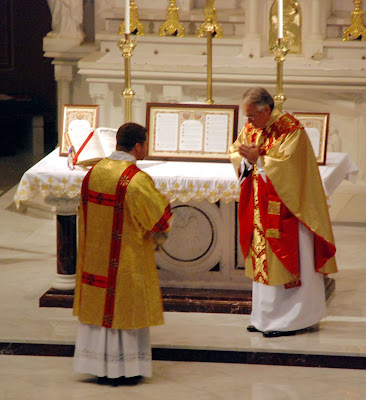 From a reader about St. Joseph’s Catholic Church in Macon, GA where Fr. Allan McDonald is building brick by brick. You will remember Fr. McDonald from his
  I received a note from the Latin Mass Society in England about a fine celebration of St. Joseph’s Day in Westminster Cathedral. A few lines and a photo…





























