Try as I might, I just can’t get my head around Facebook.
Now I have discovered that by Facebook account has been disabled, for reasons I cannot guess at.
No warning. No explanation. Just disabled.
Anyone have experience with this sort of rubbish?

Try as I might, I just can’t get my head around Facebook.
Now I have discovered that by Facebook account has been disabled, for reasons I cannot guess at.
No warning. No explanation. Just disabled.
Anyone have experience with this sort of rubbish?
 First, I am so very happy for Catholics in England who had the privilege of being addressed with this sermon.
The Holy Father’s sermon for Mass at Westminster Cathedral.
Let’s read the sermon closely with emphases and comments.
The setting is a Mass of the Precious Blood in a Cathedral dedicated to the Precious Blood. The sermon depends on the motif that Christ is the High priest and that therefore the Church is also the High Priest, which suffers and offers suffering.
Dear friends in Christ,
I greet all of you with the joy in the Lord and I thank you for your warm reception. I am grateful to Archbishop Nichols for his words of welcome on your behalf. Truly, in this meeting of the Successor of Peter and the faithful of Britain, “heart speaks unto heart” as we rejoice in the love of Christ and in our common profession of the Catholic faith which comes to us from the Apostles. I am especially happy that our meeting takes place in this Cathedral dedicated to the Most Precious Blood, which is the sign of God’s redemptive mercy poured out upon the world through the passion, death and resurrection of his Son, our Lord Jesus Christ. In a particular way I greet the Archbishop of Canterbury, who honours us by his presence. [A gracious gesture.]
The visitor to this Cathedral cannot fail to be struck by the great crucifix dominating the nave, which portrays Christ’s body, crushed by suffering, overwhelmed by sorrow, the innocent victim whose death has reconciled us with the Father and given us a share in the very life of God. The Lord’s outstretched arms seem to embrace this entire church, lifting up to the Father all the ranks of the faithful who gather around the altar of the Eucharistic sacrifice and share in its fruits. The crucified Lord stands above and before us as the source of our life and salvation, “the high priest of the good things to come”, as the author of the Letter to the Hebrews calls him in today’s first reading (Heb 9:11).
It is in the shadow, so to speak, of this striking image, that I would like to consider the word of God which has been proclaimed in our midst and reflect on the mystery of the Precious Blood. For that mystery leads us to see the unity between Christ’s sacrifice on the Cross, the Eucharistic sacrifice which he has given to his Church, and his eternal priesthood, whereby, seated at the right hand of the Father, he makes unceasing intercession for us, the members of his mystical body.
Let us begin with the sacrifice of the Cross. The outpouring of Christ’s blood is the source of the Church’s life. St John, as we know, sees in the water and blood which flowed from our Lord’s body the wellspring of that divine life to the Hebrews draws out, we might say, the liturgical implications of this mystery. Jesus, by his suffering and death, his self-oblation in the eternal Spirit, has become our high priest and “the mediator of a new covenant” (Heb 9:15). These words echo our Lord’s own words at the Last Supper, when he instituted the Eucharist as the sacrament of his body, given up for us, and his blood, the blood of the new and everlasting covenant shed for the forgiveness of sins (cf Mk 14:24; Mt 26:28; Lk 22:20).
Faithful to Christ’s command to “do this in memory of me” (Lk 22:19), the Church in every time and place celebrates the Eucharist until the Lord returns in glory, rejoicing in his sacramental presence and drawing upon the power of his saving sacrifice for the redemption of the world.
The reality of the Eucharistic sacrifice has always been at the heart of Catholic faith; called into question in the 16th century, [indeed] it was solemnly reaffirmed at the Council of Trent against the backdrop of our justification in Christ. Here in England, as we know, there were many who staunchly defended the Mass, often at great cost, [martyrdom] giving rise to that devotion to the Most Holy Eucharist which has been the hallmark of Catholicism in these lands. [In the Cathedral there is, for example, the body of
St. Robert Southwell, hanged, drawn and quartered at Tyburncorrection… St. John Southworth.]The Eucharistic sacrifice of the Body and Blood of Christ embraces in turn the mystery of our Lord’s continuing passion in the members of his Mystical Body, [This is an important image/motif for what follows.] the Church in every age. Here the great crucifix which towers above us serves as a reminder that Christ, our eternal high priest, daily unites our own sacrifices, our own sufferings, our own needs, hopes and aspirations, to the infinite merits of his sacrifice. Through him, with him, and in him, we lift up our own bodies as a sacrifice holy and acceptable to God (cf Rom 12:1). In this sense we are caught up in his eternal oblation, completing, as St Paul says, in our flesh what is lacking in Christ’s afflictions for the sake of his body, the Church (cf Col 1:24). In the life of the Church, in her trials and tribulations, Christ continues, in the stark phrase of Pascal, to be in agony until the end of the world (Pensees, 553, ed. Brunschvicg). [So… the Pope is driving at what we do with our suffering.]
[] We see this aspect of the mystery of Christ’s precious blood represented, most eloquently, by the martyrs of every age, who drank from the cup which Christ himself drank, and whose own blood, shed in union with his sacrifice, gives new life to the Church. It is also reflected in our brothers and sisters throughout the world who even now are suffering discrimination and persecution for their Christian faith. [This "Christian" must be intentional. Other Christians suffer because they are Christians. The Pope is widening the circle.] Yet it is also present, often hidden in the suffering of all those individual Christians who daily unite their sacrifices to those of the Lord for the sanctification of the Church and the redemption of the world. My thoughts go in a special way to all those who are spiritually united with this Eucharistic celebration, and in particular the sick, the elderly, the handicapped and those who suffer mentally and spiritually. [The whole Church.]
[From that springboard…] Here, too, I think of the immense suffering caused by the abuse of children, especially within the Church and by her ministers. Above all, I express my deep sorrow to the innocent victims of these unspeakable crimes, along with my hope that the power of Christ’s grace, his sacrifice of reconciliation, will bring deep healing and peace to their lives. I also acknowledge with you the shame and humiliation which all of us have suffered because of these sins; [I + You = We.] and I invite you to offer it to the Lord with trust that this chastisement will contribute to the healing of victims, [Suffering is propitiatory and healing.] the purification of the Church and the renewal of her age-old commitment to the education and care of young people. I express my gratitude for the efforts being made to address this problem responsibly, and I ask all of you to show your concern for the victims and solidarity with your priests. [He is saying this to lay people and to bishops, who are present. The Pope asks for solidarity with priests. The Pope reminded everyone that they are a priestly people who are enabled and charged to unite their sufferings with those of the Lord. We share in the priesthood of Christ by sharing in their sufferings. The abuse of children is one of the way in which we are all suffering now. When one of us suffers, we all suffer. People can suggest that Popes and bishops and superiors should have done more. We don’t deny that. But this is the sin of the whole Church. We can’t make this an us v. them issue. We are all in this together. We all share in the sin of a member. There are corporate consequences to personal sin. This is a reason why in confession we must be reconciled to the whole Church. The news media will say "POPE FEELS SHAME!". What Benedict is saying is "WE FEEL SHAME". Yes, of course HE feels it and HE personally expresses sorrow. But in a second move, he widens the circle and points to the corporate dimension of the responsibility and the solution: suffering and healing.]
Dear friends, let us return to the contemplation of the great crucifix which rises above us. [This from a Pope who wants ad orientem worship and, in lieu of that, the Crucifix front and center on the altar. The Cross is central to his reflection on mystery.] Our Lord’s hands, extended on the Cross, also invite us to contemplate our participation in his eternal priesthood and thus our responsibility, as members of his body, to bring the reconciling power of his sacrifice to the world in which we live. [Sin is a corporate reality. Responsibility is a corporate reality.] The Second Vatican Council spoke eloquently of the indispensable role of the laity in carrying forward the Church’s mission through their efforts to serve as a leaven of the Gospel in society and to work for the advancement of God’s kingdom in the world. [On many occasions the Pope has said that we must raise our voices in the public square. We need a strong identity to persevere in doing that. However, today he is adding another dimension. As a priestly people we also suffer in the public square. Bearing witness = martyrdom.] The Council’s appeal to the lay faithful to take up their baptismal sharing in Christ’s mission echoed the insights and teachings of John Henry Newman. May the profound ideas of this great Englishman continue to inspire all Christ’s followers in this land to conform their ever thought, word and action to Christ, and to work strenuously to defend those unchanging moral truths which, taken up, illuminated and confirmed by the Gospel, stand at the foundation of a truly humane, just and free society.
How much contemporary society needs this witness! [Martyrdom.] How much we need, in the Church and in society, witnesses of the beauty of holiness, witnesses of the splendour of truth, witnesses of the joy and freedom born of a living relationship with Christ! One of the greatest challenges facing us today is how to speak convincingly of the wisdom and liberating power of God’s word to a world which all too often sees the Gospel as a constriction of human freedom, instead of the truth which liberates our minds and enlightens our efforts to live wisely and well, both as individuals and as members of society. [In his "inauguration" sermon in 2005 he said: "Are we not perhaps all afraid in some way? If we let Christ enter fully into our lives, if we open ourselves totally to him, are we not afraid that He might take something away from us? Are we not perhaps afraid to give up something significant, something unique, something that makes life so beautiful? Do we not then risk ending up diminished and deprived of our freedom? And once again the Pope said: No! If we let Christ into our lives, we lose nothing, nothing, absolutely nothing of what makes life free, beautiful and great."]
[The Holy Father now speaks to reinvigorate the Catholic identity of the flock in England.] Let us pray, then, that the Catholics of this land will become ever more conscious of their dignity as a priestly people, called to consecrate the world to God through lives of faith and holiness. And may this increase of apostolic zeal be accompanied by an outpouring of prayer for vocations to the ordained priesthood. [He has been speaking about how all the people are a priestly people. Now he underscores the priesthood of the ordained.] For the more the lay apostolate grows, the more urgently the need for priests is felt; [Lay apostolates are not, in themselves, enough. They must have the support of the indispensable ordained priesthood.] and [More about our identity…] the more the laity’s own sense of vocation is deepened, the more what is proper to the priest stands out. [The roles must not be confused. They are different and complimentary.] May many young men in this land find the strength to answer the Master’s call to the ministerial priesthood, devoting their lives, their energy and their talents to God, thus building up his people in unity and fidelity to the Gospel, especially through the celebration of the Eucharistic sacrifice. [It is refreshing to read such clear words about vocations to the priesthood, without priesthood being blended in to generic "vocation".]
Dear friends, in this Cathedral of the Most Precious Blood, I invite you once more to look to Christ, [Crucified, bleeding] who leads us in our faith and brings it to perfection (cf Heb 12:2). I ask you to unite yourselves ever more fully to the Lord, sharing in his sacrifice on the Cross and offering him that “spiritual worship” (Rom 12:1) which embraces every aspect of our lives and finds expression in our efforts to contribute to the coming of his Kingdom. I pray that, in doing so, you may join the ranks of faithful believers throughout the long Christian history of this land in building a society truly worthy of man, worthy of your nation’s highest traditions. [The last line again brings together Benedict’s message of how Catholics must have a strong identity in order to contribute to society.]
Powerful and clear.
This will bear reading and rereading.
I note that the press is getting something wrong about this. For example, the BBC wrote: "Pope Benedict XVI has expressed his "deep sorrow" for the "unspeakable crimes" of child abuse within the Catholic Church." Yes, he did, but not in the way that the BBC leads.
John Allen, alas still writing for the National Catholic Reporter, pointed to how Pope Benedict is in a "box" concerning clerical sexual abuse of childen. Benedict has to talk about it, but when he does critics say it isn’t enough or it isn’t right. Allen adds that the Pope has to find something new to say: "Either he must figure out something new to say, or he has to supplement his words with actions – some new policy, some new spiritual initiative, or some new gesture of accountability, which would lend his words new significance." The way I heard this sermon, the Pope has in fact something new to say. But he is speaking as a Pope, not as a politician. If people expect him to speak as if he were an American politicians dealing with a political crisis, they will merge into the crowd of those who are never to be satisfied no matter what is done. I agree to an extent that something more than words is required. Perhaps the Holy Father’s sermon might give a theological underpinning to an initiative by individual bishops to prostrate themselves on the street before their cathedral doors once a month, before leading their people into the church for a penance service. Enough? I don’t know. But it is a start along the lines the Pope indicated today. But we have to consider who the audiences are. Who’s in really in the box? Benedict XVI with his listeners or John Allen with his readers?
In a first move Benedict spoke very properly and necessarily of his own sorrow. In a second move, he blends in the "we". This is not just Benedict‘s issue. If belongs to everyone. This surely goes beyond formal membership in the Catholic Church as well.
This Pope always speaks both ad intra (to Catholics) and ad extra (to the larger world). He is working to revitalize our Catholic identity. If we don’t know who we are, we cannot contribute to the social discussion and cannot make a difference. Why should anyone listen to us if we are uncertain about who we are? Perhaps this is one reason why secular humanist contempt for the Church has grown in England in the last few decades into something that it wasn’t before. I don’t know.
But the Holy Father today blended into his already strong tonic a bitter-sweet tincture of suffering. To be Catholic means not only being clear about our teachings, or practicing our devotions, and being able to give reasons for the faith that is in us. Being Catholic disciples of the Lord means involvement in suffering, our own and that of others.
If we are members of Christ the High Priest, we are also members of Christ the Victim for Sin.
Bearing witness to our Lord in the public square (in the family home, in the workplace, in the isolation of privacy) means also involvement in the Cross of the Lord, in the Precious Blood of the Lord shed to heal and give final meaning to the mysterium iniquitatis.

 Damian Thompson offers some analysis.
I found it reassuring that many of his points are in harmony with some of my thoughts.
Here is some of with my E&C:
How odd that it should be the Guardian that grasped the magnitude of what happened yesterday. Andrew Brown, religion editor of Comment is Free, and the possessor of an intellect as mighty and muddled as that of Rowan Williams, writes:
This was the end of the British Empire. [!] In all the four centuries from Elizabeth I to Elizabeth II, England has been defined as a Protestant nation. The Catholics were the Other; sometimes violent terrorists and rebels, sometimes merely dirty immigrants. The sense that this was a nation specially blessed by God arose from a deeply anti-Catholic reading of the Bible. Yet it was central to English self-understanding when Queen Elizabeth II was crowned in 1952 [sic], and swore to uphold the Protestant religion by law established.
For all of those 400 or so years it would have been unthinkable that a pope should stand in Westminster Hall and praise Sir Thomas More, who died to defend the pope’s sovereignty against the king’s. Rebellion against the pope was the foundational act of English power. And now the power is gone, and perhaps the rebellion has gone, too. [!]
This was indeed a day of unthinkable events. Many Protestants will have been disturbed to see Pope Benedict XVI in Westminster Hall praising St Thomas More (who incidentally died to defend what he saw as the sovereignty of God). I don’t agree, [I don’t know as much about it, but I think Damian is right, and I said as much in my piece.] however, that rebellion against the Pope was the “foundational act of English power”.
[…]
Even Catholics who would never be so crude as to say “the Abbey belongs to us, not to you” sensed that history was being re-balanced in some way. [Indeed they would] They realised that the Pope had as much right to sit in that sanctuary as the Archbishop of Canterbury (who, to be fair, showed the Holy Father a degree of respect that implied that he, at least, recognises the spiritual primacy of the See of Peter even if he rejects some of its teachings). [Williams recognizes Benedict’s "Spiritual primacy"? I wonder about that.]
[…]
Protestant anti-Catholics, in contrast [to secular humanists to are anti-Catholic], don’t have mates in the media or useful allies in the Church of England. All they can do is watch in horror as the Pope of Rome processes into the church where Protestant monarchs are crowned, declares unambigously that he is the successor of St Peter with responsibility for the unity of Christendom, and then walks out again – to hearty applause. [And I suspect quite a few of them would also applaud… and will, given time.]
To be honest, I’m still not quite sure what to make of it all myself. Benedict XVI’s speeches are worth reading several times; they often turn out to be more radical than they first appear. But one thing is for sure. Despite the unassuming courtesy of the Pope’s manner, he didn’t give an inch. [Exactly.]
Right! Pope Benedict, as usual, won ground of inestimable worth because he was willing to give something. In doing so, he compromised on no essential point. On the contrary, he made himself clear on everything that counted.
Good analysis from Damian, who knows far more about the dynamics of this than the undersigned.
His combox has some truly hateful comments, the sort that are born of panic, guilt, and fear.
Moreover, Benedict XVI is not only the Successor of Peter – a fact he repeated several times in Westminster – he is the Pope of Christian Unity.
I watched the live feed of the Holy Father’s visit today pretty closely.
But Vincenzo of Sancte Pater – the official WDTPRS photoshopper – caught a screenshot I missed.

IMPORTANT ADDITIONAL UPDATE BELOW
I responded to a question about a Jewish congregation using a Catholic church in Austin, TX. One of the complications was that the Rabbi of the community was involved with Planned Parenthood and was a pro-abortion advocate. Last year, that community rearranged the church sanctuary in a way that was not in keeping with the nature of a Catholic church’s belief.
There are developments.
LifeSiteNews has a story that through some continuing conversations, it was determined that the Jewish community would not have the use of the church.
The Vicar General of the Diocese of Austin, Msgr. Mike Sis, Vicar General told LSN,
[…]
“Now that Bishop Vásquez is aware of the associations of this particular rabbi, he will be in dialogue with his advisers and with Father Larry Covington, pastor of St. Louis, to determine what course of action might be appropriate in future years. Since our Jewish brothers and sisters are presently in the midst of their high holy days, the parish will, for this year, honor its commitment to the community of Temple Beth Shalom and will allow them to use the facilities of St. Louis on Yom Kippur,” Sis concluded.
Read LSN about the dynamics of getting the story.
Also, LSN had photos of the change made to the sanctuary.
When the first such event took place at St. Louis Church last year, the Church was transformed into a non-Catholic worship space. The altar was decked with apparel for the Jewish ritual, the tabernacle was covered, Catholic statues were removed and the Stations of the Cross covered. Before and after photos obtained by LifeSiteNews from last year’s event demonstrate some of the transformation.
LifeSiteNews spoke with someone who attended the Jewish ceremony at the parish last week. The transformation was similar. The cross and statues were removed, the altar decked, and the tabernacle covered; however the Stations of the Cross remained visible.
Photos:
Before and after:

There remains one last Jewish celebration at the parish which is to take place Friday September 17 and Saturday September 18.
It remains that the Rabbi of that community is deeply involved with Planned Parenthood. I assume that he will be preaching within the walls of that Catholic church.
UPDATE 18 Sept 02:44 GMT
This is on the website of the Diocese of Austin. My emphases.
Temple Beth Shalom to move Yom Kippur services
AUSTIN — The Diocese of Austin has directed that the services of Yom Kippur for the congregation of Temple Beth Shalom not take place as planned at St. Louis Catholic Church on September 17 and 18.
Bishop Joe Vásquez is aware of recent press and Internet reports that have questioned the appropriateness of the invitation having been extended to Temple Beth Shalom by Father Larry Covington, Pastor of St. Louis Catholic Church. In view of the fact that Rabbi Alan Freedman is a member of the board of Planned Parenthood of the Texas Capital Region, and questions about the suitability of the use of a Catholic sanctuary by a non-Christian community, Father Covington has determined, in consultation with Bishop Vásquez, to withdraw the invitation.
After mutual consultation, Rabbi Freedman and Father Covington have also come to an amicable agreement that it is in the best interests of both communities that the services not be held at St. Louis Church. Rabbi Freedman and Father Covington are both committed to continuing dialogue and building friendship between the local Jewish community and the Catholic Diocese of Austin. Dialogue between the two communities can perhaps include discussions of important moral topics surrounding the sanctity of human life, especially the unborn. We hope that such a dialogue can also allow us to explore together a broad range of life issues.
Bishop Vásquez has invited Rabbi Freedman to join him in this dialogue soon after the conclusion of the Jewish high Holy Days.
The Catholic Diocese of Austin remains united in prayer with our Jewish brothers and sisters, and Bishop Vásquez extends to them his best wishes in this holy season.
WDTPRS applauds Fr. Covington for his effort to find a good solution in discussion with the Bishop and the Rabbi.
As you know, my friends and I have been exploring …
We managed to send in the remote probe to take photos of the thing, a portentous plant or growth of some kind, in or near the epicenter of the ecclesial force vectors emanating from the Chancery of the Diocese of Kansas City St. Joseph, The SSPX parish St. Vincent’s and, of course, the HQ of the National Catholic Fishwrap.
Our investigations may have actually changed the balance of forces! We saw, for example, that the NCR the other day praised Bp. Finn!
Some of the data has come back and we have subjected it to analysis. While I wait for the Holy Father to arrive at Lambeth Palace, I decided to share some of the ominous findings.

Here is some of the analysis:
Sorry the tree ID has taken a while. It’s been a bit perplexing because what I can see of it doesn’t quite match any of the classic descriptions. The leaves look like something between a chestnut and a beech (both in the same family, at least), but the twigs are definitely not beechy (smooth and grey), nor are some of the characteristics quite like the native chestnut that appears in my guides. However, it is quite possible that the specimen is a hybrid of American and Chinese chestnut; they hybridize freely and are being used as ornamental plantings to replace the native chesnuts that have almost been wiped out by chestnut blight. The hybrids have much better resistance to the fungal blight. I can’t see some of the characters we would use to ID things because there are no fruit or flowers to be seen. Were there any burs or nuts around? I can’t tell what the trunk looked like. Single stem or branched near the ground? Color? Smooth or rough? Leaves hairy on the underside? Twigs smooth or hairy? All of those characters might help, but you could also ask the KC streets department if they have arecord of what they planted there, assuming they are in charge of it. :-) Anyway, our best guess is some hybrid chestnut. (For the person who wanted the Linnean name, the genus would be Castanea and the species unknown, but possibly a hybrid of dentata and mollissima; Castanea means chestnut, dentata = toothed; mollissima = very soft). Of course, we could be wrong. “We” includes me, my plant systematist colleague, […], and her PhD student.
There it is.
I think we may have to send the probe in again.
In the meantime, steady your nerves now with a piping hot mug filled with….
It’s swell and not a bit portentous!
There was a beautiful Mass in Philadelphia for the Feast of the Exaltation of the Cross.
The Mass was at at St. Paul’s Church.
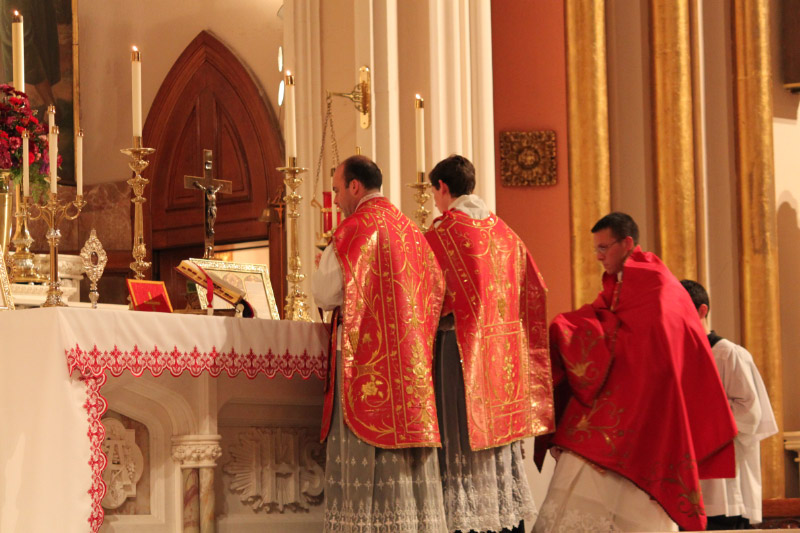
The celebrant was the Pastor of St. Paul’s Church, Fr. Gerald Patrick Carey; the deacon was Fr. Richard McFadden of St. Charles Borromeo Church, Cornwells Heights across from the National Shrine of St. Katherine Drexel; and the sub-deacon was Friar David Spencer, O. de M. from the Monastery of Our Lady of Mercy.
Brick by brick.
I was sitting at my desk, writing the entry about Fr. Finigan’s annd Fr. Blake’s comments on the Mass at Glasgow and ….
I figured it was one of the dopey Mourning Doves.
I stood up to see what happened and spotted a new visitor to the feeder… a different sort of feeder.
We stared at each other for a while.

Then he … she? … went into the bushes under my window to get, I suspect, the fallen prey.

I will go out later to see what it might have been, if anything is left.
I am thinking Broad-Winged Hawk.
UPDATE: 21:30 GMT
I am not so sure. The tail is very like.
Anyone else?
I am still thinking Buteo platypterus Broad-Winged Hawk.
His Hermeneuticalness, Fr. Finigan and the great PP of Brighton, Fr. Blake, share their views of the Papal Mass in Glasgow today.
Be sure to visit their fine blogs.
Some comments from Fr. Finigan about the Mass today:
Liturgically, the Mass at Bellahouston Park was a mixed bag. It looked very much like the result of a tussle between the Papal celebrations team and the Scots new liturgy enthusiasts. There was some superb music and singing side by side with some that was so ghastly I took the headphones off until it finished. …
Visually, the sanctuary was disappointing. The throne, altar and lectern were made from fine materials, including marble, but managed to look pedestrian. This was particularly helped by the placing of three candles in boxes in a line either side of the altar. Whatever nuLiturgy expert managed to browbeat Mgr Marini into allowing that, instead of having some beautiful candleson the altar, should stick to school assemblies and creative liturgy prayer sessions for discussion groups.One of the most striking positive elements was the reverent silence before Mass and at various points during the celebration. Under Pope Benedict we have learnt how to be quiet at the sacred liturgy where appropriate. I noticed this at the Mass for the Epiphany at St Peter’s in January and it seems to be something that the Holy Father takes on pilgrimage with him.
[…]
Some comments from Fr. Blake:
The announcer in a rather comperish style which seemed to break the prayerful mood announced Bishop Conti and who welcomed the Pope rather nicely talking of the saints of Scotland. He was presented with a book on St Ninian and in return gave chalices to Bishop Conti and Cdl O’Brien.The compere burst in again destroying prayerfulness by asking for it!
The Pope gave Holy Communion to people kneeling and on the tongue, I wonder if any bishop will follow his example, everyone else receives the Lord standing, there is not even a communion plate used. A man even received Communion from the Pope wearing a hat!!!
Sounds from the Mass in Glasgow.
Podcast: Play in new window | Download
Subscribe: RSS
Also, a friend of mine is saying that Our Lord must have sent the Blessed Virgin and angels to clear the skies, given the demons that must be swirling around that Mass.
Moreover, I am told that the SKY TV has put the salient quotes from the Holy Father’s address before Her Majesty the Queen on the crawler at the bottom of their screen. They have been running constantly the Pope’s words about "some who now seek to exclude religious belief from public discourse".
The Scots have set a high bar for the English.

Coat of Arms by D Burkart
 emmatag1126 on Thoughts about the collision of the Holy See and the SSPX. Wherein Fr. Z rants.: “Also, the Declaration said that we can be saved only through the Roman Catholic Church, which unfortunately leaves out my…” on Thoughts about the collision of the Holy See and the SSPX. Wherein Fr. Z rants.: “I just wanted to say how much I appreciate your charity and well-worded wishes/prayers for hearts to change. Whenever I’m…”
 on ROME 26/5– Day 52: lace imitates God’s beauty enlaced in flowers: “Fr. Z: It wasn’t until I started reading your writings a few years back that I realized how important vestments…” on ROME 26/5– Day 52: lace imitates God’s beauty enlaced in flowers: “Speaking of age, I think I am lucky not to be in my teens or even early twenties right now.…”
 on ROME 26/5– Day 52: lace imitates God’s beauty enlaced in flowers: “The “seriously cool APP” Father Z is referring to is the Ava Maria Clock which if you have not downloaded…”
 on ROME 26/5– Day 53: Persevere!: “Black to move and mate in 4 1) … Qd1+ 2) RxQd1 (or Kh2) RxRd1+ 3) Kh2 (forced) Be5+ 4)…”
 on ROME 26/5– Day 52: lace imitates God’s beauty enlaced in flowers: “@Charivari Rob: How about calling it the Old Chestnut Award? It will probably only be slightly less feared than the…”
A Daily Prayer for Priests










They find you a pro-life agent in your area who commits to giving a portion of the fee to a pro-life group!

PLEASE subscribe via PayPal if it is useful. Zelle and Wise are better, but PayPal is convenient.
A monthly subscription donation means I have steady income I can plan on. I put you my list of benefactors for whom I pray and for whom I often say Holy Mass.
In view of the rapidly changing challenges I now face, I would like to add more $10/month subscribers. Will you please help?
For a one time donation...



Help Monks in Wyoming (coffee – UPDATED LINK) and Norcia (beer) and the wonderful "Soap Sisters" of Summit, NJ!


Please follow me on Twitter!










Visits tracked by Statcounter
since Sat., 25 Nov. 2006:

 Dear friends, let us return to the contemplation of the great crucifix which rises above us. [This from a Pope who wants ad orientem worship and, in lieu of that, the Crucifix front and center on the altar. The Cross is central to his reflection on mystery.] Our Lord’s hands, extended on the Cross, also invite us to contemplate our participation in his eternal priesthood and thus our responsibility, as members of his body, to bring the reconciling power of his sacrifice to the world in which we live. [Sin is a corporate reality. Responsibility is a corporate reality.] The Second Vatican Council spoke eloquently of the indispensable role of the laity in carrying forward the Church’s mission through their efforts to serve as a leaven of the Gospel in society and to work for the advancement of God’s kingdom in the world. [On many occasions the Pope has said that we must raise our voices in the public square. We need a strong identity to persevere in doing that. However, today he is adding another dimension. As a priestly people we also suffer in the public square. Bearing witness = martyrdom.] The Council’s appeal to the lay faithful to take up their baptismal sharing in Christ’s mission echoed the insights and teachings of John Henry Newman. May the profound ideas of this great Englishman continue to inspire all Christ’s followers in this land to conform their ever thought, word and action to Christ, and to work strenuously to defend those unchanging moral truths which, taken up, illuminated and confirmed by the Gospel, stand at the foundation of a truly humane, just and free society.
