Why today’s beatification of John Henry Newman is something every Englishman should be proud of, by CONRAD BLACK
By Conrad Black
Pope Benedict XVI’S beatification today of Cardinal John Henry Newman on English soil should underline in the minds of us all that Newman must rank among the very greatest Englishmen of any time or faith.
This process, which is rigorous and laborious, [As someone who has been through the Studium of the Cong. for Causes of Saints, I can attest to that.] and far from the hocus-pocus pop-chart rise the Church’s detractors might imply, would make him the first Englishman born since the 17th century recognised by the Roman Catholic Church as a saint; pretty thin canonical gruel for a country whose Roman Catholics still whisper about it as ‘the Dowry of Mary’, just as France describes itself (with scarcely greater plausibility) as the ‘eldest daughter of the Church’.
Newman’s beatification today rests not just on his accepted possession of saintly and miraculous powers. It rests also on his moral and intellectual courage, his worldwide influence as a writer, educator and theological philosopher, and his personification of many of the most universally admired characteristics of the English people, as perceived by the English themselves and by foreigners, not least of which was stoicism. [As in the "stiff upper lip"? No… his beatification does not rest on those things. If someone is not a martyr, he or she is declared blessed because they possessed heroic virtues. They were holy. They also, after their deaths, had the fama sanctitatis, they had a strong reputation of holiness. This needs to be determined before a person is called venerable. Yes, the miracle moves the Venerable to the next stage, as it were. But the foundation for beatification is not intelligence, or worldly fame, or "intellectual courage", but holiness.]
He was always seen as an outsider. During the early years he spent as a clergyman in the Church Of England, Newman did his best to justify the Church’s theological claim to be part of the ‘One, holy, Catholic and Apostolic Church’. He understood the Church Of England to be a half-way house between Rome and popular Protestantism, between what Protestants traditionally regard as Rome’s exaggerated claim to authority, and the non-conformist view of spontaneous religiosity.
This Orthodox Anglican view of the Church’s doctrine found little favour in the corridors of power and he was attacked by the Anglican bishops for what was perceived as the Popish tendencies [Sound like many chanceries and seminaries in years past…] in his theological pamphlet, Tract 90 where he challenged the 39 articles, the overriding principles, of the Church Of England. It was an intellectual position that changed his life and, aged 40, he was effectively cast out and violently attacked throughout Protestant Britain as a papist agent.
Four years later, in 1845 at the age of 44, he became a Roman Catholic. But it was a hard conversion and at first he was mistrusted in much of the Roman world. He was seen as an exotic and tempestuous itinerant, from a country that was apostate, and whose Roman Catholic community had endured 300 years of fluctuating but almost unbroken discrimination.
He had gone from the Anglican pulpit at St Mary’s, Oxford, and the high table at Oriel College, to the Spartan obscurity of the church at Littlemore, in Oxford and then, after a sojourn in Rome at the Oratory of St Philip Neri, he moved into relative seclusion in Edgbaston in Birmingham where he established the first order of Oratorians in England.
It was from this base in Birmingham that he sent a detachment of his community to build a house in London, in what was eventually to become the Brompton Oratory, in Knightsbridge. The Brompton Oratory was Newman’s greatest physical monument, though he rarely visited it, died before it was completed, and did not like it. He personally chose, in Italy, the statues of the saints that adorn it, but found Birmingham, and the comparative ordinariness of the Midlands, oddly congenial.
Newman made Catholicism respected in Britain by his refusal to join the ranks of reactionary Catholics or to be less conspicuously English in his attitudes. He [NB] believed in a version of papal infallibility himself (as it is generally defined now, of applying to what has been universally and durably accepted within the Church), but not the version accorded to Pius IX, a dogmatic carte blanche consolation prize for the loss of the papal states to the Italian Risorgimento unification movement.
More than Acton or Ripon (the leading lay Catholics of England at the time), Newman de-fanged the widely believed English caricature of the grasping, insidious, alien papist monster. He changed the widespread impression in England of Catholics from a rag-tag of drunken, priest-ridden, proliferating Irish labourers and a few respectable ancient recusant families, to an intellectually distinguished and patriotic pillar of the nation.
They were no longer seen as aliens by the majority nor as outcasts by themselves. He fought the battle of faith on behalf of all Christians and provided the greatest, most rigorous Christian argument for the existence of God since Thomas Aquinas, and is frequently called ‘the English Aquinas’. Thus our conscience, God speaking to us, he believed, was ‘powerful, peremptory, unargumentative, irrational, minatory and definitive’.
Newman’s version of faith was accessible to everyone.
‘Lead kindly light… lead thou me on… One step enough for me,’ he wrote while still an Anglican in 1833, and becalmed in the Straits Of Bonifacio in the Mediterranean.
I believe that he was, with Abraham Lincoln, the most elegant writer of English non-fiction prose of the 19th century. [!] He wrote not only with burning expressions of faith, surer of God’s existence ‘than that I have hands and feet’.
But also with sudden lurches into the secular, as in the closing pages of Grammar Of Assent when he quoted ‘the great man who so swayed the destiny of the nations of Europe in the early years of this century’ – Napoleon, the defeat of whose navy at Trafalgar Newman well remembered as a boy of four in 1805. (Napoleon effectively was claimed to have held that Christ had to be divine because although he was a mere travelling provocateur and died the death of a ‘miscreant’, he was vastly more renowned than Alexander The Great, Julius Caesar, or Napoleon himself.)
His Idea Of A University and Apologia Pro Vita Sua (A Defence Of One’s Life) were particularly, but not uncharacteristically, brilliant. Though often ill-tempered, Newman was not vain, and his writing, a colossal volume of work spanning 70 years, never sought to dazzle the reader.
Like the greatest 20th-century writers, such as Joseph Conrad or George Orwell, his prose was spare and simple, stirred to adjectival or polysyllabic climaxes only by the gravity or intensity of his thought. His effort to found a Catholic university in Dublin was hampered by the very parties who had most to gain from it, the narrow-minded custodians of insular Irish victim-Catholicism, which are not extinct, even today. [Do I hear an "Amen!"?]
Yet it produced Newman’s educational concepts, luminously written and a beacon for all subsequent educators in every land. His effort to establish an Oratory at Oxford was sabotaged by his fellow Catholics, whose every declared purpose should have motivated them to support such an initiative.
Cardinal Manning, his talented but devious rival, who tried to prevent his elevation to the College Of Cardinals, obstructed almost everything he did for 30 years, and then eulogised him in the Brompton Oratory as ‘my friend and mentor of 50 years’. (On Newman’s death, Manning privately called him ‘a great hater’, an exaggeration, perhaps motivated by the fact that Newman had prevailed against all Manning’s obstructions.)
For almost an entire century he was the unflagging champion of intellectual and intuitive Christian faith, who revealed the inconsistencies of the Established Church, yet was a force for Christian reconciliation, and always dissented from what was trendy and opportunistic. He was a bridge to the universal and premier church, but always an Englishman. He was as representative of the highest form of the English character as Samuel Johnson or the Duke Of Wellington.
The same man who opposed the Crimean War, as besmirching British integrity by propping up the Ottomans, who rendered unto the Pope what was his, once said he ‘could not imagine being or wanting to be anything but English‘.
When he died in his 90th year, the whole Christian world mourned him. Today, there is a Cardinal Newman school in almost every community in the once-Christian world. [Not far off the mark! At least in the anglophone world.]
Pope Benedict XVI is one of the greatest intellects who has held that office in several centuries, a man of great philosophical scholarship, rigour and originality, as well as an accomplished writer, linguist, practical administrator and musician.
His visit to Britain today is to render homage to a man endowed with a character of comparably exceptional quality, which he believes, on the evidence of ecclesiastical scrutiny, has been recognised and amplified by divine blessings. [Benedict XVI did not beatify John Henry Newman because he had "a character of comparably quality". It was determined that Newman had live a life of holiness, which no doubt shaped that exceptional character. But this article was written less for Catholics and more for the average English reader. The writer appeals to those aspects with which they will quickly resonate.]
Those who share his faith are uplifted by Newman’s intelligence and character. Those British who do not should at least be aware that in his lifetime and in the 120 years since his death, Newman has carried the colours of this country in his spheres of endeavour with a brilliance, panache and durability that has put him in, or close to, the company of history’s most distinguished Englishmen.
John Henry Newman is being elevated for a rare fusion of genius and virtue [There it is.] that does great honour to the whole nation.
A good article! I hope this helps to dispel something of the bilious cant of the blinkered secularists who in recent time have shown their colours.
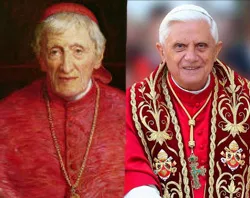 Birmingham, England, Sep 19, 2010 / 08:50 am (CNA/EWTN News).- Speaking to journalists less than an hour after Blessed John Henry Cardinal Newman’s beatification, Vatican spokesman Fr. Lombardi expressed confidence in his being canonized. There is a "concrete possibility," also, that he will be made a "doctor of the Church."
 Facing crash, Vancouver man sacrifices self to save pregnant wife
 From Oscott College the Holy Father’s address to Bishops of England, Scotland and Wales:


 Benedict XVI has beatified John Henry Card. Newman.
 England has a long tradition of martyr saints, whose courageous witness has sustained and inspired the Catholic community here for centuries. Yet it is right and fitting that we should recognize today the holiness of a confessor, a son of this nation who, while not called to shed his blood for the Lord, nevertheless bore eloquent witness to him in the course of a long life devoted to the priestly ministry, and especially to preaching, teaching, and writing. He is worthy to take his place in a long line of saints and scholars from these islands, Saint Bede, Saint Hilda, Saint Aelred, Blessed Duns Scotus, to name but a few. In Blessed John Henry, that tradition of gentle scholarship, deep human wisdom and profound love for the Lord has borne rich fruit, as a sign of the abiding presence of the Holy Spirit deep within the heart of God’s people, bringing forth abundant gifts of holiness.
 The definite service to which Blessed John Henry was called involved applying his keen intellect and his prolific pen to many of the most pressing "subjects of the day". His insights into the relationship between faith and reason, into the vital place of revealed religion in civilized society, and into the need for a broadly-based and wide-ranging approach to education were not only of profound importance for Victorian England, but continue today to inspire and enlighten many all over the world. I would like to pay particular tribute to his vision for education, which has done so much to shape the ethos that is the driving force behind Catholic schools and colleges today. Firmly opposed to any reductive or utilitarian approach, he sought to achieve an educational environment in which intellectual training, moral discipline and religious commitment would come together. The project to found a Catholic University in Ireland provided him with an opportunity to develop his ideas on the subject, and the collection of discourses that he published as The Idea of a University holds up an ideal from which all those engaged in academic formation can continue to learn. And indeed, what better goal could teachers of religion set themselves than Blessed John Henry’s famous appeal for an intelligent, well-instructed laity: "I want a laity, not arrogant, not rash in speech, not disputatious, but men who know their religion, who enter into it, who know just where they stand, who know what they hold and what they do not, who know their creed so well that they can give an account of it, who know so much of history that they can defend it" (The Present Position of Catholics in England, ix, 390). On this day when the author of those words is raised to the altars, I pray that, through his intercession and example, all who are engaged in the task of teaching and catechesis will be inspired to greater effort by the vision he so clearly sets before us.

 Benedict XVI used Hyde Park for his soap box tonight, and gave this address.
 Let me begin by recalling that Newman, by his own account, traced the course of his whole life back to a powerful experience of conversion which he had as a young man. It was an immediate experience of the truth of God’s word, of the objective reality of Christian revelation as handed down in the Church. This experience, at once religious and intellectual, would inspire his vocation to be a minister of the Gospel, his discernment of the source of authoritative teaching in the Church of God, and his zeal for the renewal of ecclesial life in fidelity to the apostolic tradition. At the end of his life, Newman would describe his life’s work as a struggle against the growing tendency to view religion as a purely private and subjective matter, a question of personal opinion. [We return to a major theme of this Pope’s pontificate and this Visit. There are many people who would forcibly eject any Christian voice from the public sphere. This is especially true in the case of a Catholic voice. Even many Catholics who are not entirely faithful to the Church’s teachings are complicit in this.] Here is the first lesson we can learn from his life: [1]
 in our day, when an intellectual and moral relativism threatens to sap the very foundations of our society, Newman reminds us that, as men and women made in the image and likeness of God, we were created to know the truth, to find in that truth our ultimate freedom and the fulfilment of our deepest human aspirations. In a word, we are meant to know Christ, who is himself "the way, and the truth, and the life" (Jn 14:6). [The British Humanist Association needs to get this part straight.]
 Newman’s life also [2] teaches us that passion for the truth, intellectual honesty and genuine conversion are costly. [Bearing witness – martyrdom] The truth that sets us free cannot be kept to ourselves; it calls for testimony, [Martyrdom.] it begs to be heard, and in the end its convincing power comes from itself and not from the human eloquence or arguments in which it may be couched. Not far from here, at Tyburn, great numbers of our brothers and sisters died for the faith; the witness of their fidelity to the end was ever more powerful than the inspired words that so many of them spoke before surrendering everything to the Lord. [NB] In our own time, the price to be paid for fidelity to the Gospel is no longer being hanged, drawn and quartered but it often involves being dismissed out of hand, ridiculed or parodied. And yet, the Church cannot withdraw from the task of proclaiming Christ and his Gospel as saving truth, the source of our ultimate happiness as individuals and as the foundation of a just and humane society.
  One of the Cardinal’s best-loved meditations includes the words, "God has created me to do him some definite service. He has committed some work to me which he has not committed to another" (Meditations on Christian Doctrine). Here we see Newman’s fine Christian realism, the point at which faith and life inevitably intersect. Faith is meant to bear fruit in the transformation of our world through the power of the Holy Spirit at work in the lives and activity of believers. [Here is some realism for you:…] No one who looks realistically at our world today could think that Christians can afford to go on with business as usual, ignoring the profound crisis of faith which has overtaken our society, or simply trusting that the patrimony of values handed down by the Christian centuries will continue to inspire and shape the future of our society. We know that in times of crisis and upheaval God has raised up great saints and prophets for the renewal of the Church and Christian society; we trust in his providence and we pray for his continued guidance. But each of us, in accordance with his or her state of life, is called to work for the advancement of God’s Kingdom by imbuing temporal life with the values of the Gospel. Each of us has a mission, each of us is called to change the world, to work for a culture of life, a culture forged by love and respect for the dignity of each human person. As our Lord tells us in the Gospel we have just heard, our light must shine in the sight of all, so that, seeing our good works, they may give praise to our heavenly Father (cf. Mt 5:16).
 Here I wish to say a special word to the many young people present. Dear young friends: only Jesus knows what "definite service" he has in mind for you. Be open to his voice resounding in the depths of your heart: even now his heart is speaking to your heart. Christ has need of families to remind the world of the dignity of human love and the beauty of family life. He needs men and women who devote their lives to the noble task of education, tending the young and forming them in the ways of the Gospel. He needs those who will consecrate their lives to the pursuit of perfect charity, following him in chastity, poverty and obedience, and serving him in the least of our brothers and sisters. He needs the powerful love of contemplative religious, who sustain the Church’s witness and activity through their constant prayer. And he needs priests, good and holy priests, men who are willing to lay down their lives for their sheep. Ask our Lord what he has in mind for you! Ask him for the generosity to say "yes!" Do not be afraid to give yourself totally to Jesus. He will give you the grace you need to fulfill your vocation. Let me finish these few words by warmly inviting you to join me next year in Madrid for World Youth Day. It is always a wonderful occasion to grow in love for Christ and to be encouraged in a joyful life of faith along with thousands of other young people. I hope to see many of you there!

 emmatag1126 on Thoughts about the collision of the Holy See and the SSPX. Wherein Fr. Z rants.: “Also, the Declaration said that we can be saved only through the Roman Catholic Church, which unfortunately leaves out my…”






























