 From a reader:
Can the Churching ritual be performed directly after the baptism, or should it be done on a different day? I ask this for clarity, as this will be the priest’s first time performing a baptism in the EF and is not very familiar with Churching.
This custom should be brought back, and brought back soon and brought back everywhere.
This is one of those über-Catholic things we should know and love and revive.
Thank you, Lord, for Pope Benedict and Summorum Pontificum.
I usually “Church” directly after a baptism, but the really traditional way is to wait for 40 days after childbirth. If the baptism is more than forty days after the birth of the child, this is a moot point. Forty, however, is that special Biblical number.
Just as the Mother of God went to the Temple, bringing the Christ Child, according to the Law, so too a Christian mother should desire to present herself and her children in church to obtain graces.
The older Rituale Romanum and the Collectio Rituum can be used for the Churching of women after childbirth. Pastors may and should always use the Rituale Romanum. Churching cannot, I believe, be delegated to a deacon. The Rituale says “priest” throughout. I think it must be done by a priest. Sorry, guys.
Furthermore, I hope that one of the results of the “gravitational pull” created by Summorum Pontificum, is that the “Book of Blessings” (a misnomer, since most of the prayers in the book don’t actually bless anything) gets pulled into a black hole and is never seen again. I would settle for all but a few copies to be burned.
So, some of you may be asking, “But Father! But Father! What’s ‘Churching’?”
Churching is a nickname for a blessing given by the Church to mothers after recovery from childbirth. It must be given in church (thus the name) and not just any place.
Traditionally, only a Catholic woman who has given birth to a child in legitimate wedlock, provided she has not allowed the child to be baptized outside the Catholic Church, receives it. It is not a precept. It is a pious and praiseworthy custom, dating from the early Christian ages.
The guidelines for “Churching” were obviously from before people were dreaming up all manner of ways to twist and usurp God’s role in the nature he gave us. Thus, I would refuse, even in front of media cameras to “Church” a lesbian who, with her lesbian partner, in an obvious scheme to entrap and embarrass the Church, came along to my parish of St. Fidelia carrying their test-tubular stupor mundi.
A mother would go to church when she could, to thank God for her delivery, and to obtain graces though the priest’s blessing the graces to help her raise her child in a Christian manner.
The prayers indicate that this “Churching” blessing is intended solely for the benefit of the mother. Therefore, it is not necessary that she should bring the child with her, which could be a consolation to mothers whose children may be premature. However, it could be edifying for the whole family to be there, especially for girls, to watch, listen and learn.
And there is a blessing for newborns that can also be given. We mean old women-hating male hierarchs think of everything.
“Churching” can to be impart to the mother even if her child was – absit – stillborn or – quod Deus avertat – died without baptism.
During the rite, the mother kneels in the vestibule or within the entrance to the church, carrying a lighted candle. The priest sprinkles her with holy water and recites Psalm 23, “The earth is the Lord’s and the fullness thereof”. She kisses the priest’s stole and he leads her forward into the church, saying: “Enter thou into the temple of God, adore the Son of the Blessed Virgin Mary who has given thee fruitfulness of offspring.” She advances to the main altar, or a side altar (perhaps one dedicated to Mary or a patron) and kneels before it. The priest recites the prayers of the blessing and again sprinkles with holy water saying: “The peace and blessing of God Almighty, the Father, the Son, and the Holy Ghost, descend upon thee, and remain forever. Amen.”
Not complicated. Call it “noble simplicity” at its most practical.
Here is a prayer from the Rituale for “Churching”:
Let us pray.
Almighty everlasting God, who by means of the blessed Virgin Mary’s childbearing has given every Christian mother joy, even in her pains of bringing forth her child; look kindly on this servant of yours who has come in gladness to your holy dwelling to offer her thanks. And grant that after this life, through the merits and prayers of that same blessed Mary, she and her child may be deemed worthy of attaining the happiness of everlasting life; through Christ our Lord.
All: Amen.
The Collectio Rituum for the U. S. A there is this blessing for the child (children, I guess, if they are twins, etc., mutatis mutandis):
Lord Jesus Christ, Son of the living God, begotten before time was, yet willing to be an infant within time; who love childhood innocence; who deigned to tenderly embrace and to bless the little ones when they were brought to you; be ready with your dearest blessings for this child as he (she) journeys through life, and let no evil ways corrupt his (her) understanding. May he (she) advance in wisdom and grace with the years, and be enabled ever to please you, who are God, living and reigning with the Father, in the unity of the Holy Spirit, forever and ever.
All: Amen.
There is another prayer in the case of a still born child as well as a fine prayer for an expectant mother.
Thus, you know more about “Churching” women. Thank you for your attention.



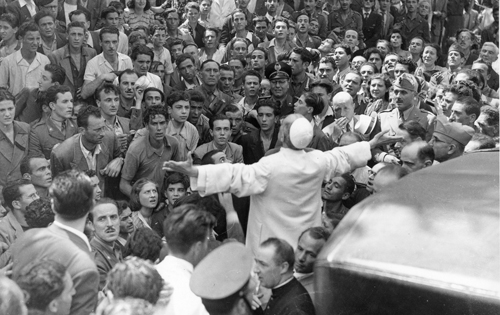 Rome, Italy, Aug 2, 2012 / 04:03 am (CNA/EWTN News).- He’s now 96-years-old, but during World War II, Cardinal Fiorenzo Angelini was a young priest in a Roman parish who first came face-to-face with Pope Pius XII in the aftermath of an Allied air raid.































