Do you have any good news to share with the readership?
And is there some good point from your Sunday sermon you can pass along?
Do you have any good news to share with the readership?
And is there some good point from your Sunday sermon you can pass along?
I had a very pleasant Sunday.
First, a quiz. Who can say what that object is. Yes, we know that the statue is St. Philomena.

After the Sunday Masses, I went with His Hermeneuticalness to Chislehurst to meet our friend Fr. Brigg’s the parish priest. In the cemetery of his parish is the grace of the late and great Michael Davies, of happy memory.

We went to a nearby golf course for lunch, a fine carvery. The house belonged to Napoleon III.

One side of the table!

There is a copy of Napoleon’s death certificate on display.

Fr. Briggs before the nice facade. There are perks to being the parish priest.

A nice day.
 As I wind down a day, I am listening to a reading of Patrick O’Brian’s Clarissa Oakes, known in the USA as The Truelove.
Martin, an Anglican minister but sailing in HMS Surprise as surgeon’s assistant, not being a great preacher, is reading a sermon on a Sunday when the ship is rigged for church. Stephen, a papist, who has said the Rosary elsewhere, overhears him:
[…] he heard Martin’s voice: ‘Let no man say, I could not miss a fortune, for I have studied all my youth. How many men have studied more nights than he hath done hours, and studied themselves blind and mad in the mathematics, and yet wither in beggary in a corner? Let him never add, But I studied in a useful and gainful profession.
How many have done so too, and yet never compassed the favour of a judge? And how many that have had all that, have struck upon a rock, even at full sea, and perished there?’ And then some time later: ‘What a dim vespers of a glorious festival, what a poor half-holiday, is Methusalem’s nine hundred years to eternity! What a poor account hath that man that says, This land hath been in my name, and in my ancestors’ from the conquest! What a yesterday is that? Not six hundred years. If I could believe the transmigration of souls and think that my soul had been successively in some creature or other since the Creation, what a yesterday is that? Not six thousand years. What a yesterday for the past, what a tomorrow for the future is any term that can be comprehended in cipher or counters?’
 From a reader:
It is my understanding that those ordained to the priesthood are bound by canon law to pray the main hours of the Divine Office daily. I think by main hours, it is Matins, Lauds, Sext?, Vespers & Compline. However, how come there is no such stipulation for the celebration of Mass? Is there a reasonable answer for this???
I suspect the reasons for this are practical. At one point there was a strict rule against saying Mass alone. While it is ideal to have another person present this is not longer a hard and fast rule. Today, priests can say Mass without any human presence for a good reason, and a good reason can be simply that he wants to say Mass. Also, ideally priests should not say Mass in the state of mortal sin. It is not always easy or possible for a priest in some areas to find a confessor. In old manuals of moral theology authors suggested that a priest can say Mass but should seek a confessor within three days. This is a great deal easier in the age of automobiles, of course.
Moreover, I believe the old Code of Canon Law for the Latin Church obliged priests to say Mass a minimum of several times a year, not daily. Furthermore, in the new Code, as in the old, pastors with the care of souls in a parish were obliged either personally or by a proxy to make sure that on all Sundays and days of precept Mass was offered “pro populo”, for the intention of the people under his charge. There is also the case of the priest taking on the obligation of saying 30 Masses for a single intention for a deceased person on 30 consecutive days. He must say these Masses on these days without interruption.
Of course if a priest does not say Mass on a Sunday or day of precept, he is nevertheless obliged like every other Catholic under the obligation to hear Mass in order to fulfill the obligation.
The Office, on the other hand, is something that does not require the presence of another or that the priest be in the state of grace.
There is a strong moral obligation based on the priest’s state in life to say Mass daily, for the benefit of the living and the dead. However, there was and is no juridical obligation.
From CNA:
Pope believes secularized nations can become Christian again
Vatican City, Oct 15, 2011 / 03:24 pm (CNA/EWTN News).- Today Pope Benedict XVI told over 8,000 Catholics involved in the “new evangelization” that he has every confidence they can return their respective nations to Jesus Christ. [Hmmm… I think I am involved in the “New Evangelization” in someway. Many bloggers are. Lot’s of notice about this event in advance, wasn’t there?]
“Seeing all of you and knowing the hard work that everyone of you places at the service of the mission, I am convinced that the new evangelists will multiply more and more to create the true transformation which the world of today needs,” the Pope said Oct. 15. in the Vatican’s Paul VI Audience Hall.
The Pope was addressing a conference entitled “New Evangelizers for the New Evangelization – The Word of God grows and spreads,” organized by the Pontifical Council for Promoting the New Evangelization. [Ah yes, the office that didn’t have a computer when it was opened.]
Noting that the title of the conference was drawn from a phrase often used in the Acts of the Apostles, the biblical account of the early Catholic Church, the Pope suggested that modern society still yearns for God, just as it did 2,000 years ago.
“Modern man is often confused and cannot find answers to the many questions which trouble his mind in reference to the meaning of life,” said the Pope. [But Holy Father! But Holy Father! Where O Where could they find some of those answers? Where could they find others across the globe and engage them in solidarity while seeking those answers?]
And yet, he observed, man “cannot avoid these questions which touch on the very meaning of self and of reality.” Consequently, modern man often despairs and simply withdraws from “the search for the essential meaning of life,” settling instead for “things which give him fleeting happiness, a moment’s satisfaction, but which soon leave him unhappy and unsatisfied.”
It was with such people in mind, that Pope Benedict said he created the Pontifical Council for Promoting the New Evangelization last year. The council is charged with spearheading the re-evangelization of traditionally Christian countries that have been particularly affected by secularization in recent decades.
As he spoke to the thousands of evangelists from around the world, the Pope gave them three reasons for hope in their mission.
He first reminded them that “the power of the Word does not depend primarily on our action” but on God. Secondly, he said that even in the modern world “there continues to be the good soil” into which the word of God will fall and produce “good fruit.” And lastly, he counseled the missionaries that despite “indifference, misunderstanding,” and “persecution,” there are still many people willing to “courageously open their hearts and minds to accept the invitation of Christ,” and become missionaries themselves. [Do I hear an “Amen!”?]
Those gathered in the audience hall heard testimony from those involved in various new movements, schools of catechesis and evangelizing projects.
“I felt it very important to be here today as a witness for our young people working in the new evangelization,” said 29-year-old Patrick Muldoon from Dublin, Ireland. He was at the Vatican gathering with 19 others from the Emmanuel School of Mission, a Rome-based project that prepares young people to be Catholic missionaries.
“We’ve all left jobs and studies to come to Rome for one year to spend that year for God and we really feel that in our own lives we can be great witnesses to other young people,” said Patrick.
Standing next to him was 22-year-old Haydi Koussa from Cairo, Egypt. She felt the meeting was “a great opportunity to learn new ways of carrying out evangelization, particularly in my home country.”
“The new evangelization is there,” Archbishop Bernard Longley of Birmingham, England remarked to CNA. He is also a member of the Pontifical Council for Promoting the New Evangelization.
“It’s there in groups of young people who are already gathering together to witness to the faith with a new strength and a new courage,” the archbishop said, adding that this is particularly important “in those places where our young people can be influential – such as their places of work and study.”
Before imparting his blessing on the crowd, Pope Benedict asked them to continue to “be signs of hope, able to look to the future with the certainty that comes from the Lord Jesus, who has conquered death and gave us eternal life.” He entrusted them to the protection of the Virgin Mary, “star of the new evangelization.”
Apparently the New Evangelization hasn’t yet engaged the New Media.
Given the recent rioting in Rome, could here be a few opportunities locally to give their message a try?
From a reader:
In my parish, some of the parishioners approach the Communion Rail at what seems to be too early a time. They go up as the second Confiteor is said by the servers, and are kneeling at the rail while the Ecce: Agnus Dei! prayer is taking place. Is this too soon, or are they on to something which I am unfamiliar with?
Maybe they just really love Jesus and can hardly wait to receive Him. Maybe they usually go to a TLM where the rubrics of the 1962MR are actually observed and the Second Confiteor is not recited. Maybe they are choristers. Maybe they just like to be first.
Friend, I wouldn’t worry about this.
Yes, it might be a little early as far as standard practice is in some places. I have seen this happen as well. Often people who are a little motion impaired will get a head start.
I don’t think we have to be too regimented about the Communion rail.
Via CMR comes this truly scandalous piece.
On the House floor today Nancy Pelosi sank to a new low in criticizing pro-life Congressmen behind the Protect Life Act, which simply ensures that no funds from Obamacare may be used to pay for abortion or abortion coverage and also reinstates conscience protections for pro-life medical workers. Check out her despicable verbiage.
How disgusting is that? But that’s not even the worst part. Think about this. Pelosi is fighting to keep abortion funding in Obamacare after months of insisting that “there is no public funding of abortion.”
Horrible. Pray for her and that a bishop will act to correct the scandal.
[wp_youtube]pcfZfsR4gRY[/wp_youtube]
And this shocking piece of mendacious argumentation …
[wp_youtube]NtcLlwldLGg[/wp_youtube]
 From a reader:
Is it required that a communicant say “Amen” in order to receive Holy Communion at the Novus Ordo?
I ask because we normally attend the Extraordinary Form, but last weekend we were traveling and attended the Novus Ordo. My 10-year-old went up the Communion and put out his tongue. The priest stopped, told him to say “Amen”, but my son did not hear/understand, and thought the priest was telling him to put out his hands to receive. This went back and forth a bit and my son finally realized what he was being told, in line, and said “Amen.” He was a little embarrassed, as the line was held up as he was being publicly corrected.
Obviously “Amen” is not said in the EF, and my son was not used to it. Should the priest have done this?
Hmmm. “Should the priest have done this?”
That’s one way to frame this. I’ll track back to that.
Let’s first look at the rubric in the new, corrected English translation of the Missale Romanum:
134. After this, he takes the paten or ciborium and approaches the communicants. The Priest raises a host slightly and shows it to each of the communicants, saying:
The Body of Christ.
The communicant replies:
Amen.
And receives Holy Communion.
Say the black and do the red, right?
Yes, the proper thing to do is to say “Amen” and then receive. And yes, that is not how we do it in the Extraordinary Form. Parents who take their kids to the Extraordinary Form exclusively might want to run through this with kids in case they do go to the Ordinary Form sometimes.
I think it is good to do this according to the book. One reason is that, if you don’t say anything during the Ordinary Form, you might give the priest (or … who knows who) the impression that you don’t know what to do because you aren’t a Catholic. In that case, the minister of Communion might hesitate to give you Communion.
Also, “Amen” is an entirely appropriate response, since it expresses belief in and consent to what has been said: “Corpus Christi“.
Should the priest have done what he did in that moment?
I can’t say for sure, but it seems to me that he had some justification. I am supposing that virtually all the people presenting themselves in his Communion line are Catholics who attend exclusively the Ordinary Form and, therefore, they know to say “Amen”…. unless they are not Catholic, as happens during weddings, funerals, etc. It strikes me that the priest was making sure the communicant in front of him was a Catholic who could receive.
So, should the priest have done what he did?
Let’s think about this.
10-year-olds who have only been to the Extraordinary Form shouldn’t be expected to be psychic or have infused knowledge about what to do at the Ordinary Form any more than 10-year-olds who have never been to the Extraordinary Form should know when brought for the first time. And the priest doesn’t usually have psychic powers about 10-year-olds who only go to the Extraordinary Form. Perhaps writing on their foreheads would give him clue.
Parents must see to it that their children know how to receive the sacraments to which they are admitted. This includes both sides of the Roman Rite.
It also includes knowing a regular formula for how to make a good confession.
Parents should make sure that their children know what to do so that they are not uncertain or overly nervous or put off so that they next time they might not want to do it.
I picked this up from the intrepid Andrea Tornielli.
Apparently from tomorrow onward, Sunday, Pope Benedict will start using the moving platform used by John Paul II when it became hard for him to walk. He will do this in the Vatican Basilica tomorrow for a Mass he will celebrate.
The papal spokesman, Fr. Federico Lombardi, SJ, says: «Non c’è nessuna malattia o indicazione di tipo medico … There is no malady or suggestion of medical nature.» Thus, we are not supposed to read too much into this. Lombardi said that this is just to alleviate some of the fatigue the octogenarian pope feels when walking long distances, particularly in heavy vestments.
What immediately occurred to me is that it might also give him a little more protection in the case of an aggressor. Sure enough, Lombardi mentioned that as well.
If they want to alleviate fatigue, make the Holy Father more visible to people and keep people from jumping out at him as has happened a couple times already, I have a similar idea.

Remember the POLL we had in 2009? The plugin for that poll is long gone, though comments remain. Let’s have another WDTPRS POLL!
Chose your best answer and then leave a comment in the combox, below, about this new development for Pope Benedict, Popes in the past, and/or the Sedia Gestatoria.
UPDATE:
From the Holy Father’s Mass this morning:

Not exactly the Sedia Gestatoria. Since the Holy Father is not very tall, this will help him to be more visible.
There are massive and now violent protests going on in Rome at the moment. A journalist friend there says 6 police officers have been injured. Two massive groups, “gli indignati” including high school aged kids, and the “black bloc”, many wearing helmets, are aligned against each other, perhaps 500k at the piazza in front of St. John Lateran. The “indignants” are/were fairly benign, as I understand it, and were peacefully protesting big business, banks, government, blah blah blah. The “black bloc” are essentially leftist-anarchists out to pick fights and hurt people. Think Genova in 1998. Some cars have been burned. Police have vans with water cannons. Tear gas is being used. A supermarket was sacked. La Repubblica has videos. Apparently, some of the protesters marched up the via Cavour wearing Guy Fawks masks, as in “V”. I’ve been watching some of the live video. Pretty nasty.
This is effectively urban warfare with a group of anarchists who infiltrated another protest. Again we see idiots wearing hoodies.
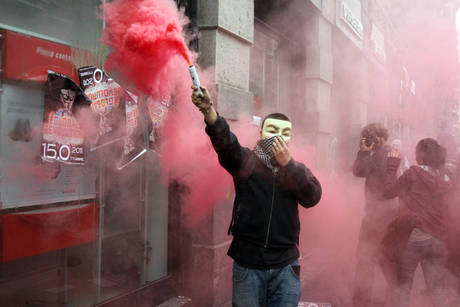
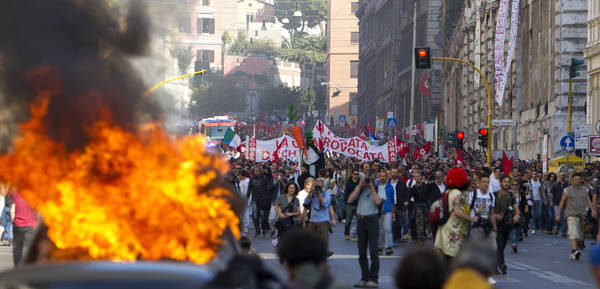
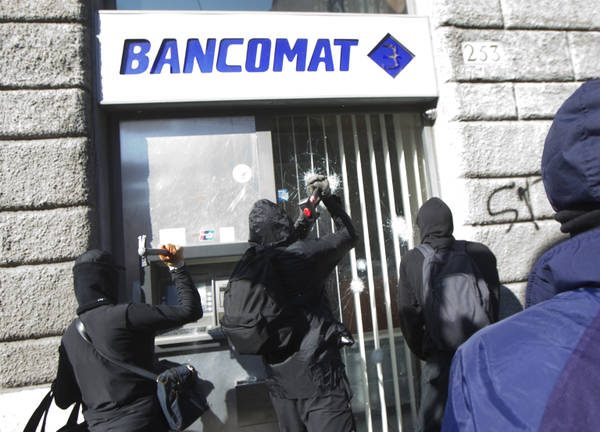
Remember. This sort of thing is coming to a neighborhood near you.
UPDATE:
Things have gotten worse.
Apparently the Basilica was opened up to some of the peaceful protesters who were getting caught in the middle. Meanwhile, a police van burned and the idiots threw cobblestones. Some offices were ransacked. Police have barricades around the area to force the violent idiots into a smaller space. Dumpsters are burning
It seems, however, that some of the idiots got into St. John Lateran. On the V. Labicana protesters destroyed a devotional statue of Mary.
Another protest by unemployed factory workers is set for tomorrow. Oh joy.

UPDATE:
Right next to my Alma Mater and the Basilica of St. John Lateran. VIDEO HERE. And HERE.
Meanwhile, here in London, thousands rallied in the City and Julian Asange whipped them up.
In the meantime, Pope Benedict XVI today spoke to a group called “Fondazione Centesimus Annus – Pro Pontifice” saying, among other things: “We need a new synthesis of family and of work.” I don’t have time to translate the speech at the moment, but he spoke of the need to build societies bonds in the family and not just depend on the state to do everything.
As I consider the riots in London, and now this violence in Rome, it occurs to me that the more the family and the meaning of true marriage is undermined by agendas contrary to nature, the more God and Holy Church is shoved out of the public square, and religious liberty threatened, the more we will see this sort of urban warfare breaking out. Perhaps it is good that winter is coming in the northern hemisphere.


Coat of Arms by D Burkart
 emmatag1126 on Thoughts about the collision of the Holy See and the SSPX. Wherein Fr. Z rants.: “Also, the Declaration said that we can be saved only through the Roman Catholic Church, which unfortunately leaves out my…” on Thoughts about the collision of the Holy See and the SSPX. Wherein Fr. Z rants.: “I just wanted to say how much I appreciate your charity and well-worded wishes/prayers for hearts to change. Whenever I’m…”
 on ROME 26/5– Day 52: lace imitates God’s beauty enlaced in flowers: “Fr. Z: It wasn’t until I started reading your writings a few years back that I realized how important vestments…” on ROME 26/5– Day 52: lace imitates God’s beauty enlaced in flowers: “Speaking of age, I think I am lucky not to be in my teens or even early twenties right now.…”
 on ROME 26/5– Day 52: lace imitates God’s beauty enlaced in flowers: “The “seriously cool APP” Father Z is referring to is the Ava Maria Clock which if you have not downloaded…”
 on ROME 26/5– Day 53: Persevere!: “Black to move and mate in 4 1) … Qd1+ 2) RxQd1 (or Kh2) RxRd1+ 3) Kh2 (forced) Be5+ 4)…”
 on ROME 26/5– Day 52: lace imitates God’s beauty enlaced in flowers: “@Charivari Rob: How about calling it the Old Chestnut Award? It will probably only be slightly less feared than the…”
A Daily Prayer for Priests










They find you a pro-life agent in your area who commits to giving a portion of the fee to a pro-life group!

PLEASE subscribe via PayPal if it is useful. Zelle and Wise are better, but PayPal is convenient.
A monthly subscription donation means I have steady income I can plan on. I put you my list of benefactors for whom I pray and for whom I often say Holy Mass.
In view of the rapidly changing challenges I now face, I would like to add more $10/month subscribers. Will you please help?
For a one time donation...



Help Monks in Wyoming (coffee – UPDATED LINK) and Norcia (beer) and the wonderful "Soap Sisters" of Summit, NJ!


Please follow me on Twitter!










Visits tracked by Statcounter
since Sat., 25 Nov. 2006: