9 August: Fr. Z in Cleveland, blognic

On 8 August I fly to Cleveland where I will be for a few days.

We have said that there will be a blognic on Saturday morning 9 August.

The plans must be firmed up now, I think.

Let’s meet on Saturday 9 August, let’s say at 10:30–noon, at The Phoenix Coffee Co. at Mayfied and S. Green Road, in S Euclid.

This is very informal.  You buy your own coffee, or whatever, and come and go as you wish, with no pressure. 


Posted in SESSIUNCULA, What Fr. Z is up to |
Comments Off on 9 August: Fr. Z in Cleveland, blognic

Remember the Perseids! (The Tears of St. Lawrence)

You might want to put on your calendar the Perseid Meteor Shower.  Here is a note from SpaceWeather.

The Perseid Shower is called the "Tears of St. Lawrence" because it peaks around the time of the Feast of St. Lawerence.

Yet another reason not to tinker with the calendar and feast days … but I digress.

Space Weather News for August 5, 2008

http://spaceweather.com


COUNTDOWN TO THE PERSEIDS: The annual Perseid meteor shower peaks one week from today, on Tuesday, August 12th. [I will be in Cleveland.] The best time to look is during the dark hours before dawn on Tuesday morning when forecasters expect 50 to 100 meteors per hour.  Get away from city lights if you can; plan a camping trip!  The darker the sky, the more meteors you will see.


The source of the Perseids is Comet Swift-Tuttle, which has littered the August portion of Earth’s orbit with space dust.  The dusty zone is broad and Earth is already in its outskirts.  As a result, even before the peak on August 12th, you may see some "early Perseids" streaking across the night sky. Photos of these early arrivals will be featured in the days ahead on http://Spaceweather.com as part of our full coverage of the Perseid meteor shower.


BONUS:  Last Friday’s total solar eclipse is history, but new pictures continue to appear in our photo gallery.  Start browsing here.

Posted in SESSIUNCULA |
9 Comments

5 Aug: O.L. of the Snows – Roman tradition – photos

Our friend John Sonnen of Orbis Catholicus has some photos of the moment when, to commemorate the ancient miracle of the August snowfall in Rome, panels in the ceiling of the papal Basilica of St. Mary Major are opened and white rose petals are let fall.

Here is his entry.  Be sure to go over their and spike his stats!

Tuesday, August 05, 2008

The liturgical life in Rome is rich with custom and tradition (unlike everywhere else after the sixties). One of the most special days to be in Rome is August 5th. This is the day in which is celebrated the liturgical feast of the "Madonna of the Snow."
And so today the Romans flocked back into the city from the beaches of Ostia for the morning to see the "snow" of the white jasmine and rose petals showering atop the confessio of the Patriarchal Basilica of Saint Mary Major during the choral singing of the Gloria. "Long live Catholic traditions in the face of the devil!" was all I could think of as I stood in awe amid the enchanted faithful in the face of the falling blessed flowers.

It was during the night of the nonae of August, between the fourth and fifth of August in the year 358 when the Virgin Mary appeared both to Giovanni Patricio and Pope Liberius, asking that a basilica be dedicated to her on a site in Rome where, that night, it would snow. The next morning the wealthy senator and the pope went to the Cispian, where that very night a heavy snow had fallen. Here, Pope Liberius watched by a giant crowd, traced the outline of the future church in the heavy snow and thus the basilica and another beautiful addition to our Catholic story.
 
5 Aug: O.L. of the Snows - Roman tradition - photos 

5 Aug: O.L. of the Snows - Roman tradition - photos 

5 Aug: O.L. of the Snows - Roman tradition - photos 

5 Aug: O.L. of the Snows - Roman tradition - photos 

Posted in SESSIUNCULA |
10 Comments

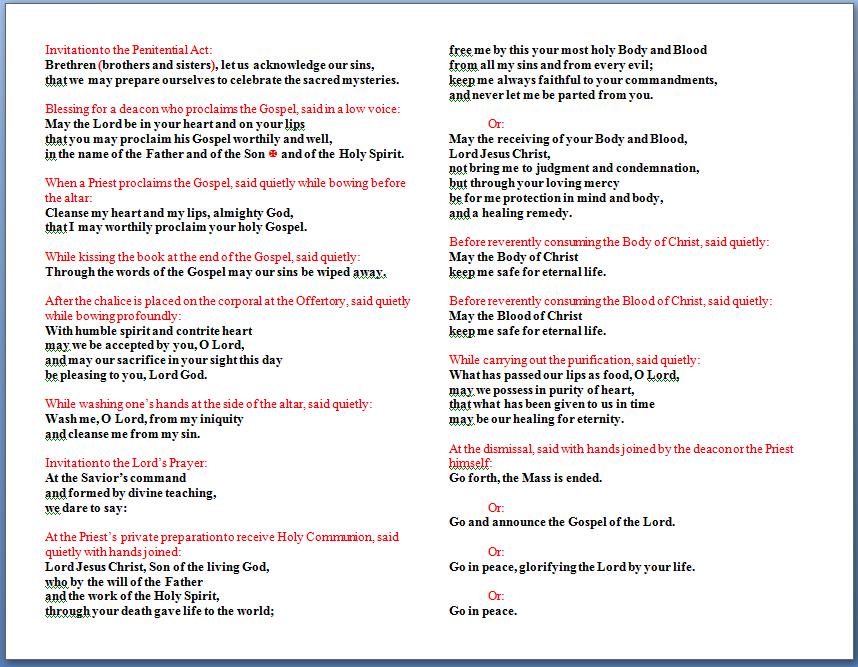
A helpful “cheat sheet” for priests for Mass translation changes

Priests who celebrate the Novus Ordo in English might be interested in this.

Here is a "cheat sheet" put together by a priest who sent it to me to share with priests.

This sheet puts in a convenient format some of the alterations of texts, according to the new translation of the Ordo Missae, the priest is to say during Holy Mass.

Using a sheet like this could be a handy way of getting familiar before hand with the new texts.

You can get the document here.

A helpful "cheat sheet" for priests for Mass translation changes 

Posted in SESSIUNCULA |
21 Comments

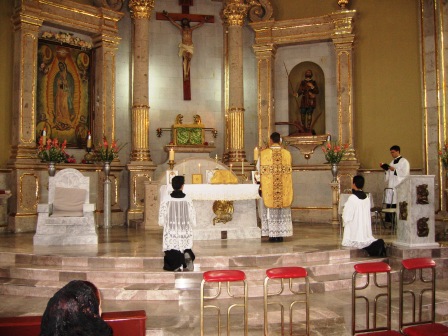
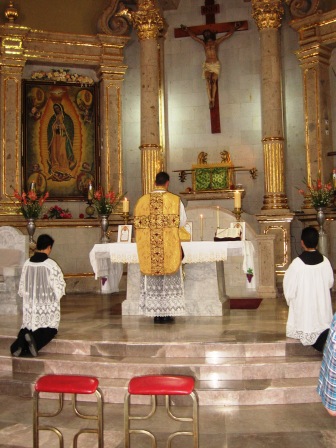
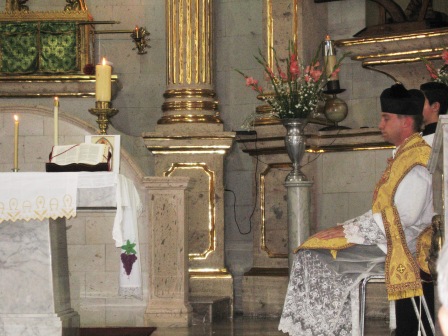
TLM in Guadalajara, Mexico

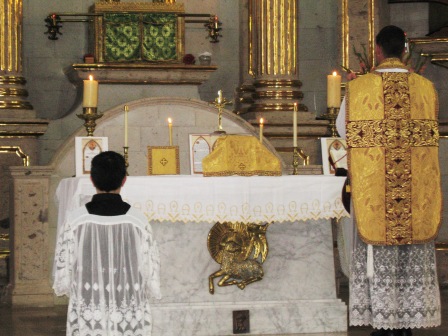
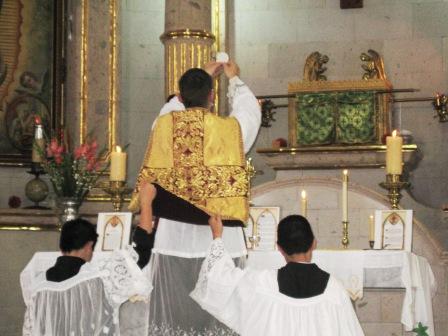
I posted the news reported by Una Voce in Mexico, about the expansion of the TLM in Guadalajara and Mexico City.

I received some photos of a TLM celebrated in Guadalajara by a priest of the FSSP in San Isidro Labrador:

TLM in Guadalajara, Mexico

TLM in Guadalajara, Mexico


TLM in Guadalajara, Mexico 


TLM in Guadalajara, Mexico 


TLM in Guadalajara, Mexico

Posted in SESSIUNCULA |
21 Comments

Bp. of Raleigh (NC) issues diocesan norms for liturgy

I received this from a reader in Raleigh, North Carolina.

You might remember that the bishop there, His Excellency Most Rev. Michael F. Burbidge, Bishop of Raleigh, issued a very good response to Pope Benedict’s letter Summorum Pontificum.

Now Bp. Burbidge has issued diocesan norms for liturgy for the Novus Ordo.

The whole document, which you can find here, is too long to post in its entirety here.

However, a kind reader highlighted some of the salient points.

I think you’ll like them.

I received this through e-mail:

Fr. Z,

Our wonderful Bishop issued a document yesterday on General Norms for the Celebration of the Sacred Liturgy of the Mass in the Forma Ordinaria.  [read = Novus Ordo]

In it he addresses such items as:

pg.2 #6  Sacred silence prior to the beginning of a Sacred Liturgy

pg.2 #9  Faithful are encouraged to dress appropriately

pg.3 #13  Explains difference between lector and reader

pg.4 #18  All liturgical ministers should dress appropriately. T-shirts, shorts, tennis shoes and flip-flops are inappropriate

pg.5 Section 1.3  Sacred Texts
Liturgical Books

pg.5 #19,  No approved texts are to be altered either by the priest or by the assembly…

pg.6 Section 1.2.3,  The use of Latin and languages particular to the assembly

pg.6 #26  …it is laudable that the faithful be familiar with the acclamations and other prayers in Latin, namely the Gloria, the Sanctus, the Credo, the Pater Noster, and the Agnus Dei. Pastors are instructed to be pastorally judicious in forming the faithful in the use of these ancient sacred texts of the Mass.

(We love our Bishop!)

pg.7 Section 1.5,  Sacred Vessels
Outlines what materials the vessels can be made of.

pg.9 Section 1.7,  Liturgical Music
pg.9 #42  It is laudable that the processional hymn or introit, the acclamations, the dialogues, and the litanies of the Mass be sung…even when musical accompaniment is not possible.

pg.9 #43  …The use of simple chant is laudable given that Gregorian chant holds pride of place in the Sacred Liturgy.

(Did I mention that we love our Bishop?)

pg.9 Section 1.8  Use of Incense
pp.9-10 #46, …Incense is customarily used during celebrations of the Sacred Liturgy on Sundays…

pg.10 Section 1.9 Use of Bells
pg.10 #50, …The use of bells during the Liturgy of the Eucharist is recommended…

pg.15 Section 4.3, Communion Rite
pg.15 #79 While it may be a custom in some place to hold hands as the Our Father is prayed, this gesture is not encouraged, as the reception of Holy Communion is the sign and bond of unity of the Church at prayer.

pg.17 Section 4.3.2 Posture and Gestures for Reception of the Holy Eucharist by the Faithful in the Assembly

pg.17 #92, The normative posture for the reception of the Holy Communion in the Dioceses of the United States is standing. However, communicants are not to be denied Holy Communion because they kneel.

pg.18 Section 4.3.3,Purification of the Sacred Vessels
pg.18 #97 Sacred vessels may only be purified by a priest, deacon, or an instituted acolyte.

pg.20 Section 6 Additional Particular Norms in the Diocese of Raleigh
6.1 Place of Reservation for the Holy Eucharist pg.20 #106, …the Blessed Sacrament is reserved in the tabernacle located in or near the sanctuary of the church…

The tabernacle is not to be located behind where the assembly is seated in the nave.

pg.20 #110 Parish church buildings in the Diocese of Raleigh, whether new or existing construction, are to be adapted to reflect the norms in paragraphs 106-109. If adaptations are required, proposals are to be submitted to the Bishop for review and approval for implementation.

pg.21 Section 6.2, Sacred Images
pg.21 #111, A cross adorned with the image of the Crucified Lord is to be…located on or near the altar…

pg.21 Section 6.4, Parochial Liturgical Formation
pg.21 #114 Liturgical formation is encouraged for the faithful in parishes. Among the formation topics, the following are recommended: The significance of the Eucharist in the life of a Catholic, the Eucharist and the Paschal Mystery, the Real Presence in the Eucharist and the Mass, Reservation of the Blessed Sacrament, the right disposition of the faithful before Mass, active participation during Mass, posture during Mass, purification of sacred vessels, and sacred images and devotions in Roman Catholic worship.

Posted in SESSIUNCULA |
65 Comments

Steubenville Franciscan Univ. TLM news

This is in from Franciscan University at Steubenville:

Father Z,

I thought you would like to know that a have received unofficial word that starting this fall semester Franciscan University of Steubenville will be offering the Traditional Latin Mass every Saturday morning (low mass) and once a month on Sundays (missa cantata).  I also believe that the university’s schola will continue to offer Compline on a few Saturday evenings per semester like they did last semester (which was well attended and quite lovely).

Keep up the good work and remember all of us here in Steubenville when you offer the Holy Sacrifice.  Be assured that you are in our prayers.

Posted in SESSIUNCULA |
9 Comments

Tomorrow: 30th Anniversary of death of Paul VI

A reader sent this interesting e-mail:

Wednesday will be the 30th anniversary of Paul VI’s death.  I was about to begin my senior year in high school when he died & had been a Catholic for two years.  His passing made a deep impression on me.

This obituary appeared in Time magazine a week later.

I am sure it was written by Wilton Wynn – who after his retirement as Time’s Rome correspondent joined the Church.  I still remember the astonishment I felt at reading these lines in an atheist newsmagazine (and indeed most of the rest of the obit. is predictable 1970s boilerplate).

Yet Humanae vitae was not a stubborn, willful decision. It was the work of a pastor deeply concerned by the erosion of moral values. Throughout his life, Paul was an ascetic—a dedicated worker who pushed his frail body regularly through a schedule that lasted from 6 in the morning until midnight, with little more than his meals and a siesta to break the day. Abstinent himself, he worried much and cautioned often about society’s move away from traditional family patterns and its increasing self-indulgence. He warned that the rise of militant feminism risked "either masculinizing or depersonalizing women" and condemned "the most cunning aggression of conscience through pornography."

Paul VI was preceded & followed by two popes who were much more widely loved – indeed one might argue, more lovable.  But he was the Vicar of Christ, the father of Christendom, in difficult & turbulent times.  We might all offer a prayer for him tomorrow.

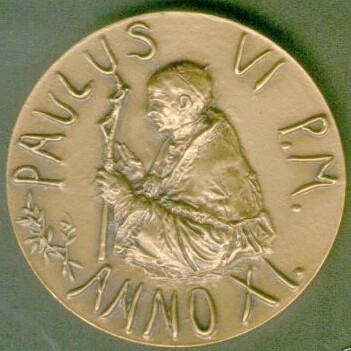
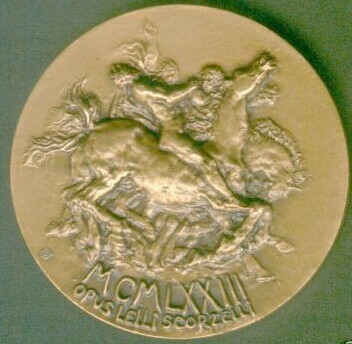
I am reminded of the fascinating medalion struck by Pope Paul in the 11th year of his pontificate, 1973.

Keep in mind that Pope Paul was rather interested in modern art.

Keep in mind also, that these medals usually show the Pope in profile on one side, and on the other some classic images associated with the Apostle Peter, such as Peter kneeling before Christ to receive the keys, or Peter in the boat with his net making the miraculous catch.

When a Pope dies, a bag with all the medals from his pontificate are placed in the tomb with him, an ancient way of identifying the body and the years he was pope.

The front of this 1973 medal depicts Pope Paul in an unclassic pose.

Tomorrow: 30th Anniversary of death of Paul VI

But it was the reverse of the medal that the truly fascinating image is found.

You can see, no doubt himself, depicted as a naked man on the back of a wildly bucking horse. 

The bas relief’s multple layers of multiple legs, tails and heads of the horse portray the thrashing movement.

The man’s arms are outstretched and you can make out that he is being supported by angels, held on the back of the horse.

Tomorrow: 30th Anniversary of death of Paul VI

Here is the article my sender, above, linked.

You might read it and then go back to the images of the medals… then say a prayer for Paul VI:

Time Magazine
Monday, Aug. 14, 1978
A Lonely Apostle Named Paul

As Pope he inherited a revolution, then wrestled with it in spiritual anguish

Vicar of Jesus Christ, Supreme Pontiff of the Universal Church, Patriarch of the West, [a title Pope Benedict has dropped] Bishop of Rome and Servant of the Servants of God—these are among the many titles that impose unique burdens on the Pope, the anointed spiritual leader of 683 million Roman Catholics, [that number has really changed!]  the world’s largest body of Christians. Few of the 261 successors to St. Peter worked at that responsibility more tirelessly than Giovanni Battista Montini, Pope Paul VI.  Sunday night, after suffering a heart attack while hearing Mass [I embrace the use of these old descriptions of "reading" and "hearing" Mass] in bed at Castel Gandolfo, Paul, 80, died, laying down the burden.

He had assumed the Papal Tiara in 1963, in the midst of the Second Vatican Council, that theater for the most profound process of change that the church had experienced in centuries. At the time, Cardinal Montini seemed just the man to steer the church through the turbulence that confronted it.  Idealistic and sensitive, a thoughtful scholar and a connoisseur of theology, he had a reputation for being open to new ideas. He was a subtle diplomat with an acute knowledge of the inner workings of the church’s machinery.

But the shy, intense new Pope labored in the shadow of his jovial, grandfatherly predecessor, Pope John XXIII. It was John’s revolution that he inherited, with John’s open, hopeful stamp of approval upon it.

In the years that followed, the movement that John called aggiornamento, or modernization, became part of a revolution larger than John had foreseen—a tumultuous moral and social upheaval around the world.

Both inside and outside the church, old values were questioned, traditional authority challenged.

Paul became a study in anguish—wanting reform but fearing the consequences of too much too fast, trying to please progressives while placating conservatives.

He said yes to more changes than any Pope since the 16th century Council of Trent: a thoroughgoing revision of liturgy, a streamlining of the Curia, an unprecedented rapprochement with other faiths.

But his no could be emphatic and crucial: no to any genuine sharing of power with his fellow bishops, no to married priests, no to the ordination of women, and no—a still-reverberating no—to artificial birth control. The late Jesuit Theologian John Courtney Murray accurately predicted the tone of Paul’s pontificate in the early years of his reign. "From a cerebral point of view," said Murray in 1965, "he is a convinced progressive. But when he starts to reflect on the duties of his office he begins to get qualms. If cracks in the ice begin to appear, he fears, who knows where they will end?"

Giovanni Battista Montini was born in 1897 in the country village of Concesio, near Brescia, in northern Italy. His father, Giorgio Montini, was a newspaper editor and an early champion of the Popular Party (a forerunner of the Christian Democrats) who served three terms in the Chamber of Deputies. Young Giambattista, second of Giorgio’s three sons, was so frail and sickly that he had to get much of his education—including some of his seminary training—at home. But he learned quickly: in 1920, not yet 23, he was ordained a priest in Brescia Cathedral. Dispatched to Rome for graduate work, he became a Minutante—document writer in the Vatican’s Secretariat of State. He also served as a Chaplain to students at the University of Rome, among whom he fought the tide of Mussolini’s Fascism, and his work with them won him the title of Monsignor in 1925.  [Or perhaps he was made Monsignor after five years of work in the Secretariat of State.]

While the young Montini studied the works of Catholic liberals, he also listened to one of the Church’s last great autocrats—his superior in the Secretariat of State, Eugenic Cardinal Pacelli. In 1939 Pacelli became Pope Pius XII. Monsignor Montini, as a Substitute Secretary of State, was soon embroiled in the delicate Vatican maneuvering between the enemy forces of World War II. It was Montini, evidence suggests, who coined the famous phrase that Pope Pius uttered on the eve of that conflict: "Nothing is lost by peace; everything may be lost by war."

After the war the relationship between the two men became strained. Pius again promoted Montini in 1952, making him a Pro-Secretary of State,* but the Pope and his protege were drifting apart politically. Pius was so hostile to Communism that he sometimes trembled when he spoke of it; Montini, on the other hand, was sensitive to the social and economic distress of postwar Italy and elsewhere, and more understanding of those who were driven to radical solutions. When Pius named Montini Archbishop of Milan in 1954 but failed to give him the Cardinal’s red hat that normally went with the see, some Vatican insiders viewed the promotion as an exile.

The new archbishop nevertheless moved into Italy’s economic capital with the eagerness of a new priest assigned to his first parish. To combat the influence of the Communists, he said Mass in factories, mines, jails and workers’ homes. He commissioned priests to conduct street-corner crusades.

He built scores of new churches in the working-class suburbs that ring the city. Pope John XXIII named Montini a Cardinal in 1958, and Montini reportedly had a hand in John’s keynote address at the opening of the Second Vatican Council, which encouraged the church "ever to look to the present, to new conditions and new forms of life."

Pope John had written in his diary that he wanted Montini to be his successor. When John died in 1963, the College of Cardinals agreed. They elected him on the fifth ballot. The day after his election, Paul announced on television that the Vatican Council would continue, and he guided it through three more sessions. His interventions were rare but usually decisive. During the fourth session, in 1965, when the critical document on religious liberty seemed threatened by a filibuster of Conservative Prelates, Paul forced a vote. The declaration passed overwhelmingly, 1,997 to 224, affirming to the world that the Catholic Church respected the rights of conscience of other believers.  [The document on religious liberty is one of the most highly and harshly debated documents of the Council.]

By then Paul had already begun to translate that principle into action. In January 1964 he journeyed to Jerusalem to meet and embrace Ecumenical Patriarch Athenagoras I,on the Holy City’s Mount of Olives. The next year the spiritual leaders of Roman Catholicism and Eastern Orthodoxy withdrew the mutual anathemas that their predecessors had hurled at each other a full millennium before. Later Paul established an international commission of Roman Catholic theologians to discuss differences of creed with Anglican colleagues, and approved a similar commission with Lutherans in the U.S.  [And now Pope Benedict, working on that foundation, and in his project to strengthen Catholic identity, is sending strong signals to the Anglicans that they are turning into something like Methodists, and he is drawing the Orthodox closer and closer.]

Both groups achieved a remarkable consensus on such issues as the nature of the ministry and the presence of Jesus Christ in the Eucharist—key doctrines that divided Christianity in Reformation days. The two Protestant groups went so far as to concede a rationale for some kind of limited papacy.  [And we have seen, for them, what it has meant to lack the Petrine ministry.]

Paul could act with surprising calm in sweeping away the disciplines of centuries. In 1966 he decreed an end to the traditional obligation of abstaining from meat on Fridays. [He didn’t do that, exactly.  There is still an obligation to do penance on Friday, but it is now far more vauge.  What he did was a great mistake, IMO.] He abolished the notorious Index of Forbidden Books, which had once included the works of John Locke, Victor Hugo and Voltaire. In theological controversy, excommunication and charges of heresy gave way to milder methods. Even Swiss Theologian Hans Küng’s celebrated critique of papal infallibility was handled gently: Küng was simply warned not to teach such opinions in the future, but did not have to recant them.  [And he is still shooting off his sef-appionted infallible mouth.]

Despite Paul’s reforms, he saw the church being weakened by the dramatic departure of thousands of priests from the ministry; he called the exodus his "crown of thorns." Many of the priests left in order to marry, but Paul firmly resisted the suggestion that the centuries-old tradition of priestly celibacy be made optional. He extolled the celibate life as "the precious divine gift of perfect continence." Still, he left the door open for a successor to move further. He permitted the ordination of married deacons, who could exercise many ministerial functions, and he conceded the possibility of ordaining married men in mission countries.

Sometimes Paul raised expectations, or at least allowed them to grow, then disappointed those who hoped for change
. In the spirit of Vatican II’s declaration on collegiality (the sharing of authority), Paul established a synod of bishops that would meet regularly to advise him. Five times during his reign, churchmen from round the world convened in Rome to discuss such issues as clerical celibacy and evangelism. But the Pope controlled the agenda (he vetoed a discussion of the family in 1974, presumably because it would raise such questions as birth control and divorce), and he insisted on having the final say on the language of any published synod documents.

To some, his reform of the rusty machinery of the Curia was similarly disappointing. He internationalized the once overwhelmingly Italian bureaucracy, but only very gradually was real power transferred from Italian hands. The internationalization of the College of Cardinals was far more dramatic. The conclave that elected Paul in 1963 numbered 29 Italians out of the 80 Cardinals present. After his last consistory in 1977, there were only 36 Italians out of 137 Cardinals.

Paul’s internationalization of church leadership was at least partly a result of his own travels. From the start, he took his chosen name seriously and became, like his evangelical namesake, "an apostle on the move." He was the first Pope in modern times to leave Europe, traveling more than 70,000 miles outside Italy and visiting every continent but Antarctica. In 1965 he flew to the U.S. to address the U.N. and to plead, in a memorably hoarse and earnest voice, "Never again war. War never again."  [Think of how these items prefigured John Paul II.]

Paul was at his best on these trips, smiling often and enjoying particularly the unconventional displays of piety [Does that not sound like the way the press today talk about Pope Benedict?] that greeted him in the Third World. In Western Samoa in 1970, he stood before an outdoor altar in the blazing sun while eight sarong-draped men came forward, bearing on their shoulders an immense 400-Ib. pig, a traditional Samoan gift. In Uganda he was delighted by a platoon of blue-haltered, red-skirted dancing girls who met the papal jet in Kampala. More somberly, especially in his Third World visits, Paul made a point of seeking out the poorest neighborhoods.

In India in 1964, he wept at the poverty he saw.

Throughout his pontificate a procession of world leaders visited the Vatican, including some key figures from Communist countries: Yugoslavia’s President Josip Broz Tito, Rumania’s President Nicolai Ceaucescu, Soviet President Nikolai Podgorny and Soviet Foreign Minister Andrei Gromyko. Of all the Pope’s many diplomatic initiatives, including a long and fruitless attempt to mediate peace in VietNam and similarly frustrating efforts in Biafra, Northern Ireland and the Middle East, his Ostpolitik was the most successful. [i wonder.] His overtures to the Communist world helped to win the church such concessions as limited freedom to teach, nominations of new bishops and permission for public festivals. They also settled such ancient controversies as the 18-year isolation of Hungary’s Cardinal Mindszenty at the U.S. Legation in Budapest.

To political conservatives in the church, Paul was all too sympathetic to socialism. In Populorum progressio (On the Development of Peoples), the strongest and most moving of his seven encyclicals, he wrote in 1967 that the ownership of property "does not constitute for anyone an absolute and unconditional right. No one is justified in keeping for his exclusive use what he does not need when others lack necessities." The document warned prophetically that rich nations must share their wealth with poor ones or risk "the judgment of God and wrath of the poor."

Paul wrote voluminously; each year his speeches, apostolic exhortations and decrees filled more than 1,000 printed pages. But he issued only one more encyclical after Populorum progressio. It was Humanae vitae (On Human Life) in the summer of 1968, and it aroused widespread criticism for its total rejection of artificial birth control. Paul agonized over the document, but he chose to ignore the advice of a special papal birth control commission that had advised him to accept certain methods of contraception.

In forbidding artificial contraception for Catholics, Paul cited natural law, but a more important reason lay in the consequences he foresaw: "a wide and easy road…toward conjugal infidelity and a general lowering of morality." Millions of Catholics, unwilling to accept Paul’s reasoning, disobeyed the encyclical.  [And, 30 years after this article was written, we can see the results.]

Yet Humanae vitae was not a stubborn, willful decision. It was the work of a pastor deeply concerned by the erosion of moral values. Throughout his life, Paul was an ascetic—a dedicated worker who pushed his frail body regularly through a schedule that lasted from 6 in the morning until midnight, with little more than his meals and a siesta to break the day. Abstinent himself, he worried much and cautioned often about society’s move away from traditional family patterns and its increasing self-indulgence. He warned that the rise of militant feminism risked "either masculinizing or depersonalizing women" and condemned "the most cunning aggression of conscience through pornography."

His caveats belied Paul’s deep compassion for individuals. He could not, like Pope John, simply give mankind an indiscriminate embrace, but he could be surprisingly open in small audiences, as in a 1971 encounter with some rock musicians. "We are aware of the values you seek," he told them. "Spontaneity, sincerity, liberation from certain formal and conventional restrictions, the need to be yourselves and to interpret the demands of your time."

If Paul had expressed such views more often, his reign might have been less anguished. [Hmmm… probably not.] His exhortations might have seemed less imperious, and some measure of reciprocal understanding might have reached him, rekindling the hope and the courage that seemed to die in him as his pontificate wore on.  The papacy weighs on its bearer like a cross of centuries, and Paul VI had to carry his alone. –

*Ever the diplomat, Pius acted as his own Secretary of State after 1944, but two pro-secretaries—Montini and the late Domenico Cardinal Tardini—directed the day-by-day work.

Posted in SESSIUNCULA |
35 Comments

Caption

Caption

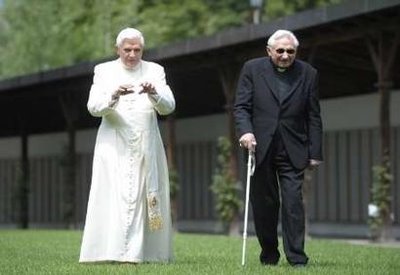
Not to be outdone by his brother’s Ray Charles stylin,

Pope Benedict practices his new Air Piano moves.

Posted in SESSIUNCULA |
Comments Off on Caption

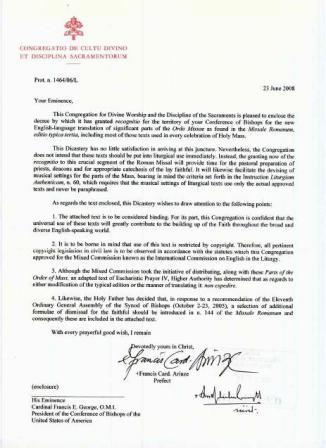
Card. Arinze’s letter to Card. George with approval of the Ordo Missae translation

Card. Arinze's letter to Card. George with approval of the Ordo Missae translationAs you know, the Holy See granted approval (recognitio) to the translation of significant parts of the 2002 Missale Romanum‘s Ordo Missae, the parts that remain the same nearly every day.

Here is the letter from the Prefect of the CDWDS, His Eminence Francis Card. Arinze, to the President of the US Conference, His Eminence Francis Card. George.  You might say the letter is very "frank".

So, we have taken a big step in the right direction.

Here is my transcription of the text with my emphases and comments:

Prot. n. 1464/06/L

23 June 2008

Your Eminence,

The Congregation for Divine Worship and the Discipline of the Sacraments is pleased to enclose the decree by which it has granted recognitio for the territory of your Conference of Bishops for the new English-language translation of significant parts of the Ordo Missae as found in the Missale Romanum, editio typica tertia, including most of those texts used in the every celebration of Holy Mass.  [As we will see later on, there are still some things to be done.]

The Dicastery has no little satisfaction in arriving at this juncture.  [Considering how long they had to wait to get the texts from the Conference…] Nevertheless, the Congregation does not intend that these texts should be put into liturgical use immediately.   [In other words: THEY CANNOT BE USED until WE say they can be used!] Instead, the granting now of the recognitio to this crucial segment of the Roman Missal will provide time for the pastoral preparation of priests, deacons and for appropriate catechesis of the lay faithful. [Notice the difference: preparation and catechesis.  I wonder if that shouldn’t be the other way around, in a sense.]  It will likewise facilitate the divising of musical settings for the parts of the Mass, bearing in mind the criteria set forth in the Instruction Liturgiam authenticam, n. 60, which requires that the musical settings of liturgical texts use only the actual approved texts and never be paraphrased.  [Write new music settings, but the words better adhere to what we have sent.]

As regards the text enclosed, this Dicastery wishes to draw attention to the following points:

1. The attached text is to be considered binding. [Roma locuta est.  You cannot now push for changes.  It’s over.] For its part, this Congregation is confident that the universal use of these texts will greatly contribute to the building up of the Faith throughout the broad and diverse English-speaking world.  [This sentence is an answer to an implict objection, one raised explicitly for a long time before this recognitio came.]

2. It is to be borne in mind that use of this text is restricted by copyright.  Therefore, all pertinent copyright legislation in civil law is to be observed in accordance with the statutes which this Congregation approved for the Mixed Commission known as the [ICEL] International Commission on English in the Liturgy.  [Pretty hard to grasp this.  I have a hard time understanding how the texts of Mass or of Sacred Scripture (Lectionary) can be copyrighted.  Rather, why would they want to?  I suspect it has to do with money.  The production of liturgical books is a source of income for a Conference now gutted by cuts in giving by lay people – for obvious reasons.  Also, the copyright can insure that the texts are reproduced properly, accurately.  Once upon a time there was a license from the Holy See and, way back, an excommunication for those who made illicit changes to texts, again for obvious reasons.]

3. Although the Mixed Commission [ICEL] took the initiative of distributing, along with these Parts of the Order of Mass, an adapted text of Eucharistic Prayer IV, Higher Authority [!] has determined that as regards to either modification of the typical edition of the manner of translating it: non expedire.  [What does this mean?  Briefly, "no".  Latin expedio means a whole raft of things, but eventually in the phrase res expedit, or impersonally expedit, constructed with the dative (e.g., alicui – literally "it helps out, furthers, promotes) it thus means "it is serviceable, profitable, advantageous, useful, expedient".    Note also the word "although".  You know there is a "no" on the way.  So, read this as "It’s not useful to adapt texts of EP IV."  What isn’t clear is precisely who the "Higher Authority" is here.  It is either the Congregation itself or the Holy Father himself: those are the only two options.  But this will be clearer in a moment.]<

4. Likewise, the Holy Father ["Likewise" and "the Holy Father", following the above "Higher Authority" means that the "Higher Authority" was Pope Benedict himself.] has decided that, in response to a recommendation of the Eleventh Ordinary General Assembly of the Synod of Bishops (October 2-23, 2005), a selection of additional formulae of dismissal for the faithful should be introduced in n. 144 of the Missale Romanum and consequently these materials are included in the attached text.  [I suspect that this will include phrases commonly in use, such as "Go in the peace and love of the Lord!", and will not  include "Have a nice day!  See you ’round", which would be more in keeping with the older ICEL versions.]

With every prayerful good wish, I remain

Devotedly yours in Christ

+Francis Card. Arinze
Prefect

+A. Malcolm Ranjith
Secret.

Soon, I’ll start looking at some of these texts which were approved.

Posted in SESSIUNCULA |
72 Comments