SSPX-UK: Letter of District Superior for JULY

I was tipped to this via e-mai.  It is from the site of the SSPX in the UK:

LETTER FROM THE DISRICT [sic] SUPERIOR (July)  My emphases and comments.

My dear brethren,

On the 14th June 2008 Cardinal Castrillon Hoyos, President of the Ecclesia Dei  Commission, celebrated the Traditional Mass in Westminster Cathedral, the first by a cardinal in forty-years! [They noticed!  o{]:¬)  ] In a conference preceding the Mass, the Cardinal stated that the Traditional Mass should be celebrated, not just in many parishes, but in all parishes.

Those present at the event describe how it was as if the hands of time had been turned back  [or… forward…]when they witnessed the solemn splendour of the liturgy and the beauty of the chant and polyphony. However the dream was short-lived because [… he means business and this is not about being dreamy?…] in his homily the Cardinal spoke of the parity of the New Mass with the Old Mass of their being mutually enriching, and how polemics against the New Mass should cease. . .  [There are ways of expressing dislike of something and then there are ways.  THAT is the point.]

At the very same moment, but at the Church of SS Joseph and Padarn in north London, Bishop Richard Williamson was giving a vivid expose of St Pius X’s encyclical against Modernism. [So, in contrast to Card. Castrillon, Bp. Williamson is held up.  Fine.]  He exposed the Modernist doctrine of ‘evolving dogma,’ and its need for Tradition, and applied this to Rome’s efforts to rally Traditionalists today. A few days previously, Bishop Fellay had met with Cardinal Hoyos in Rome, at which occasion the bishop received an ultimatum – the end of June 2008 – to accept five conditions or to face renewed condemnation and charges of schism. [I don’t remember that being in the letter to Bp. Fellay.  Perhaps this is what some SSPXers were putting around?  Is this a case of the "telephone" game?] The conditions in question require: ‘Bishop Fellay and the Society to commit themselves to making an adequate response to the Pope’s generosity, to avoid any public intervention which does not respect the person of the Holy Father; to avoid the pretence of a magisterium superior to that of the Pope’s; and to manifest the will to act in all ecclesial charity with regard to the authority of the Vicar of Christ.’ [Is that so hard?]

As our Superior General himself commented in his recent letter to the members of the Society with regard to this ultimatum, ‘we are accorded the right to be silent, and then all will be well.’ He continued, ‘we cannot enter in Rome’s game unless we accept to renounce the exclusive Truth of Tradition which we maintain in our Society and accept . . . a shared position regarding the devastating reforms of Vatican II. And this is impossible Non possumus (we cannot).’

I wonder what the letter will say next month.

Posted in SESSIUNCULA |
Comments Off on SSPX-UK: Letter of District Superior for JULY

Vernacular Masses but with Latin consecration?

A kind reader alerted me to a story which will be in tomorrow’s number of the Italian weekly Panorama.  This item by Ignazio Ingrao was previewed on Dagospia. 

This very much concerns important work we did with WDTPRS a few years back, namely examination of the infamous pro multis question, and the proper translation of sacramental forms.

The present official translation of pro multis in the formula of consecration of the most Precious Blood, in English is wrong.  It is presently "for all" and it should be "for many – for the many – for the multitude" (Spanish “por todos los hombres”, Italian "per tutti", French is actually good, "pour la multitude”, the German "für alle", Portugese "por todos" Slovak "za vsetkych”, Hungarian "sokakert", Polish "za wielu", etc., and all the Eastern Catholics translate their form as "for many" or something similar).  

Frankly, its a mess right now.

And NO! – saying "for all" (in a vernacular Mass) does NOT make the consecration invalid and those who say it does are dead wrong.  Period. 

Moving on….

For years a debate raged, a war, about the translation of pro multis in various languages. WDTPRS played a strong part in the deep in fighting, where the elbows are sharp.

To make long story of sweat and intrigue short, eventually Francis Card. Arinze, Prefect of the CDW sent out to all Bishops Conferences one of the happiest letters ever issued by the Holy See: Prot. n. 467/05/L of 17 October 2006.  Card. Arinze told all the bishops in the world that His Holiness wanted pro multis to be translation correctly, in some form like "for many, for the many" and so forth.  Furthermore, this was not the decision of either the CDWDS or the CDF.  This was the Pope’s decision.  There is no appeal. 

The Holy Father reserves to himself the approval of translations of sacramental forms (AAS 66 (1974) 98-99 – a circular letter dated 25 October 1973).  Remember that all the sacraments have both matter and form, the form being the words spoken in the conferring or confecting of the sacrament.

However, lots of people whined and whinged about this. 

I am sure it has been very difficult to secure some agreement on the best way to do this in English as well as all the other languages through the whole world that need to be adjusted.

Now we read this very significant bit (my emphases and comments):

Benedict changes the Mass again – a study of the new liturgy entrusted to the Congregation for Divine Worship

The Rite of Mass could change. According to some leaks, Benedict XVI has give the Congregation for Divine Worship the task of studying some modifications in the liturgy. In particular, it is said the Pope intends to reinstate the Latin for the formula of the Eucharistic consecration in Mass in the vernacular, i.e., the one celebrated in different national languages. [This means that in Masses in English, Italian etc., when the priest would get to the two fold consecration, he would switch to LATIN.] The same thing could happen for the [sacramental] formulas of baptism, confirmation, confession and the other sacraments. In addition the sign of peace among the faithful during Mass, which today takes place before the distribution of the Eucharist, could be moved forward (as in the Ambrosian rite) to the offertory in order so as not to disturb the recollection before Communion.  [This is something Papa Ratzinger wrote about in one of his books, I forget which.  But honestly, this leaves me a little troubled.  Let’s leave the Ambrosian Rite aside, the Sign of Peace has had its proper place in the Roman Rite since the early Church.  I would rather have it moved to before the Offertory if it is going to remain a group grope.  But I would much rather leave it in its traditional place and then do it right, which might mean not inviting the congregation to do anything.  That’s the way I prefer, and say, the Novus Ordo.  Since the invitation to the Sign of Peace is an option left to the priest, I opt not to make the invitation.]

These modifications would be joined to the changes to the liturgy and sacred vestments which the Pope, together with his Master of Ceremonies, Msgr. Guido Marini, has accomplished in these last few months, in order to recover ancient traditions: the restoration of the Crucifix at the center of the altar, the distribution of Communion to the faithful on the tongue while kneeling, [though non of these things are changes to the liturgy as such, they are changes in practice] the retrieval of the pastoral staff of Pius IX (the ferula), the alteration of the shape of pallium (the strip of white wool with red crosses worn by the Pope), the restoration of the papal throne used in a consistory and the celebration of Mass with the back to the assembly, as happened in January in the Sistine Chapel.

I amuse myself to think about all the fussbudgeting bishops in certain conferences, pushing one eerie objection to "for many" after another, dragging feet, advocating resistance to the Holy See’s translation norms, etc, now being informed by the Holy See that, basically, "Since you can’t decide what words to go with, Papa says ‘Do it in Latin, if you can’t get your act together.’"

Worse than saying "for many" certainly must be to have to say it in… in… gulp… that other language!

Seriously, I think if this is all true, and it really sounds like this could be a possibility, the problems of rendering certain things into the vernacular are simply not worth the risk of loss of content. 

But that really begs a few answers, doesn’t it?

If this is so for the consecration, admittedly the most important part of the Eucharistic Prayer, there are lots of other important things being said in Holy Mass too!  Why not have those in Latin too? 

If some liturgists and theologians like to argue that the whole Eucharistic Prayer is consecratory, and not just the "magic words" in the "institution narrative", then perhaps we had better do the whole Prayer in Latin.  Right?

And since the Preface is now considered part of the Eucharististic Prayer, and since the people speak part of that dialogue, should pastors of souls start teaching their people Latin responses that pertain to them?

But.. no wait.  That is already the responsibility of pastors, isn’t it?  Yes… I believe I read that somewhere.

Folks, the vernacular is here to stay for the near and perhaps far future. 

But shouldn’t it be used along the lines that the Second Vatican Council actually mandated rather than what we actually got? 

It can be useful … in some occasions … for some parts of Mass, perhaps with children in the liturgy of the word or for catechumens.

It is all about the content.  

It’s all about what the prayer really says.

Posted in SESSIUNCULA |
63 Comments

In support and better understanding of Pius XII

In support and better understanding of Pius XIIIl Giornale’s intrepid Andrea Tornielli has an interesting post on his blog.  My translation.

Yesterday there was officially announced the birth of a committee composed of politicians (bipartisan), men of culture [Read: artists, authors, etc.], teachers, journalists, which sign up with and support, to promote a greater understanding of the figure and the magisterium of Pius XII.  Papa Pacelli was in fact a modern Pope, his magisterium set the stage for the Second Vatican Council (it is enough to consider the Encyclical Divino afflante Spiritu which opened the way to the use of the historical-critical method for the study of Sacred Scripture, or the Encyclical Mediator Dei on liturgy): he is, in fact, the Pope most cited in the conciliar texts.  The Committee, in view of the 50th anniversary of his death, next October, aims to foster an in-depth examination of the figure of Pius XII according to the hermeneutic of reform and not of rupture, which Benedict XVI said is the correct key for interpreting and reading Vatican II.  I am among those who have signed and I invite the visitors of the blog to support this.  You will find the constitutive text of the Committee as a first comment on this thread.  To support this, it is enough to send an e-mail with your proper name (not nickname!) and address.

comitatopapapacelli@gmail.com

Posted in SESSIUNCULA |
10 Comments

Castel Gandolfo, or, What Papa did on his summer vacation

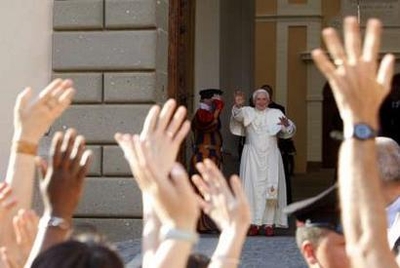
The Holy Father has transferred his flag to the papal Summer Residence at Castel Gandolfo, in the Castelli Romani.

On arriving he was greeted, as you might expect, by crowds.  He didn’t go out on the balcony, but he did charge out the front door for a bit.

Castel Gandolfo, or, What Papa did on his summer vacation 

Posted in SESSIUNCULA |
40 Comments

Benedict XVI’s sermon for Sts. Peter and Paul: be “liturgists of Jesus Christ”

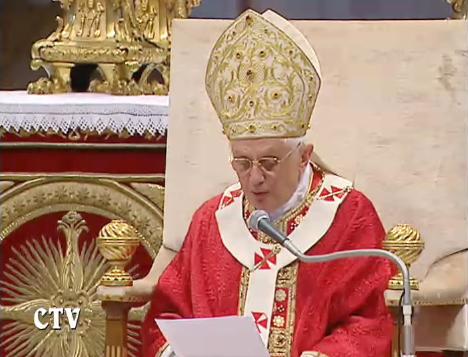
I had posted images from the Mass of the Feast of Sts. Peter and Paul, and the text of the sermons, in Italian.  I wanted to follow up with the English texts.  The texts are from Zenit –  not my translation, but me emphases and comments. 

At the very end I have comments about Pope Benedict’s description of us Catholic Christians as being true "liturgists of Jesus Christ" in the world.


Papal Homily for Feast of Sts. Peter and Paul

"Going to Rome Is for Paul the Expression of His Mission

VATICAN CITY, JUNE 30, 2008 (Zenit.org).- Here is a translation of Benedict XVI’s homily for the Mass celebrated in St. Peter’s Square [Wrong.  It was in the Basilica, not the square] on the feast of Sts. Peter and Paul, which was Sunday. Ecumenical Patriarch Bartholomew I was present at the ceremony.

At vespers on Saturday, the Pope inaugurated the Pauline Jubilee Year, which ends June 29, 2009.

* * *

Benedict XVI's sermon for Sts. Peter and Paul: be "liturgists of Jesus Christ"Your Holiness and fraternal Delegates,
Lord Cardinals,
Venerable brothers in the episcopate and priesthood,
Dear brothers and sisters

From the earliest times, the Church of Rome has celebrated the solemnity of the great apostles Peter and Paul as a single feast on the same day, June 29. [What we do today we do in continuity with the past and, today, with the Orthodox Church of Constantinople.] Through their martyrdom, they became brothers; together, they are the founders of the new Christian Rome. They are sung of as such in the hymn of the second vespers, which goes back to Paulinus of Aquileia (+806): "O Roma felix — Oh happy Rome, adorned with the crimson of the precious blood of such great princes, you surpass every beauty of the world, not by your own merit, but trough the merit of the saints whom you have killed with bloody sword". The blood of martyrs does not call for revenge — but reconciles.  [This is counter-intuitive, in terms of the world’s view of murder.] It does not present itself as an accusation but as a "golden light," according to the words of the hymn of the first vespers. It presents itself as the power of love which overcomes hate and violence, founding, in this way, a new city, a new community.

By their martyrdom, they — Peter and Paul — are now part of Rome. Through martyrdom, even Peter became a Roman citizen forever. Through their martyrdom, through their faith and their love, the two apostles show us where true hope lies, and are the founders of a new kind of city, which must again and again form itself in the midst of the old city of man, [An Augustinian image.] which continues to be threatened by the opposing forces of the sin and egotism of men.

By virtue of their martyrdom, Peter and Paul are in reciprocal relationship forever. A favorite image of Christian iconography is the embrace of the two apostles on the way to martyrdom. We can say that their martyrdom itself, in its deepest reality, is the realization of a fraternal embrace. [Another counter-intuitive idea.] They die for the one Christ and, in the witness for which they give their lives, they are one. [The Church holds that in authentic Christian martydom, the martyr fulfills all heroic Christian virtue.  In a formal study or investigation of a cause of martyrdom it is not necessary to demonstrate that the martyr lived a life of heroic virtue because enduring Christian martyrdom embodies all the virtues at that moment.] In the writings of the New Testament, we can, so to speak, follow the development of their embrace, this unity in witness and in mission.

Everything starts when Paul, three years after his conversion, goes to Jerusalem "to consult Cephas" (Galatians 1:18). Fourteen years later, he again goes up to Jerusalem to explain "to the most esteemed persons" the Gospel that he preaches in order so that he might not run the risk of "running, or having run, in vain" (Galatians 2:1f). At the end of this meeting, James, Cephas and John give him their right hands, thus confirming the communion that unites them in the one Gospel of Jesus Christ (Gal 2:9). A beautiful sign of this growing interior embrace, which develops despite the difference in temperaments and in tasks, I find in the fact that the co-workers mentioned at the end of the First Letter of St. Peter — Silvanus and Mark — were equally close co-workers of St. Paul. This having of the same co-workers makes the communion of the one Church, the embrace of the great apostles, visible in a very concrete way.  [Joseph Ratzinger’s motto on his coat-of-arms was Cooperatores veritatis.]

Peter and Paul met each other at least twice in Jerusalem; at the end their paths take them to Rome. Why? Was this perhaps more than just pure chance? Is there perhaps a lasting message in it? Paul arrived in Rome as a prisoner, but at the same time as a Roman citizen who, after his arrest in Jerusalem, as a Roman citizen appealed to the emperor, to whose tribunal he was brought. But in a more profound sense, Paul came to Rome voluntarily. Through the most important of his letters, he had already drawn close to this city interiorly: to the Church in Rome, he had addressed the writing which, more than any other, is the synthesis of his whole proclamation and his faith. In the opening salutation of the letter, he says that the whole world speaks of the faith of the Christians of Rome and that this faith, therefore, was known everywhere as exemplary (Romans 1:8). And then he writes: "I do not want you to be unaware, brothers, that I often planned to come to you, though I was prevented until now" (1:13). At the end of the letter he comes back to this theme, now speaking of a plan to travel to Spain. "When I go to Spain I hope to see you when I pass through and to be helped by you on my way to that region, after having enjoyed your presence for a little while" (15:24). "And I know that, having come to you, I shall come in the fullness of Christ’s blessing" (15:29). There are two things made evident here: Rome is for Paul a stage on the way to Spain, that is — according to his conception of the world — towards the extreme end of the earth. He considers his mission to be the fulfillment of the task received from Christ, the bringing of the Gospel to the very ends of the world. Rome is along this route. While Paul usually only goes to places where the Gospel had not yet been announced, Rome is an exception. There he finds a Church whose faith the world speaks about. Going to Rome is part of the universality of his mission as one sent to all peoples. The way to Rome, which, already before his external trip, he had traveled interiorly with his letter, is an integral part of his task of bringing the Gospel to all peoples — of founding the Church, catholic and universal. Going to Rome is for him the expression of his mission’s catholicity. Rome must make the faith visible to the whole world, it must be the meeting place in the one faith.

But why did Peter go to Rome? About this the New Testament does not say anything directly. But it gives us some indication. The Gospel of St. Mark, which we may consider a reflection of the preaching of St. Peter, is intimately oriented towards the moment when the Roman centurion, facing the death of Christ on the cross, says, "Truly this man was the Son of God!" (15:39). At the cross the mystery of Jesus Christ is revealed. Beneath the Cross the Church of the gentiles is born: the centurion of the Roman execution squad recognizes the Son of God in Christ. The Acts of the Apostles describe the episode of Cornelius, the centurion of the Italic cohort, as a decisive stage for the entrance of the Gospel into the pagan world. Following a command of God, he sends someone to get Peter, and Peter, also following a divine order, goes to the centurion’s house and preaches. While he is speaking, the Holy Spirit descends on the gathered domestic community and Peter says: "Can anyone withhold the water for baptizing these people, who have received the holy Spirit even as we have?" (Acts 10:47).

Thus, in the Council of the Apostles, Peter becomes the intercessor for the Church of the pagans who do not need the Law because God "has purified their hearts with faith" (Acts 15:9). Certainly, in the Letter to the Galatians, Paul says that God gave strength to Peter for the apostolic ministry among the circumcised, and to Paul himself, the ministry among the pagans instead (Gal 2:8). But this assignment could be in force only as long as Peter remained with the 12 in Jerusalem in the hope that all of Israel would adhere to Christ. In the face of later developments, the 12 recognized the time in which they too must go forth into the world to announce the Gospel to it. Peter who, following divine order, had been the first to open the door to pagans, now leaves the leadership of the Christian-Jewish Church to James the Less, in order to dedicate himself to his true mission: to the ministry of the unity of the one Church of God made up of Jews as well as pagans. The desire of Paul to go to Rome highlights above all, as we have seen, the word "catholica" ["catholic"] among the characteristics of the Church.

St. Peter’s journey to Rome, as representative of the peoples of the world, is above all associated with the word "una" ["one"]: he has the task of creating the "unity" of the "catholica," of the Church made up of Jews and pagans, the Church of all peoples. And this is the permanent mission of Peter: to make sure that the Church never identifies herself with any one nation, any one culture or any one state. That it may always be the Church of all. That it may unite mankind beyond every frontier and, amidst the divisions of this world, make God’s peace present, the reconciling power of his love. [Watch this next move…] Due to technology that is now the same everywhere, due to the global information network, and due also to the linking of common interests, there are new modes of unity in the world, which have caused the explosion of new oppositions and given new impetus to old ones. In the midst of this external unity, based on material things, we have all the more need of interior unity which comes from the peace of God – the unity of all those who, through Jesus Christ, have become brothers and sisters. This is the permanent mission of Peter, as well as the special task entrusted to the Church of Rome.

Dear confreres in the Episcopate! I wish now to address those of you who have come to Rome to receive the pallium as the symbol of your rank and your responsibility as archbishops [Notice that Pope Benedict does not speak of the pallium as being a papal symbol.] in the Church of Jesus Christ. The pallium is woven from the wool of the sheep that the Bishop of Rome blesses every year on the Feast of Peter’s Chair, thus setting them apart, so to speak, to be a symbol for the flock of Christ, over which you preside.

When we put the pallium on our shoulders, this gesture reminds us of the Shepherd who puts the lost sheep upon his shoulders — the lost sheep who by himself can no longer find the way home — and takes him back to the sheepfold. The Fathers of the Church saw in this sheep the image of all mankind, of human nature in its entirety, which is lost its and can no longer find the way home. The Shepherd who takes the sheep home can only be the Logos, the eternal Word of God himself. In the Incarnation, he placed us all — the sheep who is man — on his shoulders. [Nice move.  The Logos, being God, is capable of taking up all humanity, but the Logos needs the shoulders of our human nature to do it.] He, the eternal Word, the true Shepherd of mankind, carries us; in his humanity he carries each of us on his shoulders. On the way of the Cross, he carried us home, he takes us home. [The Cross is the doorway to our true home, our patria.] But he also wants men who can "carry" together with him. [We also bring to completion what Christ did not suffer during His earthly life.] Being a shepherd in the Church of Christ means taking part in this task, which the pallium commemorates. When we put it on, he asks us: "Will you also carry, together with me, those who belong to me? Will you bring them to me, to Jesus Christ?" What comes to mind next is the order Peter received from the Risen Christ, who links the command, "Feed my sheep" inseparably with the question, "Do you love me? Do you love me more than others do?" Every time we put on the pallium of the shepherd of Christ’s flock, we should hear this question, "Do you love me?" and we must ask ourselves about that "more" of love that he expects from the shepherd.  [He brings the symbol of the pallium back around to the a dimension of the Petrine ministry, shared by the whole college of bishops.]

Thus the pallium becomes a symbol of our love for the Shepherd Christ and our loving together with him — it becomes the symbol of the calling to love men as he does, together with him: [He certainly is not stressing the papal prerogative of the pallium.] those who are searching, those who have questions, those who are self-assured and the humble, the simple and the great; it becomes the symbol of the calling to love all of them with the strength of Christ and in view of Christ, so that they may find him, and in him, find themselves. But the pallium which you will receive "from" the tomb of Peter has yet another meaning, inseparably connected with the first. To understand this, a word from the First Letter of St. Peter may help us. In his exhortation to priests to feed the flock in the correct way, St. Peter calls himself a "synpresbýteros" — co-priest (5:1). This formula implicitly contains the affirmation of the principle of apostolic succession: the shepherds who follow are shepherds like him; together with him, they belong to the common ministry of the shepherds of the Church of Jesus Christ, a ministry that continues in them. But this "co-" (in co-priest) has still two other meanings. It also expresses the reality that we indicate today by what is said today about the [1] "collegiality" of bishops. We are all "co-priests." No one is a shepherd by himself. We are in the succession of the apostles thanks only to being in the communion of the college in which the college of apostles finds its continuation. [This was spoken the day before the "deadline" given to the leadership of the SSPX to sign off on those famous Five Conditions which focused on respect for Peter, his role, and a positive desire for unity.] The communion — the "we" — of the shepherds is part of being shepherds, because there is only one flock, the one Church of Jesus Christ. [He is saying this while sitting next to Bartholomew I.]  Finally, this "co-" also refers to [2] communion with Peter and his successor as a guarantee of unity. [There it is.  Communion with Peter.] Thus, the pallium speaks to us of the catholicity of the Church, of the universal communion of shepherd and flock. And it refers us to apostolicity: to communion with the faith of the apostles on which the Church is founded. It speaks to us of the "ecclesia" that is "una," "catholica," "apostolic," [In the Creed which Pope Benedict and Patriarch Bartholomew will in a few moments speak together in Greek.] and naturally, binding us to Christ, it speaks to us of the fact that the Church is "sancta" us that the Church is holy, and that our work is a service of this holiness.

This brings me back, finally, to St. Paul and his mission. He expressed the essence of his mission, as well as the most profound reason for his desire to go to Rome, in Chapter 15 of the Letter to the Romans, in an extraordinarily beautiful passage. He knows he has been called "to be a ‘leitourgos‘ ["liturgist", if you push that ancient term into our modern word!] of Christ Jesus for the Gentiles, serving the Gospel of God as a priest, so that the pagans become an acceptable offering, sanctified by the holy Spirit" (15:16). Only in this passage does Paul use the word "hierourgein" — serving as a priest — together with "leitourgos" — liturgist: [There!  The Pope did it!  Liturgist.] he speaks of the cosmic liturgy, in which the world of men itself must become worship of God, an offering in the Holy Spirit. When the whole world will have become the liturgy of God, when in its reality it will have become adoration, then it will have reached its goal, then it will be whole and saved. And this is the ultimate objective of St. Paul’s apostolic mission and of ours. It is to such a mystery that the Lord calls us. Let us pray in this hour that he may help us carry it out in the right way, to become true liturgists of Jesus Christ. Amen.

[Translation by Joseph G. Trabbic]

This last point needs to be spun out a bit more.

The role of lay people in the world is to shape the world around them, each in their own sphere, according to their own vocation, according to their influence and means, etc., and to be sanctified in doing so, to seek the kingdom of God beyond this world by doing so.  The role of priests is the teach, govern and sanctify the laity for their task, and thus seek for themselves entrance to the kingdom of heaven together with the laity to whom they bring order and the ordinary means of salvation.

The role of liturgy in this is absolutely central.  There is a reciprocal relationship between what we believe, and therefore how we pray and how we act in the macro and the micro dimensions of our lives.  Since the Eucharist, both the Sacrament and Its celebration, are the "source and summit" of Christian life, how we celebrate the Eucharist affects our ability to keep hold of the kingom of God opened for us by the Logos who took up our humanity.  Our celebration of the Eucharist forms us into a people of the Gospel, which in its essence concerns the proclamation of the kingdom of God. 

Benedict XVI's sermon for Sts. Peter and Paul: be "liturgists of Jesus Christ"Formed in this way, lay people then form the world.
If we pray a certain way, that will affect what we do in and to the world around us.  This is one way to understand what Pope Benedict is saying when he raises up the ideal of being Christ’s liturgists in the world. 

Moreover, liturgy ought to be an encounter with mystery, and an anticipation of what we will gain in full in the kingdom of God to come. Our daily acts, informed by our lifelong participation in the Church’s liturgy, open outward to the ultimate mystery, past our own fear of death, through the doorway which is our own share in Christ’s Cross.  When we are doing the work of our vocation, in prayer which is both individual the collective prayer of the Church, each of our acts opens out beyond the immediate here and now to their ultimate fulfillment in the celestial eternal liturgy before the throne of God, when Christ will have taken all things (which we also shaped) to Himself and then presents them to God, in the cosmic liturgy, so that God may be all in all.

Posted in SESSIUNCULA |
12 Comments

Bartholomew I’s sermon at the Mass for Sts. Peter and Paul

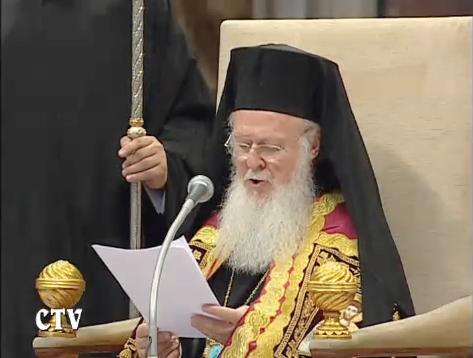
I had posted images from the Mass of the Feast of Sts. Peter and Paul, and the text of the sermons, in Italian.  I wanted to follow up with the English texts.  The texts are from Zenit, not my translation, but me emphases and comments.

Bartholomew I's sermon at the Mass for Sts. Peter and PaulPatriarch’s Homily for Feast of Sts. Peter and Paul
With Benedict XVI’s Introduction

VATICAN CITY, JUNE 30, 2008 (Zenit.org).- Here is a translation of the homily from Orthodox Patriarch Bartholomew I for the Mass celebrated in St. Peter’s Square [No.  It was inside the Basilica.] on the feast of Sts. Peter and Paul, which was Sunday.

At vespers on Saturday, Benedict XVI inaugurated the Pauline Jubilee Year, which ends June 29, 2009.

* * *

The Holy Father’s Introduction to the Patriarch’s Homily

Brothers and Sisters,

The great feast of Saints Peter and Paul — patrons of this Church of Rome and, together with the other apostles, pillars of the one, holy, Catholic and apostolic Church — brings to us every year the welcome presence of a fraternal delegation of the Church of Constantinople which, this year, because of the opening of the "Pauline Year," is led by the Patriarch himself, His Holiness Bartholomew I. I address my cordial greeting to him as I express my joy of once again having the happy opportunity of exchanging the kiss of peace with him in the common hope of seeing the coming of the day of "unitatis redintegratio" — the day of full communion between us.

I also greet the members of the patriarchal delegation, the representatives of the Churches and ecclesial communities, who honor us with their presence, offering with this presence a sign of the will to intensify the movement toward the full unity of the disciples of Christ. We dispose ourselves now to listen to the reflections of His Holiness the Ecumenical Patriarch, words that we desire to receive with an open heart because they come from our dearly beloved brother in the Lord.

* * *

Homily of the Ecumenical Patriarch Bartholomew I

Your Holiness,

Having again experienced, in November 2006, the joy and emotion of the personal and blessed participation of Your Holiness in the patronal feast of Constantinople, the commemoration of the St. Andrew the Apostle, the First Called, I set out "with a joyous step" from Fener in the New Rome, to come to you to participate in your joy in the patronal feast of Old Rome. And we have come to you "with the fullness of the blessing of the Gospel of Christ" (Romans 15:29), returning the honor and love, celebrating with our beloved brother in the land of the West, "the certain and inspired heralds, the coryphaei of the disciples of the Lord," the holy apostles Peter, brother of Andrew, and Paul — these two great, central pillars of the whole Church stretched out toward heaven, which, in this historic city, also offered the ultimate shining confession of Christ and gave their souls to the Lord here through martyrdom, one on the cross and the other by the sword, and thus sanctified this city.

We greet, with the deepest and most devoted love, on the part of the Most Holy Church of Constantinople and her children throughout the world, You Holiness, desired brother, wishing from the heart "those who live in Rome beloved of God" (Romans 1:7), good health, peace, prosperity and progress day and night toward salvation "fervent in spirit, serving the Lord, joyful in hope, strong in tribulation, steadfast in prayer" (Romans 12:11-12).

In both Churches, Your Holiness, we duly honor and greatly venerate Peter — he who made his salvific confession of the divinity of Christ, as much as Paul — the vessel of election, who proclaimed this confession and faith to the ends of the universe in the midst of the most unimaginable difficulties and dangers. Since the year of salvation 258 we have celebrated their memory in the West and in the East on June 29. In the East we also prepare for this feast by a fast observed in their honor on the preceding days, [Robust Christianity!] following a tradition of the ancient Church. To strongly emphasize their equal importance, but also their weight in the Church and her regenerative and salvific work through the centuries, the East honors them in an icon in which they either hold a little ship in their hands, which symbolizes the Church, or they embrace and exchange the kiss in Christ.

It is indeed this kiss that we have come to exchange with you, Your Holiness, emphasizing the ardent desire and love in Christ, things which are closely related to each other.

The theological dialogue between our Churches "in faith, truth and love," thanks to divine help, goes forward despite the considerable difficulties that exist and the well-known problems. We truly desire and fervently pray that these difficulties will be overcome and that the problems will disappear as soon as possible so that we may reach the desired final goal for the glory of God.

We know well that this is your desire too, as we also are certain that Your Holiness will neglect nothing, personally working, together with your illustrious collaborators, through a perfect smoothing of the way, toward a positive fulfillment of the labors of dialogue, God willing.

Your Holiness, we too have proclaimed the year 2008 "Year of the Apostle Paul" [I hadn’t known that when I heard him say this.] on the 2,000 anniversary of the great apostle’s birth. In regard to the events of the anniversary celebration, in which we have also venerated the precise place of the St. Paul’s martyrdom, we are planning, among others things, a sacred pilgrimage to some of the monuments of the apostolic activity of the apostle in the East: Ephesus, Perge, and other cities in Asia Minor, but also Rhodes and Crete, the places called "good ports." Be assured, Your Holiness, that on this sacred journey, you too will be present, walking with us in spirit, and that in each place we will offer up an ardent prayer for you and our brothers of the venerable Roman Catholic Church, fervently asking the divine Paul’s intercession with the Lord for you.

And now, venerating the sufferings and the cross of Peter and embracing Paul’s chains and stigmata, honoring the confession and martyrdom and the venerable death of both for the name of the Lord, which truly leads to Life, we glorify the Thrice-Holy God and we supplicate him, so that through the intercession of Saints Peter and Paul, who are his protocoryphaei and apostles, he will, here below, grant us and all his children of the Orthodox and the Roman Catholic Church throughout the world "union of faith and communion in the Spirit" in the "bond of peace" and there above eternal life and great mercy. Amen.

[Translation by Joseph G. Trabbic]

Posted in SESSIUNCULA |
10 Comments

Emasculated liturgy

My friend Fr. Ray Blake, over at St. Mary Magdalen has an interesting letter with this interesting quote:

John Carmel Cardinal Heenan apparently said this after attending the first demonstration of the Novus Ordo.

"At home it is not only women and children but also fathers of families and young men who come regularly to mass. If we were to offer them the kind of ceremony we saw yesterday in the Sistine Chapel we would soon be left with a congregation mostly of women and children."

Posted in SESSIUNCULA |
112 Comments

Tradition means the whole of Catholic life, not just liturgy

A story from the Catholic Herald, the best of the UKs Catholic papers to which you should subscribe if you don’t already, has a very interesting story.

Oxford’s martyrs to be honoured with a plaque
By Ed West
4 July 2008

Picture
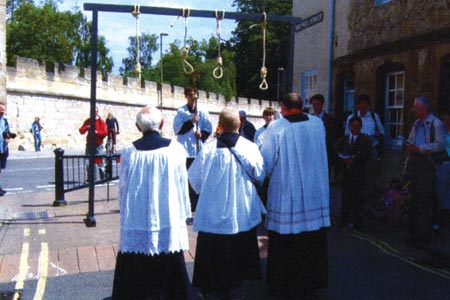
Last year’s Latin Mass Society pilgrimage honours the four martyrs

Four Catholic martyrs executed during the reign of Elizabeth I are to be commemorated with a plaque at the place of their death.

The four men – George Nichols, Richard Yaxley, Thomas Belson and Humphrey Prichard – will be remembered during a pilgrimage to the city held in October, when the Auxiliary Bishop of Birmingham will unveil the memorial.

The men died on July 5 1589 in Holywell Street, site of the 16th century town gallows.

Nichols and Yaxley were priests trained at Douai College in Rheims at a time when re-entering England after taking holy orders overseas was a capital office.

Nichols gained fame as the priest smuggled into Oxford Castle to reconcile highwayman Harcourt Taverner with the Church the night before his execution. Belson was a layman from a local Catholic land-owning family who had refused to conform. The family had moved from Oxfordshire to avoid intolerant magistrates after his father Augustine Belson had been fined for non-attendance at Anglican services, and their home, Ixhill Lodge, was a refuge for priests. Thomas Belson, his third son, was imprisoned in the Tower of London in 1585 for "conveying intelligence" for a Catholic priest, but had been released after five months on condition he be "banished from the realm". He had studied at the independent and relatively tolerant Oriel College under the Spanish Protestant Antonio del Corro, one of the earliest advocates of religious freedom.

The last to die, Welshman Prichard, had worked for 12 years as a servant at the Catherine Wheel, a Catholic-run inn on the corner of Broad Street and Magdalen Street that was a refuge for priests. The landlady of the inn was jailed for life.

Catholicism was on the increase in the city during the late 1580s at the peak of the Elizabethan state’s paranoia about the old religion, less than a year after the Spanish Armada had been defeated. Nichols was known to have returned many to Catholicism in the city, making him a high priority for the authorities.

It was in the Catherine Wheel that the four men were captured on the night of May 18 1589. The authorities arrived at midnight and, after arresting Prichard when he unbolted the door, apprehended the other three after vestments were found on the premises.

All four were taken by horseback to Bridewell Prison in London, where they were tortured and interrogated by Elizabeth’s spy chief Sir Francis Walsingham. Nichols was placed in a rat-filled dungeon while Yaxley was put on the rack, and both priests were hanged from their hands for up to five hours to make them betray their associates, although it is recorded that they maintained their silence.

The four men received much sympathy from the Oxford population during the investigation and trial. A graduate of Magdalen College was so inspired by their courage that he walked alongside the prisoners all the way to London, and was punished for reporting their ill-treatment along the way by being consigned to the notorious lunatic asylum Bedlam.  [Sounds like my seminary experience…]

All four men were condemned to death for the crime of returning to England after receiving foreign ordination in the case of Nichols and Yaxley, and for assisting priests for Belson and Prichard. All were brought back to Oxford to be executed. _The priests, guilty of treason, were hanged, drawn and quartered, while the laymen, guilty of a felony, were only hanged.

Prichard, the last to die, was the only one allowed to speak at the execution, declaring in a brief dialogue with a Protestant minister: "I believe all that the Holy Roman Church believes, and what I cannot explain by mouth, I am ready and prepared to explain and testify to you at the cost of my blood." The priests’ heads were placed on the castle wall and their bodies on the city walls.

Within a year the story of their deaths had become a bestseller across Catholic Europe, with eyewitness reports published in Antwerp and translated into Spanish, French and Italian.

The four men were among 85 martyrs of England and Wales beatified by Pope John Paul II in 1987, and among 70 Catholic martyrs associated with Oxford.

The plaque cost just over £2,600 and is being organised by the St Catherine’s Trust charity. It records how the four men "were executed for their Catholic faith" and will be unveiled on Saturday, October 25 by Bishop William Kenny, auxiliary bishop of Birmingham. The pilgrimage is organised by the Latin Mass Society and begins with a Solemn High Mass at Blackfriars at 11 am and ends with Benediction.

The Latin Mass Society has held a pilgrimage to Oxford since 2005, the procession following the route taken by the martyrs on their route from Bocardo prison to the gallows, which are marked by mock gallows.

Posted in SESSIUNCULA |
12 Comments

The Sabine Report: Penjing has a new companion!

Here is the latest from The Sabine Farm.

The weather has been gorgeous and there was a wonderful heavy rain in the early morning.  There is nothing quite as satisfying as waking up to rain on the eves knowing that it is needed.

The garden is thriving.  I will be putting some more of my herbs and tomatoes out of the green house and into the ground soon.

We did put out the Vatican flag for the feast of Sts. Peter and Paul, as all should.

The Sabine Report: Penjing has a new companion!

The birds are changing their patterns.  I don’t see as many of the old regulars.  I think there must still be some nesting and growing with some species.  But I have caught sight of a few new comers I haven’t yet identified.

For example:

The Sabine Report: Penjing has a new companion!

And the vistas around the place are lovely.

The Sabine Report: Penjing has a new companion!

The amazing irises are finished, however.

The Sabine Report: Penjing has a new companion!

The Sabine Report: Penjing has a new companion!

And my favorites.

The Sabine Report: Penjing has a new companion!

And the columbine is wonderful.

The Sabine Report: Penjing has a new companion!

And there are some amazing dragon flies around right now.

The Sabine Report: Penjing has a new companion!

The Sabine Report: Penjing has a new companion!

However, Mr. UPS and Mr. FedEx both made treks to my door today.

Mr. UPS brought me books, both from JN of FL.  Dove Descending: A Journey into T.S. Eliot’s Four Quartets by Thomas Howard and The Early Papacy: To the Synod of Chalcedon in 451 by Adrian Fortescue.  These were from my amazon.com wish list.

Mr. FedEx brought rather more exotic package.

Allow me to introduce to you Acer palmatum arakawa, a type of Japanese Maple, which in Japanese is irohamomiji. 

The Sabine Report: Penjing has a new companion!

You can see that Irohamomiji is quite a bit larger than Penjing (Carmona microphylla) and a bit more dramatic, though Penjing flowers.

This new addition, sent by LB of MT, again from the amazon wish list, will be a puzzle for a while, but a fine addition to the Sabine land and house-scape.

Thanks to all!  Many thanks also to those of you who have used the donation button of late.  I won’t be going to the Ireland conference, as I had hoped, but there is the Oxford meeting at the end July which I still have a fighting chance to get to.

Posted in SESSIUNCULA |
25 Comments

Tornielli on the SSPX reponse to Rome: more time

Tornielli on the SSPX reponse to Rome: more timeThe intrepid Andrea Tornielli of Il Giornale, an Italian daily, has this piece on his blog.  My translation, emphases.

I have learned from a certain source that, contary to what has emerged in certain articles, the response of the [SSPX] to Card. Castrillon’s letter has not been at all negative.  The Cardinal was pleased with it, responded to Fellay, and immediately passed the SSPX’s letter to Benedict XVI.  Beyond the dead line of the end of June, the Lefebvrites asked for some time – it seems – to seek a way to adhere to the five points.

This is very good.  It is consistent with what my own sources have sent me.

However, I am not sure why it should take more time to sign off on things like, "don’t pretend to have a Magisterium above that of the Pope."  Bp. Fellay affirmed that he doesn’t think that way and, in a sense, that begins to fulfill that condition. 

We wil only know in the future what the SSPX intends to do about the conditions.

If we hear and read harsh rhetoric about the Holy Father, or overarching judgments about the Pope’s ordinary Magisterium, or constant negativity about reunion, that will tell us what they think about the conditions and about dialogue.

But I wager that we are not going to see the SSPX continue according to the status quo ante.

I suspect that if they need time, they are going to use that time to try to muster together the whole leadership of the SSPX into the same orderly rank.  I suspect that they are talking intensely, arguing, discussing, persuading on this side and that, how they are going to speak and write in public for the foreseen future.

The SSPX’s negotiations are not just with Rome, but also amongst themselves and with their base of followers.

Pray for them!  Pray now!

The old Enemy, the father of lies and divisions will attack them with subtle fury.

Posted in SESSIUNCULA |
103 Comments