ZENIT and Fr. Z: “Summorum Pontificum” One Year Later (Part 1)

We are on ZENIT today.  This is part one of an interview.  Part II will be posted tomorrow.

My emphases and …. well… these are my comments.

"Summorum Pontificum" One Year Later (Part 1)

Father John Zuhlsdorf Analyzes Its Effects

By Annamarie Adkins

MINNEAPOLIS, Minnesota, JULY 6, 2008 (Zenit.org).- Benedict XVI’s letter "Summorum Pontificum" on the traditional form of the Mass has sparked an increased interest in the Latin-language liturgy, especially among priests, says an expert on liturgical translations.

Father John Zuhlsdorf, a former employee of the Pontifical Commission Ecclesia Dei, is a noted authority on both liturgical translations and the 1962 Missal. He also writes the "What Does the Prayer Really Say?" column in the Wanderer newspaper, and is the author of a popular blog by the same name.

In Part 1 of this interview with ZENIT, he spoke about new interest in the traditional Latin Mass and various concerns raised regarding "Summorum Pontificum."

Part 2 of this interview will appear Monday.

Q: Has there been much of a demand for the traditional Latin Mass since the release of "Summorum Pontificum"?

Father Zuhlsdorf: No and yes. We have not seen hordes of the faithful hammering on rectory doors to demand the older Mass. But there has been a steady increase of parishes where the traditional Latin Mass is now celebrated regularly.

The trickle is becoming a stream.

Initially, there were unrealistic expectations. Many who favor the older Mass were overly optimistic that the floodgates would crash open. The naysayers, often in positions of power, tried to stem the tide by speaking very negatively, not only about the older Mass, but also about the people who desire it.

Many diocesan bishops, incredibly, threw up unreasonable obstacles to the good provisions the Holy Father generously promulgated. That resistance is now crumbling under the scrutiny of the blogosphere and pressure from the Holy See.

The other factor is that very many young priests want to learn the traditional Latin Mass. For example, I hear that over 1,000 priests have requested the new training DVD that the Fraternity of St. Peter made together with EWTN.

Scores of priests are attending training workshops in Chicago and Nebraska, in Oxford, England, and elsewhere, whenever they are offered. As priests learn this form of the Mass, they will begin implementing it in parishes.

Cardinal Darío Castrillón Hoyos, Benedict XVI’s point man in these matters, stated that the Holy Father hopes this Mass will be offered widely, even if it has not been requested by the faithful.

University chaplaincies are being pushed by students to make the traditional Latin Mass available. This trend will only increase on an upward curve.

Q: The Pontifical Commission Ecclesia Dei is reportedly preparing a document to clarify some ambiguities related to implementing "Summorum Pontificum." What have been the main difficulties thus far that such a document should address?

Father Zuhlsdorf: The document will probably clarify some terms in the "motu proprio" that have been used by some diocesan bishops and priests to block what the Holy Father is trying to accomplish.

For example, "Summorum Pontificum" says priests must be idoneus, "capable, competent" to say Mass with the older book. Idoneus, a technical term, refers to the minimum requirements for competence, not to expertise.

Cardinal Edward Egan of New York, a distinguished canonist in his day, correctly stated that idoneus, as far as the Latin language is concerned, means that the priest must be able to pronounce the words properly. That is the minimum.

Of course we hope for far more than that. But some bishops are subjecting priests to exams in Latin before they determine whether he can exercise his right to say Mass using the 1962 Missale Romanum, or even in Latin with the Novus Ordo, that is to say, Mass in his own rite, as a priest of the Latin Church.

Another issue is how large a group, a coetus, making a request for the older Mass must be before the parish priest is required to act in their favor. Those and other questions pertain to the interpretation of the "motu proprio."

Practical questions have arisen as well. For example, the Holy See should give direction about the relationship of the two liturgical calendars. I think the Holy See should issue an "ordo" for the traditional Mass, a yearly booklet indicating which Mass must be said each day.

Clarifications about the style of vestments that may be used, or the sort of music, could be useful. There are questions about Communion in the hand or altar girls, how those fit with the spirit and the rubrics of the pre-conciliar Mass.

Smaller details, for example about the so-called second Confiteor before Communion, or some traditions people desire from before the 1962 Missal should be made clear.

This upcoming document, and its particular authoritative responses, will help make the implementation of "Summorum Pontificum" orderly and serene.

Q: You have argued that "Summorum Pontificum" is the centerpiece of Benedict XVI’s "Marshall Plan" for the Church. But the term "Marshall Plan" implies rebuilding from the ground up. Can you describe this plan and the role you believe the traditional Latin Mass fits within it?

Father Zuhlsdorf: Useful as they are, analogies limp. After World War II the United States rebuilt war-ravaged Europe both for humanitarian reasons, and also to help create trading partners and a prosperous bulwark against Communism.

After Vatican II, many spheres of the Church were devastated, ravaged by internal dissent, a loss of continuity with our tradition, and from erosion by the secularism and relativism of the prevailing modern world.

Cardinal Joseph Ratzinger had been concerned for years about the loss of Christian identity, which is at the heart of Western Civilization. Now Papa Ratzinger, I believe, is working to reinvigorate our Catholic identity, within the Church herself among her members and spheres of life, so that we can resist the negative influences of secularism and relativism.

Only with a solid identity can we, as Catholics, have something positive and healthy to offer to the world at large, a clear voice offering important contributions in the public square.

Our identity as Catholics is inextricably bound together with the way we pray as a Church.

To give shape and strength to our Catholic identity in these difficult times, we need an authentic liturgical renewal, a renewal that reintegrates us with our tradition, brings us into continuity with the deep roots of our Catholic Christian experience of two millennia.

Contrary to the notions of most progressivists, "the Catholic thing" did not begin in the 1960s.

Benedict XVI is guiding us to a healthier vision of the Church’s doctrine, history, public worship and our very identity as Catholics. There can be no authentic change for a better future without continuity with our past. Liturgy is the tip of the spear.


Posted in SESSIUNCULA |
25 Comments

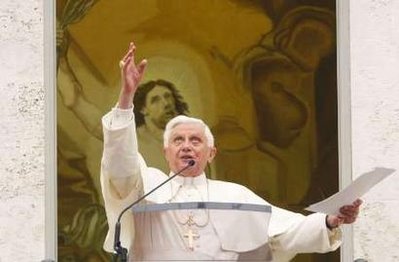
Caption call

Caption call

Posted in SESSIUNCULA |
89 Comments

The Telegraph: Anglican bishops in secret Vatican summit

A reader sent a tip about this story in The Telegraph.

Anglican bishops in secret Vatican summit
By Jonathan Wynne-Jones, Religious Affairs Correspondent

Senior Church of England bishops have held secret talks with Vatican officials to discuss the crisis in the Anglican communion over gays and women bishops.

They met senior advisers of the Pope in an attempt to build closer ties with the Roman Catholic Church, The Sunday Telegraph has learnt.

Dr Rowan Williams, the Archbishop of Canterbury, was not told of the talks and the disclosure will be a fresh blow to his efforts to prevent a major split in the Church of England.

In highly confidential discussions, a group of conservative bishops expressed their dismay at the liberal direction of the Church of England and their fear for its future.

They met members of the Congregation for the Doctrine of the Faith, the most powerful of the Vatican’s departments, the successor to the medieval Inquisition, [Just in case you were wondering if the old chestnuts of anti-popery ever went away…]  which enforces doctrine and was headed by Pope Benedict XVI before his election.

The names of the bishops are known to The Sunday Telegraph, but they have asked for anonymity because the talks are of such a sensitive and potentially explosive nature.

The disclosure comes on the eve of a critical vote as members of the General Synod – the Church’s parliament – prepare to decide whether to allow women to be bishops without giving concessions to staunch opponents.

Up to 600 clergy gave warning in a letter to Dr Williams that they may leave the Church unless they receive a legal right to havens within the Church free of women bishops.

In separate developments, three diocesan bishops wrote to the archbishop supporting the threat and two other bishops have said they are preparing to leave the Church. The letter from the Bishops of Chichester [There once was a bishop from Chichester,…] , Blackburn and Europe – seen by The Sunday Telegraph – argues that traditionalist clergy will not be able to "maintain an honoured place" in the Church without sufficient legislation.

"Clearly the ordination of women as bishops would divide the Church of England even more fundamentally than the ordination of women as priests," it says.

"This issue is one which touches all members of the Church of England and not just those with synodical voting rights. In the light of this we are convinced that some form of separate identities will be required to enable the holders of mutually incompatible convictions about the faith and order of the Church to remain in as high a degree of continuing fellowship as possible."

However, while the letter shows that there is deep disquiet in the most senior ranks of the Church, the meetings with Rome will be of far greater concern to Dr Williams.

One bishop involved in the talks, who wished to remain anonymous, said he was left with no option. "The Church of England is becoming more and more like the American Church. Those of us who hold to traditional orthodoxy are very concerned about the direction it seems to be moving in."

The Anglican communion has been arguing over homosexuality since the American Church made Gene Robinson the first openly gay bishop and issued rites for same-sex unions. Conservatives are concerned that gay blessing services are being conducted in Britain and last month this newspaper revealed that a “wedding” ceremony was held for two gay priests. The issue of homosexual priests is likely to feature strongly at this month’s Lambeth Conference of worldwide Anglican bishops.

Now the Church of England is poised to endorse women bishops — a move that will seriously damage its relations with the Roman Catholic Church and could force hundreds of clergy to defect to Rome.

"These are the presenting issues that have made talks necessary, but our concerns go much deeper than these rows to issues of basic doctrine," the bishop said. "I have to be loyal to the parishes in my diocese and to the Gospel and that’s why I felt I had to do something.W"

Another bishop said: "The internal pressure of the Anglican communion has pushed us apart and we’re committed to greater unity with Rome. There can be no future for Christianity in Europe without Rome."  [Indeed.]

The Pope’s enthusiasm for bringing traditional Anglicans into the fold was shown in 2003 when as Cardinal he sent greetings to a group of conservative churchmen meeting in Texas in protest at the election of Bishop Robinson. The Pope and Dr Williams enjoy a strong relationship, which they are keen to maintain.

However, a former aide to Cardinal Cormac Murphy-O’Connor, the head of the Roman Catholic Church in England and Wales, said that the dialogue with the Anglican bishops only started after the crisis in the Anglican communion worsened. "It is obvious things are starting to fall apart and Rome wants to be able to help if it can," he said.

The Rt Rev Kieran Conry, the Bishop of Arundel and Brighton, said: "A number of Church of England bishops are looking at the options open to them should things go wrong at the Lambeth Conference. Some are hoping for accommodation with the Catholic Church, but yet maintaining their Anglican identity."

The Bishop of Beverley, the Rt Rev Martyn Jarrett said: “In the tragic circumstances that the Church of England takes decisions which make it impossible to walk with it anymore we would want to understand more where we are in relation to wider Catholic Christendom.

“Anglo-Catholics have always had a particular concern for re-union with the Holy See. No matter what might happen Anglo-Catholics will continue to be at the forefront of that dialogue and explanation.”

The Archbishop of York, Dr John Sentamu, used his Synod address yesterday to attack members of the "breakaway" Fellowship of Confessing Anglicans — accusing them of "ungracious" behaviour.

Lambeth Palace declined to comment.

Posted in SESSIUNCULA |
100 Comments

GUEST CONTRIBUTION: Q&A with the Pont. Comm. Ecclesia Dei about SSPX, schism and sacraments

I received a piece from a frequent reader/poster here at WDTPRS, Brian Mershon (pronounced MershON).  He asked me to look at it and, if useful post it. 

My emphases and comments.

PCED Confirms Officially: Society of St. Pius X within the Church, Not in Formal Schism; Catholics Commit No Sin nor Incur Any Canonical Penalty for Mass Attendance

By Brian Mershon

Msgr. Camille Perl, Vice President of the Pontifical Commission Ecclesia Dei (PCED) has recently responded with a letter dated May 23, 2008, to questions I invoked regarding the official canonical status of the Society of St. Pius X and those Catholics who attend their chapels to fulfill their Sunday obligation.

This article is certain to generate much commentary both from die-hard SSPXers who can’t bear to believe their marriages and confessions might be invalid to “more Catholic than the Pope” conservatives who will continue to misconstrue the clear teaching of the PCED, Cardinal Castrillón and the Catholic Church regarding laity who attend SSPX chapels to fulfill their Sunday obligation.   [I love the smell of napalm in the morning… and I don’t mean the napalm patristibloggers enjoy!]

Indeed, the repeated public statements of Cardinal Castrillón that the SSPX is not in formal schism certainly rises above the level of a cleric’s private opinion on matters outside of his competence. His statements can be viewed by all Catholics as reflective of the current position of the Catholic Church on these matters. [That is so.] While some canonists, in good faith, might disagree, Cardinal Castrillón and the PCED’s responses to private correspondence certainly rise above the level of authority of a mere canonist’s opinion. [Probably.  Card. Castrillon is not just anyone.  He is President of the Commission which enjoys competence and authority from the Supreme Pontiff is act in all these matters.  He has made certain statements about the statues of the SSPX – repeatedly.  If what he were saying was not appreciated by the Holy Father, he would have been asked not to keep saying it.]

The responses to the letter below can be acted upon with a moral certitude.  [An important point is "moral certitude".  When in the Church we must deal with objective acts that everyone can see, we still cannot perfectly judge what we cannot see clearly.  Therefore, ecclesiastical authority must come to "moral certainty" when issuing a censure, for example.  This is the language Archbp. Burke used recently in his decrees about censures.  Also, when divorced lay people receive back from a tribunal a decree about the nullity of their marriages, they may then have "moral certainly" that they are free to marry.  When the Congregation for Causes of Saints issues a decree about the "heroic virtue" of a person, it does so after coming to a "moral certainty" about the person’s state of soul based on the evidence that was gathered and evaluated.  It is hard to judge perfectly things which cannot be seen or entirely grasped.  ]

His Eminence
Darío Cardinal Castrillón Hoyos
President, Pontifical Commission Ecclesia Dei (PCED)
Palazzo del Sant’Uffizio
00120 VATICAN CITY

Monday of Holy Week
Anno Domini 2008

Your Eminence,

I [Mershon] have compiled as reference numerous public interviews, both print and television, where you were quoted as stating that the case of the Society of St. Pius X “is not a formal schism” and other words to that effect.

Q: Is this your mere private opinion, or the official teaching of the Catholic Church in your official capacity as head of the Pontifical Commission Ecclesia Dei? 

PCED: “Statements made by Cardinal Castrillón need to be understood in a technical, canonical sense. Stating that the Society of St. Pius X “is not in formal schism” is to say that there has been no official declaration on the part of the Holy See that the Society of St. Pius X is in schism. Up to now, the Church has sought to show the maximum charity, courtesy and consideration to all those involved with the hope that such a declaration will not eventually be necessary.”  [This means that it might in fact be the case that the SSPX is in schism, but at this point the matter hasn’t been officially decided by the Holy See, or if it has, they have decided not to say.  No official declaration means that, right now, people can act in moral certainty that the SSPX is not in a state of schism, disagree or not.]

Would you please clarify the following for me in this private correspondence so that I can ensure that my family and I are following the current teaching of the Church on this specific matter?  [The writer wants moral certainty.  He doesn’t want to make a mistake that could affect his spiritual life and that of his family.]

Q: Does the Catholic Church currently hold that the priests and bishops of the Society of St. Pius X are in formal schism with the Catholic Church? 

PCED: “The bishops of the Society of St. Pius X are excommunicated according to the prescription of canon 1382 of the Code of Canon Law which states that “A bishop who consecrates someone a bishop without pontifical mandate and the person who receives the consecration from him incur a latae sententiae excommunication reserved to the Apostolic See.” Archbishop Lefebvre was duly reminded of this before his conferral of Episcopal ordination on 30 June 1988 and the Holy Father confirmed that this penalty had been incurred in his Apostolic Letter Ecclesia Dei, #3 [cf. AAS 80 (1988) 1495-1498; English translation in L’Osservatore Romano English edition of 11 July 1988, p. 1].

“The priests of the Society of St. Pius X are validly ordained, but suspended, that is prohibited from exercising their priestly functions because they are not properly incardinated in a diocese of religious institute in full communion with the Holy See (cf. Code of Canon Law, canon 265) and also because those ordained after the schismatic Episcopal ordinations were ordained by an excommunicated bishop. [There’s that word again.  Puzzling.]

“Concretely, this means that the Masses offered by the priests of the Society of St. Pius X are valid, but illicit, i.e., contrary to Canon Law. The Sacraments of Penance and Matrimony, however, require that the priest enjoys the faculties of the diocese or has proper delegation. Since that is not the case with these priests, these sacraments are invalid. [Invalid.  Marriages and confessions.] It remains true, however, [pay attention] that, if the faithful are genuinely ignorant that the priests of the Society of St. Pius X do not have proper faculty to absolve, the Church supplies these faculties so that the sacrament is valid (cf. Code of Canon Law, canon 144)  [What we get into here involves a person’s culpability for ignorance.  If a guy genuinely doesn’t know that the SSPX priests don’t have the faculties from the Church so that marriages and confessions can be valid, then the person himself is simply ignorant and, well, God takes care of him through the Church.  If he has never had the news or information about this at all, or if he has had it inadequately explained so that he doesn’t get it, it doesn’t stick, then he is not at fault for his ignorance – unless … unless he either a) figured out there was something really important to this he didn’t understand and, either because he was lazy or afraid of learning the truth he therefore purposely avoided more information or b) is in a position of authority or responsibility which by its very nature require him to be adequately well-informed about all those things he must deal with.  In the case of a person who could learn, but doesn’t for whatever reason, we are talking about ignorance that could be overcome.  That person is in a state of vincible ignorance.  That ignorance can then either be innocent or culpable, depending on his own degree of guilt or responsibility for his own ignorance.  Then there are those who, for whatever reason, perhaps they are very stupid or perhaps they have some genuine psychological block, just can’t figure out or learn they truth, this is invincible ignorance, which can’t be overcome. They have far less culpability, or none, for their state.]

“While it is true that participation in the Mass at chapels of the Society of St. Pius X does not of itself constitute “formal adherence to the schism” (cf. Ecclesia Dei 5, c), such adherence can come about over a period of time as one slowly imbibes a schismatic mentality which separates itself from the teaching of the Supreme Pontiff and the entire Catholic Church. [It can happen over time, though this would differ with every person.] While we hope and pray for a reconciliation with the Society of St. Pius X, the Pontifical Commission “Ecclesia Dei” cannot recommend that members of the faithful frequent their chapels for the reasons which we have outlined above. [Because, to one degree or another, you are weakening your bond wit the local bishop and the Roman Pontiff.] We deeply regret this situation and pray that soon a reconciliation of the Society of St. Pius X with the Church may come about, but until such time the explanations which we have given remain in force.”

Q: Does the Catholic Church currently hold that the situation of the Society of St. Pius X is not one for ecumenical dialogue [Good question.] because the Society of St. Pius X is an internal matter within the Catholic Church?

PCED: “Up to now the Catholic Church has acted as if the situation of the Society of St. Pius X is an internal matter within the Catholic Church and not a matter of ecumenical dialogue.”

Q: Do lay Catholics who frequent Society of St. Pius X chapels, either more less frequently, incur any sin or canonical delict by doing so, [Well… you don’t "incur" sin or delict, you "commit" them.  You incur a censure.]  if done solely out of devotion to the Church’s Latin liturgical tradition and not to separate one’s self from communion with one’s diocesan Ordinary or local pastor?  [Again we are into matters of conscience.]

PCED: “Catholics who frequent the chapels of the Society of St. Pius X do not incur any sin or canonical delict by doing so. [They are quoting his language back to him.] However, we further refer you to what we have already stated in #4 above.”

A: What level of authority do your answers to this private correspondence hold?

PCED: “As we already stated to you in our letter of 4 July 2007: “This Pontifical Commission does its best to transmit responses which are in full accord with the magisterium and the present canonical practices of the Catholic Church. One should accept them with docility and can act upon them with moral certainty.” [There is the issue of moral certainty.] We would further add that no dicastery of the Holy See will give other responses than those which we have given here.” [This is important because the PCED has competence in these matters and no other Vatican office should step on their toes.  For example, should the CDW get a question about the old Mass, they should pass it to the PCED.  If the Cong. for Clergy get these questions, they should be forwarded to the PCED.]

Please know that you and your staff and the Holy Father are in my family’s constant prayers as we prepare to celebrate the Holy Week and the season of Easter.

Pax Christi in Regno Christi,

Brian C. Mershon

Commentary on the PCED Responses   [This is by Mershon.]

1. The current language being used by the Catholic Church avoids saying that the Society of St. Pius X is in formal schism.  [They are not saying officially that the SSPX is NOT in schism.  They are avoiding saying officially anything either way.]

2. Archbishop Marcel Lefebvre and the four bishops he ordained in the Society of St. Pius X directly against the express will of the Holy Father incurred excommunication, as outlined by the Code of Canon Law and confirmed by the Congregation for Bishops and Pope John Paul II in his motu proprio Ecclesia Dei Adflicta.  [Remember, that no censure is incurred without the person having sinned.  When enough outward evidence points to the sinful nature of the act, the censure is also officially declared, as happened with the confirmation by the Congregation.  This is why some latae sententiae excommunications are later publicly confirmed.  They go by the evidence, come to a moral certainty about the person’s having incurred the censure automatically (which means they examined the evidence even of the possibility of the sinful nature of the objective act, and then made a decision, declaring the situation for the good of souls.]

3. The Society of St. Pius X priests are suspended from priestly ministry. Therefore, objectively speaking, they are committing sins of grave matter by continuing their active ministry without a specific mandate of the Church. [Of course they may subjectively not be sinning, they may either so convinced of their rectitude or, perhaps, dense, that they are not actually guilty of the objective sins they may be commiting.]  Of course, the Society’s official claim, wrongly or rightly, is that the salvation of souls and the current state of emergency in the Church forces them to continue to offer their ministries without ecclesiastical approval. There has been no indication by the Catholic Church that the priests, as a whole, are excommunicated or in formal schism.  [Remember: it is pretty hard, I would say impossible, to continue a claim of a state of emergency when more than one Pope, over quite a long time, says there isn’t not one that justified their actions.]

4. Therefore, all the sacraments offered by Society of St. Pius X priests, with the exception of Penance and Matrimony, [And that is important.] are valid, but illicit, meaning “illegal.” Penance and Matrimony both require faculties from the local bishop, [or other legitimate authority such as a religious superior, etc., but generally also the local bishop if a priest is stable in a place for a long time and working publicly.] which the Society of St. Pius X priests do not have; therefore, they are invalid. Cases of supplied jurisdiction apply to those who are, for example, in danger of death. [That is to say that the Church’s law itself gives the faculty to any priest, even one who has been "laicized" to absolve in danger of death, even if there is present also a priest in good standing.  This is because the highest good of all the law is the salvation of souls.  Thus, law foresees these possibilities.]  Those who read and understand the PCED’s response can no longer claim ignorance regarding the Church’s official teaching on these two sacraments’ invalidity.  [The writer is trying to overcome the ignorance, vinicible and perhaps also culpable ignorance of those who frequent SSPX priests for absolution or who go to them to be married.  This is like saying: at this point you have no excuse.  You have been told.  You can’t claim ignorance anymore.  From now on, if you go to an SSPX priest for absolution, it is probably not going to forgive your sins.]

5. Catholic laymen may attend Mass at a Society of St. Pius X chapel without committing any sin nor incurring any canonical penalty. However, the PCED guidance is that it “cannot recommend” attendance at the Society of St. Pius X chapels due to the danger of imbibing a “schismatic mentality.”  [And we have seen that mentality among some lay people who frequent their chapels and give them support.] In other words, someone might find some Society priests fomenting division from full communion with the Church, their local Ordinary and/or the Holy Father in their sermons. The PCED’s recommendation is not to attend their chapels habitually, but they acknowledge there is no sin committed nor canonical penalty incurred resulting from attending Mass at SSPX chapels solely out of the desire to worship according to the 1962 missal and in order to fulfill their Sunday obligation.

6. The Society of St. Pius X is in an irregular canonical situation and an “internal matter” and therefore is not a case of ecumenical dialogue. [They are, in sense, Catholics on the slippery slope.]

7. Again, the correspondence from the PCED can be accepted and acted upon with “docility and moral certitude” by Catholics. The specific questions I asked were broad enough in nature to constitute an official response for Catholics to use as guidance.  [But they are not more than that.  They are not definitive or official.  They have weight and people can act on them with confidence.]

Catholic priests, bishops or laymen who contradict these specific responses seem to be out of step with the Church’s current official position.

My additional notes: While people can to some extent or reason agree with or disagree with the specific recommendations of the PCED or statements of Card. Castrillon, I would add this caution.

First, not everyone’s opinion is of equal weight.  Joe Bagofdonuts’ opinon is not going to be, probably, as good as mine, who have training and experience in these things at a level Joe doesn’t have.  My opinion is probably not going to be as good as that of a canonist, etc.  Our opinions are not as weighty as that of the President of the Commission which enjoys competence from the Lawgiver, the Vicar of Christ.  When the Cardinal speaks, his opinion has weight.  Joe really doesn’t have strong position to criticize the Cardinal in these matters, so perhaps he ought to pipe down and listen.

Second, some of the things, above, are based on Canon Law and on moral principles.  Those are not the sort of things we can disagree with because they are the general principles applied to the particular cases in question. 

This was interesting.  I hope this was useful for you!

Posted in HONORED GUESTS |
104 Comments

CNS recap of the SSPX/Vatican dialogue

This is in from CNS.  My emphases and comments.

Traditionalists say they’ve met Vatican’s deadline for reconciliation

By Cindy Wooden
Catholic News Service

VATICAN CITY (CNS) — The traditionalist Society of St. Pius X said it met the Vatican’s deadline to respond to a memo outlining preliminary conditions for full reconciliation with the rest of the Catholic Church.

However, a statement released by the Swiss-based society July 1 implied that the traditionalist group did not accept all the conditions set out in the letter, and it appealed to Pope Benedict XVI to lift the 1988 decree of excommunication against the society’s bishops who were ordained without papal permission.  [However, if they responded by the end of June, and they did, then they met the deadline which was one of the conditions.]

The Vatican press office said July 3 that it did not plan to comment on the statement.  [Not even to say something positive.]

In the July 1 statement, the Society of St. Pius said, "The very general — not to say vague — character of the demands singularly contrasts with the urgency of the ultimatum," adding that they appeared to be geared simply to promoting dialogue rather than resolving differences.

The memorandum was given June 4 to the head of the society, Bishop Bernard Fellay, by Cardinal Dario Castrillon Hoyos, the Vatican official in charge of dialogue with the traditionalists.

In addition to asking for a response by the end of June, the memo set four other conditions for a move toward full reconciliation:

— To respond with the same generosity shown by the pope.

— To avoid public comments showing a lack of respect toward the pope or which could "be negative for ecclesial charity."

— To avoid "the pretext of a magisterium superior to the Holy Father" and to not present the society in opposition to the church.

— To demonstrate the will to act honestly in full ecclesial communion and with respect for the pope’s authority.

The society’s July 1 statement said Bishop Fellay responded to the ultimatum with a June 26 letter to Pope Benedict and that "Cardinal Castrillon Hoyos acknowledged receipt of the letter the next day."  [And, as we reported here and here, Card. Castrillon was apparently pleased with the letter.]

In a June 28 interview with an Italian-language radio station in Switzerland, Bishop Fellay said, "It is false to say (my response was a) total rejection" of the Vatican’s conditions.

"Rather, I see in this ultimatum something very vague, confused. But I have responded and it has to be seen how Rome will react," he said.

Bishop Fellay said, "It is possible that now there will be a little more coldness" in the discussions with the Vatican, but the society wants to continue its dialogue with the rest of the church.  [I pondered what that might mean since I first read it.  Does it mean that the SSPX leadership will now begin to speak with less "warmth"?  That is, with less harsh rhetoric?  Some people take passion and criticism to be sincerity.  Others see dispassionate and careful dialogue as being "cold".  Hard to say what he meant.]

"We do not want to break with the church. Our greatest desire is to be fully accepted," he said. "This is also for the good of the church, because you can see the church has serious problems and we know that we have the solution. [A bit brash.  The problems the Church has in the modern world, in all their complexity and the world’s diversity, are not going to be met by the solutions of one group.] We are not innovators; we simply follow what the church has always done and which worked in the past."  [What worked in the past was sticking closely to Peter… but I digress.]

Asked whether he risked permanently closing the possibility of reconciliation by not accepting all the Vatican’s conditions, Bishop Fellay said: "For me, this ultimatum makes no sense. We have a relationship with Rome that is unfolding with a certain rhythm, which, it is true, is slow. But it also is true that the cardinal (Castrillon) and the Holy Father would like to see an accelerated rhythm."  [Nobody is getting younger, and this combination of people involved are all as positive and open as there have ever been.]

Last year, Pope Benedict widened the possibility for use of the Tridentine rite, ["Tridentine"] the form of Mass used before the Second Vatican Council. That was a long-standing request of the society. [That is not the only reason Benedict XVI did this, of course.  It also has to do with both his desire for true reform in the Church.]

But Bishop Fellay has continued to criticize [This is unclear: continued to criticize since when?  Since Summorum Pontificum or since the Conditions, which ask for a more positive tone?  Also, there is nothing in the conditions that required the SSPX leadership not to criticize elements of Vatican II (which Papa Ratzinger has done himself, extensively and sharply, in the past.] the Vatican on other matters, and has expressed his society’s continued opposition to several teachings of Vatican II, especially in the areas of ecumenism and religious freedom. 

In April Bishop Fellay said the time was not right for reconciliation with the Vatican, because church leaders have not taken steps to reverse the "crisis" introduced by Vatican II.  [I don’t accept that.  I think steps have indeed been taken.  But you don’t get to decide what those steps ought to be unless you are the Pope.]

One source said the new Vatican offer signaled that the Vatican was not willing to continue dialogue with the traditionalist society indefinitely.  [This is perhaps true.  I suggested that myself at the beginning.  I also think that it is more likely that this is a matter of taking advantage of the intersection of circumstances.  First, it was twenty years precisely since the illicit consecrations by Lefebvre. Second, the people in leadership positions on both sides are the most positive toward unity we have seen in the interval.  Third, no one is getting younger: Castrillon will be eighty soon and His Holiness is 81 while Fellay is now also moving on in age and perhaps won’t be elected Superior again, if and when his term expires.  Then what?]

The society broke with the Vatican in 1988 when its founder, the late French Archbishop Marcel Lefebvre, ordained four bishops against papal instructions; Bishop Fellay was one of those ordained.

At that time, the Vatican said those involved in the ordinations were excommunicated.

Jesuit Father Federico Lombardi, Vatican spokesman, explained to French television July 2 that, while the four bishops were excommunicated, the priests of the society are validly ordained [but suspended] and the laity who attend their Masses are considered Catholics.

Posted in SESSIUNCULA |
35 Comments

Workin’ on the blog

I think I finally got the anti-spam plugin working properly.

You can now stop trying to figure out the secret meaning of "toast".

Posted in SESSIUNCULA |
13 Comments

Archbp. Caroll’s Prayer for Government

Archbp. Caroll's Prayer for GovernmentThe following prayer was composed by John Carroll, Archbishop of Baltimore, in 1791. He was the first bishop appointed for the United States in 1789 by Pope Pius VI. He was made the first archbishop when his see of Baltimore was elevated to the status of an archdiocese.

John was a cousin of Charles Carroll of Maryland, a signer of the Declaration of Independence.

Americans among the readership might print it and bring it to your parish priests and ask them to use it after Mass on national holidays.

This needs no translation for Catholics who love their country!

PRAYER FOR GOVERNMENT We pray, Thee O Almighty and Eternal God! Who through Jesus Christ hast revealed Thy glory to all nations, to preserve the works of Thy mercy, that Thy Church, being spread through the whole world, may continue with unchanging faith in the confession of Thy Name. We pray Thee, who alone art good and holy, to endow with heavenly knowledge, sincere zeal, and sanctity of life, our chief bishop, Pope N., the Vicar of Our Lord Jesus Christ, in the government of his Church; our own bishop, N., all other bishops, prelates, and pastors of the Church; and especially those who are appointed to exercise amongst us the functions of the holy ministry, and conduct Thy people into the ways of salvation. We pray Thee O God of might, wisdom, and justice! Through whom authority is rightly administered, laws are enacted, and judgment decreed, assist with Thy Holy Spirit of counsel and fortitude the President of these United States, that his administration may be conducted in righteousness, and be eminently useful to Thy people over whom he presides; by encouraging due respect for virtue and religion; by a faithful execution of the laws in justice and mercy; and by restraining vice and immorality. Let the light of Thy divine wisdom direct the deliberations of Congress, and shine forth in all the proceedings and laws framed for our rule and government, so that they may tend to the preservation of peace, the promotion of national happiness, the increase of industry, sobriety, and useful knowledge; and may perpetuate to us the blessing of equal liberty. We pray for his excellency, the governor of this state , for the members of the assembly, for all judges, magistrates, and other officers who are appointed to guard our political welfare, that they may be enabled, by Thy powerful protection, to discharge the duties of their respective stations with honesty and ability. We recommend likewise, to Thy unbounded mercy, all our brethren and fellow citizens throughout the United States, that they may be blessed in the knowledge and sanctified in the observance of Thy most holy law; that they may be preserved in union, and in that peace which the world cannot give; and after enjoying the blessings of this life, be admitted to those which are eternal. Finally, we pray to Thee, O Lord of mercy, to remember the souls of Thy servants departed who are gone before us with the sign of faith and repose in the sleep of peace; the souls of our parents, relatives, and friends; of those who, when living, were members of this congregation, and particularly of such as are lately deceased; of all benefactors who, by their donations or legacies to this Church, witnessed their zeal for the decency of divine worship and proved their claim to our grateful and charitable remembrance. To these, O Lord, and to all that rest in Christ, grant, we beseech Thee, a place of refreshment, light, and everlasting peace, through the same Jesus Christ, Our Lord and Savior. Amen.

Posted in SESSIUNCULA |
20 Comments

Aphelion!

From Ps 148:

Praise ye him, O sun and moon: praise him, all ye stars and light.
Praise him, ye heavens of heavens: and let all the waters that are above the heavens.
Praise the name of the Lord. For he spoke, and they were made: he commanded, and they were created.

This is in from Space Weather!

WEEKEND SKY SHOW: Saturn, Mars and a slender crescent Moon are gathering together for a pretty sunset sky show over the 4th of July weekend.  For people in the USA celebrating InAphelion!dependence Day, it’s a bit of heavenly charm among the smoke and flash of evening fireworks.  

EARTH AT APHELION: On the 4th of July, you will be farther from the sun than at any other time of the year. Earth’s orbit around the sun is not a perfect circle, it’s an ellipse, and on July 4th, Earth is at the end of the ellipse farthest from the sun. Astronomers call this "aphelion." When we are at aphelion, the sun appears slightly smaller in the sky (by about 1.7%) and global solar heating is actually a little less (by about 3.5%) than the yearly average. This provides scant relief from northern summer heat, however.  [So long as it doesn’t spin, dance and fall toward the earth, I don’t care how much smaller it is. Still, this is pretty interesting stuff!]

Aphelion!

Happy 4th of Aphelion!

Aphelion!

Posted in SESSIUNCULA |
14 Comments

From the “Your kidding, right?” files: NCR – Community supports St. Louis sister

Let’s talk about some really interesting censures!  Try interdict.

Remember, interdict, one of the Church’s censures, is applied to help a person change his … her… way.

This is from the St. Louis Archdiocese website:

As a result of his judgment of the case, Archbishop Burke has also imposed the following canonical penalties upon Sister Louise Lears: 1) the penalty of interdict and 2) the prohibition of receiving any mission in the Archdiocese of Saint Louis, effective immediately. Interdict prohibits the reception of the Sacraments. The prohibition of receiving any mission prohibits the holding of any Church position or the exercise of any apostolate of the Church in the Archdiocese of Saint Louis.

The penalties are imposed for the purpose of bringing Sister Louise Lears to repentance for the delicts which she has committed and to reconciliation with the Catholic Church.

Archbishop Burke expressed his sadness in imposing the canonical penalties which were necessitated by the refusal of Sister Louise Lears, even after repeated admonitions, to withdraw her statements and repudiate her conduct which have constituted grave delicts in the Church. The Archbishop asks all of the faithful of the Archdiocese to pray for the reconciliation of Sister Louise Lears with the Church.

Get a load of this, a breaking story from the ultra-liberal National Catholic Reporter with my emphases and comments:

Community supports ousted St. Louis nun

By Tom Fox NCR Staff
Published: 
July 2, 2008

Sister of Charity Louise Lears, forced out of all church ministerial roles [Ummm… she attended a fake ordination and publicly denies the Church’s teaching about the impossibility of ordaining women! For crying out loud!] by Saint Louis Archbishop Raymond Burke, is described by friends and colleagues in near saintly terms.

They call her a bright, energetic, compassionate and faith-filled woman. They see her as a creative, generous and selfless person, a highly effective parish minister. They say she is first rate teacher and preacher. They view her as a person guided by the gospels including an unwavering commitment to justice and the local poor.  [Do they see her as subjectively pertinacious and contumacious and probably a heretic?]

These seemingly universal accolades, however, were not enough to save Lears from a severe interdict by Burke who banished her from all Saint Louis church ministries last week.

He also banned her from receiving any of the Sacraments in the archdiocese.

It was her belief that all church ministries, including women’s ordination, should be open to women. [Which seems to trump what the CHURCH says about the matter.  "I want it this way!"] Curiously, this seems to have been only one of many of her passions and, perhaps, not her central passion, which seems to have been parish work.

Lears was shocked twice last week. [You have got to be kidding me now.  Really.  She didn’t think there were going to be repercussions from attending an invalid ordination after having been warned?]  First, she learned that Burke had judged her guilty of three grave canonical offenses against faith and church teachings; then, the next day, she learned that her accuser and judge [You have to love this partisan reporting.  Exquisite!] he had been elevated to a new Vatican post, prefect of the church’s highest canonical court in Rome.  [The innuendo is that Burke is in thick with those bad people in Rome.  But the other side of this is that when he imposes a censure, he probably knows what he is doing.]

She was out; then so was he, at least from Saint Louis.

Lears, 58, for the past three years has been a member of the pastoral team at Saint Cronan’s parish in South St. Louis, and a coordinator of religious education in the archdiocese.

Lears is not speaking to the media, but issued as statement saying she was “deeply saddened” by the judgment. [It could all be rectified by her saying she’s sorry and seeking reconciliation.]

“I love the church. I would never give scandal to the People of God.  [WHAT?!? She would never give scandal?  My heaven’s.] As a faith-filled woman, I root my life and ministry in scripture, Eucharist, and Jesus’ gospel message of nonviolence and justice. As a Sister of Charity, I vow my life to God with whom I walk in humility, simplicity, and charity.” [Perhaps not so much the obedience.]

While Lears’ primary identification is [not as a faithful Catholic, but as …] that of a member of the Saint Cronan pastoral team, she is or has recently been a member of a number of other organizations. She is past president of the board of the Center for Survivors of Torture and War Trauma in St. Louis, [Disconcerting.  Is there that much war and torture going in in St. Louis?]  a board and finance committee member for the Family Care Health Centers in St. Louis, a member of Winter Outreach to Homeless there, also a member of the W’EARTH Housing Coalition, a coalition led by low-wealth women in the Forest Park Southeast neighborhood in St. Louis.  [Laudable work.  Too bad she can’t continue.]

She is also an adjunct faculty member in the Department of Theological Studies at Saint Louis University specializing in medical ethics and spirituality nonviolence.

Mark Chmiel, also an adjunct professor in the department, had this to say about his colleague:

“Sister Louise Lears has made availability and accompaniment a way of life. I have seen how much thoughtful attention and encouragement she gives to her students at Saint Louis University in her popular course, Spirituality of Nonviolence. Several times our community in Saint Louis traveled to the annual School of Americas vigil in mid-November, and I was always touched by Louise’s calm and compassionate presence over those long weekends.

She also participated in our direct-action efforts to raise awareness and provoke responsible action about the U.S. government use of torture in Iraq and at Guantanamo. In such wise, wherever she is, she continually nurtures a community of conscience as naturally as she breathes.”

Gina Meyer, a former student in Lears’ class, Spirituality of Nonviolence, said, "The class completely reoriented my view of human relationships. We learned about Ghandi, Martin Luther King, Jr., Jesus of Nazareth, and many other peacemakers. [Jesus too?] Beyond that, though, Sister Louise showed us exercises and gave us challenges in our daily lives that made me realize how much my own language and behavior affect those around me.

Nonviolence is a true way of life and I learned if from Sr. Louise. She taught me how to be a more loving and peaceful Christian, and I am so happy that I was able to learn from her."

NCR contacted a number of her other colleagues who spoke with a mixture of outrage and mourning, anger at what they called the injustice of the action taken against Lears and sadness as they pondered the loss of her talents to the archdiocese. [But it is HER FAULT!]

Sister of Saint Joseph of Carondelet Jean Abbott recalled the time Lears arrived to help her set up a center to receive victims of torture coming from Guatemala. Abbott had found an old tavern, but it was Lears who imagined how it could be transformed into a vibrant center and set the wheels in motion. “I had very little money,” Abbott said. “Louise had an eye for organization. She brought the place to life.”

“She has a keen sense of justice,” Abbott said. [Not so keen a sense of obedience or doctrine.]

The Saint Cronan parish council last week seemed equally vexed and saddened. [I love that word… vexed… vexed… great word.] The council issued a statement criticizing Burke’s action while defending Lears’ pastoral work “wholeheartedly.” [She wasn’t censured with an interdict for her pastoral work.]  “(We have) been edified by her depth of caring for the people of this parish, our children, the children of our neighbors, and the men and women who call the Forest Park Southeast neighborhood of St. Louis home.”

The statement added that Lears “has been a model of compassion and of non-violent resolution of conflict. [They didn’t burn her at the stake.] She has encouraged us to live more fully the Gospel of Jesus. It saddens us deeply that she has been singled-out for prosecution in a church court.”

Echoing these expressions, Abbott said, “I feel tremendous compassion for Louise and I’m extremely sad for the church.”

Jerry King, a member of the parish and member of the Center for Theology and Social Analysis in Saint Louis, an organization he and Lears belong to, found irony in the Burke censure. “Louise was not spoiling for a fight; she really did not want a fight; she wanted resolution.” He said she just wanted to be a pastor  [SHE. CAN’T. BE. A. PASTOR.] – “and has been very good at it, very active in her commitments” to the parish, which he described as a “last stop” for people disaffected from the church.

King and others now worry the disaffected are now going to drop out altogether.  [I suppose this is Archbp. Burke’s fault… and the Vatican… well, everyone else’s fault.]

Ellen Rehg, another member of the parish, disagrees. She called Lears a “nonviolent saint” adding, “I don’t say that lightly.”

“She will continue to live nonviolently, maintaining her integrity. You know I’ve hardly ever heard of canon law until recently. She’s going to make it. So will we. She’s taught us to trust in the gospels.”

I think I must leave the combox closed on this.

For more on this, go here:

Especially interesting is the actual decree of Extra-Judicial Adjudication.  Try reading it aloud.

Posted in SESSIUNCULA |
Comments Off on From the “Your kidding, right?” files: NCR – Community supports St. Louis sister

QUAERITUR: Post your WDTPRS pieces earlier in the week?

I got this question via e-mail:

Dear Fr. Z.,

For the sake of those of us lay women living out our vocations in part by the education of our children … would you please consider posting your articles on "What Does the Prayer Really Say"–with their translations of prayers from the Extraordinary Form–somewhat earlier?

They are extraordinarily useful *both* for helping our older children in their Latin studies and for helping them understand the meaning of the prayers. But to be useful as part of Mass preparation and as adjuncts to Latin lessons, we would have to have access to them a day, or even two, earlier than they are customarily posted on your blog.


I originally started this blog to be an archive of my WDTPRS articles for the weekly The Wanderer.  But the blog grew into the monster that it is!  o{];¬)

Still, I go through streaks of posting my WDTPRS pieces on this blog even close before the upcoming Sunday especially to encourage your interest in subscribing to The Wanderer, for which I write those columns… for 8 years now.

The Wanderer could use some subscribers, btw.  With the way the US postal service has recently gouged small publications, and I mean gouged, you could be of real help.  Check out the website.  You can even subscribe to a full online edition, useful if you want your issue fast.

Here is what the page with my column looks like, in the issue just published and going into the post today:

QUAERITUR: Post your WDTPRS pieces earlier in the week?

You can look at individual articles on the screen, in text or in graphic form, and you can print them or e-mail them!

Posted in SESSIUNCULA |
Comments Off on QUAERITUR: Post your WDTPRS pieces earlier in the week?