
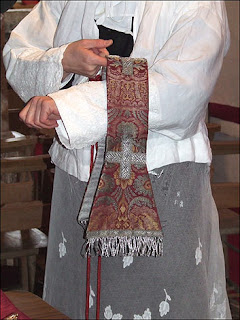
 I got this question by e-mail:
Greetings Father,
A question that the bishop and I were discussing today…If a priest celebrates Mass according to the Missal of 1962, is he REQUIRED to wear a maniple? Certainly it would be preferable, but is it required?
I am torn as to whether this is a matter of discipline, which would mean the reformed vestments would be acceptable in the Extraordinary Form, or a matter of rubrics, in which the priest would be bound by that particular missal.
Any documentation you or the readers could provide would be of great help.
I have written about maniples before. Check here and here.
My first inclination is to say, yes, it is required. If you have the maniple, it ought to be used.
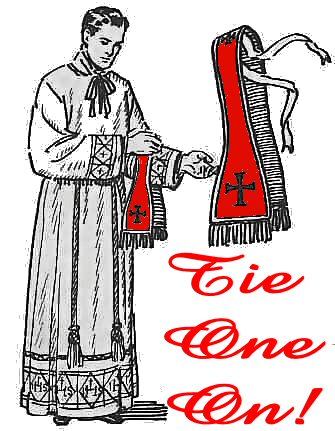
In the editio typica of the 1962 Missale Romanum, we find in the first part of the Ritus Servandus the method of vesting. In that section we find: Sacerdos accipit manipulum, osculatur crucem in medio, et imponit bracchio sinistro. This seem pretty clear to me.
Moreover, the prayers to be said be the priest while putting on vestments, including the maniple are, in fact, printed in the 1962 edito typica of the Missale Romanum. The prayers a bishop is to say, including that for the maniple, are also in the 1962MR.
Of course, no one is held to the impossible. If there is no maniple available, that does not mean that the EF cannot be celebrated. That would be silly, and it would never have been the case in the old days, either.
I think some silly people tried to block celebrations of the older Mass because, they claimed, you could not say Mass if you didn’t have the proper vestments. That is far far too rigid an approach.
By "reformed" vestments I think you might be referring to variations from the old days. For example, if an alb closes at the nexk so that it entirely covers the street clothes or cassock, then no amice would be necessary. Or if the alb is fitted, no cincture is necessary.
BTW, how often do we see priests with their Roman, military, collars visible sticking out of their albs and chasubles during Mass, in violation of the rubrics. Street clothes are to be covered! The collar of your shirt, or vest, or cassock, is part of your street clothes, Fathers! But I digress.
The vestments had a purpose beyond the merely practical or functional. They had a spiritual significance for the priest as he says Mass, a meaning which informs his words and actions at the altar.
I fear that functionalism overtook a Catholic sense of things after the Council, must as the utilitarian spirit eviscerated sacred music and architecture.
Thus… against this error of functionalism, I remind you all of my anti-functionalist battle cry:
 When in Rome – and you need to go to Mass – do as the Romans do. A few years ago, I did just that, dashing into a beautiful church a coin’s throw from the famous Trevi Fountain.
 For those of you who read Italian,
 There are ancient fragments here, however: the origin seems to be from the so-called “Leonine” Sacramentary, better known as the Veronese for the feast of the Roman deacon and martyr St. Lawrence (IIII IDUS AUGUSTAS. NATALE SANCTI LAURENTI):
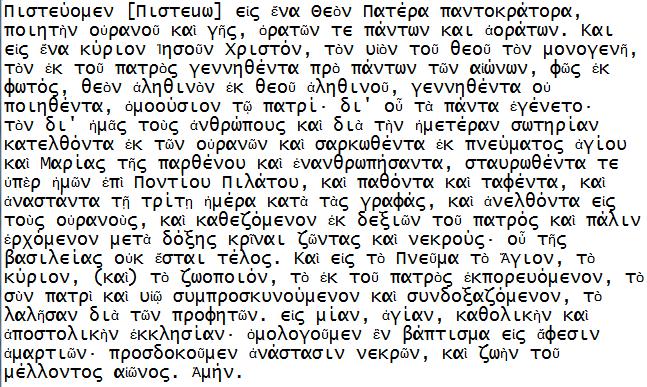
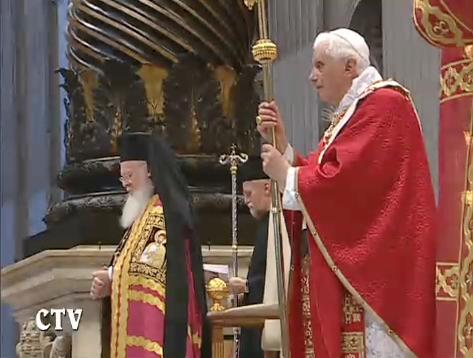 Today during the Mass for the Solemnity of Sts. Peter and Paul, Benedict XVI and Bartholomew I recited the Creed together in Greek.


 waalaw on Daily Rome Shot 1119: “In 1st variation, 2. . . . . . Q-g1# also works. As does 4. . . . . .…”




























