President Bush meets with Pope Benedict

Normally when the Pope meets a head of state, there is a special protocol to be followed.   The same goes for when the President meets with a head of state. 

When Pope Benedict came to the USA, he received very special treatment at the White House.  Yes, it was his 80th birthday, but it was indeed special. 

Now, Pres. Bush has received very special treatment for his visit to Pope Benedict.

The President and Pope Benedict spent some time walking in the Vatican Gardens. 

Of course Pope Benedict spends some time walking everyday, for his health.  But this time I don’t think he was simply multitasking.

I usually am not subject to the usual rumor rumbling of the Italian press, but it strikes me that something is up.


Posted in SESSIUNCULA |
74 Comments

Bp. Trautman doesn’t think you are smart enough to understand the proposed new translation of Mass

I was alerted to this by one of the veteran WDTPRSers who added: "Does anyone care about this stuff anymore?"

Here is the headline:

Bishop Trautman objects to some proposed language changes

So, a bishop near the end of his long career, firmly mired in the stale old ideas of yesteryear, bravely soldiering on under the baggage of the 1960’s, is still objecting to the Holy See’s norms set for liturgical translation. 

His Excellency Donald W. Trautman of Erie is nothing if not consistent.  He reminds me of a guy who might go to the same old restaurant every day for lunch, sit at the same place every day, and order exactly the same sandwich… but to do so in Rome.
 
Here is the story with my emphases and comments:

BY DANA MASSING
dana.massing@timesnews.com [more details]

"Ineffable."

The word worries Erie Catholic Bishop Donald W. Trautman.

He doubts that "John and Mary Catholic," sitting in their church pew, would understand it.   [Two things here.  Again and again His Excellency has demonstrated in his comments about liturgical translation and the new norms that he doesn’t not believe that you are very smart.  He thinks you are too dumb to understand the prayer.  He thinks you are too thick or detached to wonder what it means if you don’t immediately understand and then think about it or look it up.  Also, he thinks that every prayer must be immediately able to be clearly understood.  This leaves no room for the effect of mystery.]

That’s why Trautman will try to tell other U.S. bishops that such words shouldn’t be in a new English translation of the Roman Missal.

U.S. Catholic bishops are holding their June general meeting today through Saturday in Orlando, Fla. They are expected to vote on an English version of the portion of the Roman Missal involving prayers for seasons like Advent and Lent, unless Trautman can convince them to delay a decision on the translation.  [He wants to delay … the … translation.  Get that?  Because surely we haven’t waited long enough.]

"I am at this point reserved about endorsing it," Trautman said two days before the start of the meeting. "I will try to speak on the conference floor to point out what I consider some major deficiencies in the translation."  [Please, O God Almighty and Omnipotent Father, in your ineffable way inspire the bishops of the conference to keep this fellow in check.]

A presentation on it is likely today, with voting probably on Friday, he said.

The portion of the Missal being discussed is the Proper of Seasons.

"These would be the prayers at Mass for the opening prayer, the prayer over the gifts, the prayer after Communion," Trautman said. "These would be the prayers for all of Advent, Christmas, Lent, Easter and then the Sundays of the year."  [I have a copy of the draft of these prayers.  I think you would like them.]

The Vatican wants a translation more faithful to the original Latin text.  [Not … just … the VATICAN!]

Trautman said the draft includes words such as "ineffable" that would not be in the ordinary vocabulary of people.

"This should be the prayer of the people," Trautman said. "I’m not for having street language. … We should certainly have elevated tone, but words like that are just beyond the common comprehension."  [Okay… figure that out.  Elevated language but not comprehensible.]

Catholics coming out of a lunchtime Mass at Erie’s St. Peter Cathedral weren’t familiar with "ineffable."  [WDTPRS asks … SO WHAT?  The problem here is that if you make everything immediately comprehensible to the lowest common denominator it will wind up being pretty much like what we have now in the old lame-duck ICEL prayers:

God,
you are big.
Help us be big like you.

If people hear and interesting word, they might… oh my gosh… wonder what it all means and slowly but surely get the idea that monosyllables and grunting might not actually convey what the Latin prayers convey.]

According to Webster’s New World College Dictionary, Fourth Edition, the word means "too overwhelming to be expressed or described in words; inexpressible; too awesome or sacred to be spoken."

It’s "not in my daily language," said Shirley Skiba, a member of St. Luke Catholic Church in Erie.  [Maybe Shirley shouldn’t be the measuring stick for the language of liturgical prayer.]

Skiba said words used in the Mass should be "something we feel comfortable with." That’s the case with the current translation, for the most part, she said.  [Enough said.]

"I think it should be language the everyday person can understand," she said.

Trautman called parts of the proposed translation "archaic" and "just clumsy language."  [Then  His Excellency should take the time to explain it to Shirley.]

One proposed change, for the first week in Advent, would replace "old way of life" with "ancient bondage," the Erie bishop said.

"Ancient bondage is very ambiguous and not clear enough to the people," he said.  [Yes. But there is a problem.  I ask you, dear reader, does "old way of life" mean the same thing, even on the surface, as "ancient bondage"?]

Regarding another change, he said, "They speak of ‘into the joy of true peace.’ Well, we would say ‘rejoice in true peace.’ That’s much more understandable."  [However, entering into a state of joy means something different than simply being joyful.]

In another vote related to language, the bishops will decide whether to replace "vosotros" with the more familiar "ustedes" in Spanish-language Masses in the United States. Trautman compared using "vosotros" in Spanish to using "thou" in English.  [Aaaaaaaaand…. that would be… bad?]

…

Listen as Erie Catholic Bishop Donald W. Trautman talks about what the U.S. Catholic bishops will be discussing during their June general meeting Thursday through Saturday in Orlando.


Some English words might be hard, but they are the perfect word to do the job.  To replace that word, you need a circumlocution or paraphrase.  That makes translations overly wordy.  But it is part of the very nature of Roman prayer to be concise.  Even the concision is meaningful. 

Enough said. 

Posted in Classic Posts, SESSIUNCULA |
86 Comments

Big move coming up in Rome: Card. Ruini will move on

This is in from ANSA in my translation:

Ruini pre-announces his farewell to the Diocese [of Rome]

He should be leaving governance of the diocese of Rome at the end of June

CITTA’ DEL VATICANO, 12 June – The words pronounced this evening by Camillo Card. Ruini ring out as a farewell to the Diocese of Rome.  "Without anticipating anything I will say on 21 June in my sermon, I want to tell you that I feel enormously indebted to the Lord for having placed me for 17 and a half years as Vicar of the Holy Father as the leader of this diocese", Ruini said, who should be leaving his office by the end of the month. 

His probable successor is Agostini Card. Vallini.

Cardinal Ruini has been enormously important in the last few years.  He was a firm promoter of the policies of John Paul II, who had appointed him years ago as head of the Italian Bishops Conference.  In that role, Ruini also helped the Italian Church reclaim its voice in the public square after the dominence of the lefty Christian Democrat Party slouched ignominiously off the stage.  Card. Ruini has also helped Pope Benedict reshape that Italian Church to do serious battle in the public square over key moral issues. 

Posted in SESSIUNCULA |
2 Comments

Acton University: Day 2

Acton University: Day 2This morning’s session of the annual Acton University sponsored by the Acton Institute in Grand Rapids, MI, (392 people participating from 51 countries).  People map out their own courses. 

Today, I began with a presentation by Kishore Jayabalan, head of Rome’s office of Action, on the Catholic Social Encyclicals.  It was a sound presentation, though a bit familiar to me in some respects. 

After a break, Samuel Gregg spoke about globalization from a theological and historical perspective. 

During lunch there was a talk by Mustafa Akyol, on Islam and free markets.  He had been unable to come the day before, probably because of weather, and this gave him a chance to speak to everyone.

In the afternoon, I attended a very engaging talk by Jennifer Roback Morse called Beyond Contracts: Marriage and Sustainable Markets.  From her course description:  Marriage and family play important roles in building and maintaining both a strong society and a market economy. Marriage and family breakdown have short and long term economic costs and myriad externalities. This course will be highly economic.

Tonight we will hear a talk called Theology of Capital in Falling World by Brian Griffiths.

BTW… there is a little bit of a scuffle going on under the entry about Day 1. 

Posted in SESSIUNCULA |
13 Comments

Excommunicated SSPX Bp. Williamson speaks

Over at our friends of Rorate there are excerpts of an interview with the ecommunicated SSPX Bp. Williamson.

Rorate has quite a few excerpts, and you should go there to see them, but I want to lift and post some here.  These appear near the end.

My emphases and comments.

[REGULARIZATION OF THE SOCIETY]

[16.] On the future, how would you envision a regularization of the Society if it were ever to come about?

Well, the Archbishop used to say, and he’s quite right: “Once Rome comes back to its senses, there is no more problem”. Already the Romans are making documents, it’s already lined up how they would do it. It’s paperwork, paperwork.  [Probably not an entirely honest answer for someone who has such grave misgivings about doctrine since the Second Vatican Council.  Sure… the excommunications can be lifted pretty easily.  A structure for the Society could be created with a few strokes of a couple pens.  But there will be a lot of debate about, especially, the Church’s teaching on religious liberty and, probably, social doctrinal documents.]

[THE TRANSALPINE REDEMPTORISTS]

[17.] Lastly, would you care to comment on the latest proceedings with the Redemptorists at Papa Stronsay?

It doesn’t look good, it looks like they are going to make an agreement with modernist Rome. So, in my opinion, that’s not a very good idea, because they will be obliged, more or less, to abandon the defence of the Faith. More or less.  [Actually, if you consider it….  the SSPX heavy-weights really act as much like modernists as the old and new theological modernists do.  They set themselves up as the arbiters of what is right and wrong without any serious reference to the Holy See.  Some of them will even carefully attack Vatican I.  Interesting no?]

[18.] How would the change you predict manifest itself?

They will no longer be able to freely criticize Vatican II,  [piffle… anyone is free to criticize "Vatican II", properly understood.  I believe Benedict XVI has himself criticized Councils, saying that there were Councils which perhaps should never have been held.  Not everything about every Council is perfect.   These things can be discussed.  However, causing scandal and rifts in the Church is not the best way to go about it.] and they will come under pressure to celebrate the modern Mass, or at least attend the modern Mass with the local Bishop on a Good Thursday. [That is so very hard to do?] The New Church can hardly insist on less, it has to insist on that.  [New Church… ]

[19.] Would you even consider the Redemptorists regularizing their situation with Rome treason?

Treason is a very strong word. I distinguish subjectively and objectively: objectively I think it’s more grave than subjectively. Subjectively I dare say they mean well, they have good intentions, and they are sincere. But objectively I think they are abandoning the true cause of the Faith, yes, they are essentially abandoning the true defence of the Faith, I would say.  [In other words, he thinks they would be traitors to the cause.  On the other hand, many of us who have not broken manifest unity with the Church sometimes think of certain traditionalists who opted out almost as deserters from the front line of battle.]

[20.] Should that be taken as your personal opinion or the position of the Society?

I think a number in the Society would share that opinion, yes, that they are objectively abandoning the true defence of the Faith. A number in the Society would take that position, and I think a number would also say, they nevertheless mean well, they’re sincere, they have good intention, they mean to defend the Faith, not to abandon the defence of the Faith. But the Archbishop was quite severe about those people who abandoned Tradition in those years, years back he was quite severe.

[21.] Saying that the Redemptorists at Papa Stronsay are abandoning Tradition could be perceived a just as strong a statement as calling it treason.

I didn’t say they are abandoning Tradition, I said they are abandoning the true defence of Tradition, which is a slightly different thing. They will still be defending Tradition to some extent, but they are abandoning the complete and true defence of Tradition.

[22.] Have you read anything of the way the Redemptorists are reasoning and considering their situation?

No, I haven’t. I don’t keep up with these things.

[23.] But surely people in central command have in order to properly deal with matters?

Of course. I’m not in central command, I’m not in headquarters. I’m way out in South America so I can enjoy the sunshine and forget about a lot of problems.
 

I sincerely pray for the day when the many good men in the ranks of the SSPX will be reconciled fully with the Church, whether in some juridical structure or other, …  However it happens, I long for it to happen.  They will have so much to contribute to the good of the Church, the teaching of sound doctrine, pastoral zeal which I know many of them show generously.   They had and have so much to contribute.

Posted in SESSIUNCULA |
190 Comments

L’OssRom: Neo-Cat Stats approved by Holy See

I saw in L’Osservatore Romano‘s daily edition in Italian that the Pont. Council for Laity has approved the statutes of the Neo-Catechumenal Way.

In the past, the Neo-Cat Way has had some fairly serious liturgical aberrations as part and parcel of their practice.  I have for quite a while had some concerns about this particular movement, one of many new movements springing up to fill a clear gap and need in the Church.  One of my concerns focused on how the groups form a separate group within a parish.

I don’t have experience of the Neo-Cat Way myself and I have never participated in any event.  However, I know at least one priest whom I very much respect who is somewhat interested and favorably involved with them.  Thus, I am open to hearing more.

Furthermore, in his book long interview with Peter Seewald, Papa Ratzinger speaks about a trajectory for the Church in the future.  He thinks that parishes will remain the basic structure for the Church (interesting… parishes… not dioceses, no?) and that the movements will be also very important.  It is as if the Church will have two poles, in a sense.

Frankly, I think that ecclesial life which springs up as a fruit of Summorum Pontificum, and a new "liturgical movement" as Papa Ratzinger sought to inspire in his book The Spirit of the Liturgy might play a role in this.  But that is another matter.

So, this approval of the Neo-Cat statutes is fairly significant.

I don’t have time to translate this for you.  Perhaps a couple of you kind readers who know Italian could give it a shot in the comments.

Da parte del Pontificio Consiglio per i Laici
Approvato lo statuto
dei neocatecumenali

    Roma, 12. Il decreto di approvazione definitiva dello statuto del cammino neocatecumenale viene consegnato ai responsabili del movimento venerdì mattina, 13 giugno, nella sede del Pontificio Consiglio per i Laici.
    "L’approvazione definitiva dello statuto – si legge in un comunicato diffuso alla vigilia dal Pontificio consiglio – costituisce, senz’altro, un’importante tappa nella vita di questa realtà ecclesiale, sorta in Spagna nel 1964. Questo atto ha richiesto varie consultazioni a diversi livelli. Durante il periodo di approvazione ad experimentum dello statuto, il Pontificio consiglio ha avuto modo di constatare i numerosi frutti che il cammino neocatecumenale apporta alla Chiesa in vista della nuova evangelizzazione, mediante una prassi catechetico-liturgica accolta e valorizzata nei suoi ormai quarant’anni di vita. Pertanto in seguito a un’attenta revisione del testo statutario e all’inserimento di alcune modifiche che si sono ritenute necessarie, il Pontificio Consiglio per i Laici è giunto a concedere l’approvazione definitiva dello statuto".
    Nell’udienza accordata ai membri del cammino neocatecumenale il 12 gennaio 2006, il Papa ebbe a dire:  "La vostra azione apostolica intende collocarsi nel cuore della Chiesa, in totale sintonia con le sue direttive e in comunione con le Chiese particolari in cui andrete ad operare, valorizzando appieno la ricchezza dei carismi che il Signore ha suscitato attraverso gli iniziatori del Cammino".
    Più recentemente, il 17 maggio scorso, in occasione di un seminario di studio per vescovi, organizzato dal Pontificio Consiglio per i Laici, il Papa ha affermato che:  "I movimenti ecclesiali e le nuove comunità sono una delle novità più importanti suscitate dallo Spirito Santo nella Chiesa per l’attuazione del Concilio Vaticano ii", e volle ricordare come i servi di Dio Paolo vi e Giovanni Paolo ii "seppero accogliere e discernere, incoraggiare e promuovere l’imprevista irruzione delle nuove realtà laicali che, in forme varie e sorprendenti, ridonavano vitalità, fede e speranza tutta la Chiesa".
    In questa prospettiva, "è da auspicare – conclude il comunicato del Pontificio Consiglio per i Laici – che lo statuto del cammino neocatecumenale, approvato adesso in forma definitiva, possa essere un valido strumento al servizio di questa realtà ecclesiale, affinché essa continui a contribuire al bene di tutta la Chiesa".

(©L’Osservatore Romano – 13 giugno 2008)

Posted in SESSIUNCULA |
26 Comments

Busy morning with Acton University

I have been in conferences all morning and the Internet was down at my hotel. Thus, I am posting from my phone… again!

The Acton University has been excellent. I will finish my post on the first day and start on today’s later on.

Posted in SESSIUNCULA |
Comments Off on Busy morning with Acton University

Acton University: Day 1

We are participating here in Grand Rapids, MI, at the annual meeting of the Acton University sponsored by the Acton Institute.   Some 392 people are here for the conference from, I am told, 51 countries. 

Acton Institute is a very interesting organization.  I got to know it in Rome, where there is an office.  Acton sponsored a series of conferences in Rome a couple years ago.  I attended almost all of them and each one was gem.  I’ll give you reports about this year’s Acton U.  It might be something you might be interested in participating in some year, especially if you are interested in the Church’s voice in public square about human freedom and economics.

Acton University: Day 1

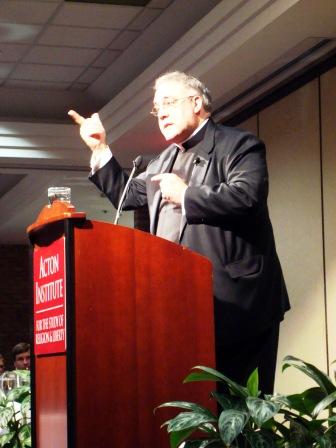
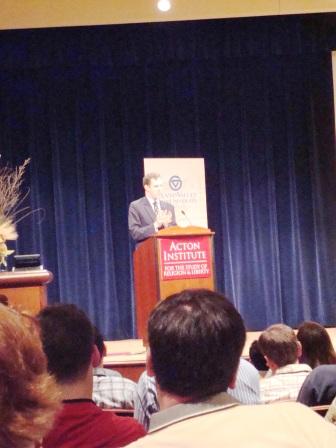
Fr. Sirico speaking on opening night

There are two tracks for participation.  For those who have never been to one of the Acton University events, there are a series of foundational courses, really lectures with lots of Q&A, on principles useful for the rest of the workshops.  Even if people have higher degrees in philosophy or economics, everyone takes the same foundational lectures first.

Since this is the first time I have been to the Acton U, this morning I heard a foundational presentation on Christian Anthropology: Freedom and Virtue.

Acton University: Day 1

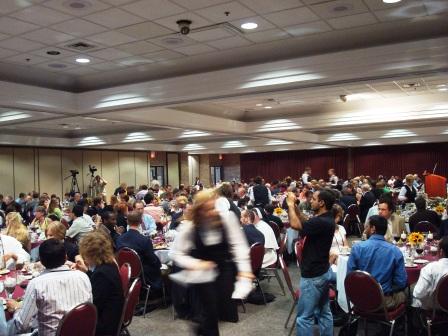
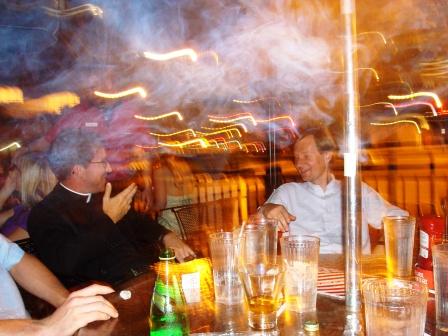
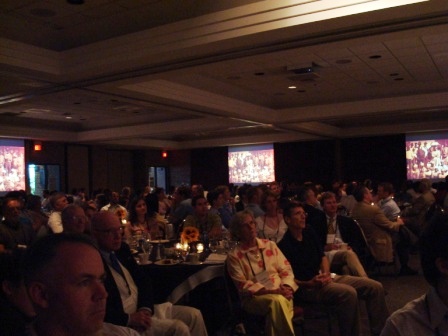
During a meal in the main hall.

In this we explored the nature of man himself.  Of particular importance was understanding how true freedom is actually freedom for virtue, for excellence, rather than freedom from various types of limitations.  So, we need to understand the proper relationship of reason and will, how we make choices, how we must reason and make choices in light of truth and goodness.  We also looked at an opposing view, freedom of indifference, which broke with the Christian virtuous liberty tradition.  The one who introduced this is principally William of Ockham (+1354).  the consequences freedom simply being seen as a neutral faculty of choice were very destructive: in the final analysis this approach leaves everyone in a conflict, clash of wills.  So, in the lecture we made a case for a Christian understanding of virtuous liberty in opposition, or as a remedy these days, to the nominalist view of Ockham, et. al.  We must restore right reason to its proper place in anthropology and put reason in the correct relationship with will and also faith.

Acton University: Day 1

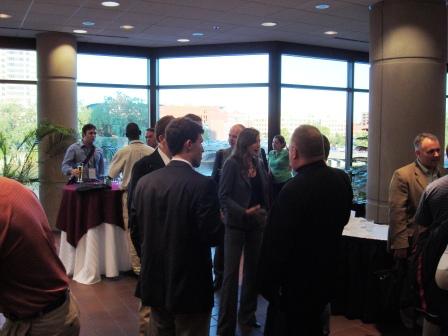
Folks talking during a break

Then there was a presentation on Christianity and the Idea of Limited Government.  In this presentation we looked at the Christian influence on the concept of limited government, namely, that the state derives its authority from God and is subject to God.  Because human beings need other people in order to flourish and live virtuously there must be some sort of government.  But we are fallen, so there must also be the possibility of coercion… but in a limited sense and in certain spheres only to the extent that the common good requires it.  We must correctly understand what "common good" means.   Natural Law helps us place the proper limits on government and helps us resolve conflicts at the right level.  The principle of subsidiarity, properly understood, helps us understand to what level and to what extent government should and must get involved with various spheres of society.

Acton University: Day 1

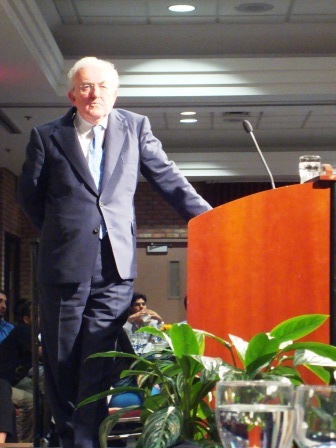
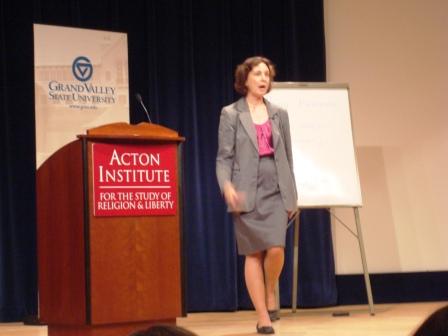
Samuel Gregg speaks

After each section, the audience could ask questions.  You can tell there are highly educated people in this group.  Some of the questions were pretty hard, but the presenters handled them well and gave answers that the general participant could grasp.

So far so good!  Lunch is over.  I am on a break.  The next session is starting in a little while.

Acton University: Day 1

CONTINUATION:

In the afternoon, Jennifer Roback Morse gave a stupendous presentation on economics, address the question of how economists approach things.

Acton University: Day 1

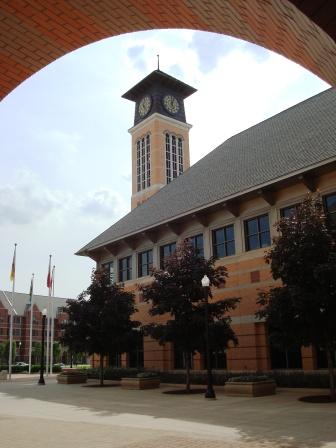
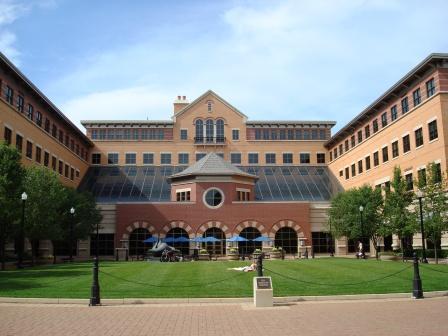
Part of the campus

A working premise is that economics and Christian anthropology share the conviction that there is a truth which we can discover.  Human nature is stable enough that we can study it and can make some determinations or predictions about how people with behave, or respond to incentives.

She then exposed two ways of working.  First she talked economy as the science of scarcity, the allocation of resources among competing groups.  Because we are grounded in a material world, resources are limited.  A problem rests in the fact that not everything humans are involved with is subject to this.  Also, humans did not fall into sin because of material scarcity.

Acton University: Day 1

Another way of looking at economics, not as prevalent, is to study exchange and trades. Each free, voluntary party in a trade winds up better off by the trade.  Everyone benefits. People work out what is agreeable and each party has gained something useful.

So, we can consider what offers people incentives in exchanges.  The most obvious is money, but there are also time and other kinds of satisfaction.

Acton University: Day 1

Out with some of the guys in the evening

Acton University: Day 1

After these basics we then talked about what kind of information prices convey to us, how human creativity, when not unduly hindered, steps in to make substitutes for things when prices are unreasonable, how competition holds the markets to account.

We discussed Catholic social teaching regarding the right to own property and being voluntary parties in exchanges, the need for a consistent rule of law.

This just scratched the surface.

Also, I don’t have time about the last presentation of the day, which exploded some popular myths.

In the evening, there was a screening of a new film called The Birth of Freedom.

Acton University: Day 1

Watching the film The Birth of Freedom

Posted in SESSIUNCULA |
99 Comments

3,000,000

3,000,000We went over 3 million visits, since I have been keeping stats that is, sometime today.

Thanks to all of you for making this such an interesting and dynamic place.

It depends on you for much of its good character and usefulness.

Posted in SESSIUNCULA |
11 Comments

Incredible as it may seem…

Soooo…. After fleeing Kalamazoo because there was no electricity now there is no internet access at the hotel where we are assigned to stay for the conference.

Thus, I am rather handicapped in how and what I can post. For example, posting photos would be a real hassle.

The front desk told me this morning that they are working on it. They have a “process”.

I knew that Michigan has some problems with people not working, but electricity and Internet seem to be similarly challenged. Grrrrrr!

This is where Zuhlsdorf’s Law kicks in, I think.

In the meantime, last night we had the opening of this conference, Acton University, and it was very good. Fr. Robert Sirico gave a fine foundational address to set the tone for the week and responded to few questions in A spirited way.

If I can get online, and won’t have to continue to post for my phone, I will keep you informed about the doings here.
392 people from 51 countries are attending.

Nevertheless, we don’t have access and I have a deadline today for the paper… a day early this week, wouldn’t you know.

Posted in SESSIUNCULA |
7 Comments