Religious bigot Bill Maher on Pope Benedict XVI

Bill Maher is tasteless and not very funny.  A bad combination for an aspiring comedian.

He is also a bigot.

If you don’t want to watch this, taking his page from the nasty business with that Mormon cult in Texas he basically called the Holy Father a former Nazi and insinuated that he himself is a child abuser.

(This video is no longer available.)

So, Bill Maher insults pretty much every Catholic in the world, and the Vicar of Christ too … remember, he grew up Catholic… then, constrained by HBO to issue an apology, he waffled.

The greater problem is not the faux apology, but rather the fact that he said these things in the first place, apparently with the blessing of HBO.

FoxNews’ Bill O’Reilly has a good response to this:

Play video

My response?  Prayers for Bill Maher, who is a hateful bigot.  He is sore in need of a change of heart.  Perhaps also some act of fasting or almsgiving down the line, since Christ recommends these for some particularly hard cases.

Also, though I don’t watch his show, I will now ask others not to watch it either.  I think expressions of disapproval to HBO are probably in order.


Posted in SESSIUNCULA |
18 Comments

Archbp. of Anchorage, again, on Summorum Pontificum

Archbp. of Anchorage, again, on Summorum PontificumIt is one thing to make a mistake, that’s human.  But to persist in error over a long a period of time,… that is harder to grasp.

I got an e-mail from a reader including a scan of a letter received from H.E. Most Rev. Roger L. Schweitz, Archbishop of Anchorage.

It seems His Excellency is still laboring under the false impression that Summorum Pontificum requires certain things, or that the 1962 Missale Romanum must not be used except when certain criteria are met.  To wit…

1. The 1962 Roman Missal must be celebrated will all of the rubrics in place; These would include a sanctuary that has 3 steps, an altar rail, and an altar that does not face the people and is permanently attached to a wall;

2. The priest must use all of the approximately 400 rubrics required for a licit and valid celebration of the Mass;

3. The priest must be able to use the Latin language in the appropriate fashion;

4. All of the vestments must be those approved for the 1962 Roman Missal;

5. There must be a stable community that desires and will benefit from the celebration of the 1962 Rite.

Incredible, no?

The thing is, His Excellency wrote this before and on 25 February WDTPRS wrote about him writing it.

I am sure that many of you readers can pick this apart and show, perhaps better I, how simply wrong are the impressions of the person who wrote this for the Archbishop.

However, we can have a couple brief comments.

1) Of course the rubrics must be observed!  That applies to the 2002 Missale Romanum also!  I wonder how stringently that is being observed?   But neither 3 steps nor an altar fixed to the wall are obligatory for the celebration of the older Mass. 

2) 400 rubrics?  Big deal!  The Novus Ordo has rubrics too.  Priests could learn them before.  They can learn them now.  

3) I should hope the priest wouldn’t use Latin in an inappropriate fashion!  Quod Deus avertat!

4) Approved vestments… so?  Again, big deal.  But, who would say that if you don’t follow all the rubrics the Mass is invalid?  If, for example, I forget to say a Gloria on the day of a saint that should have a Gloria, will the Mass be invalid?  If I forget to omit blessing the water during a Requiem, the Mass is invalid?  What if I omit a geneflection or two because I have a broken leg? 

5) The "stable community" issue must not be so strictly interpreted so that nobody can have it.
 

Posted in SESSIUNCULA |
31 Comments

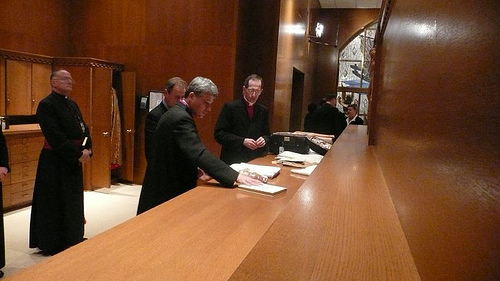
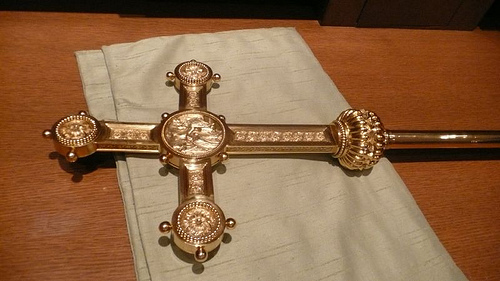
Insider view of sacristy before Papal Vespers in Washington

Please visit Order of Preachers for a view of the sacristy before Papal Vespers the other day in Washington, DC.

Here are samples.

Insider view of sacristy before Papal Vespers in Washington

Insider view of sacristy before Papal Vespers in Washington 


Posted in SESSIUNCULA |
8 Comments

Benedict XVI to the United Nations

Here is the text of the Holy Father’s address to the United Nations with my emphases and comments.   [The English voice over from the UN was slightly different in a few minor places than what was released by the Holy See.]

Mr President,
Ladies and Gentlemen,

As I begin my address to this Assembly, I would like first of all to express to you, Mr President, my sincere gratitude for your kind words. My thanks go also to the Secretary-General, Mr Ban Ki-moon, for inviting me to visit the headquarters of this Organization and for the welcome that he has extended to me. I greet the Ambassadors and Diplomats from the Member States, and all those present. Through you, I greet the peoples who are represented here. They look to this institution to carry forward the founding inspiration to establish a "centre for harmonizing the actions of nations in the attainment of these common ends" of peace and development (cf. Charter of the United Nations, article 1.2-1.4). As Pope John Paul II expressed it in 1995, the Organization should be "a moral centre where all the nations of the world feel at home and develop a shared awareness of being, as it were, a ‘family of nations’" (Address to the General Assembly of the United Nations on the 50th Anniversary of its Foundation, New York, 5 October 1995, 14).

Through the United Nations, States have established universal objectives which, even if they do not coincide with the total common good of the human family [Note well this distinction] , undoubtedly represent a fundamental part of that good. [It isn’t perfect, but it is useful.] The founding principles of the Organization – the desire for peace, the quest for justice, respect for the dignity of the person, humanitarian cooperation and assistance – express the just aspirations of the human spirit, and constitute the ideals which should underpin international relations. As my predecessors Paul VI and John Paul II have observed from this very podium, all this is something that the Catholic Church and the Holy See follow attentively and with interest, seeing in your activity an example of how issues and conflicts concerning the world community can be subject to common regulation. [subject to common regulation] The United Nations embodies the aspiration for a "greater degree of international ordering" (John Paul II, Sollicitudo Rei Socialis, 43), inspired and governed by the principle of subsidiarity, [I think this mightbe one of the key issues – to what level should issues be handled at the level of the UN: in other words butt out, UN, when you don’t need to get involved.] and therefore capable of responding to the demands of the human family through binding international rules and through structures capable of harmonizing the day-to-day unfolding of the lives of peoples. This is all the more necessary at a time when we experience the obvious paradox of a multilateral consensus that continues to be in crisis because it is still subordinated to the decisions of a few, whereas the world’s problems call for interventions in the form of collective action by the international community.

Indeed, questions of security, development goals, reduction of local and global inequalities, protection of the environment, of resources and of the climate, require all international leaders to act jointly and to show a readiness to work in good faith, respecting the law, [which means there has to be a body of international law – the Holy Father is really talking about a certain measure of formalized globalization, it seems.] and promoting solidarity with the weakest regions of the planet. I am thinking especially of those countries in Africa and other parts of the world which remain on the margins of authentic integral development, and are therefore at risk of experiencing only the negative effects of globalization. [Here is a negative result of globalization.] In the context of international relations, it is necessary to recognize the higher role played by rules and structures that are intrinsically ordered [natural law, at least] to promote the common good, and therefore to safeguard human freedom.  [Read this comment against the backdrop of what the E.U. did, in rejecting, explicitly, any mention of GOD in their constitution.] These regulations do not limit freedom. On the contrary, they promote it when they prohibit behaviour and actions which work against the common good, curb its effective exercise and hence compromise the dignity of every human person. In the name of freedom, there has to be a correlation between rights and duties, by which every person is called to assume responsibility for his or her choices, made as a consequence of entering into relations with others. [Freedom not to do what you want, but what is right.]  Here our thoughts turn also to the way the results of scientific research and technological advances [I suppose this refers mainly to genetic research.] have sometimes been applied. Notwithstanding the enormous benefits that humanity can gain, some instances of this represent a clear violation of the order of creation, to the point where not only is the sacred character of life contradicted, but the human person and the family are robbed of their natural identity. Likewise, international action to preserve the environment and to protect various forms of life on earth must not only guarantee a rational use of technology and science, but must also rediscover the authentic image of creation. [This seems to go somewhat farther than natural law.] This never requires a choice to be made between science and ethics: rather it is a question of adopting a scientific method that is truly respectful of ethical imperatives.

Recognition of the unity of the human family, and attention to the innate dignity of every man and woman, today find renewed emphasis in the principle of the responsibility to protect. This has only recently been defined, but it was already present implicitly at the origins of the United Nations, and is now increasingly characteristic of its activity. Every State has the primary duty to protect its own population from grave and sustained violations of human rights, as well as from the consequences of humanitarian crises, whether natural or man-made. If States are unable to guarantee such protection, the international community must intervene with the juridical means [juridical] provided in the United Nations Charter and in other international instruments. The action of the international community and its institutions, provided that it respects the principles undergirding the international order, should never be interpreted as an unwarranted imposition or a limitation of sovereignty. On the contrary, it is indifference or failure to intervene that do the real damage. What is needed is a deeper search for ways of pre-empting and managing conflicts by exploring every possible diplomatic avenue, and giving attention and encouragement to even the faintest sign of dialogue or desire for reconciliation.  [It sounds like the Holy Father is addressing the world’s inaction in regard to places like Darfur and also perhaps referencing the conflict in Iraq.]

The principle of "responsibility to protect" was considered by the ancient ius gentium as the foundation of every action taken by those in government with regard to the governed: at the time when the concept of national sovereign States was first developing, the Dominican Friar Francisco de Vitoria, rightly considered as a precursor of the idea of the United Nations, [!] described this responsibility as an aspect of natural reason shared by all nations, and the result of an international order whose task it was to regulate relations between peoples. Now, as then, this principle has to invoke the idea of the person as image of the Creator, [this goes beyond natural law] the desire for the absolute and the essence of freedom. The founding of the United Nations, as we know, coincided with the profound upheavals that humanity experienced when reference to the meaning of transcendence and natural reason was abandoned, and in consequence, freedom and human dignity were grossly violated. [If you don’t consciously refer to natural law and a Creator, disaster occurs] When this happens, it threatens the objective foundations of the values inspiring and governing the international order and it undermines the cogent and inviolable principles formulated and consolidated by the United Nations. [He seems to be saying that the very reason for the UN, its very existence, depends on it integrating the right principles into their deliberations.] When faced with new and insistent challenges, it is a mistake to fall back on a pragmatic approach, limited to determining "common ground", minimal in content and weak in its effect.

This reference to human dignity, which is the foundation and goal of the responsibility to protect, leads us to the theme we are specifically focusing upon this year, which marks the sixtieth anniversary of the Universal Declaration of Human Rights. This document was the outcome of a convergence of different religious and cultural traditions, all of them motivated by the common desire to place the human person at the heart of institutions, laws and the workings of society, and to consider the human person essential for the world of culture, religion and science. Human rights are increasingly being presented as the common language and the ethical substratum of international relations. At the same time, the universality, indivisibility and interdependence of human rights all serve as guarantees safeguarding human dignity. It is evident, though, that the rights recognized and expounded in the Declaration apply to everyone by virtue of the common origin of the person, who remains the high-point of God’s creative design for the world and for history. They are based on the natural law inscribed on human hearts and present in different cultures and civilizations. Removing human rights from this context would mean restricting their range and yielding to a relativistic conception, according to which the meaning and interpretation of rights could vary and their universality would be denied in the name of different cultural, political, social and even religious outlooks. This great variety of viewpoints must not be allowed to obscure the fact that not only rights are universal, but so too is the human person, the subject of those rights. ["We hold these truths to be self-evident…"]

The life of the community, both domestically and internationally, clearly demonstrates that respect for rights, and the guarantees that follow from them, are measures of the common good that serve to evaluate the relationship between justice and injustice, development and poverty, security and conflict. The promotion of human rights remains the most effective strategy for eliminating inequalities between countries and social groups, and for increasing security. Indeed, the victims of hardship and despair, whose human dignity is violated with impunity, become easy prey to the call to violence, and they can then become violators of peace. The common good that human rights help to accomplish cannot, however, be attained merely by applying correct procedures, nor even less by achieving a balance between competing rights. The merit of the Universal Declaration is that it has enabled different cultures, juridical expressions and institutional models to converge around a fundamental nucleus of values, and hence of rights. Today, though, efforts need to be redoubled in the face of pressure to reinterpret the foundations of the Declaration and to compromise its inner unity so as to facilitate a move away from the protection of human dignity towards the satisfaction of simple interests, often particular interests. The Declaration was adopted as a "common standard of achievement" (Preamble) and cannot be applied piecemeal, [This seems to be a concrete thing he is trying to accomplish.] according to trends or selective choices that merely run the risk of contradicting the unity of the human person and thus the indivisibility of human rights.

Experience shows that legality often prevails over justice when the insistence upon rights makes them appear as the exclusive result of legislative enactments or normative decisions taken by the various agencies of those in power. When presented purely in terms of legality, rights risk becoming weak propositions divorced from the ethical and rational dimension which is their foundation and their goal. The Universal Declaration, rather, has reinforced the conviction that respect for human rights is principally rooted in unchanging justice, on which the binding force of international proclamations is also based. This aspect is often overlooked when the attempt is made to deprive rights of their true function in the name of a narrowly utilitarian perspective. Since rights and the resulting duties follow naturally from human interaction, it is easy to forget that they are the fruit of a commonly held sense of justice built primarily upon solidarity among the members of society, and hence valid at all times and for all peoples. This intuition was expressed as early as the fifth century by Augustine of Hippo, one of the masters of our intellectual heritage. He taught that the saying: Do not do to others what you would not want done to you "cannot in any way vary according to the different understandings that have arisen in the world" (De Doctrina Christiana, III, 14). Human rights, then, must be respected as an expression of justice, and not merely because they are enforceable through the will of the legislators.

Ladies and Gentlemen,

As history proceeds, new situations arise, and the attempt is made to link them to new rights. Discernment, that is, the capacity to distinguish good from evil, becomes even more essential in the context of demands that concern the very lives and conduct of persons, communities and peoples. In tackling the theme of rights, since important situations and profound realities are involved, discernment is both an indispensable and a fruitful virtue.  [I think this is as close as he will get to talking about abortion and contraception and the UN’s role in their promotion in third world countries.]

Discernment, then, shows that entrusting exclusively to individual States, with their laws and institutions, the final responsibility to meet the aspirations of persons, communities and entire peoples, can sometimes have consequences that exclude the possibility of a social order respectful of the dignity and rights of the person. [States must be responsible to each other.]  On the other hand, a vision of life firmly anchored in the religious dimension [!] can help to achieve this, since recognition of the transcendent value of every man and woman favours conversion of heart, which then leads to a commitment to resist violence, terrorism and war, and to promote justice and peace. This also provides the proper context for the inter-religious dialogue that the United Nations is called to support, just as it supports dialogue in other areas of human activity. Dialogue should be recognized as the means by which the various components of society can articulate their point of view and build consensus around the truth concerning particular values or goals. It pertains to the nature of religions, freely practised, that they can autonomously conduct a dialogue of thought and life. If at this level, too, the religious sphere is kept separate from political action, then great benefits ensue for individuals and communities. [Again, we have the experience of the EU, not to mention materialistic totalitarian states.]  On the other hand, the United Nations can count on the results of dialogue between religions, and can draw fruit from the willingness of believers to place their experiences at the service of the common good. Their task is to propose a vision of faith not in terms of intolerance, discrimination and conflict, but in terms of complete respect for truth, coexistence, rights, and reconciliation.

Human rights, of course, must include the right to religious freedom, understood as the expression of a dimension that is at once individual and communitarian – a vision that brings out the unity of the person while clearly distinguishing between the dimension of the citizen and that of the believer.  [This seems to refer not only places like China, but also the Middle East.  Go back and read Benedict’s first Message for the World Day for Peace, which identifies the players in this matter of religious liberty and the roots of peace.] The activity of the United Nations in recent years has ensured that public debate gives space to viewpoints inspired by a religious vision in all its dimensions, including ritual, worship, education, dissemination of information and the freedom to profess and choose religion. It is inconceivable, then, that believers should have to suppress a part of themselves – their faith – in order to be active citizens. It should never be necessary to deny God in order to enjoy one’s rights. [Excellent.] The rights associated with religion are all the more in need of protection if they are considered to clash with a prevailing secular ideology or with majority religious positions of an exclusive nature. The full guarantee of religious liberty cannot be limited to the free exercise of worship, but has to give due consideration to the public dimension of religion, and hence to the possibility of believers playing their part in building the social order.  [Moreover, Catholics should have a voice in the public square.  Think of China and Saudi Arabia.  Also, practitioners of other religions have rights that must be defended.] Indeed, they actually do so, for example through their influential and generous involvement in a vast network of initiatives which extend from Universities, scientific institutions and schools to health care agencies and charitable organizations in the service of the poorest and most marginalized. Refusal to recognize the contribution to society that is rooted in the religious dimension and in the quest for the Absolute – by its nature, expressing communion between persons – would effectively privilege an individualistic approach, and would fragment the unity of the person.

My presence at this Assembly is a sign of esteem for the United Nations, and it is intended to express the hope that the Organization will increasingly serve as a sign of unity between States and an instrument of service to the entire human family. It also demonstrates the willingness of the Catholic Church to offer her proper contribution to building international relations in a way that allows every person and every people to feel they can make a difference. In a manner that is consistent with her contribution in the ethical and moral sphere and the free activity of her faithful, the Church also works for the realization of these goals through the international activity of the Holy See. Indeed, the Holy See has always had a place at the assemblies of the Nations, thereby manifesting its specific character as a subject in the international domain. As the United Nations recently confirmed, the Holy See thereby makes its contribution according to the dispositions of international law, helps to define that law, and makes appeal to it.

The United Nations remains a privileged setting in which the Church is committed to contributing her experience "of humanity",  [The Church is the greatest expert in humanity there has ever been.] developed over the centuries among peoples of every race and culture, and placing it at the disposal of all members of the international community. This experience and activity, directed towards attaining freedom for every believer, seeks also to increase the protection given to the rights of the person. Those rights are grounded and shaped by the transcendent nature of the person, which permits men and women to pursue their journey of faith and their search for God in this world. Recognition of this dimension must be strengthened if we are to sustain humanity’s hope for a better world and if we are to create the conditions for peace, development, cooperation, and guarantee of rights for future generations.

In my recent Encyclical, Spe Salvi, I indicated that "every generation has the task of engaging anew in the arduous search for the right way to order human affairs" (no. 25). For Christians, this task is motivated by the hope drawn from the saving work of Jesus Christ. That is why the Church is happy to be associated with the activity of this distinguished Organization, charged with the responsibility of promoting peace and good will throughout the earth. Dear Friends, I thank you for this opportunity to address you today, and I promise you of the support of my prayers as you pursue your noble task.

Before I take my leave from this distinguished Assembly, I should like to offer my greetings, in the official languages, to all the Nations here represented.

[in English; in French; in Spanish; in Arab; in Chinese; in Russian:]

If I had written this speech, I would have made an explicit reference to the rights of children, and the rights of unborn children.  I think this address lacks that dimension and it is a bit weak without it.  

On the other hand, I wonder if it wasn’t purposely left out so as not to derail the other content with problems of accusations of not having protected children from that tiny minority of priests, etc.  I can imagine a debate about this up in SecState.

Even for those lacunae, this could still be a foundation, or explanation, of a Christian humanism.

____

(This video is no longer available.)
 

Posted in SESSIUNCULA |
25 Comments

Blogs I look at react to the Washington D.C. Mass – UPDATED

[uc]

Some reactions from the internet.  My emphases and comments throughout:

Over at DC Catholic there is an entry responding to my own comments here at WDTPRS:

I was in attendance today and found the experience incredibly moving. I would like to caveat my comments by saying I only attend the Extraordinary Form, but I couldn’t stop from weeping tears of Joy. [A "Yes" vote… though not for the music, perhaps.] Was the music what I like? No. Was it a traditional liturgy? No. But the presence of the Holy Father seemed to repair any faults in the Mass. I guess it’s not something that one can appreciate via TV or radio.  [From a personal, experiential view, this is okay, I suppose.  I am very glad it was a great experience!  But the concern so many had for the music choices goes way beyond just how we feel at this great event!  We must avoid reducing the issue of the music to "taste".  There is a great more to this matter than simply what we like and don’t like.]

    Today I reaffirmed my baptismal vows to the Successor of St. Peter. Today, God gave me the grace to see a glimpse of Heaven, where a huge multitude of faithful were adoring God with genuine outpourings of faith and fidelity.

    I was sitting with a group of gentlemen in discernment for the priesthood in the Archdiocese and there were native speakers of every language spoken at the Mass, Vietnamese, Spanish, and even Igbo.

    The Holy Father’s visit to the city where I live provided me with an abundance of grace and I cannot, in good conscience, criticize the liturgy.  [Fair enough.]

Over a Ten Reasons:

"Look how wonderful we are, Your Holiness!"

Whoever wrote Archbishop Wuerl’s welcome for the Papal Mass at Nationals Stadium should resume his career as a diversity consultant.

Ditto for the liturgist. The "multicultural" music (Raymond Arroyo’s description) for the offertory and the beginning of the Eucharistic prayer simply has no place in the Mass. We’ve heard so much about "active participation" by the laity. Explain to me how anyone in attendance can hum these … pop stylings, much less sing them. (Is that a bass guitar and saxophone I hear as Communion is distributed?) Appalling. [A "No" vote?]

"Perhaps those responsible for this are unfamiliar with Pope Benedict’s many writings on the liturgy," Fr. Neuhaus said. [On EWTN] One can hope New York is more faithful to the Spirit of that liturgy.

At Argent by the Tiber

Music at the outdoor Mass

…horrid, horrid….NOOOOOOOOOOOO!!!! not Marty Haugen….Holy, Holy, Holy

After that horrible psalm then the dreadful offertory salsa music, which Raymond Arroyo called, "Amazon flavor"…then the awful Veni creator with Indian flute to be crowned by Haugen.

Aaaaaaaaaaaaaaaaaaaaaaaaarrrghhhhh!!!!!!!  [I think she didn’t like it.]

Update…yikes with the Christ has died….and then the fanfare with the Great Amen. Horrid, horrid.

So far, they have managed to mangle the Gregorian chants. The Gloria, then Veni, now Ubi…then this communion dreadful meandering stuff….who wrote this? I haven’t looked at the Mass companion booklet.

Oh, and furthermore, this style of music really is ugly for the human voice. Did you hear how the quality of singing degenerated?

Oh, no, now electronic piano. AAAAAAAAAAAAAAAAARRRRRRRRRRRRRGGGGGGGGGGGHHHHHHHHHHH!!!!

NOOOOOOOOOOOOOOOOOOOOOOOOOO!!!!!!!!!!!

Nooooooooo, clapping at Holy Communion. THIS.IS.JUST.DREADFUL. HOW.TOTALLY.EMBARRASSING!!!!!!!!!!!!  [That would be a "No" vote, then.]

The Holy Father is now sitting during Communion…his head is bowed. Please forgive us, Holy Father.

What is this dreadful setting of Pange lingua gloriosi? How hard would it have been for the choir to have learned the chant? No, we have to turn this into an operetta type duet.

Oh, caterwauling now…yes, my new mantra…overweening display of mult-culturalism.

Panis angelicus….stop.the.clapping…Mr. Domingo would prefer you to meditate. Good grief!

Papa…let us pray…

Update…the Mass is ended.

Do you know what is tragic about this mess of music? Those of us working in the parish level who are working hard to bring music back into line will now have another hill to climb. Guess what we’ll hear? "Well, if it’s good enough for a Papal Mass, it’s good enough here."

*bangs head on my desk*

Come Holy Spirit, descend upon us and renew us. Fill us with your power. Inspire us with Truth and Beauty.

And now over the pond we go to my friend Fr. Blake at St. Mary Magdelenen in the UK said:

I made a point of having a late lunchand going to EWTN to watch Mass from Washington, I am not sure I can cope with much more, so far there has been a fat priest in lounge suit waving his arms about, bastardised Missa di Angelis Gloria with chime bar accompanyment, a not very nice responsorial psalm, [you can say that again] more appropriate to a musical on Broadway.  [Or a circus.]

The first and second reader and cantor of the psalm have all been women, and they seem to have been chosen for their overacting ability, rather than any ability to communicate the Word of God prayerfully. There is a distinct absence of a sense of prayer and real spiritual participation here.

How blessed one is being a priest, I would be tempted to lapse inside a year if I had to endure this stuff week after week, how the laity are tortured by the clergy! Shameless self indulgence on behalf of someone, the worst aspects Americanism.  [hrumpf!]

I can’t endure more!

Words like meaningless, culturally bankrupt, saccharine, lack of intellectual conviction, trivial, decadent, debased, rootless, superficial, inauthentic, inconsequential, secular, horizantalist come to mind, none of these words come to mind when [one] thinks of the Pope.

Is this really the image that AmChurch wants to present to itself and the world?

Badly done Archbishop Wuerl, very badly done.

[Another "No" vote.]

The Crescat offers this:

seriously, so how many of you …

… just ended up putting the Papal Mass on mute to escape the music?

[No doubt that was a "No" vote!]

Did the event organizers read anything the Pope has written on sacred music?

A very good question.  I think the answer is "yes", actually.  Bu they had another agenda.

NLM took a wait and see stand (posted before the Mass).

It is perhaps worthwhile to note that people should manage their expectations with regard to these events. If you are expecting liturgies as you might see them at in St. Peter’s Basilica, Rome, or which fully confirm with Pope Benedict’s liturgical vision, that would not be terribly realistic for a variety of pragmatic reasons.

In view of this, the NLM’s own approach and focus for these events will be upon those things which can be understood as helping push forward one or another aspect of Benedict’s programme for liturgical reform in continuity.

Uh huh.

So far they haven’t posted anything else.  Is this an example of "If you don’t have anything nice to say…."… you know the rest?

At Thrown Back Fr. Johansen has some comments.  Here are some excerpts.

I also was struck by the apocalyptic tone of many comments [about the Mass on the blogosphere] as well. Quite a few suggested that the DC Mass indicated that the Reform movement had failed, and that we were henceforth doomed to Haugen, Haas, and the St. Louis Jesuits per omnia saecula saeculorum. [Yes.  That silliness has also been hurled about on WDTPRS.]  Please, people, get a grip. I do believe Jesus had something to say about "the gates of Hell" prevailing, and all that. [I think Father just compared listening to the music of Haugen, et al., to Hell.] Have some faith. Since the liturgy belongs to the Church, and is the "source and summit" of our faith, it seems to me that Our Lord’s promise to the Church extends to the liturgy as well. The Kingdom of God always advances in fits and starts, never in a straight line. One setback is hardly cause to abandon the field. Yes, I’m sure some will be tempted to use the DC Mass as "evidence" to perpetuate the Americanized "Spirit of Vatican II" liturgy. But really, that whole way of thinking is becoming more and more patently dated by the day. It just isn’t flying anymore, because more and more people are becoming aware of what Vatican II really taught about the liturgy, and Pope Benedict’s teaching in this area is having an inexorable effect. The priests ordained in the last 10 years are almost universally tradition-friendly, and that trend is only expanding. The current liturgical disorder wasn’t created overnight, and it won’t be undone overnight.

…

Which brings me to the larger point. Archbishop Wuerl, in his greeting of the Holy Father at the beginning of the Mass, stressed the different cultures and ethnicities represented at the Mass. Fr. Neuhaus observed that the spirit of "multiculturalism" pervaded the Mass. A different EWTN commentator, after the Mass, gushed about how the Mass represented the "diversity" of the Church in America. Others waxed about how the Mass was an opportunity for the Church in America to show the Holy Father who we are. The problem: That’s. Not. What. Mass. Is. About.

The Mass is not an "opportunity" for me, or we, to "show" anyone anything, let alone "who we are." The Mass is not about "representing" the diversity (or anything else), of those who participate in it. The Mass is about re-presenting the eternal Sacrifice of Christ at the Last Supper and Calvary. It’s about Him, not me, and not even about we.

We live in the age, as Mark Shea has coined the term, of "Generation Narcissus". Our collective motto as a society is "It’s all about me." In liturgical terms, this translates to the "Self-Actualized Community Celebrating Itself in Its Okayness". In our pride and self-centeredness, we want to turn the liturgy around to focus on ourselves. As a priest I have encountered this in many ways. This attitude commonly rears its head in weddings. When, from time to time, I have had to say "no" to the unreasonable liturgical demands of some bride, I have heard the reply "but this is my wedding". To which my response is, "yes, it is, but it’s not about you. At confirmation, graduation, and other special Masses, frequently the organizers try, in ways verging upon the silly, to concoct ways to "involve" all the confirmands or graduates, to give them all something to "do" in the liturgy, because it’s "about" them.

This kind of thinking was evident in the DC Mass. There was a seemingly never-ending parade of cantors, musicians, and pieces of a dizzying variety of styles and ethnic origins, all aimed at trying to "include" every possible different ethnic and racial group. This process had what Amy Welborn aptly called a "frenzied" quality. It seemed frenzied because it was so obviously labored, and so obviously detracted from experiencing the liturgy as any kind of unified whole. This "multicultural" approach failed liturgically, and it also failed in it’s own putative aim: rather than celebrating unity in diversity, or some such thing, it ended up exaggerating the ethnic differences and working against the communio that the liturgy is intended to bring about.

No, the problem, as I heard another priest once say, is that most Catholics "don’t know anymore what the Mass is for. " And not knowing what something is for, we will tend to make it for ourselves. Part of the cause for this state of affairs is the collapse of catechesis in the 70’s and 80’s. …

…

The liturgy, as Pope Benedict has written, should form our culture. But for the last thirty years the prevailing culture, and it’s winds of trend and fashion, has been allowed to to de-form the liturgy. This is the lesson that our bishops and priests must learn. Once again, the evidence of this tendency was glaring in the music at yesterday’s Mass. This process has both damaged the liturgical life of the Church, and weakened Catholic culture. The reversal of the process cannot begin with the prevailing culture that surrounds us – it contains much that is simply antithetical to the Faith. We must begin with the liturgy – as it is understood and lived in the continuity of the Church’s Tradition. We must allow ourselves to be formed by the liturgy, so that we can be conformed to the Something that the liturgy is about. Then we will, almost without consciously trying, begin to rebuild and reform the culture of the Faith and of the world.

Shouts In The Piazza has some observations.

Was the music really that bad?

YES!  [That sure is a "No" vote!]
Was the rest of the liturgical arrangements really that bad?
NO (except for the histrionic women doing the readings.)
Was it sort of typical of the crap many American Catholics suffer through each week?
YES!
Was it a good thing that the Pope got to see first hand how out of sync a liturgy organized by the USCCB is with what he himself has written and preached about concerning good liturgy?
YOU BETCHA!
Is this going to change the state of the liturgical life of the Church in America?

NAH!
But…Donald Wuerl should probably stop having himself measured for scarlet robes, at least for the time being.

Posted in SESSIUNCULA |
118 Comments

A different angle on the Pope’s US visit: The Catholic Herald (UK)

You might want to check out The Catholic Herald, the UK’s best Catholic newpaper, and its take on Pope Benedict’s apostolic journey to the USA.

Posted in SESSIUNCULA |
12 Comments

AP story: different take on Mass at Nationals Stadium

An AP story has different takes on the Mass at Nationals Stadium 

My emphases and comments.

Papal Mass raises questions about role of laity

By ERIC GORSKI – 5 hours ago

WASHINGTON (AP) — For 46,000 Catholics, it was a Mass like no other, with the altar standing on centerfield at a ballpark and the presiding clergyman arriving in a bulletproof vehicle.

But Pope Benedict XVI’s Mass in the nation’s capital Thursday was also different from a typical service in another way: Lay people were not asked to distribute Communion, which was administered exclusively by 300 priests and deacons.  [Just to drill into that word "typical", we should keep in mind that in some contexts (such as liturgy) it doesn’t just mean "usual" but rather "normative", as in the "typical edition of the Roman Missal".  In the case of a Mass where there are so many clergy, it would be an abuse for anyone other than clergy to distribute Holy Communion.  However, it is also very often an abuse in many parishes to employ so many extraordinary ministers, when it is likely that none are needed.]

Organizers of the Mass at Nationals Park were only following the letter of church law. [As I said.  But do you sense a kind of "violated the spirit of Vatican II" coming down the line?] But to some Roman Catholics, the ceremony was symbolic of what they see as Benedict’s desire to erect clear boundaries between clergy and lay people.  [Unreal.  I would say a table altar is a barrier.]

"What he wants to do really is to reinforce the old categories and classifications — different roles for different people," said David Gibson, author of books on Benedict and the future of the U.S. church.  [Sure.  But… that is a good thing.]

"Men and women, priests and lay people. Each one has their role according to their talents, their ordained status in the church."

The clear division of roles doesn’t sit well with all American Catholics, who are used to living in a democracy. [Then they need to have a clearer Catholic identity.  Liturgy is a good place to start with that.  That is the very place we MUST start in most cases.] Some would like a greater say in church affairs, including choosing their parish priests. [I bet they would!] Others cherish the distinct roles held by clergy and point to several examples of the two working together in harmony.

The pope has signaled his position through some relatively small gestures, Gibson said.

For example, the Vatican has issued a document reaffirming that only priests and deacons can touch and clean the chalice after Mass, something many lay people have done.

The Rev. John Wauck, a professor of literature at Rome’s Pontifical University of the Holy Cross, warned against measuring appreciation for the laity by what they can and can’t do in church.  [Precisely.  When you blur the roles of lay people and priests, and try to "empower" lay people by having them do things appropriate to priests, then you are effectively saying that lay people don’t have dignity on their own.  To have importance they must be more like priests.  Being a lay person isn’t good enough.  In fact, this is the worst sort of clericalism there is.  And it is NOT imposed by traditionally leaning Catholics.]

"The life of the church doesn’t take place in sacristies and parish meeting halls alone," Wauck said. "It takes place in homes, shops, sports fields, businesses, hospitals … wherever there are Catholics."

He added: "The relationship between the clergy and the laity can’t be seen in terms of a power struggle. [Which is the feminist view, and usually a feminism of the Marxist variety.] Both are serving the church in their own way."

Because of the priest shortage in the U.S., lay people are increasingly being called upon to run the administrative side of parishes while leaving sacramental duties to clergy.

In 2005, nearly one-quarter of the nation’s 217,000 parishes were without a resident parish priest. At the end of Pope John Paul II’s pontificate, more lay people than clergy were working full-time in American parishes and many of those lay leaders were women.

Lay people also have taken more active roles on parish financial councils and high-profile panels like the church’s National Review Board, which was formed in response to the clergy sex abuse crisis.  [Okay… this is all very interesting, but the writer seems to be drawing an equivalence between liturgical roles and what other things lay people can do in and for the Church.  The argument seems to be: if they can balance the books, they should be able to do everything else too.]

Even so, that board is advisory. Bishops still make policy decisions, and board members have left after complaining their advice was not heeded. [That is really another issue.  Sometimes the advice is bad.  Sometimes the bishops are thick.  But advice is merely advice either way.]

For distribution of the Eucharist, priests and deacons are known as "ordinary" ministers, meaning they should do the job when they are available.

At Thursday’s Mass, 1,500 priests and deacons were in the stadium — five times the number needed, said Susan Gibbs, spokeswoman for the Archdiocese of Washington.

Another staple of parish life — altar boys and girls — also were missing from the Mass. Under papal liturgy guidelines, seminarians perform those duties.  [Well… sure!  Most of them are actually installed lectors and acolytes.  Altar boys and girl altar boys actually only substitute for installed acolytes in their absence.]

But lay people also played high-profile roles, reading the Scripture and serving as cantors and petition readers.  [And I don’t think they should have.  This was a sore spot in the Mass: I got the sense that the organizers instrumentalized these people to force the Mass to be multi-cultural.]

"To me, it’s almost seamless how we work together," said Gibbs, one of nine lay people on the archdiocese’s papal planning committee. "Clergy bring pastoral teaching and direction. Lay people bring business skills, administrative skills." [That seems like common sense to me.  I can’t imagine not consulting people far more experienced than I am on matters of business, etc.]

Patty Olszewski, 51, of Potomoc, Md., was disappointed about the lack of lay Eucharistic ministers — she is one.  [Because its about Patty, right?  I dunno… maybe I am being unfair here.  After all, she didn’t say that, the writer did, about her.  But this seems to be so common in these discussions: it all comes back to "me".]

She describes herself as an anti-abortion Catholic who wishes the church would at least consider women priests and disagrees with church teaching against homosexuality. [Okay,… two solid reasons she probably should not be a distributor of Communion at all, anywhere.  Such a role should also involve a deep commitment to the Church’s teachings.  All of them.  Instead, by making a public statement in this way, she creates confusion.] Even so, she said she’s happy with her role and feels like she’s contributing.

"In everyday life, you don’t feel oppressed by any sort of hierarchy because it’s so heavily populated by the laity," Olswewski said. "That’s ‘We the People.’ The church is all of us."  [This person seems to be confused about the hierarchical structure of the Church, which Jesus Christ gave to us… and which is a gift.  Sure, it depends on how that is embraced and with what charity it is fulfilled.  But this "we are Church" stuff leads down the wrong path every time.]

Erin Johnson, 24, a parish youth minister from Gaithersburg, Md., believes "you either follow the traditions of the church, or you don’t."  [Contrast the attitude of the 24 year old, with that of the 51 year old.  Does that suggest something?  It does to me.  And let’s ask both of them some basic catechism questions.]

"I feel like I have plenty of opportunities to serve," said Johnson, who brought 30 teens to the Mass. "Each individual, every single one of us, has a place."  [Thanks for not having baggage!]


Posted in SESSIUNCULA |
31 Comments

Some problems with the combox

I think there have been problems with the combox. 

They might have come from a moment during the day when, inaptly, the data base seems to have reset itself.  That, I think, screwed up some plugins, including the anti-spam plugin.

I think now the comments box is functioning again. I logged out and posted a test comment and it worked.

Posted in SESSIUNCULA |
Comments Off on Some problems with the combox

NLM on the Papal Mass at Nationals Stadium

NLM has gotten into the act at last, posting an entry about the Holy Father’s Mass in Nationals Stadium.

You should also be visiting their site, but here – at least today – you can read what they offer with my emphases and comments.

It is the grace of all Americans to have Pope Benedict XVI visit this country. And it was to the grave embarrassment of all American Catholics that the music employed at the papal Mass at the Nationals stadium in Washington, D.C., not only represented a repudiation of everything that this pope has written on music appropriate to Mass. We can go further to say that there is no robust tradition of liturgical scholarship that is capable of defending what happened, and that is because it is indefensible.  [Okay… that’s a "No" vote from NLM.]

By now the news is out—the whole world watched this liturgy—and I don’t want to rehearse all the details of the pieces of music in question. It is too painful, [agreed] and there will be plenty of Youtube videos [Oh Lord… I forgot about that….] around for many years to remind us more than we want to be reminded.

Let us talk about principles.

In the name of "multiculturalism," the Pope was subjective to music more suitable to dingy dance halls than Churches. The Psalms of David were distorted to the point of ear-splitting dissonance. The congos, pan flutes, meringue rhythms, the jazz and blues and rock, the swaggering vocals, went beyond even the most pessimistic predictions.

Indeed, when Marty Haugen’s Mass of Creation finally came on at the Sanctus, it was a moment of dignity [Wow… is that sad or what?  When Haugen’s stuff is actually a relief?] —so much so that I want to take back all my negative comments back when I thought that this Mass setting was unsuitable for a Papal Mass. I don’t think anyone knew before this what the phrase "unsuitable" could really mean.

I personally feel the greatest hurt toward American Catholics of diverse races and ethnicities, who have been quite viciously caricatured here. How wounded they must personally feel by this presentation done in their name.

Blues and jazz – intended to appeal to African Americans? What about those African Americans who sing in chant scholas, are accomplished singers, are working to actually compose excellent sacred music?  [I just had this conversation in Virginia a few days ago when, while travelling there, I stopped at a historic church where there was a Sunday Mass taking place.  Had it not been for the stained glass windows, I would have had not a clue I was in a Catholic church.  I would have thought I was in a southern baptist church.  Who was it that told Catholic African Americans that they had to do certain sorts of things when, for so long, they were simply Catholic along with everyone else?]

Meringue for Hispanic Americans? Please. Does this include the Hispanic scholar who wrote me about an hour ago with heartbreak at what saw and heard? He is an expert in the polyphonic music tradition of Latin America, and has done extremely important work in showing how the themes from chant strongly informed the construction of 16th century mass settings.

And were all those wacky instruments somehow supposed to appeal to Asians? I recall can’t go on here. There is grave insult at the heart of all these attempts to construct styles that appeal to all people, pigeonholing their tastes the same way a racialist writing in the 1930s might do. This is not unity but division. [Whew….]

I know that none of this was intended, [They were trying to give us a sense of "New Pentecost", I think.  It turned out to be the opposite.  The division of languages is a sign of man’s divisions, whereas at Pentecost people heard the apostles in unity, their own languages.  I think Latin could have done that.] but let us remember that we are united in Christ, united in our Catholicism. The Pope has written in his book The Spirit of the Liturgy that the issue of multicultural was confronted and dealt with early in the Christian history, as the Roman Rite developed to deal with intense diversity of early converts from many regions and language groups. The result was the Latin language in liturgy, and Gregorian Chant and its timeless and universal sound, together with the text of the Psalms that speak to universal impulses in the human person. True multiculturalism is achieved in the Roman Rite itself, a point which is still emphasized in Church teaching. [Amen.  Well said.]

This is not inaccessible knowledge. The Second Vatican Council stated very plainly that Gregorian chant and polyphony should enjoy primacy of place at Mass. This teaching has been restated by the Pope time and again. This is not his personal taste at work, nor mine. Chant is the music of the Mass. Styles that elaborate on chant are also suitable. What the liturgy does not admit are styles that are at war with the liturgical sense and purpose of reaching outside of ourselves and into eternity. We face a choice between Apollo and Dionysius, wrote Cardinal Ratzinger.

"The Church’s Tradition has this in mind when it talks about the sober inebriation caused in us by the Holy Spirit. There is always an ultimate sobriety, a deeper rationality, resisting any decline into irrationality and immoderation. We can see what this means in practice if we look at the history of music. The writings of Plato and Aristotle on music show that the Greek world in their time was faced with a choice between two kinds of worship, two different images of God and man. Now what this choice came down to concretely was a choice between two fundamental types of music. On the one hand, there is the music that Plato ascribes, in line with mythology, to Apollo, the god of light and reason. This is the music that draws senses into spirit and so brings man to wholeness. It does not abolish the senses, but inserts them into the unity of this creature that is man. It elevates the spirit precisely by wedding it to the senses, and it elevates the senses by uniting them with the spirit. Thus this kind of music is an expression of man’s special place in the general structure of being. But then there is the music that Plato ascribes to Marsyas, which we might describe, in terms of cultic history, as “Dionysian”. It drags man into the intoxication of the senses, crushes rationality, and subjects the spirit to the senses. The way Plato (and more moderately, Aristotle) allots instruments and keys to one or other of these two kinds of music is now obsolete and may in many respects surprise us. But the Apollonian/Dionysian alternative runs through the whole history of religion and confronts us again today." [This morning in Nationals Stadium.]

Let me add here as an aside that I do not believe it is correct to describe this as a typical "American" event. The fact is that there are hundreds of parishes in this country that have wonderful liturgy, gorgeous music, and musicians all over the country are working very hard, at sometimes little or no pay, to learn sacred music and use it in liturgy. This is a movement of great vibrancy and growing numbers, and all the trends here are up in every way. This movement involves mostly young people who are seeking to do their best. They are Americans too. It is wrong to let a small cable [I think that is ‘cabal’] that took control of the Washington liturgy define the whole country and its liturgical sense." [Right.  I think that is one of the most insulting and disappointing results of this.]

What is the current situation in the aftermath of this Mass? There is no question that anger, even fury, is palpable. The USCCB has been deleting comments from its own website. Fr. Richard J. Neuhaus, in his running commentary on EWTN, expressed astonishment. The blogs are overflowing with bitter comments. The traditionalists are having a grand time, unjustly [not to mention stupidly] trashing the "Novus Ordo," as if the ordinary form of the Roman Rite is responsible for this.

Something tells me that this Mass is a defining moment, and possibly the end of an era. [A last gasp?]  For many years, a certain tendency of liturgical aesthetic has said that we need to loosen up, use music that appeals to our sense of things as collected from the secular world, to use music that has a beat and is drawn from the world in which we live. We need to forget all that solemn chant and "classical" stuff and move on. And what we saw this morning was the result — perhaps not the intention, but once you lose track of the liturgical ideals, there are no limits. The "no limit" model was put on display for the Pope himself this morning, while onlookers cringed. [I know my reaction, hearing this at a distance, overly amplified, etc.  I will look forward to hearing reactions of people who were actually there.  I hope they chime in with their impressions and those of people around them.]

I can understand the outrage, but the question is how it can be turned toward the good?reductio ad absurdum of the pseudo-multicultural, non-liturgical approach to music, where can we turn to re-root ourselves? The answer is the same now as it has always been: The Graduale Romanum and Church legislation. [As Msgr. Schuler used to write again and again when he was editor of Sacred Music: "Just do what the Council asked!"] The propers attached to the Votive Mass of the Holy Spirit, the Mass that was offered this morning, are posted at Cantemus Domino. You will hear in them the true music of the Church.

But can these propers and a Gregorian ordinary really sound right in a stadium? [That is a good question.]  It’s all the more important that they be used in this setting, as a way of infusing the place with the dignity and solemnity of the Christian liturgy. [Okay… but I am only half way with this: I am not sure there should be stadium Masses.  But that is another question.]  And who will sing them? There are Gregorian scholars around the Washington area. There are workshops. There are chant books and tutorials. There is a way to learn them and sing this music that is appropriate to the Mass. [There is no way anyone will ever convince me that in that metropolitan area, the nation’s capitol, a Gregorian schola could not have been developed which would have brought the whole listening world to their knees in wonder at what America can do even with liturgical music.  The White House ceremony the day before, and the perfect propriety of every single piece performed, put this whole thing to shame.]  If it is done properly, the music not only enhances the Mass; the Mass itself dwells within the music, not as performance art but as sung prayer. This is the ideal. No effort to provide music for Mass should ever proceed without an awareness of that ideal.

Without that ideal, what are we left with? Let the Pope answer:

"When the community of faith, the world-wide unity of the Church and her history, and the mystery of the living Christ are no longer visible in the liturgy, where else, then, is the Church to become visible in her spiritual essence? [The music for this Mass split us from our past, from elsewhere in the world, and from ourselves as a blended nation.  It totally failed.]  Then the community is celebrating only itself, an activity that is utterly fruitless. And, because the ecclesial community cannot have its origin from itself but emerges as a unity only from the Lord, through faith, such circumstances will inexorably result in a disintegration into sectarian parties of all kinds – partisan opposition within a Church tearing herself apart. This is why we need a new Liturgical Movement, which will call to life the real heritage of the Second Vatican Council."

Let us use this occasion to recommit ourselves and re-root ourselves to the Church’s own liturgical language. Let us close the chapter on this event and move on. Let us stop what we have been doing to our heritage of inestimable value. We can do better. We must. Benedict’s own writings show the way.


Posted in SESSIUNCULA |
95 Comments

USCCB live feed

How do you e-mail these people doing live feed from the USCCB to tell them to shut up and just let us hear the live feed?  Experience the moment of the Pope at CUA without the incessant chatter?

Rev. David Toups and Olivia Paff…. BE QUIET!


Posted in SESSIUNCULA |
2 Comments