O God of love, compassion, and healing, look on us, people of many different faiths and traditions, who gather today at this site, the scene of incredible violence and pain.
We ask you in your goodness to give eternal light and peace to all who died here— the heroic first-responders:
our fire fighters, police officers, emergency service workers, and Port Authority personnel, along with all the innocent men and women who were victims of this tragedy simply because their work or service brought them here on September 11, 2001.
We ask you, in your compassion to bring healing to those who, because of their presence here that day, suffer from injuries and illness.
Heal, too, the pain of still-grieving families and all who lost loved ones in this tragedy.
Give them strength to continue their lives with courage and hope.
We are mindful as well of those who suffered death, injury, and loss on the same day at the Pentagon and in Shanksville, Pennsylvania.
Our hearts are one with theirs as our prayer embraces their pain and suffering.
God of peace, bring your peace to our violent world: peace in the hearts of all men and women and peace among the nations of the earth.
Turn to your way of love those whose hearts and minds are consumed with hatred.
God of understanding, overwhelmed by the magnitude of this tragedy, we seek your light and guidance as we confront such terrible events.
Grant that those whose lives were spared may live so that the lives lost here may not have been lost in vain.
Comfort and console us, strengthen us in hope, and give us the wisdom and courage to work tirelessly for a world where true peace and love reign among nations and in the hearts of all.
Our friend Amy alerted me to an article in Commonwealwhich could be of interest to WDTPRSers.
My emphases and comments.
A Posture for Prayer
Posted by [Fr.] Robert P. Imbelli [prof at Boston College] on April 19, 2008, 12:53 pm
Those, who watched on television the Mass at Saint Patrick’s Cathedral, saw, from time to time, the large cross placed on the altar, between the Pope and the assembly. It is Benedict’s effort to introduce a spiritual “ad orientem” posture to the eucharistic liturgy. [He gets it. Thank you, Father.]
Yesterday, at the request of a group of Boston College students, I celebrated Mass with them in the lower church of the parish where I reside. For the first time since I was ordained, I prayed the eucharistic prayer of the ordinary form of the Roman rite facing in the same direction as the congregation, with a standing cross in front of the altar. [Excellent! At the same time, it really isn’t so much of a novelty as it sounds. It might have been for these young people. It might have been for this priest. I don’t know how old he is. I have a sense that he is not young. But for the praying Church it is really the norm, when put in the balance of the centuries!]
When I asked the students afterwards what they had experienced by this new (both for them and for me) posture, they concurred with one student’s description. They were helped to experience being offered together with Christ to the Father. [Marvelous. And the gravitational pullllll continues. There are young priests who learn about the older ways, the older Mass or ad orientem worship, and older priests who "rediscover" it. Through them great things begin to happen. They learn things about themselves as preists and people gain boundless things through them.]
Twice this past year I have attended the extraordinary form of the Roman rite; and, although I was moved by it, I felt the lack of an audible praying of the eucharistic prayer to be a limitation. [I understand that. It takes a long time to adjust to the relative quiet.]
I will need to ponder last evening’s experience further, and would welcome thoughts of others who have experienced a similar liturgical celebration.
WDTPRS gives highest marks to Fr. Imbelli. I am grateful for his good report of this interesting experience and also his honest impressions.
I look forward to hearing more from him and invite him to chime in.
I am skipping around a bit and adding and editing, so come back and recheck this with me. This is for me a work in progress.
_____________
My emphases and comments. _____________
Your Eminence,
Dear Brother Bishops,
Dear Young Friends,
Proclaim the Lord Christ and always have your answer ready for people who ask the reason for the hope that is within you. (1 Pet 3:15).[Watch for traces of this throughout.] With these words from the First Letter of Peter I greet each of you with heartfelt affection. I thank Cardinal Egan for his kind words of welcome and I also thank the representatives chosen from among you for their gestures of welcome. To Bishop Walsh, Rector of Saint Joseph Seminary, staff and seminarians, I offer my special greetings and gratitude.
Young friends, I am very happy to have the opportunity to speak with you. Please pass on my warm greetings to your family members and relatives, and to the teachers and staff of the various schools, colleges and universities you attend. I know that many people have worked hard to ensure that our gathering could take place. I am most grateful to them all. Also, I wish to acknowledge your singing to me Happy Birthday! Thank you for this moving gesture; I give you all an A plus? for your German pronunciation! This evening I wish to share with you some thoughts about being disciples of Jesus Christ walking in the Lord’s footsteps, our own lives become a journey of hope.
In front of you are the images of six ordinary men and women who grew up to lead extraordinary lives. The Church honors them as Venerable, Blessed, or Saint: each responded to the Lord’s call to a life of charity and each served him here, in the alleys, streets and suburbs of New York. I am struck by what a remarkably diverse group they are: poor and rich, lay men and women – one a wealthy wife and mother – priests and sisters, immigrants from afar, the daughter of a Mohawk warrior father and Algonquin mother, another a Haitian slave, and a Cuban intellectual.
Saint Elizabeth Ann Seton, Saint Frances Xavier Cabrini, Saint John Neumann, Blessed Kateri Tekakwitha, Venerable Pierre Toussaint, and Padre Felix Varela: any one of us could be among them, for there is no stereotype to this group, no single mold. Yet a closer look reveals that there are common elements. Inflamed with the love of Jesus, their lives became remarkable journeys of hope. For some, that meant leaving home and embarking on a pilgrim journey of thousands of miles. For each there was an act of abandonment to God, in the confidence that he is the final destination of every pilgrim. And all offered an outstretched hand of hope to those they encountered along the way, often awakening in them a life of faith. Through orphanages, schools and hospitals, by befriending the poor, the sick and the marginalized, and through the compelling witness that comes from walking humbly in the footsteps of Jesus, these six people laid open the way of faith, hope and charity to countless individuals, including perhaps your own ancestors.
And what of today? Who bears witness to the Good News of Jesus on the streets of New York, in the troubled neighborhoods of large cities, in the places where the young gather, seeking someone in whom they can trust? God is our origin and our destination, and Jesus the way. The path of that journey twists and turns just as it did for our saints through the joys and the trials of ordinary, everyday life: within your families, at school or college, during your recreation activities, and in your parish communities. All these places are marked by the culture in which you are growing up. As young Americans you are offered many opportunities for personal development, and you are brought up with a sense of generosity, service and fairness. Yet you do not need me to tell you that there are also difficulties: activities and mindsets which stifle hope, pathways which seem to lead to happiness and fulfillment but in fact end only in confusion and fear.
[What follows is truly amazing.]
My own years as a teenager were marred by a sinister regime that thought it had all the answers; its influence grew infiltrating schools and civic bodies, as well as politics and even religion before it was fully recognized for the monster it was. It banished God and thus became impervious to anything true and good. Many of your grandparents and great-grandparents will have recounted the horror of the destruction that ensued. Indeed, some of them came to America precisely to escape such terror. [The terror and destruction he experienced.]
Let us thank God that today many people of your generation are able to enjoy the liberties which have arisen through the extension of democracy [at great cost] and respect for human rights. [John Adams once said: "I must study politics and war that my sons may have liberty to study mathematics and philosophy. My sons ought to study mathematics and philosophy, geography, natural history, naval architecture, navigation, commerce and agriculture in order to give their children a right to study painting, poetry, music, architecture, statuary, tapestry, and porcelain." The cost of freedom, for oneself, for loved ones, for others whom you may never meet, may be the shedding of blood.] Let us thank God for all those who strive to ensure that you can grow up in an environment that nurtures what is beautiful, good, and true: your parents and grandparents, your teachers and priests, those civic leaders who seek what is right and just.
The power to destroy does, however, remain. To pretend otherwise would be to fool ourselves. Yet, it never triumphs; it is defeated. This is the essence of the hope that defines us as Christians; and the Church recalls this most dramatically during the Easter Triduum and celebrates it with great joy in the season of Easter! The One who shows us the way beyond death is the One who shows us how to overcome destruction and fear: thus it is Jesus who is the true teacher of life (cf. Spe Salvi, 6). His death and resurrection mean that we can say to the Father you have restored us to life!? (Prayer after Communion, Good Friday). And so, just a few weeks ago, during the beautiful Easter Vigil liturgy, it was not from despair or fear that we cried out to God for our world, but with hope-filled confidence: dispel the darkness of our heart! dispel the darkness of our minds! (cf. Prayer at the Lighting of the Easter Candle).
What might that darkness be? What happens when people, especially the most vulnerable, encounter a clenched fist of repression or manipulation rather than a hand of hope? A[1st] first group of examples pertains to the heart. Here, the dreams and longings that young people pursue can so easily be shattered or destroyed. I am thinking of those affected by drug and substance abuse, homelessness and poverty, racism, violence, and degradation especially of girls and women. While the causes of these problems are complex, all have in common a poisoned attitude of mind which results in people being treated as mere objects a callousness of heart takes hold which first ignores, then ridicules, the God-given dignity of every human being. Such tragedies also point to what might have been and what could be, were there other hands your hands reaching out. I encourage you to invite others, especially the vulnerable and the innocent, to join you along the way of goodness and hope.
The [2nd] second area of darkness that which affects the mind often goes unnoticed, and for this reason is particularly sinister. [!] The manipulation of truth distorts our perception of reality, and tarnishes our imagination and aspirations. I have already mentioned the many liberties which you are fortunate enough to enjoy. The fundamental importance of freedom must be rigorously safeguarded. It is no surprise then that numerous individuals and groups vociferously claim their freedom in the public forum. [Make no mistake! Benedict is waging a way for the public square and the rights of Catholics to be free to raise their voices and offer the great gifts and aspirations Catholic Christians can offer, because they "enflesh" the words and deeds of Christ, they reflect His light.] Yet freedom is a delicate value. It can be misunderstood or misused so as to lead not to the happiness which we all expect it to yield, but to a dark arena of manipulation in which our understanding of self and the world becomes confused, or even distorted by those who have an ulterior agenda.
Have you noticed how often the call for freedom is made without ever referring to the truth of the human person?[Superb!] Some today argue that respect for freedom of the individual makes it wrong to seek truth, including the truth about what is good. In some circles to speak of truth is seen as controversial or divisive, and consequently best kept in the private sphere. And in truth’s place or better said its absence an idea has spread which, in giving value to everything indiscriminately, claims to assure freedom and to liberate conscience. This we call relativism.[A fantastic and synthetic explanation which can help young people who study this, a way to explain to others (cf. 1 Peter 3:15!) what relativism is, why it is such a problem, and what – WHO – the solution is!] But what purpose has a freedom? which, in disregarding truth, pursues what is false or wrong? How many young people have been offered a hand which in the name of freedom or experience has led them to addiction, to moral or intellectual confusion, to hurt, to a loss of self-respect, even to despair and so tragically and sadly to the taking of their own life? Dear friends, truth is not an imposition. Nor is it simply a set of rules. It is a discovery of the One who never fails us; [And therefore ourselves (cf. GS 22)] the One whom we can always trust. In seeking truth we come to live by belief because ultimately truth is a person: Jesus Christ. That is why authentic freedom is not an opting out. It is an opting in; nothing less than letting go of self[!] and allowing oneself to be drawn into Christ’s very being for others (cf. Spe Salvi, 28).
[For this nest part, remember that the Holy Father described the saint, above, as having had journeys, but along the way they extended a hand to others. Here Benedict picks that up again. Often it is helpful to break things down in the questions of how something pertains ad intra and ad extra. The Church and her members must work through these issues of identity (the ad intra) so that we can have something to say in the public square (the ad extra). But this pertains in our personal lives as well, in our private minds and within our hearts, and then with our neighbor.]
How then can we as believers help others to walk the path of freedom which brings fulfillment and lasting happiness? Let us again turn to the saints. How did their witness truly free others from the darkness of heart and mind? The answer is found in the kernel of their faith; the kernel of our faith. [so small, sometimes… hardly to be perceived… maybe only hoped for…] The Incarnation, the birth of Jesus, tells us that God does indeed find a place among us. Though the inn is full, he enters through the stable, and there are people who see his light. They recognize Herod’s dark closed world for what it is, and instead follow the bright guiding star of the night sky. [Epiphany… a manifestation] And what shines forth? Here you might recall the prayer uttered on the most holy night of Easter: Father we share in the light of your glory through your Son the light of the world inflame us with your hope!? (Blessing of the Fire). And so, in solemn procession with our lighted candles we pass the light of Christ among us. It is the light which dispels all evil, washes guilt away, restores lost innocence, brings mourners joy, casts out hatred, brings us peace, and humbles earthly pride? (Exsultet). This is Christ’s light at work. This is the way of the saints. It is a magnificent vision of hope Christ’s light beckons you to be guiding stars for others, walking Christ’s way of forgiveness, reconciliation, humility, joy and peace. [So, he connects the light of Christmas, and the light of Easter: Incarnation leading to Paschal Mystery. For others we "enflesh" Christ’s light but then have another experience of that light in our own experience of the Passion and Resurrection, from darkness to light… and so do other people whom we can be with.]
At times, however, we are tempted to close in on ourselves, to doubt the strength of Christ’s radiance, to limit the horizon of hope. Take courage! Fix your gaze on our saints. The diversity of their experience of God’s presence prompts us to discover anew the breadth and depth of Christianity. Let your imaginations soar freely along the limitless expanse of the horizons of Christian discipleship. Sometimes we are looked upon as people who speak only of prohibitions. Nothing could be further from the truth! Authentic Christian discipleship is marked by a sense of wonder. We stand before the God we know and love as a friend, the vastness of his creation, and the beauty of our Christian faith.
[The preceeding then takes more concrete form in action…]
Dear friends, the example of the saints invites us, then, to consider four essential aspects of the treasure of our faith: [1] personal prayer and silence, [2] liturgical prayer, [3] charity in action, and [4] vocations. [There is a logical sequence to these, though in the life of a disciple they are ongoing.]
[1] What matters most is that you develop your personal relationship with God. That relationship is expressed in prayer. God by his very nature speaks, hears, and replies. Indeed, Saint Paul reminds us: we can and should ‘pray constantly’ (1 Thess 5:17). Far from turning in on ourselves or withdrawing from the ups and downs of life, by praying we turn towards God and through him to each other, including the marginalized and those following ways other than God’s path (cf. Spe Salvi, 33). As the saints teach us so vividly, prayer becomes hope in action. [You can see in this phrase that logical connection.] Christ was their constant companion, with whom they conversed at every step of their journey for others.
There is another aspect of prayer which we need to remember: [2] silent contemplation. Saint John, for example, tells us that to embrace God’s revelation we must first [!] listen, then respond by proclaiming what we have heard and seen (cf. 1 Jn 1:2-3; Dei Verbum, 1). Have we perhaps lost something of the art of listening? Do you leave space to hear God’s whisper, calling you forth into goodness? Friends, do not be afraid of silence or stillness, listen to God, adore him in the Eucharist. Let his word shape your journey as an unfolding of holiness.
[3] In the liturgy we find the whole Church at prayer. The word liturgy means the participation of God’s people in ‘the work of Christ the Priest and of His Body which is the Church’. (Sacrosanctum Concilium, 7). What is that work? First of all it refers to Christ’s Passion, his Death and Resurrection, and his Ascension what we call the Paschal Mystery. [Which is first an inward participation! That is where we first experience the Paschal Mystery… in baptism. Then in our lives it is experienced inward, at times through exterior trials. Here… life and liturgical action then interconnect.]It also refers to the celebration of the liturgy itself. The two meanings are in fact inseparably linked because this work of Jesus is the real content of the liturgy. [As WDTPRS has been saying repeatedly… the true Actor at Holy Mass is Jesus Christ. Our active participation is first and foremost interiorly active receptivity to what the Actor is doing.] Through the liturgy, the work of Jesus is continually brought into contact with history; with our lives in order to shape them. Here we catch another glimpse of the grandeur of our Christian faith. Whenever you gather for Mass, when you go to Confession, whenever you celebrate any of the sacraments, Jesus is at work. Through the Holy Spirit, he draws you to himself, into his sacrificial love of the Father which becomes love for all. We see then that the Church’s liturgy is a ministry of hope for humanity. [SAVE THE LITURGY – SAVE THE WORLD. When we celebrate liturgical rites well, we do something beautiful for the whole world.] Your faithful participation, is an active hope which helps to keep the world saints and sinners alike open to God; this is the truly human hope we offer everyone (cf. Spe Salvi, 34).
[Now you see the logical sequence clearly…] Your personal prayer, your times of silent contemplation, and your participation in the Church’s liturgy, bring you closer to God and also [3] prepare you to serve others. The saints accompanying us this evening show us that the life of faith and hope is also a life of charity. Contemplating Jesus on the Cross we see love in its most radical form. We can begin to imagine the path of love along which we must move (cf. Deus Caritas Est, 12). The opportunities to make this journey are abundant. [That’s for sure! Both ad intra and ad extra!]Look about you with Christ’s eyes, listen with his ears, feel and think with his heart and mind. Are you ready to give all as he did for truth and justice? Many of the examples of the suffering which our saints responded to with compassion are still found here in this city and beyond. And new injustices have arisen: some are complex and stem from the exploitation of the heart and manipulation of the mind; even our common habitat, the earth itself, groans under the weight of consumerist greed and irresponsible exploitation. [Concern for the environment cannot be separated from our charity: man is the steward of creation and at the top of the material realm.] We must listen deeply. We must respond with a renewed social action that stems from the universal love that knows no bounds. In this way, we ensure that our works of mercy and justice become hope in action for others.
Dear young people, finally I wish to share a word about [4] vocations. First of all my thoughts go to your parents, grandparents and godparents. They have been your primary educators in the faith. By presenting you for baptism, they made it possible for you to receive the greatest gift of your life. On that day you entered into the holiness of God himself. You became adoptive sons and daughters of the Father. You were incorporated into Christ. You were made a dwelling place of his Spirit. Let us pray for mothers and fathers throughout the world, particularly those who may be struggling in any way socially, materially, spiritually. [Our filial adoption in the Father then shapes the meaning of matrimony…] Let us honor the vocation of matrimony and the dignity of family life. Let us always appreciate that it is in families that vocations are given life.
Gathered here at Saint Joseph Seminary, I greet the seminarians present and indeed encourage all seminarians throughout America. I am glad to know that your numbers are increasing! The People of God look to you to be holy priests, on a daily journey of conversion, inspiring in others the desire to enter more deeply into the ecclesial life of believers. I urge you to deepen your friendship with Jesus the Good Shepherd. Talk heart to heart with him. Reject any temptation to ostentation, careerism, or conceit. Strive for a pattern of life truly marked by charity, chastity and humility, in imitation of Christ, the Eternal High Priest, of whom you are to become living icons (cf. Pastores Dabo Vobis, 33). Dear seminarians, I pray for you daily. Remember that what counts before the Lord is to dwell in his love and to make his love shine forth for others.
Religious Sisters, Brothers and Priests contribute greatly to the mission of the Church. Their prophetic witness is marked by a profound conviction of the primacy with which the Gospel shapes Christian life and transforms society. [especially through the evangelical counsels] Today, I wish to draw your attention to the positive spiritual renewal which Congregations are undertaking in relation to their charism. The word charism means a gift freely and graciously given. Charisms are bestowed by the Holy Spirit, who inspires founders and foundresses, and shapes Congregations with a subsequent spiritual heritage. The wondrous array of charisms proper to each Religious Institute is an extraordinary spiritual treasury. Indeed, the history of the Church is perhaps most beautifully portrayed through the history of her schools of spirituality, most of which stem from the saintly lives of founders and foundresses. Through the discovery of charisms, which yield such a breadth of spiritual wisdom, I am sure that some of you young people will be drawn to a life of apostolic or contemplative service. Do not be shy to speak with Religious Brothers, Sisters or Priests about the charism and spirituality of their Congregation. No perfect community exists, but it is fidelity to a founding charism, not to particular individuals, that the Lord calls you to discern. Have courage! You too can make your life a gift of self for the love of the Lord Jesus and, in him, of every member of the human family (cf. Vita Consecrata, 3).
Friends, again I ask you, what about today? What are you seeking? What is God whispering to you? The hope which never disappoints is Jesus Christ. [Every created thing can and will be lost!] The saints show us the selfless love of his way. As disciples of Christ, their extraordinary journeys unfolded within the community of hope, which is the Church. It is from within the Church that you too will find the courage and support to walk the way of the Lord. Nourished by personal prayer, prompted in silence, shaped by the Church’s liturgy you will discover the particular vocation God has for you.[A recap… like a good piece of music.] Embrace it with joy. You are Christ’s disciples today. Shine his light upon this great city and beyond. Show the world the reason for the hope that resonates within you. Tell others about the truth that sets you free. [cf. 1 Peter 3:15] With these sentiments of great hope in you I bid you farewell, until we meet again in Sydney this July for World Youth Day! And as a pledge of my love for you and your families, I gladly impart my Apostolic Blessing.
I took time out from watching the Holy Father’s coverage today to take in a movie. I went to Forbidden Kingdom with Jackie Chan and Jet Lee.
There were many aspects of the film that were predictable, because the film fit into a couple different genres that tend to be formulaic. On the one hand there is the wuxia film tradition, with some of its standard elements, on the other hand adventure of growing up by the fatherless boy, finding redeeming figures, etc.
The film had some very good "values" to it, both cinemagraphic as well as "moral". I suppose a few people might freak out that this movie also is steeped in Chinese mythology and some Eastern religion imagery. But… once you put it aside, you find some rather nice things in the movie about friendship, sacrifice, perseverence, good v evil, etc.
If you know something about Chinese martial arts films, you should enjoy this. You might want to brush up on the very important legend of the Monkey King, and you will recognize the sacred peaches, etc. That was fun.
Here is a follow up to what I postede the other day via John Sonnen’s fine Orbis Catholicus:
I guess the sixties are ending? And of course there’s always good news coming from Rome!
Today at Rome’s Pontifical North American College, America’s seminary in Rome, there was celebrated in the crypt chapel Holy Mass according to the 1962 Roman Missal.
Over sixty seminarians were present, including the Rector and some staff. After the Mass the seminarians had a lot to say as one student remarked: "A first and it was very nice and hope we can see more of it in the future" while another smiled and noted with emotion: "Coolest Mass I ever saw!" [This is both a very encouraging comment, and sad, in sense. It is sad that a major seminarian had to wait this long to see even the simplest version of his own Rome Rite. It is encouraging because, as I have been saying, this form of Mass is going to have a profound effect on the way young priests say Mass and who they perceive themselves to be. The gravitational pullllllll will be very strong through these young men. Very strong indeed.]
Before Mass there was a nice instructional time held in the chapel for the seminarians to become aquainted with this "new" rite. A Benedictine cleric, a member of the faculty, shared some words about the ordo of the ususantiquior and then read through some parts of it so as to instruct the students on proper proununciation, etc. [You would think that Latin instruction, required in canon law, would already have been a part of formation. But, I am glad that there was this propaedeutical moment.]
At the very end, though, there was an awkward moment when the same cleric then instructed those present that anyone could receive Holy Communion in their hand if "they so wished" as there was never any "written rule" which said one couldn’t. [Well… tehcnically he was right. However, it strikes me as singularly out of place to be saying something like that in such a moment. IMO.]
Feeling embarassed (as the layman in the crowd!) I wanted to raise my hand and say: "Gee, doesn’t everyone know that consuetudo pro lege servatur (custom is held as law) here?"
Yes, John, but most of them wouldn’t have had a clue what that meant.
Good for you, John Sonnen, for your good reporting.
Here is the music line up for the Mass at Yankee Stadium:
Symphony No. 9 in D minor – Ludwig van Beethoven I. Allegro ma non troppo, un poco maestoso II. Molto vivace
Entrance of the Holy Father Hymnus Pontificius – Charles Gounod, arr. Alberico Vitalini Dixit from Vesperae Solennes de Confessore – Wolfgang Amadeus Mozart
Music for Mass Jesus is Risen/ Cristo Jesús Resucitó – arr. John Rutter Tu es Petrus – Dom Lorenzo Perosi Kyrie, from Litany of the Saints – adapt. Richard Proulx Gloria, from Missa O Magnum Mysterium – Tomás Luis da Victoria Psalm – Dr. Jennifer Pascual Alleluia (VICTORY) – arr. Wm. Glenn Osborne Credo III Trilingual Intercessions – Michael Hay, orch. Wm. Glenn Osborne How Lovely is thy Dwelling Place – Johannes Brahms Sanctus from German Mass – Franz Schubert, adapt. Richard Proulx Christ Has Died/ Amen – Franz Schubert, adapt. Richard Proulx Agnus Dei from Missa O Magnum Mysterium – Tomás Luis da Victoria Panis Angelicus – Cesár Franck, Marcello Giordani, Tenor, Metropolitan Opera Sicut Cervus – Giovanni Pierluigi da Palestrina [One of Fr. Z’s favorites] Ave Verum – Alexandre Guilmant, orch. Deborah Jamini Amén. El Cuerpo de Cristo – John Schiavonne, orch. Carl Maultsby Let Us Break Bread Together – arr. Carl Maultsby This is the Feast – Richard Hillert, arr. Richard Kidd Joyful, Joyful, We Adore Thee/ Jubilosos te Adoramos – from Hymn to Joy Fantasy – Bruce Saylor
Symphony No. 9 in D minor – Ludwig van Beethoven IV. Presto
“At this moment I can only thank you for your love of the Church and Our Lord, and for the love which you show to the poor Successor of Saint Peter. I will try to do all that is possible to be a worthy successor of the great Apostle, who also was a man with faults and sins, but remained in the end the rock for the Church. And so I too, with all my spiritual poverty, can be for this time, in virtue of the Lord’s grace, the Successor of Peter.
It is also your prayers and your love which give me the certainty that the Lord will help me in this my ministry. I am therefore deeply grateful for your love and for your prayers. My response now for all that you have given to me during this visit is my blessing, which I impart to you at the conclusion of this beautiful Celebration.”
In italiano
«Posso solo rendervi grazie per il vostro amore per la Chiesa, per l’amore a Nostro Signore, e per l’amore che date anche al povero successore di Pietro. Io farò tutto il possibile per essere un vero successore del grande san Pietro che era anche un uomo con i suoi difetti e alcuni peccati, ma alla fine rimase la roccia della Chiesa e così anch’io, con tutta la mia povertà spirituale possa essere con la grazia di Dio in questi tempi il successore di Pietro». Parole che fanno tornare alla mente un appunto nei diari di Paolo VI, che parlava della propria «inadeguatezza» al compito ricevuto, o l’espressione di Papa Luciani che davanti ai cardinali, chiedendo preghiere per la sua missione, aveva definito se stesso un «poverocristo vicario di Cristo».
Here is the text of the Holy Father’s sermon from St. Patrick’s Cathedral in New York City. My emphases and comments:
Keep in mind that the readings for this Mass will be from the Mass of Pentecost, a theme similar to that celebrated in Nationals Stadium. The Holy Father is trying to help American’s look for a new "anointing" of the United States, with its special role in the world, by the Holy Ghost. This is a Votive Mass for the Universal Church.
Keep in mind that this Mass is for priests and religious. Backdrop: The Holy Father has already addressed issues of the scandals of a few years ago. He has also called for love by Catholics for their priests.
Dear Brothers and Sisters in Christ,
With great affection in the Lord, I greet all of you, who represent the Bishops, priests and deacons, the men and women in consecrated life, and the seminarians of the United States. I thank Cardinal Egan for his warm welcome and the good wishes which he has expressed in your name as I begin the fourth year of my papal ministry. I am happy to celebrate this Mass with you, who have been chosen by the Lord, who have answered his call, and who devote your lives to the pursuit of holiness, the spread of the Gospel and the building up of the Church in faith, hope and love.
Gathered as we are in this historic cathedral, how can we not think of the countless men and women who have gone before us, [continuity with the past] who labored for the growth of the Church in the United States, and left us a lasting legacy of faith and good works? [legacy’s must be respected] In today’s first reading we saw how, in the power of the Holy Spirit, the Apostles went forth from the Upper Room to proclaim God’s mighty works to people of every nation and tongue. In this country, the Church’s mission has always involved drawing people "from every nation under heaven" (cf. Acts 2:5) into spiritual unity, and enriching the Body of Christ by the variety of their gifts. [true inculturation, so long as what the Church gives is logically prior to what the world gives] As we give thanks for past blessings, and look to the challenges of the future, let us implore from God the grace of a new Pentecost for the Church in America.[There is the over-arching theme.] May tongues of fire, combining burning love of God and neighbor with zeal for the spread of Christ’s Kingdom, descend on all present!
In this morning’s second reading, Saint Paul reminds us that spiritual unity – the unity which reconciles and enriches diversity – has its origin and supreme model in the life of the triune God.[Interesting: a theological basis for a pluralistic society and Church in that society – even perhaps a political theory for a nation] As a communion of pure love and infinite freedom, the Blessed Trinity constantly brings forth new life in the work of creation and redemption. The Church, as "a people made one by the unity of the Father, the Son and the Spirit" (cf. Lumen Gentium, 4), is called to proclaim the gift of life, to serve life, and to promote a culture of life. Here in this cathedral, our thoughts turn naturally to the heroic witness to the Gospel of life borne by the late Cardinals Cooke and O’Connor. [a great legacy of which New York’s Church can ] The proclamation of life, life in abundance, must be the heart of the new evangelization. For true life – our salvation – can only be found in the reconciliation, freedom and love which are God’s gracious gift.
This is the message of hope we are called to proclaim and embody in a world where self-centeredness, greed, violence, and cynicism so often seem to choke the fragile growth of grace in people’s hearts. Saint Irenaeus, with great insight, understood that the command which Moses enjoined upon the people of Israel: "Choose life!" (Dt 30:19) was the ultimate reason for our obedience to all God’s commandments (cf. Adv. Haer. IV, 16, 2-5). Perhaps we have lost sight of this: in a society where the Church seems legalistic and "institutional" to many people, our most urgent challenge is to communicate the joy born of faith and the experience of God’s love.
I am particularly happy that we have gathered in Saint Patrick’s Cathedral. Perhaps more than any other church in the United States, this place is known and loved as "a house of prayer for all peoples" (cf. Is 56:7; Mk 11:17). Each day thousands of men, women and children enter its doors and find peace within its walls. Archbishop John Hughes, who – as Cardinal Egan has reminded us – was responsible for building this venerable edifice, wished it to rise in pure Gothic style. He wanted this cathedral to remind the young Church in America of the great spiritual tradition to which it was heir, and to inspire it to bring the best of that heritage to the building up of Christ’s body in this land.[Continuity.] I would like to draw your attention to a few aspects of this beautiful structure which I think can serve as a starting point for a reflection on our particular vocations within the unity of the Mystical Body. [Remember that the Holy Father addressed, if I remember correctly, priests and seminarians in a book called Built of Living Stones. We are to be built up in a spiritual ediface, as St. Paul describes.]
The first has to do with the stained glass windows, which flood the interior with mystic light. From the outside, those windows are dark, heavy, even dreary. But once one enters the church, they suddenly come alive; reflecting the light passing through them, they reveal all their splendor. Many writers – here in America we can think of Nathaniel Hawthorne – have used the image of stained glass to illustrate the mystery of the Church herself. It is only from the inside, from the experience of faith and ecclesial life, that we see the Church as she truly is: flooded with grace, resplendent in beauty, adorned by the manifold gifts of the Spirit. It follows that we, who live the life of grace within the Church’s communion, are called to draw all people into this mystery of light. [Marvelous. Simply wonderful. I give you the chapter from Hawthorne’s book here.]
This is no easy task in a world which can tend to look at the Church, like those stained glass windows, "from the outside": a world which deeply senses a need for spirituality, yet finds it difficult to "enter into" the mystery of the Church. Even for those of us within, the light of faith can be dimmed by routine, and the splendor of the Church obscured by the sins and weaknesses of her members. [Yes… I find this to be true at times.] It can be dimmed too, by the obstacles encountered in a society which sometimes seems to have forgotten God and to resent even the most elementary demands of Christian morality. [This is a rather strong comment about our society, I think.] You, who have devoted your lives to bearing witness to the love of Christ and the building up of his Body, know from your daily contact with the world around us how tempting it is at times to give way to frustration, disappointment and even pessimism about the future. In a word, it is not always easy to see the light of the Spirit all about us, the splendor of the Risen Lord illuminating our lives and instilling renewed hope in his victory over the world (cf. Jn 16:33).
Yet the word of God reminds us that, in faith, we see the heavens opened, and the grace of the Holy Spirit lighting up the Church and bringing sure hope to our world. "O Lord, my God," the Psalmist sings, "when you send forth your spirit, they are created, and you renew the face of the earth" (Ps 104:30). [Renew the face of the American Church!]These words evoke the first creation, when the Spirit of God hovered over the deep (cf. Gen 1:2). And they look forward to the new creation, at Pentecost, when the Holy Spirit descended upon the Apostles and established the Church as the first fruits of a redeemed humanity (cf. Jn 20:22-23). These words summon us to ever deeper faith in God’s infinite power to transform every human situation, to create life from death, and to light up even the darkest night. [Life from death… another comment on our society, in a way. This is not an entire condemnation of course, but an observation. Life from death or from sterility is, in Scripture, a real sign of God’s presence and favor. It is also what sets Christianity apart from all other religions… creatio ex nihilo.] And they make us think of another magnificent phrase of Saint Irenaeus: "where the Church is, there is the Spirit of God; where the Spirit of God is, there is the Church and all grace" (Adv. Haer. III, 24, 1).
This leads me to a further reflection about the architecture of this church. Like all Gothic cathedrals, it is a highly complex structure, whose exact and harmonious proportions symbolize the unity of God’s creation.[If the light image perhaps reflected a faith dimension, this will underscore the rational aspect of our faith and the Church. Faith and reason in harmony. Light fills a highly "articulated" space.] Medieval artists often portrayed Christ, the creative Word of God, as a heavenly "geometer", compass in hand, who orders the cosmos with infinite wisdom and purpose. Does this not bring to mind our need to see all things with the eyes of faith, and thus to grasp them in their truest perspective, in the unity of God’s eternal plan? This requires, as we know, constant conversion, and a commitment to acquiring "a fresh, spiritual way of thinking" (cf. Eph 4:23). It also calls for the cultivation of those virtues which enable each of us to grow in holiness and to bear spiritual fruit within our particular state of life. Is not this ongoing "intellectual" conversion as necessary as "moral" conversion for our own growth in faith, our discernment of the signs of the times, and our personal contribution to the Church’s life and mission? [This is fantastic, folks.]
For all of us, I think, one of the great disappointments which followed the Second Vatican Council, [! He mentions Vatican II and "disappointment" in the same sentence!] with its call for a greater engagement in the Church’s mission to the world, has been the experience of division between different groups, different generations, different members of the same religious family. We can only move forward if we turn our gaze together to Christ! In the light of faith, we will then discover the wisdom and strength needed to open ourselves to points of view which may not necessarily conform to our own ideas or assumptions. Thus we can value the perspectives of others, be they younger or older than ourselves, and ultimately hear "what the Spirit is saying" to us and to the Church (cf. Rev 2:7). In this way, we will move together towards that true spiritual renewal desired by the Council, a renewal which can only strengthen the Church in that holiness and unity indispensable for the effective proclamation of the Gospel in today’s world. [We seem not to have been moving correctly toward that spiritual renewal in a terribly straight line.]
Was not this unity of vision and purpose – rooted in faith and a spirit of constant conversion and self-sacrifice – the secret of the impressive growth of the Church in this country? We need but think of the remarkable accomplishment of that exemplary American priest, the Venerable Michael McGivney, [founder of the Knights of Columbus… recently the decree for his heroic life of virtue, an important step in a cause for beatification, was issued by the Congregation for Saints and approved by the Holy Father.] whose vision and zeal led to the establishment of the Knights of Columbus, or of the legacy of the generations of religious and priests who quietly devoted their lives to serving the People of God in countless schools, hospitals and parishes. [The KofC are in many ways similar the Catholic Verein phenomenon Papa Ratzinger would have known in German speaking countries.]
[This is where he touches the painful points.]
Here, within the context of our need for the perspective given by faith, and for unity and cooperation in the work of building up the Church, I would like say a word about the sexual abuse that has caused so much suffering. I have already had occasion to speak of this, and of the resulting damage to the community of the faithful. Here I simply wish to assure you, dear priests and religious, of my spiritual closeness as you strive to respond with Christian hope to the continuing challenges that this situation presents. I join you in praying that this will be a time of purification for each and every particular Church and religious community, and a time for healing. I also encourage you to cooperate with your Bishops who continue to work effectively to resolve this issue. May our Lord Jesus Christ grant the Church in America a renewed sense of unity and purpose, as all – Bishops, clergy, religious and laity – move forward in hope, in love for the truth and for one another. [It is appropriate that he speaks only of ]
Dear friends, these considerations lead me to a final observation about this great cathedral in which we find ourselves. The unity of a Gothic cathedral, we know, is not the static unity of a classical temple, but a unity born of the dynamic tension of diverse forces which impel the architecture upward, pointing it to heaven.[Upward! Transcendence! The "vertical" focus of worship!] Here too, we can see a symbol of the Church’s unity, which is the unity – as Saint Paul has told us – of a living body composed of many different members, each with its own role and purpose. Here too we see our need to acknowledge and reverence the gifts of each and every member of the body as "manifestations of the Spirit given for the good of all" (1 Cor 12:7). Certainly within the Church’s divinely-willed structure there is a distinction to be made between hierarchical and charismatic gifts (cf. Lumen Gentium, 4). Yet the very variety and richness of the graces bestowed by the Spirit invite us constantly to discern how these gifts are to be rightly ordered in the service of the Church’s mission. [Both orders must be respected.] You, dear priests, by sacramental ordination have been configured to Christ, the Head of the Body. You, dear deacons, have been ordained for the service of that Body. You, dear men and women religious, both contemplative and apostolic, have devoted your lives to following the divine Master in generous love and complete devotion to his Gospel. All of you, who fill this cathedral today, as wells as your retired, elderly and infirm brothers and sisters, who unite their prayers and sacrifices to your labors, are called to be forces of unity within Christ’s Body. By your personal witness, and your fidelity to the ministry or apostolate entrusted to you, you prepare a path for the Spirit. For the Spirit never ceases to pour out his abundant gifts, to awaken new vocations and missions, and to guide the Church, as our Lord promised in this morning’s Gospel, into the fullness of truth (cf. Jn 16:13).
So let us lift our gaze upward! And with great humility and confidence, let us ask the Spirit to enable us each day to grow in the holiness that will make us living stones in the temple[as I mentioned above…] which he is even now raising up in the midst of our world. If we are to be true forces of unity, let us be the first to seek inner reconciliation through penance. Let us forgive the wrongs we have suffered and put aside all anger and contention. Let us be the first to demonstrate the humility and purity of heart which are required to approach the splendor of God’s truth. In fidelity to the deposit of faith entrusted to the Apostles (cf. 1 Tim 6:20), let us be joyful witnesses of the transforming power of the Gospel!
Dear brothers and sisters, in the finest traditions of the Church in this country, may you also be the first friend of the poor, the homeless, the stranger, the sick and all who suffer. [The Holy Father is speaking very much from the point of view of Spe salvi, but do not forget his encyclical Deus caritas est. Faith is authentic when it also tends to works of mercy, and works of mercy must have the proper starting point.] Act as beacons of hope, casting the light of Christ upon the world, and encouraging young people to discover the beauty of a life given completely to the Lord and his Church. I make this plea [!] in a particular way to the many seminarians and young religious present. All of you have a special place in my heart. Never forget that you are called to carry on, with all the enthusiasm and joy that the Spirit has given you, a work that others have begun, a legacy that one day you too will have to pass on to a new generation. Work generously and joyfully, for he whom you serve is the Lord! [The Holy Father’s motto was "co-workers of the truth".]
The spires of Saint Patrick’s Cathedral are dwarfed by the skyscrapers of the Manhattan skyline, [an apt metaphor for the Church in the modern world] yet in the heart of this busy metropolis, they are a vivid reminder of the constant yearning of the human spirit to rise to God. As we celebrate this Eucharist, let us thank the Lord for allowing us to know him in the communion of the Church, to cooperate in building up his Mystical Body, and in bringing his saving word as good news to the men and women of our time. And when we leave this great church, let us go forth as heralds of hope in the midst of this city, and all those places where God’s grace has placed us. In this way, the Church in America will know a new springtime in the Spirit, and point the way to that other, greater city, the new Jerusalem, whose light is the Lamb (Rev 21:23). For there God is even now preparing for all people a banquet of unending joy and life. Amen.
Truly amazing.
I am struck by the use of the Gothic architecture.
Medieval architecture is distinguished by its "articulation", its division into balanced defined parts or sections.
"Articulation" comes from the Latin word artus, "joint", as in the knuckle or your fingers or joints of your limbs. Think of St. Thomas Aquinas, who wrote in "articles". Ancient and medieval teachers would organize their arguments and present each point while holding up a hand, palm outward, and pointing to the joints of their fingers as they delivered their points.
In a sense, the articulation of a gothic structure reveals the same organization of thought. It is highly rational, which gives structure to faith. Pope Benedict has been very interested in the question of the priority of faith and of reason and how they fit together. This sermon reveals decades of deep reflection on this relationship of faith and reason.
The Holy Father has articulated a foundation for a new view on the part of clergy for the Church in the United States and their vocations for and within it.
Tu es Petrus! Then Holst… O God Beyond All Praising
Interesting blend of traditional architecture with the video screens.
Brass… will trained choir … Latin motets.
9:28 Notice how the Holy Father tried to stop the applause.. his outstretched hands were to quiet people, not to say "Hi!" It was wrong, I think, to encourage the applause from the sanctuary. That changed the attitude of the moment. It will take some minutes to recover what was lost.
9:32 Applause when loyalty to the Pope is mentioned by Card. Egan. But again, the Pope tries to shift the attention away from his person.
9:34 I wish the gifts were given after Mass, … or will this chalice be used right now?
The Holy Father doesn’t make a long "Hey, Thanks, Cardinal! It’s great to be here!" speech, but goes directly to the penitential rite… and Mass VIII Kyrie sung by everyone. [Can’t the cantor listen to the congregation and stay with them rather than do his own thing?]
9:39 Latin Gloria…. don’t know the setting though, but it is familiar. Notice that the congregation listens to the Gloria. I imagine they are all participating actively with interiorly active participation.
9:45 It would have been nice for the Holy Father to sing the Collect after that setting of the Gloria.
9:49 After the first reading in Spanish, there is a responsorial psalm… alas, musically along the sentimental side. Not uncommon to parishes in style.
9:55 I like the mystical sounding pipe organ after the second reading and before the Alleluia. Just the right tone.
I note especially the care and gracious movement of the servers. It is carefully paced and precise.
10:00 The deacon sang the Gospel in a modified "Roman" tone. Very nice.
10:08 The TV camera focus on windows as the Holy Father spoke of them in the sermon
10:26 Some Latin even in the sung responses for the intercessions. Again, we have the multi-language, multi-cultural dimension. However, it just doesn’t feel so terribly "in your face", so, "look at how wonderful we are". I wonder if this isn’t a function of, first, the better sense of the organizers, but also the greater dignity of the Mass, and, moreover, the fact that in New York this is simply the way things are.
10:30 Did I just see that young cantor bump that old woman out of the way? Well… not really. He has a job to do also.
10:32 Ah… what a marvelous choice for the offertory. This Marian motet always gets to me. Everytime.
10:41 Papa is singing the Preface. Excellent. Though I wish we had the new translation.
Latin Sanctus from Mass VIII. Everyone seems to be singing! Gosh, I guess Gregorian chant isn’t too hard. Though again the cantor is doing his own thing up there. There is a point at which cantors, when they hear that people are singing, should diminish. "Congregatio" oportet crescere, me autem minui.
10:44 Roman Canon…. ahhhhh…..!
10:46 The price of a papal trip… millions. The cost of internet connection, plenty. The pleasure at listening Card. Bertone labor with English… priceless.
10:53
Papa is giving the sign of peace in the Roman fashion, lightly placing his hands on the shoulders of the other. The young deacon seemed to get it.
10:55 How to handle Communion for so many priests? I suspect all priests will be able to take a Host for themselves from a patten or ciborium held by a priest or deacon and then take the chalice for himself in a similar way.
10:57 Ego sum… wonderful
11:03 At least the ceremoniere received on the tongue before taking the ciborium from the Holy Father.
And then in all the coverage the EWTN and USCCB talker had to talk. Bad taste, fellas. Not good. Talk after the Mass so we can hear the Mass. Sure, I don’t like the song "I will raise you up" they are singing. But still.
On second thought, I think they might have seen what music piece was coming up and thought, "We can talk over this klinker."
11:10 I like the Dominus Deus. Very much in keeping with German Catholic style of Holy Mass, from our great treasury of sacred music.
11:17: Cardinal Bertone… in Spanish this time. A better choice, I think. People seem to get it anyway! What do you know!
11:21 Announcers…. BE QUIET!
11:23 The Pope speaks off the cuff. Incredible humility.
11:30 This Mass showed the world what Americans can do when we pay attention.
11:31 Alleluia… fugue! This needed a fugue.
The Holy Father is clearly very happy at the moment. There is a great spring in his step and tremendous smile.
11:34 I wonder if announcers are sometimes forced to cut in with some comment because they are broadcasting music performed by union musicians, and there are recording rights problems….
AFTERWORD:
The music line up:
O God, Beyond All Praising- arr. Deborah Jamini Ecce Sacerdos Magnus- Johann Singenberger, arr. Deborah Jamini Kyrie – Missa de Angelis Gloria from Messe in C, Op.169- Josef Rheinberger Psalm- Dr. Jennifer Pascual Alleluia (O filii et filiae)- arr. Wm. Glenn Osborne Trilingual Intercessions- Michael Hay, orch. Wm. Glenn Osborne Ave Maria- Franz Biebl Sanctus- Missa de Angelis Christ Has Died/ Amen- Danish Mass, orch. Wm. Glenn Osborne Agnus Dei from Messe in C, Op.169- Josef Rheinberger (TBD) Salvatore Licitra, Tenor, Metropolitan Opera Ego Sum Panis Vivus- Giovanni Pierluigi Palestrina O Sacrum Convivium- Dom Lorenzo Perosi Ave Verum- Wolfgang Amadeus Mozart I am the Bread of Life/ Yo Soy el Pan de Vida- Suzanne Toolan, SM, orch. Johnnie Carl Holy God, We Praise Thy Name- arr. Bruce Saylor Hallelujah from The Mount of Olives- Ludwig van Beethoven
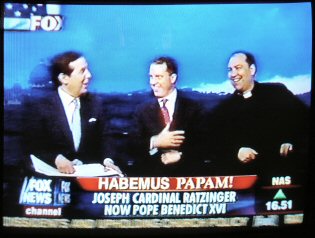
It is sometimes possible to remember precisely where you were and what you were doing when historic events took place. People often cite examples like where they were when they heard that JFK was shot, or when Neil Armstrong stepped off the LEM and onto the surface of the Moon.
Where were you and what were you doing when you heard that Joseph Card. Ratzinger had been elected Pope?
Here is a shot of what I was doing. (Many thanks to the person who sent me the video tape I took this photo from.)
SHOPPING ONLINE? Please, come here first! Up to 50% off select deals: Black Friday Week is Nov 19-27!
Please remember me when shopping online. Your use of my Amazon affiliate link is a major part of my income. It helps to pay for insurance, groceries, everything. Thanks in advance.
“This blog is like a fusion of the Baroque ‘salon’ with its well-tuned harpsichord around which polite society gathered for entertainment and edification and, on the other hand, a Wild West “saloon” with its out-of-tune piano and swinging doors, where everyone has a gun and something to say. Nevertheless, we try to point our discussions back to what it is to be Catholic in this increasingly difficult age, to love God, and how to get to heaven.” – Fr. Z
Federated Computer… your safe and private alternative to big biz corporations that hate us while taking our money and mining our data. Have an online presence large or small? Catholic DIOCESE? Cottage industry? See what Federated has to offer. Save money and gain peace of mind.
“Until the Lord be pleased to settle, through the instrumentality of the princes of the Church and the lawful ministers of His justice, the trouble aroused by the pride of a few and the ignorance of some others, let us with the help of God endeavor with calm and humble patience to render love for hatred, to avoid disputes with the silly, to keep to the truth and not fight with the weapons of falsehood, and to beg of God at all times that in all our thoughts and desires, in all our words and actions, He may hold the first place who calls Himself the origin of all things.”
Everyone, work to get this into your parish bulletins and diocesan papers.
The most evident mark of God’s anger and the most terrible castigation He can inflict upon the world are manifested when He permits His people to fall into the hands of clerics who are priests more in name than in deed, priests who practice the cruelty of ravening wolves rather than the charity and affection of devoted shepherds.
St. John Eudes
Your support is important. Thanks in advance.
To donate monthly I prefer Zelle because it doesn't extract fees. Use
frz AT wdtprs DOT com
Donate using VENMO
GREAT BEER from Traditional Benedictine Monks in Italy
Good coffee and tea. Help monks.
I use this when I travel both in these USA and abroad. Very useful. Fast enough for Zoom. I connect my DMR (ham radio) through it. If you use my link, they give me more data. A GREAT back up.
Help support Fr. Z’s Gospel of Life work at no cost to you. Do you need a Real Estate Agent? Calling these people is the FIRST thing you should do!
They find you a pro-life agent in your area who commits to giving a portion of the fee to a pro-life group!
Don’t rely on popes, bishops and priests.
“He [Satan] will set up a counter-Church which will be the ape of the Church because, he the devil, is the ape of God. It will have all the notes and characteristics of the Church, but in reverse and emptied of its divine content. It will be a mystical body of the anti-Christ that will in all externals resemble the mystical body of Christ. In desperate need for God, whom he nevertheless refuses to adore, modern man in his loneliness and frustration will hunger more and more for membership in a community that will give him enlargement of purpose, but at the cost of losing himself in some vague collectivity.”
“Who is going to save our Church? Not our bishops, not our priests and religious. It is up to you, the people. You have the minds, the eyes, and the ears to save the Church. Your mission is to see that your priests act like priests, your bishops act like bishops.”
“The modern habit of doing ceremonial things unceremoniously is no proof of humility; rather it proves the offender's inability to forget himself in the rite, and his readiness to spoil for every one else the proper pleasure of ritual.”
- C.S. Lewis
This blog has to earn its keep!
PLEASE subscribe via PayPal if it is useful. Zelle and Wise are better, but PayPal is convenient.
A monthly subscription donation means I have steady income I can plan on. I put you my list of benefactors for whom I pray and for whom I often say Holy Mass.
In view of the rapidly changing challenges I now face, I would like to add more $10/month subscribers. Will you please help?
For a one time donation...
To donate monthly I prefer Zelle because it doesn't extract fees. Use
frz AT wdtprs DOT com
As for Latin…
"But if, in any layman who is indeed imbued with literature, ignorance of the Latin language, which we can truly call the 'catholic' language, indicates a certain sluggishness in his love toward the Church, how much more fitting it is that each and every cleric should be adequately practiced and skilled in that language!" - Pius XI
"Let us realize that this remark of Cicero (Brutus 37, 140) can be in a certain way referred to [young lay people]: 'It is not so much a matter of distinction to know Latin as it is disgraceful not to know it.'" - St. John Paul II
Let us pray…
Grant unto thy Church, we beseech Thee, O merciful God, that She, being gathered together by the Holy Ghost, may be in no wise troubled by attack from her foes. O God, who by sin art offended and by penance pacified, mercifully regard the prayers of Thy people making supplication unto Thee,and turn away the scourges of Thine anger which we deserve for our sins. Almighty and Everlasting God, in whose Hand are the power and the government of every realm: look down upon and help the Christian people that the heathen nations who trust in the fierceness of their own might may be crushed by the power of thine Arm. Through our Lord Jesus Christ, Thy Son, who liveth and reigneth with Thee in the unity of the Holy Ghost, God, world without end. R. Amen.
Almighty and eternal God, who created us in Thine image and bade us to seek after all that is good, true and beautiful, especially in the divine person of Thine Only-begotten Son, our Lord Jesus Christ, grant, we beseech Thee, that, through the intercession of Saint Isidore, Bishop and Doctor, during our journeys through the internet we will direct our hands and eyes only to that which is pleasing to Thee and treat with charity and patience all those souls whom we encounter. Through Christ our Lord. Amen.

 The [2nd] second area of darkness that which affects the mind often goes unnoticed, and for this reason is particularly sinister. [!] The manipulation of truth distorts our perception of reality, and tarnishes our imagination and aspirations. I have already mentioned the many liberties which you are fortunate enough to enjoy. The fundamental importance of freedom must be rigorously safeguarded. It is no surprise then that numerous individuals and groups vociferously claim their freedom in the public forum. [Make no mistake! Benedict is waging a way for the public square and the rights of Catholics to be free to raise their voices and offer the great gifts and aspirations Catholic Christians can offer, because they "enflesh" the words and deeds of Christ, they reflect His light.] Yet freedom is a delicate value. It can be misunderstood or misused so as to lead not to the happiness which we all expect it to yield, but to a dark arena of manipulation in which our understanding of self and the world becomes confused, or even distorted by those who have an ulterior agenda.
 At times, however, we are tempted to close in on ourselves, to doubt the strength of Christ’s radiance, to limit the horizon of hope. Take courage! Fix your gaze on our saints. The diversity of their experience of God’s presence prompts us to discover anew the breadth and depth of Christianity. Let your imaginations soar freely along the limitless expanse of the horizons of Christian discipleship. Sometimes we are looked upon as people who speak only of prohibitions. Nothing could be further from the truth! Authentic Christian discipleship is marked by a sense of wonder. We stand before the God we know and love as a friend, the vastness of his creation, and the beauty of our Christian faith.
 grandeur of our Christian faith. Whenever you gather for Mass, when you go to Confession, whenever you celebrate any of the sacraments, Jesus is at work. Through the Holy Spirit, he draws you to himself, into his sacrificial love of the Father which becomes love for all. We see then that the Church’s liturgy is a ministry of hope for humanity. [SAVE THE LITURGY – SAVE THE WORLD. When we celebrate liturgical rites well, we do something beautiful for the whole world.] Your faithful participation, is an active hope which helps to keep the world saints and sinners alike open to God; this is the truly human hope we offer everyone (cf. Spe Salvi, 34).
 [Concern for the environment cannot be separated from our charity: man is the steward of creation and at the top of the material realm.] We must listen deeply. We must respond with a renewed social action that stems from the universal love that knows no bounds. In this way, we ensure that our works of mercy and justice become hope in action for others.
 I guess the sixties are ending? And of course there’s always good news coming from Rome!


 waalaw on Daily Rome Shot 1119: “In 1st variation, 2. . . . . . Q-g1# also works. As does 4. . . . . .…”




























