
Daily Fervorino HERE
WORDLE


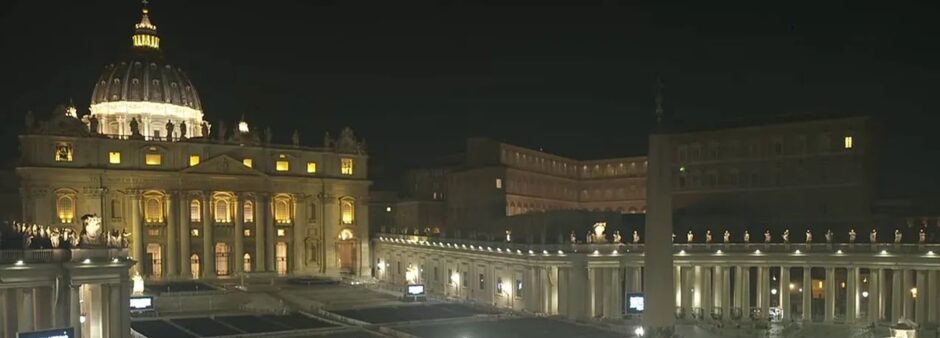
Here is something different to start, or to continue your day.
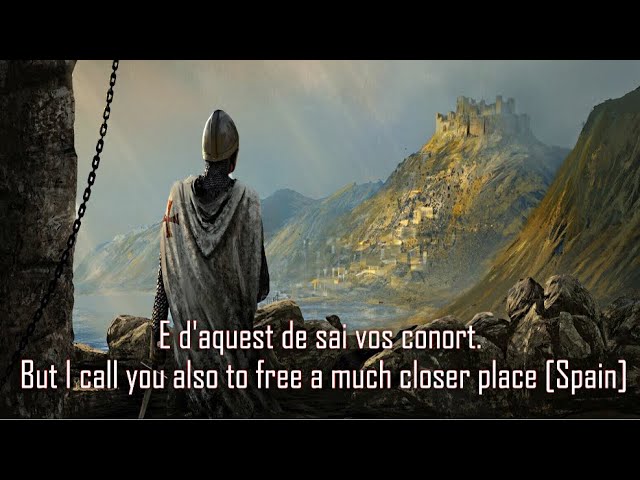
A crusader song of the 12th century.
The text is by one of the earliest troubadours, Marcabrus, and is – I think – in Old Occitan.
There is a mesmerizing quality to this piece. One can imagine it being sung of a night around a fire off the edge of a road on the way to Spain, men adjusting their gear, leaning on elbows with the light flickering off metal and eyes, everyone joining in the chorus.

ORIGINALLY Published on: Mar 3, 2022 at 14:37
So I don’t “bury the lead”.
I have some sets of the beautiful 3 volume, Latin/English Roman Breviary from Baronius Press. I must sell them.
If you are interested in buying one for someone else, rather than for yourself – for example, FOR a priest or seminarian – let me know.
Some years ago, Baronius Press in England put out an updated version of the old Collegeville, Latin and facing English in columns, three-volume edition of the Breviarium Romanum, called Divine Office.
The Baronius Press volumes are well-made, updated, and beautiful. They have, as the old Collegeville edition did, facing Latin and a sound translation in English. The Psalter is the good one (not the Pius XII).
Here are some photos of when I unboxed a set.


Helpful cards.

I say the Office in Latin, but from time to time I like to refresh my familiarity with the Psalms in English. Throughout the Psalter there are good commentaries along the way.
These breviaries would be extraordinarily helpful for those whose Latin is not the strongest, but who want to recite the traditional Office, whether because he has the obligation or she wants to do so out of devotion.
I have a limited number of these sets. Unopened.
I must sell them.
One set has already been bought, shipped and received, so the system works.
Write to me at buybreviaries@protonmail.com
Indicate your:
NAME
ADDRESS of shipping
NUMBER of sets desired
I will write back with the price and details.
____
 Fr. John Hunwicke’s blog is a constant source of fascinating details, amusing invective, and inverting insight. Those first two may be obvious, but what do I mean by “inverting insight”? I mean that Fr. H has a keen ability to “turn the sock inside out”. Okay, so what does that mean? He can flip perspectives and see an issue from another angle.
He did that on his blog today when he tackles the absurd notion about Latin that Francis apparently holds – though it’s often hard to tell what he really thinks. In an interview, Francis said that having the readings in a language not understood by every one (i.e., Latin) during Mass “would be like laughing at the Word of God”. I think he means, “treating the Word of God with disdain”, but who really knows?
What did Francis say?
For example, that the proclamation of the Word be in a language that everyone understands; otherwise it would be like laughing at the Word of God. Little things.
He didn’t say “Latin” but it was in the context of his cruel attack on the traditional Roman Rite (and… therefore on the people who want it).
We can make several points here.
Firstly, what is the level of understanding of the people of the biblical readings at Mass. If they hear the words in some arrangement from the vocabulary and grammar of their mother tongue (some have bigger vocabularies than others and better command of grammar), so what? Do they get what they are hearing? And then ask them on the way out the door (having just received Communion) what the Gospel was a few minutes before.
You will object that the priest has to “break open the bread of the Word” like Jesus at Emmaus. Okay, fine. But a priest can do that if the readings are in Latin, too. On the road to Emmaus, Christ quoted and interpreted Scripture concerning Himself. His explanations surely would have been in Aramaic or… were these two disciples of Greek Hellenic background? Did Christ bypass quoting the Hebrew Scriptures and merely paraphrase them? That doesn’t seem like His style. No, surely He quoted them in the sacred language they were recorded in: Hebrew.
Next, what Francis doesn’t seem to get is that the readings themselves are sacrificial in nature. Part of the problem with the modern view of Mass is that the readings are didactic in nature and also that they are paranetic, useful for moral teaching. While readings are certainly both instructive and hortatory, their main function in liturgical worship, just as the offerings of bread and wine, incense, the candles being burned, etc., is sacrificial. They are raised to the Father as part of the sacrificial action of the Mass. Hence, it is most fitting that they a) be read at the altar and b) by the priest and c) in a sacred language. Thereafter, if they are repeated at the ambo – the locus of proclamation and explication – in the vernacular, that is entirely appropriate, though secondary. By “secondary” I don’t mean “unimportant”.
Consider how in wreckovated and new “municipal airport terminal” churches there was even a fad of placing the ambo and the altar on equal footing in the sanctuary (if there was a sanctuary at all). This was to symbolize the belief of the designer that the altar and ambo were on equal footing, of equal importance. No wonder so many today don’t believe in the Church’s teaching on the Eucharist: it’s in the architecture itself in some places. Ironically, the desire to escalate the reading of the Word of God at Mass by stressing it so strongly and making it readily understandable, in practice diminished the Word by stripping it of mystery, sacrality, and sacrificial character.
Back to Fr. H’s post. Before checking it out, you should know what he means by “John Henry Newman on the Suspense of the function of the Ecclesia docens”, that is, the “teaching Church”. We hold that the Church is Mater et Magistra, Mother and Teacher, right? What if that teaching function goes haywire for a while?
In “On Consulting the Faithful in Matters of Doctrine”, Newman wrote:
On the one hand, then, I say, that there was a temporary suspense of the functions of the “Ecclesia docens.” The body of Bishops failed in the confession of the faith. They spoke variously, one against another; there was nothing, after Nicæa, of firm, unvarying, consistent testimony, for nearly sixty years. There were untrustworthy Councils, unfaithful Bishops; there was weakness, fear of consequences, misguidance, delusion, hallucination, endless, hopeless, extending itself into nearly every corner of the Catholic Church. The comparatively few who remained faithfu1 were discredited and driven into exile; the rest were either deceivers or were deceived.
I think we have seen examples of the “suspension” of the teaching activity of the Church in modern times, as in from Paul VI onward and the Church’s feeble adherence to what was affirmed in Humanae vitae. We have seen total lack of focus concerning Catholic higher education… speaking of Ecclesia docens. There is Amoris laetitia and adultery. The attack on traditional liturgy is also a suspension of teaching because liturgy is doctrine.
So we come full circle. Here’s Hunwicke…. my emphases and comments:
Pope Francis attacks the Holy English Martyrs
Reading the Scriptures at Mass in a non-vernacular language is, according to our Holy Father, “like laughing at the Word of God”.
I find this a remarkable insult to hurl at our English Martyrs.
It is a good thing that, some years ago now, after reading S John Henry Newman on the Suspense of the function of the Ecclesia docens, I concluded that we must now be in precisely just such a period of Suspense. I cannot see how else one can fit PF into any sort of Catholic Ecclesiology. [Liberation Theology?]
The earliest of the English Martyrs were attached to the Sarum Rite … not really, Fortescue explains, a ‘Rite’ but a dialect of the Roman Rite. S John Fisher … the Holy Carthusian Martyrs … John Forest … the blessed Benedictine Abbots … Blessed Thomas Plumtree who restored the Sarum Rite to Durham Cathedral … layfolk such as the glorious yokels martyred in the South West and Oxfordshire, and the Lord Chancellor and Cardinal Pole’s martyred mother and Thomas Percy Earl of Northumberland. (There is still a sweet little stained-glass window of him in the former, 1820s, Catholic Church in Alnwick, beneath the shadow of his castle. Secularised, the church is now a museum.)
And the readings in the Sarum Rite were not done in the vernacular.
Those martyrs were “laughing at the Word of God”!
Then, in 1576 at Douay, they started to teach the young men the ‘Tridentine’ Rite … young men whom S Philip Neri addressed in the streets of Rome with the words Salvete flores martyrum. The last beatified martyrs were Fr Thomas Thweng and William Howard, Viscount Stafford, condemned for “the Plot” in 1680.
And the readings in the Tridentine Rite were not done in the vernacular.
They, too, were “laughing at the Word of God”.
I wonder if it will ever occur to this obsessed person to apologise for his campaign of hatred against Catholic worship; against so many holy priests who have used the Authentic Form of the Roman Rite, including our Martyrs.
So many heroic lives; so much blood.
And all, we are taught by the Summus Fidei Magister, so that those martyrs could “laugh at the Word of God”.
Thanks, Fr. H.
Fr. Z kudos.

Today’s daily streamed Mass “fervorino: HERE
WORDLE

Latin: I lost today.. after the fifth guess I had the last 4 letters in place and had to guess at the first letter between three options for a Latin word: I guessed wrong.
Help the traditional Benedictine monks of Le Barroux. They are making wine from the old vineyards of the Avignon papacy! For a limited time, if you spend $100 or more on Pouilly-Fuissé Chardonnay, you’ll earn $25 towards your next purchase of white wine.

OPPORTUNITY
10% off with code:
FATHERZ10
 Back in 2013, with a remnant of a cold, I read T. S. Eliot’s Ash Wednesday.
It’s interesting to go back to that post and see the comments. For example, Supertradmum is no longer with us. Say a prayer for the repose of her soul. There are names of some commentators we haven’t see around for a while.
The Roman Station is Santa Sabina.
Video by Jacob Stein
Daily Fervorino from the streamed Mass: HERE (As a bonus I include the prayers for the blessing of ashes.
WORDLE


To help get those ashes off!

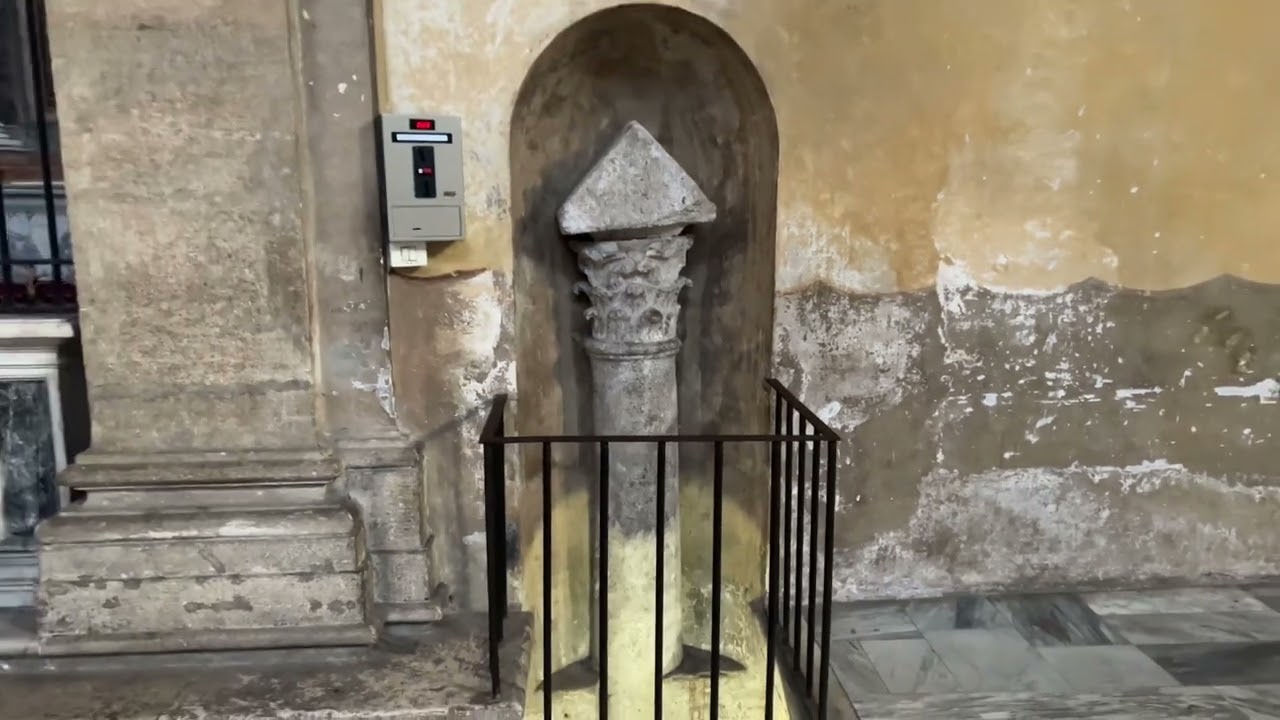
 According to the 1983 Code of Canon Law for the Latin Church, Latin Church Catholics are bound to observe fasting and abstinence on Ash Wednesday.
Here are some details. I am sure you know them already, but they are good to review.
FASTING: Catholics who are 18 year old and up, until their 59th birthday (when you begin your 60th year), are bound to fast (1 full meal and perhaps some food at a couple points during the day, call it 2 “snacks”, according to local custom or law – call it, two snacks that don’t add up to a full meal) on Ash Wednesday and on Good Friday.
There is no scientific formula for this. Figure it out.
ABSTINENCE: Catholics who are 14 years old and older are abound to abstain from meat on Ash Wednesday and on all Fridays of Lent.
In general, when you have a medical condition of some kind, or you are pregnant, etc., these requirements can be relaxed.
For Eastern Catholics there are differences concerning dates and practices. Perhaps our Eastern friends can fill us Latins in.
You should by now have a plan for your spiritual life and your physical/material mortifications and penitential practices during Lent.
You would do well to include some works of mercy, both spiritual and corporal.
I also recommend making a good confession close to the beginning of Lent. Let me put that another way:
GO TO CONFESSION!
“But Father! But Father!”, some of you are saying anxiously, “What about my coffee? I can drink my coffee, can’t I? Can’t I?”
You can, of course, coffee with and as part of your full meal and two “snacks”. No question there.
 How about in between meals on Ash Wednesday?
The old axiom, for the Lenten fast, is “Liquidum non frangit ieiunium … liquid does not break the fast”, provided – NB – you are drinking for the sake of thirst, rather than for eating.
Common sense suggests that chocolate banana shakes or “smoothies”, etc., are not permissible, even though they are pretty much liquid in form. They are not what you would drink because you are thirsty, as you might more commonly do with water, coffee, tea, wine in some cases, lemonade, even some of these sports drinks such as “Gatorade”, etc.
Again, common sense applies, so figure it out.
 Drinks such as coffee and tea do not break the Lenten fast even if they have a little milk added, or a bit of sugar, or fruit juice, which in the case of tea might be lemon.
Coffee would break the Eucharistic fast (one hour before Communion), since – pace fallentes – coffee is no longer water, but it does not break the Lenten fast on Ash Wednesday.
You will be happy to know that chewing tobacco does not break the fast (unless you eat the quid, I guess), nor does using mouthwash (gargarisatio in one manual I checked) or brushing your teeth (pulverisatio).
Concerning the consumption of alligator and crocodile – HERE I included notes also on the eating of endothermic moonfish, peptonized beef, and muskrat… just in case.
If you want to drink your coffee and tea with true merit I suggest drinking it from one of my coffee mugs. I’d like to offer an indulgence for doing so, but that’s above my pay grade.
I just happen to have available a “Liquidum non frangit ieiunium” mug! HERE

And there’s also this new choice…
3:16 isn’t just in John.

CLICK to see MORE
 Today is Shrove Tuesday, the day before Ash Wednesday which is the beginning of Lent for the Roman Church.
Did you know that there is a Mass proper for Shrove Tuesday? It’s a Votive Mass in Honor of the Holy Face of Jesus. … Missa Votiva in honorem “Sacri Vultus”, which is celebrated in Red.
The Introit is “Humiliavit semetipsum“.
Extraordinary Mass in Honour of the Holy Face of Jesus Latin-English
There is a similar Mass on Tuesday of Septuagesima (the Agony in the Garden) and Tuesday of Sexagesima (the Column of the Flagellation).
In fact, there were/are Votive Masses for all the “arma Christi“, the instruments of the Passion. I believe this was promoted by the Passionists.
The more vigorously the primacy was displayed, the more the question came up about the extent and and limits of [papal] authority, which of course, as such, had never been considered. After the Second Vatican Council, the impression arose that the pope really could do anything in liturgical matters, especially if he were acting on the mandate of an ecumenical council. Eventually, the idea of the givenness of the liturgy, the fact that one cannot do with it what one will, faded from the public consciousness of the West. In fact, the First Vatican Council had in no way defined the pope as an absolute monarch. On the contrary, it presented him as the guarantor of obedience to the revealed Word. The pope’s authority is bound to the Tradition of faith. … The authority of the pope is not unlimited; it is at the service of Sacred Tradition.
Joseph Ratzinger
in The Spirit of the Liturgy

Coat of Arms by D Burkart









A Daily Prayer for Priests


They find you a pro-life agent in your area who commits to giving a portion of the fee to a pro-life group!

PLEASE subscribe via PayPal if it is useful. Zelle and Wise are better, but PayPal is convenient.
A monthly subscription donation means I have steady income I can plan on. I put you my list of benefactors for whom I pray and for whom I often say Holy Mass.
In view of the rapidly changing challenges I now face, I would like to add more $10/month subscribers. Will you please help?
For a one time donation...



Help Monks in Wyoming (coffee – UPDATED LINK) and Norcia (beer) and the wonderful "Soap Sisters" of Summit, NJ!


Please follow me on Twitter!










Visits tracked by Statcounter
since Sat., 25 Nov. 2006:


