Total Eclipse on Monday, 21 August – What are your plans?

The Total Eclipse will occur over these USA on Monday.

The Eclipse will take place 54 days before the 100th anniversary of the Miracle of the Sun at Fatima… the length of a 54 Day Novena.

Also, because a total eclipse can only take place during a New Moon, 21 August will also be the 3rd New Moon of the season, which only occurs every 33 years.  The last time an total eclipse occurred on the 3rd New Moon was 99 years ago in 1918, which was also the last time the path of a total eclipse crossed the continent from coast to coast.

The next total will be in 2024.  HERE  It’s path will intersect with this year’s eclipse’s path near the legendary New Madrid fault… which probably means nothing.  Unless it does.  After all, in 1812 when that fault decided to do something, the Mississippi ran backwards for a bit and temporary waterfalls formed.

Be sure to check out Space Weather. Apparently, NASA has developed a model to predict the shape of your planet’s yellow star’s corona.

I, for one, plan to be in the Show Me State, where the cosmos will… wait for it… show me the eclipse.  Did you see what I did there?

For your location… HERE – really cool …

What are your plans?

Posted in Look! Up in the sky! | Tagged
36 Comments

My View For Awhile: Homeward

I’ve had enough heat for the time being.  Time to go.


At the airport TSA gave my bag their special attention (as I looked on) with all manner of care for restoring some decent order… not.   Thanks for that.

The airport here doesn’t have a club for my usual airline so I’m enjoying the sights and sounds of the concourse.   Always fun, right?


Now I get to watch my bag tracker and wonder where it’ll go this time.

Will Delta get it right today?

UPDATE

Huzzah!

My bag was loaded on the same flight I’m on!

So we begin the 3 hour flight…

UPDATE

I am happy to report that my bag is on the same flight that I am on.  That’s a good start to the last leg.

I don’t know about the “service dog” thing in the cabin.  I see this pretty frequently now and, so far, there haven’t been any complications.  I only hope that the crew washes their hands after petting them and before starting beverage service.

The jury is out.

And do people really need to treat airplanes as if they were their bathrooms?   


Please people – if you don’t have socks keep your shoes on.   Is that too much for you to grasp?

Grrr.

It’ll be over soon.

UPDATE

I guess I should change this from draft to publish.

Posted in On the road, What Fr. Z is up to |
16 Comments

Possible “formal correction” of Pope Francis?

If you read the LifeSite account, you have the impression that Card. Burke may be going for the “formal correction” option.  HERE

They seemed to have based their piece on Part 2 of an interview with His Eminence which The Wanderer posted.  HERE

What does The Wanderer really say?

Q. [NB]Setting aside the question of timing, please explain how the process for the execution of a “formal correction” would proceed should a response to the five dubia not be forthcoming? How is a formal correction officially submitted, how is it addressed within the Church’s hierarchal structure, etc.?

BURKE: The process has not been frequently invoked in the Church, and not now for several centuries. There has been the correction of past Holy Fathers on significant points, but not in a doctrinal way. It seems to me that the essence of the correction is quite simple. On the one hand, one sets forth the clear teaching of the Church; on the other hand, what is actually being taught by the Roman Pontiff is stated. If there is a contradiction, the Roman Pontiff is called to conform his own teaching in obedience to Christ and the Magisterium of the Church. [He hasn’t said that something is going to be done.]

The question is asked, “How would this be done?” It is done very simply by a formal declaration to which the Holy Father would be obliged to respond. Cardinals Brandmüller, Caffarra, Meisner, and I used an ancient institution in the Church of proposing dubia to the Pope.

This was done in a very respectful way and not in any way to be aggressive, in order to give him the occasion to set forth the Church’s unchanging teaching. Pope Francis has chosen not to respond to the five dubia, so it is now necessary simply to state what the Church teaches about marriage, the family, acts that are intrinsically evil, and so forth. [He still hasn’t said anything that indicates that he will undertake a special process.] These are the points that are not clear in the current teachings of the Roman Pontiff; therefore, this situation must be corrected. The correction would then direct itself principally to those doctrinal points. [“would” not “will”]

There have been cases, as I mentioned, of the correction of past Roman Pontiffs on non-doctrinal points where cardinals have gone to the Holy Father on one thing or the other such as, for example, matters dealing with administration of the Church.

Another question can also be raised. The Pope is the principle of unity of the bishops and all the faithful. However, the Church is being torn asunder right now by confusion and division. The Holy Father must be called on to exercise his office to put an end to this.

So then, the next step would be a formal declaration stating the clear teachings of the Church as set forth in the dubia. Furthermore, it would be stated that these truths of the Faith are not being clearly set forth by the Roman Pontiff. In other words, instead of asking the questions as was done in the dubia, the formal correction would be stating the answers as clearly taught by the Church.

So, the Cardinal describes what we pretty much know already.  He speaks in vague terms about what “would be” done.

It seems to me that we shouldn’t jump to any conclusions about this.  I don’t have the sense that something is about to take place any day now.

Meanwhile, do you know what you could do to help the overall situation?

RESIST.

We can resist cloudy, hazy, vague claims by those who want to undermine the Church’s perennial teachings.  Ask questions… well-informed questions.

Form small groups – little “base communities” – and start reading the Catechism of the Catholic Church together, and perhaps other documents such as Familiaris consortio and Veritatis splendor.

The moderation queue is ON.


Posted in The Drill | Tagged , , ,
16 Comments

Speaking of the Prayer For Vocations…

UPDATE:

ORIGINAL TEXT HERE

From a priest in the UK…

We have printed the Vocations Prayer you recommended for our parish in three designs and we say it at Mass every Sunday, and I also use it at Benediction during the week. I believe it has already begun to bear some fruit. Thank you!

This is great news.

17_08_15_voctaions_card_UK

Nice designs.

Folks, this isn’t hard.

However, may I recommend NOT changing the “thee”s and “thou”s?   In my opinion, it rings better with the original language.

That said, I am eager to know what happens in the places where this prayer is implemented and used for a solid period of time.

Posted in "How To..." - Practical Notes, Mail from priests, The future and our choices | Tagged
9 Comments

ASK FATHER: Penance given in confession was too vague

italian confessional pilgrimsFrom a reader…

QUAERITUR:

In line with your recent ASK FATHER postings on Confession, I have a question about vague penance given in Confession. We attend the local TLM and it is difficult to make it to Confession because the lines are always so long. My wife really wanted to make sure she made it to Confession, so she went to the nearest Novus Ordo parish where there is hardly anyone in line. She came back and told me the penance she was given was “to follow her heart” in a certain matter. Neither of us could figure out how to determine the fulfillment of such a penance. Is the absolution she received valid even though she could not be sure she completed her penance? She was so frustrated by this situation that she was nearly in tears.

I get this a lot and I have written about it before.  No wonder there is a difference in the length of lines.  Too bad.

FIRST: The absolution was valid.

Remember, every penance is arbitrary and cannot possibly be commensurate with offending God.

Contrary to some of the evidence, not all priests who give these sloppy, syrupy vague “penances” are nitwits.  They mean well.  They simply haven’t a) learned much about the confessional, or b) thought much about what they are doing.  They think they are being “nice”, or “pastoral” or… whatever.

I would ask them: Why risk leaving penitents confused and anxious about their confession and their penance?  Is that being “nice”?  Is that “pastoral”?

Wanna know what’s pastoral?  CLARITY.

To review, priests must give penances to penitents and penitents are obliged to fulfill penances themselves (can. 981 – they can’t pay someone else to do the penance for them, for example).  The penance should be clear, reasonable and doable in a reasonable period of time.  Common sense, right?

It should be clear: “Think a nice though about someone,” isn’t clear.  How do you know when you have done it?

It should be reasonable: “Rebuild with your own hands old St. Ugthred’s Church, which has been abandoned since 1923.”  Most people can’t do that.

It should be doable in a reasonable time frame: “Say the rosary for 100 days… Travel to the Shrine of Our Lady at La Vang, Vietnam… Next Easter Sunday (months away) do X… Obtain and watch this movie which I like and watch it….”

All of those theoretical penances are problematic.

Fathers… especially you NEW priests… assign/suggest something the penitent can complete before leaving the church.  Thus, short prayers are good penances.

And remember, validity of absolution is not contingent on the penance that is assigned.  Yes, we penitents must do our best to do some penance and we have a strong motivation to take the penance that the priest assigns seriously.  But sometimes these well-meaning nitwits suggest something incomprehensible or undoable.  So, we get out of the box, scratch our heads, and do something else that’s meaningful.  Or, if there is time and opportunity, go to a different confessor, explain the situation, and get guidance about what to do.  Not everyone has that option.

But, if you get one of these dopey penances, like “be nice to someone” or “think a happy thought”, go ahead and think a happy thought (“I’m happy when I go to confession somewhere else!”, or choose to be nice (“I’ll be nice, and not ‘penny’ the door to the confessional!”).

Then go be serious and pleased that you received absolution.

Posted in "How To..." - Practical Notes, ASK FATHER Question Box, GO TO CONFESSION | Tagged , , ,
28 Comments

What a contrast to the tensions over Confederate statues!

Honor!

I picked this up from a tweet by a friend:

In a nutshell:

A WWII Marine vet travelled to Japan to give a flag to the family of the fallen soldier from whom he had taken it during the Battle of Saipan.

A taste…

[…]

World War II veteran Marvin Strombo traveled 10,000 miles from his quiet home in Montana to the land of the rising sun to personally return a Japanese flag he had taken from Sadao Yasue during the Battle of Saipan in June 1944.

The U.S. Marine Corps veteran carried the flag with him decades after his time serving as a scout sniper with 6th Marine Regiment, Second Marine Division. He cared for the flag meticulously and never once forgot the promise he made to Yasue as he took the flag from him in the midst of war.

As a young corporal, Strombo looked up from his position on the battlefield, he noticed he became separated from his squad behind enemy lines. As he started heading in the direction of the squad’s rally point, he came across a Japanese soldier that lay motionless on the ground.

“I remember walking up to him,” said Strombo. “He was laying on his back, slightly more turned to one side. There were no visible wounds and it made it look almost as if he was just asleep. I could see the corner of the flag folded up against his heart. As I reached for it, my body didn’t let me grab it at first. I knew it meant a lot to him but I knew if I left it there someone else might come by and take it. The flag could be lost forever. I made myself promise him, that one day, I would give back the flag after the war was over.”

As years went on, Strombo kept true to his promise to one day deliver the heirloom. It was not until the fateful day he acquainted himself with the Obon Society of Astoria, Oregon, that he found a way to Yasue’s family.

[…]

Posted in I'm just askin'..., Just Too Cool, Pò sì jiù, The Coming Storm, The future and our choices | Tagged ,
9 Comments

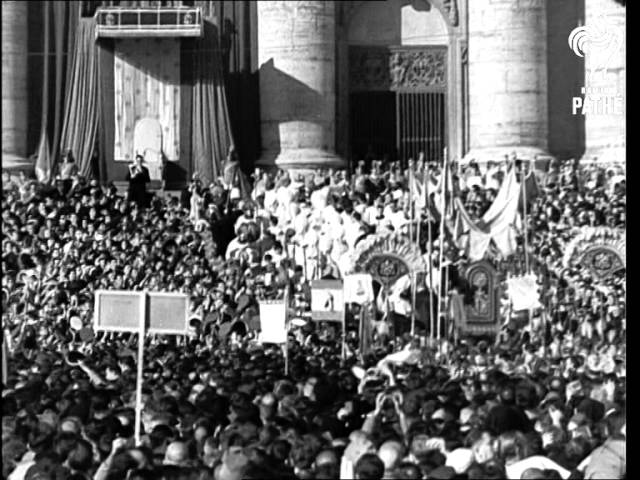
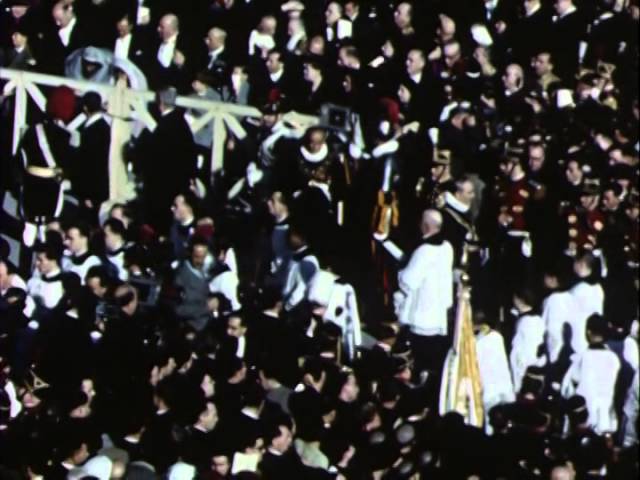
VIDEO: Pius XII declaring the Dogma of the Assumption

The fabled pastor of my home parish, the late Msgr. Richard Schuler told stories about being in Rome when Ven. Pius XII infallibly declared the Assumption of the Blessed Virgin to be a dogma of the Faith.  He was present for the procession with the icon of Salus Populi Romani and for the proclamation.

Here is a video about the event in 1950.

YouTube thumbnailYouTube icon

And there is this… just after 26:00 you hear Pius reading the actual Proclamation of the Dogma.

YouTube thumbnailYouTube icon

Posted in Just Too Cool, Liturgy Science Theatre 3000, Our Solitary Boast | Tagged , ,
5 Comments

IN THE WILD: “Prayer For Vocations” spotted

I had a great text cross-country SMS from a colleague in the TMSM this morning at a little church in Shell Lake, WI.  Here is a poster at the parish…

17_08_15_Superior_vocations_prayer

First, I am delighted that they found – note the date of copyright – 2011 – and used the prayer I have been pushing.  My only complaint is dumbing it down a bit, “ask” in place of “beseech”, for example.  That said, Fr. Z kudos to them.  I suspect that someone there found it either at St. Agnes Church in St. Paul (my home parish, where it was/is prayed during all Sunday Masses), or from one of my articles in The Wanderer years ago, or from an old post on this blog.   Alternately, perhaps the former Bishop there, originally from St. Paul, knew of it somehow.

I don’t care where they got it.  Heck… maybe from the original prayer card!

For those of you who don’t know the back story, here is something from one of my posts here, not long ago:

FATHERS! BISHOPS!

We have to get down on our knees constantly and pray for vocations to the priesthood and religious life.  Let’s not pray for generic “vocations”, lumping them all together.  No.  We need a public, manifest, constant call for vocations to the priesthood from our own homes and families, not someone else’s.

At the parish where I serve, the pastor and I had cards printed with an old prayer for vocations used at my home parish, where there was on average a First Mass every year.   From now on, at every Sunday and Holy Day Mass, after the Gospel and before the announcements and sermon, everyone will kneel and say this prayer:

LEADER: Please kneel for our prayer for vocations.  Let us ask God to give worthy priests, brothers and sisters to His Holy Church.

ALL: O God, we earnestly beseech Thee to bless this (arch)diocese with many priests, brothers and sisters, who will gladly spend their entire lives to serve Thy Church and to make Thee known and loved.

LEADER: Bless our families. Bless our children.

ALL: Choose from our homes those who are needed for Thy work.

LEADER: Mary, Queen of the Clergy!

ALL: Pray for us. Pray for our priests and religious. Obtain for us many more.

A friend back home – whom I miss rather a lot – sent me one of the original holy cards, which I prize.

20131210-104023.jpg

20131210-104032.jpg

Note that key line:

Choose from our homes those who are needed for Thy work.

We had cards made with beautiful artwork on the front and this very prayer on the back.  Soon it will be so much a part of the regular Sunday and Holy Day practice that everyone will know it by heart.  It will ring in the ears of young people and keep the idea of a religious vocations constantly present and active.  I don’t doubt the outcome.

This is an ACTION ITEM.   Fathers, consider implementing this in your parishes.  And don’t junk the prayer up with additions about “married life” or “single life” or “permanent deacons”.  Just leave it as it is.  We’ve done the heavy lifting by already printing the cards if you want to drop a line.

Lay people!  Especially you who are in sound parishes!  Go to your priests with this post and ask them to implement a prayer for vocations to the priesthood.  Keep at them.


Posted in Just Too Cool, Priests and Priesthood, Seminarians and Seminaries | Tagged ,
6 Comments

ASK FATHER: Show tune priest sings Eucharistic Prayer

From a reader…

QUAERITUR:

My pastor (who likes to sing) sings from the beginning of the Canon to the end of the Consecration. It’s not a Gregorian sound, more like something from Les Miserables Broadway play. Is this a legitimate thing to do when celebrating Mass? He has a way of being the focus of the Liturgy. I could usually tune him out but this was too much for me. I avoid his masses, but pray for his conversation. Thank you. You and all Our Lady’s Warriors are in my prayers.

GUEST PRIEST RESPONSE: Fr. Tim Ferguson

The Church has long put an emphasis on music in our Sacred Liturgy. Even before the renaissance, the most skilled and gifted musicians have found employ in the Church, and the result is a long and broad tradition of some of the most transcendent music the world has known. Da Celano, Palestrina, Ockeghem, des Prez, Clemens non Papa, through Byrd, Tallis, Gabrieli, to Mozart, Haydn, Schubert, Durufle, Gounod, Franck, Faure, Monteverdi… and now? Who are the heirs picking up the musical threads of these giants? Who are the contemporary musicians whose names will be voiced in hushed reverence hundreds of years from now as collegiate choirs struggle to bring out the subtle nuances of… Sing a New Song? Eagles’ Wings? I am the Bread of Life?

Lamentation, wailing, and woe…

But back to the question at hand. For centuries, in the Roman Rite, the Canon was said sotto voce. Recited, quietly, often under the rapturous sound of a choir and orchestra, or even just a schola of men filling the hearts and souls of the congregation with sounds that echo from the heavens themselves. And then, for the consecration itself, profound and stunning silence. At the moment when the veil between heaven and earth is lifted, the church would be nearly silent, as the priest whispers those blessed words of Our Savior that make His Presence Real and Sacramental.

In many of the other liturgical Rites of the Church, the consecration was sung – the holy doors to the sanctuary being shut, the priest would offer this anaphora to the Father vocally, though the laity would not see what was happening. Which led to the old saw that in the West, the consecration was seen but not heard, and in the East, it was heard but not seen.

But we’re in the here and now.

Musicam Sacram was promulgated in 1967 by the Sacred Congregation for Rites, and encouraged, in the Latin Rite, that the liturgy be chanted – even in its entirety. When Paul VI promulgated his Missal in 1969, provisions were made for the chanting of the Eucharistic Prayer, even the Words of Institution. In the current edition of the Missale Romanum, there is chant notation available for chanting the Eucharistic Prayer. Though other melodies would need the approval of the Bishops’ Conference (General Instruction of the Roman Missal, #393), in practice, it would be difficult to stop Fr. George M. Cohan or Fr. Andrew Llyod Webber from attempting to sing a new church into being and imposing his musical sensibilities (or not) on a helpless congregation.

Were it not such a sacred moment, one might be inclined to pass out large posters among the parishioners in the front row and, when he’s done, flash a score back at him – 5.4, 8.6, 6.4, and from the Romanian judge, 1.3. One might even be inclined to throw roses, or, as the case may warrant, tomatoes.

Were it not such a sacred moment, that is.

In short, chanting the Eucharistic Prayer is now permitted, including the consecration. One must remember, that not all things which are permitted are therefore good.

Fr. Z ADDS:

Many years ago I learned from a great Church musician, the late Msgr Richard Schuler, that there is no one exclusively right way to sing the prayers.  Besides, singing the Canon is a novelty in the Roman Rite, one of those innovations that the Council Fathers warned about.  That said, there are tones which, over the years, have proven themselves and have become virtually codified.  It’s really a good idea to stick to them, because they help to keep us from makingfools out of ourselves.

Posted in "How To..." - Practical Notes, ASK FATHER Question Box, Liturgy Science Theatre 3000 | Tagged , ,
13 Comments

ASK FATHER: During confession can a priest require a criminal to turn herself in?

seal of confessionFrom a reader…

QUAERITUR:

EWTN is reporting that the Australian government is trying to make priests mandatory reporters for child abuse, by requiring them to report what they hear in confession. While this is, obviously, a direct assault on the sacrament, it’s the next part of the report that puzzles me…

In the statement, Francis Sullivan, CEO council, said that while the Catholic Church and the council itself “have consistently argued that these reporting provisions should not apply to the confessional, the Royal Commission has now made a different determination based on information and evidence it has heard over the past four years.”

“The whole concept of confession in the Catholic Church is built on repentance, forgiveness and penance,” Sullivan said, adding that “if a child sex-abuser is genuinely seeking forgiveness through the sacrament of confession they will need to be prepared to do what it takes to demonstrate their repentance.”

Part of this, he said, especially in cases of sexual abuse, “would normally require they turn themselves in to the police. In fact the priest can insist that this is done before dispensing absolution.”  [?!?]

Is this part true?

Well… NO! it isn’t.

And, sort of, yes it is.  We have to make distinctions.

First, NO! The priest cannot make absolution conditional upon a criminal turning herself in.  To wit: “I won’t give you absolution unless you turn yourself in.”

However, a priest can withhold absolution if he does not believe, on a firm grounding, that the penitent is truly sorry.

Hence, a priest can strongly urge, firmly counsel, warmly encourage a penitent to “do the right thing”, that is, conform her amended life to the dictates of justice.  However, if he has a moral certainty that the penitent is penitent and intends to amend her life, he should not withhold absolution.

When we commit a sin, we violate others, God and neighbor. Justice is the virtue which governs how we give to others that which is due to them.  If we hurt another person, we have to make some kind of restitution.  Often perfect or full restitution is incomplete and arbitrary.  In the case of God, we limited mortals cannot do anything proportioned to God’s infinite goodness.  All the penances we get in the confessional are arbitrary in that sense.  Also, how do we truly make things up to people, or society, whom we have harmed? We have to do something, of course, in justice.  Things will get sorted out in our Particular and, especially, General Judgment at the end of things.

So, upon hearing about some serious crime or other, one that means a lot more than speeding or unpaid parking tickets, the priest has to advise the penitent to do the right thing.  He can urge the person to turn herself in, but he can’t impose that as a condition of being absolved.

Part of the reason for that is found implictly also in the canons in the Code of Canon Law covering the Seal.

Can.  983 §1: The sacramental seal is inviolable; therefore it is absolutely forbidden for a confessor to betray in any way a penitent in words or in any manner and for any reason.

Can.  984 §1. A confessor is prohibited completely from using knowledge acquired from confession to the detriment of the penitent even when any danger of revelation is excluded.

Can. 983 doesn’t explicitly deal with the issue at hand, that is, requiring a penitent to turn herself in in order to receive absolution.  However, the Seal would be implicitly violated, because the direction of the priest to go to authorities would indirectly result in his causing the contents of the confession to be revealed to third parties.  Priests cannot act on the information they receive “in any manner”, which includes constraining a criminal to (as his proxy instrument of the revelation of information) reveal herself as such even if the crime was a really serious one.

Moreover, can. 984 clearly states that a confessor may not use what he hears during a confession “to the detriment of a penitent”.  One possible detriment would be that, by so directing, the priest could undermine the penitent’s trust and attachment and future use of the Sacrament of Penance, not to mention other detriments.

Furthermore, the validity of the absolution imparted by the priest does not depend on the completion of a penance assigned.

So, NO, priests cannot “force” penitents to turn themselves in as a condition for absolution.

It is possible, however, that the priest, having heard several times the confession of the same criminal who hasn’t done anything yet to “do the right thing”, might begin to wonder whether or not the penitent has the intention to amend her life.  That, of course, is another tale.

The moderation queue is ON.

Posted in "How To..." - Practical Notes, ASK FATHER Question Box, GO TO CONFESSION | Tagged , , ,
13 Comments