1 July – Most Precious Blood and also…

Today is the Feast of the Most Precious Blood… in the older, traditional calendar of the Roman Rite.  Thus we inaugurate the month of July, during which in a special way, fire up our devotion to the Most Precious Blood of the Lord.

Every even tiny drop is worth the salvation of the souls of everyone who has ever lived.   While many have and will accept the gift Christ won by the pouring out of His Precious Blood, not all will.

Here is the Collect:

Omnípotens sempitérne Deus, qui unigénitum Fílium tuum mundi Redemptórem constituísti, ac eius Sánguine placári voluísti: concéde, quaesumus, salútis nostræ prétium sollémni cultu ita venerári, atque a præséntis vitæ malis eius virtúte deféndi in terris; ut fructu perpétuo lætémur in coelis.

Here is someone else’s translation:

Almighty, eternal God, Who made Your only-begotten Son the Redeemer of the world, and willed to be reconciled by His Blood, grant us, we beseech You, so to worship in this sacred rite the price of our salvation, and to be so protected by its power against the evils of the present life on earth, that we may enjoy its everlasting fruit in heaven.

And… by the way… today is also the feast of St. Aaron, brother of Moses.

Some people may not realize that many great figures of the Old Testament are considered saints and are listed in the Roman Martyrology.

Here is his entry in the 2005 Martyrologium Romanum:

1. Commemoratio sancti Aaron, de tribu Levi, qui a Moyse fratre oleo sacro unctus est sacerdos Veteris Testamenti et in monte Hor depositus.

Who wants to translate this for the readers?

Posted in SESSIUNCULA |
5 Comments

ASK FATHER: Why not St. Louis Jesuit Music at Traditional Latin Masses?

From a reader…

QUAERITUR:

What’s wrong with the St Louis jesuits?

A Director of Music for a Latin Mass community once said that, with regards to hymns, what we sing now as traditional hymns was once new and modern at the time. In fact many of our beloved Marian Hymns were once the equivalence to the St. Louis Jesuits. This leads me to wonder, what’s wrong about introducing stuff like the St. Louis Jesuits into the EF if it’s well-discerned and the song’s words are scriptural?

What’s wrong with the St Louis Jesuits?  Nothing.  As they say, their music isn’t nearly as bad as it sounds.

Really, the thought of this stuff during a TLM brought an audible chuckle.

There is a good book which explains something of the phenomenon of the bad music that has so tormented the Church since the Council was misappropriated.

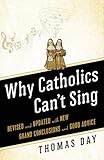
Check out Thomas Day’s Why Catholics Can’t Sing: Revised and Updated With New Grand Conclusions and Good Advice

US HERE – UK HERE

Part of the problem was that, after the Council was hijacked and a false interpretation was imposed on liturgical reforms by a small group of modernists who had control of social communication back in the day, Latin was sidelined and all but banned.  Indeed, it was illicitly forbidden in many places.   That slammed the door on the Church’s vast treasury of Church music without anything to ready to fill in.  Nature abhors a vacuum.  Alas, people with the lowest musical skills started to fill in the vacuum, producing “music” that was neither artistic or sacred, and played on instruments entirely lacking a sacred idiom or body of compositions (guitars, pianos, drum sets… and don’t forget tambourines!).   Coupled with a complete lie about the purpose of sacred music, perpetrated by an advisory board on music of the committee for liturgy of the US bishops (that music was intended to produce a human experience), we got the so-called “hootenany” Mass and the rest began to spiral around the bowl on the way down.

Day also describes how the sickly sweet Irish song influenced what was sung in churches.  Many of the clergy who came to these USA from Ireland had zero sense of sacred music because they had zero chances to develop that sense under the thumb of anti-Catholic society they left.  There was no traditional of Church music or large choir tradition.  They did know their sickly sweet songs from the pub and field, however.  That’s why so many of the ditties that passed into hymnals sound like “I’ll Taaaaaake You Home Agaaaaain Kathleeeeeeen”.  (“Mother Deeeeeearest Mother Faaaaaaaairest….”) Not their fault, of course.  But they, speaking English, came to dominate the clergy over and above other imigrants from German, France, etc., who did have a huge heritage of church music.  If you look at church’s built in a certain era, you can see the differences.  German church’s tended to have big choir lofts and organs, while Irish churches didn’t.  Anyway, the influences and roots of the problem are manifold, but that’s part of the picture.

St. Louis Jesuits at a TLM.  LOL!

And so…

YouTube thumbnailYouTube icon

Posted in "How To..." - Practical Notes, ASK FATHER Question Box, Liturgy Science Theatre 3000 | Tagged
37 Comments

UPDATE- A confluence of promptings leads Fr. Z to rant and to make a plea to bishops.

UPDATE: 1 July 2019 (Precious Blood)

Concerning the video about the late Card. Bernardin (linked below) and my association with the novel Windswept House (which has identifiable real people as fictionalized characters), I bring an update.  This is one of the things that was ringing off the hook in the back of my mind.

I was contacted by someone with an autographed copy of Windswept House which he was given by the late and very traditional Fr. Alfred Kunz, whose unsolved murder in the Diocese of Madison is an open wound to this day.   He also had a list of the real people and places whom Martin fictionalized for his novel.

The linked video about Card. Bernardin demonstrates his close connection with the late Bp. John Russell (+1993) of Charleston SC.   In Windswept House Russell is recreated as Bp. “Leo” James Russeton, who is the prelate who directs and offers the parallel satanic rites (with the gory stuff) meant to complete the satanic desecration of the Church in the heart of the Vatican City in 1963.

This was ringing bells in the back of my mind.  I once had a copy of that list, which I recall tucking into a hardback of Windswept House which I now remember lending to someone and never getting back.  The copy I dug out of my storage unit was its replacement, but I had lost the list, many names on which lingered in distant memories.

___ Originally Published on: Jun 29, 2019

A confluence of promptings drove me to my storage locker.

  • There was a recent reading about the infiltration of the Church so as to obtain for the infiltrators high positions of influence. HERE The book didn’t make a strong case based on lots of evidence, but surely the main thesis of the book was dead on accurate.
  • There was the reading of the Instrumentum Laboris for the upcoming Amazonian Synod, which reads as a blueprint for making the Church more like to an NGO with interests in earth-mother worship than the Bride of Christ, indefectible and authoritative. On that, Card. Brandmüller HERE. The Instrumentum Laboris in English HERE
  • There was the video about revelations concerning the late Card. Bernardin.  HERE

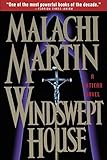
In that last link, I was already starting to think about the late Malachi Martin’s Windswept House.  US HERE – UK HERE  Something about Bernardin’s connection to South Carolina stirred my memory.

Today, I cracked old Windswept House.  It’s a tangle of tortured prose and references which are usually slightly off enacted by thinly veiled real but fictionalized players.  It conveys a grim story that you can’t but help know is, its flaws aside, dead on.   In the first few rapids sections of prologue, Martin takes you from Pius XII reflecting on the Treaty of Rome in 1957, to John XXIII refusing to release the Third Secret in 1960, to 1963… specifically the Feast of Sts. Peter and Paul.

The Feast of Sts. Peter and Paul, the day I write this.

In that section of the novel’s prologue there is enacted simultaneously a Satanic ritual in the Pauline Chapel next to the Apostolic Palace in the Vatican and also a place in South Carolina (where the gory stuff was to be done) in order to enthrone Satan in the heart of the Church.  The perpetrators of this evil want not so much to destroy the Church but to transform it into a human institution for the sake of creating a new world order.  Of course 1963 is when the Second Vatican Council is in session and Martin, in this novel, was also hinting that the Third Secret warned about a council.  Get it?

“But Father!  But Father!”, some of you libs and pseudointellects are tittering to the clink of ice in your highball glasses, “This is pure traddy fantasy fueled by years of bitter disappointment at not getting your way.  Since 1963 a new springtime has been blowing through us – we are church, after all – and the fresh air is driving out the stale old incense and trappings of religion you cling to.  It was greater than the Council of Jerusalem, though it didn’t go nearly far enough and … and… crush all opposition.  You… youuuuuuu…. racist climate-change denying homophobic haters!  YOU HATE VATICAN II!”

I esteem Vatican II enough not to lie about it.

I am also now reminded of a story from 2018 about a dreadful occurrence in one of the most important places in the Vatican City, the Palazzo del Sant’Uffizio, where the Congregation for the Doctrine of the Faith is housed.  That palazzo has also some residence apartments for curial officials, normally of high rank.   There was a druggy orgy of some kind involving a low-ranking worker bee who managed, mysteriously, to get lodging there.   HERE

Certain kinds of sins, summon to and cause to attach to and oppress places and people.  They must be driven forth by exorcism.

What happened in 2018 was close to the very heart of the Church’s heart.  As I described it then:

The Devil is good at what he does and he tells us what he is up to.  Having drug/sodomy parties in the building where the CDF and where the office that oversees the use of the Traditional Roman Rite and the new traditional religious institutes are housed is a dead give away.  THAT’s precisely the sort of place to attach and infest with demonic presence.  It’s a stone’s throw from

a) the very place Peter was crucified
b) the tomb of Peter
c) the Paul VI audience hall, where the Synod (“walking together”) meets
d) the offices of the Congregation for the Doctrine of the Faith which also handles cases of abuse
e) the offices of the Pontifical Commission “Ecclesia Dei” which, reinforced by Benedict XVI’s Summorum Pontificum is providing support for that “Marshall Plan” for rebuilding that I’m always on about.

If I were looking at this from the eyes of an enemy, that’s exactly the sort of place I would seek to infiltrate.

The Enemy is real and really good at being an Enemy.  Demons and their activities are real.

If I were a diocesan bishop, I would immediately go through my entire cathedral and chancery and residence and exorcise the places using the older, traditional Roman Ritual.

If I were a diocesan bishop, I would tell pastors of parishes and chaplains of schools, etc., whom I trusted to do it right, to do the same in their places, church, sacristy, rectory, school, all around the grounds.   Otherwise, I would send delegated priests to all the other parishes, etc., to carry out the exorcisms.

If I were a diocesan bishop, I would pronounce an exorcism over the entire diocese entrusted to my care.

If I were a diocesan bishop, I would go to the four corners of the diocese and pronounce the exorcism again at each spot and also say Masses at each, Pro Remissione Peccatorum, Pro Defensibus Ab Hostibus, Ad Poscenda Suffragia Sanctorum, Pro Gratiarum Actione.

Repeat annually.

It would be like tracing the Sign of the Cross over the whole diocese.  I got the idea from what Archbp. Sample did when he was still in Marquette.

Do it in the dead of night in a locked church or in the full light of day with public concourse.  Just do it.

This will cost nothing but a little gas money, will not require a dithering committee, and could be done in a short period of time.  But what benefits!

I think that people would flock to these “Four Corners” Masses and would be deeply edified.   And, if bishops are concerned about bring young people to the Faith and keeping them strong, this will help.  Do you doubt it?

This is serious stuff and they want something serious.

There is no more important thing a bishop does than sanctify and he wields all the weapons of spiritual warfare.

There is no more important thing that a bishop does than say Mass for the welfare of his flock.   And with the might of successors of Apostles, they command the Enemy.

If you are a bishop, please heed my plea.  If you are the secretary to a bishop, or the friend of a bishop, please make this request.

¿You want to hacer some real lío?

Find the recipe between the covers of the Rituale Romanum and Missale Romanum.

Posted in "But Father! But Father!", GO TO CONFESSION, Hard-Identity Catholicism, Liberals, Si vis pacem para bellum!, Sin That Cries To Heaven, The Coming Storm, The Drill, The future and our choices, Wherein Fr. Z Rants | Tagged , , ,
26 Comments

ASK FATHER: Should I pray my Rosary in Latin?

From a reader…

QUAERITUR:

If one knows the Our Father, Hail Mary & Glory Be in Latin, but one’s mind can’t translate the words directly as one prays them, is it OK to pray the rosary this way or should one stick to English instead where the words are easily understood? I’d like to pray my rosary regularly in Latin now but am worried that it would be much less efficacious if I don’t understand the words as easily as I do in English.

Of course it’s okay to pray in Latin.  And, as one repeats the prayers, slowly but surely, they become more natural.  This is the nature of learning another language.  At first, the words remain “outside” you, as it were, even though intellectually you know their meaning.  Then, after a while, you internalize them until they become part of the warp and weft of your language and symbol woven mind.

This is how children learn to speak and to understand nuances of words.  It’s natural.  It takes time and repetition.

After a while they are second nature to you and their meanings broaden and strengthen concepts within you that you don’t get from the other languages in which you pray.  This is what I mean when, writing about the Latin of the orations of Holy Mass, I mention “tuning your Latin ear” or “hearing latinly”, and so forth.   There are layers and tendrils of meaning in the Latin vocabulary that don’t easily transfer into the English renderings.  Something is always lost.  The old phrase about the loss of meaning in translation is, “Tradutore, traditore… the translator is a traitor”.  Even that limps.  The idea is that the translator has to make choices about which direction to go in following the layers of meaning of a word.

Perhaps for a while, alternate your decades of the Rosary in Latin and English.  Ease in.


Posted in "How To..." - Practical Notes, ASK FATHER Question Box, WDTPRS | Tagged , ,
21 Comments

VIDEO: Men and Women are Different After All: Part 1 of a series on The Gender Ideology

The Gender Theory stuff being shoved down our throats is nothing less than a toxic, totalitarian ideology.  Libs and totalitarians always demand that we deny commonsense and evidence from our senses and reason.  It’s irrational and patently from Hell.

My friend Dr. Jennifer Roback Morse, foundress of the Ruth Institute, made a brief video about the FACT that men and women are different. This is part 1, so you might want to bookmark it.  Alas, it lives on Fakebook.

She provides good resource ideas about this conflict rising in our society.

https://www.facebook.com/TheRuthInstitute/videos/2139376352837618/


And check out Jennifer’s book…

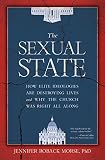
The Sexual State: How Elite Ideologies Are Destroying Lives and Why the Church Was Right All Along

US HERE – UK HERE


Posted in One Man & One Woman, Our Catholic Identity, The Coming Storm, The future and our choices | Tagged , ,
Comments Off on VIDEO: Men and Women are Different After All: Part 1 of a series on The Gender Ideology

Mail from a priest: “It finally dawned on me that the dysfunction could be demonic.” Then a short rant from @FatherZ

A priest sent an interesting email, in the wake of what I wrote HERE about the need to perform exorcisms of all church properties.   I short, I wrote:

[…]

If I were a diocesan bishop, I would immediately go through my entire cathedral and chancery and residence and exorcise the places using the older, traditional Roman Ritual.

If I were a diocesan bishop, I would tell pastors of parishes and chaplains of schools, etc., whom I trusted to do it right, to do the same in their places, church, sacristy, rectory, school, all around the grounds.   Otherwise, I would send delegated priests to all the other parishes, etc., to carry out the exorcisms.

If I were a diocesan bishop, I would pronounce an exorcism over the entire diocese entrusted to my care.

If I were a diocesan bishop, I would go to the four corners of the diocese and pronounce the exorcism again at each spot and also say Masses at each, Pro Remissione Peccatorum, Pro Defensibus Ab Hostibus, Ad Poscenda Suffragia Sanctorum, Pro Gratiarum Actione.

Repeat annually.

[…]

What did the priest send me?

So just a note in response to your post on exorcisms. I started a school at my parish. From day 1 it’s been a slog. Nothing seemed to go right in spite of many prayers, good planning, and sufficient financial backing.

The strangest problems would occur and once we handled one, there would be another.

In February, we were on the verge of closing because people were pulling out so fast. But it didn’t make sense. The problems seemed almost . . .coordinated.

It finally dawned on me that the dysfunction could be demonic.

I consulted the diocesan exorcist who encouraged me to do an exorcism on the building. So that’s what I did while assisted by my parochial vicar: old rite, in Latin, blessed salt and all.

Wouldn’t you know it, things immediately smoothed out. We got a new principal who is perfect for us, our enrollment numbers started going up again for next year, and we raised an incredible amount of money to keep the doors open.

I don’t know for sure what caused the oppression (I do have some suspicions), but praised be Jesus Christ and the power he has given to his Church!

Indeed.  Laudetur Iesus Christus.   This is entirely consistent with what I’ve heard in parallel situations.

FATHERS!   Do not underestimate the power granted to the priest through the rites of the Church.  Blessings and Deprecatory Prayers and Exorcisms are mighty tools.

After I suggested to bishops and priests to say deprecatory prayers from the Roman Ritual during one of the last big hurricane threats to the East Coast, some priests wrote to say that they had done them. Then the hurricane changed coarse and didn’t strike land as the projected course suggested.

Once during flood season I suggested that the bishop and priests use the Ritual’s prayers against floods.   I received a note from a priest that they did it and the flood subsided before the projected time.

Once I myself watched on TV radar coverage a massive storm with confirmed tornadoes dropping right and left.  On the map, that even had time stamps of the arrival of the threats on a path, it was barreling down on where I was.   So, I got out the Rituale, put on my stole, and standing on the porch recited the prayers into the face of the wind, commanding the storm.  Finished, I returned to the TV and watched as an astonished weatherman remark that he had not seen anything like what was happening.  On radar you could see the really ugly core of the storm split in half and go around my address.

One of the reasons why we consecrated bells the way we did is so that they could be rung against storms and in times of need, to call God’s help down onto communities.  Here’s but one of the puissant prayers in the “baptism” consecration of a bell:

O God, who through the blessed Moses, the law giver, Thy servant, didst command that silver trumpets should be made, through which when sounded by the priests at the time of sacrifice, the people, reminded by their sweet strains, would make ready to worship Thee, and assemble to offer sacrifices, and encouraged to battle by their sounding, would overcome the onslaughts of their enemies; grant, we beseech Thee, that this vessel, prepared for Thy Holy Church, may be sancti+fied by the Holy Spirit, so that, through its touch, the faithful may be invited to their reward. And when its melody shall sound in the ears of the peoples, may the devotion of their faith increase; may all the snares of the enemy, the crash of hail-storms and hurricanes, the violence of tempests be driven far away; may the deadly thunder be weakened, may the winds become salubrious, and be kept in check; may the right hand of Thy strength lay low the powers of the air, so that hearing this bell they may tremble and flee before the standard of the holy cross of Thy Son depicted upon it, to Whom every knee bows of those that are in Heaven, on earth, and under the earth, and every tongue confesses that the same our Lord Jesus Christ, swallowing up death upon the gibbet of the cross, reigneth in the glory of God the Father, (Philippians 2, 10), with the same Father and the Holy Spirit, world without end. R. Amen.

You would be surprised at how long and complex the rite is for the consecration of a bell.  Greg DiPippo has an informative piece about the rite at NLM.  They are “baptized”, as it were.  They are washed with holy water, anointed with the Oil of the Sick and Sacred Chrism, filled with smoke from burning thyme (or really thymiama, the recipe for which -equal parts of galbanum, stacte, frankincense and onycha) is, given by God to Moses, is a little hard to make now… but that’s another story), frankincense and myrrh, and then solemnly given a name.  Bells speak to us.  They speak with joy and they call us to joy, prayer and action.  They mourn when we mourn.  Their silence can be deafening.

And that’s just BELLS.

That’s the sort of thing that bishops and priests can do!

Have we as Catholics forgotten so very much of our identity and our Tradition?

This is one of the reasons why I bang on about the recovery of our Catholic Tradition and its reintegration into our regular daily lives, not just occasional events.   It’s a whole way of life, that integrates the rhythm of the Church’s calendar with its seasonal and festal blessings, days of penance and petition, processions of rogation and exaltation, weaving our sacred times with our daily needs.

Blessings, Deprecatory Prayers, Exorcisms.   They aren’t as amazing as the Sacraments, but they are just the tools we need for certain jobs.

Posted in "How To..." - Practical Notes, Hard-Identity Catholicism, Liturgy Science Theatre 3000, The future and our choices | Tagged , , ,
21 Comments

ASK FATHER: Can a deacon serve as acolyte in the Extraordinary Form Mass?

From a reader…

QUAERITUR:

Can a deacon serve as acolyte in the Extraordinary Form Mass?

Sure.  If there are not enough servers for the sake of a Solemn Mass, and for some reason you have a plethora of deacons and a paucity of non-clerics, sure.  It’s a little hard to imagine the scenario, but, sure.  A gathering of priests and deacons somewhere?   Perhaps some of the boys couldn’t show up so you have to fill in?

Why not?

While it is better for a deacon to be deacon or subdeacon, he can serve if need be.

As a matter of fact, it is a good thing for priests and deacons – let’s not exclude bishops – to serve Mass once in a while.  I once had a cardinal serve Mass for me.  That’s humbling.  I have served Mass for visiting priest friends.  It’s great!

It’s okay for a priest not to concelebrate, but to sit in choir in proper choir dress.  It’s okay for a priest or a deacon to take a serving role.  I will often act as a deacon on Sundays so we can have a Solemn Mass, which should be the target for Sunday worship.

It’s okay for us to get down off our high horses and pick up the curry comb.

Posted in "How To..." - Practical Notes, ASK FATHER Question Box, Liturgy Science Theatre 3000 | Tagged ,
14 Comments

WDTPRS – 13th Ordinary Sunday: error binds and truth frees

At work in the Collect for the 13th Sunday of Ordinary Time are themes of divine adoption and the splendor of truth.

Our prayer connects being wrapped up in error with separation from God.  It joins divine adoption with coming into view in the light of Truth.

Deus, qui, per adoptionem gratiae, lucis nos esse filios voluisti, praesta, quaesumus, ut errorum non involvamur tenebris, sed in splendore veritatis semper maneamus conspicui.

Involvo involves “to wrap up, envelop” and “to cover, overwhelm, surround.”  Conspicuus (as opposed to occultus) is an adjective for something in view or that comes into view.  Thus, it is “that which attracts the attention to itself, striking, illustrious, remarkable”.  Splendor is, “sheen, brightness, brilliance, luster” and moreover, “dignity, excellence.”

LITERAL VERSION:

O God, who wanted us to be children of the light through the adoption of grace, grant, we beg, that we not be bound up in the shadows of errors, but rather that we remain always striking in the splendor of the truth.

CURRENT ICEL (2012):

O God, who through the grace of adoption chose us to be children of light, grant, we pray, that we may not be wrapped in the darkness of error but always be seen to stand in the bright light of truth.

During Mass keep your ears pricked up, ready to pick up Biblical references in the prayers.  A theme of this Collect is our identity as children of God through adoptio gratiae, adoption of grace.   St. Paul writes often about spiritual adoption (e.g., Gal 4:5 and Eph 1:15, et al.).  Writing to the Romans he tells us about the moral implications of spiritual sonship.  Why not spend a half hour or so reading and thinking about Romans 8:1-15 and (under the usual conditions) gain a partial indulgence?

The phrase splendor veritatis should ring a bell.  The late Pope John Paul II in his 1993 encyclical Veritatis splendor began to correct the erroneous and dangerous tendencies of some contemporary moral theologians. Progress has been made.

Splendor, in the writings of some Fathers of the Church is, like gloria and maiestas, associated with the divine presence.  Think of the pillar of fire during the Exodus, the shining cloud wherein God spoke to Moses, the light of the transfigured Lord on Mount Tabor.  The Doctor of Grace, St Augustine of Hippo (+430), twice connected “splendor of truth” (splendor veritatis) with “fervor of charity” (fervor caritatis). Centuries later the Seraphic Doctor, St Bonaventure of Bagnoregio (+1274) expanded upon this link.   For Augustine and Bonaventure, living in the light of the truth, which is the love of God, necessarily means also love of neighbor.  With what kind of love must we hold our neighbor?   With fervor, “a boiling or raging heat”.   This is no lukewarm love which Jesus will spew away.

Splendor veritatis leads to fervor caritatis, the blazing raging fire of Jesus’ Sacred Heart, His lacerated “burning furnace of love”.

Christians cannot love God and not love neighbor.  In word and deed we must reflect this two-fold love or we are not true Christians.   I often fail in this.

The splendor of Truth brings us into the light, teaches us love, and sets us free.  Error binds us, prevents us from acting as free persons.

In the light of day we walk about freely, without hurting ourselves or getting lost.  In darkness we grope, stumble, and run against unseen obstacles.

Today’s Collect presents “shadows of errors” as a smothering envelopment hiding God from our sight and us from His sight as if we were in a dark forgotten tomb, buried alive.

The wounds of Original Sin make it difficult to know what is good and right and true.  Our intellects are clouded.  When through in the tangle of our minds or the help of human or divine authority we discern the good, then we still need to choose it with our wounded will.  We can convince ourselves that actions which are in reality bad, wrong and false are actually good, right and true.  We fool ourselves into thinking we are “free” and acting rightly when we actually are doing things that are quite wicked.  If this becomes habitual, we become numb to truth and to error and to sin.

Once we are enveloped in error’s darkness, which begins in self-deception, ever after we lurch through life like horror movie zombies, grotesque mockeries of what God intended for His holy images.

God makes it possible to put off the darkness and put on the light (Rom 13:12-14).  He flashes, shines, dispels our blindness (cf Augustine, Confessions 10,27).

By the merits of Christ’s Sacrifice and through His sacraments and Holy Church’s teaching we can be the free beautiful images God wants us to be in this life and in the life to come.

Posted in Liturgy Science Theatre 3000 | Tagged ,
Comments Off on WDTPRS – 13th Ordinary Sunday: error binds and truth frees

Listen for their hearts.

I wrote this for the current issue of the Catholic Herald, now published in both the UK and these USA.  Each week I write 400 words for the issue.

___

As this number of the weekly you now peruse was issued, we celebrate the Most Sacred Heart of Jesus.  In the Church’s post-Conciliar, Novus Ordo calendar, the day after Sacred Heart is generally the Feast of the Immaculate Heart of Mary.  This year the day, 29 June, is the Feast of Sts Peter and Paul.  In England and Wales, Saturday remains in honor of the Immaculate Heart and Peter and Paul bump aside the 13th Sunday in Ordinary Time.  In these USA, where I write, Peter and Paul, with its red martyrial vestments, displaces the Immaculate Heart’s liturgical celebration and Sunday remains the green 13th.  And, just to add liturgical zest, in the traditional calendar 1 July is the Feast of the Most Precious Blood.  Such a cornucopia of feast days.

Speaking of Our Lord’s Blood, let’s circle back to our beautiful pair of heavenly Hearts.  Before Mary conceived Our Lord beneath her heart, she conceived Him in her heart.   Christ’s Sacred Heart would come to pulse also with blood and humanity He received from her Immaculate Heart.  In a foreshadowing, He made her blood His own.  Then they gave it, circulated it, Precious, each to the other.

Surely, Mary pondered, contemplated, inwardly gazed at the pre-born Jesus.  Surely, Jesus’ Mother, our Mother, listened to His Heart.  Did you know that the hearts of mothers and their unborn babies tend to beat with synchronization?

Surely, Mary listened to His tiny Heart, ear to breast, and gazed, contemplated Him after His birth. Did you know that mothers and their babies’ hearts will swiftly synchronize when they smile at each other? Imagine, for a moment, the smiles of Mary and Jesus.  Try to picture that.  Imagine the heartbeats of Mother and Son, synchronized literally and physically.  Be still. Try to hear their hearts.

From then on, the beautiful Hearts of Jesus and Mary were harmonized.  I like to imagine that they were so close that when our Lord trudged up hill, perhaps miles away perhaps Mary felt her own heart quicken.   If so, consider Mary’s own heart beneath the Cross, as Christ’s struggling Heart cramped to its three-day rest and stopped the flow of the Precious Blood He received from her?  Surely, Christ held Mary’s heart in His nail-marked omnipotent hand at end of her earthly life, keeping her safe.

Their Hearts beat for us, long for us.  Listen for their hearts.

Posted in Liturgy Science Theatre 3000 | Tagged ,
7 Comments

VIDEO: “A Moment With The Bishop” – ACTION ITEM!

People have been writing to ask, “How’s the new bishop?”  They refer, of course, to the newly installed successor to the late Bp. Morlino of Madison.  Bp. Donald Hying, late of Gary, officially took his crook and cathedra in Madison on 25 June.
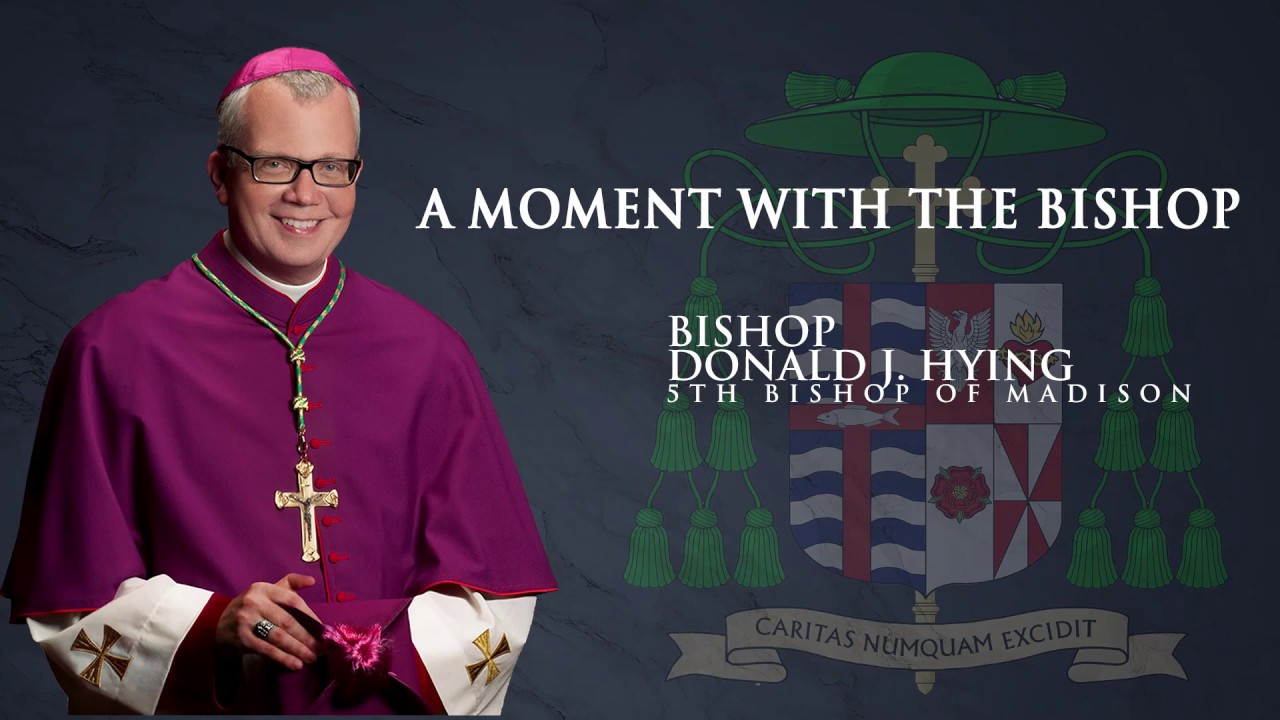

Bp. Hying is using tools of social communication!  I received a note today that he will have, as he did when he was in Gary, a regular, even daily, short video to talk about some aspect of our Catholic Faith.

So, “How’s the new bishop?”  Watch and listen for yourselves! Right now there are 232 views of the video and 576 subscribers to the channel.

YouTube thumbnailYouTube icon

Posted in SESSIUNCULA |
4 Comments