Septuagesima: “Burying the Alleluia”

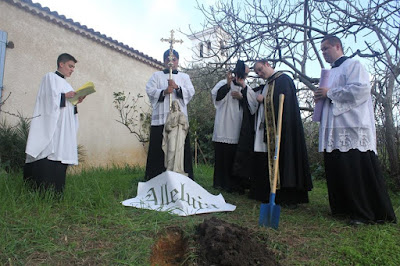
I have in the past written, just the other day as a matter of fact, about a French custom of “burying the Alleluia” on Septuagesima.  On this pre-Lent Sunday, scrapped with the incept of the Novus Ordo, we wear the purple of penitence on Sundays and we already begin thinking about our Lenten discipline which will begin pretty soon.

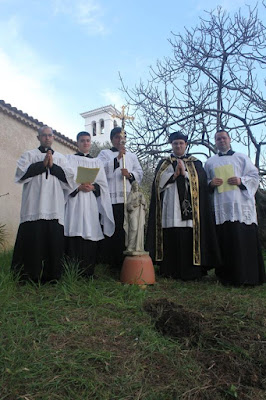
Today at NLM I saw a great post with photos of the burying of the Alleluia at a parish of the Fraternity of St. Joseph the Guardian.  Here are a couple.  See the rest over there.

A great custom… especially if you live where the ground hasn’t yet been frozen as hard as concrete.

UPDATE:

From the magnificent Benedictines of Mary, Queen of Apostles in Missouri come images of their own farewell to the Alleluia.

16_01_24_Alleluia_01 16_01_24_Alleluia_02 16_01_24_Alleluia_03 16_01_24_Alleluia_04

Posted in Just Too Cool, Liturgy Science Theatre 3000, Our Catholic Identity | Tagged ,
5 Comments

16th c. Samurai, martyr, advanced closer to beatification

I like this story.  From CNA:

This sword-wielding Samurai just moved closer to sainthood!

Vatican City, Jan 23, 2016 / 04:02 am (CNA/EWTN News).- The martyrdom of a 16th-century Samurai who died for his Catholic faith was approved this week by Pope Francis, making the Japanese warrior one among nine other causes that advanced toward sainthood.

Takayama Ukon was born in 1552 in Japan during the time when Jesuit missionaries were becoming introduced within the country. By the time Takayama was 12, his father had converted to Catholicism and had his son baptized as “Justo” by the Jesuit Fr. Gaspare di Lella.

Takayama’s position in Japanese society as daimyo[a feudal lord] allowed him many benefits, such as owning grand estates and raising vast armies. As a Catholic, Takayama used his power to support and protect the short-lived missionary expansion within Japan, influencing the conversion of thousands of Japanese.

When a time of persecution set in within the country under the reign of Japan’s chancellor Toyotomi Hideyoshi in 1587, many newly-converted Catholics abandoned their beliefs.

Instead of denying their faith, Takayama and his father left their prestigious position in society and chose a life of poverty and exile. Although many of his friends tried to persuade Takayama to deny Catholicism, he remained strong in his beliefs.

Takayama “did not want to fight against other Christians, and this led him to live a poor life, because when a samurai does not obey his ‘chief,’ he loses everything he has,” Fr. Anton Witwer, a general postulator of the Society of Jesus, told CNA in 2014.

Ten years passed, and the chancellor became more fierce in his persecution against Christians. He eventually crucified 26 Catholics, and by 1614, Christianity in Japan was completely banned.

The new boycott on Christianity forced Takayama to leave Japan in exile with 300 other Catholics. They fled to the Philippines, but not long after his arrival, Takayama died on February 3, 1615.

In 2013, the Japanese bishops’ conference submitted the lengthy 400-page application for the beatification of Takayama to the Congregation for the Causes of Saints. On Jan. 22, 2016, Takayama’s advancement in the cause for canonization was further promulgated when Pope Francis approved his decree of martyrdom.

“Since Takayama died in exile because of the weaknesses caused by the maltreatments he suffered in his homeland, the process for beatification is that of a martyr,” Fr. Witwer explained.

Takayama’s life exemplifies the Christian example of “a great fidelity to the Christian vocation, persevering despite all difficulties,” Fr. Witwer continued.

[…]

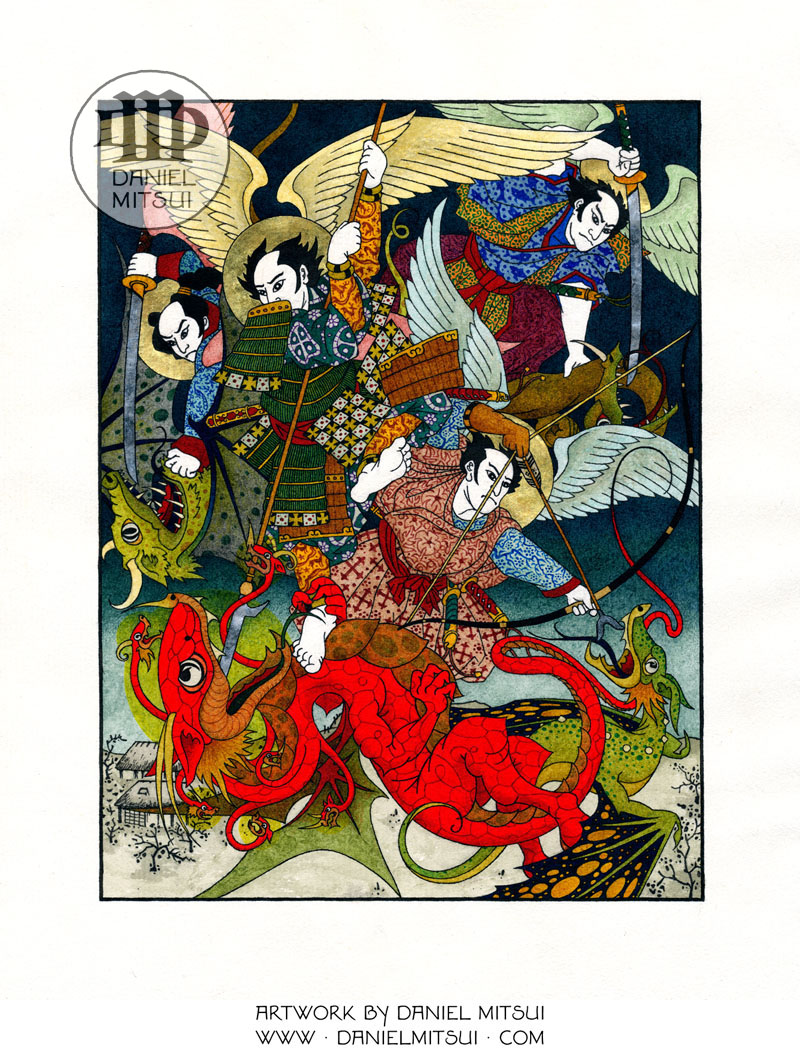
I’ll take this opportunity to remind you about the great artwork by Daniel Mitsui.  Here is his marvelous battle of angels against the Enemy of the soul.  HERE

Posted in Saints: Stories & Symbols | Tagged , , ,
7 Comments

Pope Francis: “there cannot be confusion between the family desired by God and every other type of union”

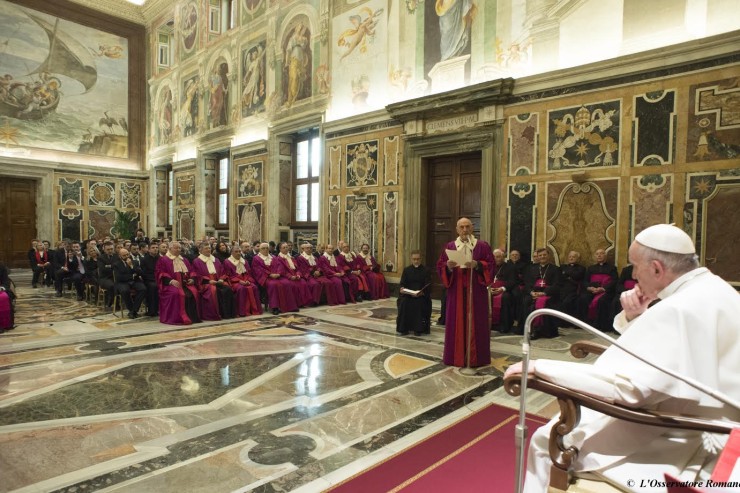
The other day His Holiness Pope Francis gave the annual address to the Roman Rota. HERE

The Rota, the Tribunal Apostolicum Rotae Romanae or Apostolic Tribunal of the Roman Rota is the Church’s highest appellate court.  It takes its name from the round table that was used.  A great deal of its business has to do with cases of nullity of marriages.

Here are a few excerpts of Pope Francis address in my fast translation:

[…]

The Church indicated to the world that, among other things, there cannot be confusion between the family desired by God and every other type of union.

[…]

The family, founded on indissoluble marriage….

[…]

It is good to reaffirm with clarity that the quality of faith is not an essential condition for matrimonial consent, which, according to perennial doctrine, can be undermined only at the natural level (cf CIC can 1055 § 1, 2).

[…]

The Church, therefore, with a renewed sense of responsibility, continues to propose matrimony, in its essential elements – offspring, the good of the spouses, unity, indissolubility, sacramentality – not as an idea for few, notwithstanding modern models centered on the ephemeral and transitory, but as a reality that, in the grace of Christ, can be lived by all the baptized faithful.

[…]

Those who promote homosexual relations and who undermine the indissolubility of marriage won’t be happy with this.   Sorry Fishwrap.

Posted in Emanations from Penumbras, Francis, Our Catholic Identity, The Drill | Tagged , , ,
7 Comments

CQ CQ CQ #HamRadio Saturday: Middle Of Nowhere

Now for another edition of Ham Radio Saturday.

I created a page for the List of YOUR callsigns.  HERE  Chime in or drop me a note if your call doesn’t appear in the list.

I’ve been really busy lately, so I haven’t been able to do much radio stuff.  It has also been really cold here, and the way I have to set up my antenna involves having a door or window slightly open.  Also, I have to go outside to adjust the antenna.  That kills the motivation a bit.

During the upcoming week we should be able to do some work on the parish radio shack. We have the room cleared and a work list.

Meanwhile, one of our priest hams had a trip to the SW of these USA.  He took his rig and set up in the middle of nowhere in NM.

I had some middle of nowhere too, but driving.  Lots of that last week.

Meanwhile, I had some equipment to fix.  The vertical I use has a design flaw.  There is a rather flimsy plastic screw that is supposed to hold the adjustable coil in place.  It broke off.  Very pesky.

Otherwise, it is a good antenna for me right now.  HERE  Thanks to a ham reader who sent it!

So… for me it’ll be a night of college hockey, Ite Rodentes.  From last night.

As of this writing, I am on 40m.

UPDATE:

20m


Posted in Ham Radio | Tagged , ,
5 Comments

WDTPRS Septuagesima Sunday: “What am I getting myself into?!?”

In the traditional Roman calendar this Sunday is called Septuagesima, Latin for the “Seventieth” day before Easter.  Already!  It is quite early this year.

This number, 70, is more symbolic than arithmetical. The Sundays which follow are Sexagesima (“sixtieth”) and Quinquagesima (“fiftieth”) before Ash Wednesday brings in Lent, called in Latin Quadragesima, “Fortieth”.

These pre-Lenten Sundays prepare us for the discipline of Lent, which once was far stricter.

Septuagesima gives us a more solemn attitude for Holy Mass.

Purple is worn on Sunday rather than the green of the time after Epiphany.  These Sundays have Roman stations.   The station today is St. Lawrence outside the walls.  St. Gregory the Great preached a fiery sermon here, which we have, and which is read in part for Matins in the traditional Office.  The traditional Office also presents three figures over the three pre-Lent Sundays, all foreshadowing Christ: Adam, Noah and Abraham.

When we want to follow what Holy Church is giving us in our sacred liturgical worship we should remember that Mass is only part of the picture.  We also have the Office, the “liturgy of the hours”.  They mesh together and reinforce and complete each other.

Alleluia is sung for the last time at First Vespers of Septuagesima and is then excluded until Holy Saturday.  There was once a tradition of “burying” the Alleluia, with a depositio ceremony, like a little funeral.  A hymn of farewell was sung.  There was a procession with crosses, tapers, holy water, and a coffin containing a banner with Alleluia.  The coffin was sprinkled, incensed, and buried. In some places, such as Paris, a straw figure bearing an Alleluia of gold letters was burned in the churchyard.  Somehow that seems very French to me.

The prayers and readings for the Masses of these pre-Lenten Sundays were compiled by St. Gregory the Great (+604), Pope in a time of great turmoil and suffering.  Looking at Gregory’s time, with the massive migration of peoples, the war, the turmoil, you are reminded of our own times.

I like to imagine the Romans who were aspiring to be brought into the Church at Easter. They were brought out to St. Lawrence for today’s Mass, only to hear in the antiphons about suffering and crying out to God, and then to hear the reading in which Paul says that God wasn’t pleased with everyone who drank from the rock.  “What am I getting myself into?!?”   But, if throughout the Mass formulary there are grim messages, there are also signs of great hope.  God does hear the cry of those who invoke him.

In the Novus Ordo of Paul VI there is no more pre-Lent.

A terrible loss.

We are grateful that with Summorum Pontificum the pre-Lent Sundays have regained something of their ancient status.

The antiphons for the first part of Mass carry a theme of affliction, war, oppression.  How appropriate right now when the Obama Administration is conducting a war against the Catholic Church and against religious liberty of all Americans.  We hear from 1 Corinthians on how Christians must strive on to the end of the race.  The Tract (which substitutes the Gradual and Alleluia) is the De profundis.

COLLECT:

Preces populi tui, quaesumus, Domine, clementer exaudi: ut, qui iuste pro peccatis nostris affligimur, pro tui nominis gloria misericorditer liberemur.

This prayer, as well as the other two we will see, is in versions of ancient sacramentaries, such as the Gregorian. Our wonderful Lewis & Short Dictionary says ex-audio means “listen to” in the sense of “harken, perceive clearly.” There is a greater urgency to exaudi (an imperative, or command form) than in the simple audi. Clementer is an adverb from clemens, meaning among other things “Mild in respect to the faults and failures of others, i.e. forbearing, indulgent, compassionate, merciful.” We are asking God the omnipotent Creator to listen to us little finite sinful creatures in a manner that is not only attentive but also patient and indulgent.

LITERAL TRANSLATION:

We beseech You, O Lord, graciously to hark to the prayers of Your people: so that we who are justly afflicted for our sins, may mercifully be freed for the glory of Your Name.

The first thing you who attend mainly the Novus Ordo will note, is the profoundly different tone of this prayer.

It is just as succinct as most ancient Roman prayers.  It has the classic structure.  But the focus on our responsibility and guilt for our sins is very alien to the style of the Novus Ordo.  For the most part, such direct references to our sinful state were systematically excised from the ancient prayers which survived in some form on the post-Conciliar Missale Romanum.

SECRET:

Muneribus nostris, quaesumus, Domine, precibusque susceptis: et caelestibus nos munda mysteriis, et clementer exaudi.

This ancient prayer was also in the Mass “Puer natus” for 1 January for the Octave of Christmas.  The first part of the prayer is an ablative absolute. In the second part there is a standard et…et construction.  The prayer is terse, elegant.

LITERAL TRANSLATION:

Our gifts and prayers having been received, we beseech You, O Lord: both cleanse us by these heavenly mysteries, and mercifully hark to us.

In the first prayer we acknowledge our sinfulness and beg God’s mercy.  In this prayer we show humble confidence that God is attending to our actions and we focus on the means by which we will be cleansed from the filth of our sins, namely, the Sacrifice of Jesus on the Cross, about to be renewed upon the altar.

As the Mass develops there is a shift in tone after the Gospel parable about the man hiring day-laborers.  An attitude of praise is introduced into the cries to God for help.

POSTCOMMUNIO (1962MR):

Fideles tui, Deus, per tua dona firmentur: ut éadem et percipiendo requirant, et quaerendo sine fine percipiant.

Glorious.

In an ancient variation we find per[pe]tua, turning “by means of your…” into “perpetual”. That éadem (neuter plural to go with dona, “gifts”) is the object of both of the subjunctive verbs which live in another et…et construction.  Requiro means “to seek or search for; to seek to know, … with the accessory idea of need, to ask for something needed; to need, want, lack, miss, be in want of, require (synonym: desidero)”.  Think of how it is used in Ps. 26(27),4: “One thing I have asked of the Lord, this will I seek after (unum petivi a Domino hoc requiram); that I may dwell in the house of the Lord all the days of my life.”  Quaero is another verb for “to seek”, as well as “to think over, meditate, aim at, plan a thing.”  The first meaning of the verb percipio is “to take wholly, to seize entirely” and then by extension “to perceive, feel and “to learn, know, conceive, comprehend, understand.”

Notice that these verbs all have a dimension of the search of the soul for something that must be grasped in the sense of being comprehended.

The New Roman Missal – 1945:
May Thy faithful, O God, be strengthened by Thy gifts,
that receiving them they may still desire them
and desiring them may constantly receive them.

The New Marian Missal – 1958:
May Thy faithful people, O God, be strengthened by Thy gifts;
that in receiving them, the may seek after them the more,
and in seeking them, they may receive them for ever.

Saint Andrew Bible Missal – 1962:
O Lord, may your faithful people be made strong by your gifts.
By receiving them may they desire them.
And by desiring them, may they always receive them.

Just to show you that we can steer this in another direction, let’s take those “seeking/graping/perceiving” verbs and emphasize the possible dimension of the eternal fascinating that the Beatific Vision will eventually produce.

A LITERAL ALTERNATIVE:

May Your faithful, O God, be strengthened by Your gifts: so that in grasping them they will need to seek after them and in the seeking they will know them without end.

In this life, the closest thing we have to the eternal contemplation of God is the moment of making a good Holy Communion.  At this moment of Mass, which so much concerned struggling in time of oppression, we strive to grasp our lot here in terms of our fallen nature, God’s plan, and our eternal reward.

I don’t believe this prayer, like Septuagesima Sunday, made it into the Novus Ordo, to our great impoverishment.
Posted in Liturgy Science Theatre 3000, WDTPRS | Tagged , ,
8 Comments

22 January: Sts. Vincent and Anastasius, martyrs

16_01_22_CH_01Each week I write an eclectic column of precisely 400 words called “Omnium Gatherum for the UK’s best Catholic weekly The Catholic Herald This column, which follow my four year series on translations, is now in its second year.

For this last week’s (22 Jan) number I wrote:

In the classical, traditional Roman liturgical calendar, this week brings us on 22 January to the Feast of Sts Vincent of Saragosa and Anastasius the Persian.  Vincent was a Deacon and the Proto-Martyr of Spain, killed around 304 when Diocletian was Emperor.  St Augustine (d 430) preached about Vincent that he suffered torments beyond what any human could endure without the help of God.   The more he suffered, the greater seemed his joy.  Anastasius, a convert from Zoroastrianism, was tortured to abandon his faith in Christ by strangulation and decapitation in 628.  These were gutsy men, who bore witness to the Faith in times of persecution.

Speaking of guts, when in Rome visit their church, Santi Vincenzo ed Anastasio, which faces the famous Trevi Fountain.    This was once the parish church for the Quirinal Palace, which was the summer residence of Popes from 1583 until 1870.  It has a beautiful baroque façade which sports the coat-of-arms of its builder and patron, the successor of Cardinal Richelieu as the French King’s chief minister, Jules Card. Mazarin (d 1661), a major character in Twenty Years After, the sequel to Alexandre Dumas’ The Three Musketeers.  In this church are deposited the praecordia, the viscera, of 22 popes.  Beginning with Pope Sixtus V (d 1590), when the pontiffs died their guts were extracted, jarred, preserved.  Leo XIII (d 1903) is the last Pope whose innards grace the place.  His body is now venerated at the Basilica of St John Lateran.

Leo XIII, famous for his 1891 encyclical on social issues Rerum novarum, was the first pope born in the 19th century and the first pope to die in the 20th.  He advanced Thomistic theology, Mariology, and consecrated the world to the Sacred Heart.  Leo gave us the tradition of the commonly called “Leonine Prayers” or “Prayers after Mass”.  We should have the guts to revive these prayers after Masses, and say often:

O God, our refuge and our strength, look down with favor upon Thy people who cry to Thee; and by the intercession of the glorious and immaculate Virgin Mary, Mother of God, of Saint Joseph her spouse, of the blessed Apostles Peter and Paul, and of all the saints, in mercy and kindness hear our prayers which we pour forth for the conversion of sinners, and for the liberty and exaltation of Holy Mother Church. Through the same Christ Our Lord. Amen.

Posted in Saints: Stories & Symbols | Tagged
Comments Off on 22 January: Sts. Vincent and Anastasius, martyrs

ASK FATHER: Why is a baptismal certificate so important for annulment process?

From a reader…

QUAERITUR:

Trying to get an annulment. Can’t find his baptismal record. Why is it so important?

Well! That was pithy.

There is a Latin adage from ancient Rome: Verba volant, scripta manent… Words merely spoken fly away, but words written down remain.

Baptismal records are wonderful things. When they are properly tended, they record all of the sacraments we receive in life. These written records are to be kept at the parish of our baptism. When a baptismal record is issued, it will have notations on the back listing the dates and places of all the sacraments we received. These records are our sacramental biography. And they supplement memories which can be inexact… for one reason or another.

With regards to a declaration of nullity, the tribunal needs the baptismal certificates for the parties for a number of reasons. Baptismal certificates establish whether the parties were baptized Catholics (and therefore bound by law to observe the Catholic form of marriage). They indicates the ritual Church to which the party is ascribed. For example, if one party is, say, a Maronite and she marries a Presbyterian in the Catholic Church, that marriage might be invalid because of a lack of jurisdiction.

The marriage which is being challenged ought to be noted on the baptismal certificate, if the records were properly kept. When there is a church wedding, the pastor or person in charge of that church is obliged by law to notify the parish of baptism of both parties so that the pastor of that parish can duly make the notations in their baptismal records. If it is not noted in the baptismal record, there may be a case of a lack of canonical form. There may also be other issues discovered in the baptismal record, such as a prior marriage, religious profession, or ordination. If these are noted on the certificate they will impact the decision of the Tribunal.

Most parishes, often through the diligent work of attentive parish secretaries, keep good records. Some, sadly, do not. Fie on them!

Every Catholic ought know where his baptismal certificate is. That said, these days there are lots of mergers and closures. If the parish one was baptized in has closed or merged, the records ought to have gone to the new parish, or they may be in the safe keeping of the diocesan chancery. If one was baptized in a hospital, or orphanage, or private residence, the records may be with that institution or they may be in the keeping of the territorial parish. If one was baptized in a non-Catholic church and then converted to Catholicism, one’s record will be kept at the Church where one made one’s profession of faith. That is what happened in my case, since I am a convert. When I was ordained, I had to produce, among the many documents required, a sacramental record from my parishes Baptism Registry. My record is in the Baptismorum Registrum Ecclesiae Sanctae Agnetis, Urbe Sancti Pauli, Minnesota, Vol. XIV, p. 31. It has the dates and place of my baptism, the names of my parents, sponsors, minister, an indication of my reception into the Catholic Church, when, where and by whom, the date, place and minister of Confirmation… and to that was added diaconate and priesthood.  It’s all written down.

These records are to be kept in a secure place, even a fire-proof vault. Some places make sure there are backup copies, perhaps at the chancery archive. After all, Jesus saves, and so should we!

Sometimes it is impossible to obtain a baptismal certificate. In that case living memory of witnesses can substitute to an extent. However, I have written about that in other places.

Posted in "How To..." - Practical Notes, ASK FATHER Question Box, Liturgy Science Theatre 3000 | Tagged ,
10 Comments

WDTPRS: 3rd Ordinary Sunday – “abound with good works”

The Collect for the upcoming 3rd Sunday of Ordinary Time in the Ordinary Form.

Omnipotens sempiterne Deus,
dirige actus nostros in beneplacito tuo,
ut in nomine dilecti Filii tui
mereamur bonis operibus abundare.

This was in the 1962 Missale Romanum as the Collect for the Sunday in the Octave of Christmas.

I wrote about sempiternity HERE.

In the superior Lewis & Short Latin Dictionary we learn that beneplacitum means “good pleasure, gracious purpose”.  The preposition in using the ablative case indicates a condition, situation or relation rather than a reference to space where or time when something was occurring.  In the Vulgate beneplacitum translates the original Greek eudokia in, e.g., Eph 1:9; 1 Cor 10:5.  Other phrases are used for eudokia too (e.g., bona voluntas in Luke 2:14, the famous “peace on earth to men of good will” or “peace on earth good will toward men”).  Paul wrote eudokia at the beginning of 2 Thessalonians (1:11-12), rendered as voluntas bonitatis in the Vulgate:

oramus semper pro vobis ut dignetur vos vocatione sua Deus et impleat omnem voluntatem bonitatis et opus fidei in virtute ut clarificetur nomen Domini nostri Iesu Christi in vobis et vos in illo secundum gratiam Dei nostri et Domini Iesu Christi…

…we always pray for you, that our God may make you worthy of his call, and may fulfill every good resolve (omnem voluntatem bonitatis) and work of faith by his power, so that the name of our Lord Jesus may be glorified in you, and you in him, according to the grace of our God and the Lord Jesus Christ (RSV).

We can find connections between 2 Thessalonians and our Collect at several points: mereamur in the Collect with dignetur in Paul (both having to do with meriting or being worth of), beneplacitum with voluntas bonitatis, bona opera with opus fidei (good works flowing from lived faith), nomen Filii with nomen Domini Iesu Christi.   Taken in the sense of “gracious purpose” we can make a connection to Paul’s vocatio too, our “calling” or the purpose for which God placed us on this earth with a part of His plan to fulfill.

Abundo means, “to overflow with any thing, to have an abundance or superabundance of, to abound in.”  If we go back to the idea of the preposition in and the ablative indicating place or location in space, (in beneplacito tuo) we have an image of our good works originating in God and, coming from Him, overflowing out from us.

Some Protestants are under the false impression that Catholics think we “earn” our way to heaven by our own good works, as if our good works had their own merit apart from God.

No.

Catholics believe that true good works always have their origin in God, but the works are truly our works as well because we cooperate with God in performing them.  Therefore, having their origin and purpose in God, they merit the reward of God’s promises.  As Augustine would say, with His merits He crowns His own works in us.

Whenever you find a reference to works in these liturgical prayers, do not forget the Catholic understanding of good works.

LITERAL VERSION:

Almighty eternal God,
direct our actions in your gracious purpose,
so that in the name of Thy beloved Son,
we may merit to abound with good works.

OBSOLETE ICEL (1973):

All-powerful and ever-living God,
direct your love that is within us,
that our efforts in the name of your Son
may bring mankind to unity and peace.

At least they didn’t split it into two or three sentences.  “Oh God, you are so big.  Help us to be big like you.”

In the Obsolete ICEL version note the vague term “love”, rather than the indication of God’s eternal plan.  Perhaps this is a bit picky, but when I hear “we may merit to abound with good works”, I think we are abounding because of God’s action within us through the good works He makes meritorious.  They overflow from us because of His generosity. In the Obsolete ICEL version, however, God’s “love” is in us, but this leads to “our efforts”.  Yes, this can be reconciled with a Catholic theology of works, but … it just doesn’t sound right.  Also, I don’t think that “efforts” to “bring mankind to unity and peace” means the same as us “meriting” by God’s grace to “abound with good works”.

When we feed the hungry and console those who mourn, visit the shut-in and imprisoned and pray for the dead, sure we are building “unity and peace”, but that phrase is so vague as to mean very little to someone in the pew.

Is it possible that the guitar strumming and all those kumbayas of the 1960’s affected the translators choice of words?  Hmmm….

Please understand: I don’t object to praying for unity and peace, but I think we ought to pray the prayer as the Church gave it to us, what the prayer really says.  We are far closer to that with the newer, corrected ICEL version now in use.  And… we can always use the Latin.


CURRENT ICEL (2011):

Almighty ever-living God,
direct our actions according to your good pleasure,
that in the name of your beloved Son
we may abound in good works
.


Posted in Liturgy Science Theatre 3000, WDTPRS | Tagged ,
Comments Off on WDTPRS: 3rd Ordinary Sunday – “abound with good works”

Benedictines of Norcia make GREAT beer! Coming to these USA!

In the wake of not-so-great news, here is some wonderful news.

Birra Nursia comes to these USA!   Dear readers, I can testify that this is excellent beer.  And it is made by monks who are worthy of your support.

Here’s the press information about the beer.

NORCIA, ITALY — Beginning January 22 at 7am EST and following closely on the heels of the chart topping release of their Benedicta CD of Gregorian chant, the Monastery of San Benedetto is elated to announce the launch of the revised, revamped 2.0 version of birranursia.com.

At long last and undoubtedly in answer to many American prayers, the revitalized website allows the online purchase and doorstep delivery of Birra Nursia, the monk-brewed craft beer that is made at the birthplace of the great founder of western monasticism.

A limited quantity of the beer will be available each month.

From January 21, pre-orders of Birra Nursia will be open to customers in the United States for March delivery. Friends of the Monastery of San Benedetto and lovers of specialty beer will now be able to enjoy the monks’ signature product in their own home.

Orders can be made through our American Online Store. Interested friends are invited to order today by visiting our website.

The beer is available in .75 liter bottles (wine bottle size) sold separately, in 6-packs and in cases (of 12). Pricing details are available at the American Online Store.  [It’s not cheap, but it is really good.]

Because the monks spend most of their day in prayer and working around the monastery, Birra Nursia will only be able to fulfill a limited number of orders per month on a first come, first serve basis. Those who place an order that cannot be fulfilled immediately will have priority for the following month’s shipping.

Friends who make a 1-year subscription are enrolled in the Brewmonks’ Club, which is the premier way to enjoy Birra Nursia at home. By signing up, you pledge to buy a six-pack or case (of 12 bottles) every month. This means that throughout the year you will be able to enjoy Birra Nursia and be a part of the developing Birra Nursia story. Members become connoisseurs of the beer and are the brewery’s ambassadors in the United States. And, needless to say, membership has its rewards. Members:

– Are the first to have their orders fulfilled each month
– Receive a personalized membership certificate
– Receive a case of Birra Nursia specialty craft goblets upon enrollment
– Receive free bottle openers
– Receive a biannual newsletter with special monastic brewing insights

The Monks of Norcia are very proud to expand the reach of Birra Nursia. Since the brewery was founded in 2012, visitors and friends from the United States have asked the monks to find a way to sell their beer in the American market. This tremendous opportunity allows the monks to further that which has been their aim from the beginning: to share the life, spirit and joy of monastic life in Norcia with the world.

Nota Bene: Ground shipping is carried out by FedEx and calculated at a base price, plus a small supplement for the number of bottles. This means that it is highly cost effective to buy multiple bottles. Please consider purchasing a case to dramatically save on shipping costs.

QUESTIONS ?

america@birranursia.com


Posted in Just Too Cool, The Campus Telephone Pole | Tagged ,
11 Comments

Rules change for Holy Thursday. Hijinx ensues.

16_01_21_washing_feet_Meister_des_HausbuchesFrom the often amusing Eye of the Tiber (my emphases):

Women May Now Have Their Feet Washed And Pedicured At Holy Thursday Mass, Pope Says

Pope Francis has changed the rules for the Church’s Holy Thursday foot-washing ceremony, issuing a decree allowing women to not only participate in the ceremony, but to have an optional pedicure for the low donation price of just $14.95. That’s right, just $14.95.
In a letter addressed to Cardinal Robert Sarah, the Pope said that 12 “lucky” people would be chosen to participate in the ritual of what is now being called the washing and pedicuring of the feet “from among all members of the People of God whose feet and toenails are in desperate need of superficial cosmetic treatment.”
“For some time I have been reflecting on the rite of the washing of the feet so that we fully express the meaning of the gesture made by Jesus in the Upper Room, his gift of self until the end for the salvation of the world, his boundless charity,” Francis said. “But also because I myself have had countless pedicures over the years and truly understand the importance of tootsie maintenance.”
Francis went on to say that “with the amount of walking the disciples did during their ministries, I am quite certain that they would not have said no to a soothing pedicure once in a while if it was ever offered them.”
Francis also stressed that the average person takes 8,000 to 10,000 steps a day, which adds up to about 115,000 miles over a lifetime, and that all the wear and tear on the feet can be harmful if they are not maintained properly.
“The Lord said, ‘The harvest is plentiful, but the laborers are few; pray therefore the Lord of the harvest to send out laborers into his harvest. Go your way; behold, I send you out as lambs in the midst of wolves.’ How can we expect to accomplish this task with wear and tear on our feet? And to the men I say be not afraid! Pedicures are no longer just for women, just as the washing of the feet is no longer just for men.”

After all, as Pope Francis said the other day during his off-the-cuff fervorino:

“Christians who obstinately maintain ‘it’s always been done this way,’ this is the path, this is the street—they sin: the sin of divination. It’s as if they went about by guessing: ‘What has been said and what doesn’t change is what’s important; what I hear—from myself and my closed heart—more than the Word of the Lord.’ Obstinacy is also the sin of idolatry: the Christian who is obstinate sins! The sin of idolatry. ‘And what is the way, Father?’ Open the heart to the Holy Spirit, discern what is the will of God.”

Posted in Lighter fare | Tagged , ,
23 Comments