This is too good not to share.
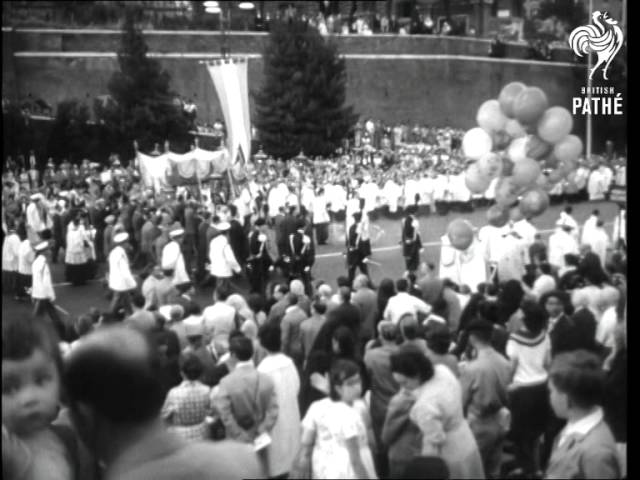
Corpus Christi may have passed for this year, but that doesn’t mean we can’t enjoy the reportage, even from years ago.
John XXIII on Corpus Christi 1960. Compare and contrast?
Interesting details.


This is too good not to share.
Corpus Christi may have passed for this year, but that doesn’t mean we can’t enjoy the reportage, even from years ago.
John XXIII on Corpus Christi 1960. Compare and contrast?
Interesting details.
 This week’s Collect is pretty much the same as one in the ancient Gelasian Sacramentary and the prayer in the 1962 Missale Romanum used during the week after Trinity Sunday.
Deus, in te sperantium fortitudo, invocantibus nostris adesto propitius, et, quia sine te nihil potest mortalis infirmitas, gratiae tuae praesta semper auxilium, ut, in exsequendis mandatis tuis, et voluntate tibi et actione placeamus.
Because of the word pairings fortitudo and infirmitas, voluntas and actio, a possible source for this Collect could be the anti-Pelagian writings of St. Augustine of Hippo (+430).
In classical Latin fortitudo rarely means just physical strength. Instead, it is “firmness, manliness shown in enduring or undertaking hardship; fortitude, resolution, bravery, courage, intrepidity”. In the Latin Vulgate of the Old Testment the Lord is often described as “my strength… fortitudo mea”. Latin and Greek Old Testament versions translate Hebrew maw’oz and ‘oz which indicate a place or means of safety, a refuge or stronghold. You probably know the great “battle hymn” of the 16th Protestant revolt in Germany, “Ein feste Burg ist unser Gott … A Mighty Fortress is our God”, the translation of a psalm by Martin Luther (+1546).
Since ancient times the battle of orthodox Catholicism with various heresies and schismatic movements has involved the use of hymns and songs. They help people learn and remember things. Augustine composed a song with sound theological points to combat the Donatists who had set up their schismatic altars against those of Catholics. This is true in more modern times as well. If the Lutherans had “A Mighty Fortress is our God” we Catholics had “Grosser Gott, Wir Loben Dich … Holy God, We Praise Thy Name” composed in 1774 as a paraphrase of the Te Deum going back to the late 4th or early 5th century, perhaps having a connection to St. Ambrose (+397).
Auxilium is “help, aid, assistance, support, succor”. The obsolete ICEL versions constantly had us asking for some “help” from God (who is, after all, really nice). In those now outdated prayers “help” was nearly always inadequate because the concept of “grace” was obliterated along with the word “grace” itself. Voluntas is mainly “will, freewill, wish, choice, desire, inclination”. This is the power of our free will which together with our intellect distinguishes us from brute beasts. It can also be more simply an “intention” or something we interiorly “will”.
LITERAL TRANSLATION:
O God, strength of those hoping in You, graciously be present to us as we are invoking You, and, because without You mortal weakness can do nothing, grant always the help of Your grace, so that, in the performance of Your commands, we may please You both in will and in action.
OBSOLETE ICEL (1973):
Almighty God, our hope and our strength, without you we falter. Help us to follow Christ and to live according to your will.
That was a good example of why we needed a new translation.
CURRENT ICEL (2011):
O God, strength of those who hope in you, graciously hear our pleas, and, since without you mortal frailty can do nothing, grant us always the help of your grace, that in following your commands we may please you by our resolve and our deeds.
In the fall of our First Parents, we were wounded and weakened in our intellect and will. It is hard for us to reason to what is good and true. After we figure them out with our reason or we learn about them from authority, because of our passions and appetites it can be hard for us to will to choose them. Our intellects and wills must be disciplined through the repetition of choices and actions in the right times, moments, and measures so that we develop good habits, virtues.

New link, as the Monks overhaul. Click and bookmark!
In our prayer voluntas is set in juxtaposition with actio “action”. We have “inclinations” to this or that thing. In actions our inclinations become concrete. Some actions are entirely mental or spiritual, in that they are actions of the mind. We have an initial idea or inclination and then we use our free will to grasp or refuse that idea. We can bring an inclination to a deeper thought, contemplate it. There are intellectual acts (for good or ill). There are also physical acts. We get an idea and then, with our intellects and wills, we figure out how to do it and choose to act (for good or ill). Because of the weakness in us from Original Sin, in order to will and act properly we must have the help of grace.
God begins and completes in us all the meritorious things we do. He gives us the strength to carry through with all good acts.
UPDATE: 16 June
Solution posted, below.
Originally posted 15 June:
___
Here is quiz.
Does anyone know what this liturgical object is?


UPDATE:
Some really interesting guesses are coming in! I’ll wait to post quite a few at once.
UPDATE:
There are some great answers piling up. Some of them are pretty funny.
UPDATE:
I received this from someone with access to the amazing Jubilee Museum and Catholic Cultural Center in Columbus, OH.
I hope you are well! Just wanted to send pictures of a holder with candles (and still labled for sale actually)


That was interesting!
This is surely for the days when many more people attended daily Mass and, especially, St. Blaise Day!

 nce upon a time I used to write about the finest rosaries I had ever seen. They were easy on the eyes, like jewelry, but they were as strong as steel cables.
The woman who made them, Gayle, had started up a cottage business. I helped her get up and running on the web waaaay back in the days of Compuserve and the Catholic Online Forum. Gayle was also on the staff of the Forum. She, with Dawn, and a couple of others were a serious hoot.
Gayle’s life was complicated and had some ups and downs. But she made rosaries. In gratitude for my early help, she would send me rosaries when I wanted to give ordination gifts or if I had given mine to someone whom I sensed was in need of it. In a few instances, the gift of the rosary was a life changer.
Gayle died in 2016. I still have one of her rosaries and I will never let it go. I’m tempted to be buried with it, but I think I’ll pass it on. Perhaps someone will pray for me with it.
There has been a development.
Gayle’s daughter, Marian, had learned her mother’s technique of making rosaries.
She has decided to start her own business, as her mother had.
>>HERE<< [UPDATED]
She wrote that she is sending me one. I am sure it will be as amazing as Gayle’s were. Even if were half as amazing, and as strong, it would be a fine rosary. I very much look forward to receiving it.
In the meantime, check out her shop. She wrote: “It’s just an Etsy page for now, but I hope that I can begin my own website once I have some momentum.”
Do you suppose you readers could give her some momentum?
There are lots of religious professions and marriages and ordinations going on at this time of the year.
Gifts… I’m just sayin’.
UPDATE: 5 June
Marian wrote:
I cannot thank you enough! In less than 24 hours, my page has had almost 5,000 views and I have sold 13 rosaries!
To which I respond: Those will be 13 very happy people.
UPDATE: 8 June
Marian had written that she would send me a rosary, so that I could see with my own eyes what she is producing. I got it right away, but I waited until today, the Feast of the Sacred Heart, to show it to you.
It came in a bag within a small gift box itself mailed in a standard priority mailer box.

As you can see, this rosary has a Sacred Heart medal at the connecting point.

This rosary is a bit lighter than the last one I had from her mother. It doesn’t have the little “caps” and the beads are a little smaller. That makes it a bit more compact. It is a good rosary for walking, if you get my drift, which is something I mentioned to her. I had asked for it to be “not too long” so that it wouldn’t touch the ground when kneeling and easy to carry in one hand when walking without touching the ground.
In other words, she incorporated my suggestions.
Seeing is indeed believing!
UPDATE: 16 June 2018
This is interesting. There was a story about these rosaries and their maker, Gayle’s daughter Marian, in her local newspaper.
Check it out, HERE. With photos!
UPDATE:
Thanks to those who have sent donations through PayPal.
MH, J-AF
_____
As you know, I am involved with a Society for the promotion of all things liturgically traditional, the Tridentine Mass Society of the Diocese of Madison. This is a 501(c)(3) organization.
In my role as President, it is my pleasure and duty to ask people for LOTS of money.
I am about to ask you for LOTS of money.
We just obtained and used on Corpus Christi our procession canopy that matches our white Pontifical Mass set. HERE That set us back a bit.
Coming up, the diocese will use the TMSM’s red Pontifical set for ordinations to the priesthood on 29 June. It should be quite a sight.
We have two concrete projects going on.
Today I received from Gammarelli in Rome photos of the cutting of the fabric for a Solemn Mass set in green. The set will have chasuble, dalmatic, tunic, cope humeral veil, frontal, and material for a tabernacle veil which we shall make.


The trim will be serpentine column in bronze. Very classy.
This set should be done in a couple of weeks. We got it so that we would not put too much wear on a few pieces of our Pontifical Mass set, which is somewhat more spectacular.

So, the green set must be paid for.
The other project, which I am researching and working on, probably with custom woven fabric and in a Gothic style, will be a new set in BLACK for Pontifical Requiem Masses and also, eventually, pre-55 Good Friday.
Sorry, no photos of that… yet. But when that moves forward, you’ll be hearing from me.
PLEASE SEND US MONEY! LOTS OF MONEY!
We are doing great things here in Madison, with the support of the Extraordinary Ordinary, Bp. Morlino. I don’t think there are as many Pontifical Masses anywhere in the world. Hence, we are raising the bar for everyone. We need to keep raising the bar.
Won’t you help us to raise that bar?
Make a tax-deductible donation to support the Tridentine Mass Society of Madison, a 501(c)(3) organization, without any service fees extracted, by mailing a check to:
Tridentine Mass Society of Madison
733 Struck St.
P.O. Box 44603
Madison, WI 53744-4603
Or, you can donate via PayPal (who doextract a service fee), using the button below:
 The other day I posted an excerpt from an offering by Peter Kwasniewski at NLM, under my title: “Why we Say The Black and Do The Red“. In a nutshell, the traditional manner of proclaiming or chanting the readings during Holy Mass makes of those readings a manifest act of worship over an above their didactic utility.
A long time reader here sent this:
I was in attendance last evening at a low mass for the Feast of the great witness of Portugal and Doctor of Evangelization, Saint Anthony. It was the first traditional mass I have attended since your post, ” Why we Say The Black and Do The Red”on 11 June. I read what Professor Peter Kwasniewski wrote at NLM and it occurred to me that there’s another piece of this excellent notion that wasn’t mentioned but that became immediately evident to me as I listened to the reading.
Where the celebrant reads the Lection, and how he is oriented makes so much sense. It is now a more settled given for me that the priest is not only reading the Lection, but lifting it up, offering it back to God; however, how much more does this now make sense that the book is upon the altar. It seems to me the Lection is another offering, and that it being offered from the altar, in itself having a deep meaning shading light upon the vertical communication between priest and God. The Lection is an offering from the altar of sacrifice. I don’t think I recall every having had that thought or read that before! It also becomes clear that in the re-reading from the ambo that the second reading is subsidiary to, and in service pointing back to, the first.
While I have been attending and praying this mass irregularly for over ten years, this insight and deeper meaning only came from the observation begun by saying we need to stick to the older way, and what the reason is behind that. If an adaptation were made now, so much of the subtle but deeply spiritual meaning is completely lost – obviously the noble point.
Thanks as always for helping us all to draw closer to Him and His Eucharistic presence

 From a reader…
QUAERITUR:
My wife and I recently discovered that Fr. Paul Wickens was schismatic priest. All we ever knew about him, we learned from our family. We attend Holy Mass at the chapel he built (now run by ICKSP with approval of the the archdiocese). Now that we know Fr. Wickens was in schism, what does that mean in regards the sacraments my wife and her sibling received from him? She received First Communion and Confirmation, and some her of siblings were baptized by him. Were these sacraments valid? Licit? Does anything have to be done on our part?
This reminds me of the early Church’s Donatist controversy.
Wickens did not have faculties from proper authority to function as a priest.
Everything that Wickens did was illicit, except in the case of danger of death (when the law itself provides faculties for valid absolution, etc).
However, being validly ordained, Wickens did truly confect the Eucharist when he validly, but illicitly, celebrated Holy Mass. Therefore, people really did receive Holy Communion from him.
Any person can baptize validly, provided they do what the Church intends. There is little doubt that Wickens baptized validly.
The ordinary minister of Confirmation is a bishop. However, can. 822 says that a priest who has the “faculty in virtue of universal law or the special grant of the competent authority also confers this sacrament validly.” The local bishop could give a priest the faculty and the law itself gives a priest the faculty in danger of death. Wickens would not have had the faculty to confirm. Hence, the validity of the confirmation is highly doubtful.
Sometimes when the unrepeatable sacraments of Baptism and Confirmation are doubtfully conferred, the rite is repeated conditionally. To the form (spoken words) of the sacrament there would be added “If you are not baptized/confirmed, …”.
What to do?
You should get in touch with your parish priest or the priest at the legitimate traditional chapel which you may now be frequenting and explain the situation. That priest should then consult with the chancery quickly and determine a way for you validly to be confirmed. I suspect that they would determine that you would need to be confirmed absolutely and not conditionally. I also suspect that the chancery has had to deal with this before, since Wicken’s chapel was there for a long time. This won’t be their first rodeo with his illicit and invalid acts.
Don’t fret over this.
If you didn’t know about any of this before, you are not guilty of the sin of simulating the administration of sacraments. However, I am sure that you want to know for sure and be at ease about having the sacramental character that Confirmation confers and you want the grace of this wonderful sacrament.
Hence, don’t dawdle, but you don’t have to dash from your computer or drop the phone, leaving supper on the burner and junior in the bathtub to fend for himself.
UPDATE:
Right on schedule, I received another email directly after posting the above.
I received confirmation from Archbishop Lefebvre in the early 80s (pre-excommunication if that makes a difference). Was my confirmation valid?
Thanks Father. I really appreciate all that you do. God Bless.
If Archbp. Lefebvre did it, you were validly confirmed.
The 1983 Code of Canon Law says…
Can. 882 The ordinary minister of confirmation is a bishop; a presbyter provided with this faculty in virtue of universal law or the special grant of the competent authority also confers this sacrament validly.
Can. 886 §2. To administer confirmation licitly in another diocese, a bishop needs at least the reasonably presumed permission of the diocesan bishop unless it concerns his own subjects.
This is essentially the same in the older, 1917 Code.
So, a bishop without faculties or permission to function in a place validly but illicitly confers Confirmation. A priest needs the faculty to confer Confirmation validly and licitly.
Ergo, an SSPX bishop confirms validly but illicitly.
An SSPX priest, however, cannot confirm validly without the faculty, which he would have to obtain from proper authority or, in danger of death, from the law itself.
The Cathedral of St. Paul in St. Paul, MN, is in my estimation a candidate for “grandest cathedral in these USA”. It is also the National Shrine of St. Paul.
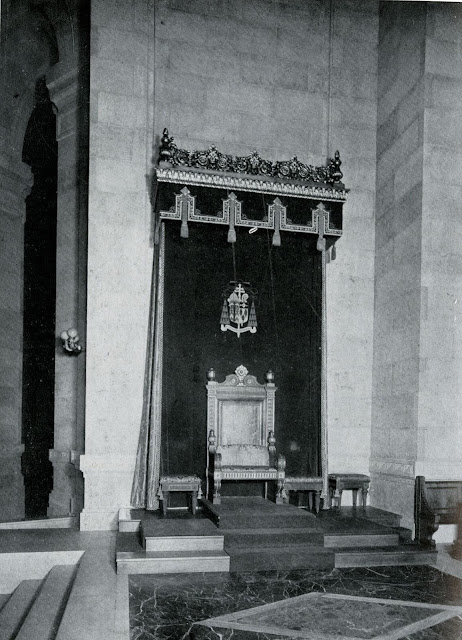
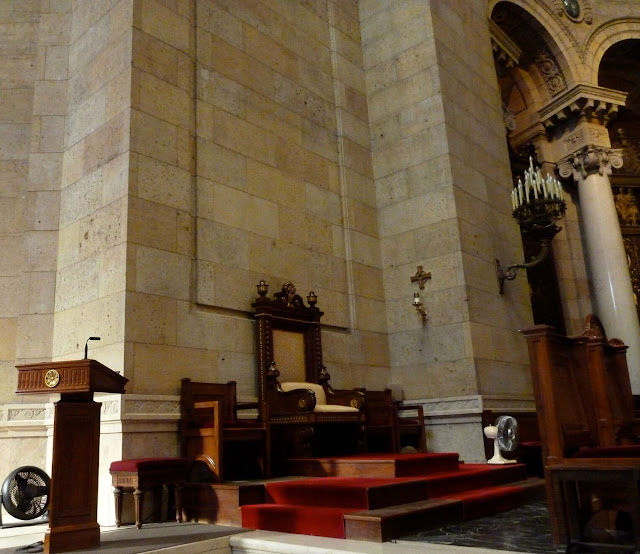
One of the advantages of this cathedral is that is wasn’t badly ravaged by the liturgical vandals that swept across the Church with their jackhammers and whitewash and sentimental gewgaws. There was one casualty, however: the cathedra, the bishop’s chair, the symbol of his authority.
In the ancient Roman churches, the cathedra was placed in the center of the apse. The bishop would preach while seated in the stylized chair. Over time it was generally moved to the “Northern” wall of the sanctuary and surmounted by a canopy. In the Roman Rite, when the bishop was present at Mass or celebrant, it would also be draped in the color of the vestments. Moreover, like a classic Roman altar, it was elevated by an odd number of steps and it had a platform wide enough so that the bishop could be flanked by deacons.
Today I saw at LAJ that a priest friend of mine, the Cathedral’s penultimate rector Fr. Joseph Johnson [NB: Originally I thought that this was more recent, under the present rector Fr. Ubel], managed to restore with splendor the cathedra‘s furnishing to something very like their original form.
Back in the bad days, when the mania to downsize the grand to the stingy in the name of “simplicity” and reduce everything supernatural to the natural, the furnishings surrounding the cathedra had been removed. If memory serves, however, traces remained: there were still fastenings left in the wall.
Here is the cathedra back in the day.
This is what was done to it.
And this is what the rector achieved.
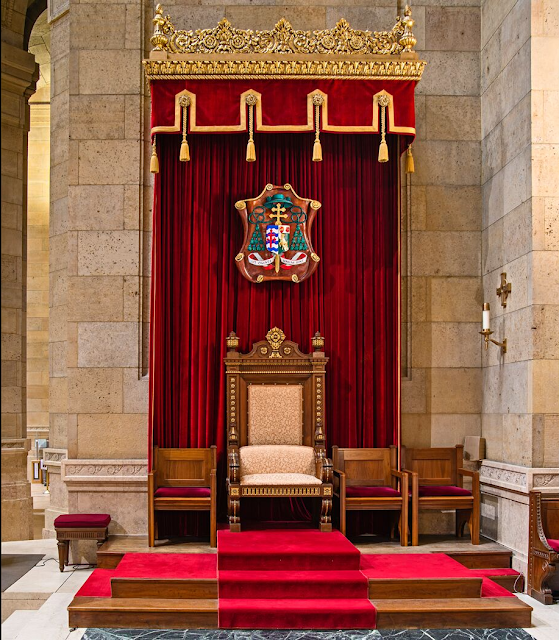
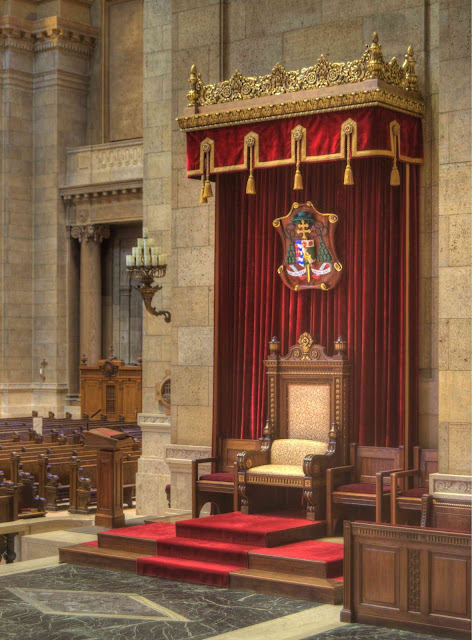
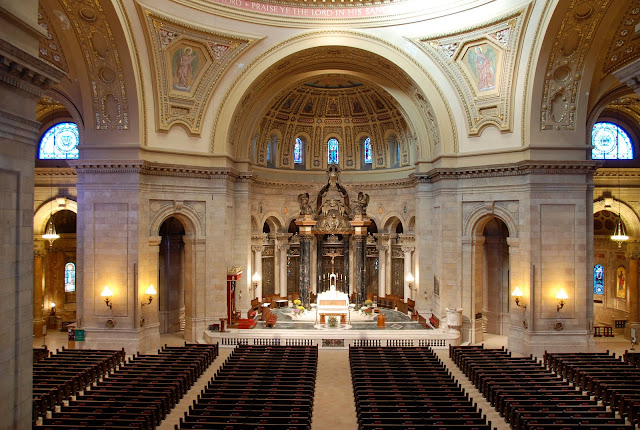
Fr. Z kudos. That was a great project.
Now it’s time to get rid of the table altar!
BTW… I linked, above, to the Cathedral’s site. They have a 360º virtual view which is pretty interesting. If you try it, make sure to check out the ambulatory behind the sanctuary.
At the UK’s best Catholic weekly, the Catholic Herald there are lots of great photos of the recent priestly ordination of a young man in the FSSP at Warrington in England by Archbishop Malcolm McMahon of Liverpool.
Really… the photos are amazing. They document in high quality the whole ritual, from the vesting of the bishop,

…through the Mass.

The sight of an ordaining bishop, using the traditional Roman Rite, and wearing the pallium is quite something.

And I am sure that the haters will love to hate the cappa magna.

What’s with all the fancy gear?
The priest and bishop are our mediators for the one Mediator. They are, during Holy Mass, both priest who offers the Sacrifice, and also the Sacrificial Victim.
The lambs prepared under the old covenant for the day of sacrifice were taken great care of and fussed over… right up to the time the knife slashed their throats open.
When you see the priest and bishop in fine vestments, remember the love and gratitude and care with which we treat sacred things and persons and places. We look to them and through them as Moses look, straining, to glimpse the Mystery as God passed by on the other side of the cleft in the rock (cf Exodus 33). They are signs that facilitate the encounter with mystery that is simultaneously frightening and alluring, hard to prepare for and yet vital for our spirits. They help us to prepare, through their beauty and challenge for our own deaths.
 I am astonished. And I am not astonished.
At the site of the UK’s best Catholic weekly, the Catholic Herald, we learn that Jesuit homosexualist activist James Martin has been asked to speak at the upcoming World Meeting of Families.
This meeting takes place every three years. Since 1994 it has been organized by what is now the Holy See’s Dicastery for Laity, Family and Life. The last meeting was in Philadelphia. The 2018 meeting will be in August 2018.
Pope Francis will travel to Ireland for the meeting.
The official site is HERE.
I have to ask this.
When the family is under attack from every direction, is it a good idea to have a homosexualist activist speak at a Vatican sponsored meeting concerning the family?
Maybe it is. Maybe it isn’t.
I can think of arguments both ways depending, of course, on the speaker.
In earlier preparations for this meeting, there had been some materials with images of same-sex “couples”. That drew some predictable resistance and the images were removed. Jesuit run Amerika Magazine has Martin lament this with a false lamentation, a straw man:
“Why wouldn’t we want to help baptized Catholics feel included in their own church? And the argument that they’re ‘sinful’ is beside the point because we’re all sinful. We need to see L.G.B.T. people as full members of the church, by virtue of their baptism. They need to know that God loves them and their church accepts them.”
Straw man, right? Who doesn’t want to “help baptized Catholics feel included in their own church”? The answer is clear: NOBODY.
But there’s more.
They need to know that God loves them and their church accepts them.
Okay! Great! But… accepts them as… what? Fellow sinners? Sinners with a past who are amending their lives? Sinners who are sinning now and who don’t repent and amend?
Amerika goes on:
As to what organizers were trying to say by inviting a priest who has called on church leaders to be more welcoming to L.G.B.T. people, Father Martin said it is clear.
“The message to L.G.B.T. Catholics seems straightforward: you’re an important part of the church,” he said.
Whatever else it is, the “message” to homosexual Catholics is NOT straightforward. And, once again, this is slippery: every Catholic is an “important part of the Church”.
It is never made clear by Martin whether homosexual Catholics are to be welcomed and valued etc etc etc because they are human beings and Catholics, or because of their homosexuality. Put another way, is it their humanity and Catholicity that is being exalted and defended, or their same-sex attraction?
I have the strongest sense that, behind the rhetoric – and you can see how elusive it is – the real agenda is to normalize homosexual inclinations and, thereafter, acts.
He could, of course, clear that up pretty quickly. Please correct me if I am wrong, but he hasn’t done so yet even though others also raise this question.
We can and should have focused outreach and concern and apostolates for specific types of sinners. For example, we can have a special concern for alcoholics as alcoholics. Do we condone abuse of alcohol? No. We understand that there is a lot of evidence about genetic tendencies to alcoholism. Do we say that inclination is good? No.
Alcohol and human sexuality are gifts from God. Do we condone the abuse of alcohol and also the abuse of human sexuality? Of course not. Homosexual persons are inclined to desire to do things that are intrinsically evil. Having a drink isn’t a sin (for most people). Having way too much all the time is a sin, not because drinking alcohol is evil, but because too much is immoderate. Too much of a good thing is too much. Moving to sex, because too much of a good thing is too much, married couples having too much sex would be sinful. Mirabile dictu.
However, same sex people having sex even once is sinful for more than one reason, which you ought to be able to rehearse.
God foresees and permits that some people will be sinfully inclined to A, B or C. He doesn’t make them that way. He offers them graces. The inclinations can, in a mysterious turn and by God’s plan, wind up being the thorny path, rocky and steep, by which people get to heaven. However, those who have whatever inclination to some sort of sin must persevere to resist the inclination. They will, in doing so, suffer. Their reward in heaven will be great.
Who will attempt to deny that some homosexuals – once their homosexuality was known – have been badly treated by some clergy?
Martin would have you believe that priests far and wide have be harsh toward homosexuals because they are homosexuals. Somewhere some priests have been uncharitable towards some chaste, continent homosexuals trying to live holy lives. That sort of priest fully qualifies as a jerk and SOB. But we must also ask the question, make a distinction. Is it the person that priests have been harsh towards or the sins they have committed? Were the sinners abounding or lacking in resolve to amend their lives? That doesn’t justify being a jerk, of course, but the distinction is important. Furthermore, there are, in fact, times when sternness is charity and pastoral. Yes, you read that right.
Hence, I circle back to my previous questions. Will homosexualist activists like Martin explain more clearly what it is that we are supposed to welcome: the people as people, or the people as homosexuals, or … the homosexuality?
If his agenda is really to help us to be charitable toward fellow sinners who are struggling with grace and elbow grease towards heaven, GREAT! I am 1000% on board. If his point is that all people are made in God’s image and have dignity and they should be treated as such, then HECK YAH! I’ll help! If he is going to stand up at the World Meeting and say that all people have dignity and must be treated with charity and that homosexuals must resist their inclinations and live continent, chaste lives and that they should avoid scandal, then… great!
If his agenda is really to shift people to think that homosexual inclinations and same-sex attraction is not any different from opposite-sex attraction, and that same-sex acts are not different from opposite sex acts, then, no, I am not on board. If his point is the main-streaming of same-sex sexuality and the legitimation of homosexual sex, then HECK NO! I’ll oppose it!
BTW… I know of another group of people who, in both the past and in the present, “often feel ignored, marginalized, excluded, insulted and even persecuted by their Church”. They have been treated like dirt by a lot of clergy because of how they self-identify and because of their “inclinations”. All they want to be is “Catholic” and to be able to realize their “legitimate aspirations”, as Pope St. John Paul called them. All they want is something legitimate and sacred, part of the warp and weft of the Church for centuries. All they want is to be welcomed and treated well. They just want to be an active part of the Church. More often than not, they are ignored and belittled.
But I digress.
In the case of the upcoming World Meeting of Families, I’m just asking if this it is a good idea to have Fr. Martin as a speaker, given that he will not provide clarifications for my points above.
If I have missed something, I sure would like to be corrected.

Coat of Arms by D Burkart









A Daily Prayer for Priests


They find you a pro-life agent in your area who commits to giving a portion of the fee to a pro-life group!

PLEASE subscribe via PayPal if it is useful. Zelle and Wise are better, but PayPal is convenient.
A monthly subscription donation means I have steady income I can plan on. I put you my list of benefactors for whom I pray and for whom I often say Holy Mass.
In view of the rapidly changing challenges I now face, I would like to add more $10/month subscribers. Will you please help?
For a one time donation...



Help Monks in Wyoming (coffee – UPDATED LINK) and Norcia (beer) and the wonderful "Soap Sisters" of Summit, NJ!


Please follow me on Twitter!










Visits tracked by Statcounter
since Sat., 25 Nov. 2006:

