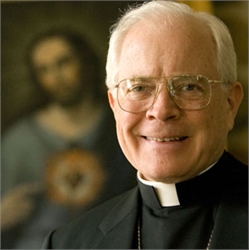
 Pontifications pointed to Amy Wellborn’s note on the "Ubiquitous Song Leader". Bishop Edward J. Slattery of Tulsa is publishing in his diocesan paper the Eastern Oklahoma Catholic a series of articles calling people to a more faithful application of the Church’s norms on liturgy. After the last Synod of Bishops His Excellency has asked clergy, liturgists and musicians to review Sacrosanctum Concilium.
Here is a sample (my emphasis added):
“I ask them to pay special attention to the sections devoted to Sacred Music (Chapter 6, 112 – 121) that those who share responsibility in a parish for the implementation of the Council’s liturgical norms might reacquaint themselves with what the Council Fathers actually wrote concerning the requirements of proper liturgical music, and in particular the principle which places the text in importance over the melody, thus acknowledging the  primacy of Gregorian Chant among the Church’s musical traditions, not merely from the position of its great venerability and beauty, but also because chant, having no rhythm, never forces the text to be rewritten to fit a specific meter. Chant allows us a certain sacred space within which that Word which God spoke in ancient times can be heard today with greater clarity and fidelity. I understand that this review of music must lead to changes and that changes will often be irksome and problematic. For this reason I would caution that this gradual, but definite, reintroduction of Gregorian chant into our parishes and communities be done with careful study, deliberate consultation and much prayer. However, as a sign of the seriousness with which I approach this topic, I am asking that pastors move with some dispatch to introduce their congregations to the simpler chants of the Kyriale, including the Gloria, Sanctus, Pater Noster and the Agnus Dei.” (Eastern Oklahoma Catholic March 6, 2006).
Bishop Slattery gives his flock a whole lot more beside. For example: “I am also asking our people to recover their sense of the sacredness of the sanctuary by refraining from idle conversation in Church before and after Mass.” Or, how about this: “If… our attention is repeatedly pulled away from the altar to the presence of the cantor or the choir, then our participation at Mass can become a kind of tennis match, and our response in prayer remains shallow and disjointed. … (W)e should be honest enough to acknowledge that the placement of the choir, cantor and the musicians (in the front of the church) has proven to be a terrible distraction in many parishes.”
I love this guy.































Wow. This is great. First to invite the monks from Fontgombault to make
a foundation, and now to actually encourage and EXSPECT parishes begin making
efforts to do “what the Council Fathers actualy wrote” …
I wish I could have him over my diocese!
I pray he continues to hold fast to this. Deo gratias!
It’s about time. The present situation with secular and non-catholic music has been a terrible detraction from the holiness of the Mass. And I agree that the presence of the choir set before the people has also been a major distraction. Also,why do choirmasters insist that the organist play at maximum volume? Some churches have such terrible reverberations that the lyrics cannot be understood (but considering the music, perhaps that’s a blessing). I wish we had more Bishops of his ilk!
Father Z,
I can’t thank you enough for posting this. It’s certainly nice to see such a piece of good news. One would think from reading the whiny traditionalists of blogdom that there’s no good news to be had. But my own bishop, Kevin Rhoades, recently announced
that he’s going to move the tabernacle in the cathedral back to the center of the sanctuary, to the spot currently occupied
by his cathedra. He’s also provided for new norms regarding new church construction demanding the same thing. On top of that,
I have it on good authority that he plans in the coming months to make our weekly indult apostolate, now staffed by the
FSSP, a full-time mission parish, with all seven sacraments celebrated in the traditional rite.
Once I get Bishop Slattery’s column to him, there’s no telling what might happen!
In Domino+
Jon
Thanks for posting this Fr. Z. It provides a bit of hope that at least positive change is happening somewhere. Out west, it seems some of our bishops are more concerned with the evils of kneeling.
Thank you as well for all of your great work on wdtprs. You’re one of my first stops everyday. After reading your column in The Wanderer for several months as well as consuming the wdtprs.com archives, I HAD to start Latin self-study (one of my Lenten commitments). I’m sure you have “multitudes” :) of faithful lurkers here.
yours in Christ,
Paul
wow, great articles by the bishop. Am printing them out to read slowly.
Father,
A most excellent fellow!
Fr. Z,
I noticed Bishop Slattery has been the bishop in Tulsa since 1994.A quick question: does Bishop Slattery have a reputation for being interested in liturgical reform, or can this move be directly tied to the Synod? If the latter, this is even more heartening as it is evidence of tangible reform results in the reign of our Holy Father. Deo Gratis!
Bishop Slattery has been “ex cathedra” in his views of the “sacredness of the
sanctuary.” These views are consistent with Pope Pius X in his excellent “chiro-
graph” over 100 years ago,” Pope John Paul II’s “Letter to the Artists” and Pope
Benedict X in his superb “The Spirit of the Liturgy,” (SF: CA Ignatius, 2000).
Gregorian chant, of the Medieval period, and polyphony of the Renaissance should
be models. Operatic and concert level professional voices or, in the alternative,
crooning, senuous lyric singers, amplified through electronics, have no place in
Mass; there must be a “balance.” Look to the Benedictines for guidance; Bishop
Slattery is certainly not an “acta non verba” leader!
“Pope Bendedict X” (sic); i.e., “Pope Benedict XVI.”
Slattery’s vicious attacks on the Church’s magnificent musical tradition , Mozart, for example, show his ignorance and lack of refinement But what can we expect from his background. Of course, you will not ‘print’ this. One page of Mozart brings us closer to God than all of the Bishop’s ranting.
John Haynes: His vicious attacks? Mozart bring us closer to God than Bishop Slattery’s ranting? ROFL!
Sorry about the delay in releasing this comment. I just found and approved a whole bunch of comments that were in the queue waiting.
o{]:¬)
Bishop Slattery has shown a consistent love for the liturgy and those interested in the ‘reform of the reform’ ought to read his earlier articles in this series. Especially his rejection of the typical panacea of ‘more committees’ and ‘more action.’
a Sheamúis Uasail O Dalaigh, an bhfuil Gaeilge agatsa?
Are you the same Brankin [crony of Slattery} who suggested I insult my 3 year old grandson by refusing to eat a piece of his birthday cake because it was cooked. You have advised men not to eat anything cooked during Lent. You take Slattery, I’ll take Mozart. Would you do the same to your==o excuse me, you would have no grandchildren. Love this site. Tells you what’s lurking out there.
Monsignor Brankin makes a good point; however, this good priest does not allow
constant mediocre music at St. Therese Shrine in Collinsville, and the good Bishop does at Holy
does at Family Cathedral, Tulsa, where he is usually Celebrant. The Bishop loves the litury
and is an exemplary Bishop, but does not know Mozart from Joncas, Latin pronunciation from
from Gaelic, Spanish or French pronunciation. Many know that the gifted Monsignor Brankin is a valuable advisor to the Bishop and hardly a “crony.” We all have to do what we
have to do.
“does” (sic); omit.
Brankin is, we all know. ‘smart’, and he loves to show it. Of course “good” is a relative term. Of course it is obvious that both Slattery and Brankin have an agenda: make sure the laity know their place–the Church is the hierarchy, so don’t think on your own, we’ll tell you what to do and think. When my friends visit Tulsa and attend Mass at Christ the King they are truly moved by its beauty. But Slattery thinks this is a distraction; so get out the hammers and mash the windows. I still want Brankin to respond to my “birthday cake” challenge. The Church is the “property” of Christ; Christ is not the “property” of the Church hierarchy to use a ‘crude analogy. Finally, if the ‘words’ are so much more impotant than the music, why not eliminate all music–Gregorian Chant included
In all the years I have known Bishop Slattery (i.e., not well) and Monsignor Brankin
(i.e.,very well), I never got the impression they put distance between me and the
clergy. The Bishop even said to me once that the priest from Collinsville
was smarter than he; he volunteered that. The “words” inspire the music,
Gregorian chant specifically. When the “words” seek another outlet, it is song,
whether Gregorian melody, the harmonic riches of Renaissance polyphony or
genius of Mozart’s “Missa Brevis”, all an “extension” of speech (with orchestra) I do not know
if your charcaterizations of the Bishop Slattery are accurate or, in the
alternative, important to anyone but you, but I would be happy to debate you, the Monsignor and the Bishop and the Monsignor anytime, any place on music at Mass, but not in
vague generalities. Form, history (i.e., musicology), performance practice(s) and,
yes, how the sacred text is treated are cogent. Mozart? How about Elgar, Bruckner
or Messian? A work like “Spem in Allium” by Thomas Tallis could be done at Holy
Family Cathedral, but it won’t. Why? Clergy, for the most part, have difficulty
with Gregorian chant, much less music after 1450! Instead they opt for syrupy
trash produced by non-talents for non-talents. Hey, protect those beautiful
windows, and I will strike a blow for musical civilization! Forget the “cake”
matter. It was only a priest’s suggestion; he is a bit of a purist, and we should
give him that.
musical generalities, just form, history (i.e., musicology) and performance
practices as it relates to the sacred text. Mozart? Yes, but how about Elgar,
Bruckner or Messiane? The great Tallis work, “Spem in Allium” could be done at Holy Family Cathedral, but it won’t be. Why? Is it music for music’s sake? Give me a break.
This site lacks proper formatting for computer amateurs like me. Please forgive
the errors!
It helps to write in another program, even one as simple as Notepad, and then transfer the text after proofing. That saves some headaches.
Thank you Fr Zuhlsdorf; I will take your advice. It it had not been for those Lutes, may have never known fully about Dietrich Bonhoeffer, the importance a German chorale tune and
the spirited debate of Luther himself; the less “headaches” the better in life.
I hope Dr. Anderson can solve his computer problem. He seems to have much to say, but either because of his writing or his computer it is hard to “follow” him. Bishop Slattery is important to me because my children and grandchildren are in his “flock”. They love the Church; even my 3 year old grandson says “it is bootiful” [ his pronunciation} at Mass. But the rather bizarre things I read in the church paper and the public press make me nervous to a degree that I would not want my grandchildren to be around the bishop or Brankin not to mention the suggestion that exorcism replace medicine {Sllivan column in EOC] and the hearing of millions of voices at 15th and Utica{Sullivan in Tulsa World}. Your field is music; mine is philosophy so a debate would not be useful. Hang in there.
That’s okay, John Haynes, I minored in Philosophy and studied with Dr Tom W. Boyd
and could dust your whining butt in a blink of an eye. It is dilettantes such as you
who are so full of yourself, you achieve verbal diarrhea thus becoming your worst enema. Keep in mind, also, that a cynic is a man who knows the price of everything and the value nothing. You, John Haynes, have just enough religion to make you hate, but not enough to make you love your Bishop and Monsignor. Lastly, stay away from Mozart; he’s too big for you too, and my three-year old grandson, Blaine, can whip your grandson.
My heavens, Dr. Anderson, what violence from a supposed Christian!! At least your writing has somwewhat improved. I hope your grandson does not inherit your violence. What must the good Bishop and the monsignor think of you?!!.. You simply verify the bizarre behavior and thinking I have been writing about But you are just having a bad day. You will be forgiven by all. And I’m sincere; I was learning from you. Incidentally, can you play all the Mozart Piano sonatas. Guess who can? So I say again: hang in there. The site needs you.
o{]>:¬(
I have a hard time with you. Your pedantry is truly amazing. But you listen to Bill Bennett? A national scold who is a compulsive gambler, or are you listening for slot machine tips
John: Another cheerful and kind contribution from you, I see. Thanks! You will be glad to know that I not only listen Bennett;s show, I also am a frequent contributor. Go to his website and find the HIGHLIGHTS archive. There are a couple of our on air discussions there, I believe. Enjoy!
Also, I am pleased to announce that you are the recipient of the WDTPRS Sour Grapes Award. Anyone who can maintain such a high degree of bilious commentary in this otherwise lighthearted and easygoing blog, deserves special recognition!
o{]:¬)
Ah, thanks for your response. Now I see what you really are. A true credit to the Church.
You still don’t ‘get it’. I’ll try again. Rumor has six must fead books coming out this year. Author in parenthesis. 1.Jesus and Gregorian Chant {Slattery}. 2 Grow Spiritually through Latin Syntax [Zuhlsdorf}. 3. Teach Your Three Year Old How To Fight {Dr. Anderson}.4. Talk More And Better Through Torture {Cheney}5.Weave your Own Hairshirt {Brankin}.6.The Book of Virtues and Gambling Tips {Bennett}, a two in one special. Hint: You’ve heard the story of the man who wrote the paper asking the city to do something about song birds waking him in the morning. The responses were the fun. Thanks for the award, I’ll cherish it. When are you going to block me from your site? I have others to get to.
When Bishop Edward Slattery, the quintessential Bishop, asked all for a
review of the “Sanctosantum Concilium”, it caused one of the longest and heated
responses in the “Eastern Oklahoma Catholic” (EOC) in “Letters to the Editor”
in quite a spell, particularly the component on music in the liturgy. His astute
comments on the “primacy of Gregorian chant” caused much debate; how odd. Only a few commented o few commented on the beauty and efficacy of Gregorian chant, the natural rise and flow of the
musical line matching the text perfectly, i.e., its wonderful prosody. Then,
too, there was a bit of paranoia on the part of “some” of the female writers,
as if Gregorian chant and Renaissance polyphony, treasures of the Roman
Catholic Church and music history were a threat. NONSENSE! Here is the
“example.” Ever hear of Saint Hildegard von Bingen? How about Gabriel Faure,
Edward Elgar, Olivier Messiaen, Arvo Part or Rene Clausen? Marilyn Duck, the
underappreciated editor of the EOC should be commended on bringing all of this
before the Diocese in such a professional and thoughtful manner.
I still do not have a grasp of the margins on this comment site. I tried it in
a compose context first, and then brought it over, but that did not work either;
I trust this, with its redundancies, gets through….
TY
Please be advised that an important musical event is happening in Tulsa, Oklahoma October 21, at Cascia Hall’s new Performing Arts Center (PAC). Do a Google search for ” Clear Creek Monks,”
when you get that, click on “Weekend with the Monks.” See you there…
Thanks for that!