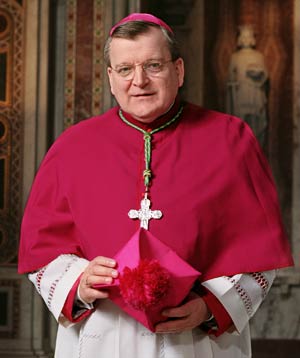
One of WDTPRS’s favorites, His Excellency Most Reverend Raymond Burke, Archbishop of St. Louis, has a statement about Summorum Pontificum. It was published on website of the Archdiocese. I edted out the section on Natural Family Planning.
Count on clarity of language, proper use of terms, and warm sympathy for the topic.
My emphases and comments.
Be not afraid!
Two forms of the Rite of the Mass
by Archbishop Raymond L. BurkeIntroduction: Two different but related subjects
In writing to you this week, I want to address two different but related subjects of concern to us all. The first is the recent publication of new liturgical norms pertaining to the celebration of two forms of the Rite of the Mass, the form used by all until 1970 and the new form introduced by Pope Paul VI. The new norms, given by Pope Benedict XVI on July 7, have been the subject of much discussion in the media. For your better understanding of the new norms, I want to offer you my reflections on the norms and their implementation in the Archdiocese of St. Louis.
…
Two forms of the one Rite of the Mass
By his apostolic letter "Summorum Pontificum," Pope Benedict XVI has provided for the easier use of the form of the Rite of the Mass until 1970, which was published by Blessed Pope John XXIII in 1962, in addition to the use of the Rite of the Mass, which was published by Pope Paul VI in 1970 and with which we are all quite familiar. The first form is sometimes popularly called the Tridentine Rite of the Mass, referring to the fact that, in its essentials, it remained the same from the time of the reforms introduced by the Council of Trent (Tridentine is the adjective for Trent). Changes were introduced into the rite over the centuries, including the changes made in the 1962 edition of the Roman Missal, but the greater part of the rite remained unchanged.
The second form is called the Novus Ordo or New Order of the Mass. It also retains the essential elements found in the Tridentine Rite but introduces a somewhat radical simplification of the rite. It is, however, one and the same Rite of the Mass.
With the norms promulgated by Pope Benedict XVI, the Novus Ordo remains the ordinary form in which the Rite of the Mass is to be celebrated. The Order of the Mass in force before the changes introduced by the Novus Ordo is now the extraordinary form, which may be celebrated by any priest, without special permission, under the conditions set forth by the Holy Father. [Yes, this is a good distinction: "conditions set forth by the Holy Father". Some chanceries seem to be soft peddling this, giving the impression that the conditions are laid down by the local bishop.] In establishing the extraordinary form of the Rite of the Mass, our Holy Father reminds us that, in fact, the use of the Roman Missal of Blessed Pope John XXIII "was never juridically abrogated and, consequently, in principle, was always permitted" (Letter of Pope Benedict XVI Accompanying the Apostolic Letter Summorum Pontificum, July 7, 2007, paragraph 6).
As he observes, there was a greater attachment to the former rite than perhaps was anticipated, [Again, this is from a bishop with a solid record of being open and generous about the older form. When you view the issue through positive lenses, you see the issues differently.] especially among the faithful "with a notable liturgical formation and a deep, personal familiarity with the earlier form of the liturgical celebration" (Ibid.). [Again, a good distinction. Many critics of the older form hint that the people who want it are really not very sophisticated.] An interest in and attachment to the former Rite of the Mass also developed among the faithful in circumstances in which the reforms of the Novus Ordo were not implemented with fidelity but were falsely seen to permit or even require a creative interpretation on the part of the priest. [This underscores how much depends on him.] Such circumstances, in the words of Pope Benedict XVI, "led to deformations of the liturgy which were hard to bear" (Ibid.). Our Holy Father reflects upon his own experience of the confusion and hurt which sometimes accompanied the implementation of the Novus Ordo.
Not infrequently, I meet young people who are attracted to the former Order of the Mass, even though they had no experience of it when they were growing up. [But…but… but… wait a minute, Your Excellency!! I have heard again and again that only OLD people want the older Mass, out of nostalgia! You mean, YOUNG people want it too? Seriously, I am so glad that His Excellency mentions this. When you go to places where the older Mass is celebrated you notice right away all the young people, young families with lots of children.] What attracts them is the beauty and reverence, which the earlier form very much fosters. Such beauty and reverence should also be evident in the celebration of the Novus Ordo. Because the ordinary form is greatly simplified, the priest and those who assist him must be attentive to the divine action taking place and not give way to an informality and familiarity which is offensive to the nature of the Sacred Liturgy. [HURRAY!]
Through "Summorum Pontificum," Pope Benedict XVI makes the former Order of the Mass more available to the faithful who are attached to it. At the same time, he maintains the Novus Ordo as the ordinary form of the celebration of the Mass. It is the expressed hope of our Holy Father that the use of the extraordinary form will support the faithful celebration of the Mass according to the Novus Ordo. [Yes. Remember the issue of cross-pollination I have spoken of so many times here at WDTPRS.]
Implementation of the new norms in the archdiocese
Some of the faithful of the archdiocese have expressed the fears that the use of the vernacular in the celebration of the Mass will be taken away and that the use of the extraordinary form of the Mass will be imposed upon them, while they, in fact, are attached to the ordinary form. Both fears are unfounded. The celebration of the extraordinary form in parishes must be requested by a group of the faithful and is to be scheduled in such a way as to permit the other faithful the use of the ordinary form. Priests, when they celebrate the Mass without a congregation, that is, when they are on vacation or away from a parochial assignment, may choose either form. Members of the faithful can, of course, assist at the Mass, no matter in which form it is celebrated.
At present, the Archdiocese of St. Louis has a most effective apostolate [I think we could say "model" apostolate.] on behalf of the faithful who are attached to the extraordinary form of the Rite of the Mass, that is the Roman Missal of Blessed Pope John XXIII. St. Francis de Sales Oratory is the center of the apostolate and serves well the faithful who desire the celebration of the Mass and of the other sacraments according to the rites which were in force in 1962. The Canons Regular of the New Jerusalem also provide Sunday and holy day Masses at the Chapel of the Passionist Nuns in Ellisville. In addition, the Canons Regular, as befits their form of religious life, celebrate daily and publicly the Liturgy of the Hours in the chapel of their Priory in Chesterfield.
If additional requests of the regular celebration of the extraordinary form of the Rite of the Mass are received, I will work with the parish priests in responding appropriately and generously to the requests. Also, courses of liturgical formation [!!!!] pertaining to the Roman Missal of Blessed Pope John XXIII will be provided for priests who desire it. The seminarians at Kenrick-Glennon Seminary will be provided the liturgical formation necessary to celebrate the Mass according to the extraordinary form. [ o{]:¬) ] Their studies of Latin will also give attention to the texts of the extraordinary form. [What a blessing Archbp. Burke is. I wonder if there is someway he could, well…. be given a few more dioceses?]
Gratitude for the richness of the forms of the Sacred Liturgy
In concluding my brief reflections on "Summorum Pontificum," I express, in the name of us all, deepest gratitude to Pope Benedict XVI for providing so richly and well for the worthy and beautiful celebration of the Sacred Liturgy, especially the Holy Mass. With Pope Benedict XVI, I am certain that the richer possibilities for the celebration of the Mass and the other sacraments will lead us all to a deeper appreciation of the immeasurable love of God for us and to a deeper response of love, on our part.
 Not infrequently, I meet young people who are attracted to the former Order of the Mass, even though they had no experience of it when they were growing up. [But…but… but… wait a minute, Your Excellency!! I have heard again and again that only OLD people want the older Mass, out of nostalgia! You mean, YOUNG people want it too? Seriously, I am so glad that His Excellency mentions this. When you go to places where the older Mass is celebrated you notice right away all the young people, young families with lots of children.] What attracts them is the beauty and reverence, which the earlier form very much fosters. Such beauty and reverence should also be evident in the celebration of the Novus Ordo. Because the ordinary form is greatly simplified, the priest and those who assist him must be attentive to the divine action taking place and not give way to an informality and familiarity which is offensive to the nature of the Sacred Liturgy. [HURRAY!]






























Fr. did you get my email on this? I just wanted to make sure it went through.
An amazing man and a faithful shepherd, please God send us more Bishops like him!
I wonder how well does the Pope know of Archbishop Burke? I don’t know how the appointment of Bishops work, but if the Pope would consult Archbishop Burke on who to appoint as Bishops in this country…well I think things would improve dramatically.
I especially loved the part about the formation of seminarians in latin and the extraordinary use!! I’ve been waiting for word about how the MP will effect seminaries, and it looks like at least one seminary will be substantially effected by it!
Let us pray for Archbishop Burke (as he has some substantial enemies) and let us pray for more Bishops like him!
Why is Burke not a Cardinal yet???
His Excellency Most Reverend Raymond Burke is such a blessing for us and the whole Church. More, he provides his brother bishops with an excellent example of how to be a bishop. Hopefully, more bishops will follow the example Archbishop Burke is setting. Truly, I wish he could have been sent to my diocese instead of St. Louis. Since that is no longer an option, I am applying for internship positions in St. Luis. The change of scenery will do my soul good.
Hopefully to Cardinal Burke and then maybe the next Pope Burke!
I am also so thankful to this great bishop for his backing of a cause in which I’ve been involved. Once again, we wait on the bishops to move while certain great ones go ahead and actually do something to benefit the faithful:
http://www.ourladyofamerica.com/pdf/OpinionLetter-May-2007.pdf
More info here by Fatima’s Fr. Fox of the Immaculate Heart Messenger:
http://www.oltiv.org/images/May2007Article.pdf
Thank you so much, Bishop Burke for your faithfulness.
After reading this, I am slightly annoyed. All these dioceses are sounding off for good and for bad towards the letter, but my own only had a snippet in the paper last week saying that His Excellency and his liturgist were studying the issue and that they would have directives by the time the letter comes into effect in September…
Hardly words to inspire the faithful…
Archbishop Burke will probably not be made a cardinal in St. Louis. Even though it is an old archdiocese it is very small (575,000) smaller even than many dioceses. I have heard there will no longer be cardinals in St. Louis…except for the baseball team.
Rumor has it Archbishop Burke may end up in Chicago in a few years…of course, as a cardinal. The Archdiocese of Chicago needs a man like him to fix it up. The seminary is very good now, but the parishes are still deeply troubled.
methinks he would still make many changes at Mundelein, were His Excellnency to become the Eminent Abp. of Chicago!
Some of the faithful of the archdiocese have expressed the fears that the use of the vernacular in the celebration of the Mass will be taken away
I hope that we will see more Latin used in the ordinary form of the Mass (thanks to cross-pollination and a growing appreciation of what the Second Vatican Council asked for), but it could also back-fire. I can just hear it: “We’re a Vatican II parish. If you want Latin, you should go to St. Senilis–they use the pre-Vatican II Mass over there.”
It is true about the attraction of younger people to the Extraordinary form. The Benedictines of Mary Queen of Apostles professed vows in our Basilica and it was wonderful to see the Church full of young families!
Pater, OSB
Chicago will do just fine without Archbishop Burke. He should be sent instead out here to Los Angeles, where real change is needed. Or perhaps better yet, New York or Washington. I would also like to see Archbishop Chaput in a higher visibility diocese such as LA, New York or Washington, DC.
Following up on Greg Smisek’s comment, there are some parishes, like, unfortunately, mine, where the silliness is so cherished that it is unimaginable that the parish would take any cues from the extraordinary form of the Mass. But nevertheless I think the traditional Latin Mass is definitely going to have a substantial positive impact on ordinary rite. I am encouraged by the response to the motu proprio so far. Sure, some bishops predictably have been less than generous in their response. But overall the immediate fruit has been more substantial than I would have predicted — in a number of dioceses traditional Latin Masses already are being added and there has been a ton of commentary, much of it positive. It seems to me to be quite plausible to expect that as more people assist at the traditional Latin Mass, which is now officially destigmatized, they are going bring home what they see to their so-called Vatican II parishes.
That seems to be in contrast to how the Motu Proprio is being viewed in Miami
“Father Hogan noted, however, that the pope?s document clearly states that the Tridentine Mass is an ?extraordinary form of the Roman liturgy. The ordinary Mass is the one that we have been celebrating? since 1970. The difference between the two Masses is more than linguistic, said Father Hogan, who is also rector of St. Mary Cathedral. The Tridentine Mass is basically a private Mass of the priest where people attend but participate minimally, he said. It was intended to be a private Mass (where) a priest acted in the name of the people. Most of us have grown up with the form where we participate more, with the music and the ministries,? Father Hogan said.”
The full article is available
http://www.miamiarch.org/ip.asp?op=H1000070720E&kw=tridentine
Father Hogan’s Explanatory letter to the priests of the Archdiocese
http://www.miamiarchdiocese.org/Atimo_s/news/TridentinePDF2.pdf
Hello all!
I have a question. If there is a group of faithful who want the the use of the Missal of Blessed John XXIII on Sunday, must the pastor still ask permission from the bishop? This is what the good bishops seems to be saying.
However, I thought it was up to the pastor? Then, of course, if there were problems in saying it, the pastor could call on the bishop for help? Didn’t the Holy Father say this in his MP? Am I wrong?
I think, regarding the cross polination issue, that the new English translation will also have an enormous
effect when it hits the parish level. Hopefully, the new English translation (which they cannot avoid–the
extraordinary usage for now is something that they can try to ignore) will make some of the more conservative
Novus Ordo Catholics want to take a look at where these changes are coming from.
Archbishop Burke is one extraordinary ‘Ordinary’. Fr. Hardon recognized his strength and holiness some years back by asking him to oversee his Marian Catechist program.
And, of course, someone else saw his potential and he was made a bishop. He is certainly one of the brightest lights in the episcopate in the United States. May God grant us more like him!
Yes, I would love to vote for him as a Cardinal if I had a vote!
It is encouraging to see such a positive response to the MP. It is also significant that so many bishops are taking notice of it (even if they seek, in some cases, to diffuse its impact). I wonder how many bishops even made public comment on Ecclesia Dei Afflicta when it came out. The tendency was probably to ignore it and hope it would be a dead letter.
“What a blessing Archbp. Burke is. I wonder if there is someway he could, well…. be given a few more dioceses?”
Send him to L.A.
Give him a firehose and demolition charges.
On second thought, however, I would hate to see St. Louis deprived of him.
A great letter from a great bishop.
Abp Burke can certainly be made a Cardinal in Detroit should he be appointed when Cardinal Maida is granted his request for retirement (I think going on close to two years now).
Oh – and don’t miss this one Father, by the Rev. Thomas Rausch in the LA Tidings. Isn’t that the diocesan paper of Los Angeles?
What a gem of an article (snicker)!
There are some, ehem, interesting quotes for sure.
I would expect nothing less from Archbishop Burke. If only the Holy Father would give him a red hat and send him to Los Angeles….last week. Here in the diocese of Fresno the silence from Bishop Steinbock on the motu proprio is deafening. I understand he is in consultation with his legal people.
Since everyone is sending up hope and wishes for Archbishop Burke to come to there diocese. I have to say there is something refreshing in seeing a bishop that gets what is being written and is open to encouraging those priests in his diocese to learn the extraordinary form. Would I love to see him in my archdoicese …. heck yeah but I think that LA might beat us to the punch darn you Cardinal Mahoney, however I liked Cardinal Egan article in Catholic New York. I love to see bishops stand up for the faith and the truth because it has such an impact upon the faithful and the priest. So I continue to pray for more bishops with the courage and the forthrightness to stand up and correctr the world when it is wrong. Hmmm … Cardinal Burke of New York hmmm or Cardinal Chaput hmmm either way I would be happy.
Wouldn’t it be great if we had, in the episcopate, a “draft” system like in professional sports… ;-)
-J.
I am so thankful to God for sending St. Louis this amazing bishop! And word is around St. Louis that the seminary is running out of rooms! Fidelity = vocations? Huh. Who knew?
Fr. Z:
Thanks for posting my beloved Archbishop’s letter! At the same time, I was a disappointed that you didn’t at least post the paragraph where Archbishop Burke ties together his commentary on the liturgy and his commentary on contraception. Sure, your space (and time) are limited, but this paragraph is phenomenal and, quite frankly, very profound. He says:
“The two topics [contraception and liturgy] seem to be quite diverse. In fact, however, they are closely related. The sanctification of our lives through participation in the Liturgy, especially the Sacrifice of the Mass, is expressed concretely in the manner by which we fulfill the daily responsibilities of our vocation in life. For the married, the communion with our Lord in the Eucharistic Sacrifice is the source of their communion of life, also in its sexual or conjugal expression. The more we grow in reverence for the sacredness of the Liturgy, the more we also grow in care to live a holy life in all things.”
Sure, this isn’t new, nor is it as succinct as the phrase: “save the liturgy, save the world.” However, how often do we see bishops with the chutzpah not only tackle the issue of the 1962 use, but also to tackle the of contraception AT THE SAME TIME. And not just at the same time, but to link them together!
Certainly, if there are two things that are more misunderstood and most seen by society as “the old Church,” it is the 1962 use and the teaching on contraception. Completely amazing.
A most grateful seminarian,
~Anthony
You cut out my favorite line:
“The more we grow in reverence for the sacredness of the liturgy, the more we also grow in care to live a holy life in all things.”
or Save the Liturgy, Save the world!
Also, sorry everyone else, but I am praying, with His Excellences permission, that he stay in St. Louis. After all it is the Rome of the West. (First place ever to do the Mass in English, with the appropriate approval,and look how quickly that caught on, first to have Pontifical High Mass in the Cathedral in 40 years, while 2 other places will have one in September! St. Louis is the cutting edge of American ecclesiastical affairs, what better place for Archbishop Burke! )
…first to have Pontifical High Mass in the Cathedral in 40 years,…
St Louis is not the first Pontifical High Mass in a Cathedral in 40 years…this is a strange claim.
Good heavens.
A Catholic archbishop.
Whatever next.
I love Burke. One way to keep him in St. Louis would be for the Pope to suppress the Springfield/Cape Girardeau diocese and give the entire territory to Burke. Or split the diocese and give half to Bishop Finn of Kansas City, MO and half to Burke. As a resident of the Springfield/Cape diocese I can tell you that we face nothing but obstruction of the Motu Proprio. We have a handful of priests who want to have the extraordinary form, but they all cover two or more parishes and don’t have time to learn. But the real factor in their hesitancy is fear of retribution from fellow priests and from the bishop. These fears are not unfounded as I have been hearing this from priests for 10 years. Those who wear cassocks/habits are needled. One priest was waylaid by four other priests after a meeting and pressured to continue the same liturgical abuse they were refusing to give up. They wanted the abuse to be uniform in the area! I am not making this up. This was told to me by the priests who are suffering through this. Another priest was moved from the southwest end of the diocese to the southeast for preaching against contraception. The pastor was afraid of losing donations if this continued.
I hope Burke has a say in who our next bishop will be. Those of us following the current events know that he has the respect of Pope Benedict. It would be hard to find a better team player than Burke. We should pray for him and Bishop Finn, both very courageous men who have dismantled much of the old regime of CathProtism in their dioceses. Please, God, let us have the same.
Maybe if all of us offered our pain and suffering up for a good and holy bishop in our respective dioceses good things would happen. For a good 4 years now, many of us have been praying, doing penances and offering up all of our woes for whoever our next bishop will be. Surely God will hear us!
Only one additional word is necessary or appropriate here. AMEN!
Springfield, KC, and Jeff City are all suffragan dioceses of the archdiocese of St Louis. That, combined with Msgr Burke being Roman trained, a former member of the Apostolic Signatura, and highly regarded in Rome, means that he will probably have a lot of input into the new bishops in Springfield.
And for various reasons Cardinal Rigali will probably also be consulted.
I would not be worried that you will get a squishy bishop. If you look around the country at the men who have been consecrated as bishops in the last 10 years and then assigned to smaller dioceses, they are overwhelmingly good and holy men. Many of our strongest bishops are the younger ones and that trend seems to continue. This is also reason to believe that the Church in America is growing stronger every year. Think of the bishops who were in place 20-30 years ago…we have many more good, strong, orthodox, well-educated bishops now than we did then.
Barb,
Your Bishop turned 75 two years ago, so hopefully we won’t have to wait long.
Our parish priest has notified us that the N.O. readings will be used in the Tridentine Mass. We are here in Huntington Beach, California. Can this be done? Is this allowed? Thank you, Gloria Balaskas, St. Mary’s By the Sea
Robert, you will be most welcome in St. Louis and in St. Francis de Sales Oratory, where the priests of the Institute of Christ the King Sovereign Priest offer the Extraordinary Form daily, and both a low and solemn high Mass on Sunday. They spend hours in the confessional and offer Holy Hour with Benediction Thursday evening. This is the Promised Land of America!
Thank you Fr. Zuhlsdorf for publishing this.
Archbishop Burke and Msgr. Schmitz residing in the same city in a few years possibly? Wow that would be heavenly indeed!!!
Adveniat Regnum Tuum!
It is in fact true that the theology section of Kenrick seminary in St. Louis is running out of rooms this year, at least based on the number of applicants. (Not all these men, of course, are studying for the St. Louis archdiocese.)
sigil7:
I was under the impression that the Ordination Mass celebrated on June 15 was the first Solemn Pontifical Mass (extraordinary form) celebrated by the Ordinary of a diocese in his own cathedral (at least in the United States) since the reform. If there’s another example out there, I’d be interested to learn of it. Has Bp. Bruskewitz perhaps done it? Or the late Cardinal O’Connor?