
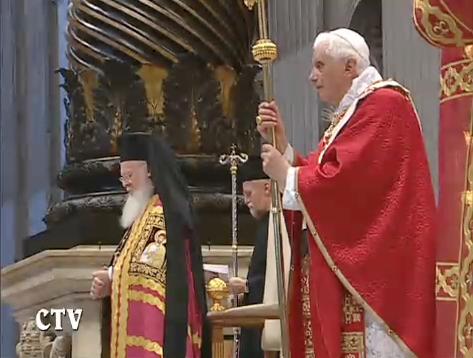
 Today during the Mass for the Solemnity of Sts. Peter and Paul, Benedict XVI and Bartholomew I recited the Creed together in Greek.
This is interesting for several reasons.
First, for so long it has been nearly obligatory to have the whole congregation sing the Creed alternating with the Sistine Chapel "Choir".
Apparently it isn’t so obligatory as we thought that the whole congregation recite the Creed.
Second, the text of the Creed is that the 381 Council of Constantinople, and thus it is the Niceno-Constantinopolitan Creed:
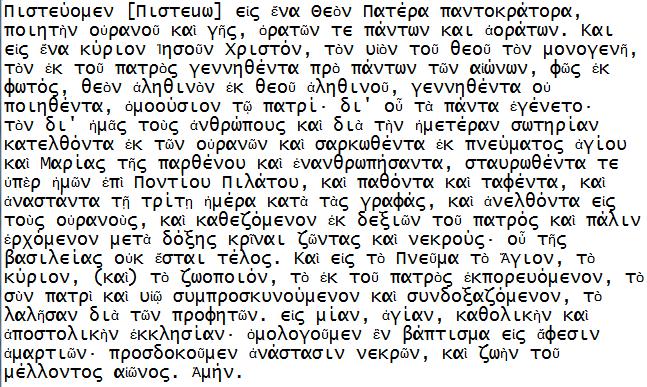
The Patriarch and the Pope both use the singular "I believe", rather than "We believe" of the conciliar formula. The conciliar form of the Creed was a group document, that needed a plural form. The liturgical form is a personal declaration made together with everyone else gathered.
This brings the third point: It did not contain the so-called "Filioque" clause. This is why they could recite it together easily. The Filioque clause has been a source of division from the time when the Latin Church and the Greek Church were talking past each, with a lack of comprehension on both sides of the theology of the Holy Spirit and His relationship to the Father and the Son. Now that there is greater comprehension about this relationship and what each side means when they talk about the Holy Spirit, there is far less reason to stress the differences that historically surround the Filioque clause.
Thus, the fourth point is notice how well the Holy Father reads the Greek text.
Fifth, could your local priest, seminary instructor, or bishop do the same, even with the Creed in Latin?































Did I see homoousion (transliterated), which had been a source of trouble? Syn patri kai to uio symproskynoumenon – close to filioque but not quite?
Regards.
Filioque clause
Can someone explain what the big deal is here. Some people paint this as a really big issue. Maybe it is but I cannot for the life of me understand why it should be. I would be grateful for some sensible input on the subject.
The Holy Father is trying to use the Greek pronunciation of Greek (!), but keeps slipping back into the classical pronunciation. Full marks for his fluency – he is faster than the Patriarch! Patriarch is better at accenting the words, however, and has a more virile voice, as is common with eastern priests. Ever notice how the western priest is naturally a tenor, the eastern priest a bass?
I like this better than Assisi ecumenism!
It is both a doctrinal issue and a politeness issue, Dob. Doctrinally, it appears that the Holy Spirit has a dual procession from both the Father and the Son. Also, it seems that the Holy Spirit has God the Son as a source of existence as well as God the Father. More appropriately, it should say that the Holy Spirit proceeds from the Father through the Son, less confusing. When the filioque clause was inserted into the creed, it was done without consultation of any Eastern bishop. That is why it has to do with respect. The Eastern bishops felt they were brushed aside and that their opinion did not matter. This was a catalyst for the East-West schism of 1054.
Fr Z : Fifth: could your local priest, seminary instructor, or bishop do the same,even with the Creed in Latin?
*
Not in Greek from memory !!!!
Oh, yes, this is far better than Assisi ecumenism! Thank you for posting this audio file; I think that this will be edifying to share with some protestants.
I once heard somewhere that the equivalent of “filioque” has never been inserted into the Greek creed by the Catholic Church, but only in the Latin version (and then into the various vernacular languages.) Is that true?
Viva il papa!
. . . “a lack of comprehension on both sides
of the theology of the Holy Spirit and
His relationship to the Father and the Son.”
. . . “now that there is greater comprehension.”
Do you mean to say the Catholic Church had an imperfect
understanding of this doctrine & taught imperfectly
for 2000 years until our present time?
Sounds that way to me, Father.
Fr. Z,
I believe the problem of “I believe” vs “We believe” is not the problem of the Council but rather the former members of ICEL. The books still say “Credo”. Perhaps before the end of the century we too shall have the opportunity to say “I believe” in English!
Whether they say it out loud or not I firmly believe that the members of the congregation, who are Catholic/Orthodx/Christian, should at least say it silently. In my opinion it is a testimony that we are part of the Faith and thus can be admitted to the Eucharistic Sacrifice. Even if not in full communion.
AP,
MAybe I am mistaken, but does not the Catholic Church openly allow that the Church may understand a doctrine imperfectly and but to understand greater understanding and clarification over time. This of course does NOT mean that doctrine imperfectly understood is incorrect or contradictory.
Excellent post, Fr. Z. This is going on my Facebook profile. Bravo ecumenism! Forget the Russian Orthodox and Greek Orthodox clergy who do not like it.
Is the Holy Father telling us that the doctrinal issue over the filioque doesn’t really exist, or is he modelling the idea that earlier formulations of the Magisterium can always be used, even if overtaken by later ones?
The first position is certainly arguable (although it would be nice to have the case spelt out given that this has been a matter of formal theological disputes between East and West for centuries). The second is a view the Pope has I think suggested before as a possible basis for reconciliation between East and West (and has some relevance to Latin rite traditionalists as well!).
It will be interesting to see how this plays out!
Dear Fr Zuhlsdorf,
Thanks for your comments in regards to the “filioque” – what you say makes sense. We so often fail to understand one another because we are not listening with care, we are failing to mirror back to the sender what the sender really said, we are only too interested in making our own points and proving that “we” are right and the other is wrong. This approach does not work very well, as the history of Catholic and Orthodox relations has shown. Hopefully, we are a little more ready to listen now, and make a concerted attempt to understand. Pope Benedict gives us an excellent example of listening and understanding.
Fr. Protodeacon: I am glad for your comment.
It seems to me that from our far better informed perspective, ironically the fruit of bickering and division – which has always historically driven clarifications – we can start putting aside things that no longer need to be a problem and start focusing on the things that matter.
Is the Filioque – a dogma of the Catholic Church and a such inspired by the Holy Ghost – a thing that can be put aside, a thing “that no longer need to be a problem”, a thing that does not matter, if you write, that we should start focusing in the things that matter?! Isn’t rejecting a dogma of the Church heresy? Doesn’t that concern one’s salvation? Does that not matter?
AP: Do you mean to say the Catholic Church had an imperfect understanding of this doctrine & taught imperfectly for 2000 years until our present time? Sounds that way to me, Father.
Are you hoping to find something to pick on? If so, you can always find a phrase that sounds wrong.
In fact, that is partly what caused the split between the Greeks and the Latins.
What I am saying that the the perfect comprehension was between the Latins and the Greeks. They talked past each other – as I said above. They weren’t understanding each other properly – as I explained above.
And, by the way, the relationship of the Holy Spirit to the Father and the Son remains a mystery, imperfectly understood. We work toward a more perfect understanding through faith, our reason striving under the light of grace and authority.
@ Father Z.: The Church, Councils, great Saints and doctores Ecclesia made quite clear and distinct statements about the “mystery” of the relationship of the Holy Spirit to the Father and the Son!
There is also a question of vocabulary and grammar in the Latin translation of the Greek original of the Nicene-Constantinopolitan Creed. The Greek verb for “to proceed” used in the original version of the Creed can only mean to proceed from ONE source, i.e., the phrase can only be translated as “…proceeds from the Father” The verb in the Latin translation (and in the English translation) is not that specific, and thus, does not pose a grammatical problem when the “filioque” clause is added. My source for this is my NT Greek professor (and no, it wasn’t “Baptist” Greek, either ;-))
Filoque: quite clear and distinct statements about the “mystery” of the relationship of the Holy Spirit to the Father and the Son
Clear statements does not mean that the relationship is now no longer a mystery.
It is a mystery. We can understand some things about it, but not everything.
All: It would be good to have some discussion here about the history of the Filioque dispute and then later get into what it all means.
That could be helpful to a lot of readers.
“Fifth, could you local priest, seminary instructor, or bishop do the same, even with the Creed in Latin?”
Sadly, I have not met a priest or seminarian who could…………..but I’ve managed to learn it and am able to recite it from memory.
Father,
Could you please take a moment to explain what the role of the Patriarch at this Mass means? Is he concelebrating (that sin’t possible at this point is it?)? Is he an observer? Is this a prodromos (to use a good Greek word) of an announcement of reunification? And what would need to happen between the two sisters to have reunification?
Thanks and God bless. You are a Godsend in this traditional desert we ironically call Maryland.
@Father Z.: Ok, that seems quite reasonable to me. I have a suggestion: Wouldn’t be the filioque a very interesting topic for a podcazt? I would really love to listen to you speaking about it. by the way: I LOVE your padcazt!
I’ll have to look up references later, but I was reading (for a discussion with protestants on Orthodox and Catholic relations) about the creed issue last week, and the requirement for reconciliation. Since 1895 (article in Catholic Encyclopedia on EO) the Church has been progressively more open. Specifically regarding Filioque I read in at least 2 places that the Church will not require the Orthodox to agree to or use the filioque form. From the Catholic side, it seems to not be a deal breaker. For many Orthodox, it is a BIG deal.
Pray for Unity
Paul in the GNW
Filioque: Thanks for the suggestion!
On the First Sunday of Advent 1987, Pope John Paul II and Patriarch Demetrios I of Constantinople did the same thing during Mass at St. Peter’s. The pope and patriarch sat on matching chairs, equally distant from the center of the altar. A Latin deacon sang the Gospel in Latin, and a Greek deacon sang it again in Greek. The pope took the Greek Gospel Book and the patriarch took the Latin Gospel Book and they blessed the congregation together. Both men preached, as they did today, and then after the homilies they recited the Creed together (just the two of them) without the filioque. Before the Offertory, the patriarch and his deacons went down to a special seat prepared for him facing the altar. At the end of Mass, the two of them descended into the Confessio to pray at the relics of St. Peter, and they appeared together on the central balcony of the basilica to bless the crowd in the Square. Later that week the patriarch gave a lecture at the Lateran University and was greeted with great enthusiasm by the seminarians and clergy present. I remember all of this very well because I was privileged to be present for all of the public events, and the Urbs was buzzing with expectation that reconciliation would soon come. That was 21 years ago, and both of those men are now in their graves. Quamdiu, Domine?
Fr. Newman: Thanks for that! Very useful! Please drop me a line sometime with a report about how the ad orientem worship is going!
Filioque,
In response to your statement: “Is the Filioque – a dogma of the Catholic Church and a such inspired by the Holy Ghost – a thing that can be put aside, a thing “that no longer need to be a problem”, a thing that does not matter, if you write, that we should start focusing in the things that matter?! Isn’t rejecting a dogma of the Church heresy? Doesn’t that concern one’s salvation? Does that not matter?”
The Filioque originated in a Latin translation of the Creed. The Latin translation was not an exact translation of the Greek. What the Latin Church means by adding the filioque to the Latin is not the same thing as it would appear to mean in Greek. There are not exact equivalents for words between the two languages.
Also, it is not correct to say, as AP appears to suggest, that in omitting the filioque, Benedict XVI and Bartholomew I were saying something different from what the Church has taught for 2000 years. In fact, the filioque was not used in Rome until some point between 1003 and 1024. The traditional timing of the first papal Mass to ever use the filioque thought to have been between 1013 and 1014. Thus, the Holy Father was going back to a tradition that held for the first 1000 years of the Church.
There was a North American agreed statement on the filioque that explains in more detail what I think Father Z was saying about the Latins and Greeks talking past each other:
http://www.usccb.org/seia/filioque.shtml
There is also a clarification by the Pontifical Council for Promoting Christian Unity that may help:
http://www.ewtn.com/library/CURIA/PCCUFILQ.HTM
An excellent page I found recently concerning Orthodox and Catholic issues. This is posted by Jay Dyer, who after apparently coming very, very close to Orthodoxy is refuting his own arguments for that decision and professing Catholicism. He provides and excellent, fairly brief, overview of the main theological issues.
If it is O.K. with Father Z, I have included a longish citation concerning the Filioque issue:
“It’s a fact that many Easterns are now willing to deal with the possibility of a genuine reconciliation, with some, such as Metropolitan Zizioulas, admitting even the possibility of a kind of filioque at the level of ousia, but not of hypostasis. These thinkers have also corrected Lossky’s error that the Spirit lacks an eternal relation to the Son, as Fr. Behr explains in his The Trinitarian Being of the Church article. If that’s the case, then its true that the Father remains the sole source of the godhead, while the Son becomes a kind of mediating principle (St. Gregory of Nyssa), communicating to the Spirit the common essence. According to Zizioulas, this was St. Maximus’ view. Zizioulas writes in his article, One Single Source:
“Closely related to the question of the single cause is the problem of the exact meaning of the Son’s involvement in the procession of the Spirit. Saint Gregory of Nyssa explicitly admits a mediating role of the Son in the procession of the Spirit from the Father. Is this role to be expressed with the help of the preposition ??? (through) the Son (?? ?????? ?? ‘????), as Saint Maximus and other Patristic sources seem to suggest? The Vatican statement notes that this is the basis that must serve for the continuation of the current theological dialogue between Catholic and Orthodox. I would agree with this, adding that the discussion should take place in the light of the single cause principle to which I have just referred.
Another important point in the Vatican document is the emphasis it lays on the distinction between ?????????? and processio. It is historically true that in the Greek tradition a clear distinction was always made between ??????????? and ????????, the first of these two terms denoting exclusively the Spirit’s derivation from the Father alone, whereas ???????? was used to denote the Holy Spirit’s dependence on the Son owing to the common essence or ????? which the Spirit in deriving from the Father alone as Person or ????????? receives from the Son, too, as ???????? that is, with regard to the one ????? common to all three persons (Cyril of Alexandria, Maximus the Confessor et al). On the basis of this distinction one might argue that there is a kind of Filioque on the level of ?????, but not of ?????????.
However, as the document points out, the distinction between ??????????? and ???????? was not made in Latin theology,which used the same term, procedere to denote both realities. Is this enough to explain the insistence of the Latin tradition on the Filioque? Saint Maximus the Confessor seems to think so. For him the Filioque was not heretical because its intention was to denote not the ??????????? but the ???????? of the Spirit.”
Thus, the eternal procession from a “single principle” as stated by the councils of Lyons and Florence , can be read in this manner. This appears to be the direction the Vatican Clarification on the Filioque takes. In short, as well as I can understand, I find this Vatican statement to be good enough. Besides, Bulgakov and others admit that the Spirit can be understood as the love of the Father and the Son (The Orthodox Church, pg. 2). But apart from several books and tons of articles, its evident that this cannot be the determining factor between East and West, since it becomes so obscure and drowned in questions of Liturgy, Greek and Latin, biblical texts, dogmatic decrees of councils and the writings of the Church Fathers only the best of theologians are able to sift through the masses of data (and I don’t mean myself). Fr. Stylianopoulos admits this.
Sorry, I guess I needed to edit the HTML to get the Greek Characters where the question marks are, you will have to go the the site to read it properly. Of course, it is all “Greek” to me,so if you don’t know Greek just realize that the Orthodox and Catholics are using slightly different Greek terms.
Paul
Paul, could you repost with transliterations of the Greek? For some reason, I can’t get the blog to show these characters properly.
Father Z, here I have tried copying it from the page source code, instead of from the browser, It is displaying correctly in the preview. Saint Isadore be with us!
It’s a fact that many Easterns are now willing to deal with the possibility of a genuine reconciliation, with some, such as Metropolitan Zizioulas, admitting even the possibility of a kind of filioque at the level of ousia, but not of hypostasis. These thinkers have also corrected Lossky’s error that the Spirit lacks an eternal relation to the Son, as Fr. Behr explains in his The Trinitarian Being of the Church article. If that’s the case, then its true that the Father remains the sole source of the godhead, while the Son becomes a kind of mediating principle (St. Gregory of Nyssa), communicating to the Spirit the common essence. According to Zizioulas, this was St. Maximus’ view. Zizioulas writes in his article, One Single Source: “Closely related to the question of the single cause is the problem of the exact meaning of the Son’s involvement in the procession of the Spirit. Saint Gregory of Nyssa explicitly admits a mediating role of the Son in the procession of the Spirit from the Father. Is this role to be expressed with the help of the preposition ??? (through) the Son (?? ?????? ?? ‘????), as Saint Maximus and other Patristic sources seem to suggest? The Vatican statement notes that this is the basis that must serve for the continuation of the current theological dialogue between Catholic and Orthodox. I would agree with this, adding that the discussion should take place in the light of the single cause principle to which I have just referred.
Another important point in the Vatican document is the emphasis it lays on the distinction between ?????????? and processio. It is historically true that in the Greek tradition a clear distinction was always made between ??????????? and ????????, the first of these two terms denoting exclusively the Spirit’s derivation from the Father alone, whereas ???????? was used to denote the Holy Spirit’s dependence on the Son owing to the common essence or ????? which the Spirit in deriving from the Father alone as Person or ????????? receives from the Son, too, as ???????? that is, with regard to the one ????? common to all three persons (Cyril of Alexandria, Maximus the Confessor et al). On the basis of this distinction one might argue that there is a kind of Filioque on the level of ?????, but not of ?????????.
However, as the document points out, the distinction between ??????????? and ???????? was not made in Latin theology,which used the same term, procedere to denote both realities. Is this enough to explain the insistence of the Latin tradition on the Filioque? Saint Maximus the Confessor seems to think so. For him the Filioque was not heretical because its intention was to denote not the ??????????? but the ???????? of the Spirit.” Thus, the eternal procession from a “single principle” as stated by the councils of Lyons and Florence , can be read in this manner. This appears to be the direction the Vatican Clarification on the Filioque takes. In short, as well as I can understand, I find this Vatican statement to be good enough.
Apart from the Filioque, there appears to be another discrepancy between the Greek and the Latin: there’s nothing in the Greek corresponding to “Deum de Deo” (though there is for the later phrase “Deum verum de Deo vero”). I can’t see this discrepancy having any doctrinal significance, since the missing phrase is obviously covered by the later one, but I’m still curious as to how it arose.
The Nicean Creed is the only prayer in the Church that (must) begin with “I” it is a profession of personal belief — often said “severally” ie in a group.
The filoque insertion into the Creed was a change from the 8th century imposed (at spear-point) upon the Church by the Franks — the Pope at the time DID NOT sign the OK.
If you want to change one of the basic building agreements of the Church then hold another council and change it — but don’t call it the Nicean Creed…
Note also that an Orthodox deacon read the gospel (very interesting) and that both Bartholomew and Benedict held up together their respective gospel books ie: BE BELIEVE THE SAME…
Look “for all” to be removed from the prayers of consecration at a parish near you — very soon.
there are two different things to keep in mind with regard to the Filioque. One, is it true? Second, if it is true, when and where do we say it? The Catholic Church believes it is true. Much ecumenical dialogue in the past 30 years with the Orthodox has been about this point. Second, the late Pope John Paul II stated that the ecumenical Creed (in its original form, i.e. without the Filioque) would be the basis of union in faith – not the totality, but the basis. So Catholics can say the Creed without the Filioque, without denying the Filioque.
Francesco, the Filioque was part of the Nicene Creed confessed by Greek-speaking Roman (i.e. Latin rite) Catholics on the Isles and in Athens (if I remember the texts I saw correctly).
Nick,
The filoque insertion into the Creed was a change from the 8th century imposed (at spear-point) upon the Church by the Franks—the Pope at the time DID NOT sign the OK.
Could you provide any references for this?? I don’t recall anything about this episode. I thought the basic source of the problem actually began about 250 years before the time period you indicate. In fact I believe even during Augustine’s time this argument had begun.
“The filoque insertion into the Creed was a change from the 8th century imposed (at spear-point) upon the Church by the Franks—the Pope at the time DID NOT sign the OK.
If you want to change one of the basic building agreements of the Church then hold another council and change it—but don’t call it the Nicean Creed…”
Nick, actually a canon of the Council of Florence (an ecumenical council) asserts that
the Filioque was added to the Creed both by necessity and with proper authority for
the change. So that is the Church’s final word on the matter.
As for the matter of misunderstanding, the essential issues were resolved at
Florence. It is not as though we needed to wait until the 20th or 21st centuries before
the two sides achieved the necessary theological acumen to
resolve them. The Church Fathers at Florence, both Latin and Greek, affirmed that
by “Filioque” the Latins did not assert that the Son was a second “arche”
in the Trinity, one set up against the Father, as though the Son had anything not from
the Father. That satisfied the Greek objections to the Filioque on the doctrinal
level. A further canon asserted that the Latin Church added the clause to the Creed
out of duress caused by heresy, and they followed procedure in doing so. That
resolved the pastoral question. As for the Greeks, the Greeks asserted that the
*Catholic dogma* that was expressed in Latin theology with the words “Filioque” (and
from the Son) was best represented in Greek terminology by “kai dia huiou” (? — “and THROUGH
the Son”). So the Latins were satisfied that the Greeks acknowledged the proper role
of the Son in the eternal procession of the Holy Spirit. Everything was signed and
dated. The last emperor of Constantinople died a Catholic, as did the Patriarchs of
Constantinople Joseph II and Metrophanes II, the Metropolitan of Kiev, Moscow, and All Russia
(Cardinal Isidore), and Cardinal Bessarion. The matter was successfully resolved . . . until the Greek delegates got
back to the East and found that the people rejected the reunion. And the schismatic
party was led by Mark of Ephesus, the only bishop who did not sign off on the
Florentine Union, and whom the Greek Orthodox have canonized. So, though
there were disagreements and misunderstandings between the Latin Catholic and
Greek Orthodox theologians, the actual state of schism we’re currently in is not the
result of Latin misunderstanding. In the mid-1400s, the Catholics were not forcing
anything down the Greeks’ throats — the Vatican was satisfied with the Greek “through
the Son” so long as the Greeks acknowledged that the Latin formulation of “Filioque”
was orthodox, as the Father and Son were one principle. It was a very
nuanced and dare I say “modern” arrangement, one that acknowledged a plurality of
orthodox (small “o”) theologies with different emphases and built-in linguistic
assumptions, etc. And the Latins were not the ones who rejected it. Rather, when
the last Byzantine emperor was slain, the Sultan Mehmed II rode in and appointed
Mark of Ephesus’ spiritual protege, Gennadios II, as the new anti-Unionist patriarch.
So the present schism was formalized by the Sultan, after the last two Paleologid
emperors, John VIII and Constantine XI had ended the previous schism.
Joe
…with regard to the Filioque. One, is it true
I think this is a question that needs to be considered in charity, and with care to try to understand the origins of the difference. I am convinced (and there are indications that some Orthodox are convinced) that if you are willing to understand in the sense that the Holy Spirit is mediated from the Father through the Son it doesn’t actually conflict with the Eastern formulation.
I think the bigger issue(s) is(are) as always, how Rome has acted with Authority; how Rome has changed (Filioque, Marian dogma, calender, …) and how Rome has mistreated us. I know many, many Orthodox strongly believe that the theological differences are significant. I can’t help suspecting that the differences are emphasized, while the similarities are neglected in many Orthodox Churches. My own experience with protestant friends here in the GNW who have converted to Orthodoxy is that each of them can describe in detail the issue and whole history of about 7 grievances the Orthodox have against Rome. Part of their catechism was to focus on each one of these issues. At least one says they were quizzed on these. Now that is a very limited perspective, I admit. Still, it seems like every schismatic and heretical group in Christianity has at least some significant group of adherents who ‘keep score’ and pass on the ‘list of grievances’ of why we are not Roman Catholic, or in union with the Pope. Truth is, in the world today, I imagine if I were not fully Catholic, in full communion, I would have to be able to answer that question myself.
God Bless
It is both a doctrinal issue and a politeness issue, Dob. Doctrinally, it appears that the Holy Spirit has a dual procession from both the Father and the Son. Also, it seems that the Holy Spirit has God the Son as a source of existence as well as God the Father.
Agree, except I wouldn’t use the word “existence”.
More appropriately, it should say that the Holy Spirit proceeds from the Father through the Son, less confusing.
That’s St Thomas’ explanation for why the Eastern understanding does not contradict the filioque, but he never says it’s the best way to put it. NB: Eastern theology has sometimes been thought of as having tendencies toward (or at least leaving the door open to) Monarchianism or Subordinationism.
When the filioque clause was inserted into the creed, it was done without consultation of any Eastern bishop. That is why it has to do with respect. The Eastern bishops felt they were brushed aside and that their opinion did not matter. This was a catalyst for the East-West schism of 1054.
Comment by Cory
I have long thought–and taught–that there is a connection between the Filioque and the Western love of philosophy and theology. St Thomas has a very famous phrase in the Ia pars–Verbum spirans amorem, which describes not only the Filioque but also true aim of theology.
\”In the first place, then, we give them the holy creed issued by the hundred and fifty bishops in the ecumenical council of Constantinople, with the added phrase and the Son, which for the sake of declaring the truth and from urgent necessity was licitly and reasonably added to that creed, which runs as follows: I believe . . . I We decree that this holy creed should be sung or read within the mass at least on Sundays and greater feasts, as is the Latin custom, in all Armenian churches.\”
Whoops, not a canon, but a decree. http://www.piar.hu/councils/ecum17.htm It says
here: \”from urgent necessity was licitly and reasonably added to that Creed.\” This
is a magisterial text. I\’m not saying it\’s de fide that the addition of the Filioque
was a good idea, but the Magisterium has deemed this addition both necessary and
reasonable.
Fr. Z.,
I’d very much like a podcast about the Filioque. I’m not as well versed in Theology to understand what the division is. It seems to me that the Orthodox and Latin Church believe the same thing, however, the words cause division over misinterpretation of them.
That is only my, admittedly, very flawed interpreation. I’d love to know the true differences.
“as the Father and Son were one principle.”
Excuse me, rather the Holy Ghost proceeds from the Father and the Son as from
one principle.
I am delighted to see Benedict and Bartholomew together. A common technique in many disciplines is to keep a visual reference of the desired outcome in mind whilst undertaking a certain task. Certainly, the pope and the patriarch are not indicating that they are just going to smooth over deep and ancient differences, but they are saying by their “visual” that this is something incredibly important, in fact, God-willed, and that the entire Church must undertake the task to achieve this outcome.
This will require from both the Catholic and Orthodox Churches the abilities to speak more clearly, listen more carefully, leave pride at the door, and even be willing to reconsider and modify a position if it is shown to be more correct. That last will be incredibly difficult, but requires the humility to admit that, while definitions and formulas are useful tools to help us come to intellectual grips with God, ultimately God is beyond human definitions.
My icon class teacher (a Dominican with Greek Melkite faculties) gave us an primer on the Eastern idea (from St. Gregory of Nyssa?) of “antimony – an equilibrium of cataphasis and apophasis.” More practically, he explained it as living with the seeming incompatibility of mutual laws that will not permit a comfortable definition, ie., Mysteries, in the deepest sense – certainly like the Trinity. This is portrayed as luminous darkness in icons. Thus even the B.V. Mary in her perpetual virginity is shown surrounded by luminous darkness. There are some things that our mind can and will never grasp this side of the veil, but we give them the assent of faith nonetheless.
This doesn’t dismiss the need of the Churches to engage in this discussion, but it puts the idea of coming up with the best definition or formula in a healthy context. Remember, even the Angelic Doctor wanted his books destroyed after his mystical experience.
Tobias,
Thank you for the detailed explanation. The only thing I could remember was that the filioque controversy was an excuse to forward some political agenda.
Some things never change.
Filioque = stuff and nonsense. The creed was just fine before, and the filioque should be omitted once and for all, save the entire churches of the early councils agree to its insertion, which is how it should have been in the begining. The filioque is not “wrong” in dogma, but it is wrong in protocol. The Catholic church needs to take the high road here, which Benedict (may God bless him and grant him 100 years) is doing.
Filioque = stuff and nonsense. The creed was just fine before, and the filioque should be omitted once and for all, save the entire churches of the early councils agree to its insertion, which is how it should have been in the begining. The filioque is not “wrong” in dogma, but it is wrong in protocol. The Catholic church needs to take the high road here, which Benedict (may God bless him and grant him 100 years) is doing.
Comment by Deusdonat
Oh, boy, another anti-intellectual. Are you Protestant?
Deusdonat: Are you Catholic? Then please see what the Council of Florence said
about your claim.
Joy, there were also long, complicated messes involved when Photius was patriarch in
the 800s and when Michael Cerularius was patriarch in 1054. Cerularius’ schism was
the beginning of the break that the Church Fathers at Lyons II (1270s) and Florence
(1430s-40s) tried unsuccessfully to end.
Although the “filioque” may have been inserted into the liturgy around the 8th century, St. Augustine had already clearly articulated it his De Trinitate a couple of centuries before.
Deusdonat said: Filioque = stuff and nonsense.
Words that exhibit a most un-Catholic spirit.
The creed was just fine before, and the filioque should be omitted once and for all, save the entire churches of the early councils agree to its insertion, which is how it should have been in the begining.</i.
Yes, and the Creed was just fine before the Homoousion, and before the addition of the words clarifying the divinity of the Holy Spirit, and before the addition of the words “One, Catholic, and Apostolic,” and before the addition of the words “God of God, Light of Light, True God of True God,” and “begotten not made” . . .
Inasmuch as the Roman Pontiff enjoys universal jurisdiction, his approval long, long, long ago of its insertion in the Latin Rite’s version of the Nicene Creed means that the entire churches of the early Councils have agreed to its insertion. The least that can be said is that it’s the height of presumption for a Catholic to proclaim that the Catholic Church’s Creed should be edited in accordance with one’s own opinion.
Tobias, Jordanes and RBrown, I hate to break it to you, but I am an Uber-Catholic. I am merely reiterating the stance of Catholics for the past 1,200 odd years on the subject. It is not my personal opinion, but the opinion of the entire Eastern church (which incidentally, does not say the filioque at all, ever). Please look into the matter before you make comments which make you look unscholarly and ignorant on the subject.
Pax
“Fifth, could you local priest, seminary instructor, or bishop do the same, even with the Creed in Latin?”
My priest can’t speak anything other than English (I’m still not entirely sure how he got through both law school and seminary with so little knowledge, not to mention a strong dislike, of Latin), so I’m going with a pretty firm no on that one.
Fr., does the filioque really matter? Wouldn’t it be better to ignore it and move on?
Atlanta, it matters to those who make it matter. Which is why I say stuff and nonsense. The Holy Spirit will prevail.
Amen. This schism is not of God, but of man. I went to the Greek Orthodox Church last week and felt perfectly at home with the Divine Liturgy. I pray to God that this division is remedied not by man, but by God.
What! All of a sudden a Dogmatic pronouncement from the Council of Florence regarding the Filioque can change? Have you all lost your minds!
I think that one sticking point surrounding the filioque dispute was not merely the insertion of the term into the Creed, but the question as to who had the authority to do such a thing, as it was done in an Ecumenical Council, which at least some of the Eastern Catholics did not recognize as having such authority.
However, authority is also found in a long list of the Fathers of the Church including SS. Athanasius, Cyril of Alexandria,Gregory of Nyssa, Epiphanius of Salamis,Hilary of Poitiers,Pope St. Damasus I, and of course, the great Augustine of Hippo in his “On the Trinity”, or “De Trinitate”. There are other “Fathers” who treat this subject as well. Indeed, the subject is important, even in 2008.
As the, um, Filioque debate heats up yet again (and thanks for the warning flag, “Uber-Catholic”), I would like to know what other views there are on the singular vs. plural voice of the liturgical Creed. Contrary to Nick at 8:11, the present pope said somewhere (but perhaps before he was pope, I can’t recall the reference) that the singular pronoun reflects the fact that each person reciting the Creed speaks in the name of the one mystical Body. Yet clearly plural recitations comport with the mind of the Church as well. Seems like another “many/all” issue: we can hardly pretend that two such different words have the same meaning, but we can acknowledge that their different meanings are each orthodox, properly understood. Thoughts, anyone?
I was always under the impression taht the filioque was the product of a “regional council” more like a meeting of the USCCB and was used as a solution to a specific issue being raised in that region. It found it’s way into the Roman Church later and not at a Council. Whether the Pope at the time signed off on it under threats I do not know. But it was not a term chosen by a formal Church Council including the Eastern Church. Of course we have several dogmas that fit that same mold and all of these are subjects of discussion with the Eastern Orthodox. Tender feelings were present then and are present now. Witness the less than friendly and courteous exchanges that take place here from time to time. Imagine getting all dressed up in your finest episcopal garb with head gear and then trying to beat the tar out of the other chap also neatly attired. Some of these Councils must have been anything but pretty and polite. It is no wonder that C. Ratzinger was and I imagine Benedict XVI still is opposed to the idea of a new Council.
Dob,
To answer your question as best I can without being polemical and without going into the kind of detail that is beyond the scope of a com box post, the filioque is regarded as a serious matter in Orthodoxy. Its unilateral addition to the Creed by the Latin Church (which was heroically resisted by many Orthodox Roman Popes) has never been accepted by the Churches of the East. There are many reasons for this however the two main points are…
1. It clearly violates the canons of the Third (431) and Eighth (879-880) Oecumenical Councils both of which expressly forbade and anathematized any alterations or additions to the creed. Both of these councils and their canons were confirmed by Rome (although Rome retroactively repudiated the eighth council in the eleventh century). And…
2. It is almost universally seen as heretical in the Orthodox Church.
A number of Roman Catholic apologists have pointed out (accurately) that no Oecumenical Council has specifically and formally condemned the filioque as heresy. However it has been roundly declared to be such by virtually every Orthodox saint who ever commented on it including very importantly the three pillars of Orthodoxy, St. Photias the Great, St. Gregory Palamas, and St. Mark of Ephesus. It was also denounced as heresy by the Eastern Patriarchs in their Encyclical of 1848.
So yes the filioque remains a rather serious problem. I hope this answers your question without going into excessive detail.
Yours in ICXC
John
John,
While your comments are accurate, nevertheless the real issue is the unauthorized addition to the creed, as we Orthodox hold. However, as cooler heads prevail in these days, the issue of what does the filioque in and of itself mean is what joint commissions are hammering out. Personally I believe Pope Benedict gets it. Keep the Creed in the original form, and then move on to other issues that are more pressing, to wit the role of His Holiness the Pope in a hypothetical, reunited Orthodox and Catholic Church. And further develop the theology of the office of Peter as reflected in the roles of the Bishops.
Fr. Zuhlsdorf has been asking readers of his blog to PRAY! PRAY NOW! for greater unity, and I laud him for it. Let me offer what might be a hare-brained idea: that the Latin Church officially omit the f.que from the Creed and adopt the Julian liturgical calendar. It seems to me that our brothers in the Orthodoxy could not but take this for what it would be: an incalculably humble act expressing the desire to repair the fraternal relationship once and for all.
You ask what is the procession of the Holy Spirit? Do you tell me first what is the unbegottenness of the Father, and I will then explain to you the physiology of the generation of the Son, and the procession of the Spirit, and we shall both of us be stricken with madness for prying into the mystery of God.
Saint Gregory Nazianzen
Fifth, could you local priest, seminary instructor, or bishop do the same, even with the Creed in Latin?
Happily, yes. He does it nearly every Sunday during Mass – I daresay the majority of those in attendance can recite it by heart as well. (And yes, the parish masses are NO.)
W.r.t. the filioque, Tobias brings up a good point: will the Orthodox rank and file (and I include many bischops in that, actually) accept something akin to the interpretation offered at Florence?
Like mentioned before: not saying the filioque does not by definition imply rejection of the theology behind it, especially when we arrive at terms that are not completely translatable between latin and greek. From my perspective, other matters (such as the position of the Pope) will be much harder nuts to crack.
But even on the filioque, I’m quite pessimistic in that I suspect – short of a miracle – that the Orthodox rank and file will keep regarding it as heretical. There’s plenty of historical grief (which in the east seems to be carefully nourished at times) as well as an inherent inflexibility when it comes to matters that are/were not put in Greek. Ofcourse it’s more complicated, but even before 1054 Constantinople had very little appetite to learn what Rome was up to (and vice versa too).
And another small point that arose as I read this thread:
Ofcourse ‘Credo’ means ‘I believe’. Yet when the credo is sung, I’ve seen many times that the priest starts it alone, singing exactly those words, after which the choir and/or congregation picks up. I’ve found (and do find) this rather peculiar: ofcourse one assents to the entire creed merely by saying the ‘Amen.’ at the end, but since it is a personal profession of faith, it adds more force by letting everyone join at exactly the word ‘Credo’ as well. [I readily confess to jumping the gun regularly, singing father’s and the choirs parts in a much lower voice as well as the alternating parts for the people, such is the joy a properly sung Credo gives]. Still, the other choice was made, somehow, somewhere along the line.
Can anyone inform us about its reasons and when this evolved?
I am impressed, and gratified that apparently TWO Second Vatican Council “reforms” were discarded this time during the Mass….hopefully for good.
One was the back and forth choir/faithful singing of the Creed, and the second point was the discarding of the “We believe”, in favor of the more ancient “I believe”…which is far more personal.
I was delighted to see the faithful recieve Holy Communion kneeling and on th tongue. But I DO very much wish that rather than JUST by example, the Pope would before too long mandate three things:
1). ad orientam posture for Mass
2). mandate a return to Holy Communion kneeling and only on the tongue.
3). an end to “altar girls”
I think 1 out of the three (#2) might be coming alot sooner than the liturgical liberals would like.
I read somewhere that JPII didn’t allow communion in the hand in his diocese of Rome. So, while communion in the hand was still done at public papal Masses, it wasn’t the case in the parishes.
Dominus Iesus begins with the Creed from ” The First Council of Constantinople, Symbolum Constantinopolitanum: DS 150.”
The one without The Filioque…..
http://www.vatican.va/roman_curia/congregations/cfaith/documents/rc_con_cfaith_doc_20000806_dominus-iesus_en.html
The then Cardinal Ratzinger was Prefect of the CDF, than whom none know Theology better or more completely. so If’n he drafts such an important Document and does not use The Filioque, why ought we insist it must be used?
Tobias, Jordanes and RBrown, I hate to break it to you, but I am an Uber-Catholic.
There is nothing Uber Catholic about dismissing the importance of the Filioque.
See above, my comments on its relation to theology.
I am merely reiterating the stance of Catholics for the past 1,200 odd years on the subject.
Huh? Which Catholics?
It is not my personal opinion, but the opinion of the entire Eastern church (which incidentally, does not say the filioque at all, ever). Please look into the matter before you make comments which make you look unscholarly and ignorant on the subject.
Comment by Deusdonat
Unscholarly and ignorant? Well, let’s try this: There are Christological implications to the Filioque. In fact, St Thomas says that it was added to oppose the Nestorian heresy. Are you maintaining that heresy is not relevant?
As I said before, there is also a connection between the Filioque and respect for the Intellectual Life of the believer.
All: It would be good to have some discussion here about the history of the Filioque dispute and then later get into what it all means.
As it was taught to me:
There is a semantic difference between Greek ek and Latin ex. ek means “out from the ultimate or original source”. Now The FATHER is the ultimate and original sources of the Persons of the Bl. Trinity. He who would deny this is moving toward heresy, be he in the Western or Eastern Church.
ex means “out from all of the sources”. He who would deny that the SON has a role in the spiration of the HOLY SPIRIT, or who says that the SON would have no role, also is moving toward heresy, be he in the Western or Eastern Church. And thus the real question is: What is meant by “relation”, that particular relation is called “procession”, and that particular procession is called “spiration”?
Understood this way, both Churches are correct. I add that some Easterners tell me that the issue is just liturgical conservatism: “Who gave you the right to change the text of the liturgy?”
And I must say that the acrimony I see among writebackers — an acrimony that has led inevitably to the toasting of toes — makes me almost and sometimes think my atheist, agnostic, and Enlightenment friends to be correct in judging religion pejoratively as a license to be violent.
Spartacus,
I think the Catholic Church has a \”praxis\” on the Filioque\’s use in the Creed.
When in Greek, it is not said; when in Latin it is said. Pretty clear, I think.
The reasons are many, but among them is that to \”insert\” the filioque into the Greek
would (given the meaning of the Greek terms) render it nonesensical. One of the
reasons for leaving it in the Latin is that it is traditional, is not heretical
in Latin, does not violate the language, and possibly witnesses to a perfectly
orthodox development of doctrine, though parallel to that of the Cappodocian Fathers
who developed Nicaea into Constantinople. I know Orthodox who would not disagree
with my statement about this.
Canon viii of Ephesus forbids any man composing a \”different Faith\” other than
that defined by the fathers and the Holy Spirit at \”Nicaea\”, not Constantinople.
I am aware that the phrase \”development of doctrine\” is \”problematic (heretical)\”
for some Orthodox, but how else to explain the existence of the Constantino-
politan Symbol as Orthodox in the light of the existence of that of Nicaea?
Cardinal Dulles has a study on this, and rendered his opinion (which I share) that
the \”praxis\” I mentioned above should not change; but that where the Western and
Eastern Church is gathered together, the original \”Greek\” version should be used.
That is what the Popes have actually been doing. I think Pope St. Pius X did the
same thing, when celebrating in the Greek Rite?
Others,
Although there may be other places where the significance of praying \”Credo\” versus
\”Credimus\” has been elucidated, it was one of the points made in \”Liturgiam
Authenticam\” for changing the English back to \”I believe\”, and the reason given
was because it is as members of the Universal Church that we recite the Creed
at the Liturgy, not just as members of the local congregation, etc.
Sid,
\”Understood this way, both Churches are correct. I add that some Easterners
tell me that the issue is just liturgical conservatism: “Who gave you the
right to change the text of the liturgy?”
I do not disagree with your comments. In the quote, though, the presumption
seems to be that the Creed always formed part of the Liturgy. I think this
is false, though it was clearly incorporated into the Liturgy in the East
before it was incorporated into the Liturgy in the West.
In fact, many assert that the Filioque arose from a Spanish Synod, Toledo III,
which reconciled the Visigoths to the Catholic Church (AD 589). However, that Council
lists complete and in Latin, the entire texts of Nicaea, Constantinople and
Chalcedon, with no filioque in sight. The words \”ex Patre et Filio\” do appear in
the declaration of Faith made by King Recared and his nobles and clergy separately.
More significantly, one of the canons declares that as a consequence of the recon-
ciliation, and following the custom of the Greek churches, the Creed would be recited
before the reception of Christ in Communion from thence forward.
I don\’t know when the Popes inserted the Creed into the Mass at Rome, but Toledo
occured during the reign of Pope St. Gregory the Great, who was notified of the results.
So, perhaps we should think of two tracks here: a) the Symobl of Faith as an expression
of the Catholic Faith universally; and b) the Symbol of Faith as it is used in catechesis
and the Liturgy. There have always been more than one single Symbol of Faith — just
think of the \”Apostles\’ Creed\”.
I was always under the impression taht the filioque was the product of a “regional council” more like a meeting of the USCCB and was used as a solution to a specific issue being raised in that region. It found it’s way into the Roman Church later and not at a Council. Whether the Pope at the time signed off on it under threats I do not know. But it was not a term chosen by a formal Church Council including the Eastern Church. </b.
According to Catholic doctrine, the validity of a Council is based on the Pope’s authority, not universal or representative attendance. Trent was rather sparsely attended compared to Vat I and II.
Of course we have several dogmas that fit that same mold and all of these are subjects of discussion with the Eastern Orthodox. Tender feelings were present then and are present now. Witness the less than friendly and courteous exchanges that take place here from time to time. Imagine getting all dressed up in your finest episcopal garb with head gear and then trying to beat the tar out of the other chap also neatly attired. Some of these Councils must have been anything but pretty and polite. It is no wonder that C. Ratzinger was and I imagine Benedict XVI still is opposed to the idea of a new Council.
Comment by Larry
There is doctrine like the Immaculate Conception, with whose substance the Easterns might agree but disagree with the the teaching authority, the pope. In fact, there is no Church doctrine that is more a manifestation of papal authority than the IC. Although there was a tradition of Mary having been sanctified in the womb, there was none that she was immaculately conceived, which is why St Thomas opposes it.
There is also doctrine like the Assumption, promulgated by the pope, which has a long tradition–the Dormition in the East.
IMHO, the Eastern objection to the Filioque is based as much in the substance of the doctrine as the lack of authority behind it. As I noted above, there is a nexus between the Filioque and the respect for the intellectual life. And so I don’t think it’s an accident that the Eastern Rite seminarians in Rome don’t have their own theologate–despite encouragement from the Vatican to establish one.
Rather than dropping the Filioque, I wonder why the Church would not just add that the Holy Spirit proceeds from the Father and the Son “as from one principle”?
Alaskastan: I would like to know what other views there are on the singular vs. plural voice of the liturgical Creed.
This is one of those happy occasions where there is only one correct view … As to the meaning of the initial word Credo of the of the Nicene creed as it appears in the Latin Mass. The question for liturgical translation is not what it should mean, or what it might well mean, but what, in fact, it does mean.
Credo is the first person singular form of the verb \”believe\”, thus \”I believe\” (pronouns not being explicit in Latin, but indicated by verb endings). The first person plural \”We believe\” is Credimus.
It\’s that simple. If the creed started \”We believe in one God …\” then it would be Credimus in unum Deum … rather than Credo in unum Deum …
This is what the current English translation issue is about. ICEL circa 1970 asked \”What do we think the prayer ought to say?\” Liturgiam authenticam says we must instead ask \”What Does The Prayer Really Say?\”, and translate it accordingly.
This is why the new English translation of the 2002 Missale Romanum, when approved, will say \”I believe …\”, and the incorrect \”We believe …\” wiill no longer be heard at Mass in English.
MPM. Thanks for the response. While it is obvious that Catholic Orthopraxis is as you state it is the reality is the ancient Creed was used in Dominus Iesus. If it was used to move both Churches towards a reunion, I have no problem with that and maybe that is because I have no problem with anything this Patristic genius, Pope Bendict, does :)
However, you are, clearly, far more well-read in this area than am I and so I happily depart from the stage on this matter.
Mr. Cundiff. Thanks for your input. That was very helpful to me
A decision was made not to include the filioque in the Greek text of the creed–it’s also not included in the Roman Catholic creed used in Greece–because of the problem of finding an adequate Greek equivalent of ‘procedentem’; the traditional Greek equivalent ‘ekporeuomenon’ is problematic. The decision, I believe, is specific to the Greek language–the Russian text of the creed for use by Roman Catholics includes the filioque (‘ot otca i sina ishodyashchevo’)–and I don’t think that it can be omitted in the Latin or English.
More here:
http://www.geocities.com/trvalentine/orthodox/vatican_clar_images.html
trp,
and I don’t think that it can be omitted in the Latin or English.
The Creed in the English translations of Greek Catholic Divine Liturgies also does not include the Filioque because it is a translation from the Greek. I found this out at the Divine Liturgy celebrated at the Eucharistic Congress.
GCC Catholic,
Thanks. That’s a good commentary on staying with your tradition!
Spartacus,
I was only trying to register the current “praxis” as I understand it.
Please don’t read my comments as a personal attack. I think you have
the right idea.
GCC Catholic,
I was referring to the Roman Rite: that’s where it can’t be used. The omission of the filioque is specific to the Roman Catholic creed in Greek; thus the Holy Father did not make any special changes to accommodate the Ecumenical Patriarch. He was merely doing what all Roman Catholics do when reciting the creed in Greek. I don’t think that one can, on the basis of this instance, conclude that the filioque can now be omitted in the Roman Rite.
Deusdonat, I may make myself look unscholarly. No big deal. You make the Church Fathers
of Florence, an ecumenical council, look like liars. Big deal.
This was a catalyst for the East-West schism of 1054
Actually, the Filioque wasn’t a catalyst for the events of 1054 at all.
As far as the Filioque being “unauthorized,” why, the Eastern bishops made plenty of “unauthorized” changes at the First Council of Constantinople in 381, which was not Oecumenical in either its sessions or its canons.
The following paragraph from the Union of Brest, which formed the Ukrainian Greek Catholic Church should settle the issue:
1.—Since there is a quarrel between the Romans and Greeks about the procession of the Holy Spirit, which greatly impede unity really for no other reason than that we do not wish to understand one another—we ask that we should not be compelled to any other creed but that we should remain with that which was handed down to us in the Holy Scriptures, in the Gospel, and in the writings of the holy Greek Doctors, that is, that the Holy Spirit proceeds, not from two sources and not by a double procession, but from one origin, from the Father through the Son.
It was approved by Pope Clement VIII in 1596
Sid Cundiff,
The Western and Eastern ways of considering the procession of the Holy Spirit are not contradictory, but, as your analysis of Latin and Greek shows, the Western is much more specific.
The approach of Eastern theology is much more pneumatic and thus mystical.
“Fr., does the filioque really matter? Wouldn’t it be better to ignore it and move on?
Comment by Atlanta — 29 June 2008 @ 11:16 pm
Atlanta, it matters to those who make it matter. Which is why I say stuff and nonsense. The Holy Spirit will prevail.
Comment by Deusdonat — 29 June 2008 @ 11:18 pm ”
Well, I am not Fr., but I will answer Atlanta’s question. YES, absolutely the Filioque is
important. Regardless of the appearance of the words in the Nicene-Constantinopolitan
Creed, the Church has solemnly defined the dogma of the procession of the Spirit from
both the Father and Son. This definition has been made several times, at several
ecumenical councils. It is an integral part of the true Faith. Those “Orthodox”
(actually pseudo-orthodox) who say that the Filioque is heretical are themselves the
heretics, whether materially or formally. They deny a dogma of the Faith. This will
not go away.
Secondly, the best minds of East and West have already reconciled Latin and Greek
theology. As I pointed out, the Fathers at Florence, another ecumenical council,
came up with a very elegant solution that showed that the Latins were not guilty of
heresy and that the Latin “from the Son” and Greek “through the Son” were equivalent.
The same Council also asserted that the Filioque had been added to the text of the Creed
1) out of necessity brought on by the threat of heresy, and that 2) the proper authority
was employed. All the relevant concerns were solved. Those Eastern dissenters who
rejected Florence are the spiritual progenitors of the current Eastern Orthodox Church.
The problem lies with the Greek dissenters, as the Westerners were not the ones who
rejected the Council of Florence. And nowadays, if not before, no one forces the Eastern
Catholics to recite the Filioque in the Creed, nor would the Easterners be forced to do
so if they reunited with us. They just need to admit that we are orthodox and that the
dogma is dogma, the equivalent of their “through the Son.”
So, Deusdonat, yes, absolutely this is important. The Catholic Church can no more
reject, ignore, or downplay the Filioque than it could reject, ignore, or downplay
the Incarnation, the Resurrection, the Real Presence, or any other dogma.
The reasons for the Latin Church’s unilateral addition of the Filioque to the Creed are irrelevant. The Council of Ephesus forbade additions to the creed, and it was accomplished by a local council, not even an ecumenical one.
The filioque obscures the Father’s role as the fountainhead of the Trinity. It should be dropped out of humility to the Eastern objections that predate the schism.
Pope Leo III condemned the Franks for adding the filioque to the creed around the year 800, and mandated the inscription of the creed on silver plates in both Latin and Greek without the filioque at old St. Peter’s Basilica.
“As far as the Filioque being “unauthorized,” why, the Eastern bishops made plenty of “unauthorized” changes at the First Council of Constantinople in 381, which was not Oecumenical in either its sessions or its canons.”
Last time I looked the Council of Constantinople was included in the Catholic Church’s list of ecumenical councils. It became formally ecumenical after it was accepted by the pope and the Latin bishops.
James Likoudis, a former Eastern Orthodox who now is (I think) a Latin Rite Catholic, has great discussions of the Filioque. http://credo.stormloader.com/jlindex.htm In his published
works, he points out that the rejection of Papal primacy, the rejection of the Filioque,
and hesychasm all go together. The end result is a pneumatology in which the Spirit’s
relationship with the Son is obscured. This leads to an ecclesiology in which the Spirit’s
supposedly “free movement” is opposed to corporate union under Christ’s Vicar. It is a
dense read, to be sure, but well worth it.
John R.: “The filioque obscures the Father’s role as the fountainhead of the Trinity. ”
Not when you add “from the Father and the Son *as from one principle*,” which is the
Church’s official interpretation of the Filioque. All of this has been dealt with at
Florence. In fact, that shall be my shibboleth: Florence!
We, in Christian humility, should avoid speaking in triumphalistic terms. The trouble is that saying the Holy Spirit procedes from the Father and the Son ab utroque isn’t equivalent to saying the Holy Spirit procedes from the Father through the Son because it confuses the persons of the Father and the Son. It falls into what St. Photios of Constantinople (who is liturgically venerated by Byzantine Catholics) called Semi-Sabellianism. It reduces the Trinity to the level of a diarchy.
“The following paragraph from the Union of Brest, which formed the Ukrainian Greek Catholic Church should settle the issue:
1.—Since there is a quarrel between the Romans and Greeks about the procession of the Holy Spirit, which greatly impede unity really for no other reason than that we do not wish to understand one another—we ask that we should not be compelled to any other creed but that we should remain with that which was handed down to us in the Holy Scriptures, in the Gospel, and in the writings of the holy Greek Doctors, that is, that the Holy Spirit proceeds, not from two sources and not by a double procession, but from one origin, from the Father through the Son.
It was approved by Pope Clement VIII in 1596
”
John R., yes, of course. The point is that while the Ukrainians and Ruthenians did not
add “Filioque” to their text of the Creed, they acknowledged that the Latins were not
heretical or wrong for adding that clause to their text of the Creed. The Eastern Orthodox
have traditionally accused the West of heresy in this regard. So the Catholic Church
traditionally has permitted the East to keep the Creed without the Filioque, whereas
the Eastern dissidents have opposed this. So who has been more or less accommodating
to the other’s respective spiritual and theological tradition?
A little too fast on the translation history of the Creed by ICEL. Under the translation principles in effect at the time, since superceded a generation later, ICEL was not translating the Creed from the Latin Missal text but directly from the original Conciliar Greek. So, first person plural was correct under those principles.
“We, in Christian humility, should avoid speaking in triumphalistic terms. The trouble is that saying the Holy Spirit procedes from the Father and the Son ab utroque isn’t equivalent to saying the Holy Spirit procedes from the Father through the Son because it confuses the persons of the Father and the Son. It falls into what St. Photios of Constantinople (who is liturgically venerated by Byzantine Catholics) called Semi-Sabellianism. It reduces the Trinity to the level of a diarchy.”
John R., are you Catholic? If so: Florence. If not, there is much additional teaching
on this from various Latin Fathers of the Church, back to St. Augustine, who were orthodox
and who maintained the Filioque. Triumphalism is justified where there is a triumph.
The triumph achieved by the Catholics and the pro-Unionist East was that the Latin
“from the Son” is the proper rendering in the Latin language and theology of the Greek
“through the Son.” Photios got it wrong, to everyone’s detriment.
“The end result is a pneumatology in which the Spirit’s
relationship with the Son is obscured.”
James Likoudis is overstretching. To say the Holy Spirit procedes from the Father and the Son as from one principle leads to the confusion of the Father and the Son into one person.
The Eastern Church believes and professes the Holy Spirit procedes from the Father (takes his origin from the Father) and abides in the Son. (same difference) The sending of the Holy Spirit by the Son is way different from his eternal procession from the Father.
Florence was a one-sided event akin to the Japanese surrender at Tokyo.
BTW, John Paul II wrote laudingly of hesychasm in Orientale Lumen.
“The triumph achieved by the Catholics and the pro-Unionist East was that the Latin
“from the Son” is the proper rendering in the Latin language and theology of the Greek
“through the Son.” Photios got it wrong, to everyone’s detriment.”
I doubt St. Augustine read Greek a day in his life. The Latins ignorance of Greek, and the more nuanced nature of Greek leads to an obscurance of the fact Greek is far more precise than Latin. What the Greeks and Latins mean by the procession of the Holy Spirit are two different things. The creed was originally written in Greek, so the Greek meaning of procession of the Holy Spirit must be retained.
I’d read the Vatican’s clarification on the Filioque if I were you.
http://www.ewtn.com/library/CURIA/PCCUFILQ.HTM
I’m a Byzantine Catholic, and thankfully my eparchy omits the filioque. The Latin Church should do the same.
To me, the problems between the Catholicism and Orthodoxy has more a basis in antiquated historical situations than anything else. The Orthodox have never forgiven the West for not being the victim of Islamic Occupation, for having monatery and cultural success from the 15th century onward, and probably for the sack of Constantinople in the 13th century, amoung others. I am sure people on this blog could add to the list.
If these historical grevencies did not exist, there would be less difficulty in securing unity amoung the Churches and theological agreement in issues like the Filioque. The fact the Catholocism has been so successful in the missionary field outside Europe in the last 400+ years and is more than triple the size of all the Eastern Orthodox and Monophisite Churches combined does not help matters. Russia\’s historical situation is a little different, but their history also leads them to mistrust the Western Church from what I understand.
If they joined us, they are probably afraid of being swollowed up in a sea of Western culture and Identity.
I think to them, recognizing Papal authority is like capitulating their fight to preserve their identity in the midst of the pressure Islam and the West. They have been the underdog too long to give up the fight to keep the unique identity alive. Catholicism is in an easier position to negotiate because of its greater size and sphere of influence.
I hope that events like these can foster authentic good will and open the hearts of people on both sides to recognize the common Apostolic heritage in each other. Only with good will can the theological discussions be recieved by both sides These wounds that happened many years ago speak for the need of healing which is beyond any theologians power to heal through discussion. Come Holy Spirit Come! Sorry for overgeneralizing a bit, but I can’t help but understand the problem between East and West in this light.
John R,
If the Greek is so uniquely precise why don’t you use it in the Byzantine Catholic liturgy? The misunderstanding about the filioque was and continues to be a two-way street: the Orthodox were and many continue to be quite persistent in reading into the teaching something that isn’t there, namely a denial of the unique status of the Father. The document that you cite affirms the teaching behind the filioque while at the same time noting that it would be problematic to include it in the Greek. It says nothing about the ignorance of the Latins or the poverty of Latin theological tradition. We’ll leave that sort of language to the fringe elements of Orthodoxy.
Tobias,
I am curious, how old are you? the term Greek dissidents I haven’t heard since before Vatican II. On to yesteryear I guess.
The reasons for the Latin Church’s unilateral addition of the Filioque to the Creed are irrelevant. The Council of Ephesus forbade additions to the creed, and it was accomplished by a local council, not even an ecumenical one.
The Council of Ephesus was referring to the symbol of faith defined at the Council of Nicaea.
The First Council of Constantinople made plenty of additions to the Creed and it was basically a local council of Eastern bishops!
TOBIAS – “Deusdonat, I may make myself look unscholarly. No big deal. You make the Church Fathers
of Florence, an ecumenical council, look like liars. Big deal.”
If I make them look like liars, it’s only because my point is valid. Is that what you were trying to say? Either way, you have severe issues with reading comprehension, since I stated very clearly that dogmatically, the filioque is of course sound. The protocol by which it was inserted (see: changed) to a creed created by a legitimate council was wrong and in error. Anyway, it appears you are fixed in your opinion and that’s fine. The Pope has apparently made his decision here, and I will follow him over you any day : )
RBROWN – “There is nothing Uber Catholic about dismissing the importance of the Filioque.”
LOL, tell that the His Holiness, Pope Benedict (may God bless him and grant him 100 years). He seems to have quietly dismissed the matter rather well over the weekend : )
See above, my comments on its relation to theology.
I’ll pass. Not worth my time.
Huh? Which Catholics?
Huh? Read the next sentence after the one you quoted. I specifically mentioned the Eastern CATHOLIC church as well as MANY conservative legitimate (note: not liberal) Roman rite scholars. You don’t agree, and that’s fine. I’ll follow the Pope hin this (and all) issue, and you can follow whoever you want.
As I said before, there is also a connection between the Filioque and respect for the Intellectual Life of the believer.
And I’ll say again, it’s only a big deal if you make it one. 900 years of Roman Rite and 2000 years of Eastern Rite Catholics didn’t seem to need the filioque. If for some odd reason you need it for your own personal salvation, then by all means hold onto it like some lucky penny or magic talisman around your neck. But when it is eventually (and finally) dropped from the Creed as it should have been 1100 years ago, should you feel the need to run off and create your own “true” church on the sole basis of your usage of the filioque in the creed, that’s a good sign you never had a firm grasp on tradition or the church to begin with.
Pax
John R. said: I doubt St. Augustine read Greek a day in his life.
You’re wrong. He read Greek, but didn’t have a very good understanding of it.
http://satucket.com/lectionary/Augustine_Hippo.htm
The Latins ignorance of Greek, and the more nuanced nature of Greek leads to an obscurance of the fact Greek is far more precise than Latin.
I’ve heard others say the same thing about Latin vis a vis Greek.
What the Greeks and Latins mean by the procession of the Holy Spirit are two different things.
The only thing that matters is that what the Latins and Greeks mean by the procession of the Holy Spirit is what the Catholic Church believes about the procession of the Holy Spirit. If East and West are in communion with each other, and if they both believe and hold the same Catholic faith, then the way Greek and Latin explain the Filioque and the procession of the Holy Spirit must be compatible. If they’re not, then someone must be in error, and we know it can’t be the Holy See. There have just been too many conciliar and papal statements upholding the Filioque for the Holy See to be mistaken about this.
The creed was originally written in Greek, so the Greek meaning of procession of the Holy Spirit must be retained.
No, I think the Catholic meaning of procession of the Holy Spirit is what must be retained.
I’m a Byzantine Catholic, and thankfully my eparchy omits the filioque. The Latin Church should do the same.
Since the Filioque is Catholic doctrine, believed and held by all Catholics both East and West, there is no need for the Latin Church to omit the Filioque, and there would be nothing wrong if Eastern Catholics chose to include it. But that is something for the Pope to determine, whether in Council or on his own authority, not for us.
Deusdonat
The filioque is omitted in the Greek by Latin Rite Catholics. The Holy Father did not do anything new by omitting it. He most certainly did not:
– dismiss the importance of the filioque
– change the practice in the Latin rite (the filioque continues to be included, except in Greek)
– concede that the filioque is akin to ‘talisman’ or a ‘lucky penny’
– concede that the ‘protocol’ by which the filioque was added to the creed was ‘wrong and in error’
What is a “legitimate council”? Was Vatican II a legitimate council? If not, then the Orthodox must revert to pre-VII status in the eyes of the Western Church. If yes, then why was the council of florence not “legitimate”?
Deusdonat said: 900 years of Roman Rite and 2000 years of Eastern Rite Catholics didn’t seem to need the filioque.
No, 2,000 years of Western and Eastern Rite Catholic need the Filioque, since it is de fide that the Holy Spirit proceeds from the Father and the Son. It’s a part of the deposit of faith. It’s impossible for the Church to approve the addition of an erroneous or unnecessary clause in the Creed. If it’s in the Creed, it is by definition a core doctrine of the faith.
If for some odd reason you need it for your own personal salvation, then by all means hold onto it like some lucky penny or magic talisman around your neck.
That’s just not how a Catholic talks about a doctrine of the Catholic faith.
But when it is eventually (and finally) dropped from the Creed as it should have been 1100 years ago,
Don’t hold your breath waiting for that to happen. It’s more likely that the Filioque is someday added to the Eastern versions of the Creed (not that that is terribly likely either) than that it is deleted from the Western version of the Creed.
should you feel the need to run off and create your own “true” church on the sole basis of your usage of the filioque in the creed, that’s a good sign you never had a firm grasp on tradition or the church to begin with.
From where I’m standing, it seems that you might have to think about your own grasp of tradition and the Church. No one who understands and respects Catholic tradition and Magisterial authority would characterise the Filioque as a matter of indifference, or suggest that Catholics who believe the Filioque and agree with the Successor of St. Peter’s decision to include it in the Western version of the Creed and to leave it out of the Eastern versions are treating the Filioque as a pagan charm or talisman.
JORDANES – I’ve heard others say the same thing about Latin vis a vis Greek.
Granted, I’m no Greek speaker. But I can say Latin is extremely precise, specifically because it is a “dead” language. So, no wiggle-room or innovation with regard to meaning of translation.
If East and West are in communion with each other, and if they both believe and hold the same Catholic faith, then the way Greek and Latin explain the Filioque and the procession of the Holy Spirit must be compatible.
Very true. No need for false eccumenism.
Since the Filioque is Catholic doctrine, believed and held by all Catholics both East
and West, there is no need for the Latin Church to omit the Filioque
Once again, I humbly beg to disagree. The immaculate conception is also Catholic doctrine, so is Papal Infallibility. Yet the church has not seen it necessary to ammend the Nicene creed to reflect these points.
and there would be nothing wrong if Eastern Catholics chose to include it.
Yes, there would. You don’t get it. This is why they are not forced to.
But that is something for the Pope to determine, whether in Council or on his own authority, not for us.
Amen. On this we should all agree as Catholics.
John R. said: To say the Holy Spirit procedes from the Father and the Son as from one principle leads to the confusion of the Father and the Son into one person.
If so, then that means the Catholic Church teaches error as if it were the truth — so why are you a Catholic, then? If you’re a Byzantine, then that means you are in communion with and subject to the Pope, which means, according to your logic, that you are in communion with and subject to heresy.
This is really off the serious discussion, but did anyone besides me get the impression that the two of them together sounded like a Gandalf/Saruman session from Lord of the Rings?
From where I’m standing, it seems that you might have to think about your own grasp of tradition and the Church.
My grasp is both scholarly and spiritual. But thank you for your unmerrited concern.
No one who understands and respects Catholic tradition and Magisterial authority would characterise the Filioque as a matter of indifference, or suggest that Catholics who believe the Filioque and agree with the Successor of St. Peter’s decision to include it in the Western version of the Creed and to leave it out of the Eastern versions are treating the Filioque as a pagan charm or talisman.
First, I didn’t insert the word “pagan” there, YOU did. I’ve always found it difficult to speak with people who would stoop to distortion and misconstruance to prove their point. Second, I already stated the dogmatic rammifications of the filioque. It’s the protocol of it’s insertion which was in error, and thus makes the matter nonsense with regard to eccumenism. Third, ask yourself this: if it is so important to our salvation, then why did/does it allow the Easter church to omit it?
Anyway, in the spirit of charity, this will be my last post to you on this discussion.
Pax.
TRP – The filioque is omitted in the Greek by Latin Rite Catholics.
Yes, I only stated this in about 5 posts already : )
He most certainly did not: – dismiss the importance of the filioque –
Matter of opinion.
change the practice in the Latin rite
Obviously. But this may happen in the future.
– concede that the filioque is akin to ‘talisman’ or a ‘lucky penny’
No, nor did I. I was relating that to an individual poster, using hyperbole to show how silly the act of schism would be over one word.
– concede that the ‘protocol’ by which the filioque was added to the creed was ‘wrong and in error’
Matter of opinion. Look for clarifications, apologies etc regarding the filioque coming to a magesterium near you : )
What is a “legitimate council”? Was Vatican II a legitimate council? If not, then the Orthodox must revert to pre-VII status in the eyes of the Western Church. If yes, then why was the council of florence not “legitimate”?
“I’m a Byzantine Catholic, and thankfully my eparchy omits the filioque. The Latin Church should do the same.”
There’s no reason to omit something that’s true. The Church has dogmatically defined the filioque. This doctrine of the Church deserves to be shown alot more respect, since it must be confessed by every Christian.
I can remember when John Paul II receited the creed with one of the Orthodox Bishops a few years ago. The Nicene-Constantinopolitan text was used. However, John Paul II deliberately slowed down at the time of the Filoque clause and — manifestly did not say the word.
There was a nice write-up in the Observatore romano, if I remember correctly.
My 2 cents:
IMHO : The filioque was not the cause of the schism but is a justification after the fact…
Greek Catholics continue to recite the N-C Creed… no filioque.
But, it is an imp. issue, and they are (theor) required to accept the dogmas of the Catholic Church
– which include double procession… In practice, I’m not sure this is the case… but they
are much more orthodox than the liberals and progressives for sure. Not sure this is a
communion breaking issue… and clearly, the Church doesn’t think so either.
Paul, once again, there IS a reason to omit it, just because it is true. The church did not create the Nicene Creed as a “catch-all” for every dogma in the books. There is no mention of the immaculate conception, or papal infallibility there either. The creed wasn’t “broken’ or in error without the filioque. Hence, it should not have composed originally.
Deusdonat said: Tobias, Jordanes and RBrown, I hate to break it to you, but I am an Uber-Catholic.
That may be the heart of the difficulty. No one should be, or try to be, “more Catholic” than the Church. We should be Catholics, plain and simple, not Hyper-Catholics, traditionalist Catholics, progressive Catholics, or whatever other party or faction one might think of.
The immaculate conception is also Catholic doctrine, so is Papal Infallibility. Yet the church has not seen it necessary to ammend the Nicene creed to reflect these points.
And yet all Catholics believe in those doctrines — and if the Church did decide it was needful to add those articles of faith to the Creed, she would be within her rights to do it. Not that I expect that to ever happen, and admittedly I can’t conceive of a reason to add them, and can conceive of reasons not to. With the Filioque, however, the Church saw a need to add it to the Creed, and also saw a need not to require Eastern Catholics to include it in their version of the Creed.
“there would be nothing wrong if Eastern Catholics chose to include it.”
Yes, there would. You don’t get it. This is why they are not forced to.</i.
So, because the Church does not force them to include it, it would be wrong if they agreed of their own volition to include it? How does that work? Including it in the Creed is not heretical, and if the Eastern Churches authorise it and the Pope assents to it, it would not be unauthorised. So how could there be anything wrong with it in such a circumstance? Pastorally, prudentially, I would think it wouldn’t help our efforts to restore communion with the Orthodox (to say the least), and for that reason alone I can understand the Church not making any changes to the Creed — but objectively, in terms of what would be true and legitimate, it would not be wrong if Eastern Catholics began to say the Western version of the Creed someday.
John R. said:
Florence was a one-sided event akin to the Japanese surrender at Tokyo.
Very bad analogy — the Latin Church were not dictating terms to a people they had conquered, and the decrees of Florence were assented to by the Eastern representatives freely. That they had the Muslim hordes breathing down the backs of their necks at the time does not mean the Latin Church was wrong to work out doctrinal agreements with them.
deusdonat said; First, I didn’t insert the word “pagan” there, YOU did.
You didn’t have to say “pagan” — talismans and good luck charms are pagan and superstitious. But perhaps you did not know that.
I’ve always found it difficult to speak with people who would stoop to distortion and misconstruance to prove their point.
Then you should have no problem speaking with me. And if your grasp is both scholarly and spiritual, then you shouldn’t have any difficulty finding time to interact with what RBrown has said about the connection between the Filioque and respect for the intellectual life of the believer. As longtime visitors to Father Zuhlsdorf’s weblog know by experience, RBrown’s scholarly and spiritual grasp of the faith is outstanding and his scholarly credentials are impeccabl.
It’s the protocol of it’s insertion which was in error, and thus makes the matter nonsense with regard to ecumenism.
The Church added it to the Creed centuries and centuries ago. Even if the Church didn’t follow protocol back then, it’s water under the bridge now: in fact, it’s flowed down to the ocean, evaporated, rained on the mountains and then flowed past the bridge a few thousand times since then. Even if the Church decided to omit it — unlikely in the extreme, since the Church had only ever developed and augmented her Sunday Creed, never deleted from it, and a deletion would make it seem like the Church was denying her infallibility — all Catholics would still have to believe it.
Third, ask yourself this: if it is so important to our salvation, then why did/does it allow the Easter church to omit it?
That argument cuts both ways: if it were so unimportant to our salvaton, why does the Church require the Western Church, the overwhelming majority of Catholics, to say it every Sunday? But there is no dispute here that saying the Filioque on Sunday is not required for salvation nor a mark of who is and isn’t a Catholic, so that point need not be belabored at all.
I doubt St. Augustine read Greek a day in his life. The Latins ignorance of Greek, and the more nuanced nature of Greek leads to an obscurance of the fact Greek is far more precise than Latin. What the Greeks and Latins mean by the procession of the Holy Spirit are two different things. The creed was originally written in Greek, so the Greek meaning of procession of the Holy Spirit must be retained.
(John R.)
I said before: “as well as an inherent inflexibility when it comes to matters that are/were not put in Greek. Ofcourse it’s more complicated, but even before 1054 Constantinople had very little appetite to learn what Rome was up to.” I’m sad to see it’s still the same towards this day, at least in some. Once you get to the point that everything that isn’t in neat Greek is discarded or worse, the discussion ends. Constantinople isn’t Rome, even in its heyday – long, long gone, partly due to such stubbornness even – it was a second Rome. Get over it.
Please don’t read my comments as a personal attack.
MPM. Words in a com box can not mask your good heart. It shines through.
I did not take your post as an attack.
Deusdonat
I am enjoying the heck out of your posts. How old are you and are you an Aussie?
Even if you do not desire to reveal much about yourself your posts and your elan speak volumes. Keep writing, brother.
“TOBIAS – “Deusdonat, I may make myself look unscholarly. No big deal. You make the Church Fathers
of Florence, an ecumenical council, look like liars. Big deal.”
If I make them look like liars, it’s only because my point is valid. Is that what you were trying to say? Either way, you have severe issues with reading comprehension, since I stated very clearly that dogmatically, the filioque is of course sound. The protocol by which it was inserted (see: changed) to a creed created by a legitimate council was wrong and in error. Anyway, it appears you are fixed in your opinion and that’s fine. The Pope has apparently made his decision here, and I will follow him over you any day : )”
Deusdonat, *you* have the problem with reading comprehension. I cited the Council of
Florence because that council, which I quoted, defended the *protocol* whereby the
Filioque was added to the Creed. The Council dealt *not only* with the dogma, but also
with the state of necessity (the threat of heresy) that prompted the *inclusion of the
clause in the Creed.* The Council also pointed out that the Church used the proper
authority in doing this. So *you* should learn how to read, and cease to be so fixed in
your own opinion.
To see my citation, Deusdonat, see my post from 9:06 last night. Florence addressed the protocol issue as well as the theological one, and defended the addition. That is why I alleged
that you were making the Florentine Fathers out to be “liars” (by which I meant that,
according to you, they were making a false statement) — not because you rejected the dogma. Thanks for your forthcoming apology for impugning my reading comprehension.
Hieromonk Gregory: I do not answer the question about age. If one is young, the other
person says, “You should not speak to your elders that way,” or “You need to grow up.”
If one is middle-aged or older, then the other person says, “I guess wisdom does not always
go with years” or “a younger man would at least have the excuse of youthful idiocy —
you have no excuse.” There is no way to win by revealing age.
Tobias. It is good to read another citing The Council of Basil-Ferrara-Florence. In the past, I have often cited it against the SSPX
Tobias,
You said specifically, “You make the Church Fathers
of Florence, an ecumenical council, look like liars”. You did not say, “you are calling them liars” or “you are attempting to make them look like liars” or even “making them out to be liars” as you later inserted. If each post from you comes complete with 2 to 3 qualifying posts explaining exactly what you meant in the first, then maybe you can provide an exegesis for us all to make things move along faster : )
PAX
Spartacus, thanks. I enjoyed your comments as well. Nope, not an Aussie. Just a simple dago from the south.
My dear Tobias I would never do that to you; just trying to figure out your perspective a bit more. You don\’t seem to be a Catholic in tune with the attitudes of the present Pope, that was my only reason for asking.
Deusdonat,
If you recognize that the Holy Father did nothing more than recite the creed recited every Sunday by Roman Catholics in Greece, why do you continue to insist that he has made some dramatic gesture vis a vis the inclusion of the filioque in other languages? It doesn’t make sense.
Furthermore, why should the Orthodox (or Greek Catholics, for that matter) continue to obsess about the inclusion of the filioque in the creed said by Roman Catholics? It’s clear that the Church, for better or for worse, no longer requires it of Eastern Catholics. So why does it remain a contentious issue?
You say that there’s no need to include every dogma in the creed. But clearly the Roman Catholic Church thought it necessary to include it, and required its inclusion by way of councils that were valid. The Holy Father will not and cannot retroactively erase the filioque from centuries of use. No decision by the Holy Father now will give you what you want–an affirmation of your claim that its inclusion in the past was invalid. But if it was valid to include it in the past, surely it continues to be valid. If the Orthodox will insist as a prerequisite for union an affirmation of the Orthodox claim that the Church was wrong to include the filioque then union will never come.
If so, then that means the Catholic Church teaches error as if it were the truth—so why are you a Catholic, then? If you’re a Byzantine, then that means you are in communion with and subject to the Pope, which means, according to your logic, that you are in communion with and subject to heresy.
>> I can’t be accused of heresy anymore than the Orthodox can. The Catholic Church and the Orthodox Church both believe the Father and the Son coequally send the Holy Spirit and that the Father alone is his ultimate source. I point to the Union of Brest and the Vatican’s Clarification on the Filioque. I point to the aforementioned response of Metropolitan John to the Vatican document, which he upholds as compatible with Orthodox theology.
http://www.agrino.org/cyberdesert/zizioulas.htm
Vladimir Lossky offers a good critique of the filioque:http://www.geocities.com/trvalentine/orthodox/lossky_filioque.html
Florence was a one-sided event akin to the Japanese surrender at Tokyo.
Very bad analogy—the Latin Church were not dictating terms to a people they had conquered, and the decrees of Florence were assented to by the Eastern representatives freely. That they had the Muslim hordes breathing down the backs of their necks at the time does not mean the Latin Church was wrong to work out doctrinal agreements with them.
>>When I look at the Florentine decrees they are purely from a Latin theological framework
without any deference to the Eastern Christian tradition. That is why the East rejected it. The Council of Florence was an excercise of Latin triumphalism.
Maybe the fact you are Latin who doesn’t understand the Eastern POV causes you to fail to see the Union of Florence was a surrender party on the part of the East rather than a union of equals. The Greek East at the time of Florence was a largely defeated empire that signed the union to obtain military assistance that was too little and too late.
Additionally, Florence did a relatively poor job of reconciling Eastern and Western views of purgatory. The Orthodox may formally deny purgatory, but they believe in it in practice. I threw John Paul II’s teaching on purgatory to an Orthodox acquaintance, and he didn’t have any problems with it.
If Latin Trads want to live in the past that is their business. We need a new Council of Florence,and this time let’s do it right by according Eastern Christian theology an equal footing with St. Thomas and the Latin Fathers.
I concede that hardliners on both sides are more interested in preserving their comfort zones than achieving a reunion that isn’t a surrender party.
I think Catholics and Orthodox share the same faith on the filioque. It’s just a matter of getting past the narrow-minded hardliners on both sides.
This is simple, really.
1. – The Creed before the addition of the “filioque” was not a lie; it was officially promulgated by the Catholic Church, it represented and represents the Truth, and as such, was officially used by the Holy Catholic Church for centuries. Then it cannot be wrong to use this Creed.
2. – The Creed after the addition of the “filioque” is not a lie; it was officially promulgated by the Catholic Church, it represents the Truth, and, as such, has been officially used by the Catholic Church for centuries. Then, it cannot be wrong to use this Creed.
***
The simple statement, “the Holy Spirit proceeds from the Father” is not wrong; it is correct. As such, it held used in this simple way by the Church for centuries, and the Church herself promulgated that statement
However, the statement “the Holy Spirit proceeds from the Father and the Son” is also not wrong; it is correct. It was also promulgated by the Church centuries ago. It represents a fuller, more complete, more developed understanding of the Dogma of the Trinity.
However, saying that the Third Person proceeds from the First and the Second does not make wrong the fact that the Third Person proceeds from the First.
Of course, Mother Church insists that her sons hold the more developed understanding of the Dogma of the Trinity, that She has more recently promulgated at the Ecumenical Council of Florence.
However, that does not transform the previous statement, “The Holy Spirit proceeds from the Father” into a lie, so long as, when reciting it, you do not exclude the reallity that the Third Divine Person also proceeds from the Son To deny that the Holy Spirit proceeds from the Son is heretical, but to simply state that he proceeds from the Father is not, because that statement does not imply denial of procedence from the Son.
Of course, the Church, in Her wisdom, requires her children to recite the fuller formula of Faith, so as to avoid the possibility that one, when saying that he believes the Holy Spirit proceeds from the Father, also believes that this procedence is exclusive, and not from the Son also. But that does not make the previous formula a lie, provided that one also believes that the Holy Spirit proceeds from the Church.
So, in pronouncing that formula together with the Patriarch, the Pope is merely stating what the common ground of our Faith is , using a formula that is correct but less developed, without denying that He, the Pope, also believes in the procedence of the Holy Spirit from the Son.
Deusdonat: You can drop your pomp and nonsense. For all your cleverness and “elan” (i.e.
being a wise ass), [Tone it DOWN. – Fr. Z] you still are at odds with what the Fathers at Florence
say. They say the addition of the clause was correct — inspired by necessity, done with the necessary authority. You say that the protocol was wrong. Do you disagree with the Fathers at Florence, or not? Were they wrong, or are you?
Hieromonk Gregory — I suspected that you would not use my age against me, but obviously
more than you will read my response. But, eh, what the heck, I’ll grant this much — I was born in the last pontificate. I’m a young fogey. Have you been around since prior to Vatican
II then?
Thank you, Father, I’ll tone it down.
CORRIGENDUM
…”proceeds from the Church” should read “…proceeds from the Son”; And I make this correction before anyone calls me a heretic.
“Eugenius, bishop, servant of the servants of God, for an everlasting record. With the agreement of our most dear son John Palaeologus, illustrious emperor of the Romans, of the deputies of our venerable brothers the patriarchs and of other representatives of the eastern church, to the following.
(…)
In the name of the holy Trinity, Father, Son and holy Spirit, we define, with the approval of this holy universal council of Florence, that the following truth of faith shall be believed and accepted by all Christians and thus shall all profess it: that the holy Spirit is eternally from the Father and the Son, and has his essence and his subsistent being from the Father together with the Son, and proceeds from both eternally as from one principle and a single spiration. We declare that when holy doctors and fathers say that the holy Spirit proceeds from the Father through the Son, this bears the sense that thereby also the Son should be signified, according to the Greeks indeed as cause, and according to the Latins as principle of the subsistence of the holy Spirit, just like the Father.
And since the Father gave to his only-begotten Son in begetting him everything the Father has, except to be the Father, so the Son has eternally from the Father, by whom he was eternally begotten, this also, namely that the holy Spirit proceeds from the Son.
We define also that the explanation of those words “and from the Son” was licitly and reasonably added to the creed for the sake of declaring the truth and from imminent need.”
RBROWN – “There is nothing Uber Catholic about dismissing the importance of the Filioque.”
LOL,
I have a Law Professor friend who says that LOL is a euphemism for “I’m an idiot”.
tell that the His Holiness, Pope Benedict (may God bless him and grant him 100 years). He seems to have quietly dismissed the matter rather well over the weekend : )
Incorrect. In a mass with the Orthodox he used the Orthodox Creed. That doesn’t mean he dismissed the Filioque as being unimportant.
You seem to think there will be a big Ecumenical Shindig on the Feast of the Immaculate Conception. But wait, no problem! The Creed will not have the Filioque.
See above, my comments on its relation to theology.
I’ll pass. Not worth my time.
To anti-intellectual, which I mentioned above, I’ll add narrow-minded. If anyone disagrees with your erroneous opinions, you simply write them off.
Huh? Which Catholics?
Huh? Read the next sentence after the one you quoted. I specifically mentioned the Eastern CATHOLIC church as well as MANY conservative legitimate (note: not liberal) Roman rite scholars.
I am well aware of Eastern Catholics. In fact, one of my Roman classmates was just made a Ukrainian bishop. But your use of the word “Catholics” was sloppy. In your syntax, one could say that “Catholics practice contraception”.
I’ll follow the Pope hin this (and all) issue, and you can follow whoever you want.
You’re assuming too much. No surprise, that.
And I’ll say again, it’s only a big deal if you make it one. 900 years of Roman Rite and 2000 years of Eastern Rite Catholics didn’t seem to need the filioque.
It’s a big deal to anyone who is interested in the subtleties of the Blessed Trinity.
If for some odd reason you need it for your own personal salvation, then by all means hold onto it like some lucky penny or magic talisman around your neck. But when it is eventually (and finally) dropped from the Creed as it should have been 1100 years ago, should you feel the need to run off and create your own “true” church on the sole basis of your usage of the filioque in the creed, that’s a good sign you never had a firm grasp on tradition or the church to begin with.
Comment by Deusdonat
If it’s a matter of my personal salvation, it’s because it was a matter of St Augustine’s and St Thomas’.
The concept of the Filioque is found in St Augustine. This concept, which is that active and passive spiration are the same explains why there are Four Relations in the Trinity but Three Persons. But this concept not merely Western–it is found in Gregory Nazianzen, who predates Augustine by 30 years.
BTW, I wouldn’t bet the farm on it being dropped from the Creed.
Thank you, Prof. Basto, for adding those citations from Florence. The specific line I cited
above did not include the word “define.” So now we have a solemn magisterial ruling on
the validity, liceity, and propriety of the addition of the Filioque clause to the Creed.
Those who say that the addition contravened protocol are going up against the Magisterium.
This was more than “Roma locuta est,” since not just the Pope but an entire ecumenical
council together with all the Greek Orthodox bishops save one (Mark of Ephesus) signed off.
I would also add error #38 from the Syllabus of Errors condemned by His Holiness, Blessed Pope
Pius IX: “38. The Roman pontiffs have, by their too arbitrary conduct, contributed to the division of the Church into Eastern and Western. — Apostolic Letter “Ad Apostolicae,” Aug. 22, 1851.”
My apologies again to Fr. Z. and Deusdonat for my intemperance above. That was not
excusable.
It cannot be dropped now that it was added. It was proclaimed as an article of the Faith. See above the solemn definition by the Ecumenical Florentine Council.
If you think that an article of Faith can be dropped, you have very wierd and heterodox views about dogma.
Using a Creed without the filioque is only ok so long as the people reciting it still hold the Truth that the Holy Spirit proceeds from the Father AND the Son.
Looks like the thread is about over now, and my interest was peripheral to the main theme in any case, but thanks to Henry Edwards, 30 June 8:38 am for assurance concerning the eventual appearance of “I believe” in the English translation. Nevertheless, my main query was not about the meaning of the Latin, but how the Church validates two rather different meanings — “I” and “we” — in the current state of things. (Not to mention that various authentic creeds in their original formulation have made use of here one pronoun, there the other.) Theologically, the differences in meaning must either be reducible to one, or justifiable in their very difference.
Same goes for “many / all” in the second consecration formula — what is the official justification? Does “all” in the ICEL version mean many, or can multis in the authentic text be construed as “all” (i.e., “the many”) — or must we employ one theological explanation for the one term, and another for the other? The Council of Trent was emphatic on the appropriateness of “many” instead of “all.” But I digress.
The Council of Florence is as ecumenical as the Council of Ephesus of 449. The fact is Mark of Ephesus represented the vast majority of the Eastern Orthodox faithful at the council, not the bishops who signed the decree. It was because of them the council failed. The Eastern Church’s conception of self has always been the faith lies with the people, not just with the bishops. Hence the popular propensity to depose heretical bishops and patriarchs. In any effect, the patriarch’s successor and subsequent bishops nullified their signatures making the ecumenicity of the Council of Florence a moot point. It was/is no more ecumenical than the English Synod of Cloveshoo in the 7th century or
I might note that Pius IX’s Syllabus of Errors no longer represents the magisterium, and the Second Vatican Council’s Decree on Ecumenism overrides the relevant quote.
“However, that does not transform the previous statement, “The Holy Spirit proceeds from the Father” into a lie, so long as, when reciting it, you do not exclude the reallity that the Third Divine Person also proceeds from the Son To deny that the Holy Spirit proceeds from the Son is heretical, but to simply state that he proceeds from the Father is not, because that statement does not imply denial of procedence from the Son.”
To quote St. John of Damascus in his on the Orthodox Faith: “The Holy Spirit is the spirit of the Son, not from the Son.”
At the Union of Brest, the Ukrainians were allowed to reject the double procession of the Holy Spirit. Again,”1.—Since there is a quarrel between the Romans and Greeks about the procession of the Holy Spirit, which greatly impede unity really for no other reason than that we do not wish to understand one another—we ask that we should not be compelled to any other creed but that we should remain with that which was handed down to us in the Holy Scriptures, in the Gospel, and in the writings of the holy Greek Doctors, that is, that the Holy Spirit proceeds, not from two sources and not by a double procession, but from one origin, from the Father through the Son.”
The meaning of the word procede in the original Greek means something completely different than the Latin verb “processio.” The Holy Spirit takes his ultimate origin from the Father alone, not the Son, because the Son is also from the Father. The heretical filioquism of St. Thomas Aquinas obscures the unique origin of God the Father as the principle without principle.
I would venture to say using the logic of some on this board Pope Clement VIII was a heretic when he approved the Ukrainians profession of faith, which explicitly denied the double procession from the hypostasis of the Father and Son. (I’m stating this for argument’s sake.)
The problem here is speculation, because the Holy Trinity is a mystery beyond all understanding. If the filioque simply means the Holy Spirit is sent by both the Father and the Son in a generic sense without reference to the Holy Spirit’s ultimate origin then even the Orthodox believe that.
RBROWN – LOL,
I have a Law Professor friend who says that LOL is a euphemism for “I’m an idiot”.
Your Professor friend was way too harsh on you. I certainly don’t think you’re an idiot, regardless of what he said about you. I do think you can’t tolerate an opinion contrary to your own without ad hominem. And I do think you feel when you are bested in an argument you have to call the other person an anti-intellectual, narrow-minded etc. Believe me, if I thought you had anything insightful to add, I would read and comment. But from what I’ve read so far, I simply don’t need to. No disrespect.
So, unless you want to clean up your act, we’re done : )
Pax
omo-OUsion to patRI dhi ou ta panta egyeneto
of one essense with the Father by whom all things came into being.
(that’s actually way more towards the beginning of the Creed than the other famous issue this thread is all about, and instead of the Spirit, the omo-OUsion [homoousion, as the person wrote] is in reference to the Son)
That’s what the first question on this thread was about (homoousion), and no one seems to have answered Tom’s question! But there are a lot of thoughts from a lot of people here, and it could be buried amidst the stuff I’m missing by lack of memory or poorness of reading. I don’t use the “h” at the beginning of “omoOUsion,” because that so-called “hard-breathing” is really not something any Greek you will meet is very accustomed to doing. The letter “Chi” or “Hi” or “Kay” (looks like “X”), the first letter in Xristos (Christ), sounds much more like a “hard-breathing.” And light-breathing is almost unheard of. “Spirants” some people say – Greeks know what they are, and they pick such nuances in speech from birth, but they are far more subtle than non-Greeks might normally think.
BTW, my use of the letter combinations “dh” and “gy” for the Greek Delta (Thelta, in another way of thinking, or Dthelta) and Gamma (Yamma, or Gyamma, or Ygamma), above are not really something I’ve seen a lot, or any other people do. Your comprehension of what I’m saying here is likely in direct proportion to your ability to say dthelda, gyamma, or for example, giota, like a Greek person would actually say it – these days. And then there is the whole debate about how people yusta’ say stuff.
Depite all I’ve just said I intend to be rather inconsistent in how I transliterate, Tom. Just deal with it. Knowing Greek is the best way, if you don’t know it, learn it.
Yes, I myself can recite the Nicene-Constantinopolitan Creed, in the original Greek THAT IT WAS WRITTEN IN, from memory, with the same kind of pronunciation you can hear the Ecumenical Patriarch Bartholomew using if you hear the now famous recording of His All Holiness and Pope Benedict XVI reciting the Creed together on June 29, 2008.
And yes, I was impressed with the Pope’s pronunciation, but I know that any real Greek would tell me that I pronounce it more accurately (more Hellenically) than the Pope, as does of course the Ecumenical Patriarch Bartholomew. I had to toss that in to stick a fork in the whole thing here a little. I understand, after all, that the Roman Catholic claim to the Pope’s infallibility has to do with the Pope specifically speaking on a matter of faith and morals ex cathedra (from the chair) as the head of the church, but nonetheless, sometimes it can be fun to point out the fallibility of that apparently fallible side when the issues like originality, authenticity, authority, and conciliarity in relation to two sides arguing over an ecumenical pronunciation of faith are at hand, when they’re at the throne of authority on the feast day celebrating the person who first sat on that throne, eh?
It’s some rather loopy stuff, if you ask me.
Syn patri kai to uio symproskynoumenon
that was the other thing Tom (asked?) about.
The Creed says there, regarding the spirit,
to sin patRI kai yiO symproskynOUmenon kai syndoxaZOmenon
“who with the Father and the Son is co-worshiped and co-glorified.”
That, Tom, is actually the line after where the filioque has been traditionally inserted.
That is to say, the Creed says,
Kai eis to Pnevma to Agion to KYrion, to ZO-o-pee-On,
to ek tou Patros ekporevOmenon,
to sin patRI kai yiO symproskynOUmenon kai syndoxaZOmenon,
to lalIsan dhiA ton profiTON
And in the Spirit the Holy, the Life-Creator,
the from the Father proceeding,
the with Father and Son co-worshiped and co-glorified,
the speaking (one) through the prophets.
(or, more colloquially,)
And in the Holy Spirit, the Lord the giver of Life,
who proceeds from the Father,
who with the Father and the Son is worshiped and glorified,
who spoke through the prophets.
(the filioque would traditionally be inserted after “the Father” in the second line)
The word “ekporevOmenon” in the Creed is directly taken from the Gospel of John (which, like the Creed, was originally written in Greek). Specifically, it comes from John 15:26,
Otan Elthi o parAklitos on Ego pempso imin para tou Patros,
to Pnevma tis aliTHEIas,
o para tou Patros ekporEVetai,
ekEInos martirIsei perI emOU.
When comes the Advocate whom I will send to you from the Father,
the Spirit of Truth
the from the Father proceeds,
that one will testify about me.
(or, more colloquially,)
When the Advocate whom I will send you from the Father comes,
the Spirit of Truth,
who issues forth from the Father,
he’s gonna testify about me. (jus’ you bet on that).
Just a chapter earlier, though, Jesus had said, (John 14:26), “But the Advocate, the Holy Spirit whom the Father will send in my name, He will teach you all things and will remind you of all the things which I told you.”
So who’s doing the sending, Jesus or the Father? We dare not doubt Jesus or the Gospel – So is there a problem? There are two kinds of biblical criticism – suspicion and appreciation, and our goal should always be for the latter. Some critics here might try to brush off the whole Bible as hogwash because John’s Gospel seems to have this contradiction. Is it really a contradiction? Not really, because the Procession starts with the Father, who sends the Spirit on the Son, who in turn sends the Spirit to us.
What’s another seeming historic contradiction? How about what the issue of the council of Ephesus? I often see people trying to argue, “It was the 325 Creed it said you couldn’t change,” but is that really what the council of Ephesus said? No, the most Orthodox interpretations always agree that the Council of Ephesus in 431, said that the Nicene Creed, first formed in Nicea in 325, and as it had developed, and solidified by 381 in Constantinople, was complete and could no longer be added to or subtracted from.
Contrary to what someone had indicated before, Ephesus was not just some ‘regional’ council. Most specifically it involved Constantinople, Alexandria and the approval of Rome. Pope Cyril of Alexandria was admonishing Nestorius of Constantinople with the approval of Pope Celestine of Rome. That Ephesus council of 431 is considered the Third Great Ecumenical Council in both the Orthodox and Catholic Churches.
So the Church fully agreed, in an unchangeable, infallible ecumenical agreement in 431 that the Creed was mature and could no longer be altered, even in the least.
But, that was certainly not the end in the West, was it…
It is true, numerous Roman Catholic Popes vehemently opposed the addition of the filioque to the Creed, most notably Pope John VIII, who gave his approval to the condemnation of the filioque at the 879 Fourth Council of Constantinople (not today considered an ecumenical council by Rome, but by many in the Orthodox world). You can find a good account of this topic in Clark Carlton’s book “The Truth” (although it is a rather polemical work by a protestant convert to Orthodoxy, so it’s view of the Roman Church is rather grim).
I’ve noticed socially that people often refer to people’s ability to understand Greek and Latin (references to Augustine above, for example) and how much we “pull out” of the Father’s teachings in reference to this issue of the filioque. Therefore, I also recommend George C. Papademetriou’s book “Introduction to St. Gregory Palamas” for a good introduction to how this amazing Orthodox thinker delved into the minds of the first ecumenical councils and truly helped develop Church teaching like one who cares for a blossoming flower. He did not innovate or change, he truly cared for the blossoming flower and let it unfold under God’s direction. Most specifically, he became in tune with the language and thinking of those who wrote the Creed, in the first place, and what they meant by what they said.
Because Pope John Paul II was a phenomenologist, and a personalist, I believe he had a soft-spot for Gregory Palamas. Mathematicians have now definitively proven that no matter how much work you do, there is always more to learn about the number pi (3.141592654). Pi is transcendental – we can have more and more exacting knowledge and get to know it more and more fully, but it will never be fully known. While Gregory Palamas said there is “absolutely no” communication with the essence of God, only with his engergies (which are every bit as eternal and uncreated as his essence), this transcendental world view of phenomenologists is a way to re-visit the theology of Gregory Palamas and revitalize it. I would say we can know more and more about God, the relationship between the persons of the Trinity, the procession of the Spirit, etc…, but there will always be more to learn about these subjects – our job is never complete.
So then, we come to the council of Florence. Was the Roman Church ‘forced’ to make the filioque doctrine? Perhaps. The council itself says it is doctrine “of necessity,” so maybe that is a subtle indication of how much people were really feeling the pinch, eh?
Simply put – If the Pope is infallible, can he reverse a previous infallible decision – That would seem to make somebody (either the old or new Pope) fallible regarding matters of faith and morals as head of the Church, eh?
People here (and Catholics in general) seem to usually say, “No, the Pope can’t just reverse a previously established dogma.”
You must realize that the Council of Florence was no easy matter. Stretched over years, it began in Basel, Switzerland, moved to Ferrara, and later to Florence, Italy. There were many vested interests on many sides, and many topics were likely not researched well, but the atmosphere was one of negotiation – and the Orthodox do not negotiate – we witness to the truth, as our Saviour has taught us.
It was about this time also that the idea of the primacy of the Pope was really coming into recognizable form. You must make that choice for yourself. Do you really believe that the Pope has the final call on everything, or is it the Council that is the ultimate authority?
The recent Ravenna Document from the October 2007 meeting of the Joint International Commission for Theological Dialogue Between the Catholic Church and the Orthodox Church suggests tension between authority and primacy at the local, regional, and universal levels. It suggests that the Orthodox Church has more work to do in understanding primacy at the Universal level, and that the Roman Catholic Church has more work to do in understanding conciliarity at the Universal level.
I could probably write much more now, but I’ll sum it up like this. Pope John Paul II asked God and the world for forgiveness for anything the Roman Church has ever done wrong during the year 2000 jubilee. I really believe this current Pope, Benedict XVI, or the next Pope, will say that we have come to recognize that one of those “screw-ups” was the filioque. The church, he will say, had no authority to add it to the Creed. Furthermore, I believe he may even say that the Church could not so much as teach the filioque as a dogma, because it had been so vehemently rejected by Pope John VIII.
After that I think the Orthodox and Catholic churches will be in communion with in a few days, as the issue of the papacy will dwindle in light of what has been admitted (indeed the Papal infallibility issue of Vatican I may be tossed altogether), and disputes over things like azyme Eucharistic celebrations will fall by the wayside.
Also, for TRP commenting on John R.
“If the Greek is so uniquely precise why don’t you use it in the Byzantine Catholic liturgy?
TRP,
I have received communion in the current Roman-Rite (novos ordo), Old-Latin-Rite, Greek-Orthodox-Rite, Melkite-Rite, American-Orthodox-Rite, Jerusalem-Rite, Serbian-Rite, and Antiocian-Orthodox-Rite.
Believe me when I say, the Byzantine Catholic Churches (Eastern Churches in full communion with Rome) for example, the Melkite Church, does indeed use liturgical Greek.
I have sung many a Kyrie eleison in Melkite churches.
The Creed in a Melkite Church might be said in English, Greek, Arabic, or French. You might be surprised at the amount of French used in the Holy Land.
You say that the Pope “cannot retroactively erase the filioque from centuries of use.” Fair enough — let’s not be to concerned with erasing history right now — the possibility or impossibility of which of course has nothing to do with essences or sciences or humans or even the phenomenology and husserlian thoughts I hold so dear, but simply on God’s choice alone. Still, could the Pope say that the Church is currently in contradiction because of two previous Popes teaching as infallible things that (by God’s will) are not compatible with each other? And would such a Pope not then be more correct than previous Popes, even if he himself does not know the solution to the problem (much like a Socrates)?
Let’s face it; this is the issue we are all after…
Oops, forgot a couple ” ” marks and said “to” instead of “too” — guess I’m human — guess I’m fallible.
And my own answer, everybody — I don’t pick the Pope or the Council, I pick Jesus (period). Someday, He’ll let us know for sure who’s voice was shepherding us rightly.
Some days it was Mother Theresa who was the visible Vicar of Christ on Earth. Some days she had a firmer grasp on the keys than anyone. She was basking in the Riches of the Kingdom sitting like the King on the Throne of Israel as David’s successor. Some days it was me. Some days it was you. Some days it was somebody’s baby sister. Some days it was your Mom. Some days it was somebody’s cousin, Frank. Who, besides the Bishop of Rome, or of Constantinople, or any OLD GUY in any OLD CITY will be for you the Vicar of Christ today?
I thank the many participants for their thoughts. Here’s how I line up the Latin and Greek texts:
(Credo) et in Spiritum Sanctum [(pisteuo) kai eis to pneuma to hagion]
Dominum et vivificantem [to Kyrion kai (to) zoopoion]
qui ex Patre Filioque procedit. [to ek tou Patros ekporeuomenon, to sun Patri kai to huio sumproskunomenon]
Qui cum Patre et Filio simul adoratur et conglorificatur [to sun Patri kai to huio sunproskunomenon kai sundoxazomenon]..
Note the break in the Latin after procedit. There’s no break in the Greek. Can you consider that the relative clauses in the Greek all refer unto pneuma to hagion?
Holy Father Benedict\’s Greek sounds like the diction I heard in school with Xenophon, Homer, Sophocles, Hesiod and Euripides.
Thanks again.
“I might note that Pius IX’s Syllabus of Errors no longer represents the magisterium, and the Second Vatican Council’s Decree on Ecumenism overrides the relevant quote.”
You have a totally messed up understanding of the Magisterium. The Truth cannot change. The Syllabus represents, and will always represent, the Magisterium and the Truth
I am not surprised that the Holy Father has excellent pronunciation of Greek. Msgr. Swetland (sp?), a professor at Mt. St. Mary’s in MD who worked with Papa Ratzinger on the CCC told us in a talk that Cardinal Ratzinger’s usual activity in any sort of down time was to open up his Greek Bible and pace the room, reading / praying.