
[uc]
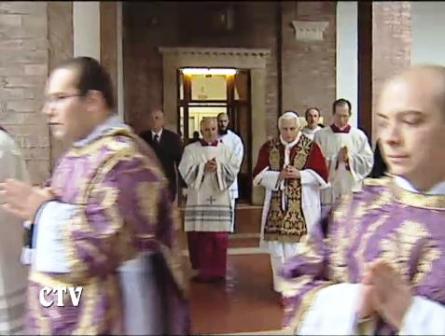
The Holy Father has begun his journey from Sant’Anselmo to Santa Sabina for the Ash Wednesday Roman Station Mass.
The Mass to be heard on Vatican Radio and CTV.
I know the liturgical eye-candy folks at NLM will probably be diligent in posting images, so I won’t do too much of that.
Maybe a few.
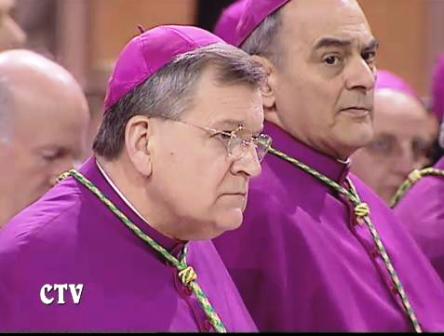
It is nice to see Archbishop Burke on hand.
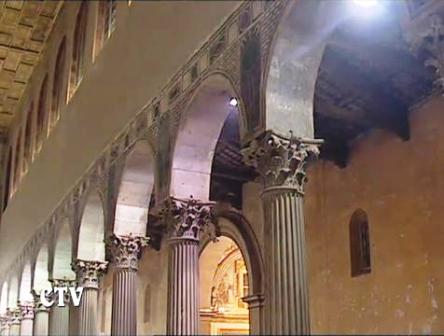
The wonderfully preserved Roman Basilica Santa Sabina.
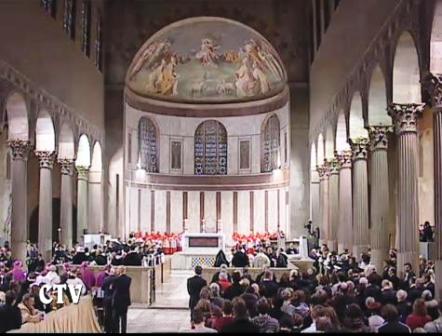
There are Cardinals vested as deacons.
NO CONCELEBRANTS
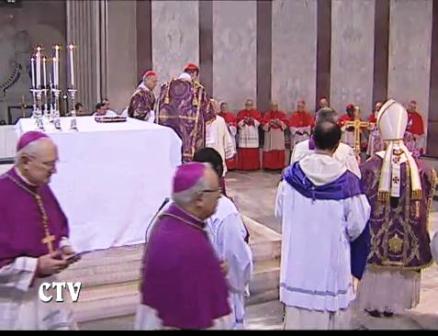
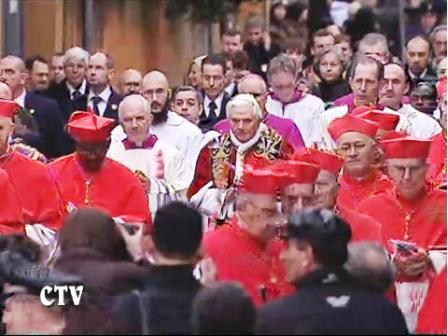
The Holy Father and sacred ministers are vested in the wonderful "Philip cut" of the Roman vestment, which was in use after the Council of Trent. This style shows the organic development of vestments from the fuller version, to the more cut-down Roman vestment in use today.
[CORRECTION/UPDATE: Since I wrote this, some people jumped on my in e-mail. I posted another entry about the Holy Father’s vestment.]
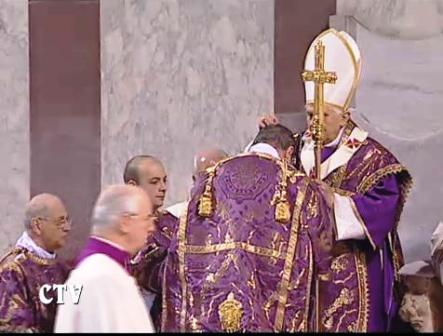
Note the pontifical dalmatic.
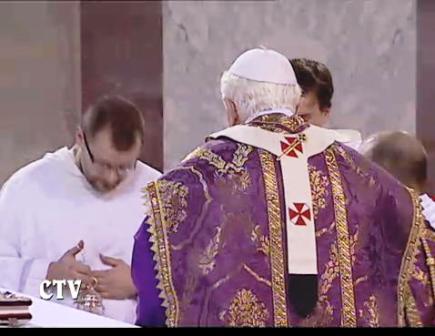
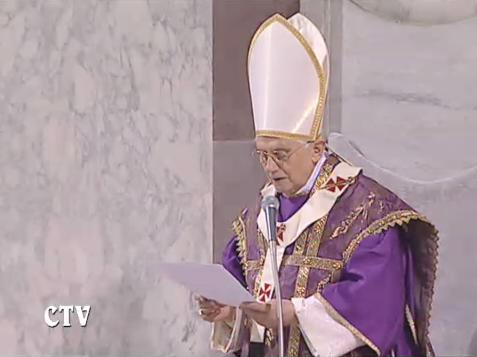
A view of an interpretation of the "Benedictine arrangement" of the altar.
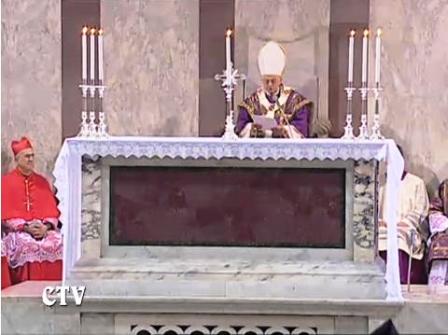
Note that the corpus is turned to the celebrant. Also, note the 7th candle.
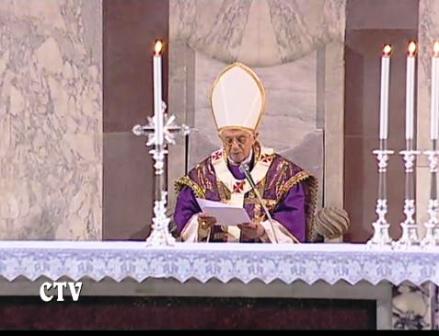
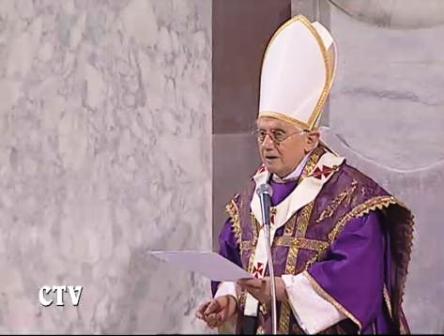
The Holy Father with the principle clergy of Rome, his cardinals.
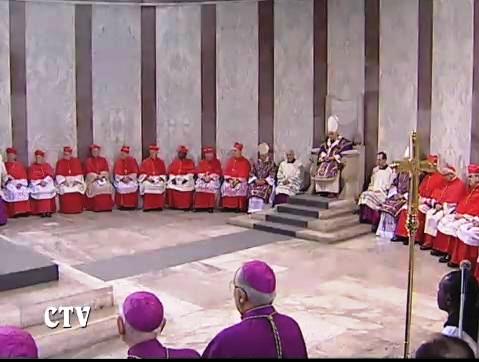
In Italy is the custom to sprinkle ashes on the top of the head rather than to trace a Cross on the forehead.
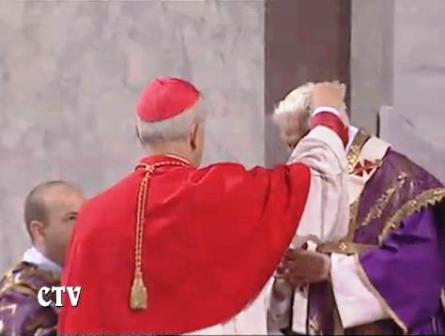
A better look at a dalmatic. Note the tassels from the shoulders.
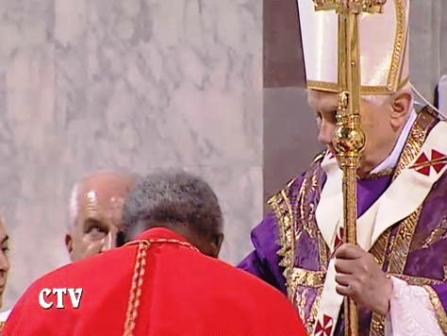
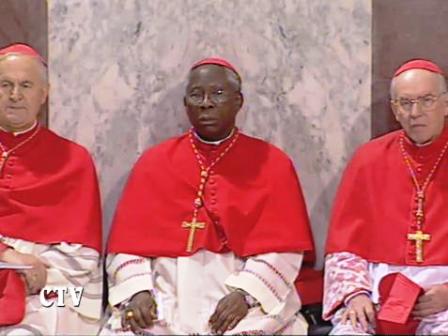
With Card. Arinze.
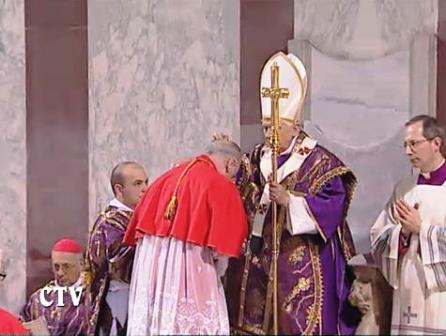
UPDATE 2145 GMT:
I thought other blogs would pick up more images from this Mass, so I stopped posting them here.
But I do have a few more.
Here are a couple for starters.
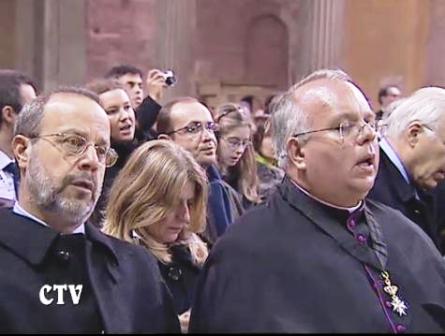
Here is the controversial editor of L’Osservatore Romano, Gian Maria Vian next to a cleric who may be known to some of you.
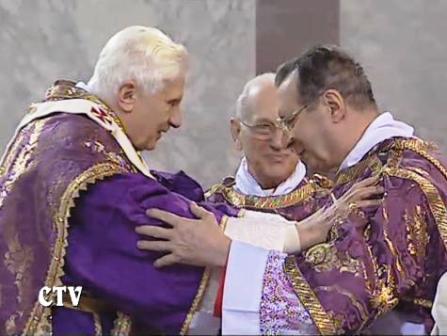
The Roman manner of giving the sign of peace.
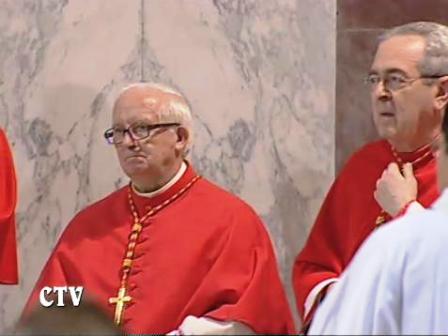
If anyone around the Philadelphia area was wondering where Card. Rigali was today…
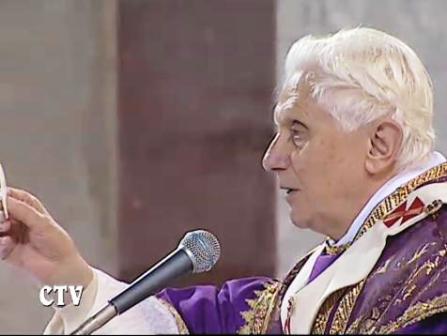
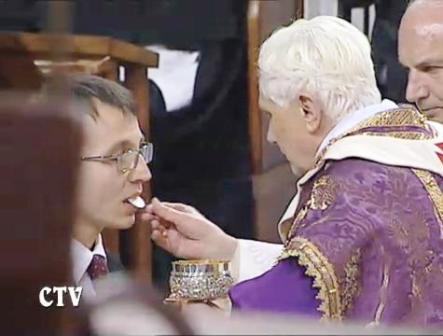
UPDATE 0247 GMT:
Okay… a few more.
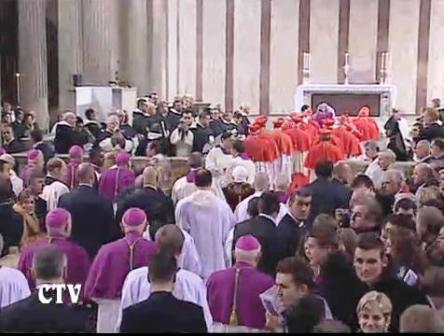
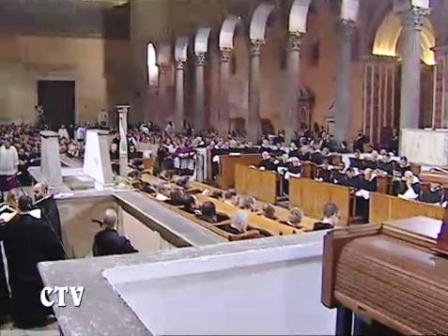
A glimpse at one of the most beautiful of the ancient Roman basilicas, the stational church for this Mass. Mussolini stripped out all the baroque stuff and restored it to is pristine form.
My friend Cardinal Arinze, Cardinal Bishop of the Suburbicarian Diocese of Velletri-Segni.
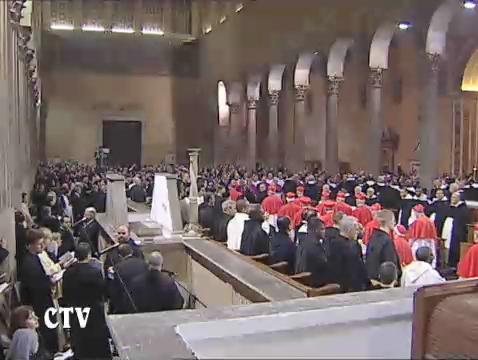
I just caught a glimpse of the former papal MC, H.E., Most Rev. Piero Marini. Not a clear view, but you can see Msgr. Guido Marini at work on the left.
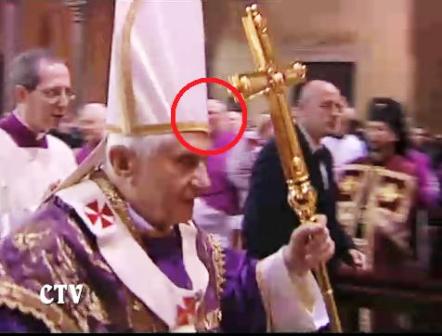































I notice there are no concelebrants at this Mass. Clergy in attendance are all in choir. I even see that the Dominican vimp is in a surplice! Very nice!
It took me a minutes to realize that was a pontifical Dalmatic…. Keep looking at the picture (despite the caption explaining it), wondering why he had a purple item under the Chasuble
Definately looks like a brick by brick afair, complete with the “Cardinal” Deacons.
Does anyone know why the ashes are imposed on the top of the head as opposed to marked on the forehead as in England and North America? Is it a Roman custom?
I thought I read somewhere that clerics should have it on the Top of their head,,, particularly if they are tonsured…maybe I am wrong
patrick: Yes… clerics would receive the ashes where the tonsure was cut.
NO CONCELEBRANTS!
Is there a problem with people accesing the website from Europe not seeing the images? Cause it happens a lot to me.
This is the second important, recent, public Mass where the Holy Father has offered Mass without concelebrants; he also did this at Epiphany.
NO CONCELEBRANTS!!!!! – U.S. bishops are you taking notice? Always good to see the future Cardinal Burke on scene. I especially like to see him at prominant events such as this because it soooooooooo infuriates american liberals, lay and ordained. Thank you Fr. Z for the post.
Stunning photos. Thanks much for sharing. Traditional liturgy is coming back, big-time. Tom
Sorry for being so dense – why the 7th candle?
Maybe this has been touched on before, but I’ll ask it again anyway…
Instead of concelebrating, may priests act as deacons in the Novus Ordo? Or is that only a special faculty granted to the Cardinal deacons?
Why can everybody but me see the photos??
Can’t see them in Google Reader, can see them at the blog itself, they just load as broken images.
Wouldnt a priest be able to always play the role of deacon? Why would Mass rubrics dictate canonical status? I priest is always a deacon, etc
I like the tradition of imposing ashes on the head. The only place I’ve ever seen it done besides in Rome is in Vietnam.
Here in Mexico about half the priests put ashes on top of head, others on forehead.
But today I saw something for the first time in any country : the priest just stood there with a tray of ashes and had the people put ashes on themselves.
Alas, alas (sigh)
In Spain, too, the priest sprinkles dry ash on your head.
I like the sequence of pictures. Cardinal Rigali looks horrified. Then you see people kneeling and receiving communion on the tongue. Then you know why. This is a rarity in the Archdiocese of Philadelphia. Most stand and receive communion in the hands. [I think this is an unworthy comment, but I will leave it here as an example and not lock you out.]
No Concelebrants :)
Also the Miter isn’t the same color as the vestments…Take note LA :)
“Cardinal Rigali looks horrified”. Comment by becket1
It’s ridiculous to interpret the look on the cardinal’s face as one of horror, and even more absurd to assume he is negatively reacting to people reverently receiving Holy Communion. He is not exactly a young man. Does it occur to you he might have been fatigued?
I’m curious as to why Cardinal Rigali was in Rome and not in Philadelphia for Ash Wednesday. I thought there was an old rule that ordinaries were to be in their diocese’s during Lent.
Fr. Z wrote: “If anyone around the Philadelphia area was wondering where Card. Rigali was today…”
the seminarian wrote: “I’m curious as to why Cardinal Rigali was in Rome and not in Philadelphia for Ash Wednesday. I thought there was an old rule that ordinaries were to be in their diocese’s during Lent.”
Cardinal Rigali is in Rome at least every two weeks for meetings of the Congregation for Bishops, of which he is a member. He is probably seen in Rome as much (if not more) as he is seen in Philly.
Here is the controversial editor of L’Osservatore Romano, Gian Maria Vian next to a cleric who may be known to some of you.
OK, I’ll bite. Who is that cleric? The one who is wearing a decoration, which appears to be a crown above a Maltese cross?
chris1, pewpew: Same problem here. Strangely, reloading the page helps.
Is it just me, or is Msgr. Marini smiling knowingly as he passes Bishop Marini by… [thought balloon:] (((“So, Piero, sorry about you not concelebrating… and how about the Roman vestments! Enjoy your retirement: you deserve it!)))
I have a question. Someone commented that the Holy Father’s Mitre doesn’t match his vestments (of which I am confused about the proper terminology.) It was implied that this was the proper thing to do. I always thought that the Mitre should match the vestments- green vestments~green mitre; white vestments~white mitre; purple vestments~purple mitre. ???
Dr. Eric, I think the Holy Father is wearing the “simple miter.” I know to compare it with the gold miter (more solemnity) and the precious (jeweled) miter (most solemnity), but that is how it is in the TLM Pontifical Mass (where the celebrating prelate would change from the gold to precious miter as the action of the Mass progressed). I would speculate that a miter that matched the vestments would be the OF equivalent of the gold miter, perhaps, because gold vestments could be substituted for white, red, or green vestments. For Ash Wednesday and the rest of Lent, a simple miter would be, I think, appropriate.
Is there a traditional use for green, red, and purple miters?
In Christ,
In Christ,
@ Dr. Eric: That isn’t really the case. Green, red, and purple miters were generally not employed before the liturgical reforms; there might have been miters highlighted with those colors, but they didn’t make miters that were predominantly green, red or purple. Traditionally, there are three kinds of miters: the “simple miter,” the “precious miter,” and the “gold miter.” The simple miter would be entirely white, and would be worn at funerals, on Good Friday, and in some other settings (for example, the Cardinal Deacons would and still do wear them when assisting the Pope). The gold miter was entirely of gold thread, and would be worn during Advent, Lent, and other penitential days. The precious miter had precious stones set into it, and would generally be the more ornate and lavish sorts of miters; they would generally be white or gold, and have lots of ornate needlework. These would be worn by bishops in non-penitential times.
Dr. Eric, here’s what I found in the 1917 Catholic Encyclopedia at New Advent:
“The bishop must wear the mitra pretiosa (precious miter)on those days on which the hymn Te Deum is used in the Office, the mitre auriphrygiata (gold miter) in the seasons of Advent and Lent, on fast days and during penitential processions, the mitra simplex (simple miter) on Good Fridays, at funerals, and at the blessing of the candles on Candlemas-day. When bishops attend a general council, or are present at solemn pontifical acts of the pope, they wear a plain linen mitre, while the cardinals on occasions wear a simple mitre of silk damask.”
The only thing I could find online regarding the use of the miter in the OF came from the diocesan newspaper in Sioux Falls, IA (see of the good Bishop Nickess):
“The bishop (and abbots in monasteries) wears a mitre during liturgical functions. This is the tall, two-horned, pointy headdress. The two horns on the mitre represent the Old Testament and the New Testament, both of which the bishop is to teach his people. The mitre can be simple (such as for Lent, Advent, Good Friday, or Funerals) or ornate (such as for major feasts and solemnities). However, all bishops wear simple mitres in the presence of the pope.”
On first blush, it looks like there is not a liturgical precedent for miters that match the red, green, and purple vestments. I do know that the Episcopalian Church leaders in the US tends to be photgraphed quite a bit in matching miters.
In Christ,
Thanks to the three posters above. I guess it is an abuse then as I have seen matching mitres in the Latin Church. I am going to have to research it more. I found the above posts interesting.
Here at the Grand Séminaire de Québec, the ashes are sprinkled on the head. Then they fall OFF the head all day long…
TNCath He is probably seen in Rome as much (if not more) as he is seen in Philly.
….
Then Rome needs to send a Bishop to Scranton tout suite, since Card. Rigali is currently Ordinary (and will be for St. Patrick’s Day celebrations on March 13) and if he is not in Phila often we can imagine even less time in Scranton….
@Nathan,
“The only thing I could find online regarding the use of the miter in the OF came from the diocesan newspaper in Sioux Falls, IA (see of the good Bishop Nickess):”
Bishop Nickless is the Bishop of Sioux City, Iowa. Sioux Falls is in South Dakota. Probably a freudian slip, however, since that is my home diocese, I thought I would interject.
Blessings….
As a matter of clarification for Dr. Eric:
The precious mitre would be worn processing in through the kyrie, at which point he would switch to the gold mitre. He would then use the gold mitre for the rest of the Mass when prescribed to wear a mitre. This was done for one reason, the precious mitre was/is simply too heavy.
The white damask mitre can be worn anytime, however, it is prescribed during official times of mourning, such as a Requiem and also at any time the bishop is in a position of inferiority, such as any cardinal in the presence of the pope.
Color in the mitres are a modern (and incredibly tacky, IMHO) innovation of “liturgists” and vestment makers….
Apologies for the double post, however, the precious mitre would then be donned again for the final blessing then processed out.
I’m amazed the Holy Father could say Mass “all by himself” without the need for concelebrants. (I think there may be a papal message here) Deo Gratias. Tom
Quote: “Cardinal Rigali is in Rome at least every two weeks for meetings of the Congregation for Bishops, of which he is a member. He is probably seen in Rome as much (if not more) as he is seen in Philly.”
No wonder the Masses at most churches in the Archdiocese of Philadelphia are not in tune with the Holy Father’s reform of the reform. The Archbishop is never around to oversee things. Practically every church in the Archdiocese has EMHC, like it’s a requirement, altar girls abound, everyone is worried about swine flu, so communion in the hand is the norm, and the music, well you know.
Nathan, I can’t resist a little snark:
Looking to the current crop of Episcopalians for fashion advice is about as useless as looking to them for theological counsel.
Exhibit “A”:
http://www.standfirminfaith.com/images/technicolor_yawn.jpg
I rest my case.
Color-coordinated mitres matching the vestment colors are very prevalent in the U.S. Archbishop Dolan in NY wears such mitres regularly.