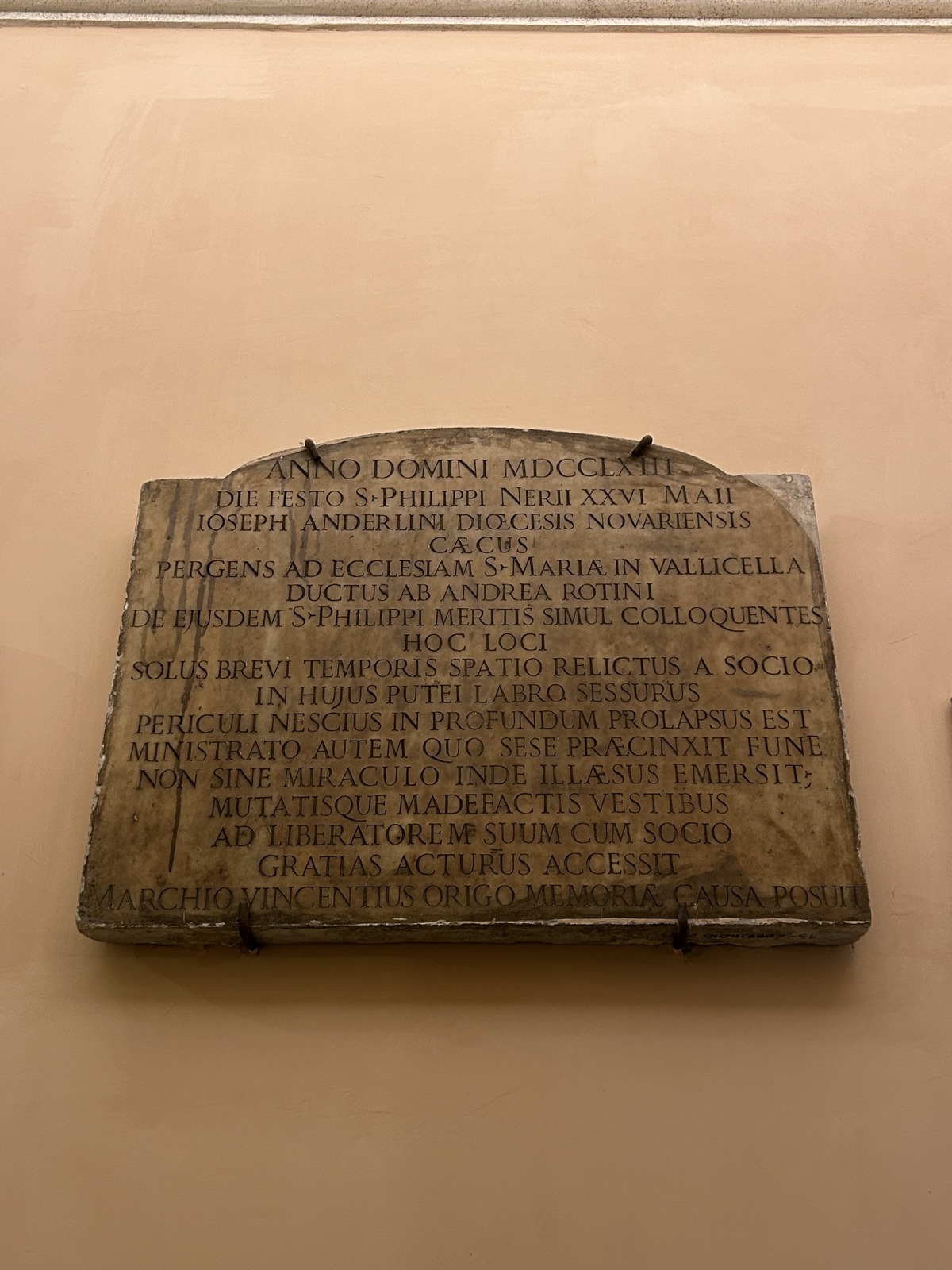
The World’s Best Sacristan™ sent this inscription which tells an interesting story. To make it easier for you to provide us with your own accurate rendering, here is the transcription.
ANNO DOMINI MDCCLXIII
DIE FESTO S. PHILIPPI NERI XXVI. MAII
IOSEPH ANDERLINI DIOECESIS NOVARIENSIS
CAECVS
PERGENS AD ECCLESIAM S. MARIAE IN VALLICELLA
DVCTVS AB ANDREA ROTINI
DE EIVSDEM S. PHILIPPI MERITIS SIMVL COLLOQVENTES
HOC LOCI
SOLVS BREVI TEMPORIS SPATIO RELICTVS A SOCIO
IN HVIVS PVTEI LABRO SESSVS
PERICVLI NESCIUS IN PROFVNDVM PROLAPSVS EST
MINISTRATO AVTEM QVO SESE PRAECINXIT FVNE
NON SINE MIRACVLO INDE ILLAESVS EMERSIT
MVTATISQVE MADEFACTIS VESTIBVS
AD LIBERATOREM SVVM CVM SOCIO
GRATIAS ACTVRVS ACCESSIT
MARCHIO VINCENTIVS ORIGO MEMORIAE CAVSA POSVIT
It helps to know Latin when getting about in Rome. It’s everywhere and packs a lot of information.
Welcome registrants:
salver
sam@farr*****.com
Please remember me when shopping online and use my affiliate links. US HERE – WHY? This helps to pay for health insurance, utilities, groceries, and now also my late mother’s place. At no extra cost, you provide help for which I am grateful.
White to move and mate in 5.
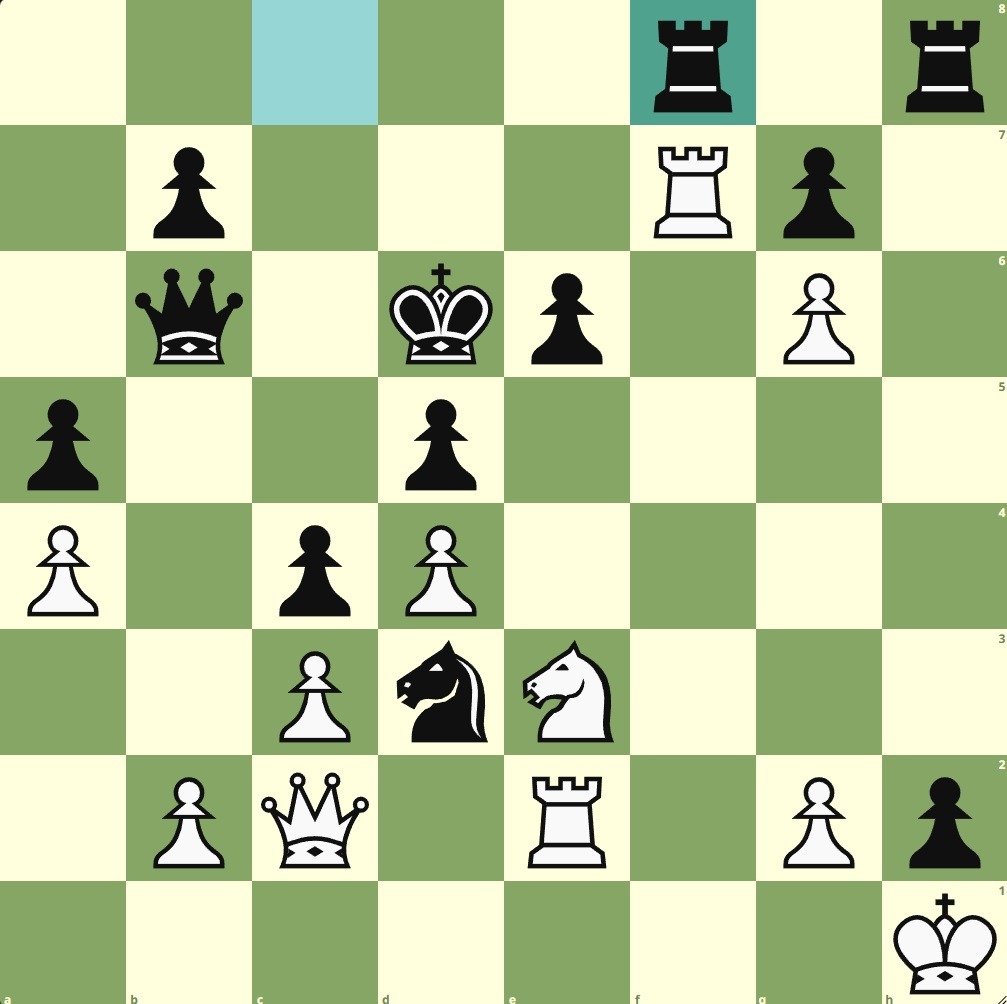
NB: I’ll hold comments with solutions ’till the next day so there won’t be “spoilers” for others.































1. N-f5+
If . . . . . . K-c6
2. R×e6#
So . . . . e6×f5
2. R-e6+ . . K×e6
3. Q-e2+
Then if . . . N-e5
4. Q×e5#
Or if . . . . . K-d6
4. Q-e7+ . . K-c6
5. Q-d7#
Very on-the-fly:
IN THE YEAR OF THE LORD 1763
ON MAY 26, THE FEAST OF ST. PHILIP NERI
JOSEPH ANDERLINI, OF THE DIOCESE OF NOVARO (?),
A BLIND MAN
WHILE TRAVELING TO THE CHURCH OF ST. MARY IN VALLICELLA,
LED BY ANDREA ROTINI,
AND SPEAKING TOGETHER OF THE MERITIS OF THE SAME S. PHILIP,
IN THIS PLACE,
WHEN HE WAS LEFT ALONE FOR A SHORT SPAN OF TIME BY HIS COMPANION,
[SOMETHING] OF THIS DITCH,
HE FELL INTO THE BOTTOM OF THE UNKNOWN PERIL.
BUT WITH THE AID OF THE CORD WITH WHICH HE GIRDED HIMSELF,
HE EMERGED UNHARMED, NOT WITHOUT A MIRACLE,
AND WHEN HE HAD CHANGED HIS [SOMETHING] CLOTHS,
HE WENT WITH HIS COMPANION TO THANK HIS LIBERATOR.
MARCHIO VINCENT ORIGO PLACED THIS HERE AS A MEMORIAL. (??)
I have no idea what the miracle is supposed to have been, so I’m clearly not understanding something.
@David L
You have given a good start.
I offer these improvements:
IN HVIVS PVTEI LABRO SESSVS
Seated on the edge of this well
and
MVTATISQVE MADEFACTIS VESTIBVS
Having changed his soaking wet garments
It seems to be a miracle of St. Philip drawing the blind man up out of the well by the cincture he was wearing
@ David L. I agree that this inscription is puzzling. I think that the miracle is in the line “ministrato autem quo sese praecinxit fune” i.e. “since, however, a rope was provided, with which he girt himself”. The person who provided the rope to the blind man at the bottom of the well is not specified, so it’s like the rope came out of nowhere; St. Philip Neri must have interceded so that God would bring the rope into existence, and so “liberatorem” refers to St. Philip Neri, who freed the man from the well.
Mate in five sounds impressively challenging.
I set up the problem on our chessboard for my 12-year-old grandson. He solved it almost instantly — less than two minutes — even with an unprompted adjustment for the knight interposition.
Here is a looser rendering in rhyming trimeter couplets:
Blind Joseph was walking,
And with his friend talking,
Philip’s greatness extolled,
From St. Mary’s they strolled.
For a brief moments space,
Being left off a pace,
In the depth of this well,
The side breaking, he fell.
But his saviour at hand,
Placed help where he would land
And with a rope as his guide
Which he bound to his side,
Unhurt emerged he soon.
A miraculous boon!
His wet clothes having changed,
A great thanks he arranged,
And a plaque he arrayed
At the place he was saved.