
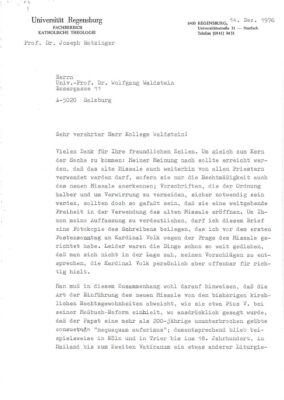
 I spotted something interesting at Fakebook, posted by Peter Kwasniewski… a letter from Prof. Joseph Ratzinger to Wolfgang Waldstein in 1976.
Dear Colleague Waldstein,
Thank you very much for your kind note. To come straight to the heart of the matter: In my opinion, the aim should be to ensure that all priests may continue to use the old Missal, provided they acknowledge the legitimacy of the new Missal as well. While regulations—certainly necessary for the sake of order and to avoid confusion—will be required, they should be framed in such a way as to allow considerable freedom in the use of the old Missal. To clarify my position, I am taking the liberty of enclosing a photocopy of the letter I sent to Cardinal Volk regarding the Missal issue prior to the First Sunday of Lent. Unfortunately, matters had already progressed to a point where it was deemed impossible to accede to my proposals—proposals which Cardinal Volk himself evidently considered sound.
In this context, it is worth noting that the manner in which the new Missal was introduced departs from established ecclesiastical legal customs—such as those observed by Pius V during his reform of the Missal. In that instance, it was explicitly stated that the Pope was by no means abolishing a *consuetudo* (custom) that had been practiced without interruption for over two hundred years (*nequaquam auferimus*). Accordingly, a somewhat different liturgical form remained in use—for example, in Cologne and Trier until the 18th century, and in Milan until the Second Vatican Council, as well as within the Dominican Order; many other examples could easily be cited. The “Missal of Pius V” was not, in fact, a new Missal at all, but merely a version of the existing Roman Missal that had been slightly revised based on historical sources; it represented, therefore, simply another growth ring in a continuous process dating back to Hippolytus. For this reason, I consider the terms “Tridentine Mass” and “Missal of Pius V” to be historically incorrect and theologically disastrous. The problem with the new Missal, by contrast, lies in the fact that it breaks away from this continuous history—which had persisted both before and after Pius V—and creates an entirely new book (albeit one made of old material). Its introduction was accompanied by a type of prohibition regarding what had gone before—a prohibition of a kind entirely alien to the history of ecclesiastical law and liturgy. Based on my knowledge of the Council debates and a re-reading of the speeches delivered by the Council Fathers at the time, I can state with certainty that this was not intended. Admittedly, it is difficult to articulate and defend this view today because it is all too easy to confuse it with the position of Lefebvre—a position of a fundamentally different nature, which is compelled to deny any form of growth and thus places itself in opposition not only to Pius V but also to the very Catholic principle of papal and episcopal authority. For this reason, it seems important to me to emphasize the full legitimacy of the new Missal; yet, on that basis, one can and must advocate for a revision of that prohibition—which runs counter to tradition—so that the course of development may be set right again. It can then be left to the future to decide whether the “new Missal” will flow back into the old one and merge with it, ultimately serving merely as a stage in its growth—for the stagnation of the old Missal would, in the long run, spell its demise; precisely for this reason, one must hope that it will be reintegrated into the living development of the liturgy.
I warmly reciprocate your Advent and Christmas greetings and remain, with best regards,
Yours very sincerely,
Joseph Ratzinger
Sehr verehrter Herr Kollege Waldstein!
Vielen Dank für Ihre freundlichen Zeilen. Um gleich zum Kern der Sache zu kommen: Meiner Meinung nach sollte erreicht wer-den, daß das alte Missale auch weiterhin von allen Priestern verwendet werden darf, sofern sie nur die Rechtmäßigkeit auch des neuen Missale anerkennen; Vorschriften, die der Ordnung halber und um Verwirrung zu vermeiden, sicher notwendig sein werden, sollten doch so gefaßt sein, daß sie eine weitgehende Freiheit in der Verwendung des alten Missale eröffnen. Um Ihnen meine Auffassung zu verdeutlichen, darf ich diesem Brief eine Fotokopie des Schreibens beilegen, das ich vor dem ersten Fastensonntag an Kardinal Volk wegen der Frage des Missale ge-richtet habe. Leider waren die Dinge schon so weit gediehen, daß man sich nicht in der Lage sah, meinen Vorschlägen zu ent-sprechen, die Kardinal Volk persönlich aber offenbar für rich-tig hielt.
Man muß in diesem Zusammenhang wohl darauf hinweisen, daß die Art der Einführung des neuen Missale von den bisherigen kirchlichen Rechtsgewohnheiten abweicht, wie sie etwa Pius V. bei seiner Meßbuch-Reform einhielt, wo ausdrücklich gesagt wurde, daß der Papst eine mehr als 200-jährige ununterbrochen geübte consuetndn “neguaquam auferimus”; dementsprechend blieb bei-spielsweise in Köln und in Trier bis ins 18. Jahrhundert, in Mailand bis zum Zweiten Vaticanum ein etwas anderer Liturgie-Typus in Geltung, ebenso im Dominikanerorden – die Beispiele wären leicht zu vermehren. Das “Missale Pius3V.” war dabei gar kein neues Missale, sondern nur eine anhand der Quellen geringfügig bearbeitete Form des bisherigen stadtrömischen Missale und insofern nur ein Wachstumsring innerhalb eines seit Hippolyt geradlinig verlaufenden Prozesses. Deswegen finde ich die Rede von der “Tridentinischen Messe” und vom “Missale Pius’V.” historisch falsch und theologisch fatal. Das Problem des neuen Missale liegt demgegenüber darin, daß es aus dieser kontinuierlichen, vor und nach Pius V. immer weitergegangenen Geschichte ausbricht und ein durchaus neues Buch (wenn auch aus altem Material) schafft, dessen Auftreten mit einem der kirchlichen Rechts- und Liturgiegeschichte durchaus fremden Typus von Verbot des Bisherigen begleitet ist. Ich kann aus meiner Kenntnis der Konzilsdebatte und aus nochmaliger Lektüre der damals gehaltenen Reden der Konzilsväter mit Sicherheit sagen, daß dies nicht intendiert war.
Freilich ist solches auszusprechen und zu vertreten heute deshalb schwierig, weil die Verwechslung mit der in Wirklichkeit ganz anders gearteten Position Lefebvres allzunahe liegt, die in Wirklichkeit jedes Wachstum bestreiten muß und sich damit in Widerspruch auch zu Pius V. und überhaupt zum katholischen Prinzip der päpstlichen und bischöflichen Vollmacht setzt. Deswegen scheint mir die Betonung der vollen Rechtmäßigkeit des neuen Missale wichtig; unter ihrer Voraussetzung kann und muß man sich dann aber doch dafür einsetzen, daß der traditionswidrige Verbotstypus revidiert und damit die Entwicklung wieder begradigt wird. Man kann es dann der Zukunft überlassen, ob das “neue Missale” wieder ins alte zurückmündet und sich so mit ihm verschmilzt, daß es zuletzt einfach eine Etappe in seinem Wachstum ist – die Erstarrung des alten Missale wäre ja auf Dauer doch dessen Untergang; gerade deswegen muß man wünschen, daß es wieder in die lebendige liturgische Entwicklung eingeholt wird.
Ihre Advents- und Weihnachtswünsche erwidere ich sehr herzlich und verbleibe mit den besten Grüßen
Ihr sehr ergebener
































I wonder just what he means by – and therewith what his basis is for – “der in Wirklichkeit ganz anders gearteten Position Lefebvres allzunahe liegt, die in Wirklichkeit jedes Wachstum bestreiten muß und sich damit in Widerspruch auch zu Pius V. und überhaupt zum katholischen Prinzip der päpstlichen und bischöflichen Vollmacht setzt” (“the position of Lefebvre—a position of a fundamentally different nature, which is compelled to deny any form of growth and thus places itself in opposition not only to Pius V but also to the very Catholic principle of papal and episcopal authority”)?
I do not yet know much of what Archbishop Lefebvre said (only one of his book so far – in English translation, and any number of quotations, etc.) but this does not sound like anything I have ever heard coming from an FSSPX source, and indeed seems quite the opposite of something I heard (in English translation) in a recent video about the character of St. Pius V and what he did in producing the ‘Tridentine’ Missal.
The only way forward is to go back. We’re liturgically lost, and we can talk all we want about making the Novus Ordo “more reverent,” but what’s our reference point? Summorum Pontificum was prophetic, and Benedict’s stated reason for issuing it was to foster an “inward reconciliation” in the Church. To stop hating our patrimony.
That is an excellent letter by Father Ratzinger.
The only way forward is to go back. We’re liturgically lost, and we can talk all we want about making the Novus Ordo “more reverent,” but what’s our reference point?
Well, the reference points IMO are the Latin Novus Ordo Missal, as well as Sacrosanctum Concilium and the provisions in it that a majority of priests and Bishops routinely ignore, plus knowledge and understanding of the TLM.
A reverent and Latinate NO Mass (sung with Gregorian chant, perhaps mixed with some of the better more modern hymns) can be quite excellent, though in my experience in that case such Masses tend to be given by priests who also regularly give the TLM.
A group of women I meet with are reading and studying the documents of Vatican II. I have forwarded this letter to the group.
Thank you for posting this.
“…which is compelled to deny any form of growth and thus places itself in opposition not only to Pius V but also to the very Catholic principle of papal and episcopal authority.”
Wow! So…then-Fr Ratzinger stated the crux of my issue with SSPX all the way back in 1976. …and apparently with a professor’s credentials, no less.
@Venerator
For understanding Ratzinger’s reference to Lefebvre’s position in 1976 it may be helpful to remember the highly publicized 29 June 1976 ordination sermon by Lefebvre a few months before Ratzinger’s letter (easily available online). Lefebvre made a central theme of his sermon the idea of a “canonization” of the Mass of 1570 that a future pope could not remove.
Archbishop Lefebvre was so, so naughty. Wheeled out to frighten the children. All the diocese in Ireland and the UK are in a state of collapse, fair enough there are all sorts of societal bits and pieces out there. The church can’t help anyone with a silly sing a long a ding dong on a Sunday morning.
The world is in serious trouble it needs a serious church to help recreate civilisation like it did after the fall of the Roman Empire.
A silly church with effeminate priests is not fit for purpose.
It is so distressing to see that even in 1976 Ratzinger fully recognized the problem of the lack of continuity and saw that “matters had already progressed to a point where it was deemed impossible to accede to my proposals—proposals which Cardinal Volk himself evidently considered sound.”
Deemed impossible.
Impossible.
Does this sound like the slow, thoughtful, measured process used by the Church to implement change for, at that time, some 1,950 or so years? Or does it sound like the ramming through of an agenda conceived by some very bad actors, which, as is typical for those with bad motives, moved so rapidly and without consultation that it could not be slowed or stopped?
No one with good intentions does that.
Fr Jackson,
Many thanks! I do not recall reading that sermon before – and I think I would, if I had, having now read the English translation uploaded on the SSPX “District of Asia” website “Courtesy of the Angelus Press […] Vol. XV, No. 6, June 1992”.
In the fourth-last paragraph there, he says (among other things) “this Mass is canonised. He canonised it definitively. Now a Pope cannot remove a canonisation. The Pope can make a new rite, but he cannot remove a canonisation. He cannot forbid a Mass that is canonised.”
The assertion that “The Pope can make a new rite” seems quite opposed to the good Professor’s assertion that “the position of Lefebvre […] is compelled to deny any form of growth”. One might say, that the sermon’s critique of the “new rite of Mass” is that the Pope has in this instance failed to “make a new rite” which (like that of St. Pius V) “contains our whole faith, the whole Catholic Faith”.
I do not know if any FSSPX priests are ‘bi-‘ or ‘multi-ritual’ with respect to, e.g., the Byzantine liturgy, but have never heard they reject any of the traditional rites of the (so to put it) Non-Latin Roman Churches. I keep wondering what they think about the affirmation of existing rites and uses in ‘Quo primum’, but have not properly pursued that question – e.g., with respect to the current possibilities of Sarum Use.
@JabbaPapa
That’s my point: the TLM is the reference point.
The NO in Latin, as well as Sacrosanctum Concilium, do not address the details of how to celebrate the Mass. Here’s an example. I once was asked to prepare the altar for an NO Mass. There were six candles on the altar, but it was a daily Mass: clearly a Low Mass setting. I knew that if I lit only two of the candles, though, I’d be making two of the six candles shorter than the rest (and if you know anything about parish politics, priests, and sacristans, you’ll know that wouldn’t go over well).
These types of things might not seem to matter, but they add up to that general feeling of “what are we even doing here?” that often seems to plague the celebration of the NO.
Anyway, I make this point in a more eloquent way here: https://youtu.be/SFUTr3l86m8?si=UmkLiMQ8Nz-GcApI
@Venerator Sti Lot
Also, to claim the language of a “canonized Mass” is equivalent with a rejection of any kind of growth is misleading, at best. Surely Archbishop Lefebvre was referring to Quo Primum, and pointing out that it was St. Pius V who said the Latin Rite could not be suppressed. The fact that the SSPX use the 1962 missal is, itself, an acknowledgement that growth, even in liturgical matters, can be legitimate.
What I find sad is, even this far back, the maniacal demand that “all things new” MUST be held as valid as a minimal requirement to be considered legitimate was established and championed even by someone as thoughtful as Cardinal Ratzinger. Truly, it was an age of intoxicating novelty, and we are still paying the price 60 years later.
In general, to reiterate my point about the whole “reverent Novus Ordo” position – the more important problem is that people, today, see the Liturgy as alterable and subject to the desires and opinions of currently living Catholics. THIS is what has to be addressed, and THIS cannot be addressed by championing one set of personal preferences over someone else’s set of personal preferences.
If folks could read C.S. Lewis in “The Abolition of Man” and realize the same argument explains the mess of liturgical innovation we find ourselves in – much actual progress might be made.
WVC,
Thanks! Well said!
At the time Archbishop Lefebvre preached that sermon, I had been to two Latin Masses, I suspect given the date reverent Novus Ordo, and my further experience was certainly reverent Latin Novus Ordo, whether ad orientem (with, for whatever reason, an occasional Ambrosian Rite Mass) or in a cathedral where there was only a sturdy stone ‘table altar’ where I think the priest would have had to stand on the highest step rather than the floor of the choir to face East.
And what chance of a universal enforcement of reverent Latin Novus Ordo – (“Let’s sing with the Pope”) where the Novus Ordo is celebrated – when TC, etc. are variously episcopally used to oppose it as is?
In any case, my last six years of TLM experience – in schola – have persuaded me of its superiority (though I’ve enjoyed watching videos of Sarum Rite Masses, e.g., one in 1997 in Oxford, before they were quashed, still happily on YouTube).
When Archbishop Lefebvre ordained those priests in 1976, my father, a coal miner in Scotland who’d never heard of Archbishop Lefebvre jumped right out of his seat waving the Daily Mail shouting….. “At last…at last…here is a man doing the right thing”
My father died in 2010, my mother in 2019 both requiem masses were said by SSPX priests. I have my father’s missal complete with Achbishop Lefebvres autograph…. only discovered after my mother died.
I was 18 in 1976…. 68 now, I have told my wife that when my time comes it will be an SSPX priest for my requiem…. even if it is said in a hotel basement.