
 From a reader:
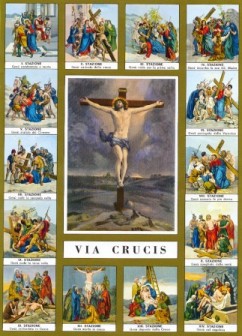
I was wondering if the stations have to be in a certain direction in the church. I was in a church where they were just arranged on a single wall in rows one above the other in a sort of zig-zag. That’s doesn’t seem right to me.
In the recitation of the Stations there must movement from one station to another. Station comes from Latin “statio… stopping place”. In public recitation, it is not necessary for everyone in church to move. Just the celebrant can move with the servers. But if the crosses of the Stations are all grouped together, it is hard to imagine what sort of significant movement there can be. Putting them all together seems like a bad idea to me – unless the space of the church or chapel or oratory is very small and not much area is available. There could be some movement possible even if they are arranged very closely.
I don’t know if there more recent legislation about the Stations of the Cross, or Via Crucis as it is also called, but we can get some insight from an old (reprinted) liturgical manual by Trimeloni, which is an Italian version of Fortescue/O’Connell, for the Extraordinary Form.
Trimeloni has detailed descriptions of the contents and arrangement of a church, which includes, of course, Stations of the Cross.
Here is what I found:
1. For Latin Church Catholics to gain the indulgences, the Stations must be canonically “erected” by a Franciscan or someone who had an indult, such as all diocesan bishops.
2. The Stations themselves don’t have to have images, but they must have visible crosses of wood.
3. The order of the 14 images can start from either the Epistle side or the Gospel side, that is, the side of the church corresponding to the sides of the altar where the Epistle or the Gospel of Holy Mass are said or sung during Mass. The direction of their order should correspond to the predominant direction of the artistic representation’s movement of the figures toward the right or left. For example, if the figures move predominantly from right to left for most of the Stations (that won’t be the case with the Crucifixion, for example), the 1st Station would begin on the wall closest to the Gospel side of the altar, so that the figures are artistically/metaphorically moving away from the altar during the narrative of the Via Crucis.
4. During more solemn exercises of this devotion it is not necessary to light candles before the Stations, a processional Cross without a corpus is used, there can be a folded “shroud” hanging on the Cross, servers go on either side of the Cross with lighted candles, the priest does not wear a stole, since this doesn’t concern the Blessed Sacrament or a sacramental.
There are some places where Stations are done in the presence of the Blessed Sacrament exposed, which is somewhat avant-garde and controversial. In that case, however, it seems reasonable that the priest would wear a stole.
A few other points. The Stations were not always 14 in number, but they are now. Adding a 15th Station is strange. There are different ways to observe the Stations now, but the traditional 14 were once obligatory. The Franciscans are deeply connected to this devotion from the time of pilgrimages in the Middle Ages to the Holy Land. The devotion of the Stations, to correspond with the places of the Lord’s journey to the place of His Crucifixion, were for the benefit of people who couldn’t go to Jerusalem. Franciscans still have custody of many pilgrimage places in the Holy Land.
The principle motivation for this devotion is for reparation for our part in the Passion and Crucifixion of the Lord and reparation for all the sins and offenses we commit which, in a sense, continue to crucify the Lord even now.
So, repeating my lack of awareness of some subsequent I don’t think there is a specific and obligatory arrangement or order, but the principles of common sense ought to apply.
I hope that helps a little.































I always “enjoyed”, for lack of a more appropriate word, the Stations of the Cross, and didn’t mind pulling incense duty for them when I was altar boy. I seem to remember Blessed John Paul II “changing” or offering an alternative set similar to his Luminous Mysteries. I think it is one of the most important rituals during Lent.
Father,
“The principle motivation for this devotion is for reparation for our part in the Passion and Crucifixion of the Lord and reparation for all the sins and offenses we commit which, in a sense, continue to CRUCIFY THE LORD EVEN NOW.”
How do we understand this father? Is it in the same sense as – In Holy Mass, Chris’ts sacrifice on the cross is made present now, and in like manner our sins are made present in Christ’s sacrifice on the cross then?
Father, are you certain that the Stations must be “erected” by a Franciscan or the bishop? [You’ll have noticed in the top entry that I wrote: “we can get some insight from an old (reprinted) liturgical manual by Trimeloni, which is an Italian version of Fortescue/O’Connell, for the Extraordinary Form.”]
This requirement is not present in the current grant of the plenary indulgence (Enchiridion of Indulgences, English trans., pp. 75-76, no. 63). It merely says “1) The pious exercise must be made before stations of the Way of the Cross legitimately erected.” And then it explains in what this “legitimate” erection” consists: “2) For the erection of the Way of the Cross fourteen crosses are required, to which it is customary to add fourteen pictures or images, which represent the stations of Jerusalem.” That’s it on erection, no requirement of any special authority “erecting” it or blessing it. Nor is it specified that the crosses be of wood.
To show that this comment is not made out of competition with my brother Franciscans, I will also note that the former requirement for a plenary indulgence by saying 5 decades of the Rosary that it be blessed by a Dominican is also gone from the Enchiridion (pp. 67-68, n. 48). It seems that the Rosary need not be blessed at all.
I point this out not because I think these were good changes, but because they are the current norms as I read them. For what it is worth, he stations of our House of Studies chapel here in Oakland are crosses of wood (no pictures or numbers) and were erected by the Archbishop of San Franciscan in 1949 as a framed document in the sacristy attests.
And the current law specifies that the “properly erected” Way of the Cross have 14, not 15, stations, I doubt that one could earn the plenary indulgence there were 15 stations in the set as this is contrary to the specifications for “proper erection.” On the other hand, as section 3) says, there is no special requirement that the 14 stations be assigned to any particular incident of the Passion, so one might change the 14 meditations to something other than the traditional Jerusalem list.
Dear Fr. Z., opps. Sorry I missed that. Thanks for the pointer; I shouldn’t skim.
In a church in my hometown, there’s a set of stations that looks like a jigsaw puzzle of symbols of the Way of the Cross. The Puzzle is mounted on a 4′ x 8′ space on a brick wall, and is made out of wooden pieces that are so dark that they tend to look like blobs on the wall, and the details can only be seen close up. There’s really no space for a procession through the church, and the images are towards the back of the building.
And no, the fourteen crosses required aren’t there either.
“…but they must have visible crosses of wood.”
That’s an interesting item. Does that mean that the Stations are to include a physical wooden cross? Or maybe they’re to use a wooden cross for backing?
Most of the Stations I’ve seen have been metal plaques, stone carvings, or paintings. (For what it’s worth, I saw a near-life-size stone carving Stations in the cathedral in Spokane, WA. One of the most beautiful I’ve ever seen.)
We once had a lightning strike and power blackout in the middle of the stations . . . right as the priest said “. . . and with a loud cry, he yielded up the spirit.” ka-POW!!!!
Pitch dark except for the two candles flanking the cross. Choir had to hum because we were way into the “Stabat mater” and nobody knew the words – until somebody felt their way into the sacristy and got candles.
As Ray Stevens said in the “Mississippi squirrel revival” – seven deacons and the pastor got saved, and thirty-seven hundred dollars got raised, and thirteen people volunteered for missions in the Congo on the spot . . . .
And that was when we were Episcopalians!
jflare: That’s an interesting item. Does that mean that the Stations are to include a physical wooden cross? Or maybe they’re to use a wooden cross for backing?
All the properly installed ones that don’t look like piles of scrap metal that I have ever seen have wooden crosses in them somewhere. For example, my cathedral parish has a set of Martin von Feuerstein Stations executed in oil on canvas, each one surmounted by a small wooden cross. Sometimes the wooden cross has the number of the station on it.
Not only should each Station have a wooden cross in it, but Stations of the Cross — especially when publicly recited — should be authentic manifestations of the devotion and not centered upon Leninist-Marxist “social justice” themes. But that’s a post for another day.
Good Evening, Ms. Moore,
I don’t think the set I’ve seen looked like scrap metal, per se. ..’Course I didn’t think they looked all that great, either, I thought them somewhat tacky. Maybe that’s what you meant. I didn’t care much for them because they didn’t depict the scenes very well in the best light; they were quite difficult to view when the candles above them were lit.
If I remember right, the Stations at the parish I grew up in WERE (nicely done) metal placed on (nicely done) wooden crosses..I think. I’d actually need to look at the renderings at my current parish. I know they’re paintings–nice ones–but I don’t remember if they have a cross (wood or otherwise) above them. I’d need to look.
Given our pastor’s interest in orthodoxy, I wouldn’t be the least bit surprised if they did.
One of these days, I ought to look at the paintings in the back more closely too. I’m not sure what they depict, but I think there’re 4 (or 6) of them with a Marian theme. That was my rough impression anyway….
In the oldest church in our town (1840s) the Stations start at the Gospel side – which is also the Sacred Heart altar – and continue around to end at the Epistle side, where the Our Lady altar is. Don’t know about the 2 other ones which are slightly “younger (late 19th century, early 20th) as I’m rarely if ever in them.
And now that I think about it, the figures do “move away” towards the back on the one side and then face back towards the front on the other – there are 7 on each side and as each altar is at the head of a separate aisle there is plenty of room for people making the Stations. I’m not sure that the order of the Stations was in any way linked to the 2 side-altars but it just struck me that with this arrangement one starts with the Sacred Heart and then ends with placing of Him in the tomb and the agony of Mary, which can be meditated on at her altar. This final Station is practically at the rail of the Lady altar.
Obviously, putting all the Stations on the same wall is anti-processional (or to be fair, just means the architects have totally forgotten that Stations are supposed to be a mini-procession, because they have no history or culture in their thought process).
But OTOH, having all the Stations on one wall makes it much easier to do the Stations on your knees. (Pants with some give and good knees are strongly recommended.)
(And if you do it on your knees in front of somebody else with pull, you may find that the Stations get decently spaced around the walls pretty soon. Either that or they’ll just think you are weird or Hispanic, and I’m sure you can live with either of those.) :)
A 1970’s-era church I know has the stations erected outside the church, in a rock garden along the back wall, which is floor-to-ceiling glass. You look at them from inside. It is always winter here during Lent. The snow tends to pile up in drifts there because of the winds. It is very distracting from meditating on the Passion, to be looking at Jesus outside in the dark and snow. I’ve often wondered if they are “lawfully erected” if they are not actually inside the church.
Having paths outside the church with the Stations on them is about as old as having them inside a church. It was very common in many places that had convenient hills, to create a sort of “climb to Calvary”. You would often see carved wooden stations outside under little roofs outside churches also (much as we often have Lourdes grottos outside churches today), to facilitate devotion at all hours; and often they used to be placed along the road toward a church or a pilgrimage shrine. I think Germany and Austria were very big on this, as they were on little wooden roofed outdoor statues and pictures in general.
There’s always that not-so-easy-to-prove devotional story that the devotion of the Stations of the Cross was started by Our Lady. But, for obvious reasons, this is quite difficult to prove and most people would not accept it as historically accurate.
It was the rule before that the crosses for the 14 Stations of the Cross that were to be canonically erected in a church (or chapel, etc.) had to be made of wood. I believe that when they the crosses do not appear to be of wood but of other materials, the wooden crosses were encrusted in whatever other materials were use in order to made the crosses look more ornate.
It was common that wherever there were no Franciscans available, the Bishops had an indult from the Holy See to erect the Statiosn canonically and/or could delegate (in writing) Priests to do the same whenever it was needed. Now, of course, like the investiture of the Brown Scapular and the Blessing of the Rosary, the privative link to the Franciscan Order with regards to the canonical erection has almost disappeared – for better or for worse.
For those who were in prison or were prevented (illness, etc.) from going to church to make the Stations of the Cross in church, the Holy See made special provisions. There was a special blessing for a Crucifix (unlike the Crosses for the Stations, this had to have the corpus) that had to be made of material that was not fragile. To gain the same indulgenes as those attached to the Stations of the Cross, there was a certain number of Paters, Aves and Gloria Patri’s that had to be said by the onwer of the Cruficix while holding it in his/her hands.
I have not been able to “track” where this practice of doing the Stations while the Most Blessed Sacrament is exposed. It was the more reverential practice to veil or repose the Blessed Sacrament when something else was going to be done in church that would get people away from giving their full attention to the Consecrated Host exposed in the Monstrance… Besides, who would venture to argue that doing the Stations would get us more spiritual benefits than adoring God in the Most Blessed Sacrament?
Priests were even discouraged from preaching in such case, unless it was short and connected to the Blessed Sacrament (fervorino). I have never found anything that gives the impression that this was a traditional practice. The American Ecclesiastical Review had to responses for peolpe who asked about this during Lent and the response was that either the Blessed Sacrament had to be resposed or, the more encouraged practice, the Stations had to be omitted or moved to after Benediction was over. So, I must conclude that the practice of doing the Stations in the presence of the Blessed Sacrament exposed started very recently.
That said, I believe that the Stole would not be required for the Stations even if the Blessed Sacrament were exposed (which It shouldn’t in such case) because the Stole would only be used if the Priests were going to handle the Monstrance/Blessed Sacrament directly: to expose, to bless with It, or to repose. The same thing applies to Vespers. Even if Vespers is done “coram Sanctissimo,” the Stole is not to be used unless the Priest will give the Blessing with the Monstrance or repose the Blessed Sacrament immediately after Vespers (or unless he will expose the Blessed Sacrament immediately after Vespers). However, for some reason, most Priests think that the Stole should be worn (even when Rubricians discourage it) and feel awkward not to wear it… unless they just want to do it out of habit.