Beastly reporting by Barbie

The abdication of Pope Benedict is yet another opportunity to see how ignorant most of those contributing to the mainstream media can be when it comes to the Catholic Church.

A case in point is The Daily Beast who has someone, I am not making this up, named “Barbie” writing about papal “scandal”.  I found this story on the same page with the heading “Viva la Papa!”  Yes, “la”. Did anyone over there go to school? Ever?

Let’s have a brief look at this risible piece by Barbie Latza Nadeau.

American Nuns Hope For Sister-Friendly New Pope

American nuns—fiercely [!] condemned under Pope Benedict for being too “radical”—are looking forward to a fresh start with a new pontiff. [The first factual error: “American nuns” were not condemned, fiercely or even mildly.  And what does “radical” mean?  Probably not like St. Francis of  Assisi.]

Of all the scandals [“scandal”?  I’ll tell you what’s a scandal.  The real scandal is that the Holy See should have to have deal with women religious who have moved “beyond Jesus”.] that have been pinned to Benedict XVI’s papacy, perhaps none has been more divisive [The writer lives in a tiny little world in which, when women religious go off the rails, it is the Pope’s fault when he does his job to bring them back to their senses.] than the so-called clampdown on American nuns last April. Its no wonder, then, [You are just supposed to accept that premise.] that sisters across America [only those of the liberal-loony stamp… which, thank God, are not all sisters across America] are hoping that the next pope gives them a fairer shake. [I’ll bet the writer has a photo of Pres. Obama in her purse.] In an exclusive interview with The Daily Beast, the head of the largest group of American nuns  shares what she is looking for in a new leader.  [Another factual error.  The LCWR is not the “largest group of American nuns”. It is merely a large group of the leaders of communities of women religious.  The LCWR is the “Leadership Conference”, and it does not represent automatically all the members of the communities represents.]

[…]

It is one thing to not appreciate the Catholic Church or the Roman Pontiff.  It is another thing entirely to write about something you know so little about.

Weigel’s contribution is better.  At least it has the virtual of getting the facts right.  HERE.

Posted in Liberals | Tagged , ,
30 Comments

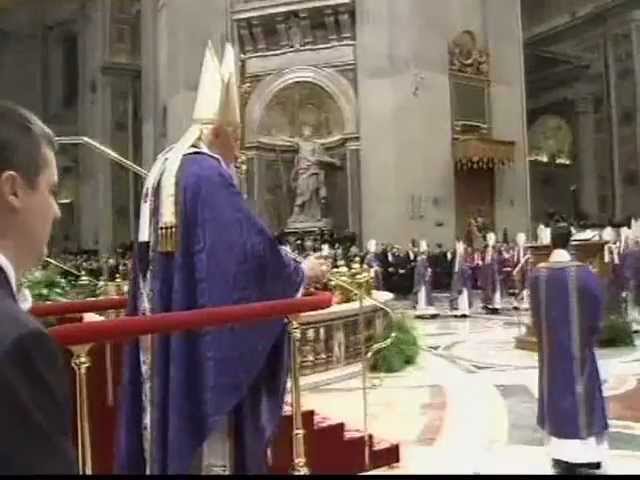
Tu es Petrus

At the end of the Holy Father’s last public Mass as Bishop of Rome.

YouTube thumbnailYouTube icon

Posted in Benedict XVI | Tagged , ,
60 Comments

Ash Wednesday by T.S. Eliot

Have you ever read or studied T.S Eliot’s poem Ash Wednesday?

You should have, you know.

Let us not let Ash Wednesday pass without at least touching on the poem.

If you have never read or heard it, at least you can hear it here.  Alas, I and no better read it through the remnants of a cold.

Posted in Poetry | Tagged , ,
19 Comments

Rutler on the Pope’s abdication

Someone forwarded what Fr. George Rutler contributed to Crisis about the Pope’s abdication.  Let’s have a look with my emphases and comments.

Benedict’s Decision in the Light of Eternity

What God knows is not necessarily what God wills. Each pope is guaranteed the protection of the Holy Spirit from fallible definitions of faith and morals, [NB: ] but to suppose that each pope is there because God wants him there, including the unworthy successors of Peter, comes close to the unforgivable blasphemy against the Third Person of the Holy Trinity.   Twenty year old Benedict IX was at least as nightmarish as his successor Gregory VI who usually is counted with his predecessor among the popes who relinquished their office. There are times, though, when the hand of God is not manhandled, and that, for instance, is why Cardinal Cooke once told me that he had never been so conscious of the presence of the Holy Spirit as he was in the Conclave that elected John Paul II.  It may also be that the sudden death of John Paul I, as stunning as recent events in the Vatican, was not untimely if it was part of a higher plan.

The Petrine office is not indelible like Holy Orders,  [As I wrote elsewhere today.] and  in 1415 Gregory XII nobly and efficiently made his resignation a kind of security for healing the Western Schism.  Dante  was so frustrated by what he considered dereliction of duty, that he put the abdicated Celestine V [probably, though Dante doesn’t name him as other than the one who made the “great refusal”.] into the Inferno but that was his own Commedia, when the Church, not in fancy but in fact, knew he is in Heaven.  In 2009 photographs were widely circulated showing Benedict XVI leaving his pallium at Celestine’s tomb, and many commentators then thought that this was more than a gesture of incidental piety. [As it turns out…]

As with the Spiritual Franciscans as a whole, almost in tandem with the earlier Montanists, Celestine V proved the utter impracticality of dovelike innocence without serpentine astuteness, and Boniface VIII was as right as was John XXII in condemning these “Fraticelli.”  But Boniface also proved the desperate shortcoming of cleverness without innocence.  Benedict XVI’s serene retreat to pray will not be like the last months of Pope Celestine who might nearly qualify as a martyr for the terrible treatment he endured for ten months until death when immured in the walls of the Fumone  castle in Campagna. Celestine was confined to an unsanitary cell hardly large enough for a bed and an altar.  We see in this the contempt that venal souls have for the motives of the humble, [nicely put] and Celestine was nothing if not humble. The role of Boniface in Celestine’s degradation has often been sanitized, but, as John Henry Newman wrote in the “Historical Sketches: “glosses are put upon memorable acts, because they are thought not edifying, whereas of all scandals such omissions, such glosses, are the greatest.”  [Men like Boniface VIII reassure me that this truly is the Church Christ founded and still guides.  Were it not for God, we would have destroyed the Church long ago.] A decree of Boniface, making hay of the misfortunes of his saintly predecessor, spelled out for the first time the canonical case for papal renunciation:

Pope Celestine V, Our predecessor, whilst still presiding over the government of the aforesaid Church, wishing to cut off all the matter for hesitation on the subject, having deliberated with his brethren, the Cardinals of the Roman Church, of whom We were one, with the concordant counsel and assent of Us and of them all, by Apostolic authority established and decreed, that the Roman Pontiff may freely resign. We, therefore, lest it should happen that in course of time this enactment should fall into oblivion, and the aforesaid doubt should revive the discussion, have placed it among other constitutions ad perpetuam rei memoriam by the advice of our brethren.

Benedict XVI certainly has known all this, for perhaps not since the Lambertini pope Benedict XIV has there been a pope of such mental acuity and historical erudition, nor probably has any pope since Gregory I, in his writings and witness, matched the magisterial eloquence and liturgical sensibility of this pope of Bavaria. The verdict of centuries from now will affirm the spiritual electricity of his Regensburg lecture, [Certainly one of the most important moments of his pontificate.] and how he spoke to the French academics in 2010, and, if words be immortal, his undying words in Westminster Hall.  [One of the other great moments of the pontificate. Benedict went to Westminster in much the same way as Nixon went to China.] His general audiences regularly outnumbered those of his beloved predecessor and those accustomed to spectacle actually began to listen to the crystalline reasoning of what he said. [I think the phrase is, people went to see John Paul II but to listen to Benedict XVI.] Before he became pope,  any form critic could detect his hand in Vatican documents when turgid prose suddenly [almost accidently] broke into clarity. His first rate mind did not indulge the tendency of lesser minds to obscure what is profound and to think that what is obscure is perforce profound.

If he was expected to be a caretaker pope, he took care very well, proving himself unexpectedly radical in his reform of reform, [Not so unexpected, really. ] which is more difficult than reform itself, for it restores the form that reformers forgot. So we had the renewal of liturgical integrity in an ecology of beauty,  streamlining of the Curia, [though not enough] greater attention to episcopal appointments, the overdue beatification of Newman with all its portents for theological science,  the Anglican Ordinariate which may be less significant for what it becomes than for the fact that it exists at all, [indeed] and progress with the Eastern churches.  His plans, like all “the best laid schemes of mice and men” were not completely realized.  Not all that Benedict called “filth” was removed, [cf. Joseph Ratzinger’s Stations of the Cross from 2005] and we can be sure that a  media eager to affect being scandalized, [well said] will point out among those entering the Conclave, those who bring with them the shadows of what Benedict tried to dispel. But he continues to dignify in charity even those who may not understand that “dignitas.”  He announced his renunciation of office in Latin, and  by so doing indicated his hope that even if some of those listening may have mingled astonishment with incomprehension, his successor will be able to speak the official language of the Church he leads and the city he governs. [Hmmm… I wonder… is this a hint at the writer’s preference?]

According to the postulator for the Cause of John Paul II, as early as 1989 Wojtyla had signed a  letter of renunciation to be invoked should he become incapacitated. He reaffirmed this in 1994 but in the same year he told the surgeon operating on his broken leg: “I have to heal. Because there is no place in the Church for a Pope Emeritus.”  It is only human to be so conflicted, and John Paul II opted  against renunciation. The fact that Pope Benedict had scheduled various journeys, canonizations and an encyclical to be published “within the first six months of 2013” would indicate that his decision to step down, if  considered a possibility for a while, was made more suddenly.  As  Prefect of the Congregation for the Doctrine of the Faith, he must have suffered patiently when he saw decisions made that he would not have wanted made.  And had he become pope sooner,  many tragedies such as the Legionaries of Christ scandal and other defacements of the Church, would have be handled far differently. [Do I hear an “Amen!”?] Although he is younger than Leo XIII who slogged on until his 93rd year, and his physical condition is far better than that of his predecessor in his last years,  the experience of those years had to have shaped his present decision. [And it is pro-active.  Had he waited and abdicated after the howls of the MSM and pressure from within and without had risen, his enemies would have claimed victory.  Some of the stupider of Benedict’s critics are trying to push that claim now, but they are hardly to be taken seriously.]

In an age of dangerously limited attention spans and fickle loyalties, there is a danger of proposing that popes last only as long as people want them. Romans have long said with their typical insouciance that when one pope dies you just make another one:  “Morto un papa se ne fa un altro.”  As everyone dies, it was important that John Paul defied the aimless Culture of Death by showing how to die, but that witness also came at the cost of care of the churches. There were times then when the Church Militant seemed in freefall, and the man who then was Cardinal Ratzinger must have anguished much in silence. He did not, however, trim the truth as he knew it and went so far as to say that a certain passage in “Gaudium et Spes” of which young Wojtyla was a principle architect was, “downright Pelagian.”  Cardinal Dulles observed: [NB] “The contrast between Pope Benedict and his predecessor is striking. John Paul II was a social ethicist, anxious to involve the Church in shaping a world order of peace, justice, and fraternal love. Among the documents of Vatican II, John Paul’s favorite was surely the pastoral constitution Gaudium et Spes. Benedict XVI, who looks upon Gaudium et Spes as the weakest of the four constitutions, shows a clear preference for the other three.”

The personality cults of our present age had to a degree shaped the young in the Church who had only known one pope. A most attractive charism of Benedict XVI has been his desire to vanish so that the faithful might see only Christ: “cupio dissolvi.”  He strengthened the papacy by vaulting sanctity over celebrity.  In a grand paradox, nothing in him has become so conspicuous as his  desire to disappear. Christ gave the Keys to a Galilean fisherman with a limited life span. He chose Peter; Peter did not choose Him. When the pope relinquishes the Petrine authority, he does not submit a letter of resignation to any individual, for the only one capable of receiving it is Christ. This is why “renunciation” or “abdication”  is a more accurate term than “resignation” in the case of the Supreme Pontiff. [Sound familiar?] Unless this is understood, the danger is that a superficial world will try to refashion the pope into some hind of amiable but transient office holder. Popes are not Dutch royalty. On the other hand, Queen Elizabeth II has one tiara, not three, but the longer she wears it, the more she seems to grow in the affection of her people, which bond of respect is morally more powerful than any constitutional grant of rights and privileges. But the papacy’s authority is absolute and not gratuitous, and its exercise cannot be only conditional and validated by human approval. Pope Benedict pays tribute to that imperial obligation of his office by  willing to relinquish it.

To risk the sort of truism that gets to be what it is by being true: Nothing is permanent in this world. The world is older than our centuries and cannot stop changing. We speak of papal protocols in the Middle Ages as if they happened long ago, but only from our limited perspective were they in the middle of anything. In view of the recently found fact that the declining dinosaurs were finally wiped out by an asteroid 66.03 millions years ago, the Middle Ages might as well have been when my alarm went off this morning. Study of the amino acids in the eyes of bowhead whales now reveals that these magnificent creatures can live over two hundred years, and there may be a whale in the Arctic right now that swam those same waters during the War of 1812. Line up ten of those whales and you are at the Resurrection. From that perspective, we [and the SSPXers] should speak cautiously about Rome as the Eternal City.  “Sub specie aeternitatis,” Rome really was built in a day.  Pope Benedict attests by word and example: that “… here we have no lasting city, but we seek the city that is to come” (Hebrews 13:14).


Posted in Benedict XVI, Mail from priests | Tagged , , ,
29 Comments

Bp. Sample’s great Pastoral Letter on Sacred Music

My old friend now-Archbishop Alex Sample, before his translation to Portland, issued a Pastoral Letter on Sacred Music for the Diocese of Marquette.  It is called “Rejoice in the Lord” and it is a hit.

First, remember his spectacular sermon about the older form of Holy Mass?  HERE.   Sample is the real deal.

Find the pastoral letter HERE.

Here are some samples (sorry!) from the letter:

This is an important discussion to have, since so often the music selected for Mass is reduced to a matter of subjective “taste,” i.e. what style of music appeals to this or that person or group, as if there were no objective principles to be followed. There are indeed objective principles worthy of study and proper implementation, as will be shown.

[…]

Church teaching emphasizes that the music proper to the Sacred Liturgy possesses three qualities: sanctity, beauty, and universality. Only music which possesses all three of these qualities is worthy of the Mass.

[…]

Finally, the third essential quality of sacred music must be considered, i.e. its universality. This quality means that any composition of sacred music, even one which reflects the unique culture of a particular region, would still be easily recognized as having a sacred character. The quality of holiness, in other words, is a universal principle that transcends culture.

[… I think you can see where this is going …]

Any discussion of the different forms of sacred music must start with Gregorian chant.

[…]

Given all of this strong teaching from the Popes, the Second Vatican Council, and the U.S. Bishops, how is it that this ideal concerning Gregorian chant has not been realized in the Church? Far from enjoying a “pride of place” in the Church’s sacred liturgy, one rarely if ever hears Gregorian chant.

This is a situation which must be rectified. It will require great effort and serious catechesis for the clergy and faithful, but Gregorian chant must be introduced more widely as a normal part of the Mass. Some practical steps toward this are outlined in the Directive section of this pastoral letter.

[… OORAH! …]

The Church recognizes an objective difference between sacred music and secular music. Despite the Church’s norms, the idea persists among some that the lyrics alone determine whether a song is sacred or secular, while the music is exempt from any liturgical criteria and may be of any style. This erroneous idea, which was alluded to earlier, is not supported by the Church’s norms either before or since the Second Vatican Council.

[…]

Hymns are a musical form pertaining more properly to the Liturgy of the Hours, rather than the Mass. Hymn-singing at Mass originated in the custom of the people singing vernacular devotional hymns at Low Mass during the celebrant’s silent recitation of the Latin prayers. However, the current Missal as well as official liturgical documents envision a singing of the Mass as outlined above. [You’ll have to go read that part on your own.  You won’t be wasting your time.]

[…]

The texts of the Roman Missal and the Lectionary, and none others, constitute the official Mass in English. No one in the diocese, including the Bishop, has the authority to add to, subtract from or change the words of the Mass, either sung or recited. The only exceptions are when the Missal specifically gives an option, using expressions such as “in these or similar words.” This is to be strictly interpreted and observed.

[…]

Then there are norms.

Have a look at the letter and then reflect on what you experience in your parish.

Posted in "How To..." - Practical Notes, Brick by Brick, Liturgy Science Theatre 3000, Mail from priests, New Evangelization, Our Catholic Identity, The Drill | Tagged , , ,
23 Comments

HEY LATIN STUDENTS! Conventiculum Viomingense (very cool)

The other day I shared a photo of the Wyoming Catholic College display at the Legatus Summit.  This was one of the t-shirts.

Is that cool, or what?   And now comes this!


CONVENTICULUM VIOMINGENSE

 We are happy to announce a new summer Latin immersion opportunity at Wyoming Catholic College!

The 2013 Conventiculum Viomingense will run from August 5th – August 13th.

Some of the many highlights of the Conventiculum Viomingense are:

? You will learn to speak Latin or improve your spoken Latin with several highly experienced Latin speakers

? It is designed for beginners as well as more advanced participants; for students and teachers

? We will be housed at a welcoming and friendly Catholic community

? There will be outdoor excursions and a three day camping trip, backpacking through the beautiful mountains of Wyoming (with all gear provided!)

? Small groups will attend break-out sessions separated by levels

? Interested participants will enjoy sports activities (e.g., Frisbee, soccer, touch football, yard games)

? There is an EXCEPTIONALLY low-cost

Find-out more at:

http://www.wyomingcatholiccollege.com/conventiculum

OVERVIEW

The Conventiculum Viomingense is a full-immersion residential experience, designed both to introduce aspiring Latinists to the beauty and power of the ancient language of the Church and to provide more advanced Latinists with an exciting opportunity to improve their abilities. Classes will be conducted primarily in Latin and will include an exciting outdoor component: We will take advantage of our location to discuss trees and plants, mountains and glaciers, rivers, animals, birds, insects, weather, and many other aspects of nature. The week will culminate in a camping trip.

Is that cool or what?

Posted in "How To..." - Practical Notes, Just Too Cool, Our Catholic Identity, The Campus Telephone Pole | Tagged , , ,
12 Comments

Knox Bible translation to be online

17 February will be the 125th Birthday of Fr. Ronald Knox, who did that amazing translation of the Bible.

I got a note from the nice people at Baronius Press, who reprinted the Knox Bible recently, that they will be making available the translation to newadvent.org.

Spiffing!

Posted in Just Too Cool, The Campus Telephone Pole | Tagged , , ,
5 Comments

Remember! Fast and abstinence! What’s your plan?

What are you all having for your meals today?

I had no breakfast.  I plan on vegetable soup and a grilled cheese sandwich for lunch and for supper salad of mixed greens and oil and vinegar.

Posted in "How To..." - Practical Notes, Our Catholic Identity | Tagged
92 Comments

QUAERITUR: What will Benedict XVI be called after his abdication?

Many have written asking what the Holy Father will be called after he abdicates his office on 28 February.

I haven’t seen anything from the Holy See about this yet.

However, I can speculate.  What are blogs for, after all?

First, I assume people will continue to call him “Your Holiness”.

I assume he will still go by the name “Benedict XVI”.

Will he be “Bishop Emeritus” of Rome?  I sincerely hope not, but I suspect he will be.  In 1994, when the Pope was about to undergo surgery for his broken leg, he said to the surgeon Gianfranco Fineschi: “Doctor, both you and I have only one option.  You have to cure me.  I have to heal.  Because there is no place in the Church for a Pope Emeritus.”  HERE.

Will he be made a cardinal by his successor?  Perhaps.  I have never considered whether upon his election he ceased to be a cardinal.  I suspect that is the case.  Would the  diocesan bishop of the Diocese of Black Duck have to resign being Bishop of Black Duck when he is elected Bishop of Rome?  Does a Pope resign from the College of Cardinals and resign his titual church or diocese?

In that line of thought I heard an interesting idea last night.  Perhaps a new title could be created within – or maybe “next to” – the College of Cardinals.

The College is presently divided into three orders, cardinal deacons, cardinal priests, and cardinal bishops.  All cardinals are assigned either a church in Rome (for cardinal deacons and priests) or a Roman diocese (cardinal bishops – I am incardinated in one of those little Roman dioceses though I am on loan to a diocese in the USA).  Cardinals who are ordinary bishops of dioceses are generally made cardinal priests, while curial officials are generally made cardinal deacons.  After a number of years a cardinal deacon can be “promoted” to the order of priests.  Some cardinals in key positions, such as the Dean of the College or prefect of an important dicastery, are elevated to an open slot among the six cardinal bishops.  There are seven cardinalatial titular dioceses, but the Dean always has two, Ostia and one other.  There are also a four cardinal patriarchs of Eastern Churches, who rank in the College just after the cardinal bishops.

“But Father! But Father!” you might be shouting as you drum your fingers, “What’s the interesting idea?”

It was suggested that perhaps there could be a “Cardinal Pope”.  Of course, he wouldn’t be assigned to a diaconal or presbyteral title.  To a Roman diocese? Or – along the lines of “Bishop Emeritus” – to the Diocese of Rome?  Just as there are ordinary residing bishops in the little Roman Suburbicarian Dioceses, and those little dioceses have assigned to them a cardinal bishop in a titular role, perhaps the retired Pope could be made “titular Pope” of – say – his old cathedral church in Rome, St. John Lateran.  Or even of one of the Suburbicarian Dioceses, such as the Holy Father’s former diocese (my diocese) of Velletri -Segni?  I think Benedict would like that, as a matter of fact.  He was very attached to Velletri-Segni back in the day. He even made a plan to have a house there after his retirement.  As you see over the doors of Roman basilicas the coat-of-arms of the diocesan bishop, the Pope, and also of the titular cardinal, over the doors of the cathedral of Velletri there are the coats-of-arms of the Pope, of the titular cardinal and of the local bishop, all three. Cardinal Pope of Velletri-Segni!  It might get crowded over the door to add a fourth.  Cardinal Pope of Rome with the title of St. John Lateran.  Two papal coats-of-arms by the doors?  Strange.

I am just musing aloud here, animi caussa.

Posted in ASK FATHER Question Box, Benedict XVI, Lighter fare |
57 Comments

QUAERITUR: Why can a Pope resign? Why isn’t being Pope “for life”?

I have received a lot of emotional email in the last couple days.  I am a bit emotional myself.

Many questions have been raised by the Holy Father’s impending abdication.

This is from a reader:

Can you please shed light on the question on why, in the first place, can popes resign? Why is there a provision for such in canon law? Why shouldn’t the petrine ministry be mandatorily “ad vitam”?

I would also appreciate it if you could further clarify the difference/s between the effects (and exigencies) of the sacrament of Holy Orders (one is priest – or deacon or bishop – forever) and “ministries” or “elections” or “assignments” of the ordained which they can resign from.

Priesthood – a sacrament – causes a change at the level of the soul.  The sacramental character placed on the soul by ordination can never removed.  This is also how it is with baptism and confirmation.

However, the Church has offices – which are not sacraments – which are related to the sacrament of holy orders but not so tied to orders that they cannot be separated.  For example, a man who is a priest can be given jurisdiction over a parish, a bishop over a diocese.  Those offices can be removed or renounced.   Priesthood can’t be removed but permission to function as a priest can be (as in the case of all the priests and bishops of the SSPX).   A man can be made a cardinal, which is an office that carries certain functions.  A cardinal’s cardinalatial office can be removed or renounced (which I hope in one case to see happen before the upcoming conclave).  “Bishop of Rome” is an office.  It can’t be removed from a man by anyone but God (by means of death) or by the office holder himself abdicating the office.

“Abdicate” is a better word than “resign” for what Benedict did.  Resignations are accepted by someone.  Abdications are not.

Why can the Pope abdicate his office?  The office of Pope carries with it the fullness of jurisdiction in the Church.  The “Petrine Ministry” is a little different from other offices in the Church, but it is an office.  The Successor of Peter does what other successors of the apostles do in that he teaches, governs and sanctifies.  His role also includes being a visible sign of the unity Christ desired for the Church and a point of reference as Christ’s “stand in” or Vicar (vicarius).

As Vicar of Christ, the Successor of Peter is also the one who determines the Church’s law, for the sake of the Church’s good order.

The Pope has this authority by virtue of his being the Bishop of Rome, the Successor of Peter, to whom Christ entrusted supreme jurisdiction over the Church He founded.  “You are Peter, and on this rock I will build my Church” (Mt 16: 18)  He gave Peter His own authority.  In this office he has the task also of “strengthening the brethren”. “Simon, Simon, behold, Satan demanded to have you, that he might sift you like wheat, but I have prayed for you that your faith may not fail; and when you have turned again, strengthen your brethren” (Lk 22: 31-32). This is a “hereditary” office, so that when a man succeeds to Peter’s office, he receives the authority and role that Peter had. We understand that Christ intended that the office be passed on because of the image He used in speaking of “keys” and the authority to “bind and loose”, which harks to another “hereditary” office in the Old Testament.

Over the centuries – between Peter and Benedict XVI – we have come as a Church to understand more deeply the implications of this office.  It has always been as I described, but only slowly did its practical implications emerge.  Historical circumstances helped us clarify who the Successor of Peter is and what he does in and for the Church, so that the office of “Pope” is what it is today.  I suppose that, over the years, we will learn more about the office and it will shift a bit in how it is manifested.  Perhaps that is what we are seeing now in Pope Benedict’s choice to abdicate.  Joseph Ratzinger has been thinking about the Petrine Ministry for a long time, in the scheme of a man’s life.  He has a perspective on the office that no other living person can possibly have.

Back to the questions.  How can a Pope put this ministry aside?  Why is in not mandatory for life?

No one can force the Pope to do anything.  No one but Christ has the authority to make something “mandatory” for the Vicar of Christ.

The Holy Father, from the moment he accepts the role at his election, has supreme jurisdiction in the Church.  No other person or groups of people together can exercise authority in the same way he does.  He establishes the laws.  Beyond him there is no appeal on earth.  He can act and teach for the entire Church on his own.   So, when he makes a decision he does not have to consult (though smart Popes usually do).  His decisions have effect even if he hasn’t consulted.  His decisions don’t have to be accepted by anyone or any group in order to be licit.  If the Pope decides he will lay down the office, that’s his decision.  There is no other person or group who have the competence or authority to judge his act or accept his act so that it is thereby licit.  The Pope acts freely.  Smart Popes make sure that his intentions are clear.  Therefore smart Popes follow their own laws so that there is not chaos in the Church and people more willingly obey his laws and listen to his teaching and accept him as the visible point of unity Christ intends him to be.  A smart Pope will consult and rely on people and groups to whom he delegates authority in certain areas.  He is human after all and cannot on his own do everything.  But it must not be forgotten that when the Vicar of Christ acts, he does so with an authority and jurisdiction that no other person or group has.

So, it is up to the individual Pope to determine that his papacy will be “for life” … or not.

Another question that rises from this is – If a Pope has this supreme authority that cannot be overturned, could a Pope appoint his own successor?  But that is another question and won’t be dealt with here.  By the power of the keys I give to myself as supreme pontiff of this blog, I close that rabbit hole for the time being.


Posted in ASK FATHER Question Box, Benedict XVI | Tagged , , , ,
39 Comments