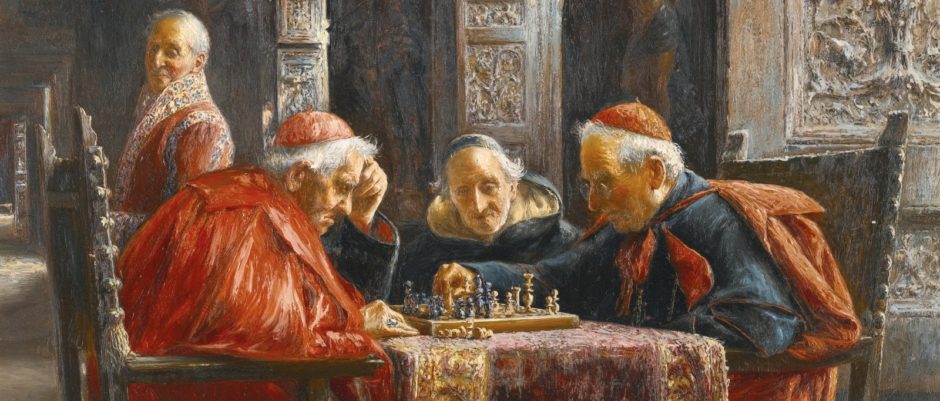
My mind returns to the moment in Pres. Obama’s State of the Union Address when he chose to scold the Justices of the Supreme Court of the United States, while they sat and, from decorum and custom, could do nothing to respond.

For those of you who are closely following the presidential campaigns, I would remind you of a major point of consideration apart from jobs and the economy:
JUDGES.
On the site of the NYT we find some good news for a change concerning the US Supreme Court and religious liberty:
Justices Grant Leeway to Churches in Job Bias Laws
By ADAM LIPTAK
Published: January 11, 2012WASHINGTON — In a major religious liberty decision, the Supreme Court for the first time recognized a “ministerial exception” to employment discrimination laws, saying that churches and other religious groups must be free to choose their leaders without government interference.
“The interest of society in the enforcement of employment discrimination statutes is undoubtedly important,” Chief Justice John G. Roberts Jr. wrote for a unanimous court. [UNANIMOUS!] “But so too is the interest of religious groups in choosing who will preach their beliefs, teach their faith, and carry out their mission.”
The decision gave only limited guidance about how courts should decide who counts as a minister, saying the court was “reluctant to adopt a rigid formula.” Two concurring opinions offered contrasting proposals. [This is important. There are shifting tides and sand bars in the matter of how civil courts adjudicate in matters that also concern canon law. Generally courts don’t want to get involved with internal matters, but times and judicial practices shift around over time. Card. Burke has done us a real service in sponsoring workshops for canonists and civil lawyers on the interplay of both kinds of law.]
The case, Hosanna-Tabor Church v. Equal Employment Opportunity Commission, No. 10-553, was brought by Cheryl Perich, who had been a teacher at a school in Redford, Mich., that was part of the Lutheran-Church Missouri Synod, the second largest Lutheran denomination in the United States. Ms. Perich said she was fired for pursuing an employment-discrimination claim based on a disability, narcolepsy.
Ms. Perich had taught mostly secular subjects but also taught religion classes and attended chapel with her class.
“It is true that her religious duties consumed only 45 minutes of each workday,” Chief Justice Roberts wrote, “and that the rest of her day was devoted to teaching secular subjects.”
“The issue before us, however, is not one that can be resolved with a stopwatch,” he wrote. [NB.]
Instead, the court looked to several factors. Ms. Perich was a “called” teacher who had completed religious training and whom the school considered a minister. She was fired, the school said, for violating religious doctrine by pursuing litigation rather than trying to resolve her dispute within the church.
Chief Justice Roberts devoted several pages of his opinion to a history of religious freedom in Britain and the United States, concluding that an animating principle behind the First Amendment’s religious liberty clauses was to prohibit government interference in the internal affairs of religious groups generally and in their selection of their leaders in particular.
“The Establishment Clause prevents the government from appointing ministers,” he wrote, “and the Free Exercise Clause prevents it from interfering with the freedom of religious groups to select their own.”
[ENTER STAGE LEFT…] The Obama administration had told the justices that their analysis of Ms. Perich’s case should be essentially the same whether she had been employed by a church, a labor union, a social club or any other groups with free-association rights under the First Amendment. That position received withering criticism when the case was argued in October, and it was soundly rejected in Wednesday’s decision. [The best news I have heard in a while. The Obama administration is trying to undermine religious liberty. They are pushing “freedom of worship” rather than “freedom of religion”.]
“That result is hard to square with the text of the First Amendment itself, which gives special solicitude to the rights of religious organizations,” Chief Justice Roberts wrote. “We cannot accept the remarkable view that the religion clauses have nothing to say about a religious organization’s freedom to select its own ministers.” [Do I hear an “Amen!” brothers and sisters?]
Requiring Ms. Perich to be reinstated “would have plainly violated the church’s freedom,” Chief Justice Roberts wrote. And so would awarding her and her lawyers money, he went on, as that “would operate as a penalty on the church for terminating an unwanted minister.”
Unanimous decision.
I repeat.
Unanimous decision.
Remember this?
[wp_youtube]NeTuWbXi5dY[/wp_youtube]
 “But Father! But Father!”, I read in my email, “You are always telling us to go to confession but around here priests don’t hear confessions very often if at all! What are we supposed to do?”
 My old mentor Msgr. Schuler used to ask the unwary: “What’s the difference between a priest and a monsignor? … None. But often the monsignor doesn’t know it.”
 From a reader:
 A priest acquaintance, Fr. Bede Rowe, has on his interesting blog
  Ciborium is also an feature of a sanctuary of a church, the canopy on columns over an altar. It is also called a baldachin.
 From
From  A reader writes asking about “bad homilies”:
 From a reader:




























