Vatican Rep. at U.N. on “Impulse-driven rights” v. “Authentic rights”.

From CNA with my emphases and comments:

Vatican official: UN gay ‘rights’ agenda endangers Church’s freedom
By Benjamin Mann

Geneva, Switzerland, Jul 8, 2011 / 06:08 am (CNA/EWTN News).- The Vatican’s representative to the United Nations Human Rights Council in Geneva says a recent resolution on “sexual orientation and gender identity” is part of an agenda that could restrict the Church’s freedom. [Quaeritur: It is part of a larger agenda?  If so, what is that agenda’s ultimate goal?]

“The resolution marks a change. It is seen as the beginning of a movement within the international community and the United Nations  to insert gay rights in the global human rights agenda,” said Archbishop Silvano Tomasi, head of the Holy See’s Permanent Mission to the U.N. in Geneva, in a recent e-mail interview with CNA.  [Resist contrary-to-nature sexual politics and you could wind up in the Hague.]

The archbishop noted that a U.S. State Department spokesperson had described the resolution as “a beginning of an international norm that will take hold gradually.” But “if norms are established,” Archbishop Tomasi wondered, “what provisions will be made for freedom of expression on the part of religious leaders?”  [At first, some grudging reassurances will be made, but then they will be systematically challenged in courts.  And the purpose of the challenges will be to hurt the Church as much as it will be to reengineer anthropology.]

He spoke of a “genuine concern” that natural marriages and families “will be socially downgraded with the eventual legislation that puts homosexual “marriage” and the marriage between a man and a woman” on the same level. [Perhaps even lower true marriage as a kind of pay back?] The Vatican representative also said the Church could be threatened by related measures that would mandate homosexual adoptions and introduce “compulsory sex education at school that clashes with Christian values.”  [And when the Church’s minsters teach the Church’s teaching, they will be charged with hate crimes.]

At a June 27 event co-hosted by the U.S. State Department and the Gays and Lesbians in Foreign Affairs Agencies organization, Secretary of State Hilary Clinton credited a “major push by American diplomats” for the June 17 passage of what she described as “the first ever U.N. resolution recognizing the human rights of LGBT (Lesbian, Gay, Bisexual and Transgender) people worldwide.”

Clinton called the resolution a “huge step forward,” and stated that “so far as the United States is concerned and our foreign policy, and our values … gay rights are human rights and human rights are gay rights.” [HUH?  Read that again!]

The resolution, which expresses “grave concern at acts of violence and discrimination … against individuals because of their sexual orientation and gender identity,” [The defense of true marriage is not discriminatory (in the sense of oppression).] will not have an immediate effect on U.N. member states. Instead, it formally requests that the High Commissioner for Human Rights undertake an investigation into such acts, in preparation for further dialogue at the council during 2012.

Although the resolution will do little in the short term, the secretary of state described its passage – over the objections of numerous Arab and African counties, as well as  Russia and Moldova – as one of the department’s “momentous achievements” on a matter of “high priority.”

In his remarks to CNA,  Archbishop Tomasi reiterated that the Church does not support violence against those who engage in homosexual behavior, or any attempt by the state to punish an individual simply because of “feelings and thoughts.”

“I think that violence against homosexual persons  is not acceptable and it should be rejected, even though this does not imply an endorsement of their behavior.”

“The terms ‘sexual orientation and gender identity’ are not defined in international law,” he noted. “To the extent that they are not external behavior, but feelings and thoughts, they cannot be subjected to punitive laws.”

But “for some people,” he pointed out, “these words are a code phrase for types of conduct.”

The archbishop expanded on a point he has previously tried to impress upon the Human Rights Council, as he observed that all societies regulate sexual behavior to some extent – by forbidding practices like incest, pedophilia, or rape – for the sake of the common good.

He contrasted the “clear message” of God’s creation, which spells out the complementarity of the two sexes, with the U.N.’s contrived and vague terminology of “orientation” and “gender identity.”

[This is a very important point.  Read carefully…]Instead of  ‘gender,’” Archbishop Tomasi said, “the concept we should use is ‘sex,’ a universal term in natural law referring to male and female.”  [Get that?  “Gender identity” is misleading.]

“In fact, it seems that terms such as ‘gender’ or ‘sexual orientation’ are devised to escape reality and to accommodate a variety of feelings and impulses that then are transformed into rights.

This use of “rights” language, to justify practices like same-sex “marriage,” may appear superficially harmless as long as the alleged rights seem to be confined to private life. But Archbishop Tomasi warned that these impulse-driven claims of “rights” are in conflict with authentic rights – such as the free exercise of religion, and the education of one’s children.  [Good distinction.  “Impuse-driven rights” v. “Authentic rights”.]

He pointed to the “traditionally Catholic country” of Spain, as “an example of where the current trend may lead.”

In that country, “legislation has been passed in the last four or five years in favor of homosexual marriage, free abortion in the first 22 weeks of pregnancy, of compulsory education even for children aged 8 to 12 on such issues as masturbation, same-sex marriage, contraception and abortion.”

This arrangement prevails in Spain, “notwithstanding the fact that thousands of parents are opposing this policy that denies their fundamental right to decide on their children’s education.”

Archbishop Tomasi suggested that Catholics today have a responsibility “to clarify legal and moral aspects of the current culture” – by drawing a distinction between desires and rights, promoting the Catholic synthesis of faith and reason, and making it clear that a judgment against homosexuality is not a condemnation of homosexuals[Tell that to Gov. Cuomo and the editors of the NCFishwrap.]

“There is confusion in some people’s mind,” he noted, “in combining a just respect and protection for every person – including homosexuals – and support for the indispensable role of the family, the parents right to educate their children, the support of the natural family for the common good.”

While the secular West may find this ethos increasingly incomprehensible, the Church will continues to promote it. “The teaching of the Church is not conditioned by political consensus,” the archbishop noted. “At times she is misunderstood and even becomes the target of reprisals and persecution.

“Reason and natural law, however, support faith-inspired positions,” he stated, “and the convergence of faith and reason is exceptionally fruitful for the progress and well-being of the human family.”

Another symptom of TEOTWAWKI.

Posted in One Man & One Woman, Our Catholic Identity, TEOTWAWKI, The Drill, The future and our choices, The Last Acceptable Prejudice | Tagged
18 Comments

Reason #177408 for Anglicanorum coetibus

Keeping in mind that Benedict XVI is the Pope of Christian Unity, here is a photo via NLM which offers one of the reasons why Anglicanorum coetibus was a good idea.

We need an infusion of this sort of blood into our anemic liturgical worship.  This is also why we need Summorum Pontificum.

Not every church or every Mass has to look like this – though that wouldn’t be so bad, given many of the alternatives we have seen over the last few decades – but our experience of this sort of liturgical worship can serve to influence overall our ars celebrandi and therefore deepen a sense of true active participation in sacred action.

Posted in New Evangelization, Our Catholic Identity, Pope of Christian Unity, SUMMORUM PONTIFICUM, The future and our choices | Tagged , , ,
25 Comments

The US Space Program – WDTPRS POLL

With this final Space Shuttle launch, the US now “leads from behind” also in the exploration of space.

Whither the US manned space program?

Chose the best answer and give your opinion in the com box.

The U.S. space program and NASA.

View Results

Posted in Look! Up in the sky! | Tagged , ,
21 Comments

WDTPRS 4th Sunday after Pentecost (1962MR): Our great Captain

Today’s prayer is found in ancient sacramentaries, such as the Veronese and the “Hadrian” version of the Gregorian, and the so-called Gelasian.  It is unchanged in the “Tridentine” form of the Missale Romanum as my trusty copy of the 1570MR shows.  It survived the Consilium’s hack and grafters who pieced together the Novus Ordo as the Collect for the 8th Sunday of Ordinary Time.
COLLECT: (1962 Missale Romanum):
Da nobis, quaesumus, Domine,
ut et mundi cursus pacifico nobis tuo ordine dirigatur:
et Ecclesia tua tranquilla devotione laetetur.

Some vocabulary from the mighty Lewis & Short Dictionary.  Cursus can mean anything from “course, way, journey” to “course of a ship”, the “flow of conversation” and “postal route”.  Dirigo is “to give a particular direction” or “to lay or draw a straight line”.  It was used, among other things, to indicate ordering an army to march to a certain point or to direct or steer a ship on its course.    Ordo means too many things to get into in depth.  Suffice to say that it can refer to the “methodical arrangement, class or condition.” By extension it is applied to everything from the “orders” of the clergy, the way trees are planted, the lines of an army, or the banks of rowers in a ship.  Pacificus is a composite of pax and facio meaning “peacemaker” or “peaceable”.  The problem with that laetetur is that it could be from the deponent laetor or passive from laeto.  Because of those ablatives in that clause, I am opting here for the passive, like dirigatur.   Among the things that devotio means are “fealty, allegiance, piety, devotion, zeal.”

LITERALWDTPRS VERSION:
Grant us, we beg, O Lord,
both that the course of the world be set by Your methodical peace-producing plan for us
and that Your Church may be made joyful by means of tranquil devotion.

Despite the wordy literal translation I have given this time, I will later lend to this a rather poetic aspect.

Notice that in our collect’s vocabulary there are traces of military and nautical imagery.

Try reading this prayer with the mental image of a ship.

Its great Captain sets its course upon the sea. So great is the Captain that He can command calm waters and a favorable wind as well.  The ship can be seen as the world.  In this case I see the ship as the Church in the world, the Church Militant, which is not an unfamiliar image to those familiar with the Barque of Peter.  The sea it sails upon is the deep and turbulent world we live in.  The Captain is our Lord Jesus Christ, who calmed the stormy waters and commanded Peter to walk to Him upon them.  He entrusted His ship to Peter, to steer it in His stead.  Once all has been put into proper order, made “ship-shape and Bristol fashion”, our own sense of loyal zeal, our devotion, is the wind that the Captain uses to steer the ship upon the course He sets, carrying us its crew to the port and safe haven.

The word pacificus brought to mind an antiphon of First Vespers of Christmas: “Rex pacificus magnificatus est, cuius vultum desiderat universa terra… The peacemaker King, whose glance the whole world longs for, has been exalted.”  Is not the sight of God, “in whose will is our peace”, our true desire?  Is that not the port and safe haven we journey towards in the turbulence of this world?

We must look more intently at devotio… devotion.

According to St. Thomas Aquinas (+1274) writing in his monumental Summa Theologiae, devotio is an “active” virtue.  The Angelic Doctor wrote:

“The intrinsic or human cause of devotion is contemplation or meditation. Devotion is an act of the will by which a man promptly gives himself to the service of God. Every act of the will proceeds from some consideration of the intellect, since the object of the will is a known good; or as Augustine says, willing proceeds from understanding. Consequently, meditation is the cause of devotion since through meditation man conceives the idea of giving himself to the service of God” (STh II-II 82, 3).

The Jesuit preacher Louis Bourdaloue (1632-1704) translates this into “a devotion to duty”. What we do, including our “devotions”, must help us keep the commandments of God and stick to the duties of one’s state in life before all else.

In other words, there is an interplay between our devotions and our devotion.

Each of us has a state in life, a God-given vocation we are duty bound to follow. We must be devoted to that state in life, and the duties that come with it, as they are in the here and now.

That “here and now”, hic et nunc, is important.

We must not focus on the state we had once upon a time, or wish we had, or should have had, or might have someday: those are unreal and misleading fantasies that distract us from reality and God’s will.

If we are truly devoted and devout (in the sense of the active virtue) to fulfilling the duties of our state as it truly is here and now, then God will give us every actual grace we need to fulfill our vocation. Why can we boldly depend on God to help us? If we are fulfilling the duties of our state of life, then we are also fulfilling our proper roles in His great plan, His design from before the creation of the universe. God is therefore sure to help us. And if we are devoted to our state as it truly is, then God can also guide us to a new vocation when and if that is His will for us.

Faithful in what we must do here and now, we will be open to something God wants us to do later.

This attachment to reality and sense of dutiful obedience through the active virtue devotio is a necessary part of religion in keeping with the biblical principle in 1 John 2:3-5:

And by this we may be sure that we know Him, if we keep His commandments. He who says ‘I know Him’ but disobeys His commandments is a liar, and the truth is not in him; but whoever keeps his word, in him truly love for God is perfected. By this we may be sure that we are in Him: he who says he bides in Him ought to walk in the same way in which He walked.

Before the creation of the universe God knew each one of us and desired us and loved us.

He called us into existence as a precise point in His great plan, His economy of salvation.  He gives us a part to play in that plan and gives each of us the tools and talents we need to fulfill it.  If we devote ourselves with real devotio to our state-in-life and strive to carry out His will, God will give us every actual grace we need since we are furthering His great plan.

This is why I suggest above that our devotion can be like the wind that the Captain uses to direct our great ship.  More than just being the “hands on deck”, we play a vital part in the actual forward motion of the ship. We are not merely being hauled along upon the “alien merits” of Christ, as some Protestants call God’s saving intervention.  While we truly depend on Him and Him alone, while we truly do not merit what He provides, mysteriously it is part of His plan. He brings it to pass that His work becomes ours and ours His.  He “makes it so”.

A Somewhat Smoother Version:
Grant, we beseech you, O Lord,
that the course of the world be steered by your plan for peace
and that your Church be filled with joy from tranquil devotion to that plan.

Or a bit more poetic:
O Lord, we beg Thee to grant
that the peaceful steerage of the world’s course be set according to Thy plan
and that Thy Church be made full with joy from our tranquil devotion.

LAME-DUCK ICEL (1973):
Lord,
guide the course of world events
and give your Church the joy and peace
of serving you in freedom.

It is hard to strike a balance between the literal, which can be awkward and wordy, and the simple, which can be banal and miss the real impact of the prayer.

NEW CORRECTED ICEL (2011):
Grant us, O Lord, we pray,
that the course of our world
may be directed by your peaceful rule
and that your Church may rejoice,
untroubled in her devotion
.

You decide.

Posted in WDTPRS | Tagged , , ,
1 Comment

Archbp. Dolan on the consequences of contrary-to-nature unions

From WaPo:

NY archbishop worried polygamy, infidelity will be next step in redefinition of marriage

NEW YORK — New York Archbishop Timothy Dolan says he’s worried that the next step in the marriage debate will be another redefinition to allow multiple partners and infidelity. [Not to mention marry their dogs.]

Writing on his blog Thursday, Dolan also lamented the anti-Catholic venom that surfaced in the gay marriage battle, saying he’s worried that “believers will soon be harassed, threatened, and hauled into court” for their convictions.

He also apologized to those in the gay community who may have been offended by the church’s stance, saying he’s honored that so many gays are at home in the Catholic Church and that his goal from the start was “pro-marriage, never anti-gay.”

New York became the sixth and largest state to legalize gay marriage on June 24.

Posted in One Man & One Woman, Our Catholic Identity | Tagged ,
25 Comments

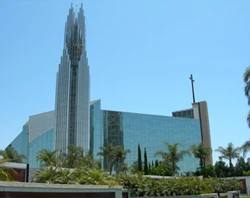
Crystal cathedral to Catholic cathedral?

I harbor doubts about a trend I have seen in some church architecture.  Am I wrong, or has there been an uptick in the use of Eastern or Byzantine elements in the design or the redecoration of Latin Church churches?   Assuming for a moment that I am right, it seems to me that Latin Church Christians have their own fine tradition of architecture and ornament.  Yes, in some places there is a fusion such as in Venice.  It may be that in our laudable efforts finally to recover a sense of the transcendent and sacred in our churches, we Latins have turned to the East.  To compensate for the auto-repair garages or municipal airport terminals we have been building, we have started filling them with icons and so forth.  Please understand that I very much like Eastern churches and their ornaments… especially in Eastern churches.  If Holy Church has two lungs by which we breathe, they don’t have to become confused.

That said, I wonder what people will think about the idea of a Catholic Diocese taking over a vast protestant/evangelical mega-church not just for use as a church, but as the diocesan cathedral.  Byzantine is one thing… but American mega-church?  Can you spell “inculturation”?

From CNA with my emphases and comments.

Orange, Calif., Jul 8, 2011 / 03:04 am (CNA).- The Diocese of Orange says it is potentially interested in buying a 3,000-seat glass church in Southern California that faces bankruptcy.

The diocese announced on July 7 that it’s currently looking for a building to meet the needs of the1.2 million Catholics in Orange County, the 11th largest diocese in the nation.

Although it’s been planning for over 10 years to build a new, 2,500-seat cathedral in Santa Ana, the diocese has only hired an architect for the project and is now considering converting the bankrupt church in Garden Grove into a Catholic cathedral.  [Economic factors must play their part in a time of economic contraction.  ]

“While we continue to develop plans for a cathedral in Santa Ana, it is prudent to evaluate the opportunity to engage in the pending auction of this property and to mitigate the chance that it cease to function as a place of worship,  [sort of] if acquired by others,” Bishop Tod D. Brown said on Tuesday.

The Crystal Cathedral –  an architectural landmark made with over 10,000 panes of glass and designed by the late Philip Johnson – would be an instant solution to the diocese’s building needs and would cost roughly half the $100 million price tag for the planned cathedral.

“I have authorized our advisors to contact the appropriate parties in the proceedings to determine a possible course of action,” Bishop Brown said.

“If the Diocese of Orange can prevent the loss of this important Christian Ministry and what the Crystal Cathedral has represented to so many for so long – and meet its own priorities for a new cathedral, we have a duty to at least review the options.”

At the same time, Bishop Brown cautioned that no official plans have been made.

“This is solely an exploratory consideration, not binding upon any party involved in the proceedings,” he said. “There is no change of course concerning development of the existing Cathedral site or other parishes in the community.”

The Crystal Cathedral, founded by pastor Robert H. Schuller, filed for bankruptcy last October. The church decided to file for Chapter 11 after some of its creditors sued for payment, according to church officials.

Documents from the U.S. Bankruptcy Court in Santa Ana show that hundreds of creditors could be owed between $50 million and $100 million, the Los Angeles Times reports.

The Diocese of Orange said that Bishop Brown has followed the news of the Crystal Cathedral bankruptcy proceedings with “concern” and is interested in the “landmark church remaining a functional part of the liturgical landscape for the region.”

Construction on the Crystal Cathedral began in 1977 and was completed in 1980 at a cost of $18 million.

Any thoughts?  I am not sure what to make of all this.

Posted in Liturgy Science Theatre 3000, Our Catholic Identity | Tagged , , , ,
76 Comments

“Ineffable” sighting!

I have not seen yet a copy of the YouCat, the catechism prepared for young people.  That said, I was amused by an excerpt, a paragraph from the same, a reader sent today:

183. Why is there music at liturgies, and what kind of music must it be to be suitable for liturgy?

Where words are not enough to praise God, music comes to our aid. [1156–1158, 1191]

When we turn to God, there is always something ineffable and unsaid left over. Then music can help out. In rejoicing, language becomes song—that is why the angels sing. Music in a worship service should make prayer more beautiful and more fervent, move more deeply the hearts of all in attendance and bring them closer to God, and prepare for God a feast of melody.

Someone thought young people are smart enough to understand “ineffable”.

Posted in Lighter fare | Tagged ,
27 Comments

Bill Donohue on liberal elite scolding of bishops over contrary-to-nature unions.

There is a good commentary by Bill Donohue of the Catholic League on the liberal commentary aimed at the US Catholic Bishops over contrary-to-nature unions and legislation to promote them.

Here is Mr. Donohue with my emphases and comments:

Responding to growing attacks on Catholic bishops over the issue of same-sex marriage is Catholic League president Bill Donohue:

The passage of a same-sex marriage bill in New York, over the objections of the Catholic hierarchy, [Some people may think the bishops should have objected more strenuously, but they did object.] has led to a storm of criticism of the state’s bishops. The most extreme condemnation comes from a July 5 editorial in the National Catholic Reporter (NCR).  [What a surprise.]

The Catholic hierarchy, says NCR, “has lost most of its credibility with the wider culture on matters of sexuality and personal morality, just as it has lost its authority within the Catholic community on the same issues.” The bishops are guilty of engaging in everything from “wholesale excommunications” to “open warfare” with dissidents[ROFL!  Let’s count up the number of excommunications issued by US bishops in the last, say, 5 years over any issue.  “Warfare”?  NCFishwrap thinks there has been “warfare”?  They should pray that the bishops don’t go to war.  They haven’t yet, not by a long shot.  And those bishops who have been outspoken on the matter of contrary-to-nature unions have been careful to distinguish between the sinners and the sins.  Sinners, people, require charity and concern.  Sin merits condemnation.  When did contrary-to-nature sexual activity cease being a sin?]

[This next part is very useful.] The popular “out-of-touch” criticism of the bishops on gay marriage rests on two faulty assumptions: (a) there is a divide between the bishops and the faithful on this issue, and (b) the bishops should take their cues from the laity.  [Excellent.  First, depending in part on which part of the country you are looking at, it is hard to imagine that the “silent majority” is in favor of contrary-to-nature sex and legal unions.  Polls will show this or that number, but when common sense is applied, it is simply too hard to imagine, and rightly so.  Second, remember that liberals want to supplant the bishops and set up their own “magisterium”.  I suspect they really don’t care what “the laity” think.  They are really saying that bishops should submit to the agenda points of the liberal Catholic elite.]

To begin with, there is a profound difference between the views of practicing Catholics and nominal ones. [This is an important distinction.  Catholics who actually go to church, practice their Faith poll differently on a variety of questions than do CINOs.] There is also a divide between what the public tells a pollster and the results in a ballot box. In the 31 states where the voters were given the opportunity to decide on gay marriage, many of the polls going into the election showed that the supporters would carry the day. The final tally was 31-0 against gay marriage. New Yorkers were denied a ballot initiative. Moreover, a Siena College poll taken just before the vote in the legislature showed only a minority of Catholics in favor of this idea.

More important, the bishops have a different charge: they are obligated to do what is morally right. [NB: Even if they have in some instances failed in that regard in the past, that failure does not diminish the duty of the bishops to teach properly.  Sure, their task is harder because of those failures and the bishops as a body have a long row to hoe to recover respect and confidence from many.  But they won’t do so by doing nothing or biting their tongues.   They probably won’t do it by “warfare” either.  But watch this next point… ] But if NCR wants the bishops to follow the laity, is it prepared to have the hierarchy junk its rejection of the death penalty[EXACTLY!  The opinion the liberal Catholic elite wants bishops to follow is not actually that of the people in the pews.  When it suits their own agenda, liberals use the populist argument against the teaching authority of the Church.  When the opinion of the people doesn’t coincide, then they look for other blunt instruments.] After all, two-thirds of Catholics want those guilty of a capital offense to be fried, so why not the bishops? Will NCR now campaign for the death penalty, lecturing the bishops to get in line with the rank-and-file? Its hypocrisy is stunning.

WDTPRS KUDOS to Mr. Donohue.  Good argument.

Posted in Biased Media Coverage, Fr. Z KUDOS, One Man & One Woman, Our Catholic Identity, The Drill, The future and our choices, Throwing a Nutty |
13 Comments

Really cool nun video

Here is a great video which I pick up from the best Catholic weekly in the UK, The Catholic Herald.

What a delightful lady. Keep your ears tuned for what she says is her constant prayer.

[wp_youtube]fLzIr16FZPA[/wp_youtube]

Posted in Just Too Cool, Non Nobis and Te Deum, Our Catholic Identity | Tagged , , ,
16 Comments

QUAERITUR: Hymns at Low Mass (Extraordinary Form)

I am focused on a myriad of things at the moment, and so I will open this to the readership to obtain sound and documented answers to this priest’s questions about the Extraordinary Form.

Note that there are two issues.

First, it is permitted.  Next, is it a good idea?  While the first can be resolved with relative ease, the second will involve some thought and discussion.  Of course the circumstances of the individual parish of the priest questioner cannot be considered, because I have anonymized this.  Still, some discussion could be helpful.

Is it tolerable to have hymns at Low Mass (namely, at offertory and after Holy Communion).

If singing is tolerated at Low Mass, why not encourage the singing of some of the antiphons in Psalm tones?

Posted in "How To..." - Practical Notes, ASK FATHER Question Box, Mail from priests, The Drill | Tagged ,
34 Comments






















