In my native place springtime comes in a little at a time, one step forward, two steps back and eventually two steps forward one step back.
Yesterday His Holiness Pope Benedict said at his Wednesday General Audience during which he focused on St. Juliana of Cornillon, known also as St. Juliana of Liege:
[…]
I would like to affirm with joy that today in the Church there is a “Eucharistic springtime”: How many persons pause silently before the Tabernacle to spend time in a conversation of love with Jesus! It is consoling to know that not a few groups of young people have rediscovered the beauty of praying in adoration before the Most Blessed Sacrament. I am thinking, for example, of our Eucharistic adoration in Hyde Park, in London.
I pray so that this Eucharistic “springtime” will spread increasingly in every parish, in particular in Belgium, [Do I hear an “Amen!”?] the homeland of St. Juliana. The Venerable John Paul II, in the encyclical “Ecclesia de Eucharistia,” said: “In many places, adoration of the Blessed Sacrament is also an important daily practice and becomes an inexhaustible source of holiness. The devout participation of the faithful in the Eucharistic procession on the Solemnity of the Body and Blood of Christ is a grace from the Lord which yearly brings joy to those who take part in it. Other positive signs of Eucharistic faith and love might also be mentioned” (No. 10).
Remembering St. Juliana of Cornillon we also renew our faith in the real presence of Christ in the Eucharist. As we are taught by the Compendium of the Catechism of the Catholic Church, “Jesus Christ is present in the Eucharist in a unique and incomparable way. He is present in a true, real and substantial way, with his Body and his Blood, with his Soul and his Divinity. In the Eucharist, therefore, there is present in a sacramental way, that is, under the Eucharistic species of bread and wine, Christ whole and entire, God and Man” (No. 282).
Dear friends, [not mention Richard McBrien…] fidelity to the encounter with the Eucharistic Christ in Sunday’s Holy Mass is essential for the journey of faith, but let us try as well to frequently go to visit the Lord present in the Tabernacle! Gazing in adoration at the consecrated Host, we discover the gift of the love of God, we discover the passion and the cross of Jesus, and also his Resurrection. Precisely through our gazing in adoration, the Lord draws us to himself, into his mystery, to transform us as he transforms the bread and wine. The saints always found strength, consolation and joy in the Eucharistic encounter. With the words of the Eucharistic hymn “Adoro te devote,” let us repeat before the Lord, present in the Most Blessed Sacrament: “Make me believe ever more in You, that in You I may have hope, that I may love You!” Thank you.
The Holy Father is surely right that there is a slow resurgence of Eucharistic Adoration. It is slow, but sure. If we think about how springtime comes in, say, far northern climes, perhaps there is a springtime.
I think the days of hearing aging hippies burble inanities such as “Jesus said ‘Take and eat’, not ‘Sit and look’!” are pretty much a thing of the past.
That said, where there is Eucharistic Adoration, there are usually also many blessings. I think in particular about vocations to the priesthood and religious life.
Another thing that occurs as I write is the old adage: naming calls. It seems at times, doesn’t it, that when you name a thing or person, it shows up or occurs. If the Holy Father is talking about a “springtime”, that is because he wants there to be one. He is not naive, of course. A great deal must be done yet before most places experience this.
Also, note that again the Holy Father relates our Catholic identity back to the Eucharist, by which he means both the Sacrament itself and Its celebration, Holy Mass.
Let’s have a WDTPRS poll. Chose the answer you think best describes your thoughts and give your reasons in the combox, below.


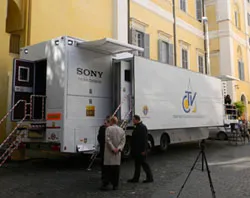 Vatican City, Nov 16, 2010 / 07:22 pm (CNA/EWTN News).- The Vatican has unveiled a new tool for evangelization in the form of a van equipped with 17 high-definition cameras for live and outdoor broadcasting.
 Parish mergers happen. When they do, sometimes a new name is cobbled up to identify the new entity. Sometimes, however, names of churches are changed.
 emmatag1126 on Thoughts about the collision of the Holy See and the SSPX. Wherein Fr. Z rants.: “Also, the Declaration said that we can be saved only through the Roman Catholic Church, which unfortunately leaves out my…”






























