Thoughts about correcting the Corrected Translation

Yesterday we had a glimpse of the CDW’s revision of the ICEL text of the Roman Missal which had been approved by the USCCB and sent for Rome’s approval, which it obtained.   The revised text was leaked and put on the internet.

Furthermore, reports have circulated concerning something like 10,ooo changes made by the CDW to the ICEL text sent in by the bishops.

Yesterday, Bp. Serratelli of Patterson, head of the USCCB’s liturgy committee, released a statement addressing the situation.
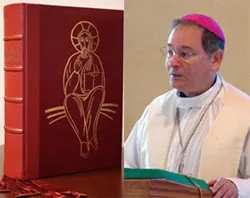
Bp. SerratelliCNA has this headline: Bishop Serratelli denies report new Roman Missal underwent major changes

Here is Bp. Serratelli’s statement from the site of the USCCB.  Let’s have a look with my emphases and comments:

There has been some discussion recently about a report surfaced through some segments of the Catholic Press regarding the present state of the text of the Roman Missal, Third Edition.  A number of facts will hopefully clarify the situation and, in so doing, give us the calm needed to welcome and implement the new text.

[He begins with some history… ] First, it is helpful to keep in mind the genesis of the final text that is now being prepared for publication.  The International Commission on English in the Liturgy (ICEL) prepared for the English-speaking Conferences of Bishops preliminary drafts (“green books”) of the 12 sections of the Roman Missal.  After incorporating the feedback and responses of the individual Conferences of Bishops and the Vatican Congregation for Divine Worship and the Discipline of the Sacraments, ICEL then prepared the final drafts (“gray books”).  These were approved by canonical vote by each of the member Conferences.  In approving the gray books, each conference also had the opportunity to make further suggestions to the Congregation, as was done in particular by our Conference.  We submitted many amendments to the texts.  The Congregation, working with the Vox Clara Committee, carefully listened to what the bishops said.  The Congregation incorporated many of the suggestions of the various Conferences (including our own), combined with their own review and changes, and put forth the final text.  The Congregation followed the principles of Liturgiam Authenticam faithfully but not slavishly. [Interesting.  This is what we are to understand from this?  The Congregation did not follow its own norms?]

This is the final text now being readied for publication. [“Final text”… “readied”… if it is “final”, how is it being “readied”?] This process includes a final review [at which point changes could be made?] and copy edit which, given the size of the text, uncovers some minor questions of consistency, [consistency of interpretation?  In the document called “Areas of Difficulty” shows problems of consistency in the translation of certain important words.] typographical errors, and layout.  Those questions are being addressed by the Congregation for Divine Worship.  This review has not dealt with the translation itself[I wonder at that.  I think I would want to know why the Congregation did not adhere to the norms it issued.  Also, after all this “review” and “readied”, etc., they are not dealing with the translation itself?  Are we to understand that all the changes made were to typos and format?] The critique that has circulated has necessarily failed to take into account the final version of the text, which incorporates some corrections issued by the Congregation since the transmittal of the full text to the English-speaking Conferences of Bishops in August 2010[This seems to be the escape route.]

To sum up, there is a final text.  It has received a recognitio.  As the work of editing and assembling nears completion, there is assurance that the published text will be available in more than ample time for implementation in Advent 2011.  It is good to note also that the catechetical preparation for implementation is already underway and has proceeded with much enthusiasm and wide acceptance by both clergy and laity.  It is clear at this point in time that there is an attitude of openness and readiness to receive the new text.  Let us pray in this time of transition and change that the Roman Missal, Third Edition, will enable all to understand more deeply the mysteries we celebrate.

Bishop Arthur J. Serratelli
Chairman
November 18, 2010

Several points.

1) Julius Caesar in his writings laid down important principles for the commander of troops.  One of them is that you should leave an honorable escape route for your opponent if you are not in a position to crush him under such huge forces that you cannot be hurt.    Bp. Serratelli is saying that the critiques that are circulating are based on a previous revision of the revised ICEL text.  There is another, subsequent, revised revision of the revised text.   Since this is the case, and even thought the text is now theoretically finalized, the Congregation could quite honorably (quietly, discreetly) correct the mistakes made by the Congregation, pointed out in documents such as the “Areas of Difficulty”.  I hope they do.  I found myself in agreement with what I read in that “Areas of Difficulty”.

2) I repeat what I wrote elsewhere:

If the English version is goofed up – not at all certain – imagine my grief were people simply to opt for Latin because English has been shown by ecclesiastical authority yet again not to be a liturgical language.

Don’t like the changes to the new translation?

Just say NO!  Just USE LATIN!

Consider the inexorable biological solution and shifting demographics among priests and seminarians in the wealthier English speaking world.  It is in the best interests of those for whom Latin and the older Mass are the stuff of nightmares to do a good job of the English Novus Ordo.

If the translation is unsatisfactory, many of the young men being ordained will be happy to use more Latin.  People can use whatever translations they prefer.  That worked before.  It will work again.

No priest needs permission to use Latin.  We are (most of us reading here) members of the Latin Church.  Latin is our liturgical language.

3) What we are talking about is a translation.

I, for one, want people to remember that it is a translation.  I am therefore happy to sacrifice some beauty and smoothness for the sake of accuracy.   If the text sounds like a translation, so be it.  I don’t think it is always bad for a translation to sound like a translation.

4) It may be that some of the changes made to the ICEL text approved and sent by the USCCB – changes made by the Congregation – were made with a view to English speakers who are not in the major English speaking countries (USA, England, Australia, most of Canada, S. Africa, etc.).  I wonder if the changes we haven’t been happy with are, how to say it, … a way to involve some other regions which aren’t Anglophone superpowers.

5) As I understand the situation, we are mostly concerned about the proper and not the ordinary of Mass.  The ordinary seems to be pretty much fixed down.  We are mostly concerned about the translation of the prayers that change from day to do. (Though there are some points of the ordinary….)

6) Even though we are now being assured that there is a final text out there, beyond that which has been munched over on the internet, I think that some pressure should still be applied.  The Congregation can continue to make changes… ehem… correct the obvious mistakes of translation that have been introduced up until the minute the “enter” key is pressed to send the text to publishers or to conference heads to relay to publishers.

We should continue to scan the orations for Mass in the version of the Roman Missal that we do have, looking for anything that doesn’t work.  After all, there is a version out there and the Latin texts are not a secret.  If people find things that the Congregation has already properly corrected, nothing has been lost.  If people expose changes made by the Congregation that are suboptimal, then a good service will have been rendered to everyone.

7) All during the history of WDTPRS I continually asked people to pray to those involved and even to write letters expressing their hopes for the new translation.  I renew that plea now.  Pray and even write.  Write short – one side of one page – legible, courteous notes a) thanking them for their work and b) expressing your desire that the translation be accurate in its adherence to the Latin original.  In past years bishops and Vox Clara members mentioned to me that they had received such letters and that they had been appreciated.

His Eminence Antonio Card. Canizares Llovera
Prefect of the Congregation for
Divine Worship and Discipline of the Sacraments
Palazzo delle Congregazioni
P.za Pio XII
00120 Vatican City

Writing such a letter will take you very little time and will cost you very little.  It may do a good deal of good if many of you do so.

Posted in The Drill, WDTPRS |
24 Comments

Thanks, Californians, thanks a lot.

CNS via CMR:

Sen. Barbara Boxer (D-Calif.) today likened the United States of America to Iran, North Korea and Pakistan because those nations also do not allow homosexuals in their militaries.

Boxer likened the U.S.A. to the Communist regime in North Korea, the Islamic regime in Iran and the Pakistani government at a press conference in which she called for repealing the ban on homosexuals in the military during the lameduck session of Congress, which is taking place now before the new members elected on Nov. 2 can arrive in Washington, D.C. and replace the members who are retiring or who were defeated.

This is so offensive for a United States Senator to compare this country to those awfully oppressive regimes.

The funniest part is that this is so clearly simply political because Democrats had the Senate, the House and the White House for the past two years. If they really wanted to change this policy they would’ve done so. But legislators aren’t going to stick their necks out on this, they’re simply going to wait for judges to forcibly overturn it and then they’ll be able to simply throw their hands up in the air claiming powerlessness. And Senator Boxer knows she’s safe in her seat for the next seven years so she can go back to badmouthing the country without worrying about joining the unemployment line.

Posted in Throwing a Nutty | Tagged
15 Comments

The new Roman Missal leaked, online for your perusal

I was standing in a gallery of the Tate Britain looking at a piece by William Blake… this one as a matter of fact…

Satan Triumphing Over Eve

… when I had an SMS to check mail.

Therein I found a link to something mentioned during lunch by His Hermeneuticalness.

Aside: I should travel more often: exciting things happen when I am on the road and less connected.

A great deal the new Roman Missal has been leaked in several .PDF files (images of the pages rather than usable text).  They may be found on a site called Wikispooks.

I found the “cover letter” or “introduction entitled “Areas of Difficulty” to be very interesting.  The person who wrote it, not necessary the same as the one who leaked it or caused it to be leaked, has obviously had the texts both the “white book” approved by the Holy See’s CDW and then the revisions to the same that have come along.

I find it interesting that this happens at the time the bishops of the USA and of England and Wales are having their respective meetings.

Having read through “Areas of Difficulties” I can say that I agree in large part with the author’s concerns.

Where Liturgiam authenticam = LA and Ratio translationis = RT, here are the areas of concern identified by the writer:

1. change of meaning from the Latin original (RT 41)
2. mistranslation of the Latin (RT 20)
3. limiting of the vocabulary (LA 49/51; RT 20, 46-50)
4. additions of an element not found in the Latin (LA 20)
5. omission of an element found in the Latin (RT 44)
6. weakening of Scriptural allusion (RT 6, 36)
7. loss of intensity of original (RT 50/62)
8. introduction of a theological problem (RT 102)
9. difficulty with English grammar or usage (LA 44/74)
10. adoption of Neo-Vulgate when an antiphon uses the Vulgate (LA 37/38; RT
37/107)
11. capitalization of LORD when it renders YHWH. (LA 41c; RT 81/116)
12. suppression of a rhetorical device (LA 57a/58/59)
13. translations of ‘unigenitum’ (RT 81)

Here is an example of the writer’s work:

Prayer after Communion, Wednesday, Week I, Advent (A20pc)

This prayer appears five additional times in Advent; cf. A35pc, A55pc, A70pc, A75pc, and
A90pc.

Lines 2 to 4 of the Received Text read:

that this divine sustenance
may cleanse us of our faults
and prepare us for the coming feasts.
The Gray Book text reads:
that these divine provisions,
which have cleansed us of vices,
may prepare us for the coming feast.

The corresponding Latin text reads:

ut haec divina subsidia, a vitiis expiatos,
ad festa ventura nos praeparent.

The translation of vitiis as “faults” is at best weak but more likely wrong in this context. A vice as described in the Glossary of the Catechism of the Catholic Church is a “habit acquired by repeated sin in violation of the proper norms of human morality.” This habitual form of evil is seen in contrast to virtue which is described in the same Glossary “as a habitual and firm disposition to do good.” This contrast is illustrated in the third section of the blessing of baptismal water at the Easter Vigil (P634bn): “so that from the mystery of one and the same element of water would come an end to vice and a beginning of virtue.” Translating vitiis as “vices” emphasizes that God’s grace enables us to overcome habitual evil, not just the cleansing of individual faults.

Elsewhere in the Proper of Time vitiis/vitia is mistranslated in the Prayer after Communion, Second Sunday after the Nativity (p.168, N197pc “our offenses may be cleansed”), in the Prayer over the Offerings for Tuesday, Week II of Lent (Q344so, “we are cleansed of earthly faults”), in the Prayer after Communion for Wednesday, Week V of Lent (Q476pc, “that…we may constantly be cleansed of our faults”).

It is with paschal faith that the Church confesses in its Easter Proclamation (P616pr):

This is the night,
that even now, throughout the world,
sets Christian believers apart from worldly vices
and from the gloom of sin,
leading them to grace,
and joining them to his holy ones.

This will give you and example of the way the writer has looked at the texts.

In seven instances the following examples of Latin verbs that designate God’s agency are not accounted for in the translation, though they are translated in the text approved by the Conference.

20. concede, Prayer over the Offerings, Vigil, Nativity of the Lord (N148so)
21. tribue, Prayer over the Offerings, Monday of Holy Week (Q528so)
22. dedisse, Prayer after Communion, Wednesday of Holy Week (Q542pc)
23. ut .., facias, Collect, Friday, Sixth Week of Easter (P866co)
24. praesta, Collect, Twenty-Second Sunday in Ordinary Time (O1053co)
25. ut…permittas, Prayer after Communion, Thirty-Fourth Week OT (O1129pc)
26. digneris, Alternative Collect, Most Sacred Heart of Jesus (O1143co)

Worth paying attention to?

You decide.

WDTPRS will start drill into texts.  That’s what we do around here.

Posted in The Drill, WDTPRS |
38 Comments

Anglican Archbp. Williams is in Rome. No, he is dry. No swimming.

From CNA:

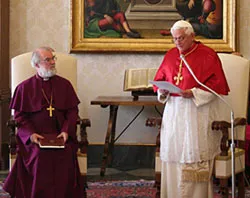
Vatican City, Nov 18, 2010 / 02:28 pm (CNA/EWTN News).- The head of the Church of England, Archbishop Rowan Williams of Canterbury met privately in Rome with Pope Benedict XVI on Nov. 18.

The meeting comes at an awkward time in relations between the Church of England and the Catholic Church.

On Nov. 8, five Anglican bishops announced they were resigning their posts to enter the Catholic Church under special terms outlined last year by Pope Benedict.

One of the five, Bishop John Broadhurst of Fulham, told the London Times, that he believed thousands, not hundreds, of laity would follow them into the Catholic Church.

Archbishop Williams had already been scheduled to visit Rome to take part in 50th anniversary celebrations of the Vatican’s Pontifical Council for Promoting Christian Unity.

However, his meeting with the Pope recalled one held in Rome almost exactly one year ago — after the Pope had released his plans to create “personal ordinariates” for Anglicans seeking to come over to Rome.

Details of this latest meeting have not been released. Archbishop Williams did address the conversions in an interview with Vatican Radio Nov. 18.

He said he was “deeply skeptical” about the “larger claims” of a massive exodus of Anglicans to Rome.

I wonder.  It will probably come in a couple waves.  There will be the initial wave.  Down the line, when the Anglicans actually approve ordination of women as bishops there will be more.  Some will trickle out because of blow-back for having thought about going to Rome.

In the meantime, Benedict XVI is the Pope of Christian Unity.

Posted in Pope of Christian Unity | Tagged , ,
8 Comments

Summorum Pontificum in Scotland

Damian Thompson, whom I was able to see in NYC but not in London for some reason, posted this enlightening entry:

Why is Summorum Pontificum a dead letter in Scotland? I’ve been contacted by a student at St Andrews University who claims the following:

1. That he and about 15 of his university friends form a “stable group” of Catholics who would like to attend Mass in the Extraordinary Form in St Andrews once a month. (Other residents of the town are also interested.)

2. That a priest has agreed to celebrate the TLM for these students.

3. That the St Andrews Catholic chaplaincy has refused permission for the Mass to be celebrated in the university or the local parish. [I must ask… what does the chaplaincy have to do with the local parish?]

4. That the chaplaincy has also refused to allow the celebration of Vespers according to the traditional form of the Roman Rite.  [If the students had asked for some paraliturgical ceremony in honor of, I dunno, throwing the caber, would the chaplaincy have gone along?]

Needless to say, the chaplaincy can’t be reached for comment. But I gather that this dispute has been dragging on for a long time. Also, that a very senior figure in the Roman Curia is taking an interest in the matter, dismayed at what appears to be yet another example of the reluctance of the Scottish clergy to implement of the Motu Proprio.

If what I’ve been told is true, I hope an appeal to Ecclesia Dei is in the works.

I think we need something from the PCED which will help us understand what to do in places that are not parishes.

Posted in SUMMORUM PONTIFICUM | Tagged ,
21 Comments

QUAERITUR: thanksgiving tree during entrance procession

From a reader:

What do you think about the following announcement at Mass: “At the
rear of the church, please pick up a paper leaf and write on it what
you are thankful for this year. We will put all of them on a tree and
then carry that tree in the entrance procession at Mass on
Thanksgiving Day.”

What is this, my old seminary? … er um… kindergarten?

I think that sort of stun cheapens what Mass is about, erodes what the Eucharist (the Sacrament and Its celebration) is as both Sacrifice and Thanksgiving.

Surely some of you might be saying, “But Father! But Father!  Shouldn’t people be bringing their expressions of thanksgiving to Mass?  Isn’t that also part of why we go?”

I think that way of expressing thanks is a distraction.  It refocuses the attention of the congregation on itself in misdirected sentimentalism.  For example, who will pay attention to the processional Cross once that sort thing is being hauled in, probably by a child.  How cute!

I am not against this sort of thing outside of Mass.   Maybe they should plan something during the coffee and donuts?

Posted in ASK FATHER Question Box, Wherein Fr. Z Rants |
26 Comments

London: Going into Town

Yesterday I spent a glorious afternoon in the Victoria and Albert Museum in the galleries for the Medieval and Renaissance periods.  If you haven’t been, do go.

Today I believe I must go to the Tate Britain.  I understand there are quite a few Turner’s there.

Also, yesterday evening we had an impromptu blognic.  Given the short notice, quite a few people came!  It was nice to see faces new and familiar.  Since I am still a bit under the weather, I ran out of steam toward the end and started losing my voice.  It is back, but not strong.

Some of you have sent SMS to my UK phone.  Thanks!   Even if I didn’t immediately respond, I did read them.  One in particular I bring to your notice: A request for prayers for an 18 yr old killed in a motorcycle accident.  RIP.

Since I am using my Jurassic Motorola Razr (I miss this phone) for the UK sim, SMS me (don’t send MMS or lots of data) at 07501852559.  It may be that I will settle somewhere in the evening for a little bit.  Not sure.  I’ll post a comment under this entry to that effect and maybe add a Foursquare checkin.

Alas, I will leave all too soon.  I am in my final days here.

Posted in On the road |
2 Comments

Napolitano May Exempt Muslims From Airport Pat-Downs

A reader alerted me to this story on Corruption Chronicles, a “judicial watch” blog.

Remember the photo the other day of a woman religious (probably not from a community in the LCWR) get once-over by the TSA?

My emphases.

Napolitano May Exempt Muslims From Airport Pat-Downs

Last Updated: Tue, 11/16/2010 – 4:52pm

As the U.S. government retaliates against an American for refusing to allow airport security to grope his genitals, the nation’s Homeland Security secretary considers waving the intrusive “pat-downs” for Muslim women who consider them offensive.

The demand came last week from the politically-connected Muslim rights organization that serves as the U.S. front for the Palestinian terrorist group Hamas. Calling the searches “invasive” and “humiliating,” the Council on American-Islamic Relations (CAIR) advises Muslim women wearing religious head covers known as hijabs to reject full-body checks before boarding planes.

Those who are selected for the secondary screenings should remind Transportation Security Administration (TSA) officers that they are only supposed to pat down the head and neck and that they should not subject Muslim women to a full-body or partial body pat-down, according to CAIR’s advisory. It further says that, instead of a body search, Muslim women can request to check their own hijab and have officers perform a chemical swipe of their hands.

While Americans are forced to deal with the degrading searches, Homeland Security Secretary Janet Napolitano is actually considering exempting Muslims as per CAIR’s demands. Madame Secretary confirmed this week that there will be “adjustments” and “more to come” on the issue of Muslim women in hijabs undergoing airport security pat-downs.

In the meantime her agency is targeting a San Diego man who received worldwide media coverage for refusing to let a TSA agent conduct a thorough body search that he felt amounted to a “sexual assault.” Referring to his genitals, the man told the TSA officer; “you touch my junk and I’m going to have you arrested.

The head of TSA in San Diego called a press conference this week to announce that the agency has launched an investigation into the 31-year-old software programmer who was not allowed to board the plane. The feds plan to prosecute and fine him thousands of dollars for making them look bad. Actually, the official charge is leaving the airport’s security area without permission, which is prohibited to prevent terrorism.

Speaking of, TSA’s lapses over the years have certainly left the country vulnerable to another terrorist attack. The agency in charge of securing the nation’s transportation system has approved background checks for illegal immigrants working in sensitive areas of a busy U.S. airport and has failed miserably to ensure the security of tens of thousands of cargo packages transported daily in the bellies of passenger planes.

Just last week a Massachusetts news station revealed that TSA cleared dozens of illegal immigrants to train as pilots in the U.S., despite “strict security controls” implemented after 9/11. Some of the illegal immigrants provided the station with official TSA documents approving pilot lessons through the agency’s alien flight student program. After the story broke, Homeland Security officials promised to “review the process” for clearing foreign nationals to become licensed pilots.

Posted in The future and our choices |
Comments Off on Napolitano May Exempt Muslims From Airport Pat-Downs

Is the “Vatican’s” government a “train wreck”?

There is a slow seismic tremor running very deep, but it is discernible.

For example, some in the UK are saying that the Bishops meetings there ought to be live-streamed so that the Catholic people know what is going on.  People far and wide want clarity in teaching and a Catholic voice in the public square.  Many Catholic lay people I know are rethinking how best to direct their contributions of money to the Church.

Is there a growing desire for greater accountability?

Just some thoughts before leading you to this article in USAToday:

Vatican government is a ‘train wreck’: Experts

If you are waiting for the Vatican to make clear, immediate and transparent responses to the ongoing global sexual abuse crisis … well, don’t hold your breath, two Vatican experts said Monday at a media seminar. [It is hard to know what that “global response” might look like, given that laws and social conditions are so different in different parts of the world.  This is, however, the standard way now to begin any article about the Church.  Cliche.  Beyond the cliche, however, there follow some good points which I can corroborate.]

Neither can you expect anything to come from the 30 minutes or so that the world’s cardinals will address this topic, among five topics on their agenda at their business meeting in Rome on Friday.

The frankly grim visions of Vatican structure and function — in crisis moments and daily governance of a church of 1.2 billion people — came from George Weigel, biographer of Pope John Paul II and author of numerous books on the Church and John Allen, the National Catholic Reporter Vatican specialist for 15 years and a biographer of Pope Benedict XVI.

They agreed there is, essentially, no media strategy, no war room, no one with a handle on reforming communications or, worse, reforming the governing structure itself. [This indeed seems to be the case.]

They spoke to reporters and columnists at this week’s Faith Angle conference sponsored by the Ethics and Public Policy Center on how the media has covered the 2002 explosion of the abuse crisis in the USA and the Spring 2010 sweep of the crisis across Europe.

Vatican officials, Weigel said, “can appear to be dissembling or disinterested when there is no well-formed intent to deceive, they just don’t know what’s going on,” said Weigel. And their default position — no story is a good story — “is completely dumb.”

He bluntly reminded the media that the pope is not a monarch, the bishops are not “branch managers,” that he can appoint them but, realistically, he can’t dump them for incompetence or malfeasance. [Well… I think he can.   But practically speaking it would be difficult.]

The Vatican’s internal system of information is so antiquated [As I have said on many occasions, in the Vatican they update their equipment every 75 years, whether it needs it or not.] that Pope Benedict XVI was blindsided by the failure of his staff to discover the common knowledge on the Internet that the renegade prelate he wanted to reel back into the church, Bishop Richard Williamson, was “a world class lunatic,” said Weigel.”

Weigel’s answers: “The Vatican communications debacle has to end” and the Church must find away to dump bad bishops, which he called …the single biggest management problem in the church today… and the single biggest fix that can affect the life of the Church. [What remains, however, is just why a bishop might be a “bad bishop”.]

Allen echoed Weigel’s’ points and added the obvious problem of the culture gap between the Americans and the Italian-dominated Vatican. Americans expect leaders to pounce on problems, “act and act now” but the Vatican culture is one of ruminating, often for years, simmering and studying and, in some corners of the curia (the church government in Rome) fretting about conspiracies. [The old phrase is “Cunctando regitur mundus”.]

Allen walked through the most controversial cases Benedict had a hand in when he was Cardinal Ratzinger, head of the Congregation for the Doctrine of the Faith, and confronting the abuse crisis. The argument by supporters of Benedict is that he was the reformer who read every vile case of clerical abuse of a minor and kick started the church’s response, finally, between 2001 and 2003.

But, says Allen,

If you want to say Benedict is the reformer, you have to explain the opposition he faced in the Vatican, what he did to overcome other officials and what those others did wrong. They have no way in their culture, no vocabulary, for saying anything critical about each other.

This governance mess is why a great teaching pope’s legacy — brilliant speeches, letters and books — could be lost in coverage of the schoolhouse on fire, he said. Allen concluded,

The papacy is adrift and has been for a long time…(It is) a papacy defined by its train wrecks.

Allen quoted a favorite Italian newspaper headline printed after the Vatican took 19 days to debunk a false rumor: “The Vatican denies everything. No one believes it.”

Thus the irony. When Ratzinger was elected pope, some in the media, including USA TODAY revived the image of him as John Paul II’s enforcer, as the Rottweiler. Said Weigel:

It turns out he’s not a Rottweiler after all. People thought he would dramatically reform the Roman curia and that turns out to be an inadequate expectation. I think he thought he would die soon, so he would focus on what he knew best and leave the institutional rebuilding to the next guy.

And when that day comes, Weigel and Allen agreed, expect a long, long conclave as the cardinals look among themselves for someone with a demonstrated track record of managerial talent in the Vatican swamp.

While Benedict seems likely to be pope for years to come, what qualities would you want to see in his successor? Does the Church need a theologian with a CEO set of skills?

Thought provoking article.

Discuss.

Posted in The Drill, The future and our choices | Tagged , ,
30 Comments

A new cause for beatification opens in the US… with a twist…

Here is an interesting piece of news from the Diocese of Kansas City-St. Joseph where His Excellency Most. Rev. Robert Finn has the reins.  From the blog of the diocesan newspaper The Catholic Key:

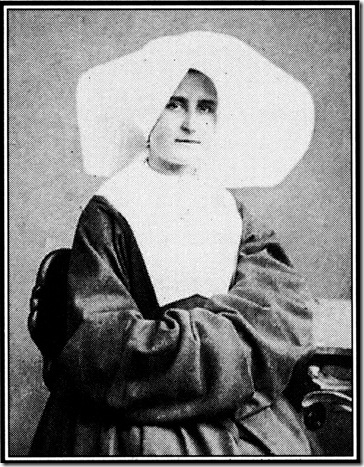
Sister Marie de Mandat-GranceyBeatification Cause for Founder of Mary’s House at Ephesus to Begin in Kansas City

The cause for the beatification and canonization of the French Daughter of Charity regarded by the Church as the Founder of Mary’s House at Ephesus will open in Kansas City, January 21. In the words of one of Sister Marie de Mandat-Grancey’s biographers, Mary’s House is a remarkable place where Muslims, Orthodox and Catholics “all join together in the home of a Jewish Mother.” . . .MORE

Posted in Just Too Cool, Saints: Stories & Symbols | Tagged , , ,
2 Comments