Homosexual activist’s “documentary” about Pope Benedict to air before visit to England

I don’t know whether this is mainly for your Last Acceptable Prejudice file or your Throwing a Nutty file … from CNA.  My emphases and comments:

Catholics denounce slated ‘documentary’ on Pope by homosexual activist

London, England, Jun 8, 2010 / 01:07 am (CNA).- A homosexual activist [deviant, and therefore in liberal eyes well-qualified…] and Vatican protestor in the U.K. is slated to make what he calls a “factual” documentary on the Holy Father, [It will be truly unbiased, I bet.] which is set to air just before the upcoming papal trip. One critic of the proposed film called it further evidence of England being “a profoundly anti-Catholic country.[What a very sad statement that is, consider that the soul of England is really, ought really to be, Catholic.  Aidan Nichols’ book The Realm needs wide distribution  in England.]

Peter Tatchell, a noted gay activist and leader of the group Protest the Pope, [yawn] is being sponsored by the U.K. broadcaster Channel 4 to make an hour long film on the Holy Father that will air before the papal visit this September.

“My aim is to make a robustly factual [What does that mean?  What is "robustly factual"?] program that explores the Pope’s personal, religious and political journey since the 1930s, as well as the motives and effects of his controversial policies,” [Controversial from which point of view?] said Tatchell in a statement on his website.

“I intend to ensure that we hear the voices of the Pope’s defenders, as well as his critics,” [When someone has to reassure that the Pope will get fair treatment, you know he isn’t going to get fair treatment.] he went on. “I would be like to interview the Pope himself. It would be ideal for Pope Benedict to be able to explain himself in his own words. But I doubt that I will be granted an audience.”

U.K. broadcaster Channel 4 released a statement in support of Tatchell, and the company Juniper TV that is producing the film.

“Human Rights campaigner Peter Tatchell, a long-term critic of the Papacy, [… a true heavyweight, he….] will challenge Pope Benedict XVI’s beliefs and positions on a range of issues – including condoms, homosexuality and fertility treatment – and examine the impact his policies have had on both the developing and Western world,” Channel 4 wrote in a general statement. “The program will give voice to a range of views on the Pope – featuring interviews with both critics and supporters.”

Ralph Lee, head of Specialist Factual programming [Now that is worthy of George Orwell.] at Channel Four, said on June 4 that the papal visit in September “provides an ideal opportunity to examine the impact of Benedict XVI after five years in office.”

“In keeping with Channel 4’s remit to provide a platform for diverse and alternative perspectives,[read "liberal perspectives"] he added, “equality campaigner Peter Tatchell will assess the effect of the current Pope’s teachings throughout the world and the conflict between some of his values and those held by modern Britain.”

Several critics of the slated documentary have denounced the film as “hostile” and “polemical.”

On June 7, London’s Daily Telegraph reported former conservative Member of Parliament Anne Widdecombe as saying, “I think this will confirm the view that there probably already is in the Vatican that this is a profoundly anti-Catholic country.” [It is less important to state the obvious about what the view is in the Vatican than to point out the anti-Catholic bias to the English establishment themselves.]

“I wouldn’t call this the right thing for any serious broadcaster to do, but they’re doing it for the publicity, they’re doing it to stir up controversy,” charged Widdecombe, a Catholic convert.

“Mr. Tatchell certainly won’t be sympathetic to his subject, so what’s the point of doing it? It won’t be skeptical, it will be hostile.”

The Telegraph also quoted Catholic writer Christina Odone, who said that Tatchell himself  “would be the first to admit that he is no authority on the subject.”

“And perhaps it would be good, rather than have some polemical, knee-jerk reaction to the Pope if Channel 4 would be interested in actually shedding light on a figure who is so important, and so often misinterpreted and misunderstood – and of whom more needs to be known,” Odone added.

Catholic composer James MacMillian, whose music is rumored to be performed at some of the Masses during the Pope’s visit, denounced Channel 4 and other media outlets in the country.

“There is nothing surprising in the continued frantic jumping up and down [great!] by the Guardian/Channel 4/BBC axis in opposition to the Pope,” he observed.

“Their venom is now so repetitive that it has lost any potency it once had. Frankly, people are getting bored with them.”


Posted in Biased Media Coverage, The Last Acceptable Prejudice, Throwing a Nutty |
22 Comments

The Feeder Feed – literally

Here is a long distance edition of the Feeder Feed.

I am in Manhattan, but I was checking the webcams at the feeders back home to see what was up and if any of them were empty.

Here is what I found!

I was able to enjoy from afar Mr. Indigo Bunting and some Mozart on RADIO SABINA, followed immediately by a selection of Chinese Opera.

I could see on another cam that the big hanging feeder is empty.  Time to make a call or two.

In any event, you never know who is going to show up when you happen to be looking.

Posted in The Feeder Feed | Tagged
5 Comments

QUAERITUR: rubrical V and R symbols for leader and response

A great question for you knowledgable readers and my chance to learn something:

A reader queries:

My question is this: what is the name of the symbols that denote “leader” and “response”? They look like V’s and R’s with ornate slashes through them, but I’ve had no luck finding what they are called or a font that includes them. Any ideas?


Okay!  Have at!

Posted in "How To..." - Practical Notes, Brick by Brick | Tagged , , , ,
21 Comments

Your Corpus Christi Sunday experiences

People have been mentioning their Corpus Christi processions under my WDTPRS entries.

Here is an entry specifically for your processions.

Yesterday I was at St. Mary’s in Norwalk, CT where, coincidently, I found also my friend Fr. Uwe Michael Lang.

Fr. Markey is pastor at St. Mary’s.  We have seen him before in these electronic pages.

The parish church is getting a renovation, by stages.  The sanctuary has been spiffed up and it looks splendid.   They have more work to do on the nave.

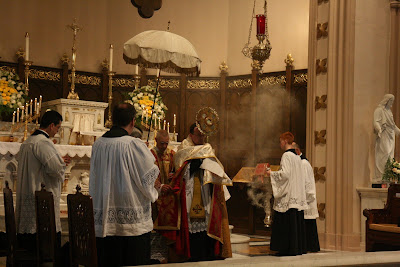
For Corpus Christi (external celebration on Sunday) there was a Solemn Mass in the Extraordinary Form.  The ceremonies were very smooth and you could tell that the servers were well-trained and comfortable with them.   There are certain points during a Solemn Mass when you can tell if they really know what they are doing: the sanctuary takes on the aspect of one of those wonderful clocks in a German town square with smoothly moving figures.

It was good to see the range of ages among the servers.  Some of the little shavers had just made their First Holy Communions.  They alternated between the sort of solemn that only the very young are able to convey and moments of wandering attention.  Solemn won in the end.  The range of ages in the sanctuary assure that they will have well-trained servers in the future.  The young one learn from the older boys and they absorb the manner and attitude required near the Lord’s altar.

The music was polyphony and Gregorian chant.  The Mass setting was Palestrina’s Missa Lauda Sion, which was entirely appropriate.  There were a number of children involved.   I am not a great proponent of mixed Gregorian chant groups (males and females singing at the same time), and would prefer separate but equal choirs.  When a women’s schola sings Gregorian chant, the effect is stunning.  But everyone sang very well and greatly contributed to the reverence of the rite.

The procession was quite long, winding down to the town center and then back to the church. During the procession there were prayers in English and Spanish, as well as hymns and, thanks for Fr. Markey with a blowhorn readings citing the Council of Trent about the usefulness of processions to combat heresy. Very festive.

After the procession I stopped in briefly at the informal reception and met some very nice folks, including readers of this blog.

It was a fine Sunday.

St. Mary’s in Norwalk is a happy, healthy Catholic parish with a strong liturgical life and a sound, dedicate pastor.   They are revitalizing their Catholic identity brick by brick in Norwalk. 

WDTPRS kudos.

Posted in Brick by Brick |
83 Comments

Into the heart of darkness…


UPDATE:

The great Vincenzo‘s version….


Posted in My View |
28 Comments

WDTPRS: Corpus Christi – Super Oblata (2002MR)

Most of the world’s parishes are observing Corpus Christi today.  In another place I drilled into the Collect.   Let’s look at the Super Oblata, or "Prayer over the gifts".

SUPER OBLATA (2002MR):
Ecclesiae tuae, quaesumus, Domine,
unitatis et pacis propitius dona concede,
quae sub oblatis muneribus mystice designantur
.

ICEL (1973 translation of the 1970MR):
Lord,
may the bread and cup we offer
bring your Church the unity and peace they signify
.

LITERAL TRANSLATION:
We beseech You, O Lord
graciously grant to Your Church gifts of unity and peace
which are mystically signified under offered gifts.

The vocabulary of today’s prayer doesn’t drive us scratching our heads to the informative Lewis & Short Dictionary, so let’s consider what the prayer is really saying in its content. 

In Thomas Aquinas’ beautiful sequence for Corpus Christi, the Lauda Sion, we hear sung, “Signs, not things, are all we see… here beneath these signs lie hidden priceless things.”  We can use this to pry open the prayer, seeking also insight from the Doctor of Grace, St. Augustine of Hippo (+430). 

Augustine looks at the Eucharist in his monumental City of God (ciu.) Book X where he is examining the kind of worship which is due to God (latreia).   He reminds us that God does not need sacrifices offered to Him.  We need the sacrifices. 

He wrote in a letter, “God commands nothing for His own benefit but for the benefit of the person to whom He gives the command”. Sacrifices are, “…signs of gifts God has bestowed either for imbuing the soul with the virtues or for attaining eternal salvation, and by the celebration and performance of them we carry out acts of piety useful to us, not to God” (ep. 138.6).  

The outer physical actions of sacrifices are signs of something else: “The visible sacrifice is the sacrament, the sacred sign, of the invisible sacrifice” (ciu. 10.5). 

Augustine says that in the Eucharist Christ, who is the mediator, accepts the Church’s sacrifice “in the form of God”.  However, Christ, “in the form of a servant” also is the sacrifice He receives.  Christ is both priest and victim who commanded the Church to continue this sacrifice in the celebration of the Eucharist, the sacramental sign.  “

The Church, being the body of which He is the Head, learns to offer itself through Him” (ciu. 10.20).  Christ’s Sacrifice unifies Christians in offering themselves to God through their participation in the inner reality perceived in outward sacramental signs, sacramenta

For Augustine sacramenta fall into three categories:

1) the rites of the Law and those commanded by Christ;
2) symbolic figures or types, such as the Red Sea which was parted;
3) mysteries like the Trinity or resurrection. 

This three-fold division wasn’t Augustine’s idea.  Augustine did, however, give a definition for a sacrament. 

In ep. 138.7 he says “signs are called sacraments when they have reference to divine things (ad res divinas pertinent)”. 

For Augustine, in his theory of signs, a sign is an intermediary which causes something to enter into our thoughts.  Signs do not distract from the truth of things.  They lead us away from the sign itself onward to something greater, the res.  Similarly, a sacramentum which is a rite leads us beyond the rite itself. 

Later, in Medieval theological reflection founded on Augustine, we get the tripartite distinction of sacramentum (the outward sign of a greater spiritual reality) and res (the invisible reality it points at) and res et sacramentum (in the Eucharist at least, how Christ is truly present).   Augustine, however, considers only sacramentum and res.  This is why some people get confused into thinking that when Augustine speaks about the Eucharist in terms of sacramentum he thought they were merely symbols and not really the Body and Blood of Christ. 

On the contrary, Augustine in an Easter Sunday sermon (s. 229.2), describes to newly baptized Catholic neophytes what is going on in the Eucharistic section of the Mass to which they were not previously admitted.  He describes the effect of the consecration by the priest’s “word” (i.e., the Eucharistic Prayer):

“And from there we come now to what is done in the holy prayers which you are going to hear, that with the application of the word we may have the Body and Blood of Christ.  Take away the word, I mean, it’s just bread and wine; add the word, and it’s now something else.  And what is that something else?  The Body of Christ, and the Blood of Christ.  So take away the word, it’s bread and wine; add the word and it will become the sacrament.  To this you say, Amen.  To say Amen is to add your signature.”

Most of the time when discussing the Eucharist Augustine doesn’t dwell on the change from bread and wine to Christ’s Body and Blood.  Instead, he moves quickly to talk about what the Eucharist means to us and what effect it has, that is, our unity with Him and in Him with each other in the Body of the Christ the Church.  

This is the gift of the Eucharist, what later theology called res tantum whereas the Real Presence would be called res et sacramentum.  The res tantum is the effect in us. 

Let’s listen to another Easter sermon (s. 229A, 2).   Remember, there were stenographers writing his words down as he preached and this is exactly how we have his sermons today!  Augustine compares the people of his flock, especially those just baptized during the night, to the Eucharistic species:

“What you can see on the Lord’s table, as far as appearance of the things goes, you are also used to seeing on your own tables; they have the same aspect, but not the same value.  I mean, you yourselves are the same people as you used to be; you haven’t brought us along new faces, after all.  And yet you’re new; the same old people in bodily appearance, completely new ones by the grace of holiness – just as this too is new.  It’s still, indeed, as you can see it, bread and wine; come the consecration, that bread will be the Body of Christ, and that wine will be the Blood of Christ.  This is brought about by the name of Christ, brought about by the grace of Christ, that it should continue to look exactly like what it used to look like, and yet should not have the same value as it used to.  You see, if it was eaten before, it would fill the belly; but now when it’s eaten it nourishes the spirit.”  

Augustine then explains that on many altars there can be many loaves but in reality all are just one loaf.  So too in the Church there are many people but one Body of Christ (cf. 1 Cor 12:27). 

“What you receive is what you yourselves are, thanks to the grace by which you have been redeemed; you add your signature to this, when you answer Amen.  What you see here is the sacrament of unity.”

Thousands of altars.  Millions of Hosts.  Thousands of chalices.  Millions of faithful.  One Christ.

The Eucharist is our sign of unity. 

It is also the flashpoint of division. 

Pride is the catalyst of discord. 

Many kernels of grain go into the one bread offered at the altar for the renewal of Christ’s Sacrifice. 

Many grapes make one wine. 

Wheat and grapes, the individual elements, are crushed and brought into a deeper unity.  

Humility is the catalyst of unity.

Posted in WDTPRS | Tagged
7 Comments

Sr. Keehan off hospital board for defying bishops, supporting Obamacare

Remember A Magisterium of Nuns?

From Lifesite:

Sister Keehan Off Prestigious Hospital Board over Obamacare Fallout

By John-Henry Westen

WASHINGTON, DC, June 4, 2010 (LifeSiteNews.com) – Sister Carol Keehan, President of the US Catholic Health Association, has been pressured off the prestigious Holy Family Hospital Foundation board over her support for the federal health care bill. Sr. Keehan, in opposition to the United States bishops, was a key supporter of the abortion-expanding bill – so much so that she was given one of the 21 ceremonial pens President Obama used to sign the measure into law.

The hospital is a work of a Catholic Order known as the Knights of Malta.  

One of the members who holds the position of Hospitaller, a leading office in the ancient Order, wrote a letter of concern to the presidents of all the Order of Malta associations in the United States noting that Sister Keehan remained on the board of the Holy Family Hospital Foundation even though she supported the health care bill, which opens taxpayer funding of abortion, and even though she acted in contradiction to U.S. bishops.

In response to the complaint, Sister Keehan resigned from the board with a letter of her own in which she expressed great displeasure with the criticism directed at her, characterizing it as “abusive.

However, the “abusive” criticisms in the letter of complaint were mostly a compilation of quotes from the Vatican’s Archbishop Raymond Burke who, like other bishops in the US such as Kansas City Archbishop Joseph Naumann, expressed shock at Sister Keehan’s defiance of their pro-life opposition to Obamacare.

“Who could imagine that consecrated religious would openly, and in defiance of the bishops as successors of the apostles, publicly endorse legislation containing provisions which violated the natural moral law in its most fundamental tenets – the safeguarding and promoting of innocent and defenseless life, and fail to safeguard the demands of the free exercise of conscience for health care workers?," wrote Burke.

“The spiritual harm done to the individual religious who are disobedient and also the grave scandal caused to the faithful and people in general are of incalculable dimensions.” [How is that "abusive"?  Sorry… I needed to throw that switch and try to think like a liberal.]

Although LifeSiteNews viewed Keehan’s letter of resignation decrying "abusive" treatment, Fred Caesar, Special Assistant to the CHA President, Keehan denied the situation.  "Sr. Carol Keehan was not ‘pressured off the Holy Family Hospital Foundation Board’ in any way,” Ceasar responded to LifeSiteNews.  “You can verify that fact with the Chairman,” he added, refusing further comment.

In fact, Chairman James Murray’s letter to the Hospitaller, also seen by LSN, said specifically that “Sister Carol has tendered her resignation from the Board as a result of your letter.”

The Chairman expressed displeasure with the situation saying that the Hospitaller had, by causing Keehan to resign, harmed the work of the foundation and the hospital as well as the women who use it.

In the end, suggested a Knight who wished to remain unnamed, “Carol Keehan was basically forced out under pressure by Knights and Dames of Malta.”  It was, he said “part of an ongoing effort to keep the Order of Malta true to its pro-life foundations.”

Posted in Emanations from Penumbras | Tagged
34 Comments

QUAERITUR: clerics fulfilling office obligation with older Office in vernacular

From a priest reader: Twitter

I’m a priest and religious and I’ve wanted to pray the psalter in the traditional way for a long time and while clearing out our library I came across a Breviary in English from 1964, an approved  translation of the official text of the Breviarum Romanum, published by Benziger and with an imprimatur from Cardinal Spellman, all in one volume (one does have to get the Gospel readings from a bible and there’s no text for the martyrology). 
 
My first question is: under Summorum Pontificum do I fulfill my obligation to pray the Divine Office or do I also have to pray the LOTH?  At the moment I am only present for Office with my community on some evenings in the week and at that I use the LOTH and pray vespers from the breviary I found later on.  I enjoy this alternative (even though the translation is a little clunky) and it certainly puts me into more intimate contact with the psalms.  In addition I find the seven hours more effectively sanctifies my day than the LOTH.
 
My second question: which calendar am I to use.  At the  moment I try to follow the revised calendar so that Mass and Office harmonize but I had not realised that the creators of the LOTH and the NO also moved so many feasts around!  It’s a bit of a mess and of course the saints canonized since the 60’s are not there.  I have to admit I miss the readings from the Fathers in the Office of Readings.
 
That said I want to pray with the Church and not at cross-purposes with her and I want to be obedient while praying the psalter.  I am of the generation that was not given the option of learning Latin and as yet I have not the funds to buy a bi-lingual breviary set.  So English is my only medium for using the old form for the present.

Your spiritual adviser/director could be of good use here.  Be sure to include him.

Priests can use the older Breviarium Romanum and fulfill the obligation. 

However, the Breviarium Romanum is in Latin, as is the Liturgia Horarum.  The Council’s document Sacrosanctum Concilium stated that clerics and religious were to say the office in Latin unless they obtained explicit permission from their superior to use the vernacular.  Since then that has been relaxed, but the principle does remain: Latin clerics should use Latin whenever possible and practical.  Of course we now like in an age when clerics – horribile scriptu – are not so well-versed in Latin as they ought to be.  I suppose… suppose that a cleric today with permission to fulfill his obligation using the vernacular (which I think is all clerics these days) could also fulfill his obligation with the English version of the older office.  Odiosa restringenda and all that.

The calendar situation is messy for clerics who use both forms.  That said, I think we have to be flexible and not get overly worked up about it.  I usually suggest that when you use the older form of Holy Mass you might also benefit from the older form of office.  That takes care of the calendar from day to day.  When using votive Masses in the older form, this is obviously less complicated for the office.

There is no reason why you cannot fulfill your obligation with English Liturgia Horarum and then, on your own time as it were, do some hours from the Breviarium Romanum in whatever version to get the feel of it, get used it, get something more out of it, etc.  Time consuming? Yes!

Posted in ASK FATHER Question Box | Tagged , , ,
37 Comments

REMEMBER! 1st Thursday PLENARY INDULGENCE

Remember!  The final 1st Thursday in Year for Priests.

In this year dedicated to priests and prayer for priests, Holy Church has provided lay people with a special plenary indulgence on first Thursdays of each month.

For the faithful, a plenary indulgence can be obtained on the opening and closing days of the Year for Priests, on the 150th anniversary of the death of St. Jean-Marie Vianney, on the first Thursday of the month, or on any other day established by the ordinaries of particular places for the good of the faithful.

To obtain the indulgence the faithful must attend Mass in an oratory or Church and offer prayers to "Jesus Christ, supreme and eternal Priest, for the priests of the Church, or perform any good work to sanctify and mould them to his heart."

The conditions for the faithful for earning a plenary indulgence are to have gone to confession and prayed for the intentions designated by the Pope.

This is the last 1st Thursday in the Year for Priests.  The last opportunity for this indulgence with be the final day of the Year for Priests.

[Please pray for this priest.]

Posted in Year of Priests |
21 Comments

QUAERITUR: flying a papal flag

From a reader:

The Feast of Sts Peter and Paul is coming up this month which prompted me to order a Papal Flag to fly on that occasion.  What is the custom for flying the flag throughout the year?  Every Sunday, holy days, etc.?  Technically, are we even permitted?


I don’t see why you couldn’t display a papal flag.

I don’t believe there is any special protocol to be observed, other than that which you should observe in regard any other flag flown near your national flag.

Posted in ASK FATHER Question Box |
15 Comments