QUAERITUR: “The homily consisted of rap music…”

From a priest reader:

I recently attended an international conference in Omaha, Nebraska.  The homily consisted of rap music, dialogue with the deacon, dancing, racing back and forth across the "stage" (it was in a convention center), and the like (actually worse).  I can’t really find documents on the homily that prohibit this kind of "performance".  Know of any official documents?


Everyone… I haven’t the time today to dig into this and find the documents.

Will you help?

In the meantime, I warmly recommend that this be addressed also to the Congregation for Divine Worship, sending documentation of what happened… photos, videos, eyewitness testimonies, etc.

Posted in ASK FATHER Question Box |
9 Comments

Proper Preface for St. Clare of Assisi

A Franciscan reader, who has his own blog, called A Minor Friar, has posted an interesting note about a proper preface for the Feast of St. Clare of Assisi.  Of course today, in the post-Conciliar calendar, is the Feast of St. Clare while in the traditional Roman calendar her feast is tomorrow.

Here is the comment Brother Charles posted on his blog (which you should visit and SPIKE those stats sky high!).  I found it interesting especially because I do not have any of the Missals of religious orders.

Prefaces of St. Clare
One of the treasures of the Franciscan liturgical calendar is having proper prefaces for Francis and Clare. Here is the preface for Clare’s Mass in the 1962 Missale Romano-Seraphicum:

Per ómnia saécula saeculórum.
R. Amen.
V. Dóminus vobíscum.
R. Et cum spíritu tuo.
V. Surusm corda.
R. Habémus ad Dóminum.
V. Grátias agámus Dómino Deo nostro.
R. Dignum et iustum est.

Vere dignum et iustum est, aequum et salutáre,
nos tibi simper et ubíque grátias ágere:
Dómine, sancte Pater, omnípotens aetérne Deus:

Qui fámulam tuam Claram,
per beátum Francíscum,
studio vitae sublimióris incénsam,
ad sanctae Maríae Virginis
aram Fílio tuo mýstice desponsásti;
eámque, ad seráphicae perfectiónis culmen evéctam,
matrem plurimárum virginum delegísti.

Et ídeo cum Angelis et Archángelis, cum Thronis et
Dominatiónibus, cumque omni milítia caeléstis exércitus,
hymnum glóriae tuae cánimus, sine fine dicéntes:

And here is the version as it appears in the 1974 Roman-Franciscan Sacramentary:

V. The Lord be with you.
R. And also with you.
V. Lift up your hearts.
R. We lift them up to the Lord.
V. Let us give thanks to the Lord our God.
R. It is right to give him thanks and praise.

Father all-powerful and ever-living God,
we do well always and everywhere to give you thanks.
You wondrously inflamed your servant Clare
to follow like Francis in the footsteps of your Son.

To him you espoused her mystically
through perpetual fidelity and love.
Raising her to the summit of seraphic perfection
through the highest poverty.
You made her the mother of countless virgins.

Through him the choirs of angels and all the powers of heaven
praise and worship your glory. May our voices blend with theirs
as we join in their unending hymn of praise:

The progression is interesting. In the newer preface, the Marian element is eliminated, but some specifically Franciscan vocabulary is added, such as "highest poverty" and the idea of following in the "footsteps" of Christ. Amen. Pray for us, holy mother Clare.


Since this blog is called What Does The Prayer Really Say? why don’t some of you WDTPRSers out there work on a good translation of the older, 1962 Latin Preface?

And if any of you have the Latin Preface for the post-Conciliar Franciscan Missal, that would be interesting as well.

Posted in WDTPRS |
5 Comments

Zhuan by zhuan in Hong Kong

I received a note from the Latin Mass Society of Hong Kong.

For some reason, this blog’s software won’t any more allow me to post Chinese characters.  It used to, but it doesn’t now.  I suspect that has something to do with a past change to the server which didn’t allow for different character sets.  In any event, I made an image, to preserve the Chinese characters.

It can be done, folks.  Anywhere.

Zhuan by zhuan!

Céng céng!

Posted in Brick by Brick |
9 Comments

NYT: New Nuns and Priests Seen Opting for Tradition

Hell’s Bible has an interesting article.

The following will resonate with the experience most of us have. 

The aging hippies are passing on and the young men and women coming up, without the 60-80’s baggage, want their Catholic heritage intact and they want to apply it to their vocations with continuity, not rupture.

This is from The New York Times with my emphases and comments.

August 11, 2009
New Nuns and Priests Seen Opting for Tradition
By LAURIE GOODSTEIN

A new study of Roman Catholic nuns and priests in the United States shows that an aging, predominantly white generation is being succeeded by a smaller group of more racially and ethnically diverse recruits who are attracted to the religious orders that practice traditional prayer rituals and wear habits.

The study found that the graying of American nuns and priests was even more pronounced than many Catholics had realized. Ninety-one percent of nuns and 75 percent of priests are 60 or older, and most of the rest are at least 50.

They are the generation defined by the Second Vatican Council, of the 1960s, which modernized the church and many of its religious orders. Many nuns gave up their habits, moved out of convents, earned higher educational degrees and went to work in the professions and in community service. The study confirms what has long been suspected: that these more modern religious orders are attracting the fewest new members[As we all know.]
 
The study was already well under way when the Vatican announced this year that it was conducting two investigations of American nuns. One, taking up many of the same questions as the new report, is an “apostolic visitation” of all women’s religious orders in the United States. The other is a doctrinal investigation of the umbrella group that represents a majority of American nuns, the Leadership Conference of Women Religious.

The new study, being released on Tuesday, was conducted by the Center for Applied Research in the Apostolate at Georgetown University, for the National Religious Vocation Conference, [I would like to see the results!] which is looking for ways for the church to attract and retain new nuns and priests. It was financed by an anonymous donor.

“We’ve heard anecdotally [and we all know that the plural of anecdote is not "data".  Therefore this was a good idea for a formal study.] that the youngest people coming to religious life are distinctive, and they really are,” said Sister Mary Bendyna, executive director of the Center for Applied Research in the Apostolate. “They’re more attracted to a traditional style of religious life, where there is community living, common prayer, having Mass together, praying the Liturgy of the Hours together. They are much more likely to say fidelity to the church is important to them. And they really are looking for communities where members wear habits.”  [Can I hear an "Amen!"?]

Of the new priests and nuns who recently joined religious orders, two-thirds chose orders that wear a habit all the time or regularly during prayer or ministry, the study found.

The study also showed that whites account for 94 percent of current nuns and priests but only 58 percent of those in the process of joining orders.

Asians and Pacific Islanders are disproportionately represented among the newcomers, [Philippines?] accounting for 14 percent, far above their 3 percent share of the Catholic population in the United States, Sister Bendyna said.

Hispanics are 21 percent of the newcomers, compared with only 3 percent of the current priests and nuns.

Of women who recently entered religious orders, the average age is 32; for men, it is 30. But retaining new recruits is a challenge. About half of those who have entered religious orders since 1990 have not stayed, and almost all who left did so before making their final vows[Also, not a surprise.  First, religious life is very counter-cultural and we remain people of our own age.  Second, perhaps they tried to join some group that still has a lot of squishy things going on.]

People come to religious life because they feel they’re being called,”  [There is no lack of vocations, I think.] said Brother Paul Bednarczyk, executive director of the National Religious Vocation Conference, adding that the purpose of the church’s training process “is to discern that call before a commitment is made.” So “it’s not surprising,” he said, “that you would have people that would leave.” 

 Too bad the article left off there, on that sour note.   What was necessary was a line or two about the way some religious orders have so many applicants that they must be turned away.  Also, some dioceses have many vocations while others… not so many.  Usually this has something to do with a bishop who is also in favor of tradition.

Brick by brick, folks.

Posted in Brick by Brick |
14 Comments

QUAERITUR: consuming blessed salt

From a reader:

Is it a respectful and proper use of the sacramentals of Holy Water and Blessed Salt for a pious Catholic to either consume or cook with them, for the purpose of (without superstition) restoring and promoting health of mind and body for themselves and their loved ones?

I have heard differing opinions on the matter, both from priests and laity, and was wondering if Canon Law or other documents spoke to their proper usage. Your personal opinion would also be most appreciated.

I think it is proper to use blessed salt also for cooking.

The prayer for the blessing of salt refers to its consumption.

O you creature of salt, I purge you of all evil by the living + God, by the true + God, by the holy + God, who commanded by the Prophet Elisha that you be put into water in order that the sterility of the water would be healed: so that you might be rendered a purified salt for the salvation of believers, and so that you might be a healthiness of soul and body to all who consume you, and so that you may put to flight and drive out from a place in which you will have been scattered every phantom and wickedness, and cunning trap of diabolical deceit, and every unclean spirit be solemnly banished by command through Him Who shall come to judge the living and the dead, and the world by fire.  R. Amen.


As you can see, blessed salt is for the blessing of holy water, for sprinkling in places, and for consumption.

Using Holy Water?  I don’t see why not.  However, sometimes it is old.  If it wasn’t perfectly fresh I would hesitate to use it.

Posted in ASK FATHER Question Box |
20 Comments

QUAERITUR: Canon aloud in the TLM

From a reader:

Is there any precendence for saying the Offertory and Canon audibly at a TLM?  I’ve heard a few people who are attached to a traditional group who say that the "silence" in the Mass pertaining to the Offertory and Canon is to be considered a "stage whisper" and it’s a good thing for at least those serving at the altar to be able to hear the Canon.


Precedent?  I suppose in very ancient times.  In more modern times, you could call the Novus Ordo a precedent.

Gravitational pull, remember?

It works both ways.

Right?

Seriously, I don’t think you should strive for this in celebrations of the TLM.   Leave the Canon silent.

One of the most important dimensions of the TLM is the lack of the constant talking found in the Novus Ordo.  Even Joseph Card. Ratzinger said we needed to explore a return to a silent Canon in one of his book on liturgy.

And yes, it is good that servers know where you are.  Thus, the voice should be just loud enough for the server to hear where you are.   However, even if the server can’t hear, he should be able to know where ‘the priest is are by his gestures.

In any event, the description of the level of voice for the priest in most manuals is that he should be just loud enough for the servers to hear.

I think the Canon out loud is overrated.  I the think the silent Canon has a great deal more to recommend.

Posted in ASK FATHER Question Box, SUMMORUM PONTIFICUM |
20 Comments

QUAERITUR: wedding processions

You would not believe the dopey things people want to do during weddings.

I had a question from a reader about marriage processions.

I had a (hopefully quick) question. I am getting married soon and just found out about entrance processional guidelines set by the USCCB HERE and HERE:

This appears to be a post-Vatican II development, and despite my google searches, I was unable to find how processionals worked pre-Vatican II. What were the Church’s guidelines? Also, what is your opinion on the new processionals, if they are in fact different?

Yes… they were very different.

Here is a good example.

Well… maybe that wasn’t the pre-Vatican II video.  Sorry.  Must have gotten mixed up with… well… I dunno….

I believe this sort of thing was handled by local custom more than by legislation. 

After all, it is before Mass or the wedding rite.  There are no clerics involved, so issues of precedence are not regulated.  There could be civil authorities, but that is not regulated by rubrics.

It would not surprise me were there no indications of any kind before the Council, since the silliness season didn’t begin until later.

In any event, here is what the Rite of Marriage says about the entrance procession:

If there is a procession to the altar, the ministers [e.g., lectors, altar servers] go first, followed by the priest, and then the bride and bridegroom. According to local custom, they may be escorted by at least their parents and the two witnesses. Meanwhile, the entrance song is sung. (#20)


This seems consistent with common sense.

Seasoned married Catholics might chime in with memories of their pre-Vatican II marriage processions.

Posted in ASK FATHER Question Box, Lighter fare |
26 Comments

OFFICIAL RELEASE OF THE HOLY SEE: Training DVDs for the TLM

Some people claim that even though the Holy Father issued Summorum Pontificum, no one is really supposed to actually use the older books.

They have the same attitude about the TLM as they do about Gregorian chant: it should be seen and not heard.

Here is an interesting announcement.

The Pontifical Commission Ecclesia Dei has issued their own helpful material for the older form of Mass, the Missa Extraordinaria, or Usus Antiquior, in line with the Supreme Pontiff’s own Summorum Pontificum.

This is an official multimedia release, by the Holy See, on DVD in four languages for priests and laypeople to learn the older form of Mass.

It is an official release of the Holy See.

The project had been announced by the former President of the PCED, Card. Castrillon.

On the first DVD is a recording of a Low Mass.  There are also other videos of Masses including a Pontifical Mass at S. Maria Maggiore in 2003.

On the second DVD is a didactic presentation with detailed explanations of rubrics and directions for serving, as well as the preparatio ad missam and thanksgiving in the sacristy.

On can obtain it on request from the PCED.  It is hoped that it will be distributed also in bookstores and religious goods stores.

PONTIFICIA COMMISSIONE ECCLESIA DEI
presenta


LA FORMA STRAORDINARIA DEL RITO ROMANO
Sussidio didattico audiovisivo per sacerdoti e laici

con presentazione di S.Em.Rev.ma
il Sig. Dario Card. Castrillon Hoyos

Cofanetto di 2 DVD
sottotitoli in italiano/english/espanol/francais

per richiederne una copia

Pontificia Commissione Ecclesia Dei – Palazzo della Congregazione per la Dottrina della Fede
Piazza del Sant’Uffizio, 11 – 00193 ROMA – Tel. 06/69885213 – 69885494 – Fax 06/69883412

Una produzione multimediale ufficiale in quattro lingue per favorire sacerdoti e laici ad apprendere il rito romano nella sua forma straordinaria: ecco il primo concreto contributo della Santa Sede allo sviluppo delle ambizioni papali contenute nel Summorum Pontificum. Un progetto didattico annunciato dall’allora Presidente della Pontificia Commissione Ecclesia Dei, il Cardinal Castrillon Hoyos subito dopo l’entrata in vigore del Motu Proprio, e completato proprio quando il prelato sudamericano giunge al termine del suo mandato.

Nel primo DVD è contenuto il filmato completo di una messa letta nella forma straordinaria introdotta da un’intervento del Cardinale Presidente. Vi sono anche contributi video con alcune messe gregoriane, compreso il Pontificale tenutosi a S.Maria Maggiore nel 2003.

Nel secondo DVD è contenuto il filmato didattico vero e propri oche spiega nel dettaglio gesti e rubriche del messale giovanneo per la Messa letta, dalla preparatio ad missam al ringraziamento in sagrestia.

Per acquistare una copia è possibile chiedere direttamente agli uffici della PCED. Si spera presto in una sua distribuzione più ampia presso tutte le librerie e i negozi di articoli religiosi.

This is an official release of the Holy See.

Please take note, editors of The Tablet et al.,…. this is an official release from the Holy See.

With a tip of the biretta  o{]:¬)   to Rinascimento Sacro.

Posted in "How To..." - Practical Notes, Brick by Brick, SUMMORUM PONTIFICUM |
14 Comments

QUAERUNTUR: lots of picky questions about minor orders and liturgical roles

A very enthusiastic reader sent the following list of questions.

I don’t like lsits of questions.  I generally like to deal with them one at a time.

Still… I will give some response according to my lights.

My emphases and comments.

Dubiums [dubia] about the Old Rite, regarding minor orders, the subdiaconate, married men or single men from a parish, etc:

1) May a married permanent deacon ordained in the new rite function as a deacon in the old rite? [YES!  He is a deacon.] I have heard he may, and that makes sense: a deacon is a deacon is a deacon. May he thus also presumably act as subdeacon or one of the minor orders?  [Of course.]

2) Do the Minor Orders and Subdiaconate conferred under the ’62 books, such as in seminaries using the Old Rite, maintain their validity as sacramentals in the ritual context of the Old Rite (ie, giving actual graces to assist the carrying out of their respective liturgical ministries) even though they no longer have canonical effect when it comes to the clerical state and obligations thereof?  [I don’t know what graces they confer.  You cannot make a person a sacramental.  You can consecrate him or her as a sacred, consecrated person.  But you cannot make people into "sacramentals".]

3) Does an approved reception of the Old Rite minor ordination to Lector now have the same or equivalent canonical effect as the New Rite Institution to the Ministry of Lector?  [No.]

4) Under the principle of "higher orders contain the lower" does the reception of Old Rite minor ordinations HIGHER than lector (ie, Minor Exorcist and Acolyte) and/or Subdiaconate…now have the same canonical effect as the New Rite Institution to the Ministry of Lector, even if the minor ordination to lector has not previously been preformed? [No.]

5) Similarly, does the reception of the Old Rite minor ordination to Acolyte now have the same canonical effect as the New Rite Institution to the Ministry of Acolyte? [No.]

6) Under the principle of "higher orders contain the lower" does the reception of Old Rite subdiaconate…now have the same canonical effect as the New Rite Institution to the Ministry of Acolyte, even if the minor ordination to acolyte has not previously been preformed?  [No.  I am sensing a theme.]
 
7) If his bishop is willing, is there any canonical block to a married man preparing for ordination to the permanent diaconate being ordained using the Old Rite diaconal ordination?  [Not that I can tell.  A bishop can choose to use the older form of ordination if he wishes.]

8) Similarly, may such a man also go through the ceremonies of first tonsure, Minor Orders, and subdiaconate if he wishes and his bishop is willing?  [May he?  Sure!  He doesn’t have to, however.]

9) If a bishop is willing, may men from a parish receive first tonsure and/or some or all of the Minor Orders, such as if they want the special graces to serve in such capacities in the Old Rite?  [I don’t accept the premise that this confers special graces.  We don’t know what it does.] And if the answer to #8 is affirmative, does this imply even married men in a parish may receive a sort of "permanent subdiaconate" or "permanent acolytehood" if they wish and a bishop is willing (perhaps upon the recommendation of a pastor or after some training)?  [No.  There is no "permanent subdiaconate".  There is now the ministry of acolyte according to Ministeria quaedam.]

10) Men in minor orders or merely first tonsure were traditionally not bound to celibacy. Up until the subdiaconate, they could decide to marry with no consequence. Does this remain true for those who have received the Old Rite minor orders? [The minor orders were SUPRESSED.  This needs to be the clear principle.  Men can go through whatever rituals, and I think they are meaningful, and they probably do something… what I am not sure.  But they don’t have any effect in the sense of binding them by law, unless perhaps some religious group would connect them to vows or promises men take as a part of membership in that group, etc.]  I assume so seeing as they have no longer canonical effect. But if such a man marries, should he be considered to have terminated that liturgical status or forfeit the special graces of the sacramental, or may he continue to be considered as maintaining it? [A man may participate in the liturgy in those ministries which are open to him according to law.  If he is a layman (not ordained at least DEACON, then those ministries are fairly well defined.]

11) Subdeacons, on the other hand, WERE traditionally bound to celibacy. [There are no subdeacons today, in the sense that there were once.  The DIACONATE is where a man is bound to celibacy (unless he is ordained to the permanent diaconate and is already married.]  Presumably, if married men may now become deacons, and the answers to #7 and #8 are affirmativ e, married men may also receive the sacramental of old rite subdiaconal ordination (either transitioning to the permanent diaconate, or as "permanent subdeacons"). [Why would they?  If there is going to be some traditional group that has married deacons… well… I just need to get my mind around that one.]  However, though married men may be ordained deacons, once they are ordained they can no longer marry. Traditionally, this has held for the Major Orders (including subdiaconate), but not for the Minor, where marriage was possible after ordination, even while retaining the status. However, since the subdiaconate no longer has canonical effect in terms of clerical obligations, may it now be treated like the Minor Orders when it comes to the possibility of marriage after reception of it (ie, not binding/may be left without consequence)? If such a man marries, should he be considered to have terminated that liturgical status or forfeit the special graces of the sacramental, or may he continue to be considered as maintaining it?  [The answer is the same: the ministries open to laymen and to clerics are well-defined.  In this sense it is as if the old minor order of subdiaconate didn’t exist.  A man in one of these groups who is made a subdeacon doesn’t have any more right to a liturgical role than any other baptized layman.  Internal to these groups, they can do as they please.  If men don’t like that, they can leave.]

I would like to know if you have answers to these questions, and if and how a dubium could be submitted to Ecclesia Dei or whatever department of the curia is relevant.  [I wouldn’t bother.  The principles here are pretty clear. ] I understand some of the questions would have to be more streamlined, but I would like to make sure the question is understood properly on the other end. Any help you could give would be great.

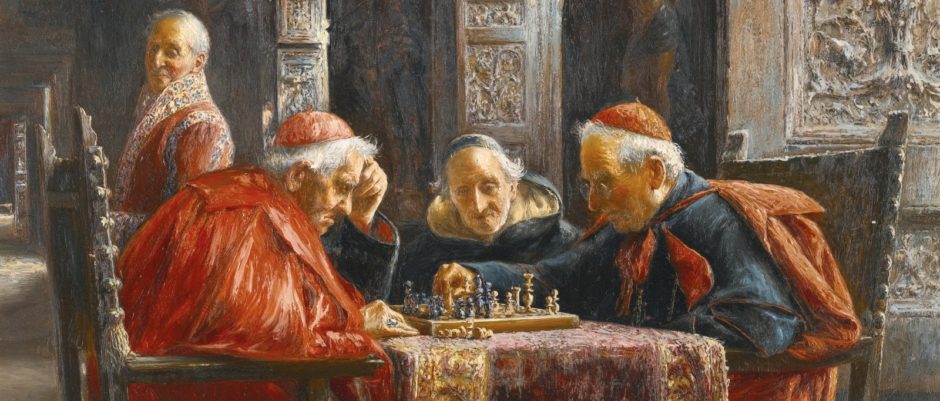
Remember: Even though there are religious groups of men who go through these old minor orders, in the Latin Church the clerical state begins at ordination as a deacon, either permanent or transitional.  At that point a men either makes promises of celibacy or he doesn’t (if he is already married).  If these groups have their own internal practices about the old minor orders, and they decide among themselves that they are going to treat those rituals with gravity and make them a part of what they do, fine.  But they don’t have juridical force.  I have no idea what spiritual effects they might confer.  I suppose that depends on their spiritual state and God’s benignity.


Posted in ASK FATHER Question Box |
12 Comments

Start praying… or else!

Biretta tip to the great Fr. Blake,  o{]:¬)  PP in Brighton!

I don’t think we want this… so we had better pray for vocations!

Now!

Start praying!

UPDATE 2228 GMT

Some people don’t think this is funny.  I do.  But then… I have a sense of humor!  o{]:¬)

Funny or not?

Total Votes: 803 Started: 9 August 2009


Posted in Lighter fare, The future and our choices |
30 Comments
























