The Feeder Feed

It has been a long time since I have been able to share photos from the Sabine feeder.

Things have changed.

I haven’t seen many Orioles, but there are a few around.

A woodpecker checking things out.

The enemy is baffled.  These things really work!

It was definitely girls day out for breakfast this morning for the Grosbeaks.  There were four females at the feeder at the same time. 

I have not seen any males since I have been back…. which actually hasn’t given me much time at all to observe!

However, there was one with different coloring, trying to get at a feeder no self respecting Grosbeak would try for.  I conclude this is an immature bird who hasn’t figured things out yet.  Also, I noted the red under the wings and a more discernible reddish hue to the breast feathers.  Interesting.

Not the only flying things at the feeder right now.  Wasps have found the grape jelly.  Grrr……  I must kill them when I find their nest.

This woodpecker was amusing.  She got a nice shiny peanut and couldn’t get it down, try try as she might.

Eventually she actually put it back into the feeder, regrouped, grabbed it again, and flew away with it.

The Chickadee contingent has been scare.  But this one is coming in to eat… note the darker gray feathers of the breast.  Also immature?

Posted in The Feeder Feed |
8 Comments

More photos of “play Mass”

It is interesting how one post can engender another.

This is from a reader:

Dear Father,

A friend forwarded our family a link from your site–a young boy had replicated the mass using some small plastic toys. We found it quite amusing because we, too, replicate mass with the very same toy brand.  There is usually quite a bit of improvisation, including paper clips, tissue paper, fabric scraps, and saint statuettes snatched from various bedside tables, bookshelves and dressers.  You may also notice that the kneeling altar boys are not actually kneeling (they bend only at the waist and arms);  rather, they are sitting down and their heads have been turned backwards. If you look at their feet you may find a humorous sight.

Attached you will find a few pictures detailing the fruits of a rainy Saturday afternoon. Below you will find short descriptions of each photo. 

The numberings are the last two digits of each file name.
#20: Holy Mass-Asperges action shot: Narthex view
#24: Holy Mass-Asperges action shot: behind Altar view
#32: Altarpiece close-up
#36: Asperges action close-up

You may notice that Mary and Joseph were added in a few of the pictures–they are a bit larger than the other statuettes, and we weren’t quite sure how to place them at the beginning of the photo shoot.

Thank you so much for your blog; it is our family’s computer home page and the cause of many fruitful dinnertime discussions.


Posted in Brick by Brick, Just Too Cool, Lighter fare | Tagged ,
4 Comments

PENJING REPORT

PENJING REPORT

Penjing still thrives and still has very little to say. 

Time to get out the clippers.

The Chinese Elm, Penzai, has leafed out very well.

A trim will be necessary soon.  I’ll have to read up on this tree.

The Japanese Maple, Irohamomiji, is doing well. 

I thought he had been dropped on his head as a sprig, but everything is fine now!

Posted in My View |
4 Comments

Transfiguration: Feast for the Lateran Basilica

Did you know that today is the titular feast of the Basilica of St. John Lateran, the Cathedral of Rome?

"But Father! But Father", I can hear you objecting. "Don’t you know that that basilica is called ‘St. John‘? How can the Transfiguration of the Lord be the titular feast?"

Glad you asked. The real name of the Lateran Basilica is the Archbasilica of the Most Holy Savior, St. John Baptist and St. John the Evangelist at the Lateran. So, for a titular feast you really need a feast of the Lord.

While today is the main day for the basilica, they do make much over the two saints John as well. I do too. For my "onomastico", as the Italians call it, or "name day" I claim both the Baptist and the evangelist. That way I get two says in the summer (don’t forget the feast of the Beheading of St. John the Baptist) and one in the winter.

And let us not forget that the Lateran Basilica is a Major Papal (formerly Patriarchal) Basilica. There are lots of minor basilicas in Rome and throughout the world There were five Patriarchal Basilicas in Rome to go with the five ancient patriarchal sees, four major patriarchal basilicas and one minor. How did that happen? The patriarchs always were allocated (symbolically) a basilica in Rome, thus Constantinople, Alexandria, and Antioch, had St. Peter’s in the Vatican, St. Paul’s outside the walls, and St. Mary Major. When Jerusalem was added as a patriarchate it was assigned St. Lawrence outside the walls, though it remained a minor basilica.

The Bishop of Rome as Patriarch of the West had the Lateran Basilica obviously. And he still does, even though the Pope seems to have dropped the title of Patriarch of the West (remember that?). Interesting move that. And now some of the Orthodox are irritated that the Pope dropped the title.

I opined a long time ago that by dropping the title the Pope might be signaling that he is not patriarch of the West ONLY, but patriarch of pretty much everywhere (except for outer space, which I think belongs to someone else whom I shall not name).

Anyway, this is the titular feast of the Lateran Basilica.

Posted in Classic Posts, Linking Back | Tagged ,
4 Comments

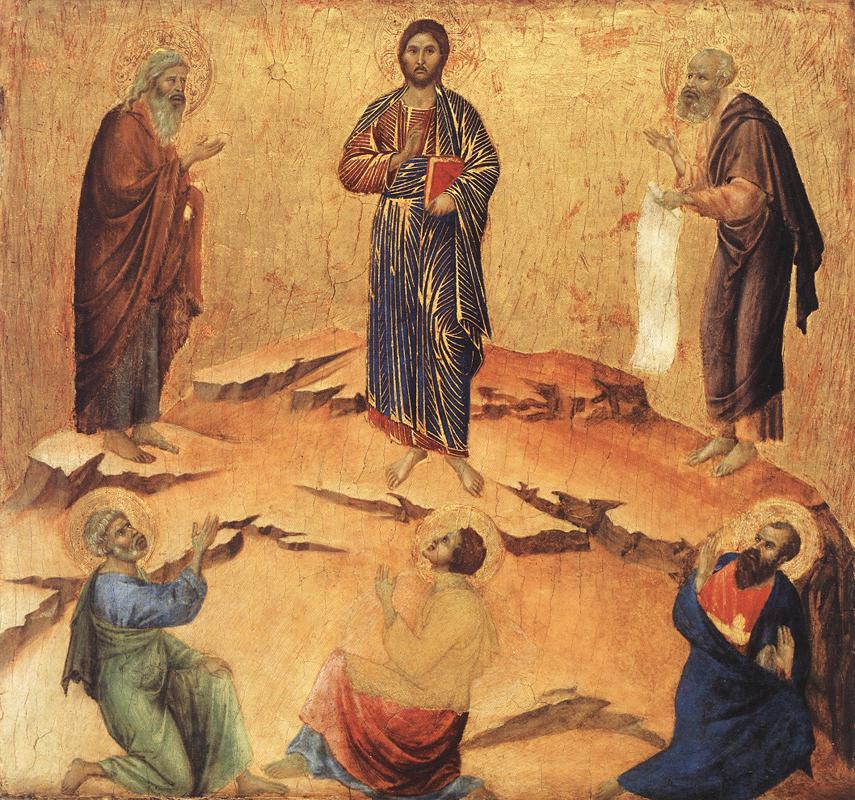
The 4th Luminous Mystery: Transfiguration

We continue our Patristic Rosary Project today with the:

4th Luminous Mystery: The Transfiguration

The Mystery of the Transfiguration was a matter of intense reflection on the part of the Fathers.

Remember that this takes place some eight days after the Lord confers the keys on Peter by the Jordan at Caesarea Philippi.  The Fathers thought everything in Scripture was significant and they attached great meaning to numbers.  Let us see what the mighty Ambrose of Milan (+397) has to say about the timing of the Transfiguration in relation to the events at Caesarea Philippi:

You may know that Peter, James and John did not taste death and were worthy to see the glory of the resurrection.  It says, "about eight days after these words, He took those three alone and led them onto the mountain." Why is it that he says, "eight days after these words"?  He that hears the words of Christ and believes will see the glory of Christ at the time of the resurrection.  The resurrection happened on the eight day, and most of the psalms were written "For the eighth".  (cf. e.g., Ps 6:1; 12:1 LXX and Vulgate)  It shows us that He said that he who because of the Word of God shall lose his own soul will save it, (Luke 9:24) since he renews his promises at the resurrection.  (Matthew 16:25-27)  But Matthew and Mark say that they were taken after six days.  (Cf. Matthew 17:1; Mark 9:2)  We may say that they were taken after six thousand years, because a thousand years in God’s sight are as one day.  (Ps 89:4 LXX)  We counted more than six thousand years.  We prefer to understand six days as a symbol, because God created the works of the world in six days (Gen 2:1), so that we understand works through the time and the world through the works.  [Exposition of the Gospel of Luke 7.6-7]

St. Augustine (+430) also gets into this issue of six days, as recounted in Matthew and Mark, and eight days (as in Luke) in a discussion of the resurrection three days after the Passion and death of the Lord.  He is trying to make sense of the numbers.  In other places I have explained how the ancients numbered their periods of days, that is, inclusively.

St. Cyril of Alexandria (+444) wrote of the Transfiguration in terms of the connection between suffering and glory, between the Law and the Prophets, between the foreshadowings of the past and their fulfillment.

"I say to you, there are some of those standing here who shall not taste of death until they have seen the kingdom of God." … By the "kingdom of God" He means the sight of the glory in which He will appear at His revelation to the inhabitants of earth.  He will come in the glory of God the Father and not in a humble condition like ours.  How did He make those who received the promise spectators of a thing so wonderful?  He goes up into the mountain taking three chosen disciples with Him.  He is transformed to such a surpassing and godlike brightness that His garments even glittered with rays of fire and seemed to flash like lightning.  Besides, Moses and Elijah stood at Jesus’ side and spoke with one another about His departure that He was about, it says, to accomplish at Jerusalem.  This meant the mystery of the dispensation in the flesh and of His precious suffering upon the Cross.  It is also true that the law of Moses and the word of the holy prophets foreshadowed the mystery of Christ.  the law of Moses foreshadowed it by types and shadows, painting it as in a picture.  The holy prophets in different ways declared before hand that in due time He would appear in our likeness and for the salvation and life of us all, agree to suffer death on the tree.  Moses and Elijah standing before Him and talking with one another was a sort of representation.  It excellently displayed our Lord Jesus Christ as having the law and the prophets for His bodyguard.  It displayed Christ as being the Lord of the Law and the Prophets, as foretold in them by those things that they proclaimed in mutual agreement beforehand.  The words of the prophets are not different from the teachings of the law.  I imagine this was what the most priestly Moses and the most distinguished of the prophets Elijah were talking about with one another.  [Commentary on Luke, Homily 51]

The last line here is interesting.  It makes me call to mind what one finds in studying ancient historiography, such as Herodotus and Thucydides.  When reporting the speeches great figures made, about which they might at the very best have some distant report from someone who heard about the content of the speech, such as Pericles’s great oration, from a generation or more removed, Thucydides would record what the great man ought to have said in that momentous occasion.  This sounds much like what Cyril is doing.

Have you ever wondered why some get some graces and others do not?  St. Maximus Confessor (+682) gives an interesting insight while he comments on the Transfiguration:

The Lord does not always appear in glory to all who stand before Him. To beginners He appears in the form of a servant (Phil 2:7); to those able to follow Him as He climbs the high mountain of His Transfiguration He appears in the form of God, the form in which He existed before the world came to be (John 17:5). It is therefore possible for the same Lord not to appear in the same way to all who stand before Him, but to appear to some in one way and to others in another way, according to the measure of each person’s faith. When the Logos of God becomes manifest and radiant in us, and His face shines like the sun, then His clothes will also look white. That is to say, the words of the Gospel will then be clear and distinct, with nothing concealed. And Moses and Elijah – the more spiritual principles of the Law and the Prophets – will also be present with Him.  

St. John Chrysostom (+407) takes on this same issue:

"Now after six days Jesus took Peter, James and John his brother, led them up on a high mountain by themselves;" (Matt. 17:1) …Note, I pray you, the severe goodness of Matthew, not concealing those who were preferred to himself. Also, John often does this (in his Gospel), recording the peculiar praises of Peter with great sincerity. For the choir of these holy men (disciples) was everywhere pure from envy and vainglory. Having taken, therefore, the leaders, "He was transfigured before them. His face shone like the sun, and His clothes became as white as the light. And behold, Moses and Elijah appeared to them, talking with Him." (Matt. 17:2,3) Why does Jesus take with Him these three only? Because these were superior to the rest. And, Peter indeed showed his superiority by exceedingly loving Him; John; by being exceedingly loved by Him; and James again by his answer which he gave with his brother, saying "We are able (to drink this cup);" (Matt. 20:22) but not by this answer only, but also by his works …For so earnest was he (James), and so grievous to the Jews, that Herod himself supposed that he found favor with the Jews by slaying him (James)."  [St. John Chrysostom, Homily 56]    

I suppose we ought to be careful what we ask for.  Our earthly fate notwithstanding, we are always able to have a moment of Transfiguration in the proper reception of Holy Communion, which is far more than a mere vision of something of Christ’s divine shining through our humanity.  The Eucharist is not only the Body, Blood, Soul and Divinity of Christ, it is for us a "pledge of future glory, containing in Itself all delight", as St. Thomas Aquinas (+1274) wrote for the feast of Corpus Christi, and which we all sing whenever there is Benediction of the Blessed Sacrament.  A good reception of Communion is an even greater encounter with the Lord, than a Transfiguration.  It opens up the way to a bright future for us.  On that note, Gregory of Nazianzus (+389) ties us all into the mystery of the Transfiguration, saying:

He was bright as the lightning on the mountain and became more luminous than the sun, initiating us into the mystery of the future.  [Oration 3.19, On the Son]
Posted in Classic Posts, Linking Back, Patristic Rosary Project |
4 Comments

Pears

From the Confessions 4.9 of St. Augustine (+430):

Theft is punished by thy law, O Lord, and by the law written in men’s hearts, which not even ingrained wickedness can erase. For what thief will tolerate another thief stealing from him? Even a rich thief will not tolerate a poor thief who is driven to theft by want. Yet I had a desire to commit robbery, and did so, compelled to it by neither hunger nor poverty, but through a contempt for well-doing and a strong impulse to iniquity. For I pilfered something which I already had in sufficient measure, and of much better quality. I did not desire to enjoy what I stole, but only the theft and the sin itself.

There was a pear tree close to our own vineyard, heavily laden with fruit, which was not tempting either for its color or for its flavor. Late one night — having prolonged our games in the streets until then, as our bad habit was — a group of young scoundrels, and I among them, went to shake and rob this tree. We carried off a huge load of pears, not to eat ourselves, but to dump out to the hogs, after barely tasting some of them ourselves. Doing this pleased us all the more because it was forbidden. Such was my heart, O God, such was my heart — which thou didst pity even in that bottomless pit. Behold, now let my heart confess to thee what it was seeking there, when I was being gratuitously wanton, having no inducement to evil but the evil itself. It was foul, and I loved it. I loved my own undoing. I loved my error — not that for which I erred but the error itself. A depraved soul, falling away from security in thee to destruction in itself, seeking nothing from the shameful deed but shame itself.


And now a more modern take, from the other point of view, through the help of the Laudator temporis acti:

Eden Phillpotts, My Garden (London: Country Life, 1906), pp. 198-200:

    Prime of garden pests is the human boy. In the pupa stage this creature evadeth every lure, and causeth much anguish of mind within the confines of cultivated ground. He hath no eye to distinguish between the grass plat and the garden knot, but trampleth indifferently upon either, and loveth best to frisk over soil wherein rare and curious seeds are germinating. Glass hath an affinity or attraction for him, and when he breaketh the same, he lifteth up his voice shrilly in merriment; but maketh still louder sounds to indicate anguish, when captured and chastened. At the season of Spring he haunteth shrubberies, and leapeth out upon the innocent traveller with horrid, inarticulate sounds. The ear may mark his unseen progress through plantations by the snapping of green boughs and by the outcry of parent birds. Occasionally, in his efforts to secure the nurseries of fowl upon lofty trees or precipices, he falleth and breaketh his neck; but this seldom happeneth, because he hath a feline plenitude of lives, and, in the art of self-preservation, is ever very nimble, discreet, and unscrupulous. During the autumnal months he affecteth the place of fruit, and by strategy may there be taken at any time in the day with full pockets and full cheeks. He hath no special taste in fruits, but devoureth with the impartial profusion of the caterpillar and canker worm. The birds of the air surpass him by their wise patience, for they know to an hour when the perfection of plum or pear has come; but not so he.

    ….

    There is no cure for the human boy save time. Then, by exceeding slow stages, he groweth into the adult organism, and either turneth from his mysterious courses toward justification of existence, or else, as too often happeneth, doth wax in wickedness, as well as in the power to perform it.


Posted in Patristiblogging |
3 Comments

PAKISTAN: Muslims burn 6 Christians to death after false allegations

Will the Obama Administration have a comment on this?

From CNA:

Muslims burn 6 Christians to death after false allegations

Lahore, Pakistan, Aug 2, 2009 / 11:31 am (CNA).- Religious extremists struck again in Pakistan on Saturday when a violent mob of Muslims looted and burned a Christian neighborhood, killing six Christians by burning them to death. The attacks took place in reaction to a rumor that the Koran was desecrated in a nearby village.

The violence, which took place in the central Punjab town of Gorja City, occurred early on Saturday when a throng of Muslims surged into the Christian quarter, setting all 40 of the Christian houses and two churches aflame.

As the crowd of Muslims approached Gojra City, Christians fired shots at them in self-defense.

Six Christians—four women, a man and a 7 year-old child—were burned to death in the attacks.

The rioters were enraged by the alleged desecration of the Koran in the village of Koriyan, about two miles away.

However, Rana Sanaullah, provincial minister for law, who is also responsible for security matters of Punjab, said that an initial investigation found there was no desecration of the Koran. "It was just a rumor which was exploited by anti-state elements to create chaos," he said.

According to locals, the police observed the looting and burning, but took no action. “Though police was present at the time of attack, miscreants were not stopped by them,” local Christians complained. After some time, the police tried to stop the protesters, but the mob turned on the police, resulting in some injuries.

According to Minorities Concern of Pakistan, “this is the third incident in the last two months of this kind in Punjab province in which Christian localities were attacked due to alleged blasphemy.”

Christians make up just 1.5 percent of the total population of Islamic Republic of Pakistan

Posted in The future and our choices | Tagged
12 Comments

QUAERITUR: blessing an iPhone for use in reciting the Rosary

From a reader:

Fr. Z:

Much of the time, I use one of the Rosary applications on my iPod touch in order to pray the Rosary.  Would it be appropriate to ask a Dominican or other priest to use the Rosary blessing on my iPod touch, or is this just too weird?  I suppose the same would be true of any other non-beads way of praying the Rosary.

In all seriousness, does one need to use bead-Rosaries in order to get your Rosary mechanism blessed?  This might be an increasing issue going forward.


I quickly reviewed the Enchiridion Indulgentiarum to see what is required for gaining the indulgences attached to recitation of the Most Holy Rosary of the Blessed Virgin Mary.

I did not discover, as I suspected I would not, that rosaries must be blessed for you to gain the indulgence.

It was indeed the custom that if you used a rosary blessed by a Domincan or a priest with a special faculty to do so, you could gain additional indulgences than those which were laid out in, for example, the Raccolta.  I don’t believe that is any longer in force.

Nevertheless, I think it is a very good thing to have your rosary blessed by a priest or bishop…. or Pope for that matter.

A rosary is a thing most terrifying to our deadly spiritual enemies, Ol’ Scratch and his demonic minions.  They really hate this thing.  However, when it is also a sacramental, that is, ripped from the realm of the profane and given over entirely to the realm of the sacred, a rosary is an even greater tool and defense against evil – especially when used.

I recommend that you have your rosaries blessed by a priest using the older, traditional Rituale Romanum.  The simple prayer for blessing in the older Rituale actually constitutes the rosary as a blessed thing.  I believe that one of the options in the newer (and nearly useless) "Book of Blessings" or in Latin De Benedictionibus, retains the older form of blessing as it is in the older Rituale Romanum

The Rituale has two forms for blessing a rosary, a longer used by Dominicans (and other priests) and a shorter, which is the usual.

That said, we might consider that whole blessing the iPhone business.

There are blessings for Telegraph machines in the older Rituale.  And iPhones are used for e-mails and SMSs.  There is a blessing for a radio station, and the iPhone does broadcast and receive.

This is why we do need an updated book with blessings for some modern things not even in the imagination of those who originally worked with the Rituale Romanum.  But it has to be a good book, with a sound theology of blessings rather than the insipid tasteless-salt book I mentioned above.

I guess you could use the blessing "For all things", but I rather like the idea of a little adaptation to those I mentioned above.

I once blessed the hardware going into someone’s knee-replacement.  I used the blessing for mountain climbing equipment. 

I am ever the optimist.

Posted in ASK FATHER Question Box | Tagged , , ,
8 Comments

A reader reacts about the SSPX “emergency powers” argument

Under another entry, a reader posted a comment about the whole SSPX "emergency powers" argument, by which the same SSPX justifies its lack of obedience to the Bishop of Rome and continues to act without any kind of permission or jurisdiction.

Here it is, edited slightly, and with my emphases and comments.

Father, it so hard for me not to be sympathetic to the SSPX’s "state of necessity" position.

The situation in my home diocese is absolutely wretched. A third of the parishes have been closed in the last 10 years, and those that remain are mostly in a deplorable state.

The Cathedral has been wrecked, with the "altar" now in the middle of the nave and other renovations to promote a heterodox understanding of the Mass.

Even worse, prominently displayed in the Cathedral bookshop (located at the entrance of the nave) are books by Joan Chittister (in good standing), Charles Curran (in good standing), Richard McBrien (in good standing), and John Shelby Spong.

Father Z, my bishop is selling books by JOHN SHELBY SPONG in our Cathedral!

My family’s old parish has LGBT rainbow flags in the vestibule. You can imagine how the rest of it is. Yet this scandalous priest and others operate with the support of my bishop.

I say it is my family’s OLD parish because almost my entire family has fallen out of the Catholic Church.

Gone. My father and I are the only practicing Christians in my immediate family—he’s a Baptist. He left after his world (the Church) imploded with chaos and novelty. He decided that the Church was obviously just a man-made institution, and a sick one at that.

Most of the rest of my family has simply fallen away.

I did not grow up a Catholic and was (by the miraculous grace of God) a convert in college. My family, before the 1970s, was Catholic for probably a millennium and a half going back to Italy.

The only other Catholics left in my family are several second cousins—and they (and their children) go to the SSPX chapel in my diocese (which is booming with young families).

Father, I never go to SSPX chapels (out of obedience). But I can’t begrudge my second cousins—I fear for their children’s prospects if they were elsewhere.

Indeed.

While it is necessary to interject at this point that "two wrongs don’t… er um… well… a whole bunch of wrongs don’t make a right", it is indeed hard to begrudge people their search for something which seems simply "normal" instead of the Salvador Dali landscape they find themselves in when they go to church.

Posted in Linking Back, The future and our choices |
16 Comments

Tasty beers and …. free SNAKES!

I know how hard it is to learn another language and to translate from one language to another with anything like both accuracy and correct idioms.

That is why I enjoy the site Engrish.

For a chuckle:

Posted in Lighter fare |
5 Comments