General Chapter of the SSPX is underway. PRAY!

The General Chapter of the SSPX is underway in Ecône, Switzerland.

I warmly request everyone to PRAY for the men as they meet, asking the Holy Spirit to bend what is rigid and warm what is cold.

Also, I noted with great interest that the new Vice President of the Pontifical Commission “Ecclesia Dei“, His Excellency Most Rev. Augustine DiNoia, OP, has asked his fellow Dominicans to pray the Litany of Dominican Saints for the reconciliation of the SSPX.  HERE.

One of the things I pray for is that, when the reconciliation comes (and I think it will), few if any of the SSPX priests will separate themselves and refuse to be reconciled.

Posted in SSPX, Urgent Prayer Requests | Tagged ,
18 Comments

Gregorian chant recordings from 1904 – interesting but… YIKES!

Over at Rorate I found links to fascinating recordings on Youtube from 1904. 

First is the famous Benedictine pioneer of modern Gregorian chant, Dom André Mocquereau. He conducts students of the French Seminary in Rome in the chant Alleluia Pascha nostrum.

I find the chant deeply … disturbing, but then I am firmly in the camp of Dom Cardine.

In my conversation about this recording with Jeffrey Tucker at Chant Cafe, the comment came up:

“Chant had to be destroyed to be saved.”

Only too true.

[wp_youtube]cthAs7-OC7I[/wp_youtube]

Whew! We have come a loooooong way since then.

Don’t sing chant that way.  Again, I am in the more fluid Cardine camp. I also don’t go for the choppy proportional approach.

The other recording, of Dom Joseph Pothier with a schola of Benedictines from Sant’Anselmo in Rome is marginally better.  Pothier was a promoter of a style that stuck to the sense of the prayer though with a strong adherence to equality of length of notes.  But under Pothier they have the same tendency to chop up the figures and … what’s with that dreadful glide?

[wp_youtube]FtQGuasAx0I[/wp_youtube]

Mocquereau and Pothier butted heads over the values of, the duration, of notes.

Anyway, chant probably had to be destroyed to be saved.

Posted in "How To..." - Practical Notes, Liturgy Science Theatre 3000 | Tagged , ,
55 Comments

QUAERITUR: Mass obligation at an SSPX chapel and receiving Communion

From a reader:

I would love to attend the TLM, and there is an SSPX Chapel less than 15 miles from my home; but everytime I try to get information regarding the SSPX, I’ve received contradictory information. One “expert” claims that attendance at an SSPX chapel fulfills the Sunday Obligation, another says it doesn’t; one says that I may receive Holy Communion there, another says that I may not receive their sacraments.

I’ve also been told that I’m welcome to attend, so long as I’m only there for the love of the TLM. Are there “official rules” somewhere?

Canon 1248 § 1 of the Code of Canon Law states:

The precept of participating in the Mass is satisfied by assistance at a Mass which is celebrated anywhere in a Catholic rite either on the holy day or on the evening of the preceding day.

Unless you are for a serious reason prevented from attending Mass at a recognized chapel or church, I will not recommend that you attend regularly a chapel of a group that is not in clear union with the Roman Pontiff.  If you do attend occasionally, from the motive of experiencing the TLM (and not, for example, because you reject the Church’s teaching in some way), I will not recommend receiving Holy Communion, unless there is serious reason why you cannot receive in a normal place clearly in union with the Holy Father and local bishop.  That said, it would be permissible to make a small donation when the collection is taken up.

Furthermore, if that chapel is truly a chapel staffed by an actual priest of the SSPX, then you do fulfill your obligation on days of precept by attending Mass there on the day itself or on the evening before.  However, there was a recent letter from the Pontifical Commission “Ecclesia Dei” clarifying that attending Mass at some independent chapel associated with the SSPX but not actually under its aegis does not fulfill the obligation.  More on that HERE.

Pray for an end of the division and the full reconciliation of the SSPX with the Roman Pontiff.

Posted in "How To..." - Practical Notes, ASK FATHER Question Box, Liturgy Science Theatre 3000, Our Catholic Identity, SSPX, The Drill, The future and our choices | Tagged , , ,
35 Comments

QUAERITUR: Returning to the Church after joining another church for many years

From a reader:

If a person leaves the church and joins another faith for 10 plus years, what is required to return to good standing in the church?

This isn’t as hard as one might imagine.

Usually all a person has to do is make a sincere and complete confession of all mortal sins of commission or omission since the last confession, have whatever censures she incurred lifted (not hard), and then return to the proper life of a good Catholic!  Easy Peasy.

In the case that a person made a formal act of apostasy (e.g., in Germany in order to avoid paying the Church tax), she – once upon a time – would have had to go though other steps before returning to the sacraments.  However, in 2009 a document called Omnium in mentem was issued whereby the Church’s law about these formal acts was changed.  Now, the Church no longer considers it possible to defect from the faith by formal act.  Therefore, there are no canonical consequences from formal defection.  Were a person to film herself signing a document and then publish the photos and take out ads in the newspaper, according to the Church they would not have formally defected from the Church.

Thus, people cannot now formally defect.  They can, however, still incur a censure of excommunication – a spiritual and medicinal penalty – for heresy or schism or apostasy (cf. can 1364).  In order to incur any censure she would have had to understand the consequences of the act.  Therefore, if she joined another church without really understanding the canonical consequences (e.g., she married a Lutheran and started going to services with her spouse and then joins the Lutheran parish…) then it is likely that no excommunication is incurred.

So, in order to return to the light and grace of the Church and leave the darkness of soul endangering heresy and schism, in most cases simply going to confession and getting any censure lifted is all one has to do to.

Finally, on a slightly different but related note, the Code says in can. 1366 that parents or those who take the place of parents who have their children baptized or educated in a non-Catholic religion are to be punished with a censure or other just penalty. If we have an obligation to maintain our Catholic identity for ourselves, we also have an obligation to maintain the Catholic identity of children for whom we are responsible.

Posted in "How To..." - Practical Notes, ASK FATHER Question Box | Tagged , , , , , , ,
17 Comments

QUAERITUR: Music during the consecration

From a reader:

Lately, the music director at our church has been “tickling the ivories” during the Consecration. While at the piano, in the front of church (naturally), he has been playing tunes, based on hymms for sure, on the piano during the entire Consecration (with a well timed pause during the elevation). It’s not irreverent, but it does sound like “lounge music“. [As the non-liturgical instrument, the piano, nearly always does.] I find it annoying, and keep wondering when Tony Bennett comes on stage (I’m kidding, of course). [Put a brandy snifter with a dollar bill on the piano next time and see if he gets the hint.]
Is this permissible? I tried to looking this up in Canon Law on the Vatican site, but did not see any prohibition.

This is NOT permitted.

There must be no music during the consecration.  This has been repeated in many documents, but Redemptionis Sacramentum made it clear again:

[53.] While the Priest proclaims the Eucharistic Prayer “there should be no other prayers or singing, and the organ or other musical instruments should be silent”, [cf. GIRM 32] ….

[53.] Dum Sacerdos celebrans Precem eucharisticam «profert aliae orationes vel cantus non habeantur, atque organum vel alia instrumenta musica sileant», ….

And the General Instruction Of The Roman Missal states:

32. The nature of the “presidential” parts requires that they be spoken in a loud and clear voice and that everyone listen to them attentively.[Cf. Sacred Congregation of Rites, Instruction, Musicam sacram, March 5, 1967, no. 14: Acta Apostolicae Sedis 59 (1967), p. 304.] Therefore, while the Priest is pronouncing them, there should be no other prayers or singing, and the organ or other musical instruments should be silent.

32. Natura partium «praesidentialium» exigit ut clara et elata voce proferantur et ab omnibus cum attentione auscultentur. Proinde dum sacerdos eas profert aliae orationes vel cantus non habeantur, atque organum vel alia instrumenta musica sileant.

Pretty clear.

The music director should be given a copy of these texts.  If the problem persists, inform the parish priest.  If the problem persists, notify the local bishop.

Posted in "How To..." - Practical Notes, ASK FATHER Question Box, Liturgy Science Theatre 3000 | Tagged , , , ,
59 Comments

Being as “cunning as serpents and as innocent as doves” without losing dignity, honor, and self-respect.

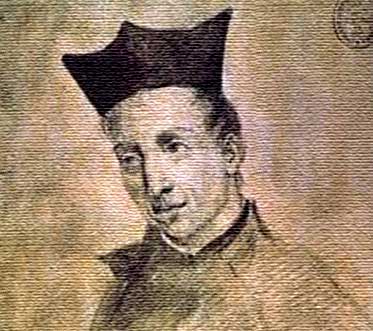
At the blog The Art of Manliness I was pleasantly surprised to see the image of a priest in a biretta.

Here is some of the entry, but I have bulletpoint-ized the headings.  You’ll have to go there to find out about them.

Emphases added:

Back when I was in high school, a mentor of mine gave me a copy of a small book that I’ve read and re-read several times over the years. The Art of Worldly Wisdom or The Pocket Oracle and the Art of Prudence, [KINDLE HERE for $0.99.  UK HERE.] is a book of 300 maxims and commentary written by a 17th century Jesuit priest named Baltasar Gracián. Considered by many to be Machiavelli’s better in strategy and insight, Gracian’s maxims give advice on how to flourish and thrive in a cutthroat world filled with cunning, duplicity, and power struggles, all while still maintaining your dignity, honor, and self-respect. In many ways, The Art of Worldly Wisdom is a how-to book on fulfilling Christ’s admonition to his apostles to be “cunning as serpents and as innocent as doves.”  Philosophers Schopenhauer and Nietzsche both admired Gracian for his insight, subtlety, and the depth with which he understood the human condition.

While Gracian’s maxims were directed to men trying to gain favor in the dog-eat-dog world of 17th century Spanish court life, they’re just as applicable to a 21st century man trying to both succeed in a hyper-competitive globalized economy and develop an upright, heroic character. Taken together, Gracian’s frank, incisive maxims are reminders of the power of living with sprezzatura and that practical wisdom–the ability to do the right thing, at the right time, for the right reason—is essential to success in life. Below I highlight a few of my favorite Gracian maxims. I highly recommend that you pick up a copy of his book with all 300 nuggets of wisdom and keep it on your nightstand. It’s a great little book to flip through and read in spare moments. You’ll be a better man for it.


Maxims of Baltasar Gracián

  • In your affairs, create suspense.
  • The height of perfection.
  • Don’t arouse excessive expectations from the start.
  • Never exaggerate.
  • Never lose your self-respect.
  • Never lose your composure.
  • Don’t be uneven, or inconsistent in your actions:
  • Choose a heroic model, more to emulate than to imitate.
  • Understand yourself:
  • Don’t hang around to be a setting sun.
  • Get used to the bad temperaments of those you deal with, like getting used to ugly faces.
  • Never complain.
  • Avoid familiarity when dealing with people.
  • Know how to appreciate.
  • Undertake what’s easy as if it were hard, and what’s hard as if it were easy.
  • Take a joke, but don’t make someone the butt of one.
  • Carry things through.
  • Don’t be carried away by the last person you meet.
  • Go with the flow, but not beyond decency.
  • Act as though always on view.
Posted in "How To..." - Practical Notes, Our Catholic Identity, The Drill | Tagged ,
20 Comments

Your Good News

Tell us some good news that you have.

Posted in SESSIUNCULA |
28 Comments

Islamic terrorists target and kill more Christians in Nigeria

From AP/ABCNews:

52 Killed in Central Nigeria Raids and Reprisals
By AHMED SAKA Associated Press

JOS, Nigeria July 8, 2012 (AP)

Raids and reprisal attacks have left 52 people dead in Christian villages near a Nigerian city where authorities have struggled to contain religious violence, officials said Sunday.

Assailants launched “sophisticated attacks” on several villages near Jos early Saturday, said Mustapha Salisu, spokesman for a special taskforce made up of policemen and soldiers deployed in the area to curb years of violence.

They came in hundreds,” Salisu said. “Some had (police) uniforms and some even had bulletproof vests.”

He said the special taskforce fought back for hours [!] and lost two policemen in the battle. Salisu initially said that 37 people were killed including 14 civilians and 21 assailants.

However, later in the day, Nigerian Red Cross official Andronicus Adeyemo said aid workers had counted 52 dead and more than 300 displaced people from the attacks. He did not give a breakdown.

He said a federal lawmaker and a state lawmaker were ambushed and killed Sunday afternoon on their way to a mass burial for the victims.

[…]

Mark Lipdo, who runs a Christian advocacy group known as the Stefanos Foundation, gave a list of the 13 villages where he got reports of attacks. He said they were all Christian.

[…]

Nigeria, a multiethnic nation of more than 160 million people, is largely divided into a mainly Christian south and a predominantly Muslim north. Jos is located in the “middle belt,” at the meeting point of these two regions.

Human Rights Watch says at least 1,000 people were killed in communal clashes around Jos in 2010.

However, the rise of a northern-based Islamist insurgency known as Boko Haram has added a new dimension to the long-running conflict, fanning religious tensions in this flashpoint area.

[…]

All previous Jos attacks have targeted churches, a deliberate move to trigger more religious violence, many have said. They all sparked reprisals.

Sts. Nunilio and Alodia, pray for us.

Posted in Modern Martyrs, Religious Liberty, The Last Acceptable Prejudice | Tagged , , , , , , ,
17 Comments

Troy, NY: Holy Mass in the traditional Carmelite Rite

From a reader:

“We are very happy to announce that each Monday in July Fr. Romaeus Cooney OCarm. will celebrate the Carmelite Rite Liturgy at St. Joseph’s Church, 416 3rd Street, Troy NY.

There will also be a Carmelite Rite Missa Cantata on Sunday the 15th to commemorate the Feast of Our Lady of Mount Carmel. Each of these liturgies [Masses!] is at 12pm.”

Posted in Liturgy Science Theatre 3000, The Campus Telephone Pole | Tagged
8 Comments

“In The Wild” – “Lockstep Sheep and Papist Throwbacks” Z-Swag

I always enjoy photos people send of Z-Swag out there “in the wild”. Here is a “Lockstep Sheep and Papist Throwbacks” mug in use.

Here is a note from a reader:

As per your request for more WDTPRS mugs in use, I snapped this photo of the Lockstep Sheep mug accompanied by a robot tea infuser. I use them together to remind me what a thoughtless automaton I am. ;-)

To get one of these (and many other things, too) click HERE.

Posted in In The Wild, Just Too Cool, Linking Back |
2 Comments