Your Good News!

Do you have some good news? C’mon! I know you do.

Posted in SESSIUNCULA |
38 Comments

Your Sunday Sermon Notes

Was there some particularly good point or line from the Sunday sermon you heard?

Posted in SESSIUNCULA |
44 Comments

Fox News show “Huckabee” has two powerful pro-life segments

I caught Mike Huckabee’s weekend show tonight.

After he interviews three of the four presidential candidates (ho hum), in the second part of the show, he interviewed a woman named Rebecca Kiessling, who was conceived during a rape.  A conversation with her helped Gov. Perry change his mind about the “rape and incest” exception.  Her story was pretty powerful.

And then there was Carol Everett, who ran abortion mills as a business because she wanted to be a millionaire.  She knew that, because of her cut from every abortion performed, she had to get 40,000 abortions performed.  Therefore, she needed repeat customers.  She described the strategy of getting young women to start using abortion as their strategy for all of their pregnancies.  She distributed low does contraceptives and defective condoms which would fail.  She eventually had a conversion experience, which she described during the interview.

I sure hope that Huckabee posts video clips of these brief interviews.

Finally, it is important to remember that there is no sin that any of us little humans can commit that the infinitive power of our loving God will not forgive provided we confess our sins and receive absolution.  And when we receive absolution, the sin is gone, removed, taken away, it is no more.  It isn’t covered over or ignored.  It is gone, removed by Christ, through the actions of the priest, and it will not be held against you at your judgement.

You may have the memory of the sin and you will have to do penance.  It may be very hard for a long time, but the guilt of the sin will have been taken away from you.

There is nothing we can do that is so bad that God cannot forgive.  Never forget that.

What a magnificent gift we have from Our Lord: the Sacrament of Penance.

Posted in Emanations from Penumbras | Tagged , , , ,
3 Comments

The Holy See did NOT approve NeoCat liturgical variants for Mass

The other day I posted about a certain approval given by the Holy See to some thing the NeoCats do.

At the time, I speculated that this was NOT an approval for the NeoCat liturgy, which many were (rightly, I think) worried about.

Despite my warning observations, some readers of the more traditional stripe out there staged a little nutty.

It seems, however, I was right.  The Holy See did NOT approve the NeoCat variants for Mass (Deo gratias).

Read this on CNA:

Vatican approval for Neo-Catechumenal Way only applies to non-liturgical catechesis

Vatican City, Jan 21, 2012 / 05:15 pm (CNA).- The Vatican’s approval of the Neo-Catechumenal Way’s forms of “celebration” only applies to non-liturgical prayers within their catechesis and not to the Mass or other liturgies of the Church.

“With respect to the celebrations of the Holy Mass and the other liturgies of the Church,” communities of the Neo-Catechumenal Way must “follow the norms of the Church as indicated in the liturgical books – to do otherwise must be understood to be a liturgical abuse,” a Vatican official told CNA on Jan. 21.

[…]

In this process, “the Neocatechumenal Way obtained no new permissions whatsoever,” said the official, who is familiar with the approval process for prayers and liturgies.

“Essentially, the Pontifical Council is only approving these things that are found in the Catechetical Directory of the Neocatechumenal Way, and in no way touches those things contained in the liturgical books.”

[…]

coffeeYou can read the rest over there at CNA.

And those of you who were worked up about this can relax and have a WDTPRS mug filled with soothing Mystic Monk Coffee!

Better make that decaf, okay?  Or herbal tea?  Maybe “Peaceful Monk”?

Try the Universae Ecclesiae mug.

UPDATE : 23 Jan 01:55 GMT:

I am getting love notes from NeoCats now.

One of them reads:

New and varied liturgical forms are good for the church.

You are an idiot and a mental retard.

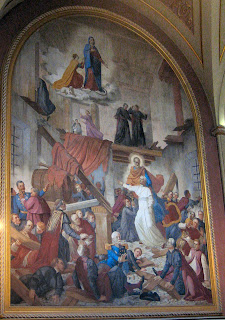
Varied liturgical forms like this?

I respond: We need Summoum Pontificum.

You know… this hurt my feelings soooooo much. I think you should all buy some Mystic Monk Coffee or Tea to make me feel better!

o{];¬)

Posted in Linking Back, Liturgy Science Theatre 3000 | Tagged ,
98 Comments

Collect 3rd Sunday of Ordinary Time

Some less than doctrinally-minded Christians are under the false impression that Catholics think we can “earn” our way to heaven by our own good works, as if our good works had their own merit apart from God.

Catholics believe that true good works always have their origin in God, but the works are truly our works as well, since we cooperate with God in performing them.  Therefore, having their origin and purpose in God, they merit the reward of God’s promises.

Whenever we find a reference to works in our liturgical prayers, do not forget the Catholic understanding of good works.

Omnipotens sempiterne Deus,
dirige actus nostros in beneplacito tuo,
ut in nomine dilecti Filii tui
mereamur bonis operibus abundare
.

This our Sunday Collect was in both the 1962 Missale Romanum and the 8th century Liber sacramentorum Engolismensis for Sunday in the Octave of Christmas.

Beneplacitum means “good pleasure, gracious purpose”.  In the Vulgate beneplacitum translates the original Greek eudokia in, e.g., Eph 1:9; 1 Cor 10:5.  Other phrases are used for eudokia too (e.g., bona voluntas in Luke 2:14, the famous “peace on earth to men of good will” or “peace on earth good will toward men”).  Paul wrote eudokia at the beginning of 2 Thessalonians (1:11-12), rendered as voluntas bonitatis in the Vulgate:

… we always pray for you, that our God may make you worthy of his call, and may fulfill every good resolve (omnem voluntatem bonitatis) and work of faith by his power, so that the name of our Lord Jesus may be glorified in you, and you in him, according to the grace of our God and the Lord Jesus Christ (RSV).

Abundo means, “to overflow with any thing, to have an abundance or superabundance of, to abound in.”  In that preposition in with the ablative indicating place or location in space (in beneplacito tuo) we have an image of our good works originating in God and, coming from Him, overflowing out to and from us.

A LITERAL VERSION:
Almighty eternal God,
direct our actions in your gracious purpose,
so that in the name of Thy beloved Son,
we may merit to abound with good works
.

OBSOLETE ICEL (1973):
All-powerful and ever-living God,
direct your love that is within us,
that our efforts in the name of your Son
may bring mankind to unity and peace
.

NEW CORRECTED ICEL (2011):
Almighty ever-living God,
direct our actions according to your good pleasure,
that in the name of your beloved Son
we may abound in good works
.

From before time and the universe were created, God knew each one of us.  Of all the possible universes He could have created, He chose to create this one, into which He fashioned us at the precise moment He foresaw we would be needed in His plan.  Along with existence, He gives us work to do, and offers the graces to do it.  When we cooperate, we “abound” because of God’s action within us through the good works He makes meritorious.  They overflow from us because of His generosity.

St. Augustine of Hippo (d 430), working against the errors of Pelagianism, wrote in a monumentally important letter to the Roman priest Sixtus (later Pope Sixtus in 432):

“What merit, then, does a man have before grace, by which he might receive grace, when our every good merit is produced in us only by grace and when God, crowning our merits, crowns nothing else but his own gifts to us?” (ep. 194, 5, 19).

To abound, we must bow and we must bend.

When we bend our will to God’s will and plan, especially as manifested through the teachings and disciplines of Holy Church, we lose nothing of our selves or our prized “freedom”.  In fact we become freer in our self-fettering to God.

Picking up a theme Pope John Paul II presented from the beginning of his pontificate, “Do not be afraid! Open wide the doors for Christ!”, Pope Benedict said in April 2005 during his homily for the Inaugural Mass of his pontificate:

“Are we not perhaps all afraid in some way? If we let Christ enter fully into our lives, if we open ourselves totally to him, are we not afraid that He might take something away from us? Are we not perhaps afraid to give up something significant, something unique, something that makes life so beautiful? Do we not then risk ending up diminished and deprived of our freedom? …  No! If we let Christ into our lives, we lose nothing, nothing, absolutely nothing of what makes life free, beautiful and great. No! Only in this friendship are the doors of life opened wide. Only in this friendship is the great potential of human existence truly revealed. Only in this friendship do we experience beauty and liberation.”

Posted in Our Catholic Identity, WDTPRS | Tagged , , , ,
11 Comments

The fruits of fixation!

Just. Too. Cool.

From Astronomy Pic of the Day comes this very cool photo.

What’s going on?

Here is part of their very cool description:

From solstice to solstice, this six month long exposure compresses time from the 21st of June till the 21st of December, 2011, into a single point of view. Dubbed a solargraph, the unconventional picture was recorded with a pinhole camera made from a drink can lined with a piece of photographic paper. Fixed to a single spot for the entire exposure, the simple camera continuously records the Sun’s path each day as a glowing trail burned into the photosensitive paper. In this case, the spot was chosen to look out over the domes and radio telescope of the University of Hertfordshire’s Bayfordbury Observatory. Dark gaps in the daily arcs are caused by cloud cover, whereas continuous bright tracks record glorious spells of sunny weather. Of course, in June, the Sun trails begin higher at the northern hemisphere’s summer solstice. The trails sink lower in the sky as December’s winter solstice approaches. Last year’s autumn was one of the balmiest on record in the UK, as the many bright arcs in the lower part of this picture testify.

What a great project for a kid!

Posted in Just Too Cool, Look! Up in the sky! | Tagged
2 Comments

What is Pres. Obama’s attack on the 1st Amendment really about?

I’ve been thinking about how Pres. Obama is no longer even pretending to seek “common ground”, as he said when he duped Notre Dame against the will of the American Bishops.  Pres. Obama, through his surrogate catholic Sec. of HHS, Kathleen Sebelius, is warring on the 1st Amendment.  He is attacking religious liberty.  There is no way around this.

Here’s the point of this little rant.

Pres. Obama probably won’t succeed.  This attack will probably be struck down by the Supreme Court.

He has to know that.

Therefore, he is really after something else.

He is doing this now so that it won’t be a campaign issue later.

He probably wants to make sure his supporters in his Democrat Party and the far left know that he is on record promoting their agenda.  He wants them to know that he tried.

Fine.  He is, indeed, trying.

But, regardless of his long game, in the short game everyone must close ranks against Pres. Obama’s attack on the 1st Amendment.

Posted in Religious Liberty, Wherein Fr. Z Rants | Tagged , ,
51 Comments

Inspiration!

I just got off the phone with an octogenarian parish priest.

My God!…what an inspiration.

Friends, pray for and encourage your priests.

Posted in SESSIUNCULA |
11 Comments

Fr. Z applauds Card. Mahony (yes, you read that right)

I’ve gotta hand it to him.

Roger Card. Mahony, emeritus of Los Angeles, has taken a stand on his blog – yes, he has a blog – against the Obama Adminstration’s attack on the religious liberty and, therefore, the Catholic Church.

He doesn’t mince words, either.

My emphases:

[…]

For me there is no other fundamental issue as important as this one as we enter into the Presidential and Congressional campaigns. Every candidate must be pressed to declare his/her position on all of the fundamental life issues, especially the role of government to determine what conscience decision must be followed: either the person’s own moral and conscience decision, or that dictated/enforced by the Federal government. For me the answer is clear: we stand with our moral principles and heritage over the centuries, not what a particular Federal government agency determines. [Do I hear an “Amen!”?]

As Bishops we do not recommend candidates for any elected office. My vote on November 6 will be for the candidate for President of the United States and members of Congress who intend to recognize the full spectrum of rights under the many conscience clauses of morality and public policy. If any candidate refuses to acknowledge and to promote those rights, then that candidate will not receive my vote.

This is a sad moment in the life of our country where religious freedom and freedom of conscience led to the formation of this new Nation under God.

[…]

WDTPRS kudos to Card. Mahony…. for this.

As you know, the HHS under catholic Kethleen Sebelius did THIS.

The USCCB said it was “literally unconscionable”.

The HSS announcement came one day after Pope Benedict gave an important address to US Bishops about the Church, the public square in America, and religious freedom.

UPDATE:

The combox is closed.

Posted in Our Catholic Identity, Religious Liberty, The Drill, The future and our choices, The Last Acceptable Prejudice | Tagged , , ,
1 Comment

Agnes: “Shining with the fire of divine love”

Let us invoke St. Agnes, virgin and martyr.

O glorious Agnes, chosen by God, though weak,
to make His own might manifest in your martyrdom,
together with the Apostles
intercede before the throne of our Our Father in heaven
and beg strength for the bishops of the Church in the United States
so that they will in  a timely manner,
and with no uncertain words and actions,
stand up for religious freedom in the face of attacks by the Obama Administration.

I have posted this in times past, but it bears repetition:

Here is something I have posted in the past… about St. Agnes of Rome.  Newcomers to WDTPRS may not have seen it.

Behold the skull of Agnes, in situ.

The dies natalis (“birthday into heaven”) of Agnes was recorded in the register of the depositio martyrum as 21 January.

St. Agnes was slain probably during the reign of the Emperor Diocletian in 304. Some say she died during the time of the Emperor Valerian (+260).

The little girl was buried by her parents in praediolo suo, on their property along the Via Nomentana where there was already a cemetery.

This cemetery expanded rapidly after that, because many wanted to be buried near the grave of the famous martyr. The ancient cemetery grew in stages between the Basilica which Constantina, daughter of Constantine and Fausta began over her tomb from 337-350 and the small round Basilica of Constantia (Constantine’s daughter).

There was an acrostic inscription from that time in verses about the dedication of the temple to Agnes:

Constantina deum venerans Christoque dicata
Omnibus impensis devota mente paratis
Numine divino multum Christoque iuvante
Sacravit templum victricis virginis Agnes…

You get the idea.

The Basilica of St. Agnes was reconstructed towards the end of the 5th c. by Pope Symmachus (+514). Honorius I (+638) rebuilt it as a basilica with three naves, adding a wonderful fresco of Agnes. It was worked on again in the 16th c. by St. Pius V and in the 19th by Bl. Pope Pius IX.

Excavations in 1901 uncovered the silver sarcophagus made by Pius V for St. Agnes together with St. Emerentiana.

It contained the headless body of a young girl.

Zadock gave us a photo of the miraclous protection of Bl. Pius IX when once at the Basilica there was a near disastrous cave-in/collapse and no one was injured.

While Agnes’s body is in her tomb on the Via Nomentana, her skull is now at the place of her supposed martyrdom at the Piazza Navona in Rome’s heart. It is a fitting place to venerate a saint so much in the heart of the Roman people even today. It is not unusual for people to name their children Agnes in honor of this great virgin martyr, whose name is pronounced in the Roman Canon.

The skull was bequeathed to that church at the Piazza by Pope Leo XIII who took it from the treasury of the Sancta Sanctorum.

The Piazza itself was in ancient times the Stadium of Domitian (+96) a place of terror and blood for early Christians, far more than the Colloseum ever was. The Piazza is thus called also the “Circo Agonale” and the name of the saint’s church Sant’Agnese in Agone. “Navona” is a corruption of “Agonale”, from Greek agon referring to the athletic contests of the ancient world. St. Paul used the athlete’s struggle as an image of the Christian life of suffering, perseverance, and final victory even through the shedding of blood. Early Christian tombs often have wavy lines carved im the front, representing an iron instrument called a strigil, used by athletes to scrape dirt and oil from the bodies after contests. Victory palm branches are still used in the iconography of saints, as well as wreathes of laurels.

We know about St. Agnes from St. Jerome, and especially St. Augustine’s Sermons 273, 286 and 354. St. Ambrose wrote about Agnes in de virginibus 1,2,5-9 written in 377 as did Prudentius in Hymn 14 of the Peristephanon written in 405.

Ambrose has a wonderful hymn about Agnes (no. 8), used now in the Roman Church for Lauds and Vespers of her feast. The Ambrosian account differs somewhat from others. For Ambrose, Agnes died from beheading. Prudentius has her first exposed to shame in a brothel and then beheaded.

Here is the text of the hymn from the Liturgia horarum for the “Office of Readings” with a brutally literal translation.

Igne divini radians amoris
corporis sexum superavit Agnes,
et super carnem potuere carnis
claustra pudicae.

Shining with the fire of divine love
Agnes overcame the gender of her body,
and the undefiled enclosures of the flesh
prevailed over flesh.

Spiritum celsae capiunt cohortes
candidum, caeli super astra tollunt;
iungitur Sponsi thalamis pudica
sponsa beatis.

The heavenly host took up her brilliant white spirit,
and the heavens lifted it above the stars;
the chaste bride is united to the
blessed bride chambers of the Spouse.

Virgo, nunc nostrae miserere sortis
et, tuum quisquis celebrat tropaeum,
impetret sibi veniam reatus
atque salutem.

O virgin, now have pity on our lot,
and, whoever celebrates your victory day,
let him earnestly pray for forgiveness of guilt
and salvation for himself.

Redde pacatum populo precanti
principem caeli dominumque terrae
donet ut pacem pius et quietae
tempora vitae.

Give back to this praying people
the Prince of heaven and Lord of the earth,
that he, merciful, may grant us peace
and times of tranquil living.

Laudibus mitem celebremus Agnum,
casta quem sponsum sibi legit Agnes,
astra qui caeli moderatur atque
cuncta gubernat. Amen.

Let us celebrate with praises the gentle Lamb,
whom chaste Agnes binds to herself as Spouse,
he who governs the stars of heaven
and guides all things. Amen.

We can note a couple things from this prayer. First, the reference to fire probably a description of Agnes’s death related in a metrical panegyric of Pope Damasus about how Agnes endured martyrdom by fire. On the other hand, St. Ambrose, when speaking of her death, speaks of martyrdom by the sword.

Pope St. Damasus composed a panegyric, an elogia, inscribed in gorgeous letters on marble (designed and executed by Dionysius Philocalus) in honor of Roman saints, including Agnes.  This was the period when the Roman shifted from Greek to Latin.  Damasus was also trying to make a social statement with these great inscriptions, set up at various places about the City.   The panegyic of St. Agnes was placed in the cemetery near the saint’s tomb, but through the ages it was lost. Amazingly, it was at last rediscovered in 1728 inside the basilica, whole and complete: it had been used upside down, fortunately as a paving stone!

Now it is affixed to the wall in the corridor descending to the narthex. Its discovery was a find of vast importance (thanks to Zadok for the photo of the inscription).

FAMA REFERT SANCTOS DUDUM RETULISSE PARENTES
AGNEN CUM LUGUBRES CANTUS TUBA CONCREPUISSET
NUTRICIS GREMIUM SUBITO LIQUISSE PUELLAM
SPONTE TRUCIS CALCASSE MINAS RABIEMQUE TYRANNI
URERE CUM FLAMMIS VOLUISSET NOBILE CORPUS
VIRIBUS INMENSUM PARVIS SUPERASSE TIMOREM
NUDAQUE PROFUSUM CRINEM PER MEMBRA DEDISSE
NE DOMINI TEMPLUM FACIES PERITURA VIDERET
O VENERANDA MIHI SANCTUM DECUS ALMA PUDORIS
UT DAMASI PRECIBUS FAVEAS PRECOR INCLYTA MARTYR

It is told that one day the holy parents recounted that Agnes, when the trumpet had sounded its sad tunes, suddenly left the lap of her nurse while still a little girl and willingly trod upon the rage and the threats of the cruel tyrant. Though he desired to burn the noble body in the flames, with her little forces she overcame immense fear and, gave her loosened hair to cover her naked limbs, lest mortal eye might see the temple of the Lord. O one worthy of my veneration, holy glory of modesty, I pray you, O illustrious martyr, deign to give ear to the prayers of Damasus.

Damasus used the sources available. There were the stories told by her parents, the 4th edict of Diocletian against Christians in 304 (lugubres cantus tuba concrepuisset). Agnes did what she did of her own free will (sponte). Note the reference to the body as temple of God (1 Cor 3:16 and 2 Cor 6:16).

St. Agnes of Rome, has two grand churches in Rome.  She has two feast days in the traditional Roman calendar.  Since the reform of the calendar, Agnes now has only one day, alas.

Posted in Linking Back, Patristiblogging, Saints: Stories & Symbols | Tagged , ,
Comments Off on Agnes: “Shining with the fire of divine love”