Something to spark your reading interests

Something to spark your reading interestsI noticed that Amazon is pushing now their Kindle reader at a lower price with the tradeoff that they can push ads and sponsored screensavers to your device.

You can pre-order Kindle with Special Offers (read = ads) for $114 today.  Kindle for #139 and Kindle 3G for $189 (includes free 3G wireless) also continue to be available, without special offers and sponsored screensavers (read – ads).  There is also the bigger Kindle for $379.

In my opinion, I would rather spend just a little more and get the version that doesn’t have any ads.  However, you might not mind them and might want to save a few bucks.  It is nice to have the option.

I didn’t think I would take to this method of reading books, but I have.  I wouldn’t want to use a Kindle for everything.  I tend to write in my books. I read pen in hand.  You can add notes to Kindle pages, however.  It is clunky, but it can be done.  You can highlight and bookmark passages.  You can see what other people who read the book highlighted as interesting to them.

My main uses of the Kindle are a) when I am traveling and b) when I want to read something which I don’t need or want to retain on my bookshelf.   I use the public library as much as possible.  I use the Kindle: the Kindle version of many books I don’t want to retain on my shelf is lower than a store bought or Amazon bought book.  You can also download daily newspapers and magazines.  However, the catch is that you have to have the actual Kindle device: you can’t get subscriptions if you have only the free apps.

If you are not using your wi-fi or 3G and switch them off the Kindle holds a standby charge for a very long time.

You can use Kindle to read this blog, btw.

I have the 3G version.  I can connect it to my wi-fi at home or any phone network, without an additional cost, when I am out and around.

The Kindle will automatically sync your purchased books between the Kindle app on your iPhone and iPad.   I also use the Kindle app on the iPad… the advantage is that you can read the iPad in the dark: the Kindle does not have a back lit screen.  You can read the Kindle easily in sunlight, but not the iPad.

I imagine many readers of WDTPRS have experience with other devices.  It would be interesting to hear about them and how they are being used.

I don’t think a Kindle would be everyone’s cup of Mystic Monk Tea, but it has been – in my book at least – a great tool.  I am grateful to the kind reader who sent it to me from my wish list.  I use it often.

Posted in REVIEWS, The Campus Telephone Pole | Tagged
29 Comments

Sensible examination of the beatification, the Assisi meeting and ecumenism

There is a very smart post over at The Sensible Bond.

He deals with the beatification and the Assisi meeting and the important question of what ecumenism is.

My usual treatment is applied.

Blogging from the geopolitical epicentre of the culture of death … [Britain… review here.]

Monday, 11 April 2011

The Assisi Obex

I’m dismayed this morning, cher lecteur, mon semblable, mon frère. [Baudelaire and Eliot.  Actually… I don’t know if I like this… hey… wait!  No!] I know what is going to happen in the next few weeks. Quite apart from the liturgical season, it is going to be full of excitement about the approaching beatification of John Paul II. As I remarked yesterday, the buzz on the blogs is all about the alternative bloggers’ meeting in Rome. [Sounds fun!] The weather here in the UK is hot. We’ve forgotten the worst of the recent past, and the year is full of Spring promise.

So nobody wants to read or hear about reservations with the good ship Vatican at the moment. Tribalism is alive and well. If we object to the current mood, then we must either belong to the lunatic fringe of the Great-Dotty Traditionalist variety, or we must just be sour pessimists. I cannot say I agreed with half of the content of the recent petition that was got up to protest at the beatification of John Paul II, but I certainly share their fear that the beatification will not simply stand for beatification of the person of John Paul II – a man of immense piety, sacrifice, devotion to duty and chronic suffering – but a stamp of approval on his papacy, good and bad. [Recently Card. Amato said that the beatification is not about the papacy of the late Pope.  I wonder about that.  As I see it, it seems to me that over the last few decades there has been a shift in the theology of “heroic virtue”. But… they didn’t ask me.]

The biggest mistake in this beatification is that we have no historical perspective. Comparisons with popular acclamations of holiness by the faithful in the past are lame. [This is where the vox populi, the popular dimension, comes to hold great sway perhaps over the vox Dei dimension (confirmed by authenticated miracles), and the vox ecclesiae which has a process by which everything is verified.] We live in an age of fadism and fancy where yesterday’s fringe indie is today’s modishness, and where last week’s scapegoat is next week’s pop idol. John Paul II’s holiness would not change one bit if the Church left it ten or twenty years before going any further in this beatification process. But another ten years would give us calmer minds and spirits, greater objectivity, and more willingness to sift and discern. [Qui bene distinguit bene docet.]

For me, the greatest sign of the refusal to discern further is this meeting planned for October in Assisi. Don’t get me wrong. I believe the traditionalist position which states that such meetings contravene the First Commandment is not well founded. I also applaud the changes in format in this meeting which are meant to be another barrier against such intepretations.

Sensible examination of the beatification, the Assisi meeting and ecumenismNo, the Assisi Obex is the way that it embodies a certain philosophy of religion which is unbalanced. You can read all about it [ehem] in Cardinal Ratzinger’s book Truth and Tolerance in which he describes the change in how theologians view other religions. Nowadays the procedure is to regard all religions from the perspective of the religion of the Three Kings.

[… go over to his blog for this part … I like this bit …]

Of course it is marvellous that we ‘share’ the Sacred Scriptures with our Protestant brethren, but we cannot thereby air-brush out of existence the fact that Sola Scriptura is the context in which vast swathes of Protestants receive those writings. In other words, at the very point we can acknowledge what we have in common, we have to acknowledge the gulf in how we conceptualise the passing on of Revelation.

But that would be considered unecumenical. In practice – I’m not speaking of the theory – ecumenism seems to be an ecclesiological form of the English vice of saying the very opposite of what we mean. [What – a – great – sentence.] ‘Oh, yes I’m quite comfortable’; ‘oh, yes, I’ve had enough to eat’; ‘oh, I don’t mind at all.’ In point of fact, we aren’t comfortable, we’re starving, and too right we bloody mind! But we had better not say it for fear of making a scene.

What I’m saying here is that Assisi III, even if it avoids the symbolic manifestation of indifferentism, will necessarily articulate an entirely benign – and, therefore, unbalanced – view of such religious distinctions.

[… again, go over there … good stuff here, but I want you to go there … ]

Please tell me what ecumenism has done, other than encourage the idea that we all belong to the same slightly odd club of ‘religious people’?

But Christ isn’t religious. He is religion. How did we forget?

So, what is my conclusion? Simply that we cannot deal with other religions solely as seedbeds of the Word. THIS is the Assisi Obex. Nor indeed should we go back to treating them as if they are simply the work of the partisans of error. But Christ spoke sometimes with compassion and sometimes with anger: mustn’t the Church do the same? How very sad that this failure to distinguish – this failure that, for me, will always mar JPII’s memory – is going to be reinforced by Pope Benedict whose own motto declares his commitment to cooperating in the truth.

Very insightful.

Remember my post on Pius IX’s Mortalium animos?

We cannot turn our backs on the ecumenical challenge.  But ecumenism must be authentic.  We must make distinctions about truths and about the way we express them.  There is a hierarchy of truths, and yet not one iota can be denied.  How do we maintain that fidelity in the face of an irreversible ecumenical course?

Posted in New Evangelization, Our Catholic Identity, Pope of Christian Unity, The Drill, The future and our choices | Tagged , , , , ,
1 Comment

QUAERITUR: TLM “straw” subdeacon

QUAERITUR: TLM "straw" subdeaconFrom a reader:

I serve Low Mass five or six days out of the week as well as participating in Sunday Vespers, so my priest recently asked if I would be able to serve as the straw subdeacon for the Mass. I expressed my willingness, but when I started to read, I found out that the Church mandates straw subdeacons to be Instituted Acolytes. This was the first time I had even heard of such a status, and after researching it, I don’t know anyone that would be, unless it is the same thing as a “lay minister.”

My priest is prudent and knowledgeable man, so I don’t think he would ask me unless he thought it permissible. I want to be obedient to the Church, and I also want to help make a Solemn High Mass for the Easter Vigil possible. I plan on contacting a transitional deacon from an adjoining diocese to see if he would be able to do it, but if he can’t, is this something that, while not ideal, I could do this once.

If you can do it once, you can do it more than once.

When for good or ill Pope Paul VI suppressed the minor orders with Ministeria quaedam, he said that the role of the subdeacon was assumed by the new version of lector and acolyte.  He also said that  Acolyte 2.0 could be called “subdeacon”.

In the past, even though the rubrics assumed that those serving in all roles in the sanctuary were tonsured clerics, the non-tonsured, non-cleric substituted for altar servers in the natural course of things.  So it is today.  So it is that non-acolytes and non-lectors substitute for those installed ministries
now.  Let’s say the “beta” version of Acolyte 2.0.

Moreover, the Pontifical Commission “Ecclesia Dei“ once responded to a question posed by the Australian Ecclesia Dei Society in the early nineties about this very issued.  The reference for this PCED letter is 7 June 1993, Prot. 24/92 to the Australian Ecclesia Dei Society. The PCED said then that, yes, an officially installed acolyte could take the role of the subdeacon in a Solemn Mass if a cleric wasn’t there to take the role.

It seems to me quite reasonable that a non-installed lay person could substitute for an installed acolyte lay person in the role of subdeacon, who would not now be a cleric anyway in the Latin Church.

An installed acolyte would not wear a maniple.  He would not wipe the chalice after the ablusions, etc. QUAERITUR: TLM "straw" subdeacon

That said, I doubt that a non-installed acolyte substituting for an absent subdeacon in a solemn TLM is an “abuse”.

It is not the ideal, but it wasn’t an abuse in the past when things were far stricter in many ways.  Someone who says it is an abuse should produce his own documentation saying that it is.

For notes and documentation, you need to 1983 Code, Ministeria quaedam, and you can get help from the new (and older) edition of Fortescue-O’Connell edited by Reid.

The can of worms opened up by this line of argument is that there has been an official interpretation of CIC 1983 can. 230 §2 indicating that females can substitute for absent acolytes and lectors in some liturgical actions.  If that is the case, what – other than common sense, a horror of the downright wrong, and a healthy sense of self-preservation – would prevent a female from substituting for the absent acolyte who would be substituting for the absent cleric to take the role of subdeacon in a Solemn or even Pontifical TLM?

Posted in "How To..." - Practical Notes, ASK FATHER Question Box | Tagged ,
35 Comments

Do you have 5 minutes?

Listen to a LENTCAzT!

Posted in SESSIUNCULA |
Comments Off on Do you have 5 minutes?

RECENT POSTS OF INTEREST

RECENT POSTS OF INTERESTNB: Registration and message moderation matters

And: It’s Tea Time for Mystic Monk!

Also, it would be great to have not only a big influx of donations, but also a but influx of new Twitter followers.

RECENT POSTS OF INTEREST

Posted in SESSIUNCULA |
Comments Off on RECENT POSTS OF INTEREST

QUAERITUR: New translation and inclusive language

From a reader:

What is and is not currently allowed to be used at Mass? What will and won’t be allowed after November? What falls into the “bad but nothing to be done about it” category and what can be taken to the bishop or beyond if it occurs?

Most of our liturgy refers to God and Christ as male, but there are frequent hymns that use inclusive language for the people in general, even when quoting scripture (yesterday we had “I am the Bread of Life, you who come to me shall not hunger, you who believe in me shall not thirst; no one can come to me, unless the Father beckons”; the Gloria is often said as “Glory to God in the Highest, and peace to God’s people on earth” with language about God being the King remaining — that sort of “soft” inclusiveness, which I believe is an attempt to appease all sides).

First, what is permitted to be used at Mass is what is published in the official books to be used at Mass, that is the Latin edition of the Missale Romanum and/or an approved translation of the Ordinary Form Missale Romanum and its Lectionarium.  Approved books with chants for the Mass can be used, for example, the Graduale Romanum.

In these approved liturgical books you say or sing what is in black print.  Easy.

Second, this may sound a little hard or unrealistic, but those “hymns” to which you refer are not really part of the official liturgical texts of Mass.  See my comment above, about the Graduale Romanum.

If there is some problem with the text of a hymn, just get rid of the hymn.  Don’t sing it in church.

Just say “NO” to bad hymns.

If people don’t like some aspect of the new, corrected translation we will begin to use in November, then it is always possible to opt for Latin.  Latin eliminates the problems of a) bad theology, b) illicit texts, c) inadequate translations, b) excluding anyone of a different sex or species or astrological sign.

The basic solution to all of this is summed up in

QUAERITUR: New translation and inclusive language

Posted in "How To..." - Practical Notes, ASK FATHER Question Box, Liturgy Science Theatre 3000, Our Catholic Identity, The Drill, The future and our choices | Tagged
23 Comments

QUAERITUR: Tarting-it-up for a church wedding

[Raising my eyes to heaven even as I grope for that third rail with my outstretched toe.]

From a readerette:

I’m having a bit of a conflict with my bride-to-be best friend, who has gone Bridezilla on me. She asked me to be her Maid of Honour, and she agreed on the conditions (I could only witness her marriage, nothing else because I’m a student with no time or money to plan or pay for her bridal shower and stagette, and no immodest dress). When it came time for dress shopping and only being able to find strapless dresses, we agreed that I could wear a matching bolero. [Dunno “bolero” … ummm … really big hat?  Some sort of bull-fighting cape?  Okay.. I have no idea what a bolero is, but I assume it will make you look less of a tart while wearing it.]

That was eight months ago, and now that the wedding is almost here, she has decided she wants all of her bridal party to having matching necklines. [Lord, strengthen me to the end of this…] She is strongly convinced “it will look funny” if we don’t all wear strapless dresses and won’t let me wear the bolero in the church or for pictures.

Things are getting ugly and I’m trying to be patient with her because I know these are stressful times.  [I know what you mean.] I know strapless dresses are inappropriate, especially in a Catholic Church.

This brings me to the other problem. [There’s more?] When the dress was undergoing alterations, the seamstress and I didn’t make a big fuss that the huge bra support-band [?!?!?] was visible in the back because it was going to be fully covered by the bolero. It really should not be worn without the bolero. [The … ummm… right… ]

I want to make one last attempt to try to make her to understand why it’s important to wear modest clothing in the church, but I don’t know what to tell her, or how to tell her. Her priest doesn’t want to get involved with this either, [NO!  Really?  How come?  Actually, I’d be more concerned if he wanted to get into this.] so I’m on my own. What would you recommend?  [Who… me?]

If that doesn’t work, given the situation, would it still be inappropriate for me to participate in the wedding party in a strapless dress with the bra visible in the back, [I am guessing that the strapless dress and no bra sort of defeats the aim of modesty.] or should I stick to what I know to be appropriate and quietly bow out of the wedding party?

SIGH

Okay… I have the perfect solution.  King Solomon himself could not do better, and it doesn’t involve threatening to cut anything in half, especially straps of any kind or … purpose.

Switch to the groom’s party and wear a tux.

Seriously, if the bride wants you to wear what you consider immodest clothing in church, and you don’t want to wear immodest clothing in church, then don’t.

Graciously bow out.

Still on the serious note … I am sorry that this is causing strain in your friendship.  You want to be part of this happy event, but you are in a bind.  You have to chose if your friend won’t budge.

Thanks for wanting to be modest.

Part of situations like this is the incessant imposition on women and girls that they have to look like tarts.  Another part of situations like this is that the Catholic Church has in so many places abandoned decorum and a true sense of liturgical worship, has neglected to instruct people what sacraments are, that women and girls think they can and even should tart-it-up in church.

No tarts in church, please.  Well… let me rephrase that.  Tarts are welcome.  We are all sinners, after all, and sinners are welcome in their Father’s house.  BUT, for any tarts reading this… if you are a tart, please don’t dress like a tart for weddings.  Please?

And then there are the funerals.

Posted in "How To..." - Practical Notes, ASK FATHER Question Box, Lighter fare | Tagged ,
103 Comments

QUAERITUR: Do you/why don’t you take ads?

adsI have had questions from several readers in the last week, and two today, asking if I am willing to take advertisements or, on the other hand, why I don’t do advertisements.
The answer is: I think about it and then I don’t, and then I think about it again.

However, when I have thought about it, have done some investigations about what people charge for ads.  Then I think about it.

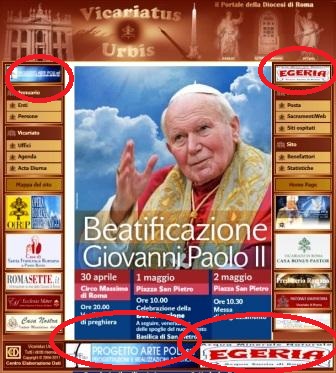
Then I see that the website of the Vicariato di Roma (the Diocese of Rome) has ads, and they are even all for churchy companies.  Egeria is a popular bottled water in the area of Rome.

Parish bulletins have ads on the back for businesses which have nothing to do with the church.

So, I am not entirely entirely closed to the idea.  And I like helping Catholic concerns such as Mystic Monk and sisters who make soap and good books, etc.

Furthermore, when I consider how high my traffic is, ads would probably be very useful to the client.  I would probably ask for a reasonable CPM.

Posted in ASK FATHER Question Box | Tagged
Comments Off on QUAERITUR: Do you/why don’t you take ads?

Collect for the Commemoration of Bl. John Paul II

When a person is beatified their “cult” or the public liturgical observance of the person is normally restricted to the place most closely associated with the blessed’s life and work or the blessed’s religious institute, if a member.

The liturgical cult of Bl. Pope John Paul II will be observed in Rome and in Poland.  Bishops would have to seek permission from the Holy See to have local observances.

I see also that the COLLECT for the new blessed’s feast, 22 October, is released in English.  I haven’t see the Latin, but I bet we could fairly closely reconstruct it.

O God, who are rich in mercy [a reference to Dives in misericordia]
and who willed that the Blessed John Paul II
should preside as Pope over your universal Church, [like the classic collect for a Pope]
grant, we pray, that instructed by his teaching,
we may open our hearts to the saving grace of Christ, [Echoing his “Be not afraid” sermon.]
the sole Redeemer of mankind. [reference to Redemptor hominis, 1st encyclical]
Who lives and reigns.

UPDATE:

Someone sent me the Latin:

Deus, dives in misericordia, [As I suspected]
qui beatum Ioannem Paulum, papam,
universae Ecclesiae tuae praeesse voluisti,
[ditto]
praesta, quaesumus, ut, eius institutis edocti,
[hmmm… ]
corda nostra salutiferae gratiae Christi,
[perhaps better gratiae Christi salutiferae]
unius redemptoris hominis, fidenter aperiamus
. [As I suspected, on both counts.]

That “eius institutis edocti” sounds a little odd to my ear… my liturgical Latin ear.

First, institutum, usually plural in liturgical Latin, seems to be paired up with divine, rather than the human.  Let that pass.  Also, whereas in the English, above, it is rendered as “teachings”, the Latin word has more of a deeds and manner of life connotation.  Of course one teaches through those as well, no question.  But institutis edocti… edocti institutis… it feels strange.

Also, for that final line, perhaps aperiamus fidenter.   I’m not wedded to that.  I can see ending on that aperiamus, which stresses that connection with the famous “Be not afraid to open wide… ” etc.  And aperiamus provides a singable clausula.  But there are a lot of sibilants in that last line.

Okay.. whatever.

Posted in The Drill | Tagged
14 Comments

Confraternity of Catholic Clergy in England already attacked in The Tablet

The TabletA while back I told you that in England some priests have started a new Confraternity of Catholic Clergy. They want a Confraternity which is faithful to Catholic doctrine and their identity as Catholic priests. I know quite a few of these men and they are great priests.

Therefore, it was simply a matter of waiting a few days before this fine initiative was attacked in The Tablet (aka The Bitter Pill aka RU 486 aka FishnChipsWrap).

Here is a letter accepted by RU for your disedification in the 9 April number. My emphases and comments:

Dubious models of priesthood?

It was interesting to read about the new Confraternity of Catholic Clergy in the British Province of Pope St Gregory the Great (News from Britain and Ireland, 2 April). The theologically dubious description of the priest as being an image of Christ, acting in the person of Christ, and possessing an “active instrumental power” all in a way in which the layman respectively is not, cannot, and does not, betrays a clericalist and power-based notion of priesthood at odds with any notion of service. [I am not sure from which planet the writer came, but on my planet the Catholic Church teaches these very things about the difference between priests and lay lay people.] This could all be put down to a traditionalist nostalgia for past priestly status or to an outmoded and flawed theology of the priesthood, were it not for the fact that psychologists and others are very aware that it is precisely that kind of power-focused selfdefinition that has in part contributed to the abuse of power within the priesthood, including the sexual abuse of children. [Nasty business, this. Affirm that there is a difference between the priesthood of the laity and the priesthood of the ordained and you on the same course as a child abuser. Tell that to the feminist nuns who abused kids.]

John J. Dunne
Bridge of Earn, Perth

The TabletOkay… take a moment to … I don’t know… perhaps to wash your face after that slimy green-ink diatribe.


I don’t think any Catholic publication, even one such as The Tablet, should print a letter like that. Shame on the editor.

And to the writer:

I, a priest, can consecrate the Eucharist and absolve sins, and even confirm if necessary. If you are a lay person, you can’t. Even if you are a deacon, you can’t.

I, a priest, act in the person of Christ when I consecrate or absolve or forgive your sins during sacramental confession. I, a priest, am alter Christus when I do those things in a way that you, a lay person or even a deacon, cannot be. I, a priest, when I do those things, do them by Christ’s power through my poor and unworthy person.

I, a priest, can hold certain offices in the Church, which you, if you are a lay person, can’t.

I, a priest, am not better than you, if you are a lay person, but I have received a sacrament which made a change to my soul. I am different. I will be a priest in that sense forever, even after death, in heaven or in hell (God forbid).

If you are a lay person, you share in the priesthood of Christ insofar as you are baptized, but you are not a priest in the sense that I am a priest.

That’s how it is in my Church. The Catholic Church.

I hope the English Confraternity grows in numbers quickly. Let it be attacked often in the pages of The Pill.

Lay people can join as “friends” of the Confraternity.

Also, the Confraternity is going to be able to take donations through a PayPal button on their website. I hope many of the readers, in honor of The Tablet will go mobilize in support of these good men and make a donation…

… and then write a letter to the editor of The Tablet saying how much you gave and why.

Posted in Green Inkers, Mail from priests, Our Catholic Identity, The Last Acceptable Prejudice | Tagged , ,
13 Comments