I believe I have a new older-comer to the feeder today. I happened to look up and spotted a less-familiar creature.
But first, a glimpse at FINCH MADNESS.
There are various finches feeding in a frenzy these days.
House finches and Goldfinches are flocking more or less together.
And they come in great numbers.
This might be hard to see, but I assure you it isn’t even close to half the finches that are coming around.
Now for the different bird.
The Goldfinches were not welcoming this this newcomer.
I am not sure who this is, exactly. I am pretty sure this is a finch rather than a sparrow. It doesn’t seem to be the enemy sparrow, House Sparrow, in any stage of development.
The black bib suggests but lack of red breast suggests that this a Hoary Redpoll, though you would think that the cap would be brighter red. I have had Redpolls here in the past and their caps were pretty brilliant. Could this be an immature bird? Perhaps an immature Common Redpoll? There is streaking on the breast but the rump seems white.
This House Finch is waiting for your donations to the feed fund.
UPDATE: I asked around and the consensus is that the mystery bird is Common Redpoll.
Welcome to another installment of What Does the Prayer Really Sound Like?
Today we will hear the three tones of the Preface for Christmas in the 1962 Missale Romanum and the 2002MR as well. I don’t speak them this time. I just sing the ferial, solemn, and more solemn tones.
If I could make a recommendation to priests who sing prefaces. When you get to the end of a phrase, and especially at the end before the Sanctus, soften the volume a little. Few things are as nasty as hammering that last note of a phrase in any chant, but especially going into the Sanctus… even more especially if there is a bit of a gap while the choir is trying to figure out what to do next.
How can choirs be surprised that it is their turn to sing? Why are they so often not ready? Why do they start look for a pitch after they were supposed to begin? That is the stuff of another entry.
Also, I have the prayers for the Masses of Christmas in another PRAYERCAzT here.
If priests who are learning to say the older form of Holy Mass can get these prayers in their ears, they will be able to pray them with more confidence. So, priests are my very first concern.
However, these audio projects can be of great help to lay people who attend Holy Mass in the Traditional, or extraordinary form: by listening to them ahead of time, and becoming familiar with the sound of the before attending Mass, they will be more receptive to the content of the prayers and be aided in their full, conscious and active participation.
Pray for me, listen carefully, and practice practice practice.
For a traditional Latin Solemn High Nuptial Mass with three priests, are there any known restrictions on which priest may administer the nuptial blessing, and which priest may deliver the homily?
In other words, may the priest acting as deacon deliver the sermon in the middle of Mass, and the priest acting as subdeacon administer the nuptial blessing before the Mass? Or must the celebrant administer the nuptial blessing and deliver the homily?
My sources indicate that the nuptial blessing at the end of Mass is to be given by the celebrant even when another priest witnessed the marriage. Since the rubric in the 1962MR connects the blessing and the little sermon at the end before the blessing, the celebrant is to give both.
A priest acting as the deacon, could give the sermon after the Gospel reading during Mass.
A priest acting as the subdeacon could witness the marriage before the Mass.
This was an interesting question for me. I have never married anyone in the older rite, and so I haven’t studied the rubrics very carefully. I look forward to doing this someday.
This is the sort of person Pres. Obama chooses for his speech writing staff. Now we will have to wait to see what POTUS does about this.
From The Catholic League:
OBAMA SPEECHWRITER’S IDEA OF COMEDY
The winner at last night’s “Funniest Celebrity” competition in Washington D.C. was White House speechwriter Jon Lovett. In a quip he made about the TSA’s pat downs, he said, “it’s giving a way for, you know, defrocked priests to get their lives back together, giving back to the community, lend a…Well, not lend a hand, but you know.”
Catholic League president Bill Donohue responds as follows:
Had this been some flunky entertainer appearing in an urban comedy club, no one would blink an eye. But it is at least an interesting window into the mind of one of the speechwriters for the president of the United States: Jon Lovett could have chosen a million examples to poke fun at the TSA, so it is revealing that what he settled on was a former priest guilty of sexual molestation.
This is an administration that has bent over backwards not to offend Muslims. Even in a comedic forum, it would never countenance a joke of this sort that targeted an imam. But for Catholic priests, the White House obviously has a different standard. [Does President Obama think that his staff can offend Catholics with impunity?]
At the very least, Lovett should never be given an assignment ever again that touches on matters Catholic. And quite frankly, a statement by President Obama on this issue is entirely warranted. We can’t have one standard for Muslims and another for Catholics.
At best this reveals a double-standard. At worst this reveals gross anti-Catholicism.
He also used abused children as part of his “joke”.
This requires an explanation from the White House.
Last March, in the wake of sexual abuse of children by clergy, Benedict XVI wrote a pastoral letter to the people of Ireland. He asked the Church in Ireland to do penance, especially on Fridays.
One of the practices that distinguished Catholic, of which everyone was aware, was the fact that on Fridays Catholics did not eat meat. Some will argue that this is, in a wealthy society, not a very meaningful penance. The rules should be flexible enough for people willingly to chose to perform something more meaningful so that it is from the heart. On the other hand, abstaining from meat was a concrete way to do something.
This week in the UK’s best Catholic weekly, The Catholic Herald, there is an article and debate about whether or not we should return to a more serious observance of Friday penance.
Debate: Should the Friday Fast be restored?
Or should it be left up to individual Catholics to observe?
By The Catholic Herald on Friday, 3 December 2010
This week the Irish bishops urged the faithful to take up Friday penance again. They suggest abstaining from meat or alcohol, but also visiting the Blessed Sacrament, making the Stations of the Cross, or helping the sick, poor, old or lonely.
The English and Welsh bishops, meanwhile, considered whether to restore the Friday Fast at their plenary meeting last month.
They have asked Fr Marcus Stock, general secretary of the bishops’ conference, to investigate ways of revitalising Lent as a penitential season.
Of course, Catholics are meant to do some kind of penance on Fridays; the practice, though, is no longer widely observed. Should the bishops put more emphasis on it? The Friday Fast would be another way for Catholics to commit publicly to their faith. It would be an opportunity to remember Christ’s Passion and death, and, in a small way, to share in his suffering.
On the other hand, Friday Fasts, making the Sign of the Cross, saying grace before dinner – these are all external actions. What matters is our interior faith, our interior relationship with Christ.
So, should the bishops restore the Friday Fast? Or should it be left to individual Catholics to observe voluntarily, rather than being imposed?
WDTPRS POLL.
Chose the best of the two answers and give your reasons in the combox, below.
This morning I trotted out my “French Press” coffee maker for a change of pace. Well… not so much of a change of pace, since at the rectory in England this is how we had coffee everyday. I think this must be a very common way of making coffee in England. If you use one of these, however, when you have added your hot water, be sure to stir the coffee up from the bottom and mix it well with the water and then let it rest and steep for a few minutes before pressing it down.
This morning I have the Dark Roast from Mystic Monk!
Try it for the first time, get some as a gift, refresh your supply!
They have Jingle Bell Java right now.
So, after Mass and office the rest of the morning begins with strong coffee and a muffin with strawberry jam. I am at the moment not cold, not hungry and my cough is fading. That in itself is good news.
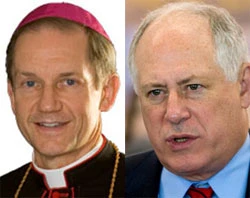
Bishop calls out Catholic governor in Illinois for approving civil unions
By Benjamin Mann, Staff Writer
Springfield, Ill., Dec 2, 2010 / 08:13 am (CNA/EWTN News).- The Illinois legislature passed a bill on Dec. 1 that will establish same-sex civil unions in state law. While the state’s Catholic governor Pat Quinn said his faith prompted him to support the bill, [?!?] his bishop has warned that the governor’s actions clearly contradict Church teaching.
“If the Governor wishes to pursue a secular agenda for political purposes, that is his prerogative, for which he is accountable to the voters,” said Bishop Thomas J. Paprocki of Springfield, Ill., after the contentious vote.
[Here it comes…] “But if he wishes to speak as a Catholic, then he is accountable to Catholic authority,” he continued, “and the Catholic Church does not support civil unions or other measures that are contrary to the natural moral law.” [Clear enough?] In the governor’s case, the local “Catholic authority” is Bishop Paprocki himself. [OORAH!]
The Springfield Journal-Register quoted the governor as saying, “My religious faith animates me to support this bill.”
“He did not say what religious faith that would be,” Bishop Paprocki noted. “But it certainly is not the Catholic faith.” [I would like to remind the readers at this point that Bp. Paprocki was, while an official in the chancery of Chicago and then an auxiliary bishop, a supporter of the older, traditional form of Holy Mass and was not rarely at St. John Cantius. I not absolutely saying that there is a connection between this bishop’ clarity and his liturgical foundation. But… ]
Governor Quinn has promised to sign the civil union measure into law, following its passage in the state’s House and Senate. Local reports indicated that the Democratic governor received a standing ovation from members of his own party, following the 61-52 vote in the Senate. [Say he does. What will Bp. Paprocki do, actually do?]
The governor joined Democratic Representative Greg Harris, the self-described “highest ranking openly gay elected official in the State of Illinois,” in supporting the initiative.
The bill drew opposition from Chicago’s Cardinal Francis George, as well as the Catholic Conference of Illinois, due to its potential impact on the Church’s work in adoption and foster care. [What will Card. George do?]
Cardinal George and the conference also expressed concerns that the bill would diminish the status of marriage in public life, by granting most of its benefits to any two consenting adults. They warned that the bill could substantially alter the law’s definition of what constitutes a “family,” and said its supposed provisions for religious liberty were vague and subject to restrictive readings.
Robert Gilligan, Executive Director of the Catholic Conference of Illinois, spoke to CNA Dec. 1 about the new law. He predicted that future generations might have to learn some harsh lessons about the unintended consequences of using the law for what he called “social engineering.”
Civil unions, he said, indicate America’s trajectory toward a European model of living, in which adult romantic relationships have little or nothing to do with family or a lifetime commitment.
He noted that although individuals might enjoy this lifestyle or even deem it a “right,” a culture cannot sustain itself by functionally equating such arrangements with marriage. In time, he said, societies that choose to diminish marriage in this way will face the effects of shrinking populations and family breakdown.
If the Catholic governor of Illinois does this, after this warming, what will the bishops of Illinois do?
Upon my return at-long-last home found a box from my amazon wishlist which included, from some kind soul, 2 pudding basins!
I once tried (successfully) to make a pudding with an improvised setup. It was a anxious experience.
This time I want to do something particular.
RESOLVED: I shall make an English Christmas Pudding.
I have already found a suet supply.
I will eventually need to obtain sprigs of holly. It won’t grow here in this drastic place.
Now: I must look for recipes!
In the meantime, here are images from a book I recall from my distant childhood, depicting “Max” preparing what I now at long last understand to be The Christmas Pudding! As a kid I had always wondered what he was making.
Any resemblance to hamsters on sidebars is entirely intentional.
It seems that recently our parish, at the direction of or with the consent of our priest has changed the wording of the Agnus Dei.
Apparently, saying “Lamb of God” three times is boring and silly so now we are to address the second stanza to the “Bread of Life” and the third to “Jesus, Prince of Peace”. I fully recognize that Christ is clearly and fully addressed as any of these three titles, but isn’t the Agnus Dei the Lamb of God and only the Lamb of God? Furthermore, I was taught years ago that the reason for the threefold recitation of Lamb of God was to indicate Christ’s perfection as the sacrifical lamb without blemish. No one else seems bothered by this, but I am just irked by what seems to me to be unnecessary tinkering with a beautiful part of the Mass. So, Father Z., am I out of line, or is this unnecessary at best or even improper? Thank you for your guidance and perspective.
Not everything that seems silly in the Ordinary Form, or Novus Ordo is illicit.
A USCCB document (not having a recognitio from the Holy See) suggests that during the singing of the Agnus Dei (Lamb of God) additional “titles” can be interjected while the “fraction rite” is going on. That is, as long as the priest and sacred ministers are arranging and preparing the Hosts for distribution, these additional Christological titles can be interpolated into the singing of the “Lamb of God”, provided that the first and last thing sung is always the “Lamb of God”, the final ending “grant us peace”. I think, however, that is to be done in addition to singing the first two verses as is, not instead of. If they are not singing the first and, at the end, the final verse as written, they may be straying from the rubrics. Again… this suggestionof the USCCB document, does not seem to have the official approval of the Holy See. Therefore, it seems not to be entirely licit to do this.
The 2000 GIRM 83 says: “The supplication Agnus Dei, is, as a rule, sung by the choir or cantor with the congregation responding; or it is, at least, recited aloud. [NB:]This invocation accompanies the fraction and, for this reason, may be repeated as many times as necessary until the rite has reached its conclusion, the last time ending with the words dona nobis pacem (grant us peace).”
In the combox, below, a commentator points out that GIRM 83 says that the text of the Agnus Dei itself may be repeated. GIRM says nothing about adding additional titles.
My own view is that silence is a good thing during Holy Mass. When you are finished singing the actual text of the Agnus Dei, why not just be quite instead of vamping till ready?
“To vamp”, of course, is the verb used by musicians to describe repeating a phrase over and over again to fill time until moving on. Think of Dave Brubeck’s Take Five.
This Agnus Dei thing is sort of a liberal liturgist’s … is sort of a liberal liturgist’s … is sort of a liberal liturgist’s Take Five.
Of course in the Roman liturgy we have always been able to extend a musical moment during Holy Mass when we use Gregorian chant simply by adding psalm verses, or looping back to the antiphon or parts of the antiphon.
The Kyrie and other parts of Mass were often sung with “tropes”. Here is an example of a troped Kyrie. You can hear the interjected verses.
The Agnus Dei was text that was sometimes troped.
Hmmmm …. Dave Brubeck seems to have gotten it liturgically right after all, and that “troped Lamb of God” you are hearing actually has a bit of a pedigree in the history of Church music.
The drawback is. of course, that the interjected titles for the Lamb of God could get pretty silly, couldn’t they. Imagine how a liturgy committee could go to the zoo with that opportunity.
Today in the VIS there is an English rendering of the article I mentioned yesterday from L’Osservatore Romano.
CARDINAL RATZINGER AND REVISION OF CANONICAL PENAL LAW
VATICAN CITY, 2 DEC 2010 (VIS) – Given below is the text of an article by Bishop Juan Ignacio Arrieta, secretary of the Pontifical Council for Legislative Texts. the article is to be published on 4 December by the Italian magazine “Civilta Cattolica” under the title “Cardinal Ratzinger’s Influence on the Revision of the Canonical Penal Law System”.
Please remember me when shopping online. Your use of my Amazon affiliate link is a major part of my income. It helps to pay for insurance, groceries, everything. Thanks in advance.
“This blog is like a fusion of the Baroque ‘salon’ with its well-tuned harpsichord around which polite society gathered for entertainment and edification and, on the other hand, a Wild West “saloon” with its out-of-tune piano and swinging doors, where everyone has a gun and something to say. Nevertheless, we try to point our discussions back to what it is to be Catholic in this increasingly difficult age, to love God, and how to get to heaven.” – Fr. Z
Not on ROME 26/5– Day 57 & 58: doubled up: “Reminds me of going to Novus Ordo Christmas Mass. Priest came down from Altar with microphone with long cable and…”
Federated Computer… your safe and private alternative to big biz corporations that hate us while taking our money and mining our data. Have an online presence large or small? Catholic DIOCESE? Cottage industry? See what Federated has to offer. Save money and gain peace of mind.
“Until the Lord be pleased to settle, through the instrumentality of the princes of the Church and the lawful ministers of His justice, the trouble aroused by the pride of a few and the ignorance of some others, let us with the help of God endeavor with calm and humble patience to render love for hatred, to avoid disputes with the silly, to keep to the truth and not fight with the weapons of falsehood, and to beg of God at all times that in all our thoughts and desires, in all our words and actions, He may hold the first place who calls Himself the origin of all things.”
Everyone, work to get this into your parish bulletins and diocesan papers.
The most evident mark of God’s anger and the most terrible castigation He can inflict upon the world are manifested when He permits His people to fall into the hands of clerics who are priests more in name than in deed, priests who practice the cruelty of ravening wolves rather than the charity and affection of devoted shepherds.
St. John Eudes
Your support is important. Thanks in advance.
To donate monthly I prefer Zelle because it doesn't extract fees. Use
frz AT wdtprs DOT com
Donate using VENMO
GREAT BEER from Traditional Benedictine Monks in Italy
Good coffee and tea. Help monks.
I use this when I travel both in these USA and abroad. Very useful. Fast enough for Zoom. I connect my DMR (ham radio) through it. If you use my link, they give me more data. A GREAT back up.
Help support Fr. Z’s Gospel of Life work at no cost to you. Do you need a Real Estate Agent? Calling these people is the FIRST thing you should do!
They find you a pro-life agent in your area who commits to giving a portion of the fee to a pro-life group!
Don’t rely on popes, bishops and priests.
“He [Satan] will set up a counter-Church which will be the ape of the Church because, he the devil, is the ape of God. It will have all the notes and characteristics of the Church, but in reverse and emptied of its divine content. It will be a mystical body of the anti-Christ that will in all externals resemble the mystical body of Christ. In desperate need for God, whom he nevertheless refuses to adore, modern man in his loneliness and frustration will hunger more and more for membership in a community that will give him enlargement of purpose, but at the cost of losing himself in some vague collectivity.”
“Who is going to save our Church? Not our bishops, not our priests and religious. It is up to you, the people. You have the minds, the eyes, and the ears to save the Church. Your mission is to see that your priests act like priests, your bishops act like bishops.”
“The modern habit of doing ceremonial things unceremoniously is no proof of humility; rather it proves the offender's inability to forget himself in the rite, and his readiness to spoil for every one else the proper pleasure of ritual.”
- C.S. Lewis
This blog has to earn its keep!
PLEASE subscribe via PayPal if it is useful. Zelle and Wise are better, but PayPal is convenient.
A monthly subscription donation means I have steady income I can plan on. I put you my list of benefactors for whom I pray and for whom I often say Holy Mass.
In view of the rapidly changing challenges I now face, I would like to add more $10/month subscribers. Will you please help?
For a one time donation...
To donate monthly I prefer Zelle because it doesn't extract fees. Use
frz AT wdtprs DOT com
As for Latin…
"But if, in any layman who is indeed imbued with literature, ignorance of the Latin language, which we can truly call the 'catholic' language, indicates a certain sluggishness in his love toward the Church, how much more fitting it is that each and every cleric should be adequately practiced and skilled in that language!" - Pius XI
"Let us realize that this remark of Cicero (Brutus 37, 140) can be in a certain way referred to [young lay people]: 'It is not so much a matter of distinction to know Latin as it is disgraceful not to know it.'" - St. John Paul II
Let us pray…
Grant unto thy Church, we beseech Thee, O merciful God, that She, being gathered together by the Holy Ghost, may be in no wise troubled by attack from her foes. O God, who by sin art offended and by penance pacified, mercifully regard the prayers of Thy people making supplication unto Thee,and turn away the scourges of Thine anger which we deserve for our sins. Almighty and Everlasting God, in whose Hand are the power and the government of every realm: look down upon and help the Christian people that the heathen nations who trust in the fierceness of their own might may be crushed by the power of thine Arm. Through our Lord Jesus Christ, Thy Son, who liveth and reigneth with Thee in the unity of the Holy Ghost, God, world without end. R. Amen.
 I believe I have a new older-comer to the feeder today. I happened to look up and spotted a less-familiar creature.

 This might be hard to see, but I assure you it isn’t even close to half the finches that are coming around.


 From a reader:

 From
From 



 Fr. Reader on WDTPRS – Pentecost Sunday – Vetus Ordo: Savvy?: “Thanks. Interesting because I have been reading it for many years, missing something.”






























