I have received dozens of e-mail from people alerting me to the news that my friend Fr. Uwe Michael Lang of the Brompton Oratory and the CDW has been appointed as a consultant for the Office of Pontifical Ceremonies headed up by Msgr. Guido Marini.
Yes. I know that. As a matter of fact I wrote about this in my weekly column for The Wanderer:
The Holy Father has appointed some new consultors to the Office of Liturgical Celebrations of the Supreme Pontiff. This is the office of the Master of Ceremonies so long held by Archbishop Piero Marini, the disciple and former secretary of the late Archbp Annibale Bugnini, and now happily held by a man of an entirely different school, Msgr. Guido Marini, who is more along the lines of the late great Cardinal Siri of Genoa. Among those now appointed as consultors are Msgr. Nicola Bux, professor at the Theological Faculty of Puglia and Fr. Uwe Michael Lang C.O., of the Brompton Oratory in London and presently working for the Congregation for Divine Worship and the Discipline of the Sacraments. Fr. Lang and Fr. Bux both spoke at the recent conference in Rome for the anniversary of Pope Benedict’s Summorum Pontificum. Fr. Lang and Fr. Bux have both published useful books about the importance of celebrating Holy Mass ad orientem, priest and congregation on the same side of the altar of Sacrifice, facing liturgical East, whence Christ will return.
Fr. Lang not long ago had an article in the Vatican’s paper L’Osservatore Romano, and elsewhere, explaining how it is false to argue in favor of the vernacular over Latin today on the basis that in the ancient Roman Church there was a shift from the liturgical language Greek to Latin for worship. The Latin used in ancient times in worship was very stylized and not at all like people actually spoke. An obvious point, to anyone who has every studied Latin in depth, but Fr. Lang provides excellent citations and arguments.
Fr. Bux, a highly engaging speaker, had a wonderful response to a question put to him during the Q&A at the conference I mentioned above, which I attended. When someone queried him about what lay people and priests can do regarding bishops who are dead set against the Holy Father’s provisions in Summorum Pontificum, Fr. Bux responded that we must pray to St. Joseph. St. Joseph, he reminded the crowd, is the universal patron of the Church and a very powerful intercessor. When bishops go off the rails we must, Fr. Bux said, “We must pray for them. Pray to St. Joseph that God will open their eyes, or else close them for good”.
Fr. Lang and Fr. Bux, champions of the use of the 1962 Missale Romanum and ad orientem worship, are now consultors for the Office of Pontifical Ceremonies, collaborators with Msgr. Guido Marini. Whatever else that might mean, the fact of the appointment is interesting.
These appointments strengthen Pope Benedict’s liturgical plans. Liturgy is the key to a revitalization of Catholic identity. It is the tip of the spear. It may be too early to say that having Bux and Lang in associated with the Master of Ceremonies office signals a future shift in papal ceremonies to more frequent ad orientem worship. The “Benedictine” arrangement of the altar (Cross front and center flanked by six candles even for versus populum worship) has taken firm roots far and wide. It is clear from Papa Ratzinger’s earlier writings that this arrangement was a transitional compromise aimed toward an eventual reclamation of ad orientem worship. It is also too early to say that this is a preparatory move for His Holiness’ own celebration of the older rite of Mass. Frs. Bux and Lang will also be excellent resources for supporting a sound celebration of the Novus Ordo. Nevertheless, Pope Benedict has been appointing very sound people to key liturgical positions.
Frankly, I am not surprised by these appointments. Not at all.
The Holy Father has been gradually positioning his pieces on the curial liturgical board.
What I find more interesting here is that Fr. Manilo Sodi, SDB, was bumped from the Office of Ceremonies.
I have written about Fr. Sodi’s vile little pamphlet/book which in English would be entitled The Missal of Pius V: Why the Latin Mass in the Third Millennium?. Sodi launches a long attack on Pope Benedict’s Summorum Pontificum.
 Sodi forcefully stated that the older liturgy was "abrogated" and "abolished". He works from the perspective that people who want the older Mass are set against the wondrous reforms of Vatican II.
Ooops!
And yet Sodi was an editor of the edition of the 1962 Missale Romanum published through the Vatican Press.
Thus, he bites the hand that feeds him.
Sodi’s name was also once being bandied about as a possible successor of Archbp. Ranjith at the CDW should he be moved from his post.
You don’t hear his name anymore.
When in Rome a week or so ago a friend gave me a copy of a collection of monographs in Rivista Liturgica. Among the authors represented is Manlio Sodi, SDB.
It seems Sodi has somewhat changed his tune: Now he sees value in having the 1962 Mass along side the Novus Ordo. He doesn’t go so far as to say that it could be spiritually useful, but it might give us historical perspective and help us appreciate even more what Vatican II began.
As an aside, that Rivista Liturgica volume begins with an unsigned editorial which contains the following whiny comment about the provisions of and reactions to Summorum Pontificum: "The crowd of those who place themselves against the liturgical reform of Vatican II found ample space in many blogs on the web, internet news agencies, dailies and periodicals of various genres, on the microphones of some broadcasters, in mini-publications. A consistent choir of voices to say… what?"
The editorial is unsigned, but the director of Rivista Liturgica is Fr. Manlio Sodi, SDB.

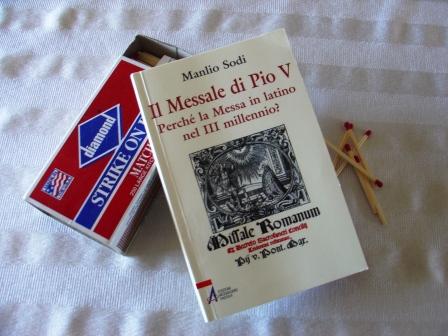 Sodi forcefully stated that the older liturgy was "abrogated" and "abolished". He works from the perspective that people who want the older Mass are set against the wondrous reforms of Vatican II.


 ex seaxe on Pope Leo XIV airplane interview: remarks about relaxing Traditional Latin Mass restrictions: “Asked whether he would reconsider his priorities after his surgery and the long trip, Leo replied, “I don’t feel like…”




























