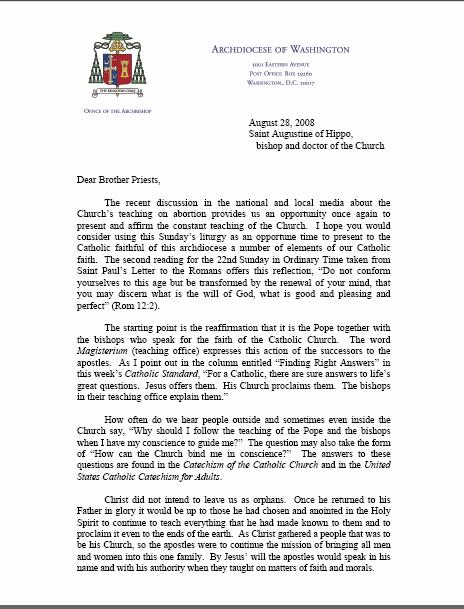
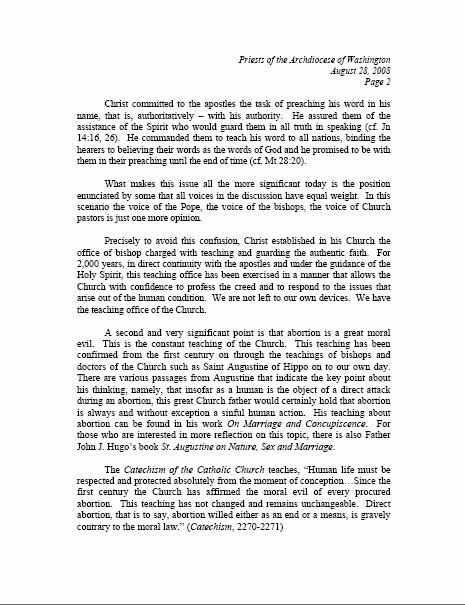
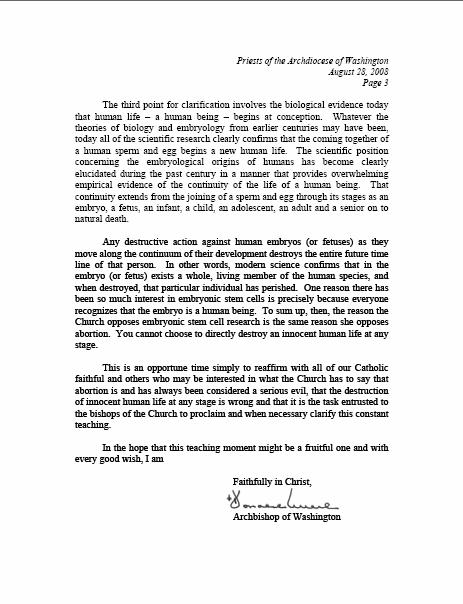
“Clarifications” from Archbp. Wuerl! Priests of Washington DC preach on human life

I received a copy of a letter sent out by His Excellency Most Reverend Donal Wuerl, Archbishop of Washington, DC to the priests of the Archdiocese.

It is, I believe, his response to the remarks of Speaker of the House Rep. Nancy Pelosi (D-CA) on Meet The Press on Sunday 24 August.

The Archbishop speaks of what St. Augustine said, what the Catholic Church teaches, what science indicates and what the duties of pastors of the Church are regarding preaching the sanctity of life.

I hope you would consider using this Sunday’s liturgy as an opportune time to present to the Catholic faithful of this archdiocese a number of elements of our Catholic faith. …

This is an opportune time simply to reaffirm with all of our Catholic faithful and others who may be interested in what the Church has to say that abortion is and has always been considered a serious evil, that the destruction of innocent human life at any stage is wrong and that it is the task entrusted to the bishops of the Church to proclaim and whatn necessary clarify this constant teaching.

Bishops like the word "opportune".

But never was there a time more opportune than this!

Here is the letter, which I am too tired to transcribe.  People send me stuff by pdf file when what I need are pdfs and transcripts! … sigh

"Clarifications" from Archbp. Wuerl! Priests of Washington DC preach on human life

 "Clarifications" from Archbp. Wuerl! Priests of Washington DC preach on human life

"Clarifications" from Archbp. Wuerl! Priests of Washington DC preach on human life

Gigantic WDTPRS kudos to Archbishp Wuerl!

Posted in SESSIUNCULA |
18 Comments

Latin wymynpryst hymns

The Mulier Fortis is spreading scandal.   This is starting to get amusing… er um… really serious.  o{]>:¬(

She posted this on her blog, 

Mea Culpa, Mea Culpa… … Oh dear, what have I done? I may have led other traddy womyn astray! I wonder if that’s an excommunicable offence?

Ekurlowa must be seriously traddy… she not only understands Latin, she can blog in Latin too!

She wants to join me as a traddy womynpriest. To that end, she suggests sending the following petition to the Bishops. It’s in Latin verse, so we shall have to enlist the services of Fr. Z to find out what it means…

Sooo…. what did she read that has worried her?

Go over to Levabo oculos meos.  Here it is, with my simple corrections of spelling:

Feminarum personant saepius clamores:
sumusne servitio sancto digniores?
Quaesumus te, optime antistites domne
te petentes feminas ordinare omnes.

Ubi nunc invenies zelum animarum? –
matronarum cordibus atque puellarum!
Paenitentem audient, lacrimas abstergent,
statim pro consilio ad amicam pergent.

Et quam pulchre possumus Missam celebrare,
pretiosis vestibus corpus adornare,
illa aureos capillos, ista habet nigros
vestimento virido atque rubro dignos.

Introibit tenera ad altare Dei,
quaesumus, considera gravitatem rei:
quam libenter venient Missam audire
(et spectare, clara res) juvenes et viri!

Ordinare feminas Anglicani solent,
feminae catholicae ordinari volunt:
Aut tu putaberis malus et obscurus
ignorans et rigidus, severus atque durus!

I think someone is going to give Timothy of Parodist a run for his money!

In the meantime, I would like to see if any of those silly wymyn of fake ordination notoriety could read any of that.

Posted in SESSIUNCULA |
22 Comments

List of bishops who responded to Speaker Pelosi

I said that bloggers must unite in a cause.   The cause is keeping the Communion – pro-abortion Catholic politician issue in the public eye.

Diane of Te Deum Laudamus is doing a great service by aggregating the response made by US bishops to Speak Pelosi’s incredible remarks on Meet the Press.

The list of bishops issuing personal statements is growing. I found more and will update this list, as I get them. Check for updates! St. Augustine would be proud (and his feast day is tomorrow). Most of these links are direct to the respective diocese.
List of bishops who responded to Speaker Pelosi

Please! Pray for our Bishops! May God give them the courage to do all that they must to prevent others from being led into scandal.

I highly recommend that you check in at the following blogs daily for updates. I can’t keep up with the many posts they are making.

UPDATED: Some other great writeups on the topic of politicians and Catholicism:

Also, if you want to find lots of excerpts of Fathers of the Church on the issue of life and abortion, check out this post on the blog Cathlidoxy.

Posted in SESSIUNCULA |
30 Comments

WDTPRS: 16th after Pentecost – COLLECT

Here is a part of a column I wrote for The Wanderer to which you ought be subscribing.
_______________

This Sunday’s dense Collect survived the scissors and paste-pots of the Consilium during the 1960’s and lived on in the post-Conciliar Missale Romanum: it is the Collect for the 28th Sunday of Ordinary Time.  This prayer, used for centuries, in the Sacramentarium Hadrianum, a form of the ancient Gregorian Sacramentary.

COLLECT (1962MR):
Tua nos, quaesumus, Domine, gratia
semper et praeveniat et sequatur,
ac bonis operibus iugiter praestet esse intentos.

This is elegance. This is a lovely prayer to sing. Latin’s flexibility, made possible by the inflection of the word endings, allows for amazing possibilities of word order.  Latin permits rich variations in rhythm and conceptual nuances.  For example, the wide separation of tua from gratia in the first line is a good example of the figure of speech called hyperbaton: unusual word order to produce a dramatic effect. It helps the prayer’s rhythm and emphasizes tua gratia.    The use of conjunctions et and ac is very effective, as we shall see below.  

The juxtaposition of praeveniat with sequatur reminds me of a prayer I used to hear at my home parish, now greatly missed.  The Tuesday night devotions there, which featured the Novena of Our Mother of Perpetual Help by St. Alphonsus Liguori (+1787), always included: “May the Lord Jesus Christ be with you that He may defend you, within you that He may sustain you, before you that He may lead you, behind you that He may protect you, above you that He may bless you. In the name of the Father, the Son and the Holy Spirit.”

Let’s drill into vocabulary.  The adjective intentus, means “to stretch out or forth, extend” as well as “to strain or stretch towards, to extend.”  Think of English “tend towards”. The packed Lewis & Short Dictionary states that intentus is also “to direct one’s thoughts or attention to.” 

Folks, looking at a word like this should convince any of you with children that they must study Latin.  A firm grip on Latin will give shape to their ability to reason and provide insights into the meaning of our English words.  Roughly 80 percent of the entries in an English dictionary reveal roots in Latin. Over 60 percent of all English words have Greek or Latin roots. This is over 90 percent in the sciences and technology. Some 10 percent of Latin vocabulary merged into English without an intermediary language such as French.  Words from Greek origin often entered English indirectly through Latin.  Give your children, and yourselves, this splendid tool.

Latin has several particles that join parts of sentences and concepts together: et,  – que, atque or (ac), etiam, and quoque.  These little words all basically mean “and” but they have their nuances. For example, et simply means “and” while – que (always “enclitic”, i.e., tacked onto the end of a word) joins elements that are closely enough associated that the second member completes or extends the first.  Another conjunction, atque (a compound of ad and – que) often adds something more important to a less important thing.  The useful Gildersleeve & Lodge Latin Grammar points out that “the second member often owes its importance to the necessity of having the complement (– que).”  Ac, a shorter form of atque, does not stand before a vowel or the letter “h” and is “fainter” than atque. Ac is much like et.  Briefly, etiam means “even (now), yet, still”.  Etiam exaggerates and precedes the words to which it belongs while quoque is “so, also” and complements and follows the words it goes with. There are some other copulative particles or joining words, but that is enough for now. 

Let’s nitpick some  more.  Our Collect has two adverbs, semper and iugiter.  Semper is always “always”. Iugiter, however, means “always” in the sense of “continuously.”  A iugum is a “yoke”, like that which yokes animals together.  Iugum (English “juger”, a Roman unit for land measuring 28,800 square feet or 240 by 120 feet), is probably so named because it was plowed by yoked oxen.  Moreover, Iugum was the name of the constellation Libra, the Latin for “scale, balance”.  Ancient scales had a yoke-shaped bar.  Thus, libra is also the Roman the weight measure for “pound”.  Ever wonder why the English abbreviation for a pound is “lbs”? 

The iugum was the infamous ancient symbol of defeat.  The Romans would force the vanquished to pass under a yoke to symbolize that they had been subjugated.  Variously, iugum also means a connection between mountains or the beam of a weaver’s loom or even the marriage bond. 

Today’s adverb iugiter means “always”, in the continuous sense, because of the concept of yoking things together, bridging them, one after another in a unending chain.  We get this same word in the famous prayer written by St. Thomas Aquinas (+1274) used at Benediction of the Blessed Sacrament which is the Collect for Corpus Christi:

“O God, who bequeathed to us a memorial of Thy Passion under a wondrous sacrament, grant, we implore, that we may venerate the sacred mysteries of Thy Body and Blood, in such a way as to sense within us constantly (iugiter) the fruit of Thy redemption.” 

LITERAL TRANSLATION:
We beg, O Lord, that Your grace
may always both go before us and follow after,
and hence continuously grant us to be intent on good works.

On the 28th Sunday of Ordinary Time you who frequent parishes where only English is used will hear the following lame-duck version from

ICEL (1973 translation of the 1970MR):
Lord,
our help and guide,
make your love the foundation of our lives.
May our love for you express itself
in our eagerness to do good for others.

Yes… I did a double-take too.  This version, a perfectly wonderful little prayer for use on a grade school playground, is really how ICEL rendered today’s Collect.  The new draft translation being prepared will be more accurate.  How long will some members of certain bishops conferences strive to block its completion?

Back to happier things: copulative particles!  It is important not to get overly picky about particles or exaggerate their nuances.  Still, today these conjunctions could be important.  That et…et is a classic “both…and” construction. But our Collect has et…et…ac….   The et…et joins praeveniat and sequatur. That pair of verbs is followed by an ac.  The author was providing more than a simply change of pace.  While ac is not a very strong conjunction, the variation leads to a logical climax of ideas.  This is why I add “hence” to my literal version. 
u
As you read or, better yet, listen to the prayer being sung, attend to that tua gratia (“your grace”), underscored by means of hyperbaton.  First, that “tua gratia” can be an ancient form of honorific address, as used today in some countries for nobility and certain prelates: “Your Grace”.  So, in speaking of the gift, we speak of God Himself. Moreover, tua gratia is the subject of all the verbs.  We beg God, by His grace, always to be both before us and behind us.  We pray for this in order that we may always be attentive to good works.  Our good works bound up in His grace. 

We rely on grace so as not to fail in the vocations God entrusts to us.  God gives all of us something to do in this life.  If we attend to our work with devotion He will give us every actual grace we need to accomplish our tasks.  He knew us and our vocations from before the creation of the cosmos, and thus will help us to complete our part of His plan, so long as we cooperate. Living and acting in the state of grace and according to our vocations we come to merit, through Jesus Christ’s Sacrifice, to enjoy the happiness of the heaven for which God made us.   

In our prayer we recognize that all good initiatives come from God.  When we embrace them and cooperate, it is He who ultimately brings them to completion.  He goes before.  He follows after. Our good works have merit for heaven only because God inspires them, informs them, and brings them to a good completion.  He works through us, His knowing, willing, loving servants.  The good deeds are truly ours, of course, and therefore the reward for them is ours.  But God freely shares with us His merits so that our works are meritorious.  

Today’s Collect stresses how important our good works are for our salvation.  They are manifestations of God’s grace, indeed, of God’s presence.  We pray God will lavish His graces on us.  In turn, we should be generous with our good works.

Posted in WDTPRS |
6 Comments

WDTPRS: 22nd Sunday of the Year – COLLECT

Here is some work I did a while back on the Collect for the Mass for the 22nd Sunday of Ordinary Time.  It was originally in The Wanderer.

COLLECT – (2002MR):
Deus virtutum, cuius est totum quod est optimum,
insere pectoribus nostris tui nominis amorem, et praesta,
ut in nobis, religionis augmento, quae sunt bona nutrias,
ac, vigilanti studio, quae nutrita custodias.

With small differences this Collect is based on a prayer in the ancient Gelasian Sacramentary, subsequently in the 1962 Roman Missal on the Sixth Sunday after Pentecost.  In the Anglican Church’s 1662 Book of Common Prayer for the Seventh Sunday after Trinity (The Alternative Service Book of 1980 for Pentecost 17) we find: “Lord of all power and might, who art the author and giver of all good things: Graft in our hearts the love of thy name, increase in us true religion, nourish us with all goodness, and of thy great mercy keep us in the same.”

17th century English schismatics got it right.  Can’t we?  But what will you hear on Sunday?

ICEL (1973 translation of the 1970MR):
Almighty God,
every good thing comes from you.
Fill our hearts with love for you,
increase our faith,
and by your constant care
protect the good you have given us.

*ARRRGHHH!*
 
What does the prayer really say?  Your indomitable Lewis & Short Dictionary explains that insero means “to sow, plant in, engraft, implant.”  I really like that “graft”, chosen also by the Anglicans of yore.  Going on, optimum does not mean “perfect”, but rather “best.”  I think we can get away with “perfect”, given that we are applying “best” to what God has. 

Liturgiam authenticam 51 states that “deficiency in translating the varying forms of addressing God, such as Domine, Deus, Omnipotens aeterne Deus, Pater, and so forth, as well as the various words expressing supplication, may render the translation monotonous and obscure the rich and beautiful way in which the relationship between the faithful and God is expressed in the Latin text”.   Today the priest invokes God as Deus virtutum, an expression in St. Jerome’s Latin Vulgate Psalter (Ps 58:6; 79:5 ff; 83:9; 88;9) often translated as “God of hosts.”  Don’t confuse “host” as “army, multitude” with the wheat wafer used at Mass.  Virtutum is genitive plural of virtus,“manliness;  strength, vigor; bravery, courage; aptness, capacity; power” etc.  Jerome chose virtutum to render the Hebrew tsaba’, “that which goes forth, an army, war, a host.”  Tsaba’ describes variously hosts of soldiers, of celestial bodies, and of angels.   In the Sanctus of Mass and in the great Te Deum we echo the myriads of angels bowed low in the liturgy of heaven before God’s throne: Holy, Holy, Holy LORD GOD SABAOTH …. God of “heavenly hosts” or, as ICEL put it in 1973, God “of power and might”.  I think “O mighty God of hosts” conveys what LA 51 is saying we should have. 

LITERAL TRANSLATION:
O mighty God of hosts, of whom is the entirety of what is perfect,
graft into our hearts the love of your name, and grant,
that by means of an increase of the virtue of religion,
you may nourish in us the things which are good,
and, by means of vigilant zeal, guard the things which have been nourished. 

Notice that we pray to God for an increase in “religion.”  I take this to refer to the virtue of religion.

Last week I wrote about the difference between “values” and “virtues”.  Let’s make more distinctions.  The Catechism of the Catholic Church defines “religion” in the glossary toward the back of the newer English edition: a set of beliefs and practices followed by those committed to the service and worship of God. The first commandment requires us to believe in God, to worship and serve him, as the first duty of the virtue of religion (cf. also CCC 2084 and 2135).   The Angelic Doctor says in his mighty Summa (II-II, 81, 1) that religion is the virtue by which men exhibit due worship and reverence to God as the creator and supreme ruler of all things.  We must acknowledge dependence on God by rendering Him a due and fitting worship both interiorly (e.g., by acts of devotion, reverence, thanksgiving, etc.) and exteriorly (e.g., external reverence, liturgical acts, etc.).  The virtue of religion can be sinned against by idolatry, superstitions, sacrilege, and blasphemy.  We creatures must recognize who God is and act accordingly both inwardly and outwardly.  When this at last becomes habitual for us, then we have the virtue of religion.  A virtue is a habit.  One good act does not make us virtuous.  If being prudent or temperate or just, etc., is hard for us, then we don’t yet have the virtue.  This petition in the Collect follows immediately from our desire that God “graft” (insere) love of His Holy Name into our hearts.  We move from the title of God the angels and saints never tire of repeating in their everlasting liturgy in heaven: HOLY, they say, HOLY, again and again forever, HOLY.  Then we beg for all good things to be nourished in us by God as He increases in us the virtue of religion leading to the proper interior and exterior actions that necessarily flow from recognizing who God truly is and who we are. 

This Sunday’s Collect has images of armies.  I think it not a stretch to imagine also orchard or vine tending.  On the one hand, the God of hosts guards the good things we have.  On the other, this same mighty God is grafting love into us and then nourishing it so it can grow.

Posted in WDTPRS |
4 Comments

Reactions to Speaker Pelosi keep coming

Folks, we mustn’t forget the grand scale of scandal committed by Speak of the House Rep. Nancy Pelosi (D-CA) on Meet The Press.

News cycles are short these days.  It would be easy to let this scroll off the public screen.

So, bloggers should do their best to keep this story fresh until there are real consequences.

To that end, I direct your attention to something that American Papist posted.  He has an entry with some good reactions to Pelosi’s remarks.

This especially caught my eye:

Father Thomas Williams:

The most disturbing element of Speaker Pelosi’s comments, however, was not her historical fudging, her disingenuous misrepresentation of Catholic moral teaching or her implicit adoption of cafeteria Catholicism. It was her insouciant dismissal of the moral significance of abortion. She said that in the end, it didn’t matter when life begins anyway. Her exact words were: “The point is, is that it [when life begins] shouldn’t have an impact on the woman’s right to choose.” No matter when human life begins, a mother’s right trumps a baby’s, and that right includes the choice to destroy the child. This is irreconcilable not only with Catholic morality, but with the most basic natural ethics.

Pundits and liberal commentators have predictably accused the bishops of playing politics and using Speaker Pelosi’s comments to further the agenda of the Republican party. Any objective observer knows this is not the case. If Speaker Pelosi didn’t want a response, she should not have forced the bishops’ hands. And if the Democrats’ star running back steps out of bounds, it’s not the referees’ fault for calling it.

Speaker Pelosi can campaign for abortion all she likes, but to do so as an “ardent, practicing Catholic” is to invite a stiff correction. Americans still value truth in advertising, and know that words have meanings. “Catholic” means pro-life.

Posted in SESSIUNCULA |
20 Comments

Left side-bar

Take a moment to vote for WDTPRS for the Bloggers Choice Award… if you haven’t done so already, … pretty please?

Thanks!

“But Father! But Father! Where? How?”

Left side-bar.

I am in a movie theater for some R&R and working on my phone during the commercials. Can you believe it? Commercials! I hate commercials!

“But Father! But Father! Isn’t this….”

Okay. Right. I’ll stop.

Posted in SESSIUNCULA |
7 Comments

Irritated by something I hear repeated

I am irritated by something I have heard over the last couple days.

The pols and newsies keep talking about the anniversary of "giving women the right to vote" in the USA.

No!

Women always had the right to vote.  

Their right to vote was finally recognized.

We must avoid, in discussing human rights and government, falling into the trap of thinking that the state grants rights.

We have rights because our Creator made us in His image and likeness. 

They are written into our being.

We grant the state its rights and obligations.

Posted in SESSIUNCULA |
139 Comments

I bet she knows what “gralloch” means

Perhaps the new GOP VP candidate, Sarah Palin (R-AK) will be available to explain to Speaker Pelosi (D-CA) when human life begins.

And I bet she knows what "gralloch" means, too!

Posted in SESSIUNCULA |
89 Comments

That ol’ time religion

Our friend Fr. Ray Blake over in Brighton has a wonderful photo:

That ol' time religion

I saw this in a sacristy over the summer, and was impressed! There is nothing quite like old time religion.

Posted in SESSIUNCULA |
27 Comments