Emo, Ireland: 30 August – TLM for Pauline Year

I got this from a reader:

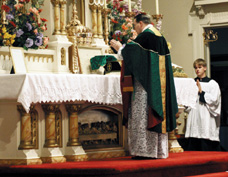
Saint Conleth’s Catholic Heritage Association invites you to honour the Holy Year of St. Paul by attending Holy Mass in the Traditional Latin Rite (Missal of Blessed John XXIII) on Saturday, 30th August, 2008, at 11 a.m., in St. Paul’s Church, Emo, Co. Laois, Ireland, followed by a tour of Emo Court House and Gardens.  The Plenary Indulgence for the Holy Year of St.
Paul has been granted, under the usual conditions, by the Bishop of Kildare and Leighlin, to all the faithful who attend this Mass.

For the past 15 years, St. Conleth’s Catholic Heritage Association has been working prayerfully for the provision of the Traditional Latin Liturgy in the Diocese of Kildare and Leighlin.

Posted in SESSIUNCULA |
6 Comments

An old priest comments: “so many of the ardent became lukewarm, many lapsed”

South Ashford Priest has guided me to a comment on the blog of the always interesting Fr. Ray Blake at St. Mary Magdalen in Brighton:

As a priest in my 83rd year I have to make a confession. I implemented the Pauline reforms without understanding or sensitivity. I did it relying on the advice and coercion of my bishop and diocesan authorities. As I did it I witnessed the hurt and pain of many of the devout, so many of the ardent became lukewarm, many lapsed. I thought I acted rightly but in my 59 years of priesthood I recognise that that which we hoped for has not come to pass.

I do welcome a careful reappraisal and assessment of what has been done since my ordination, especially by the younger clergy. In order to do that they must learn something of the spirituality that brought men of my generation in vast numbers to the seminary.

In short I welcome this Merton initiative.

Incidentally, in the solitude of my retirement, since last September, I have relearnt the Mass of my youth, it brings me great consolation. It is the Mass I have not celebrated out of obedience since 1970.

Fr P O’Rourke


I cannot say adequately how deeply impressed I am by this priest’s comment.

Posted in SESSIUNCULA |
135 Comments

Cleveland blognic report

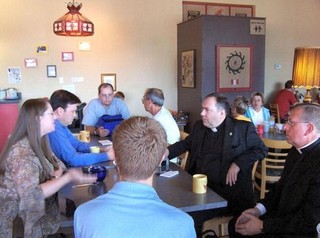
I met some wonderful people at the Cleveland blognic on Saturday.  Some of them came from as far as Columbus, OH for the event, and I am grateful.

All in all, over the whole period about a dozen people came.  Also, I learned yesterday that someone stopped in just after we has suspended the festivities, at noon.  Sorry!  We were pretty much on schedule.

Among those who were at the meeting was a young man who is considering seminary and a nice woman who said that my blog helped her to return to the Church.

Also, I learned about a marvelous museum in Columbus, which I had never heard of before.

I would very much like to visit the place, where they also have the older form of Mass.  However, to avoid confusion I mentioned that it is better to get an invitation from the pastor of the parish there.

So, this is what he sent!  (Too much!)

(This video is no longer available.)

Fun!   What an invitation.

Do you suppose they have the TLM there? 

My photos of the blognic are locked in the memory stick of my camera, which for some reason my laptop won’t read.  So, I have to wait with them.

But here is one posted by someone who came on her own blog.

Cleveland blognic report


Posted in SESSIUNCULA |
22 Comments

OLDIE PODCAzT 42: St. Augustine on St. Lawrence and how to be a Christian

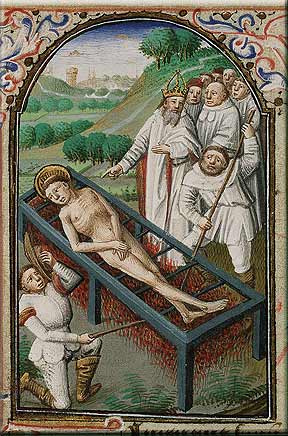
Here is an oldie PODCAzT in honor of the feast of St. Lawrence.

OLDIE PODCAzT 42: St. Augustine on St. Lawrence and how to be a Christian

Here is a fast, patristiblogger PODCAzT inspired by the second selection from today’s Office of Readings on this feast of St. Lawrence, deacon and martyr in Rome. We hear St. Augustine of Hippo’s sermo 304, preached probably in Hippo Regius in 417 on St. Lawrence’s Day.

The sermon is short enough that we can hear the whole thing.

We have the English first, to get the content into your head, followed by the whole sermon in Latin, to get your Latin ears tuned.


St. Augustine of Hippo preached various sermons on St. Lawrence. Here is another one the bishop preached in about the year 401.  It might not be quite what you expected, however!  It sure wasn’t what Augustine himself expected, you can bet on that.

Put yourself in the cathedral of Carthage on a bright morning. Bishops and emissaries are gathering from all over a great council to be held in a couple weeks. You perhaps came to see the interesting people from near and far. You are standing in the nave of the basilica and the light streams through the upper story alabaster windows in dusty shafts. Incense is still wafting from the presbyterium. It is August in N. Africa and it is blazing hot already in the morning. It is clear that Augustine, a very junior bishop in the crowd, had had no intention of preaching, but you watch as the primate of Carthage Bishop Aurelius and bishops of the North African delegation pressure him into saying something in the presence of the representatives from Rome who are there for the upcoming meeting.

Augustine reluctantly takes his seat in a chair in the center takes the scroll of the Scriptures in his lap and begins (s. 305A).

1. Because the audience is getting bored and restless, the sermon was supposed to have been cancelled [subtrahendus fuit]; but out of respect for the martyr, it has to be given. So with the Lord’s help it will be so timed that it is neither burdensome, not yet cut too short to do justice to the subject. In Rome today has dawned as one of the greatest feasts there, which is celebrated by a great concourse of the people; we are uniting ourselves to our brothers and sisters there in one body, under one head, absent indeed in body, but still present in spirit. After all, it’s not only where the tomb of his body is, that the memory of his merits is celebrated. Devotion is owed to him everywhere; his flesh is laid in one place, but his spirit is triumphant with the one who is everywhere. 

The blessed Lawrence was, as we have been informed, a youth in body, but a man gravity in spirit; the greener his age, the more unfading was the victor’s wreath that commended him so much to our devotion. Well, he was a deacon, subordinate to the bishop in rank, equal to an apostle in his crown. [And with that brief comment on Lawrence, Augustine spends the next ten paragraphs talking about everything except Lawrence!] Now this kind of festival of al the glorious martyrs has been instituted in the Church so that those who didn’t see them suffering may be led by faith to imitate them, and may be reminded of them by the festival. It’s probable, you see, that what wasn’t repeated by an annual commemoration would escape people’s minds altogether. And we can’t have fervent celebrations of all the martyrs everywhere, because then not day would pass without them; I mean, you could scarcely find a single day in the whole course of the year, on which some martyrs were not somewhere rewarded with the victor’s crown. But if fervent celebrations were a continuous event, they would induce boredom; while intervals between them renew our loving interest. For our part, let us simply listen to what we have been commanded, attend to what we have been promised. On the festivals of any martyrs you like, let us prepare our hearts to celebrate them in such a way that we do not cut ourselves off from imitating them.

At this point Augustine launches himself into to an extended and rambling talk about the different ways people celebrate and never says another word about Lawrence! He seems to be taking a few swipes at the Roman delegation there too. Then he talks about St. Cyprian of Carthage, who is far more interesting for the natives anyway, and then takes some shots at their overdoing the feast of St. Cyprian.

This is one of those sermons that Augustine, who is feeling a little testy and put upon, just doesn’t seem to be able to bring to a close easily. This often happens when people who don’t really want to speak are put in a position of having to say something anyway. And his swift writing stenographers were there and caught every word for us.

And, since I read lots of Ambrose and not just Augustine, here is what the mighty bishop of Milan had to say:

In his work De officiis ministrorum, echoing Cicero, St. Ambrose of Milan (+397) spoke about martyrs. He lingers a bit over the conversation between St. Pope Sixtus II (whose feast we had the other day) and his great deacon, the Spanish born but by adoption Roman, St. Lawrence. Who died this day in 258 on the Via Tiburina.

1.41.204. What is to be said about little children of two years who obtained the palm of victory before they had any awareness of what was going on around them? And what is to be said of Saint Agnes? Exposed to the danger of losing the two most precious goods, chastity and life, she defended chastity and exchanged life for immortality.

205. We cannot pass over Saint Lawrence, who, seeing his bishop Sixtus being led to martyrdom began to weep, not because he was being led away to die, but because he would have to outlive him. He began, therefore, to shout loudly, "Where are you going, Father, without your son? Where are you hurrying off to, O holy bishop, without your deacon? You never offered the Sacrifice without your minister. What about me has displeased you, O Father? Perhaps you have found me to be unworthy? At least reconsider whether you chose a suitable minister. Do you not want him to whom you entrusted the Blood of the Lord to shed with you his own blood, whom you caused to participate in the sacred mysteries? Be careful that while your fortitude is being praised, your judgment doesn’t waver. The OLDIE PODCAzT 42: St. Augustine on St. Lawrence and how to be a Christianridicule of a student is a bad mark for the teacher. It is necessary to remember that great and famous men are victorious through the victorious examples of their students even more than by their own. After all, Abraham offered his own son, Peter sent Stephen before him. O Father, let you also show forth your virtue in the person of your son. Offer up the one you instructed, so as to reach the eternal prize in the glorious company, safe and sure of your justice."

206. And Sixtus replied to him: "I am not leaving you, O my son, I am not abandoning you; but even greater trials are reserved for you. Because we are old an easier track to the contest was allotted; Because you are young, for you there is fated a more glorious triumph over tyranny. You will be coming shortly, so cease your weeping: you’ll follow me within three days. It is fitting that there be this interval between a bishop and a levite. It would not be worthy for you to come through to victory under the guide of your master, as if you were looking for help. Why are you asking to share in my martyrdom? I am leaving you my entire inheritance. Why are you requiring that I be present? Students who are still weak are going before their master, and those now strong, who do not have need for any more instruction are following him in order to win through without him. In such a way Elijah left behind Elisha. I am entrusting to you the inheritance of of my virtue."

207. There was a contest between them, a truly worthy contest to be fought out by a bishop and a deacon: who would be the first to suffer for Christ? They say that in the performances of tragic plays the audience would burst out in great applause when Pylades said he was Orestes and Orestes, as he indeed was, affirmed that he was Orestes: Pylades who was to be killed in Orestes place, Orestes in order to prevent Pylades from being him in his stead. But both of them shouldn’t have been allowed to live since they were guilty of the crimes of parricide: the one because he truly committed the crime and the other because he was an accomplice. In our situation, on the other hand, Saint Lawrence was driven by no other desire that to immolate himself for the Lord. Three days later, while mocking the tyrant he was burned on a grate: "This side’s done," he said, "turn me over and have a bite." ["Assum est, inquit, versa et manduca."] And so it was that he bested the heat of the flames with the might of his spirit.

Some other old PODCAzTs:

041 07-08-09 Ratzinger on liturgical silence; silent Eucharist Prayer
040 07-08-02 Eusebius of Vercelli in exile; my column in The Wanderer on detractors of Summorum Pontificum
039 07-07-27 St. Augustine on Christ the Mediator; “for all” or “for many”?

038 07-07-25 Ratzinger on “active participation”; The Sabine Farm; Merry del Val’s music

037 07-07-18 The position of the altar and the priest’s “back to the people”

Posted in Patristiblogging, PODCAzT |
5 Comments

Now this is a puzzling vestment

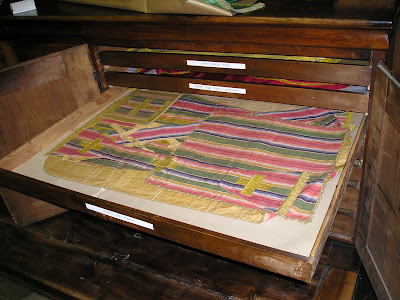
I give credit to my friend Fr. Scofield of Roman Miscellany for having found this truly hideous vestment.

Brrrr…

Now this is a puzzling vestment

And again…

Now this is a puzzling vestment

"But Father! But Father!" some of you might be momentarily tempted to object.  "Can’t you see? That’s a Roman vestment!  That is for the Extraordinary Use!  There’s a maniple and burse, too.  Everything!"

Maybe so… maybe so.  

But nothing could induce me to put that on, I don’t care what edition of the Missale Romanum is on the altar!

Can you imagine how awful the dalmatics would be? 

The cope?

The antependium?

Posted in SESSIUNCULA |
45 Comments

TIMES: Damian Thompson on the unstoppable

Damian Thompson of Holy Smoke has a piece in the Times today.   Some of our friends are mentioned.

Let’s have a look, with my usual emphases and comments.

From The Sunday Times
August 10, 2008
Let us pray in Latin: priests take on Catholics’ magic circle [I am happy to be corrected, but I think this refers to the iron grip the progressivist side has on the hierarchy of the UK.]
Damian Thompson sniffs the incense of a revolution among Britain’s parish priests

For a moment it looks as if a fire has broken out in the chapel. A cloud of smoke is billowing from the back and rolling down the aisle – and it is fiercely pungent. This is grade A incense, pure enough to guarantee an instantaneous spiritual high.  [Remember this?]

A young man walks through the door swinging a thurible on a gold chain. He passes it to a priest, deacon and subdeacon – all in gold vestments – who take turns wafting it at each other. Finally, the subdeacon turns round and, bowing low, shoots plumes of smoke diagonally across the choir stalls with the accuracy of a mid-fielder taking a difficult corner.

We are witnessing an unusual sight: [Increasingly more common, happily.] a Roman Catholic solemn mass, celebrated according to an ancient Latin rite effectively outlawed 40 years ago. And it’s taking place in the 13th-century chapel of Merton college, Oxford, which has been Anglican for 400 years.  [Now that’s more uncommon!]

Just for a week, however, it has gone back to being Catholic – but this is not Catholicism as most people know it. I’m at the summer school of the Latin Mass Society which – to the delight of the conservative Pope Benedict XVI and the dismay of trendy British bishops – is teaching priests how to say the Tridentine mass.

The last time Merton chapel regularly witnessed this sort of complex liturgy was in the 1540s, before the Protestant reformers pulled out much of the stained glass and toppled the statues of saints. The organi-sers of the summer school are reformers, too, but their aim is precisely the opposite: to restore Latin services and rich furnishings to their own Catholic parish churches, many of which were stripped bare by modernisers after the Second Vatican Council in the 1960s.

What makes this summer school rather controversial is that most of the bishops of England and Wales disapprove of the return of the Latin mass, regarding its sonorous Latin prayers and intricate gestures as a relic of the Middle Ages. Until recently, the Tridentine mass could be celebrated only with a bishop’s permission, usually granted grudgingly for special occasions. Then, in July last year, Pope Benedict XVI swept away the right of bishops to ban the old services. Most of them were horrified.

So these are tense times. But the 60 priests who have gathered at Merton college – to brush up their skills or to learn the Tridentine mass from scratch – are careful to avoid talk of civil war in the church. All are aware that this autumn, Pope Benedict is expected to announce a successor to Cardinal Cormac Murphy-O’Connor, the Archbishop of Westminster, who presides over a liberal “magic circle” of bishops unsympathetic to the Pope’s reforms. [It seems I was right about that term.] Will Benedict break the circle that has run the English church for 40 years?

Whoever gets the job, however, nobody expects a sudden return to the Tridentine mass in parishes all over the country. The seminaries do not teach priests how to say it and teaching yourself is difficult. A glance at the manual explains why: “Bring the thumb of each hand over the upper front edge of the paten [communion plate], tilting it to let the host slide off onto the crease of the front-centre fold of the corporal [linen cloth]. Place your left hand on the altar and with your right hand set the paten halfway under the right edge of the corporal.” And all the while saying: “. . . pro innumerabilibus peccatis, et offensionibus, et negligentiis meis, et pro omnibus circumstantibus . . .”  [But… you know… it isn’t that hard.]

Interestingly, the most traditionalist priests here are also the youngest – and I spot four in the choir stalls who are popular bloggers on the internet. Walking down the high street later, I encounter two clergy wearing the old-fashioned soup-plate hats beloved of Italian village padres. One of them has long knotted tassels dangling from the brim, “so I can tie them round my neck when I ride my horse through the parish”.  [And I know just who that was! o{]:¬)  ]

A priest who looks barely out of his teens explains what he does when unsolicited copies of The Tablet – a liberal Catholic magazine that opposes the Latin revival – arrive at his church: “I painstakingly remove the staples and feed it into the shredder. It’s time-consuming, but God’s work.” [ROFL!]

Most of the other priests at the summer school are less extreme: they have come because they are curious about the Latin mass and they can scent change in the air. “We’re not trying to turn them into traditionalists,” says Father Andrew Wadsworth, an authority on the old rite who is conducting classes. “We want to show priests how the underlying principles of the traditional liturgy can deepen their understanding of their priesthood.”  [Yes yes and yes.  This is really the point.  As WDTPRS has been repeating for a long time now, when priests learn the older form of Mass is changes who they are as priests and changes how they say any Mass.   Summorum Pontificum was above all a gift to priests.   It is one of those rarest of documents which emphasis the rights of priests, rather than of bishops, and it arms them with what they need to speed the revitalization of Catholic identity for which Pope Benedict has been working.]

Father John Boyle, [blogger] a parish priest in Ashford, Kent, recently taught himself to say the Tridentine mass by watching a DVD. “It’s made a profound difference to the way I celebrate the new mass in English,” he says. [See?  See?]  “There’s greater reverence now. I’m more of a celebrant and less of a compere.”

I sense a huge contrast with the atmosphere at the first Merton summer school in August 2007. Then, I was allowed to poke my head round the door of a training session. Now, Wadsworth lets me watch him take a priest right through the opening sequence of a Latin mass in a student’s room, using a reversed bookcase as an altar.

The priest, Canon Michael McCreadie, is in his fifties – yet today is the first time in his life that he has acted out the ancient gestures. He removes an invisible biretta (it’s a pretend mass). “Now, father, keep your hands joined,” Wadsworth reminds him. “Go to the centre of the altar, not touching it . . . left hand flat on the page. No, you should be over here,” and he gently turns his pupil towards the window.

After half an hour, we are still only five minutes into the order of service, but McCreadie is elated: “I wasn’t looking forward to saying the old mass, but after today I most certainly am.”

It’s only now I discover that he is dean of Leeds Cathedral. A year ago there were no senior main-stream clerics at the summer school. Later in the day, even more significantly, the Rev Malcolm McMahon, the Bishop of Nottingham, celebrates old rite pontifical vespers wearing a jewelled mitre and an embroidered cope that even Cardinal Wolsey might have considered over the top.

McMahon, a Dominican, is left-wing in his politics and certainly not part of a traditionalist faction – but nor does he belong to the politically correct, back-slapping magic circle. At dinner later, he effectively breaks ranks with his fellow bishops by unambiguously endorsing Pope Benedict’s vision of a church in which the old and new rites coexist. The traditionalists give him a standing ovation and a verse of God Bless our Pope.

He also tells Father Tim Finigan, [His Hermeneuticalness] author of the Hermeneutic of Continuity, the most influential of all the conservative blogs, to keep writing. Which is interesting, given that the Bishops’ Conference would dearly like to stop that particular blog.

Afterwards, Finigan writes: “Bishop McMahon has certainly won the hearts of the priests . . . All of a sudden, there is someone that many priests loyal to Pope Benedict will be watching closely . . . ecce sacerdos magnus!”

That’s Latin for “behold the great priest”. Those words will be read carefully in the Vatican, where Pope Benedict has been informed that the magic circle is desperate to install one of its own as the next cardinal. He isn’t pleased. Watch this space.

Damian Thompson is editor-in-chief of the Catholic Herald

Posted in SESSIUNCULA |
23 Comments

National Catholic Reporter’s shameful article on wymypryst dress-up day

The ultra-lefty dissenting National Catholic Reporter has particularly shameful coverage of another false-ordination ceremony for a woman who wants to be a Catholic priest.

The facts of the story go along the usual track: woman wants to be a Catholic priest, some other woman who want the same thing pretend to ordain her, they are now excommunicated.

However, it was the tone of the article in the National Catholic Reporter that just as shameful.

The writer uses terms like "priest" and "ordination" without making any distinctions.   And then speaks about the juridical effects of their actions as if the Church is the unjust oppressor of brave pioneers.

Let’s have a look at the article with my emphases and comments.


Sixth Catholic woman priest ordained [Note the two incorrect terms from the onset.  She is not a priest and she was not ordained.] this year
By DENNIS CODAY, NCR staff writer
Published:
August 9, 2008

Janice Sevre-Duszynska was [NOT] ordained a priest Saturday, Aug. 9, in Lexington, Ky., making her the sixth woman [NOT] to be ordained in the United States this year as part of the Roman [NON] Catholic Womenpriests movement.

The movement has [NOT] ordained 32 priests in the United States over the last two years. Saturday’s event was noteworthy because for the first time, a male, [Here is another problem.  They distinguish him as "male", … as if there were any other kind!] Roman Catholic priest in good standing publicly joined the ceremony. Maryknoll Fr. Roy Bourgeois [a very strange guy] concelebrated at the ceremony and was a homilist. (See related story and read Bourgeois’ homily.)

Sevre-Duszynska, 58, is married. She has said she will serve as an itinerant [fake] priest “speaking out for the voiceless and challenging the powers that be to hear the call of nonviolence and cooperation in our world community.”

Marjorie Maguire, a longtime friend of Sevre-Duszynska from Milwaukee, talked with NCR by phone from Lexington after the [fake] ordination. About 150 people attended the [fake] ordination, which was held in the Unitarian Universalist [figures] Church in Lexington.

She said that at the end of the [pretend] ceremony, Sevre-Duszynska told the congregation that she often thinks of something Dominican Sr. Marge Tuite told her many years ago: “Never stop making the connections between sexism, racism, militarism, nationalism and all forms of violence.”

Making those connections, Maguire said, was really the theme of the day’s [fake] ordination. “Roy and Janice represent the merging of these (struggles of justice), of making these connections,” Maguire said.

During the Litany of the Saints, which is part of [in this case fake] ordination rite, as Sevre-Duszynska lay prostrate on floor, she held two objects: a wooden cross that she held during protests at SOA Watch demonstrations and an alb made of sackcloth that she wore at demonstrations for women’s ordinations that she staged during the meetings of the U.S. Catholic Bishops conferences.

[Now watch how the language shifts.]

The Roman Catholic Diocese of Lexington condemned the Roman Catholic Womenpriests movement as “in opposition to the church’s authentic teaching” and warned that “members of the Catholic faithful should not support or participate in Saturday’s event.” Participation in the event, “carries with it very serious penal sanctions in Church Law,” a statement on the diocese’s Web site warned.  [See how menancing, oppressive and unjust the official male dominated sexist Church is?]

The event, the diocese said, “has no connection to Roman Catholic Liturgy or Sacraments and cannot in any way be recognized as a valid reception of Sacred Orders.”

Despite such threats, this has been a busy year for the Womenpriests movement. Three women were [NOT] ordained in Boston July 20. A woman was ordained in Portland, Oregon June 7 and another in Winona, Minn., May 4. A woman and a man were [NOT] ordained in Canada May 29. The Roman Catholic Womenpriests claim [finally a word that get’s closer to the truth] 26 priests and a dozen deacons in the United States. A California woman, Dana Reynolds, was elected and [NOT, and laughably so] ordained a bishop for the movement earlier this year. Reynolds presided at the Lexington [fake] ordination.

The movement has at least two more [fake] ordinations planned for this year, in St. Barbara, Calif., in September and in Chicago in November.

Vatican formally condemns [again the tenor of the language is indicative of the position of the NCRep on this issue] ordinations

The Vatican’s Congregation for the Doctrine of the Faith issued a decree May 30 formally declaring that a woman who attempts to be ordained a Catholic priest and the persons attempting to ordain her are automatically excommunicated.

Dominican Fr. Augustine Di Noia, undersecretary of the congregation, told Catholic News Service May 30 that the decree makes clear that people directly involved in an attempted ordination of a woman excommunicate themselves automatically; it is not a penalty imposed by the local bishop or the universal church.

Since the excommunication is not imposed, there is no possibility of appeal, he said: "The only recourse is repentance.  [No recourse!  How mean.]

"The problem is not that all of a sudden there was a tsunami of attempted ordinations of women," Di Noia said, but that the Code of Canon Law and the Code of Canons of the Eastern Churches "never anticipated that such a thing would happen." .  [Because it is so very weird.]

The decree was needed "for the good of the church and to ensure bishops have a common way of responding" when such ceremonies are held in their dioceses, he said.

The media spokeswoman for Womenpriests, Bridget Mary Meehan, says the punishments and excommunications are actually helping the movement.  [I doubt that.]

Such extreme treatment [Okay… these bizarre women simulate an ordination ceremony in direct defiance of the Holy See, the local bishop, and 2000 years of Christianty.  They go to some odd sect’s church to do it.  They commit scandal by trumpeting what they do.  They have all been informed of the juridical consequences…. and they do it anyway.  And the excommunication is "extreme treatment"?] doesn’t make sense to many ordinary Catholics, Meehan told NCR. “They ask, ‘Why would you excommunicate someone who just wants to serve God?’ ” [That’s pretty clear and this pretend confusion is hypocritical.] More and more Catholics are accepting the idea of women priests, she said. [So what?  Lot’s of people think that all sorts of sinful behaviors are okay.  They are still wrong.   The numbers of people who think this or that are not the basis of doctrine.]

“We are building a renewed model of priesthood for a renewed Roman Catholic Church in a community of equals in which all are welcome at the sacred Eucharistic table” said Meehan, [NOT] ordained two years ago, is a [fake] priest for house churches in Sarasota, Florida, and northern Virginia.  [Note here the imagery from the early Church: "house churches".  The idea is that the early roots of Christianity, in its first phase of growth, is somehow more authentic than what we have now.  Note the tone of words like "renewed" and "equals" and "welcome", whereas the official Church was into threats and warnings.]

“Excommunications are not keeping people from seeking us out,” [too bad] she said by phone from Lexington. “There is no punishment, there is nothing the institutional church can do to stop this movement,” she said.  [I’ve been using the word "official", but here is the code in another form: "institutional".]

Meehan had high praise for Bourgeois. She said that he is the first active male priest to take a public role in a woman’s ordination. [He should be instantly suspended a divinis, if he is really in good standing at this time.] She said he, like many other Catholics, are examining their consciences and finding that they must support a more inclusive church.  [I repeat what I sai above: there is code language here.  However, the NCRep has actually taken the side of the excommunicated separatists and trying to legitimize their movement.]

Sevre-Duszynska events leading up to ordination

    * In January 1998, Sevre-Duszynska made national news by interrupting an ordination ceremony at the Cathedral of Christ the King in Lexington and asking for ordination herself. “I am called by the Holy Spirit to present myself for ordination,” she said when the male [there are no other kind] candidate for priesthood was called forward by the bishop. “My name is Janice. I ask this for myself and for all women.”

      Sevre-Duszynska holds a master’s degree in theater from the University of Kentucky and is an award-winning playwright and received a fellowship to the Yale School of Drama.

      Even before her dramatic act at the cathedral she had worn blue arm bands to protest outside the site of ordinations, particiated [sic] in for-women-only eucharistic celebrations, written to bishops and carried placards promoting women priests.
    * In 2000, during the U.S. bishops’ November meeting in Washington, Sevre-Duszynska grapped [sic] a microphone after Cardinal Bernard Law, then of Boston, had proposed a statement on the situation in the Middle East. “I’m here to use my voice for many who cannot speak,” she said.

      “There’s an injustice within our church that affects the whole world.” She urged the bishops to be “compassionate to your sisters … women called by God to ordination.”

      Her microphone was turned off. She refused to leave the gathering, sitting there as the bishops continued their meeting in the large hotel ballroom. When that portion of the meeting ended, police escorted her out of the hotel. [What a class act.]

      The following year, as the prelates, again gathered for their November meeting, assembled for a Mass for Peace, Sevre-Duszynska interrupted the service [classy!] to answer the responsorial psalm: “Justice shall flourish in his time, and fullness of peace forever.” She responded: Justice for women in the church.” She refused to sit down and was led from the church by a group of five men, including a priest.
    * In 2002, Sevre-Duszynska was arrested and charged with trespass after she refused to leave a diaconate ordination [elegant] in Atlanta where she and several others protested sexism in the church. She told NCR in an interview at the time that she had entered the cathedral to pray. When told the service was invitation only, she said she told the ushers: “What are you talking about? I have been to many ordinations, and they’re never by invitation only. Besides, I’m a daughter of the church, and Christ welcomes everyone to the table.” The archdiocese of Atlanta filed suit seeking a permanent injunction barring her from entering any archdiocesan property.

Her protests have not been limited to ecclesiastical matters. That same year she was arrested and sentenced to three months in federal prison and fined $500 for a non-violent protest at the School of the Americas at Fort Benning, Ga. She and more than two dozen others trespassed onto fort property in an organized protest calling for the closing of the school.

(Dennis Coday is an NCR staff writer. His e-mail address is dcoday@ncronline.org)


So, I think you can see why this article is so bad.   It is not simply that they present the facts of what happened, or what people said.  It is fair to relate a person’s position, no matter how strange it is.   But this paper, which has the word "Catholic" in its name, has taken the position of the fake ordination of women, which is heresy.   By doing so they also commit scandal.


Posted in SESSIUNCULA |
49 Comments

Davenport, IA: follow up to reintro of the TLM

Here is a nice follow up story to what I posted the other day about the implementation of Summorum Pontificum in the area of Davenport, Iowa.

The following is from The Catholic Messenger with my emphases and comments.

Davenport, IA: follow up to reintro of the TLMTridentine Mass returns to diocese
By Celine Klosterman

[Photo: Father Scott Lemaster celebrates the first Tridentine Mass at St. Anthony Church in Davenport Aug. 3. Another Mass was celebrated at St. Wenceslaus Church in Iowa City the same day.]

More than 400 people combined attended the first two Tridentine [They need a new term here, but let that go for now.] Masses held in the Diocese of Davenport since last summer, when Pope Benedict XVI issued his apostolic letter that relaxed restrictions on use of the Mass.
Fathers Scott Lemaster and Paul Appel celebrated the Aug. 3 services at St. Anthony’s in Davenport and St. Wenceslaus in Iowa City, respectively. A diocesan survey [intriguing] found that the Iowa City and Davenport areas expressed the greatest interest in celebrating the Tridentine Mass.
“For many years we have waited for our eyes to see and our ears to hear what we see and hear today — the Mass of the ages,” Fr. Lemaster told more than 200 people at St. Anthony’s.
“So many people have wanted this Mass,” said Fr. Paul Appel to about 220 Catholics in his sermon at St. Wenceslaus. He’s one of six diocesan priests who will take turns celebrating Mass according to the 1962 Roman Missal.   [If they are pastors, they can do this in their parishes as well.]
His sermon and readings of Scripture were the sole English-language portions of the service, at which people of all ages followed — or attempted to follow — the Mass in booklets featuring both Latin and its English translation.
Because of the language and “silence” of the Tridentine Mass, “you have to work harder, but I think that’s good,” said Fr. Appel. “You have to pay full attention.” [Yes… this is full, conscious and active participation desired by the Second Vatican Council’s Sacrosanctum Concilium.]
Besides the language difference, other notable contrasts from the ordinary form of the Mass were the absence of lay Eucharistic ministers, lectors and female altar servers; the general silence of the congregation; the choir’s embrace of Gregorian chant; and reception of Communion on the tongue, not in the hand.
The richness and defining characteristics of the Tridentine Mass, also known as the Latin Mass, helped Fr. Appel feel drawn to it, though it made up only a fraction of his post-Vatican II priestly formation, he said. To prepare to preside at Tridentine services, he joined other diocesan priests in traveling to Chicago for training through the Canons Regular of St. John Cantius.
“Let us pray for all those who didn’t get to see this day,” he said during his first celebration of the Latin Mass. He voiced hope that those attending would “find something profound and wonderful, that draws you closer to Christ.”  [THAT’s the point!  Good!]
“This is so reverent,” said Anna Kane of Cedar Rapids after Mass in Iowa City, one of several women who wore a head scarf, or mantilla, to St. Wenceslaus or St. Anthony.
“It puts concentration on the fact that we honor Christ at the altar,” said Peter Kennedy, a St. Wenceslaus parishioner. “And the Latin hymns create a sense of solitude and peacefulness.”  [I wonder if "solitude" here isn’t really a way of trying to say "stillness" or "quiet", rather than isolation.  The older form of Mass most certainly also can create a sense of broad solidarity as well.]
He and Kane, who each have lived or traveled in Europe, also voiced appreciation for the universality of Latin Mass. “You can go anywhere and it’s the same,” said Kane.
“Deo gratias,” said Teresa Oltman of Geneseo, Ill., thanking God after attending Mass at St. Anthony with family. Her family has attended Latin Mass [Another bad term.  Some more catechesis is needed here.] for the past 10 years in the Chicago and Peoria, Ill., areas, but “we finally have a place that is close,” Oltman said. Geneseo is about a 30-minute drive from Davenport.
The Tridentine Mass “is more proper,” said Michael Smith of Monticello, who with his four sons was an altar server at St. Wenceslaus. He wanted his sons to be trained to serve at Latin Mass, a Mass he predicted “everyone will be doing eventually.”
“Maybe someday we’ll get ambitious and do even funeral Masses” in the Latin rite, [Let me go out on a limb here, but I predict that they will be needed.] said Tom Rowland, who helped coordinate preparations for St. Wenceslaus’ service. He said he was pleasantly surprised by turnout at that Mass, having expected to see only half the number who showed up. “I think a lot of people are interested in this,” he said, noting he’s still getting e-mails from people wanting to help with the Mass.
“It will be interesting to see how many people continue coming” after the novelty wears off, he added. “This will click with a lot of people; with others it won’t.”
Still, he said, “I couldn’t be happier about the way things went today.”
Tridentine Masses will take place every Sunday at 1:30 p.m. at St. Wenceslaus and 4 p.m. at St. Anthony, and on the third Sunday of each month at 1 p.m. at Ss. Mary & Joseph Parish in Sugar Creek.
(Anne Marie Amacher contributed to this story.) 

Posted in SESSIUNCULA |
21 Comments

QUAERITUR: Books for converts and reverts

I had a question put to me this morning at the blognic in Cleveland.

What are some good books for adult converts and reverts to the Church?

In addition to the Catechism of the Catholic Church or its Compendium, off the top of my head I could think of Fr. John Hardon’s Catholic Catechism.

Since I am on the road, I will ask you to pitch in.

The books you suggest should probably be geared to very readable, fairly short, volumes on history, liturgy, and maybe even some apologetics.

Posted in SESSIUNCULA |
80 Comments

UK: Is a parish being supressed because Latin is used?

I picked up this disturbing story from Damian Thompson.  I don’t know all the details, but what I read was rather alarming.

My emphases and comments.

The suppression of a Latin-loving parish
Saturday, August 9, 2008, 12:45 PM GMT

I have been passed some correspondence which tells the shocking story of the apparent suppression of a traditionalist Catholic parish in the diocese of Leeds.

The New Mass being celebrated at St John the Evangelist

One hundred parishioners of St John the Evangelist, Allerton Bywater, have petitioned their bishop, the Rt Rev Arthur Roche, to allow the parish to celebrate Mass only in Latin, in both the old and new forms. [Priests don’t need permission to use the Latin books of the Latin Rite in either the post-Conciliar form of the Mass and sacraments or the pre-Conciliar.]  Instead, he is closing the church this month and has told the parish priest, Fr Mark Lawler, that he will not be appointed to a new parish because his ministry is "divisive".  [I must caution that we don’t know the whole story here.   But it this is simply over the issue of language, this would be pretty shocking.]

Fr Lawler told me today: "This is a parish that does exactly what the Holy Father tells us to do, celebrating the Mass reverently in the old and new forms. The bishop is determined to squash it, and to destroy me because he doesn’t want me moving to another parish and doing the same thing."

The parish pastoral council has written to Bishop Roche asking why he has ignored its two formal petitions for the status of a "personal parish" celebrating Mass only in Latin, in accordance with Article 10 of Summorum Pontificum, Pope Benedict’s apostolic letter liberating the traditional Latin Mass.

It has now retained the services of a leading canon lawyer to challenge Bishop Roche’s decision to close the parish as part of a wider programme of closures.  [So, apparently this is not only about the use of Latin.]

Relations between Bishop Roche and Fr Lawler have been strained for years. The bishop told Fr Lawler some time ago that he wanted him to say Mass facing the people, and that because he had told him what to do it was therefore the will of the Holy Spirit.  [?]

Pope Benedict, in contrast, has written at length defending the ancient practice of celebrating the Eucharist facing east. He has also given priests the legal right to celebrate a public Mass in the traditional rite if they are approached by a stable group of the faithful, however small. [Even if they are not approached by a group.]  At St John’s, the vast majority of regular worshippers have asked for the old rite to be made available. ["vast majority"?  My!]  On August 17, their church will be closed by the diocese.

Fr Lawler says he asked for a meeting with Bishop Roche, but to no avail. Instead, the Vicar General, one Mgr McQuinn, has written to him, telling him: "The Bishop … believes your ministry to be divisive, is uncertain that ordinary pastoral care of parishioners is taking place and does not have confidence that you will celebrate the Ordinary Form of the Mass with a generous heart for the vast majority of parishioners who expect Sunday and weekday Masses to be in English and at an altar facing the people." [And if people wanted him to wear clown makeup and say Mass on a unicycle would he have to do that?  Saying Mass ad orientem is perfectly legitimate.  And I note the phrase "generous heart".]

In an open letter to his parishioners, Fr Lawler describes this claim as "a slur on my character, an attack upon my priesthood and totally without foundation."

Clearly, this matter must now go to Rome. Perhaps the pontifical commission Ecclesia Dei might be persuaded to take a closer look at the scandal unfolding in Allerton Bywater.

I don’t know all the details, as I mentioned above, and these situations are usually rather complicated.  However, this is an opportuity to remin everyone that according to Summorum Pontificum pastors are within their rights to celebrated the older form of Mass for their people.  According to the 1983 Code of Canon Law they can celebrate Holy Mass in Latin to any degree they think proper.  According to the rubrics in the Missale Romanum and the long tradition of the Church, not to mention sound theology and common sense, they can celebrate Mass ad orientem.  Of course we wouldn’t want priests simply imposing things on groups of people who, over a long period of time, simply don’t want it and resist it, thus leading to divisions and problems.  However, people who would resist such things are a) few and b) educable and c) … did I mention few?

However, at the same time as we all know about the Latin thing, the old Mass and ad orientem worship, we also know that priests can win this battle and that, and that bishops have a thousand ways to crucify a priest, for whatever reason it pleases them to do so.

And so, I repeat one of the most important things about Summorum Pontificum.  It was one of the first documents we have seen in the modern era which stressed the rights of priests.  

And that, friends, is one reason why some will resist it.

Posted in SESSIUNCULA |
43 Comments