NYT – John L Allen’s op-ed on Humanae vitae

My friend John L. Allen, Jr., the nearly ubiquitous fair-minded former Rome correspondent for the ultra-lefty National Catholic Reporter had an op-ed in the New York Times (or Hell’s Bible as one bishop I know calls it).

Let’s have a look at what Mr. Allen has to say, but with the usual Z-protocol (my emphases and comments).

Op-Ed Contributor
The Pope vs. the Pill

By JOHN L. ALLEN Jr.
Published: July 27, 2008

FORTY years ago last week, Pope Paul VI provoked the greatest uproar against a papal edict in the long history of the Roman Catholic Church when he reiterated the church’s ban on artificial birth control by issuing the encyclical “Humanae Vitae.” At the time, commentators predicted that not only would the teaching collapse under its own weight, but it might well bring the “monarchical papacy” down with it. 

Those forecasts badly underestimated the capacity of the Catholic Church to resist change and to stand its ground.

Down the centuries, Catholics have frequently groused [excellent word, and it sets a tone…. keep reading] about papal rulings. Usually they channeled that dissent into blithe disobedience, [still setting the tone…] though occasionally a Roman mob would run the Successor of Peter out of town on a rail just to make a point. In 1848, Pope Pius IX was driven into exile by Romans incensed at his refusal to embrace Italy’s unification.

Never before July 25, 1968, however, had opposition been so immediate, so public and so widespread. World-famous theologians called press conferences to rebut the pope’s reasoning. Conferences of Catholic bishops issued statements that all but licensed churchgoers to ignore the encyclical. Pastors openly criticized “Humanae Vitae” from the pulpit.  [painting a picture as a backdrop to what is coming up…]

In a nutshell, “Humanae Vitae” held that the twin functions of marriage — to foster love between the partners and to be open to children — are so closely related as to be inseparable. In practice, that meant a resounding no to the pill.  [Excellent.  Allen actually gives a fair view of the reasoning in Humanae vitae.  NB: This wasn’t published in the journal he usually writes for, the NCRep – which had its own dissenting editorial. For the NCRep Humanae vitae was about holding on to power and, digest this, against "real" love.]

The encyclical quickly became seen, both in the secular world and in liberal Catholic circles, as the papacy’s Waterloo. It was so out of sync with the hopes and desires of the Catholic rank and file [too be fair, we have to include the many of the hierarchy] that it simply could not stand.

And in some ways, it didn’t. Today polls show that Catholics, at least in the West, dissent [I am glad he calls it what it is.] from the teaching on birth control, often by majorities exceeding 80 percent.

But at the official level, Catholicism’s commitment to “Humanae Vitae” is more solid than ever. [This use of "official" is not charged with the negativity that it has in the NCRep editorial.]

During his almost 27-year papacy, John Paul II provided a deeper theoretical basis for traditional Catholic sexual morality through his “theology of the body.” In brief, the late pope’s argument was that human sexuality is an image of the creative love among the three persons of the Trinity, as well as God’s love for humanity. Birth control “changes the language” of sexuality, because it prevents life-giving love.

That’s a claim many Catholics might dispute, but the reading groups and seminars devoted to contemplating John Paul’s “theology of the body” mean that Catholics disposed to defend the church’s teaching now have a more formidable set of resources than they did when Paul VI wrote “Humanae Vitae.”  [Good point!]

In addition, three decades of bishops’ appointments by John Paul II and Benedict XVI, [A very important factor.  I have written about this more than once: this is one of the most important things to consider during the long pontificate of John Paul II.] both unambiguously committed to “Humanae Vitae,” mean that senior leaders in Catholicism these days are far less inclined than they were in 1968 to distance themselves from the ban on birth control, or to soft-pedal it. A striking number of Catholic bishops have recently brought out documents of their own defending “Humanae Vitae.”  [I know he is relating facts, here, but I wonder if Allen isn’t quietly arguing that dissent from Humanae vitae is out of step with the present direction of the Church?  Namely, if it isn’t a washed up cliche of the "sixties"?]

Advocates of the encyclical draw assurance from the declining fertility rates across the developed world, especially in Europe. No country in Europe has a fertility rate above 2.1, the number of children each woman needs to have by the end of her child-bearing years to keep a population stable.  [Perhaps I am unclear about terminology, but do we mean "fertility" rate or "birth" rate?  There might also be fertility problems on the rise because of the damage (usually unknown) done by some sexually transmitted diseases, but surely contraception and aboritifcients and abortions are keeping the number of live births very low.]

Even with increasing immigration, Europe is projected to suffer a population loss in the 21st century that will rival the impact of the Black Death, leading some to talk about the continent’s “demographic suicide.”  [Well said!  An artifically created "Black death" as the consequences of, really it must be said, "dissent" from Humanae vitae‘s conclusions in many ways.]

Not coincidentally, Europe is also the most secular region of the world, where the use of artificial contraception is utterly unproblematic. Among those committed to Catholic teaching, the obvious question becomes: What more clear proof of the folly of separating sex and child-bearing could one want?  [Hits the nail squarely on the head.]

So the future of “Humanae Vitae” as the teaching of the Catholic Church seems secure, [Because the Church is committed consistently to teach the truth.] even if it will also continue to be the most widely flouted injunction of the church at the level of practice.

The encyclical’s surprising resilience is a reminder that forecasting the Catholic future in moments of crisis is always a dangerous enterprise — a point with relevance to a more recent Catholic predicament. Many critics believe that the church has not yet responded adequately to the recent sex-abuse scandals, leading to predictions that the church will “have to” become more accountable, more participatory and more democratic.

While those steps may appear inevitable today, it seemed unthinkable to many observers 40 years ago that “Humanae Vitae” would still be in vigor well into the 21st century.

Catholicism can and does change, but trying to guess how and when is almost always a fool’s errand
.  [And some things really can’t be changed.]

John L. Allen Jr. is the senior correspondent for The National Catholic Reporter and the author of “The Rise of Benedict XVI.”

 Not the sort of thing readers of the New York Times expect to see, I think.

Good editorial!

Posted in SESSIUNCULA |
62 Comments

Quincy, IL: TLM parish to be established

Here is some good news:


St. Rose in Quincy to be chapel for extraordinary form of Mass 

Written by Kathie Sass, Catholic Times Editor   
07/27/2008

Extraordinary form sometimes known as Traditional Latin Mass

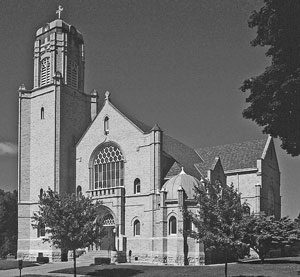
st-rose-of-lima-bw.jpg

St. Rose of Lima Church will be used as a chapel for the celebration of the extraordinary form of the Mass in the Roman Rite. It will be supported by the Latin Mass Society of Quincy and staffed by the Priestly Fraternity of St. Peter. Pope Benedict XVI, in his apostolic letter Summorum Pontificum, granted broader permission for the Mass, also known as the Traditional Latin Mass.

QUINCY – Bishop George J. Lucas has given permission for St. Rose of Lima Church, Eighth and Chestnut, to be used as a chapel for regular celebration of the extraordinary form of the Mass in the Roman Rite.

In his July 2007 apostolic letter Summorum Pontificum, Pope Benedict XVI granted broader permission for the use of the extraordinary form of the liturgy, sometimes known as the Tridentine or Traditional Latin Mass. Shortly afterward, a group of lay Catholics from the Quincy region approached Bishop Lucas for permission to use St. Rose Church as a site for celebration of the extraordinary form.

St. Rose of Lima Parish merged with St. John the Baptist Parish in Quincy in 1999 to become All Saints Parish. In 2006, All Saints was merged with two other Quincy parishes to form Blessed Sacrament Parish. The last parish Mass at St. Rose of Lima was celebrated in September 2005, and the church was scheduled to be sold.

After consultation with priests of the Quincy Deanery, Bishop Lucas granted permission to use the church, which will be known as St. Rose of Lima Chapel. A not-for-profit organization, the Latin Mass Society of Quincy, was formed to take responsibility for the facilities, which includes the church, rectory and parish hall.

The chapel will be staffed by the Priestly Fraternity of St. Peter, founded in 1988 with the approval of Pope John Paul II to provide priests conversant in the celebration of the extraordinary form. The fraternity has nearly 200 priests and 100 seminarians, with its North American headquarters in Elmhurst, Pa.

Paul Geers, president of the Latin Mass Society of Quincy, said people from as far away as St. Louis or Springfield have expressed interest in attending the traditional Mass.

"We estimate that there are 500 people in perhaps a 75-mile radius who might want to attend this Mass," Geers said. "I’ve had calls from people who have been away from the church for 20 or 30 years. This is going to bear a lot of good fruit and there will be a lot of conversions."

Geers said the church is being refitted for the celebration of the extraordinary form. A main altar and two side altars are in storage pending installation and a Communion rail has been donated. The society hopes to have a chaplain in residence and begin a regular schedule by Nov. 1.

"We would like to offer a daily Mass, with two Masses on Sunday – a high Mass and a low Mass," Geers said.

Msgr. Michael Kuse, pastor of Blessed Sacrament Parish in Quincy and dean of the Quincy Deanery, said he has fielded some inquiries about the planned celebration of the extraordinary form of the Mass.

"I have had people ask ‘Is this Catholic? Can we go? Can we receive Communion?’" Msgr. Kuse said. "My answer to them is this is a legitimate form of the Mass. They can go and check it out, even if it’s only for a little nostalgia. It can also lead to a deepening of faith for those who find it important."

For more information, contact the Latin Mass Society of Quincy, P.O. Box 3006, Quincy, IL 62305.


Posted in SESSIUNCULA |
26 Comments

The NCR dissents from Humanae vitae, the Church’s moral teaching

I imagine His Excellency Most Reverend Robert Finn, Bishop of Kansas City-St. Joseph (MO), has a very full schedule, and therefore doesn’t have time to read each issue of the ultra-leftist National Catholic Reporter (published nearly in His Excellency’s own backyard).

Just in case Bishop Finn doesn’t read it regularly… and I imagine not many people do… he ought to pay attention to this recent NCRep editorial about Humanae vitae.

Let’s read this with my emphases and comments.

Humanae Vitae at 40 years

By NCR Staff
Publication date:
July 25, 2008
Section:
C. Editorials

As we roll through 2008, the press is filled with 40-year anniversary stories. 1968 was a tumultuous year; some say it was a year that helped define America for years to come.  [It still divides much of Catholic America, for sure.]

The baby boomers recall vividly the Vietnam War Tet offensive in January; the April assassination of Dr. Martin Luther King Jr.; the Paris Peace talks and riots in May; the June assassination of Sen. Robert Kennedy; and the August protest riots in Chicago at the Democratic convention among nation-shaping events that year.

Catholics might recall another 1968 defining moment, the July 29 encyclical called Humanae Vitae, literally “Of Human Life.” The encyclical was a sensitively written expression about the sanctity of marital love and the need to nurture life in marriage. But whatever else it stated, it has been remembered for only one thing: the upholding of the Catholic church’s ban on birth control.

The encyclical upheld Pope Pius XII’s support of the rhythm method (now called natural family planning) [I think there are significant differences between the old "rhythm method" and modern NFP.  However, I think this was put in for a reason.  The "rhythm method" was widely derided.  So, I am guessing that the intention is to paint NFP with the same brush, so to discredit it.  This helps to set up the point down the line.] and in doing so, revealed its particular understanding of natural law. [Did the "rhythm method" have a "particular understanding of natural law"?]  Its reasoning, theologians say, rested on the physiological structure of the act of intercourse while largely discounting the larger context of human love and family life.

Less than a decade after the encyclical’s promulgation, polls showed it was overwhelmingly rejected by Catholics. Eight out of 10 adult U.S. Catholics simply disregarded it. While bishops were largely upholding the document, many priests in pastoral settings, including confessionals, were saying it was a matter for individual conscience.

By any measure, a gulf between official church teachings and Catholic practice [Again, watch the word choice.  I think "official" is code for "something we don’t really have to pay attention to" because, after all, people who are moved by "the spirit/Spirit" are above that sort of backward view of the Church. All those rules stiffle real Church.] had begun to grow and was to continue to grow and to permeate a host of other Catholic teachings on sexuality and morality from homosexuality to the use of condoms in the fight against the HIV virus. The right of women to have special say in reproduction, then an almost exclusively male terrain, was soon added to the list.  [Note the shift to a feminist perspective that pits women again men.]

In the four decades since the encyclical was promulgated, the church hierarchy, fully recognizing Catholic lay resistance to the strongly stated ban on the use of birth control, dug in. Pope John Paul II affirmed Humanae Vitae as a pillar of Catholic morality — as well as a pillar of papal authority.  [the NCR just made this into a power issue.]

Meanwhile, Catholic lay confidence in the institution was eroding by the year.  [What "institution", the Church?  That is the "institutional" dimension of the Church?  Otherwise, perhaps the "institution" they are talking about is "papal authority"?  The antecedent isn’t entirely clear.  However, the intent is clear.  NCR is pitting an "official" or "institution" or "rule-bound" hierarchical Church against the lay people who are making up their own minds about things and the priests who advise them.]

Torn between following the advice of a partially lay pontifical commission, created to assess the birth control issue, a commission that eventually supported changes in church teaching, and his desire to remain consistent with earlier papal declarations, Pope Paul VI chose the later course. [Hang on.  What about Paul VI’s desire to do the right thing?  It wasn’t a simple choice between the past and the future.  It was about the truth.]  The need to assert church authority persuaded him. [Again, the NCR makes this into a power issue.  The purpose is to help the reader over to the position that because the decision had such a (low) motivation, those who are enlivened the "the spirit/Spirit" can discount the teaching of Humanae vitae and other rule-bound official Church teachings about morals because they are, after all, only rooted in the desire to maintain power.]

After all, he reasoned, how could the Holy Spirit have allowed the church to be wrong for so many years on an issue of such importance? [THAT is how they describe Paul VI’s reasoning?  How stupid do they think we are?]  His decision, in the end, was more indicative of church hierarchical dysfunction — the institution’s inability to look at matters, particularly sexuality, in light of new understandings and insights — than it was seemingly of any movement of the Holy Spirit.  [And there it is folks!  The "spirit/Spirit" is guiding the enlightened!]

Research conducted by sociologist Fr. Andrew M. Greeley found that the encyclical so shook Catholics that by itself, it would have reduced religious practice by almost one-half. That decline never fully occurred, and the reason it did not, Greeley found, was the favorable impact the Second Vatican Council was having on the lives of most Catholics.  [Right.  But we are not talking about the actual documents of the Council, but rather the "spirit", again, but this time the "spirit of Vatican II", the breaking of "institutions", the deconstruction of whatever was rule-bound or official.]

Repeated U.S. surveys find that Catholics regard church teachings on sexual morality increasingly out of sync with their lived experience and their understanding of love and intimacy. [You are to conclude from this that whatever conflicts with the majority opinion (the rule-bound institutional Church still trying to keep its grip on power by controling how people have sex) is therefore against love and intimacy.] They knew and still know [Notice the authority they give to this "knowledge".  It supercedes "official" Church teaching and any insight or motivation the "hierarchy" might have.] that sex between husband and wife is capable of creating far more than new humans. [Dog bites man.] They also know their gay sons and daughters are not disordered. [Another shot at the Church’s "official teaching" about the nature of homosexual orientation.] The surveys have confirmed Rome’s worst fears, [Remember, for the NCR the " Rome" (a bad thing) is only about men struggling to maintain power.] causing at times even more thunderous condemnations [HUH?] that have failed to win many converts. So the cycle of dysfunction and disbelief continues.

National Catholic Reporter July 25, 2008

Clearly, the Diocese of Kansas City doesn’t have much to do with publishing the NCRep anymore, but it seems to me that this editorial would be reason enough for the Bishop of Kansas City to weigh carefully the reasons why the NCRep, still has the name "Catholic" in its title.

Posted in SESSIUNCULA |
98 Comments

A curious Martyrology entry

I missed posting this yesterday.

There was a very interesting entry in the Martyrologium Romanum for 27 July.

1.  Commemoratio sanctorum septem Dormientium Ephesi, qui, ut narratur, martyrio consummato, in pace quiescunt, diem resurrectionis expectantes.


I’ll let you dig into this.

Posted in SESSIUNCULA |
23 Comments

HWTN for Doctor Who fans

There is a great post over at The Shrine.

Here is a sample.   You watchers of Doctor Who will appreciate, along with the reference to Father Qui near the end.

Your Daily Dose of HWTN
HWTN for Doctor Who fans
Excerpted from transcript of Holy Whapping Television Network (HWTN) program The Daily Show with Henry Cardinal Stuart, Friday, July 25, 2008.

"…in recent Vatican news, Pope Benedict XVI ended speculation about Cardinal Arinze’s replacement, announcing the new head of the Congregation for Divine Worship was an invincible Dalek warrior from the planet Sarko. Benedict explained this move would mark the beginning of a new era of decisiveness. When asked his opinion on the future of ICEL, the extraterrestrial prelate responded, ‘Exterminate! Exterminate!’ Commentators cautioned at reading too much into this statement, considering that is about the only thing Daleks say, until, when questioned about the USCCB, the new prefect responded ‘Ineffable! Infeffable!’

HWTN for Doctor Who fans
But wait!  There’s more!

You’ll have to go there to get it.


I’ve missed these HWTN updates.  Every once in a while I have had the honor to appear in their…. interesting programs.

Posted in SESSIUNCULA |
Comments Off on HWTN for Doctor Who fans

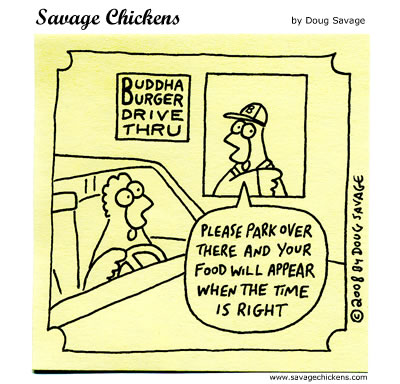
Buddha Burger drive through

Despite my mood, I thought this was pretty good:

Buddha Burger drive through

Posted in SESSIUNCULA |
Comments Off on Buddha Burger drive through

QUAERITUR: a revert and Medjugorje

I got this by e-mail:

Father,
I need your help! I am a re-vert to the faith, and my catholic upbringing had little structure as far as family prayer or teaching. Sunday mass and meal prayers and bed time prayers was about it. I didn’t learn how to pray the rosary until I returned to the faith in my …Hold on now…my 40’s!
So I am back with a burning desire to Love our Lord, obey his commandments and spend time with him in quiet every day of my life. I still feel less than adequate when it comes to comparing my self with the learned and well read people of the church, but I do know that the Magisterium of the church is what I need to follow and the teaching of the gospels.
My issue is that a very educated friend  that I know is in disagreement with the teachings of the church as far as the Medjugorje acceptance. This person says that there are many priests and even Bishops that go there and that private revelation is what is good for the catholic faith. I say, that if it is not OK with Rome, we should "Leave it alone"!  And that  this is a good reason why the church has so many issues when our own priests and Bishops don’t follow Rome!!
Father, can you send me just a short note on your facts about the teaching you know on the Medjugorje stuff?
I need to be able to answer this. All I can do is see it from the eyes of a child, as what I was taught …Do as your Father says! So that’s what I do!
I can understand if you are too busy, and may god Bless you for reading this. I always have a place for you in my prayers Father.

Folks, I just don’t have it in me at the moment to tackle this.

Perhaps a couple of you who are knowledgeable about Medjugorje issues could write to me by e-mail and I could forward things.

UPDATE 28 July 21:16 GMT


Fr. Jay Finelli has come to our aid.  

Dear Fr. Zuhlsdorf,

The Holy See has asked that there be no official pilgrimages from Dioceses or parishes, but people can go to pray and confess.  I have been several times and although I believe, I await the final decision of Holy Mother Church.  There are a few statements of the CDF that I though might be helpful.

God bless,
Fr. Jay Finelli

The Bishop of Langres in France, Msgr. Leon Taverdet, took recourse to the Apostolic See February 14, 1996 to ask what the position of the Church is regarding the apparitions in Medjugorje and whether it is permitted for one to go there for pilgrimage. The Holy See’s Sacred Congregation for the Doctrine of the Faith answered March 23, 1996 through its Secretary Archbishop Tarcisio Bertone. We present his response in its entirety.

CONGREGATION FOR THE DOCTRINE OF THE FAITH

Vatican City, March 23, 1996

Prot. No. 154/81-01985

Your Excellency,

In your letter of February 14, 1996 you inquired what is the present position of the Church regarding the alleged "apparitions in Medjugorje’ and whether it is permitted to the Catholic faith to go there for pilgrimage.

In reference to that, it is my honor to make known to you that, regarding the authenticity of the apparitions in question, the Bishops of the former Yugoslavia confirmed in their Declaration of April 10,
1991 published in Zadar:

". . .On the basis of investigation up till now it cannot be established that one is dealing with supernatural apparitions and revelations.

However, the numerous gatherings of the faithful from different parts of the world, who are coming to Medjugorje prompted both by motives of belief and certain other motives, require the attention and pastoral care in the first place of the bishop of the diocese and of the other bishops with him so that in Medjugorje, and everything related to it, a healthy devotion toward the Blessed Virgin Mary would be promoted in conformity with the teaching of the Church.

For that purpose the bishops shall issue separate appropriate liturgical-pastoral directives. Likewise by means of their Commission they shall further follow and investigate the total event in Medjugorje."

The result from this, in what is precisely said, is that official pilgrimages to Medjugorje, understood as a place of authentic Marian apparitions, are not permitted to be organized either on the parish or on the diocesan level, because that would be in contradiction to what the Bishops of former Yugoslavia affirmed in their fore mentioned Declaration.

Kindly accept, your Excellency, an expression of my profoundly devoted affection!

+ Tarcisio Bertone

CONGREGATIO PRO DOCTRINA FIDEI

Pr. No 154/81-06419 Citta del Vaticano, Palazzo del S. UffizioMay 26,
1998 To His Excellency Mons. Gilbert Aubry, Bishop of Saint-Denis de la Reunion

Excellency,

In your letter of January 1, 1998, you submitted to this Dicastery several questions about the position of the Holy See and of the Bishop of Mostar in regard to the so called apparitions of Medjugorje, private pilgrimages and the pastoral care of the faithful who go there. In regard to this matter, I think it is impossible to reply to each of the questions posed by Your Excellency. The main thing I would like to point out is that the Holy See does not ordinarily take a position of its own regarding supposed supernatural phenomena as a court of first instance. As for the credibility of the "apparitions" 
in question, this Dicastery respects what was decided by the bishops of the former Yugoslavia in the Declaration of Zadar, April 10, 1991: 
"On the basis of the investigations so far, it can not be affirmed that one is dealing with supernatural apparitions and revelations." 
Since the division of Yugoslavia into different independent nations, it would now pertain to the members of the Episcopal Conference of Bosnia-Hercegovina to eventually reopen the examination of this case, and to make any new pronouncements that might be called for.

What Bishop Peric said in his letter to the Secretary General of "Famille Chretienne", declaring: "My conviction and my position is not only ‘non constat de supernaturalitate,’ but likewise, ‘constat de non supernaturalitate’ of the apparitions or revelations in Medjugorje", should be considered the expression of the personal conviction of the Bishop of Mostar which he has the right to express as Ordinary of the place, but which is and remains his personal opinion.

Finally, as regards pilgrimages to Medjugorje, which are conducted privately, this Congregation points out that they are permitted on condition that they are not regarded as an authentification of events still taking place, and which still call for an examination by the Church.

I hope that I have replied satisfactorily at least to the principal questions that you have presented to this Dicastery, and I beg Your Excellency to accept the expression of my devoted sentiments.

Archbishop Tarcisio Bertone(Secretary to the "Congregatio", presided over by Cardinal Ratzinger)

Posted in SESSIUNCULA |
Comments Off on QUAERITUR: a revert and Medjugorje

On the “SSPX Question” – an interesting blog post

Anyone interested in the "SSPX Question", might want to take a look at an entry on the blog The Sensible Bond by a frequent commenter here, Dr. Brian Sudlow.

Confessions of a Nobody or why I quit the SSPX milieu

A taste:

I’ve made the journey, and this is how.

Imagine me in 2003, a younger and certainly a thinner chap, on the point of completing the translation of the biography of Archbishop Lefebvre (ABL from now on). It was a monumental task which I still feel honoured to have undertaken, for however one disagrees with ABL, he was for most of his life an undoubtedly great servant of the Church. His errors, when they were errors, were made out of love for the Church. It was about this time that Fr Paul Aulagnier, the very first seminarian to ask ABL for help in the late 1960s, and these days with the Institute of the Good Shepherd, was drummed out of the SSPX. There were various reasons for this expulsion but one of these was an interview he gave to The Remnant in which he said something that, for once, broke through my traditionalist view of the Church: he said that on their current course, the SSPX were on, or risked following, a schismatic trajectory.

There is a lot more. 

It is very engaging.

Posted in SESSIUNCULA |
Comments Off on On the “SSPX Question” – an interesting blog post

Request

I am very sad about something at the moment.  In your charity please pray for a personal intention.  Thanks!

Posted in SESSIUNCULA |
Comments Off on Request

ANGELUS: Interviews SSPX excomm’d bishops (part III: R. Williamson)

Here is the third part of the Angelus interview with three of the four excommunicated bishops of the SSPX.  Part one (Fellay) was here and part one (Tissier de Mallerais) here. 

Today we look at what SSPX Bishop Richard Williamson has to say, twenty years after the illicit consecrations in Ecône.

My emphases and comments.  I have changed some formatting.  This interview is in the recent number of the publication of the SSPX called Angelus.

Q: What are your thoughts on the state of the Church after 20 years of the episcopacy?

Williamson: The state of the Church is very grave. The churchmen at the summits [He doesn’t say "summit", but "summit" is included.] of the Church continue to be blinded by the errors of Vatican II. [A vague charge.] They may have their moments in which they show some sympathy for the liturgy of Tradition, but one would have to say that its doctrine remains for them a closed book. They show no signs of grasping that there even exists a Truth which is one, exclusive and immutable, let alone their accepting such a Truth. [So, Williamson is saying that they, including Pope Benedict I suppose, are "relativists", perhaps post-modern deconstructors.]

Q: What has changed, if anything, in the Society?

Williamson: What has changed in the Society is that on the one hand it has no longer had Archbishop Lefebvre to guide it for the last 17 years, who had a unique charism as Founder, and on the other hand the world around us has very much moved on since his death, and not for the better. The holding action [As also Tissier de Mallerais used throughout his interview, this is the language of battle.] of the Society is holding, but when one observes this world around us one cannot help calling to mind the words of Our Lord, “If these days were not shortened…”

Q: How many countries have you visited since your consecration?

Williamson: I have lost count of the number of countries I have visited since 1988. It would have to be dozens.

Q: What has impressed you most about the faithful on your world-wide confirmation circuits?

Williamson: What impresses most in the people presently following or accompanying the SSPX is that some may come and some may go, but numbers generally hold, and in some parts of the world, even increase. The Faith is being kept, and it continues to bear fruit, the same fruit of peace and tranquility [really?] as it has always borne.

Q: Is it possible to consider how things might have played out had the Archbishop not consecrated bishops?

Williamson: Had the Archbishop not consecrated? We would have seen some other marvel of the Lord God to ensure that the Faith and the Church continued. [An interesting observation.  In other words they did not have to defy the Vicar of Christ, and persist in defiance.  I think when people offer the argument that had Archbp. Lefevbre and the SSPX not done what they did, then we would not have the older Mass today, we should reject that premise, or at least scrutinize it closely.] There can be no doubt that the bishops of the SSPX have in fact made possible the continuance of the SSPX as one bulwark of the Faith in difficult times, but the Lord God’s arm is not shortened by the wickedness of men.  [True!]

Q: Do you see the situation with Rome as more or less encouraging after these past 20 years?

Williamson: I am afraid the situation with Rome is still more discouraging than 20 years ago. [One would not think so, unless one has an abiding problem with the person of Papa Ratzinger.  Perhaps the abiding problems is, in this case, fear.  Williamson would not be capable of "winning" an argument with Papa if it really came down to the serious doctrinal dialogue the SSPX claim they desire.  So, perhaps constantly kicking sand at the eyes of the "summits" is their best strategy right now.] As Our Lord says in one of His parables, “Some enemy hath done this.” Some enemy, very clever and cleverly hidden, is at work. [A diabolical conspiracy.  Still, I find it ironic that he cites a verse from Scripture which Augustine used when refuting the theological positions of the Donatists, who set up altar against altar, defied legitimate Catholic authority, and believed in a Church of the pure only.  Ironic.] Notwithstanding, the Lord God is in control.  [For someone who makes statements about abandonment to divine providence, there sure is an extreme need to be in control, isn’t there?]

Q: What would you say to those who, in 1988, predicted the Society was creating a parallel Church? [Which would a…. what… a "schism"?] Has not history proved them wrong?

Williamson: Of course events have shown that anyone was wrong who said that the SSPX was producing a parallel church. Amongst our people I would say the danger is rather of too much, and not of too little, love for these present Romans. But that love testifies to their true love of Rome.  [Hmmm…  I am not sure what this is saying.  However, I glean from this that Williamson thinks that those who are in the Roman Curia are not real "Romans", in the sense of living true Romanità, in the sense perhaps of sentire cum Ecclesia.  There is a Rome and the "true Rome", and the leadership of the SSPX adhere to the "true Rome".  I suppose this is part of their deeply entrenched default position that they, not Rome, are the true arbiters of what is "Catholic".  This is what, perhaps, Card. Castrillon’s conditions were aiming at when he asked if the SSPX would refrain from claiming a magisterium superior to that the Roman Pontiff.  Once again, I hear echoing through these words the attitude of the Donatist.]

Q: What stands out as the most important development of the past 20 years? The death of the Archbishop? The election of a new Pope? The Motu Proprio?

Williamson: The most important development of the last 20 years would seem to me to be no one event in particular, but rather the advance on every front of evil in general. We are surrounded. [I want to give him the benefit of the doubt here, but a close read might suggest to some that he has just including the election of Benedict XVI and the issuing of the Motu Proprio as part of the "advance of evil".  I get the impression that this fellow thinks that the MP was a Trojan Horse.  Bp. "Cassandra" is therefore warning against any close dealings with the "false Rome" or those at "the summits".]  Humanly, we are going under. [Is there a bit of a dualism behind this statement?] But God is God!  [Again the reference to divine providence.]

Q: Many Catholics who began the fight alongside the Archbishop years ago now feel inclined to unite forces with a seemingly more conservative Rome by allying themselves with organizations with a more “regular status” [Well… a groups status is regular or it isn’t.. something they ought to know.] within the Church. What would you say to these people who abandon the cause of the Society of St. Pius X? [Interesting.  So, unity with Rome isn’t the "cause" of the SSPX…]

Williamson: To those many souls tempted to join organizations that seem to defend the Faith yet are under these Romans, [!] I would say, beware, beware, beware! Look at the fruits of these Romans. Does the one, true and immutable Faith prosper under their hands, or does it not rather wilt? Doctrine, doctrine, doctrine!  [Again, the SSPX position that doctrine is at the heart of the conflict they have with the "false Rome" and they are the arbiters of Catholic doctrine.]

Q: What is your most memorable recollection of the Archbishop?

Williamson: My most memorable recollection of the Archbishop would, again, be no one thing or event in particular, but rather his steady and calm measuring of everything by the measure of the Faith, and his complete, but sane, dedication to its service. May he be resting in peace!

Q: What was the most memorable time of your seminary formation?

Williamson: The most memorable time of my seminary formation would – I am getting stuck like a needle in an old-fashioned gramophone!–be all of it.

Q: Would you say that the fight for the Mass [Is the fight for doctrine or for the Mass?  Read on.] has changed dramatically since the consecrations?

Williamson: What one might say has changed in the fight for the Mass since the Consecrations is that the enemies are pretending to yield on the liturgy, [Pope Benedict = "enemy"] but they are not giving an inch on their rotten doctrine of Vatican II. [Again, the vague label, "Vatican II".] But the relation between liturgy and doctrine is, broadly, like the relation between the ninth of the iceberg showing above water, and the eight-ninths beneath water upholding the ninth showing. Without the Faith, the Mass alone would be nowhere.  [If I am not mistaken, this was an image used by the Bp. Fellay not long ago, in Paris, at the end of June 08.]

Q: Contrariwise, would you say that the fight for doctrine [doctrine again] has become more important?

Williamson: Would that the fight for Doctrine had become more important! I fear that its fundamental importance is still not sufficiently understood. Modern man is a sentimental, not a doctrinal, animal. [This is pretty close to the mark.  It is interesting how, today, you can lead people step by step through an argument and, when you arrive at the inescapable conclusion, they will say, "I feel differently, but if that is true for you…".] Truth for him goes by inner feeling instead of by outer reality. It is all laid out in Pius X’s great Encyclical, Pascendi. 

Q: What does it mean that, besides Bishop Rifan, Rome has not given traditional bishops to any of the Ecclesia Dei communities? Does this not vindicate the Archbishop’s decision?

Williamson: Bishops are where the Church is at, as Rome very well knows. Therefore of course Rome will not give out bishops if it can possibly help it. That is not a reason to consecrate them regardless, but the Archbishop was obviously right, in retrospect. [But earlier he stated that God would have provided anyway… hmmm.] God bless his courage!

Q: What do you foresee as the greatest challenges facing the Society and the faithful in the next few years?

Williamson: The greatest challenge to the SSPX in the next few years is to grasp the primacy of doctrine, [doctrine] and to measure everything else, and to pray, accordingly. In our sentimental world, the constant temptation is to go by feelings. Not going by feelings is what marked out Archbishop Lefebvre, [really?] and if in this respect we do not follow him, the SSPX will go the way of all flesh – into the arms of the (objective) destroyers of the Church. [?!? – says one of the men who broke the Church’s unity.  Whom would he list among the "destroyers", I wonder?]

Q: What do you think would be Archbishop Lefebvre’s assessment of the crisis as things stand in 2008?

Williamson: How the Archbishop would see things today is an interesting question. Myself, I think he would be more wary of these Romans than ever. [Pope Benedict, Card. Castrillon, etc.] They are persevering, persevering, persevering in their blindness, while the Lord God must, logically, all the while be offering them all the graces they need to see clear, [My heavens the arogance of this judgment… ] and if necessary, to accept the martyrs’ crown. These graces they must be steadily refusing, or de-fusing. God is their judge. May He have mercy upon them, and upon us all.

Q: What counsel would you give to parents rearing Catholic children in today’s world?

Williamson: Parents have a specially difficult task today, but the answer to the question of what they must do is basically easy – EXAMPLE! Let parents practice their Faith sincerely and steadily, as though it is the most important thing in their lives, and the children will have there the greatest help towards saving their own souls. What else matters? But parents do also need to learn the old-fashioned basics of parenting, which today go largely lost. How learn them? From grandparents, their own parents, if they still know, and from priests who have their heads screwed on straight. All modern ideas of parenting and education are worthless.   [Actually, pretty good advice!]

Q: What advice would you offer to young men and women contemplating the religious life?

Williamson: To young men and women contemplating the religious life, I would say, look before you leap!  [Interesting.  A slight contrast to the "leap now!" approch of Tissier de Mallerais.  Though the different answers are not necessarily incompatible.  You can still act with decision while scoping out the leap.] Again, the religious life can be presented, or present itself, in a sentimental light. Such vocations cannot go very far. For boys, perhaps ask to spend a year as a gopher in a priory of the SSPX, [hmmm…. ] and make yourselves useful. For girls, I would venture to say, look for a large family in which to spend a year helping out one of those mothers who have had nine children in ten years, and are home-schooling at the same time. That, for our under-real and under-feminine lasses, would be a great apprenticeship in reality and motherliness!  [Okay… notice the difference in the way Williamson sees vocations of young men and women.  He seems not to think of women and religious vocation at all, only motherhood of large home-schooling families.  This was the approach also, wasn’t it, of Tissier de Mallerais?]

Q: Which books do you think are most essential for the faithful in these days?

Williamson: Catholics, especially men, should always be reading, in order to arm their minds against the universal delusions and deceitful propaganda which are all around us today. [Fair enough.] The books from which someone will most profit will always be the books which most interest him. But all kinds of men are interested by all kinds of aspects of the Faith, so a general recommendation is not easy. However, in this crisis of Church, world and Faith, Archbishop Lefebvre’s writings have a special character of being truthful, profound and yet accessible. [ROFL!  Okay… no disrespect to the late Archbishop, who was a great man in many ways, but this strikes me as similar to those who offer young people the poety of Maya Angelou in a basic class in great classics of English literature.  I think we have to wonder if Archbp. Lefevbre was one of the great Catholic writers who is best apt to give young people the best starting points for their Catholic future in this difficult world.  Maybe… but I am forced to doubt.  Perhaps this could be a good topic of discussion in a new entry on this blog.] Start with the Open Letter to Confused Catholics [available from Angelus Press. Price: $14.00–Ed.] and go from there.

Q: What do you foresee in the next 20 years?

Williamson: In the next 20 years I see an on-going, even accelerating, degeneration of men and morals, until either they all begin to tear one another to pieces – a Third World War is absolutely in the cards, or the Lord God intervenes – an unimaginable Chastisement is equally likely. [These fellows are really apocalyptic.  I wonder…  It is interesting that the extreme left will accuse the right of "fear mongering" and using "scare tactics".  I wonder if these strongly apocalyptic tendencies in the SSPX leadership are not, in part, a compensation for a shaky ecclesial position.  They do play well to a base inclined to an extreme.  I am sure that the leadership is accutely aware of the need to keep the base on board with them, now that Papa Ratzinger is Pope and Summorum Pontificum is in force.  I am simply wondering out load here.  Interesting questions.] Or both. Things cannot go on for much longer like they are going at present. Reality is going to come swinging back. I think we all need to pray especially for the conversion of sinners, as Our Lady at Fatima asked of the three children, because surely millions and millions are on the very brink of eternal damnation. [But… they always have been in every age.  Nothing new here.] Christ, have mercy upon us!

Sixty-eight years old, Bishop Williamson was born into an Anglican family. Receiving a degree from the University of Cambridge, he devoted more than seven years to teaching literature, an activity which took him for two years to the heart of black Africa. At the age of 30, he abjured Anglicanism and converted to the Catholic Faith, and in October 1972, he entered Archbishop Lefebvre’s seminary in Ecône, where four years of formation brought him to the priesthood on June 29, 1976. [He was ordained just 4 years after converting.] From 1976 to 1981, Bishop Williamson performed the duties of professor at the Society’s seminaries at Weissbad and Ecône, of which he was to become the Vice-Rector in 1979.  In 1982 Archbishop Lefebvre, then Superior General of the Society of St. Pius X, nominated him to the St. Thomas Aquinas Seminary, of which he was Rector until 2003. In 2003 he was appointed Rector of Our Lady Co-Redemptrix [Is the SSPX pushing also for a declaration of Our Lady as "Co-redemptrix"?] Seminary in La Reja, Argentina, a post he holds to this day.
 

Posted in SESSIUNCULA |
199 Comments