Macon, GA: TLM, ad orientem developments

I received this by e-mail:

Father Z;

I wanted to share with you the words of our Pastor, Father Allan McDonald, Pastor of St. Joseph in Macon, Georgia.  You have mentioned him at least once before on your blog a few months ago and thought you might be pleased with his latest, which appeared in the Parish bulletin dated July 13th, 2008. 

He says a thing or two you may disagree with (like the implication that only the EF can be said in Latin), but by and large I believe you would approve of what is written and consider it another "brick".  I do believe that Father is preparing us for Ad Orientum before the end of the year.  He mentions singing certain parts of the OF in Latin as well, and we have done some of it (the Sanctus, Angus Dei and the Greek Kyrie), not with regularity but some frequency.  I would love to see the other prayers he lists incorporated in their Latin form into our OF Masses. 

I wish that there was more good news from the Diocese of Savannah, but I am at least Blessed to be in the epicenter of what good news there is.  I have transcribed the entire article, feel free to edit as you find necessary.

Dear friends in Christ,
     I’m writing this letter prior to my departure for vacation.  I’ll be back in the office on August 1st.  Today we welcome Fr. Jim McGovern with Food for the Poor.  He will let us know what his organization does and how we can help.
     This past Monday, July 7, was the first anniversary of the papal document Sumorum Pontificum.  In it, Pope Benedict authorized the "recovery" of the Latin Mass according to the 1962 Roman Missal.  This Mass is also known as the "pre-Vatican II Mass" of the "Tridentine Mass."  Pope Benedict stated that in the Latin Rite of the Catholic Church there is but one Liturgy with two expressions, the Ordinary (normal) Form of the Mass, revised after Vatican II and the Extraordinary Form of the Mass celebrated in Latin.  The Extraordinary Form of the Mass is sometimes called the "Gregorian Mass."  The pope even declared that he hoped that the more frequent celebration of the Extraordinary Form of the Mass would bring more solemnity and dignity to the celebration of the Ordinary Form.  He prayed that assemblies throughout the world would together with their priests orient themselves towards Christ, rather than towards each other.  In the Extraordinary Form of the Mass the priest and congregation face the Liturgical east together, the symbol of the location of Christ’s return at the end of time.  The priest and people do not look at each other in prayer that is directed to God alone.
     Now that I am celebrating both forms of the Mass, I have a renewed appreciation for both forms.
[This is, in my experience, the universal reaction of priests who learn the older form of Mass.] The active participation of the laity in the Ordinary Form of the Mass is truly a gift from God as is the Vernacular.  However, the Second Vatican Council did not mandate the entire removal of Latin, but in fact mandated that Latin be preserved while the vernacular could be allowed.  It would be good for congregations to know how to sing the Greek Kyrie, and the Latin Gloria, Credo, Sanctus, Mysterium Fidei, Pater Noster and Agnus Dei.  We have made strides in that direction. 
     The solemnity of the Extraordinary Form of the Mass, with its quiet reverence as well as awe and wonder is important to maintain and strengthen in the Ordinary Form.  There is no real reason why the priest and congregation cannot face the same direction, the Liturgical East, even in the Ordinary Form. [Indeed.  There is every reason why they should!] To be honest with you, when I am praying to God through Christ, but in your name, looking at you while I pray can be a distraction.  The priest is not reading prayers to the congregation.  The priest looking at the congregation during prayer could confuse the nature of prayer not only in the mind of the congregation, but also in the mind of the priest.  The priest is not talking to the congregation except in greetings, explanations, scripture and homily.  In prayer, the priest, who represents the people of God, [and who is also alter Christus] is praying to God.
     What does the future hold for the Catholic Mass?  It is safe to assume that we have entered the era of the "reform of the reform."  While Vatican II has been a gift to the Church, we simply must overcome any and all denial about the deleterious effects of some interpretations of Vatican II that were not at all the mind of Vatican II or the Magisterium.  The decline and fall of most orders of nuns is a powerful example of good intentions run amuck.  Yet the elderly religious who remain, cling tenaciously to a belief that they actually went through some sort of legitimate renewal and are examples for the rest of the Church!  Yikes!
     I’m not clairvoyant in predicting the future, but change is and will continue to occur.  We need to be ready and willing to follow the Magisterium in the areas of faith and morals.  This will be the best way to implement the "reform of the reform."  God Bless you.
Your Pastor,
Father Allan J. McDonald

WDTPRS kudos to Fr. McDonald!

Posted in SESSIUNCULA |
61 Comments

Transcript of the Holy Father’s presser on the airplane

Transcript of the Holy Father's presser on the airplaneThe transcript of the presser with the Holy Father aboard the airplane en route to Australia has been released, so far in the original language of the questions (Italian and English).
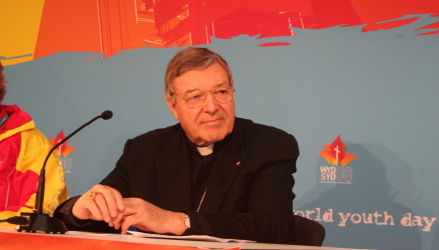
Now you can see who asked which questions.

Lucio Brunelli, of RAI asked about the main message the Holy Father wanted to give at WYD.

Paul John Kelly, of The Australian asked (In English) about secularism and overcoming religious indiffernce.

Auskar Surbakti of SBS, Australian television, asked (in English) about victims of sexual abuse by clergy.

Martine Nouaille, dell’Agence France Presse asked about climate change.

Cindy Wooden of Catholic News Service asked about the Anglicans.

Posted in SESSIUNCULA |
20 Comments

Prayer request: Gianluca Barile

According to the intrepid Andrea Tornielli, writing from Australia, the director/founder of PETRUS, Gianluca Barile, a good source of Catholic liturgical news and the pontificate of Pope Benedict XVI, has had an cerebral ischemia. 

Please join WDTPRS in praying for him.

Posted in SESSIUNCULA |
5 Comments

WYD: Communicants to kneel at papal Masses

This is just in via e-mail:

Kneeling for Communion?      
Written by Justin Lynch  
Monday, 14 July 2008

WYD: Communicants to kneel at papal Masses

9:30 am Happy & Ready: Cardinal Pell

Fresh from greeting the Pope upon his arrival, Cardinal Pell was asked this morning by a journalist about how those receiving communion directly from the Pope would do so, when the time came, at the Final Mass during WYD08.

Following on from recent sightings at Vatican events where ‘older postures’ – kneeling to take Holy communion on the tongue – have been adopted, his Eminence replied,

"I think those receiving holy communion will be kneeling."

Posted in SESSIUNCULA |
21 Comments

More video from Australia

Some video from Australia.

Pope Benedict celebrates Mass privately, has a walk, hears some music.

(This video is no longer available.)

In this piece we see the arrival of the WYD Cross.

There are also interviews with pilgrims from Burma.

(This video is no longer available.)

Muslims and Jews take in some WYD pilgrims.

(This video is no longer available.)

An AP piece, obsessing about the priest/abuse controversy.

(This video is no longer available.)

A spot from SAT2000 in Italian


Posted in SESSIUNCULA |
10 Comments

Chicago Tribune: Santissima Trinita dei Pellegrini in Rome

Here is a story from the Chicago Tribune about Santissima Trinita dei Pellegrini, the church in Rome which is established as the parish for the Extraordinary Use of the Roman Rite.

Chicago Tribune: Santissima Trinita dei Pellegrini in Rome‘A greater sense of the sacred’
With pope’s blessing, Latin masses reborn in Rome, drawing pilgrims anew

By Christine Spolar | Chicago Tribune correspondent
    10:27 AM CDT, July 13, 2008

ROME — In the cool recesses of Santissima Trinita dei Pellegrini church, a Roman Catholic rite steeped in Latin has been reborn in this country.

Three priests, garbed in lace-trimmed white and golden robes, take to the altar as a band of brothers every Sunday, their backs to worshipers, their eyes on the mass at hand.  [Count the cliches.]

Dozens of people dutifully follow a service studded with long silences and soaring choral song. Many women have pinned lace mantillas to their hair. When parishioners, young or old, seek the sacrament of communion, they move quickly to kneel, with mouths humbly open.

A celebration at Santissima Trinita dei Pellegrini is a visit to your grandfather’s mass—and that is exactly the chain of devotion that Pope Benedict XVI wants honored and maintained.

The 16th Century church, located near the lively Campo dei Fiori [actually it’s Campo de’ Fiori] in Rome’s historic district, was built about the same time that Latin liturgy was formalized. It now bears the distinction of being the first large parish in Rome to be granted free rein to celebrate the long-gone liturgy known as the Tridentine rite.

Pope Benedict’s role

Pope Benedict signaled last year that he was loosening restrictions on the Latin mass, which had essentially been swept away with the 1960s reforms of Vatican II. His desire, church officials said, was to give "greater access" to all the church’s traditions.

Part of the legacy of the Second Vatican Council was a rethinking of the liturgy to include more robust participation of parishioners and most notably to end the use of the ancient language of Latin [Nooo… the Church had a clear understanding of "active participation" which was later derailed.  Also, the Council required that Latin be retained at the language of worship.] — which was seen by some to limit understanding—and allow people to participate in their native language. [They could already.  People had hand missals.]  Pope Benedict, a fervent theologian, [A "fervent" theologian?] now appears to be rethinking the loss of some traditions.  [Indeed yes.  But that is just the beginning of what he is doing.]

By June, with the Vatican’s help, this Rome church —The Most Holy Trinity of the Pilgrim church, in English—was designated a personal parish within the local diocese and, as such, open to any Catholic who shared the new mission of reinvigorating the Latin-laced rite.  [It’s open to anyone.]

The Priestly Fraternity of St. Peter, which for years had celebrated the traditional liturgy as a religious group, was given the authority to launch the old-made-new-again mass.

"Some people say there’s a greater sense of the sacred and the transcendental when they hear the mass in Latin," said Rev. Joseph Kramer, who leads the grander services on Sunday as well as daily evening masses. "In some ways, it is less invasive. It lets people pray freely.

"What I sense is there is a lot of silence and people are very concentrated. During the mass, I can feel the concentration. There’s no one talking and no one fidgeting."

For some believers in the heart of this Catholic country, the new parish is a blessing to their long-held desire to keep the faith with the liturgy of their childhood. Only a few people after mass said they had trouble following every word. The church helps out a bit: Missals are printed, side by side, in Italian and Latin.

Unlike in the modern liturgy, the priests barely interact with the public. [Argh!  They are intimately inacting with the people but, evern more importantly, for the people with God.] They don’t face parishioners — a big visual change from the modern service—and repeat their prayers in near solitude. Still, even younger observers left the service touched by its intimacy. "There’s just more solemnity to this," said Roberta Tantalo, a 27-year-old elementary school teacher.

Alessandra Petruccioni, 40, rode a train for a half hour from her suburban home into Rome for a chance to pray in Latin. She was smiling broadly after a mass that resounded with an a cappella finale of Salve Regina.

"I grew up with this as a child and I wouldn’t change it for any other mass," Petruccioni said.

A nod to conservatives [Another cliche.]

Some American parishes, while amenable to the Vatican reforms, were more likely to look for ways to accommodate traditionalists. Some parishes in Chicago and New York, for example, have for years designated services for parishioners who wanted the old mass. Six parishes in the Chicago area currently offer Latin masses. [Again… the Novus Ordo should also be in Latin.]

But Italy’s clergy were less inclined to buck a firm Vatican line. It was not until 1992 when a small group of priests, the fraternity now in charge of Santissima Trinita dei Pellegrini, were approved to celebrate a Latin mass on a regular basis at a smaller Rome church.

But Petruccioni said even that fell short of a full-service parish to serve her needs.

"I like this now because this is a real parish, and we can have all the sacraments," she said. "We’ve had 40 years of decline in the church, and I am so glad that this pope is here, to again make people obey."  [An unfortunate quote.]

Pope Benedict’s new approach appears to have broader goals. A top Vatican official this spring indicated that the pope’s interest in the Latin mass was also meant as an olive branch to an ultraconservative group, the Society of St. Pius X, long opposed to the modern liturgy.  [Grrrr.  His vision extends way beyond this.]

The society and the Vatican share a tumultuous past. The late Archbishop Marcel Lefebvre founded the society in 1969 as a rebuke to the reforms of Vatican II. The Vatican later excommunicated Lefebvre after he consecrated four bishops without Vatican approval.

Pope Benedict, it is said, is hopeful of bringing the conservative group back to the Vatican fold and sees giving new life to Latin as a sign of reconciliation.

‘A living phenomenon’

For Kramer, such lofty Vatican aims are far beyond his immediate concerns to build a healthy congregation. This summer, Kramer said, he sees a few more pews empty when the weather is nice. The beach always claims a few summer souls, he said wryly.

Still, Kramer feels that Santissima Trinita dei Pellegrini will have a strong allure. Still graced with sculpture and paintings from the 16th and 17th Centuries, the church reflects the best times of Catholic civilization and consideration, Kramer said. (The altarpiece in particular, "The Holy Trinity" by Guido Reni, is a riveting piece of spiritual art. The entire church is a modest museum in its own right and a sanctuary from the busy city.)

"It’s part of that time, what brought millions of pilgrims to Rome in hundreds of years ago," Kramer said. "With the old liturgy, we can be part of a living phenomenon." [Exactly.]

cspolar@tribune.com

Posted in SESSIUNCULA |
10 Comments

New Bishop of New Ulm, MN – Bp. Elect John Levoir

A friend of mine has just been made the new Bishop of New Ulm, MN.  

Please pray for Bishop-Elect (or "Designate" as some prefer) John LeVoir, presently pastor of St. Michael’s and St. Mary’s in Stillwater, MN (home of the famous bookstore).  Also he was once pastor of St. Augustine’s in South St. Paul, where the Extraordinary Form has been celebrated for many years.

Fr. LeVoir was with us for several days last week for an annual gathering of clergy, about which I wrote elsewhere.

New Bishop of New Ulm, MN - Bp. Elect John LevoirIl Santo Padre Benedetto XVI ha nominato Vescovo di New Ulm (U.S.A.) il Rev.do John LeVoir, del clero di St. Paul and Minneapolis, Parroco di "St. Michael and Mary" a Stillwater.

 Rev.do John LeVoir

Il Rev.do John LeVoir è nato il 7 febbraio 1946 a Minneapolis (Minnesota). Ha compiuto i suoi studi alla "La Salle High School", e presso la "University of St. Thomas" e la "Dallas University." Ha ottenuto un diploma in ragioneria e ha lavorato per un periodo come contabile. È entrato nel Seminario St Paul dell’Arcidiocesi di St. Paul and Minneapolis e ha conseguito un Master in Teologia.

Ordinato sacerdote il 30 maggio 1981 per l’arcidiocesi di Saint Paul and Minneapolis, ha poi ricoperto i seguenti incarichi: Vice-parroco a "St. Charles Borromeo" (1981-1992); Parroco alla "Most Holy Trinity" (1992-2004); parroco di "St. Augustine" (2000-2004). È membro dell’ "International Federation of Priests". È co-autore di: "Covenant of Love: John Paul II on Sexuality, Marriage, and Family in the Modern World" e "Faith for Today". È inoltre co-autore della serie "Image of God", adottata a livello nazionale per l’istruzione religiosa cattolica nelle scuole primarie e secondarie.

Attualmente è Parroco di "St. Michael and Mary" a Stillwater, Minnesota. Nell’ambito delle due parrocchie è compresa anche una scuola regionale.

UPDATE: 1317 UTC New Bishop of New Ulm, MN - Bp. Elect John Levoir

More about the New Bishop of New Ulm.

Frankly, I thought he was going to be made Auxilliary of St. Paul and Minneapolis!

Statement by Bishop-designate John M. LeVoir
on acceptance of appointment as
fourth bishop of the Diocese of New Ulm

It is with faith in God and with devotion to Pope Benedict XVI that I accept his appointment of me as the fourth Bishop of New Ulm. I am most grateful to the Holy Father for his confidence in me.

My background is that of a parish priest. I was an Associate Pastor at St. Charles Borromeo in St. Anthony for eleven years, and Pastor of Holy Trinity in South St. Paul for twelve years and for four of those years, I was at the same time Pastor of St. Augustine in South St. Paul. I have been Pastor of St. Michael and St. Mary in Stillwater since 2004.

I am grateful to the parishioners of all of these parishes for their goodness to me. I am especially grateful to the late Monsignor Richard Schuler [pastor for 33 years at St. Agnes in St. Paul]  for the support that he gave me during my seminary years and for Father Francis Kittock, who was my Pastor and mentor at St. Charles Borromeo where I was his Associate. [What a great difference good priests as examples and mentors can make for vocations… at every level.]

I am particularly grateful to my parents, Marvin A. LeVoir, now deceased, [A career police officer, who worked also with my own mother, also a cop.]  and Mary A. LeVoir, now 93 years old, and to my brothers Frederick J. LeVoir and Paul W. LeVoir,  [Who leads the Gregorian chant schola at St. New Bishop of New Ulm, MN - Bp. Elect John LevoirAgnes Church in St. Paul.] and my sister, Mary Ellen Steinkraus. In his retirement years, I was blessed to have known Bishop Alphonse Schladweiler, the founding Bishop of the New Ulm diocese. He was a kind and gentle shepherd.  [He was also a former pastor of St. Agnes, where Msgr. Schuler was pastor.]

I am pleased that this announcement is being made on July 14, the Feast of Blessed Kateri Tekakwitha (1656-1680). She was beatified in 1980 by Pope John Paul II. Kateri is the first Native American to be declared Blessed.

I am going to be a new Bishop. I know that I have much to learn about serving as a Bishop and about the New Ulm diocese. Archbishop Nienstedt has assured me of his advice and help. I appreciate that so much. I ask the clergy, the religious, and the people of the diocese to be patient with me and to pray for me, as I will for them. With the help of God’s grace, I will do my best to be a faithful shepherd.  [And I am sure he will be!]

UPDATE: 1716 UTC 

Fr. LeVoir co-authored books with the nephew of Msgr. Schuler, Fr. Richard Hogan. Here are a couple titles.

Covenant of Love: Pope John Paul II on Sexuality, Marriage, and Family in the Modern World

Faith for Today: Pope John Paul Ii’s Catechetical Teaching

Jesus, the Way, the Truth, and the Life (Image of God Series)

Posted in SESSIUNCULA |
20 Comments

Wake up and smell the incense

Here is a find from American Papist:

Report: Does incense make you high?
Of course not, but that doesn’t prevent scientists from issuing research papers with titles such as this (I’m not making this up): "Incensole Acetate, an Incense Component, Elicits Psychoactivity by Activating TRPV3 Channels in the Brain."

MSN’s Health & Fitness gives us the popular treatment:

… Frankincense—the incense traditionally burned in religious ceremonies—can act on the brain to lower anxiety and diminish depression.

Researchers from Johns Hopkins University and Hebrew University administered incensole acetate, a component of frankincense, to lab mice and learned that it lit up areas of their little mouse brains that control emotion, including nerve circuits affecting anxiety and depression.  [Imagine what it does to the brains of progressivists…. or maybe not.]

Of course, as soon as the author strays from the science his commentary gets fairly useless very quickly.

I wonder, however, if these sorts of findings could be used as backdoor argument to convince liberal parishes and liturgy commissions to allow incense back into the celebration of Mass? Hmm….

Posted in SESSIUNCULA |
37 Comments

Radio Vaticana: Interview with Fr. Kramer in Rome

Fr. Joseph Kramer, FSSP, Pastor of Ss. Trinità dei Pellegrini in Rome, gave an interview to Vatican Radio:

Here is the Italian text.  I am rather too busy to do a translation.  Maybe one of you Italian readers can do the job?

Click here for audio:

Radio Vaticana: Interview with Fr. Kramer in Rome A Roma, la parrocchia per i fedeli che vogliono assistere alla Messa in latino, secondo il "Summorum Pontificum" del Papa. Intervista con don Joseph Kramer
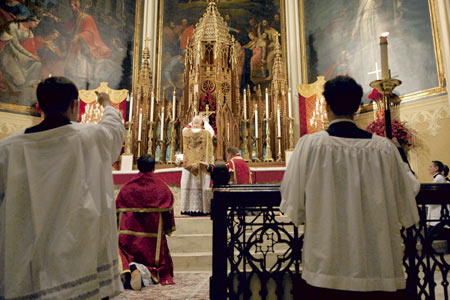
A un anno dalla pubblicazione del Motu Proprio Summorum Pontificum di Benedetto XVI, una conseguenza pastorale concreta del documento papale è stata la creazione, l’8 giugno scorso, della parrocchia "personale" della Santissima Trinità dei Pellegrini, nel settore Centro della Diocesi di Roma. Si tratta della prima comunità parrocchiale costituita in Italia in applicazione dell’art. 10 del Motu Proprio e dunque non sulla base del territorio ma del rito, in quanto composta da fedeli legati all’antica forma del rito romano. La parrocchia, eretta per decreto dal cardinale vicario su disposizione del Papa, è stato affidata a don Joseph Kramer, religioso australiano della Fraternità sacerdotale di San Pietro, in Italia ormai da tren’tanni. Eccolo al microfono di Fabio Colagrande.

R. – L’apertura è andata molto bene: erano tutti contentissimi. Questo ha suscitato molto interesse – anche la stampa ne ha parlato – e da quel giorno la gente è venuta in Chiesa ogni giorno a vedere di cosa si tratta. Questa è una parrocchia personale che non dipende dal territorio. E’ aperta a tutti i fedeli che vogliono frequentare i Sacramenti e la Santa Messa, secondo la forma antica del rito romano. E’ una parrocchia che bisogna creare a distanza. La difficoltà è, infatti, che la gente abita lontano e deve venire da fuori. L’idea è di avere non solo la Messa, ma tutti i Sacramenti – battesimi, matrimoni – oltre alla Quaresima e al Triduo pasquale.

D. – Chi sono i vostri parrocchiani, don Joseph?

R. – Molto vari: gente di tutte le età, molti giovani, famiglie con bambini, persone oltre i 50 anni, che ricordano il rito antico e che sono contente di riacquistare un posto nella vita normale della Chiesa. E anche la gente locale è contenta di vedere che siamo lì, con la forma antica del rito, e che teniamo aperta una chiesa rimasta chiusa per molti anni.

D. – Il cardinale Castrillon Hoyos ha ricordato che l’erezione di questa parrocchia personale ha un valore esemplare per le altre diocesi, sia in Italia che nel mondo…

R. – Sì, perché Roma è sempre un esempio, una città centrale per tutto il cattolicesimo. E già altri vescovi hanno deciso di aprire delle parrocchie seguendo l’esempio dato qui a Roma, ed è molto importante.

D. – Padre Kramer è corretto dire che la sua è una parrocchia di fedeli tradizionalisti?

R. – Questa parrocchia è per tutti i fedeli cattolici normali, che apprezzano la forma antica, ma non appartengono ad una categoria diversa, dei tradizionalisti appunto. Seguire la forma antica non vuol dire diventare necessariamente tradizionalisti. Il nostro desiderio è di essere integrati nella vita quotidiana della Chiesa. E siamo molto, molto grati al cardinale vicario per questa opportunità di entrare nella vita della Chiesa e di non essere considerati un "branco" al di fuori della normativa.

UPDATE: 13 July 19:45 UTC:

NLM has a translation.

A year after publication of the Motu Proprio Summorum Pontificum, Benedict XVI… a "personal" parish [was erected], Santissima Trinita dei Pellegrini, located in the center of the Diocese of Rome. This is the first parish community established in Italy under the motu proprio… The parish, erected by decree of Cardinal Vicar at disposal of the Pope, was entrusted to Fr. Joseph Kramer, an Australian priest of the Priestly Fraternity of St. Peter…

Fr. Kramer: – The opening [Mass] went very well: they were all content. This has aroused great interest – even the press has spoken of it – and from that day people have come to church each day to see what is going on. This is a parish that does not depend on territorial boundaries and is open to all the faithful who wish to attend the sacraments and the Holy Mass in the ancient form of the Roman rite… The idea is to have not only the Mass, but all the sacraments – baptisms, weddings – in addition to Lent and the Easter Triduum.

Who are your parishioners, Father Joseph?

R. – Very different: people of all ages, many young people, families with children, persons over 50 years who recall the ancient rite and are happy to regain a place in normal life of the Church. Even local people are happy to see that we are there, in the form of ancient rite, and that we re-opened a church that had remained closed for many years.

Cardinal Castrillon Hoyos said that the erection of this parish has an exemplary value for other dioceses, both in Italy and worldwide …

R. – Yes, because Rome is always an example, a city that is central to the whole of Catholicism and other bishops have already decided to open parishes following the example given here in Rome, and that is very important.

Father Kramer is it correct to say that this is a parish for faithful traditionalists?

R. – This parish is for all the Catholic faithful who appreciate the ancient form…. Worshipping in the ancient form does not mean necessarily becomes a traditionalist. Our desire is to be integrated into daily life of the Church and we are very, very grateful to the Cardinal Vicar for this opportunity to enter the life of the Church and not be considered a "flock" outside the law.

Remember Rule #4?

4) Be engaged in the whole life of your parishes, especially in works of mercy organized by the same.  If you want the whole Church to benefit from the use of the older liturgy, then you who are shaped by the older form of Mass should be of benefit to the whole Church in concrete terms.

Posted in SESSIUNCULA |
7 Comments

Review of “Worship as a Revelation” by Laurence Paul Hemming

If you are able, I recommend that you subscribe to The Catholic Herald, which seems to be pretty much on the correct side of most of our issues.

Today I read an interesting review by Alcuin Reid of a new book.  My emphases and comments.

Divine worship and the rise of ‘feel-good liturgy’
Philosopher Laurence Paul Hemming’s critique of the changes to the Mass after the Second Vatican Council will shake the liturgical establishment, says Alcuin Reid
11 July 2008

Review of "Worship as a Revelation" by Laurence Paul HemmingPicture
A priest celebrates Mass in the extraordinary form in New Orleans, Louisiana

Worship as a Revelation: The Past, Present and Future of Catholic Liturgy by Laurence Paul Hemming, Burns & Oates £14.99

We talk too much. We read too much. We hear too much. So much so, that we have lost the art of doing, of acting either as individuals or as a people. We no longer understand what it is to belong to a people who acts, who has "public action" of its own. We are no longer liturgical. For in our vernacularism and modernisation and reform, the very nature of the leiturgia – the nature of what is truly the work of the people – has been lost. [At this point, I am scratching my head wondering where he is going.  Liturgy is certainly the "work of the people", but it is first the action of the true Actor, Jesus Christ.  So… let’s read on.]

Today we seek to comprehend and explain and decide what we do in our churches but it is utterly questionable as to whether our people experience the liturgical revelation of Almighty God.  [Good.  I am constantly writing that a liturgical action which does not facilitate an encounter with Mystery, is a failure.]

In fact, let’s drop the adjective "liturgical" and use Hemming’s words which assert that the liturgy is nothing less than "the ordinary and continual revealing of [God’s] truth". If this is so, it cannot be a forum for our own self-expression. [Yes.] It cannot necessarily be within our immediate comprehension or subject to our didactic commentary. [Very good!] It must be experienced, indeed lived, as worship of Almighty God – as opposed to being "enjoyed" as a form of Christian activism – in order to begin to grasp something of what is being communicated in it: the very life of God Himself.

This raises the question not only of what liturgical practices are appropriate but, more fundamentally, of the place of the liturgy in Catholic theology.

Review of "Worship as a Revelation" by Laurence Paul HemmingWhy has Hemming, essentially a philosopher, concerned himself with this question? The answer is simple. This is not an erudite academic discourse. Nor is it an ecclesio-political one. It is the fruit of the author’s experience of Catholic worship. It is also testament to his experience that most attempts to facilitate such connection in recent decades – from guitars to garrulous clergy – while they may have resulted in our happily holding hands with each other, have in part (at least) led us to forget about the worship of Almighty God.

And while modern liturgical forms might have led us to "feel good", it is the former that most clearly and fruitfully reveals the Triune God who has definitively revealed himself in our history, and who thereby makes demands upon us by way of both orthopraxy and orthodoxy. Hemming – as a worshipping Catholic – knows this. As a philosopher and a theologian he has investigated its import for us today. Hence Worship as a Revelation.

This book’s philosophical and theological sophistication will challenge theologians and liturgists to re-examine their assumptions about how they perceive the relationship between theology and liturgy. For if worship is indeed the revelation of Almighty God, its centrality and indeed its priority in theological endeavour cannot be denied. [This is what Pope Benedict is making apparent.] The Sacred Liturgy can no longer be one component of theology; it must be its foundation, for theology that is not grounded in the living revelation of God rapidly degenerates into the mere study of religion.

Hemming’s evaluation of the liturgical reforms over the past century are provocative. Very few will have located the genesis of the late 20th-century liturgical crisis in the reign of the good and sainted Pope Pius X, but Hemming’s argument for precisely this is compelling.

The author wisely refrains from proposing simplistic solutions but allows us to see the anomalies of liturgical reform in the 20th century for what they are – a dangerous tampering with the continuity of God’s revelation. [Could we call that "tampering" perhaps a journey into "discontinuity and rupture"?] Few "trained liturgists" have been prepared to enter into serious debate on this question. It is to be hoped that this book might bring them forth.

For Hemming’s rich and clear liturgical theology is starkly distinct from that prevailing in the western Catholic Church because it is not based on the desire for archaeological reconstruction of a "dreamtime" primitive liturgical purity, nor indeed for a modern ideological construction of something tailor-made for "modern man".  [Very good.  This is a rejection of what Pope Benedict has rejected.]

Hemming is no ideologue, nor is he an antiquarian. Catholic worship is indeed a revelation. It is a live epiphany. It is tangible theology. It is the very heart – indeed the "source and summit" – of our faith. That, of course, is why we tamper with the liturgy at our peril. That is why Pope Benedict XVI has placed the reform of the Sacred Liturgy so high on the agenda of this pontificate. [as part of his Marshal Plan]  And that is why this book will provoke the liturgical establishment, for Hemming does not accept that the apotheosis of all Christian liturgy may be found in the forms produced following the Second Vatican Council, or indeed in the manner in which these forms have been celebrated in the subsequent years.

The role of Sacred Scripture in the life of the Church is another area in which his liturgical theology makes serious and important claims. In short, he points out – and at last someone has had the courage and clarity to do this – that "the liturgy is the proper ground of Scripture (and not the other way round, ie the false view that the liturgy derives from Scripture)," or, put more simply, in the modern understanding of the relationship between the liturgy and scripture, "scripture has lost its ground".  [A very good observation.  In many places liturgical studies have had the life sucked from its veins by the wrong sort of theory of reading and studying Scripture.  Also, remember what Papa Ratzinger stated in The Spirit of the Liturgy in regard to the proper translation of pro multis.  Ratzinger correctly gave the absolutely perfect answer to the issue in stating that translation of liturgical texts is not, in fact, the same as translation of Scripture.  The liturgical texts constitute their own theological source.  Thus, we must translate what the liturgical texts really say.]

This claim to priority on behalf of the liturgy over the biblical text will certainly provoke debate. But, once again, if Worship as a Revelation becomes a catalyst for the re-examination of what a Catholic understanding of the role of Sacred Scripture is, it shall have done very well indeed.

This then is a book that must be read and studied and read again by theologians, scripture scholars, liturgists, all seminary faculty and indeed by all liturgical practitioners.

It will challenge and it will inform. The pontificate of Pope Benedict continues to remind us that "the true celebration of the Sacred Liturgy is the centre of any renewal of the Church whatever". Hemming has rendered the Church a fine service by pointing us along the path toward a true understanding of the liturgy, a path that cannot but inform our celebration of it.

Dr Alcuin Read is a London-based liturgical scholar

Posted in SESSIUNCULA |
28 Comments