If you are able, I recommend that you subscribe to The Catholic Herald, which seems to be pretty much on the correct side of most of our issues.
Today I read an interesting review by Alcuin Reid of a new book. My emphases and comments.
Divine worship and the rise of ‘feel-good liturgy’
Philosopher Laurence Paul Hemming’s critique of the changes to the Mass after the Second Vatican Council will shake the liturgical establishment, says Alcuin Reid
11 July 2008
Picture
A priest celebrates Mass in the extraordinary form in New Orleans, LouisianaWorship as a Revelation: The Past, Present and Future of Catholic Liturgy by Laurence Paul Hemming, Burns & Oates £14.99
We talk too much. We read too much. We hear too much. So much so, that we have lost the art of doing, of acting either as individuals or as a people. We no longer understand what it is to belong to a people who acts, who has "public action" of its own. We are no longer liturgical. For in our vernacularism and modernisation and reform, the very nature of the leiturgia – the nature of what is truly the work of the people – has been lost. [At this point, I am scratching my head wondering where he is going. Liturgy is certainly the "work of the people", but it is first the action of the true Actor, Jesus Christ. So… let’s read on.]
Today we seek to comprehend and explain and decide what we do in our churches but it is utterly questionable as to whether our people experience the liturgical revelation of Almighty God. [Good. I am constantly writing that a liturgical action which does not facilitate an encounter with Mystery, is a failure.]
In fact, let’s drop the adjective "liturgical" and use Hemming’s words which assert that the liturgy is nothing less than "the ordinary and continual revealing of [God’s] truth". If this is so, it cannot be a forum for our own self-expression. [Yes.] It cannot necessarily be within our immediate comprehension or subject to our didactic commentary. [Very good!] It must be experienced, indeed lived, as worship of Almighty God – as opposed to being "enjoyed" as a form of Christian activism – in order to begin to grasp something of what is being communicated in it: the very life of God Himself.
This raises the question not only of what liturgical practices are appropriate but, more fundamentally, of the place of the liturgy in Catholic theology.
Why has Hemming, essentially a philosopher, concerned himself with this question? The answer is simple. This is not an erudite academic discourse. Nor is it an ecclesio-political one. It is the fruit of the author’s experience of Catholic worship. It is also testament to his experience that most attempts to facilitate such connection in recent decades – from guitars to garrulous clergy – while they may have resulted in our happily holding hands with each other, have in part (at least) led us to forget about the worship of Almighty God.
And while modern liturgical forms might have led us to "feel good", it is the former that most clearly and fruitfully reveals the Triune God who has definitively revealed himself in our history, and who thereby makes demands upon us by way of both orthopraxy and orthodoxy. Hemming – as a worshipping Catholic – knows this. As a philosopher and a theologian he has investigated its import for us today. Hence Worship as a Revelation.
This book’s philosophical and theological sophistication will challenge theologians and liturgists to re-examine their assumptions about how they perceive the relationship between theology and liturgy. For if worship is indeed the revelation of Almighty God, its centrality and indeed its priority in theological endeavour cannot be denied. [This is what Pope Benedict is making apparent.] The Sacred Liturgy can no longer be one component of theology; it must be its foundation, for theology that is not grounded in the living revelation of God rapidly degenerates into the mere study of religion.
Hemming’s evaluation of the liturgical reforms over the past century are provocative. Very few will have located the genesis of the late 20th-century liturgical crisis in the reign of the good and sainted Pope Pius X, but Hemming’s argument for precisely this is compelling.
The author wisely refrains from proposing simplistic solutions but allows us to see the anomalies of liturgical reform in the 20th century for what they are – a dangerous tampering with the continuity of God’s revelation. [Could we call that "tampering" perhaps a journey into "discontinuity and rupture"?] Few "trained liturgists" have been prepared to enter into serious debate on this question. It is to be hoped that this book might bring them forth.
For Hemming’s rich and clear liturgical theology is starkly distinct from that prevailing in the western Catholic Church because it is not based on the desire for archaeological reconstruction of a "dreamtime" primitive liturgical purity, nor indeed for a modern ideological construction of something tailor-made for "modern man". [Very good. This is a rejection of what Pope Benedict has rejected.]
Hemming is no ideologue, nor is he an antiquarian. Catholic worship is indeed a revelation. It is a live epiphany. It is tangible theology. It is the very heart – indeed the "source and summit" – of our faith. That, of course, is why we tamper with the liturgy at our peril. That is why Pope Benedict XVI has placed the reform of the Sacred Liturgy so high on the agenda of this pontificate. [as part of his Marshal Plan] And that is why this book will provoke the liturgical establishment, for Hemming does not accept that the apotheosis of all Christian liturgy may be found in the forms produced following the Second Vatican Council, or indeed in the manner in which these forms have been celebrated in the subsequent years.
The role of Sacred Scripture in the life of the Church is another area in which his liturgical theology makes serious and important claims. In short, he points out – and at last someone has had the courage and clarity to do this – that "the liturgy is the proper ground of Scripture (and not the other way round, ie the false view that the liturgy derives from Scripture)," or, put more simply, in the modern understanding of the relationship between the liturgy and scripture, "scripture has lost its ground". [A very good observation. In many places liturgical studies have had the life sucked from its veins by the wrong sort of theory of reading and studying Scripture. Also, remember what Papa Ratzinger stated in The Spirit of the Liturgy in regard to the proper translation of pro multis. Ratzinger correctly gave the absolutely perfect answer to the issue in stating that translation of liturgical texts is not, in fact, the same as translation of Scripture. The liturgical texts constitute their own theological source. Thus, we must translate what the liturgical texts really say.]
This claim to priority on behalf of the liturgy over the biblical text will certainly provoke debate. But, once again, if Worship as a Revelation becomes a catalyst for the re-examination of what a Catholic understanding of the role of Sacred Scripture is, it shall have done very well indeed.
This then is a book that must be read and studied and read again by theologians, scripture scholars, liturgists, all seminary faculty and indeed by all liturgical practitioners.
It will challenge and it will inform. The pontificate of Pope Benedict continues to remind us that "the true celebration of the Sacred Liturgy is the centre of any renewal of the Church whatever". Hemming has rendered the Church a fine service by pointing us along the path toward a true understanding of the liturgy, a path that cannot but inform our celebration of it.
Dr Alcuin Read is a London-based liturgical scholar

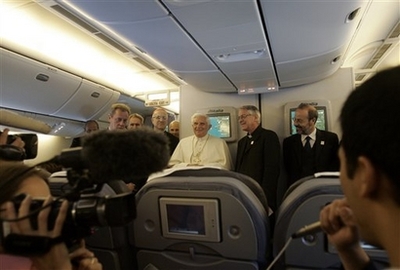 The intrepid
 Today I have an interview with newly ordained Fr. Justin Nolan of the Priestly Fraternity of St. Peter, the FSSP.




 waalaw on Daily Rome Shot 1119: “In 1st variation, 2. . . . . . Q-g1# also works. As does 4. . . . . .…”




























