I put together three WDTPRS articles I wrote about the prayers for the Feast of Corpus Christi.
It is longish but there may be some useful bits.
What Does the Prayer Really Say? The Most Holy Body and Blood of Christ – Corpus Christi)
The Solemnity of the Most Holy Body and Blood of the Lord, or Corpus Christi, celebrates the Eucharist in more focused way than Holy Thursday. It was established by Pope Urban IV in 1264 and its Mass and Office composed by St. Thomas Aquinas (+1274). In anticipation of the universal feast, in 1246 Robert of Thourotte, Bishop of Liège in Belgium, had instituted a feast for the Eucharist at the request of an Augustinian nun and mystic St. Juliana of Cornillon (+1252). The feast of Corpus Christi was inspired by a great miracle. In 1263 a German priest, Peter of Prague, stopped at Bolsena in Italy on his way to Rome. He had doubts about the Real Presence of Christ in the Host. At the tomb of the virgin martyr St. Christina, Peter celebrated Mass. At the consecration blood began to drip from the Host. It bled over his hands onto the linen corporal spread upon the altar. Fr. Peter stopped the Mass and asked to be taken to Pope Urban in nearby Orvieto where he was in residence with his court. St. Bonaventure (+1274) and St. Thomas were also there. The Pope listened to the priest’s account and began a complete investigation. Urban ordered the bishop of the diocese to bring to Orvieto both the Host and the stained linen corporal. The Pope made a great procession with the entire papal court out of Orvieto to meet the other procession approaching with the Host and corporal. St. Julianna urged Pope Urban to institute a universal feast and Aquinas, inspired by the Augustinian mystic, drafted an Office and Mass for the new feast day. The relics are still venerated in the great cathedral or “Duomo” of Orvieto which was built for their display, the cornerstone having been laid in 1290. The cathedral and the gold reliquary are wonders of medieval period. Do not miss them if you travel to Italy.
Today’s Collect, composed by the St. Thomas Aquinas (+1274) and used at Benediction, was assumed into the post-Tridentine 1570 Missale Romanum where it has remained unchanged in all subsequent editions.
COLLECT – (2002MR):
Deus, qui nobis sub sacramento mirabili
passionis tuae memoriam reliquisti,
tribue, quaesumus,
ita nos Corporis et Sanguinis tui sacra mysteria venerari,
ut redemptionis tuae fructum in nobis iugiter sentiamus.
I love that snappy clausula at the end… iúgiter séntiámus! This is a marvelous prayer to sing.
ICEL (1973 translation of the 1970MR):
Lord Jesus Christ,
you gave us the eucharist
as the memorial of your suffering and death.
May our worship of this sacrament of your body and blood
help us to experience the salvation you won for us
and the peace of the kingdom
where you live….
Shall we have some vocabulary? In case you were trying to look for reliquisti in your own copy of the Lewis & Short Dictionary, that esteemed tome of Latin wisdom, it is the perfect of relinquo. It means a range of things like, “leave, leave behind” not only in the sense of in the sense of abandoning but more importantly for us also in the sense of bequeathing. A memoria is not just “memory, the faculty of remembering,”, it is also, “the time of remembrance” and “an historical account, narration.” In early Christian Latin works memoria also means “a monument” in the sense of a “memorial”.
Iugiter is a great word. It comes ultimately from the noun iugum, “a yoke or collar for horses”, “beam, lath, or rail fastened in a horizontal direction to perpendicular poles or posts, a cross-beam”.
The yoke was a symbol for defeat and slavery. A victorious Roman general would compel the vanquished to pass under a yoke (sub iugum whence the English word “subjugate”) made of spears as a token of defeat. Vae victis! was their wail, “Woe to the vanquished!” The prisoners were yoked together and paraded in the returning general’s triumph procession through the Forum’s via sacra to the temple of Capitoline Jupiter. Iugiter (an adverb from the adjective iugis, e, “yoked together”, cf. iungo) signifies “continuously”, as if one moment in time is being yoked together with the next, and the next, and so on.
LITERAL TRANSLATION:
O God, who bequeathed to us under a wondrous sacrament
the memorial of Your Passion,
we implore, grant us
to venerate the sacred mysteries of Your Body and Blood
in such a way that we constantly sense within us the fruit of Your redemption.
I have heard from many places that the customs of Corpus Christi processions, Forty Hours Devotion, and Eucharistic Adoration are returning in force.
People want and need these things.
They help us to be better Catholic Christians through contact with Christ.
The bad old days of post-Conciliar denigration of these necessary practices lingers a bit but the aging-hippie priests and liturgists are losing ground under the two-fold pincer of common sense and a genuine Catholic love of Jesus.
In the seminary I attended in the 1980’s we were informed with a superior sneer towards those quaint old processions and devotions that, “Jesus said ‘Take and eat, not sit and look!’” Somehow, “looking” was opposed to “receiving”. This is the same error, I think, inherent in the puzzling idea that if people aren’t constantly singing or carrying stuff during Mass they are not “actively” participating as if listening and watching must be only “passive”.
Younger people no longer have that baggage, happily. They desire the good things of our Catholic inheritance. They resist passé attempts to make Jesus “smaller”. They want much more, as much as the Church can give.
Remember: none of this is the fault of the Council itself. If blame must be assigned it rests on the shoulders of those who misappropriated the Council’s authority to sustain their own ideas. Those oh so enlightened experts of the Council’s “spirit” will benignly indulge the view that old rites and customs once served a purpose long ago, perhaps for the ignorant old-world peasant and unschooled new-world immigrant, but our shiny new up-to-date man – er um – person doesn’t need those things anymore. In this modern age man has changed. Eucharistic devotions would be harmful rather than helpful. They must never be permitted! We won’t crawl in submission before God anymore. We stand! We do not go in archaic triumphal processions or kneel to Him as judgmental King. We take (h)im/she/it/ourselves by the hand as helping Buddy! We are grown up now, not child-like peasant slaves before a master who is lord and father of our household.
We have changed and so old things are no longer suitable.
Wrong.
Mayhaps passing details of society have changed, its fashions and ideas shifting like sandbars, but man has not changed, however well dressed or sophisticated.
Admittedly there is wider education now and greater affluence in first world countries. Many advances have been attained. But we, as human beings, have not changed. We poor fallen souls, citizens of modern society and newly arrived immigrants equally, all need concrete things through which by our senses we can perceive invisible realities. Urbane schooling and wealth might well be greater obstacles to the spiritual life than poverty and ignorance, urban or rustic.
Man remains human always, good but wounded.
In 1986 the English edition of Joseph Ratzinger’s Feast of Faith was published by Ignatius Press. In that volume Benedict XVI reflected on the feast of Corpus Christi. His Holiness juxtaposed the sad decline of Eucharistic devotions after the Second Vatican Council with what the Council of Trent taught. Although the anti-triumphalism of some post-Conciliar liturgists had repressed Eucharistic exposition, adoration and processions,
(t)he Council of Trent had been far less inhibited. It said that the purpose of Corpus Christi was to arouse gratitude in the hearts of men and to remind them of their common Lord. (cf. Decr. desc. Euch., c. 5; DS 1644). Here in a nutshell, we have in fact three purposes: Corpus Christi is to counter man’s forgetfulness, to elicit his thankfulness, and it has something to do with fellowship, with that unifying power which is at work where people are looking for the one Lord. A great deal could be said about this; for with our computers, meetings and appointments we have become appallingly thoughtless and forgetful (pp. 128-9).
Let us consider Trent again for a moment. There we find the unqualified statement that Corpus Christi celebrates Christ’s triumph, his victory over death. Just as, according to our Bavarian custom, Christ was honored in the terms of a great state visit, Trent harks back to the practice of the ancient Romans who honored their victorious generals by holding triumphal processions on their return. The purpose of Christ’s campaign was to eliminate death, that death which devours time and makes us cultivate the lie in order to forget or “kill” time. … Far from detracting from the primacy of reception which is expressed in the gifts of bread and wine, it actually reveals fully and for the first time what “receiving” really means, namely, giving the Lord the reception due to the Victor. To receive him means to worship him; to receive him means precisely, Quantum potes tantum aude – dare to do as much as you can. (p. 130).
Christ invites us to learn His ways through the image of His yoke taken upon our shoulders (Matthew 11:29-30). In terms of the world crosses and yokes are heavy instruments of bitter humiliation. Jesus says His yoke of subjugation is “sweet” and “light”.
True freedom lies precisely in subjugation to Him.
Yokes are sweet when they are His. To win for us this sweet yoke, He did not defeat us, He defeated the death in us. In the Blessed Sacrament we now proclaim with Christ the Triumphant Victor, “O death, where is thy victory? O death, where is thy sting?” (cf. 1 Cor 15:54b – 57).
We cannot honor enough the Body and Precious Blood of Christ by which we were redeemed.
I affirm my subjugation to Christ Victor, God and King, triumphant over death, vanquisher of hell and my sins.
Before His transforming glory in the Eucharist I am content to kneel until with His own holy and venerable hand He raises me.
SUPER OBLATA (2002MR):
Ecclesiae tuae, quaesumus, Domine,
unitatis et pacis propitius dona concede,
quae sub oblatis muneribus mystice designantur.
ICEL (1973 translation of the 1970MR):
Lord,
may the bread and cup we offer
bring your Church the unity and peace they signify.
LITERAL TRANSLATION:
We beseech You, O Lord
kindly grant to Your Church gifts of unity and peace
which are mystically signified under the gifts here offered.
The vocabulary of today’s prayer doesn’t drive us scratching our heads to the informative Lewis & Short Dictionary, so let’s consider what the prayer is really saying in its content.
In Thomas Aquinas’ beautiful sequence for Corpus Christi the Lauda Sion we hear sung, “Signs, not things, are all we see… here beneath these signs lie hidden priceless things.”
We can use this to pry open the prayer, seeking also insight from the Doctor of Grace, St. Augustine of Hippo (+430).
Since I have been thinking a lot these days about the SSPX and about a divided Church in China, let’s look at the Eucharist as sign of unity.
Augustine looks at the Eucharist in his monumental City of God (ciu.) Book X where he is examining the kind of worship which is due to God (latreia). He reminds us that God does not need sacrifices offered to Him. We need the sacrifices. He wrote in a letter,
“God commands nothing for His own benefit but for the benefit of the person to whom He gives the command”. Sacrifices are, “…signs of gifts God has bestowed either for imbuing the soul with the virtues or for attaining eternal salvation, and by the celebration and performance of them we carry out acts of piety useful to us, not to God” (ep. 138.6).
The outer physical actions of sacrifices are signs of something else: “The visible sacrifice is the sacrament, the sacred sign, of the invisible sacrifice” (ciu. 10.5). Augustine says that in the Eucharist Christ, who is the mediator, accepts the Church’s sacrifice “in the form of God”. However, Christ, “in the form of a servant” also is the sacrifice He receives. Christ is both priest and victim who commanded the Church to continue this sacrifice in the celebration of the Eucharist, the sacramental sign. “The Church, being the body of which He is the Head, learns to offer itself through Him” (ciu. 10.20). Christ’s Sacrifice unifies Christians in offering themselves to God through their participation in the inner reality perceived in outward sacramental signs, sacramenta.
For Augustine sacramenta fall into three categories: 1) the rites of the Law and those commanded by Christ; 2) symbolic figures or types, such as the Red Sea which was parted; 3) mysteries like the Trinity or resurrection.
This three-fold division wasn’t Augustine’s idea. Augustine did, however, give a definition for a sacrament. In ep. 138.7 he says “signs are called sacraments when they have reference to divine things (ad res divinas pertinent)”. For Augustine, in his theory of signs, a sign is an intermediary which causes something to enter into our thoughts. Signs do not distract from the truth of things. They lead us away from the sign itself onward to something greater, the res.
Similarly, a sacramentum which is rite leads us beyond the rite itself. Later, in Medieval theological reflection founded on Augustine, we get the tripartite distinction of sacramentum (the outward sign of a greater spiritual reality) and res (the invisible reality it points at) and res et sacramentum (in the Eucharist at least, how Christ is truly present). Augustine, however, considers only sacramentum and res. This is how some people get confused into thinking that when Augustine speaks about the Eucharist in terms of sacramentum he thought they were merely symbols and not really the Body and Blood of Christ.
On the contrary, Augustine in an Easter Sunday sermon (s. 229.2), describes to newly baptized Catholic neophytes what is going on in the Eucharistic section of the Mass to which they were not previously admitted. He describes the effect of the consecration by the priest’s “word” (i.e., the Eucharistic Prayer):
“And from there we come now to what is done in the holy prayers which you are going to hear, that with the application of the word we may have the Body and Blood of Christ. Take away the word, I mean, it’s just bread and wine; add the word, and it’s now something else. And what is that something else? The Body of Christ, and the Blood of Christ. So take away the word, it’s bread and wine; add the word and it will become the sacrament. To this you say, Amen. To say Amen is to add your signature.”
Most of the time when discussing the Eucharist Augustine doesn’t dwell on the change from bread and wine to Christ’s Body and Blood. Instead, he moves quickly to talk about what the Eucharist means to us and what effect it has, that is, our unity with Him and in Him with each other in the Body of the Christ the Church. This is the gift of the Eucharist, what later theology called res tantum whereas the Real Presence would be called res et sacramentum. The res tantum is the effect in us.
Let’s listen to another Easter sermon (s. 229A, 2). Remember, there were stenographers writing his words down as he preached and this is exactly how we have his sermons today! Augustine compares the people of his flock, especially those just baptized during the night, to the Eucharistic species:
“What you can see on the Lord’s table, as far as appearance of the things goes, you are also used to seeing on your own tables; they have the same aspect, but not the same value. I mean, you yourselves are the same people as you used to be; you haven’t brought us along new faces, after all. And yet you’re new; the same old people in bodily appearance, completely new ones by the grace of holiness – just as this too is new. It’s still, indeed, as you can see it, bread and wine; come the consecration, that bread will be the Body of Christ, and that wine will be the Blood of Christ. This is brought about by the name of Christ, brought about by the grace of Christ, that it should continue to look exactly like what it used to look like, and yet should not have the same value as it used to. You see, if it was eaten before, it would fill the belly; but now when it’s eaten it nourishes the spirit.”
Augustine then explains that on many altars there can be many loaves but in reality all are just one loaf. So too in the Church there are many people but one Body of Christ (cf. 1 Cor 12:27). “What you receive is what you yourselves are, thanks to the grace by which you have been redeemed; you add your signature to this, when you answer Amen. What you see here is the sacrament of unity.”
Thousands of altars. Millions of Hosts. Thousands of chalices. Millions of faithful. One Christ.
The Eucharist is our sign of unity.
It is also the flashpoint of division.
Pride is the catalyst of discord.
Countless kernels of grain go into the one bread offered at the altar for the renewal of Christ’s Sacrifice. Many grapes make one wine. Wheat and grapes, the individual elements, are crushed and brought into a deeper unity.
Humility is the catalyst of unity.
POST COMMUNIONEM (2002MR):
Fac nos, quaesumus, Domine,
divinitatis tuae sempiterna fruitione repleri,
quam pretiosi Corporis et Sanguinis tui
temporalis perceptio praefigurat.
The noun fruitio means “enjoyment”. It derives from verb fruor, famous to Latin students as one of the deponent verbs (utor, fruor, fungor, potior, vescor) whose “object” is usually in the ablative. Fruor (infinitive frui) is “to derive enjoyment from a thing, to enjoy, delight in (with a more restricted significance than utor (uti) “to make use of a thing, to use it)”. The L&S makes a distinction between utor and fruror: both mean “use” but fruor has the added note of enjoyment (cf. Philemon 1:20).
One might remember the use of “use” in the Early Modern English of Shakespeare such as when Brutus says to the peevish Cassius in the tent before the battle, “By the gods / You shall digest the venom of your spleen, / Though it do split you; for, from this day forth, / I’ll use you for my mirth, yea, for my laughter, / When you are waspish. (Julius Caesar IV.iii.51-55)” or when the Bawd says to Marina in Pericles Prince of Tyre, “Pray you, without any more virginal fencing, will / you use him kindly? He will line your apron with gold” (IV.vi.51-2).
Note that the L&S definition I cite above makes a distinction between utor and fruor. Both mean “use” but fruor has the added note of enjoyment. St. Augustine of Hippo in Book I of his magisterial De doctrina christiana makes some distinctions about uti and frui. Before he became Pope, our Holy Father John Paul II wrote a book in 1960 entitled (in its English translation of 1981) Love and Responsibility which grew out of his lectures during 1958-59 at the Catholic University of Lublin.
He explores the difference between uti and frui in the context of human sexuality. Taking a cue from St. Augustine, Karol Wojty?a explained that, since human beings are images of God, they are consequently the dignified subjects of actions. They must not be objectified and turned into the objects of uti – of “use” – for “utilitarian” purposes. That sort of “use” must never be applied to a human being in any sphere of human activity, whether sexual, economic, or other.
As a contrast, the other way of “use” which is more aligned with frui use, includes the element of “enjoyment”, by which is meant far more than mere sensory pleasures. Proper “enjoyment” includes an appreciation of what things (or people) truly are. This sort of enjoyment-use is found in interpersonal relationships only when there is genuine love, in the sense of charity. Thus, all utilitarian-use (uti) of another person is wrong while enjoyment-use (frui) is proper when subordinated to authentic love. Simply put, people cannot be used as a means to an end without any respect for the fact that they, too, are “acting agents”, the acting subjects of their own actions. All “use” of others must be subordinated to the good of the persons involved.
We also have the word perceptio, (from the verb percipio) which basically signifies a “a taking, receiving; a gathering in, collecting.” It is also, by extension, “perception, comprehension”.
St. Ambrose in his Commentary on Luke 4, 15 uses this noun with “frugum fructuumque reliquorum… a gathering of the produce of the earth and of the remaining fruits”. Both frux (which gives us the genitive plural frugum) and fructus (whence comes fructuum) are both related/derived from fruor, frui, fructus. At the time of his Holy Communion the priest once said or says now in the 1962MR, and may say with the 1970MR in a shortened version: Perceptio Corporis tui, Domine Iesu Christe, quod ego indignus sumere praesumo, non mihi proveniat in iudicium et condemnationem: sed pro tua pietate prosit mihi ad tutamentum mentis et corporis, et ad medelam percipiendam…Let not the partaking of Your Body, O Lord Jesus Christ, which I, unworthy, presume to receive turn out to be unto my judgment and condemnation: but by Your goodness, may it become a protection of soul and body and remedy to be received.…”
Thousands of altars. Millions of Hosts. Thousands of chalices. Millions of faithful. Different rites. One Christ their beating Heart.
In the bosom of one Church, the Eucharist is our unity.
Again, pride is the catalyst of discord and humility the catalyst of unity.
We must return to the image of countless kernels of wheat which comprise the one bread offered on the altar of Sacrifice. Many grapes make one wine. The necessary process of grinding, crushing, reducing precede their unification.
Reflect on this before pouring vituperation upon others with sharply differing views on Eucharist celebration, the Holy Sacrifice of the Mass.
What in truth are we worshipping, celebrating in our rites? Ourselves? The rite itself?
We can be angered at abuses, and express ourselves about them. However…
Is our perception, our reception, our use of Jesus in our rites self-serving or is it use in charity?
LITERAL TRANSLATION:
Cause us, we entreat, O Lord,
to be filled with the eternal enjoyment of Your divinity,
which the worldly reception
of Your precious Body and Blood prefigures.
Reception (perceptio) of the Host at Mass is the climatic moment in a sacred action which, glorious as it is, constitutes but a foreshadowing of our participation in the heavenly liturgical banquet before the throne of God.
We receive Communion in this life (temporalis perceptio) as a token or promise of future glory (praefigurat). We want this gift of God to transform us in such a way that we will never loose this perceptio.
We all have our own role to play in this transformation.
The words fruition and perceptio both have a subtle agricultural overtone.
We gather grain for bread that will be made into hosts for Mass, grapes for wine.
Spiritually we reap what we sow as well.
We must cultivate our relationship with God in the Eucharist, carefully and loving, with even greater attention than we might give to cultivating earthly relationships. Indeed our earthly relationships, for devout Catholic Christians, must reflect the bond of love and unity with have with Christ.
In our prayer we have the phrase divinitatis tuae sempiterna fruitione which speaks of the eternal “use-enjoyment” of God’s divinity. This sort of use implies an interpersonal relationship built on charity. God loves us in His own divine way of loving His creatures.
We, on the other hand, are often at fault in how we treat God and His gifts to us, even His sacrificial self-gift in the Eucharist.
We must avoid simply “using” the Eucharist by, for example, knowingly and purposefully receiving Holy Communion when not in the state of grace.
We cannot, for another example, present ourselves to the priest and knowingly, willingly, omit confessing mortal sins and then expect to be forgiven.
We must never presume on God’s love and mercy when faced with a temptation by saying something like, “I’ll just do it. I can always go to confession later.” These are ways of “using” God in a utilitarian way rather than giving Him the respect, love and worship which is His due.
And we reap what we sow.
In the prayers we say before the Blessed Sacrament during Exposition we sing with the priest the verse and response, “Panem de caelo praestitisti eis… Omne delectamentum in se habentem… You have given to them bread from heaven… Having within itself every delight.”
Truly the sacrament of the Body and Blood of the Lord contains every delight, for of all the sacraments this sacrament of the Eucharist actually is what it signifies: Jesus Christ truly with us, Body, Blood, Soul, Divinity even in the smallest fragment or tiny precious drop.
Our consideration of who gives and who is being given in this sacred gift must draw forth from us our very best in every aspect of our lives.
Again…
Thousands of altars. Millions of Hosts.
Thousands of chalices. Millions of faithful.
Different rites. One Christ their beating Heart.
In the bosom of one Church, the Eucharist pulses for our unity.
Again, pride is the catalyst of discord and humility the catalyst of unity.
Pride claws and pieces the Sacred Heart.
Division breaks the beating Heart of Christ.


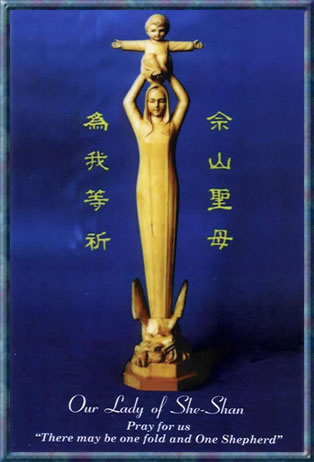 Virgin Most Holy, Mother of the Incarnate Word and our Mother, venerated in the Shrine of Sheshan under the title "Help of Christians", the entire Church in China looks to you with devout affection.



 waalaw on Daily Rome Shot 1119: “In 1st variation, 2. . . . . . Q-g1# also works. As does 4. . . . . .…”




























