QUAERITUR: What is really needed to be able to celebrate the TLM?

I received this question from a priest:

Dear Father Z.
 
A priest friend of mine, who started saying the TLM about 10 years ago, with the old Bishops permission called me this morning.   He asked me if Cardinal Hoyos had said that all that is need to celebrate the TLM mass is knowledge of the correct rubrics and correct pronunciation of the Latin prayers and readings.
 
I told him I would try to find out, ergo this email.
 
When Summorum Pontificum came out he started saying a private mass at his church.  About 12 to 22 people showed up, but his pastor ordered him to stop. 

As you know we now have our Bishop starting an inquisition panel, to give priests "a test", in order to say the TLM.  The panel is stacked with anti-Latin priests, with only the Aux Bishop seeming to be of open mind.
 
Please enlighten me with as much ammunition as you can. 
 
God bless you for what you are doing for the TLM and the church.

First, let me remind you of what the President of the Pont. Comm. Ecclesia Dei has said.

In 16 May L’Osservatore Romano Romano Darío Card. Castrillón Hoyos, President of the Pontifical Commission "Ecclesia Dei" underscored the importance of the institution of a parish in the center of Rome for the spiritual needs of traditionalist faithful, who usually attend the "Extraordinary Form" of liturgy of the Roman Rite.  "It is an act laid down by the Pope for the Diocese of Rome which has value in an of itself, in the continuing process now underway of the implementation of the Motu Proprio for the use of the Roman liturgy before the reform effected in 1970".  "However," the Cardinal added, "the achievement of a personal parish also has value as an example to other dioceses, both in Italy and elsewhere."

On the video DVD produced by the FSSP/EWTN to instruct about the older form of Mass the Cardinal said said that parishes and priests should make available the Extraordinary Form so that “everyone may have access to this treasure of the ancient liturgy of the Church.” He also stressed that, “even if it is not specifically asked for, or requested” it should be provided.  Interestingly, he added that the Pope wants this Mass to become normal in parishes, so that “young communities can also become familiar with this rite.”


Some of the language of Summorum Pontificum still must be clarified.  We know that there is to be a clarificatory document from either the Commission or the Holy Father himself.  However, in the meantime, since this is a legal document, I think we can take a page from the play books of a couple prestigious canonists, who are bishops.

First, I think we have to take note of how broadly His Excellency the Archbishop of St. Louis, Most Rev. Raymond Burke is approaching Summorum Pontificum.  This is not a man who allows personal preferences to get in the way of the proper implementation of the Church’s laws. 

Going beyond that good example, part of the problem here is what the word idoneus means in Summorum Pontificum § 4: Sacerdotes Missali B. Ioannis XXIII utentes, idonei esse debent ac iure non impediti... Priests using the Missal of Bl. John XXIII, ought to be capable and not impeded by law. 

Idoneus has to do with the priest’s "capability", what he is able to do. 

First and foremost it must be understood that idoneus means a minimum capability.  It does not mean "expertise".  Remember that the Church’s law must be interpreted in the most favorable way when it comes to people’s rights (favorabilia ampliantur).

Because Summorum Pontificum establishes that if a priest a priest has faculties to say Mass at all, he therefore automatically has the faculty also to use the 1962 Missale Romanum, one could argue that if he has faculties he must be assumed to be idoneus and also not impeded.  He is capable of celebration Mass with the Roman Rite in either use.

That is the juridical point of view.  But we know that the practical application is a little different.  So, it is reasonable to say that a priest should know the language he is going to celebrate Mass in enough so that he can not scandalize the people and it will be valid.

Second, take what His Eminence Edward Card. Egan of New York said for his Archdiocese when Summorum Pontificum came out in his policy statement.

II. Priests who choose to celebrate Mass in the "extraordinary" form must have a sufficient knowledge of the Latin language to pronounce the words correctly. 

Excellent.  The priest does not have to be an expert Latinist.  He must have sufficient knowledge to pronounce the words.  That is what idoneus is all about: it is minimum qualification, not expertise.

I think that Card. Egan is absolutely correct.  But my opinion only is as authoritative as my ability to persuade moves you to my side.  I cannot speak for anyone.  Also, while Card. Egan is a canonist of great prestige, as no one questions, he only Archbishop of New York, not of everywhere.   However, I am pretty sure that when the clarification comes out, it will be along these lines: minimum, not expertise.  Idoneus cannot be interpreted so widely as to restrict a priest’s rights unreasonably.

At this point, I have to say that, in my opinion, a bishop cannot rightly apply a separate certification process to a priest to be able to celebrate the older form of Mass.   If the priest has faculties to say Mass in the Roman Rite at all, it is his right to be able to use either Missal.  That is the point of Summorum Pontificum.  Of course the priest would be a complete dope to try to say it publicly without knowing it well enough to do a good job of it.  But priests are sometimes dopes.  Most priests, however, who would want to do such a thing would be the sort of priest inclined to serious reverence for Holy Mass.  That wrong-headed sort of priest would be pretty rare and persuasion, rather than structures, committees and local norms that violate the Pope’s provisions should be use to prevent that sort of aberration.

To impose a certification process for the older form of Mass, without also imposing a test of every priest of the diocese for the newer form, seems to me to be a punitive double-standard which violates both the rights of priests as well as the provisions given by the Supreme Pontiff.

Let’s start testing to see if priests really understand what they are saying in the Novus Ordo.  Let’s see if they really know the few clear rubrics there are, according to the 2000 GIRM.  Let’s see if every priest from overseas really understands the English or can pronounce it clearly before he is allowed to say Mass in public.

I am pretty confident that Rome would receive very positively a complaint from a priest that the bishop was imposing unfair restrictions concerning the use of the older Missal.   It remains, of course, that bishops can punish priests in a thousand ways.  You can win any number of arguments with bishops, and in the final analysis lose big time. 

The problem is more complicated for a priest who is not a pastor, who is an assistant in a parish.

The pastor is in charge.  If he doesn’t want Mass said at a certain time or altar in his parish church, I think he probably has the right to impose his will, stupidly or not.   I think we all are fully aware that assistants just barely have the right to a Christian burial, but beyond that they are mostly indentured servants until they are pastors.  If a pastor is a jerk, there is little the assistant can do about it, beyond his ability to charm and persuade, educate and judiciously suggest.

Perhaps the best approach here is to have those people make specific and repeated requests in writing to the pastor, very respectfully, for celebrations of the older form of Mass according to Summorum Pontificum Art. 5, § 1 with copies to the bishop and to the Pontifical Commission in Rome.  The pastor cannot simply straight-arm people who make these requests.  Some solution would have to be found for them.

In the meantime, my advice to the priest who is involved, who is an assistant and not the pastor, is to be very careful.  Continue to study the older form.  Celebrate it when possible.  But be careful.  Keep a copy of every scrap of paper, every note from the pastor.  Every letter that gets written or received.

Posted in ASK FATHER Question Box, Mail from priests, SESSIUNCULA, SUMMORUM PONTIFICUM |
11 Comments

D. of Monterey: TLM at Mission San Juan Bautista – 29 June

This note has come in:

SALINAS — After an absence of forty years, the Traditional Latin Mass according to the Roman Missal of 1962 returns to Mission San Juan Bautista on the Feast Day of Saints Peter and Paul, Sunday, June 29, 2008 at 2 PM.

The Latin Mass – to be celebrated by Father Nicholas Milich – will be a Sung Mass or Missa Cantata with Gregorian Schola composed of singers from throughout the northern part of the Diocese of Monterey.

In July 2007, Pope Benedict XVI removed all remaining restrictions on the celebration of the Traditional Latin Mass in his motu proprio "Summorum Pontificum." Benedict XVI decreed the traditional rite of the Mass as the "Extraordinary Form" of the Roman Rite with any Roman Rite priest free to celebrate it without the permission of the local ordinary or any other ecclesiastical authority.

Current plans call for the Traditional Latin Mass to begin being celebrated regularly on Sundays at the San Juan Bautista Mission.
Additional information: Andrew Russo, 831-753-1419.

Posted in SESSIUNCULA |
12 Comments

KCC Signs blog – RIP

I am mourning the loss of the KC church signs blog.

Pretty fun, creative stuff.

Posted in SESSIUNCULA |
6 Comments

Takin’ it to the street

Takin' it to the street

Take this onto the streets!

At least that is what one priest is doing.

I got this from a reader:

You have mentioned my pastor, Rev. Fr. Gerard Saguto, FSSP, a couple of times on WDTPRS: here and here.  Fr. Saguto was showing off a gift from a fellow parishioner this Sunday, and I thought you might appreciate a candid or two.  Thank you for all that you do, Reverend, for the faithful and the faith.  You’re in my prayers always.

Takin' it to the street

Posted in SESSIUNCULA |
6 Comments

Thanks to WDTPRSers, Penjing Report, and Sabine Blooms

Many thanks to those of you who wished me well for my anniversary of ordination (26 May) posted in comments and sent by e-mail.  A couple of you used the donation button, for which I am grateful, and and one of you utilized the amazon wish list.

Thanks go out to CG for Eamon Duffy’s The Voices of Morebath: Reformation and Rebellion in an English Village which I have heard a lot about.  This was waiting patiently at my doorstep on my return to the Sabine Farm.

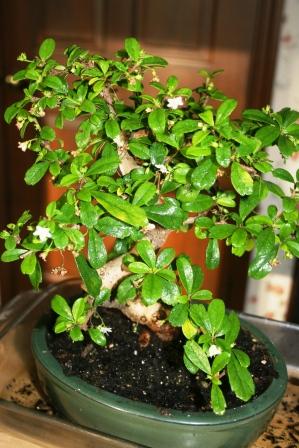
Also,  PENJING REPORT!

Penjing, which I received from a reader some time ago, is happily flowering.

Thanks to WDTPRSers, Penjing Report, and Sabine Blooms

Thanks to WDTPRSers, Penjing Report, and Sabine Blooms

Thanks to WDTPRSers, Penjing Report, and Sabine Blooms

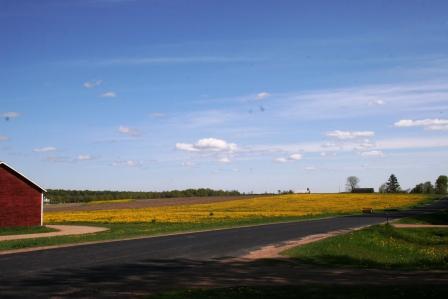
Meanwhile, other things are flowering around the Sabine Farm.  I have never seen so many dandylions.

Thanks to WDTPRSers, Penjing Report, and Sabine Blooms

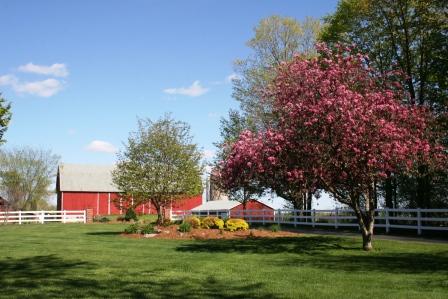
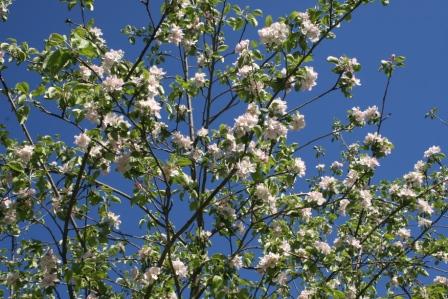
But the crabs are doing their thing and the front yard is obviously without dandylions.

Thanks to WDTPRSers, Penjing Report, and Sabine Blooms 
Thanks to WDTPRSers, Penjing Report, and Sabine Blooms

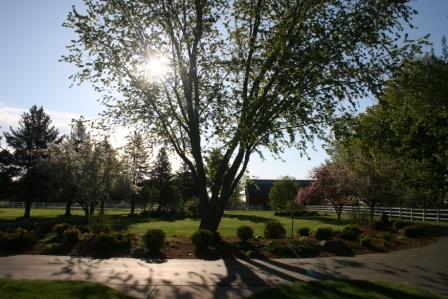
The morning view. 

Thanks to WDTPRSers, Penjing Report, and Sabine Blooms 

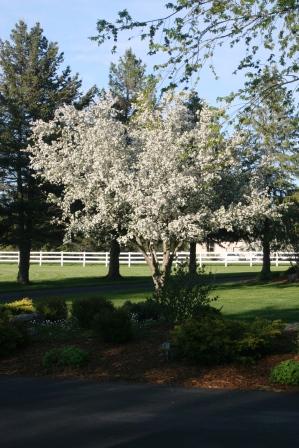
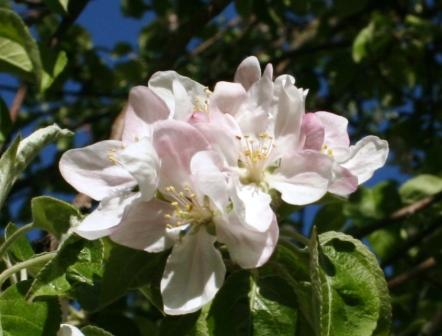
Near the chapel, the chapel apple is blooming.

Thanks to WDTPRSers, Penjing Report, and Sabine Blooms 

Back at the house, Mrs. Oriole is looking in my window at my desk while I work. 

This is through the window.  The orioles, once elusive, are trying to get at the hummingbird feeder.

Thanks to WDTPRSers, Penjing Report, and Sabine Blooms 


Posted in My View, SESSIUNCULA |
6 Comments

Mpls – St. Joan of Arc Church – I don’t even know how to label this tragic abuse

Remember the Potato Head Puppet Mass perpetrated by Call To Action in California?  Go here, but not on full stomach.  And to think a bishop was involved.

BUT WAIT!   THERE’s MORE!

I had mentioned in that entry about the Call To Action stupidity, that I had seen years ago a mystery play in the Cathedral of St. Paul by the "Heart of the Beast" giant puppet troop.

Lupus in fabula, here they are again!

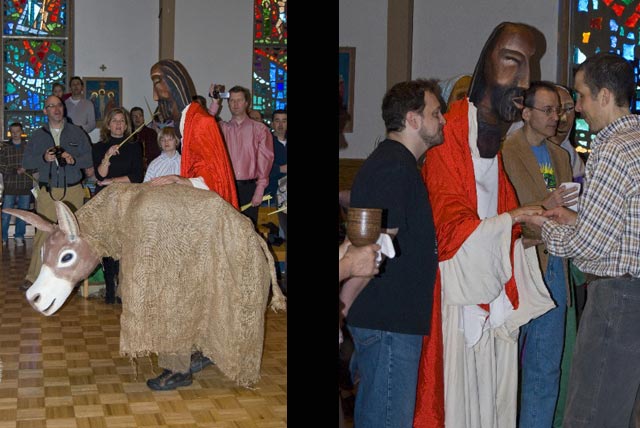
At the infamous St. Joan of Arc parish in my home town Minneapolis, one of the weirdest, wackiest, liturgically and doctrinally worst parishes probably on our Mother Gaia, there was a Palm Sunday "liturgy", I am guessing mostly oriented to children.

Behold, the Palm Sunday 2008 Mass at St. Joan of Arc Catholic Church in Minneapolis.

Here is the video which I captured, but it got a little squished:

(This video is no longer available.)

There may be a problem with the YouTube version.

(This video is no longer available.)

If you want to get at what they perpetrators think children should absorb from this "liturgy", and you can check your gag reflex for a while, go to about minute 10:20 in the video for a sort of litany of woes.

Remember, how we pray and what we believe have a reciprocal relationship.  So, what will all this do to a child’s perception of the Church and himself as a Catholic, over time?

I know that the former Archbishop, H.E. Most Rev. Harry Flynn tooks steps to clean this place up.  I suspect that the present Archbishop, H.e. Most Rev. John Nienstedt will have a lot to say to this community of faith.  I sure would.

Here are some stills which you can find at Orate Fratres.

“Around the alter, the Last Supper is prepared as the Jesus mimics Father Jim Cassidy as he performs the Consecration and gathers us for the Our Father and exchanging the sign of peace. Singing “Lamb of God” we share in Communion…”

Mpls - St. Joan of Arc Church - I don't even know how to label this tragic abuse 

I really hope these people just don’t know any better.

Did you need another reason why Summorum Pontificum is so important?

Posted in SESSIUNCULA |
90 Comments

Reviewing WDTPRS bullet points

Over time I have developed some ideas which guide most of what I post here regarding liturgy, liturgical translation, use of the older form of Mass, etc.

Let’s review some of the aphorisms and basic starting points I use here which are like helpful pegs upon which we can organize our thoughts when talking to people.

Think of a tool shop, where you see pegs on the wall with the shape of the tool that belongs their painted around the beg. 

Liturgy is the tip of the spear

There is a reciprocal relationship between how we pray and what we believe.  Change our prayer, we change our understanding of doctrine.  At the same time, if you believe a certain thing, that will affect how you pray.  Our identity begins to shift.  The Latin phrase lex orandi lex credendi expresses this… the "law of praying is the law of believing". 

The older Mass exerts a "gravitational pull"

Use the image of gravity or "cross-pollination", "harmonic resonance", whatever.

The use of the older form of Mass will exert an influence on the way the newer form of Mass is being celebrated.  First, younger priests (and older too) will discover new dimensions to Holy Mass by learning or refreshing the older form.  This will change their self perception and how they say Mass.  In turn, this will influence how people in the pews see them and understand Holy Mass.  Since the Eucharist (Its celebration and the Sacrament Itself) is the "source and summit" of our Christian life, identity, mores, etc., everything about our Church will begin to shift because of these changes of self-perception.

Say The Black Do The Red

The "Black" means the texts written in black ink on the pages of liturgical books.  The "Red" means the rubrics which explain the actions to be done.

Our sacred rites have their own interior force and power.  Remember that the true Actor in every Mass is the High Priest Jesus Christ.  He speak in every word.  He acts in every gesture. 

By our baptism, we have a share in Christ’s priesthood.  Thus, when we united our heart, mind and will with the sacred action, He takes our voices and hands and makes them his own, each according to our proper role.  The priest acts as Christ, Head of the Body.  The congregation is His Body in union with the Head. 

When we simply do what the Church asks and provides in our sacred rites, Christ is more easily discerned, His graces are more easily mediated, His voice and teaching more clearly heard. 

We must get ourselves out of the way and simply do what Holy Church asks and offers. 

Save The Liturgy Save The World

The Eucharist, its celebration and itself as the extraordinary Sacrament, is the “source and summit of Christian life”. 

If we really believe that, then we must also hold that what we do in church, what we believe happens in a church, makes an enormous difference.

Do we believe the consecration really does something? Or, do we believe what is said and how, what the gestures are and the attitude in which they made are entirely indifferent? For example, will a choice not to kneel before Christ the King and Judge truly present in each sacred Host, produce a wider effect?

If you throw a stone, even a pebble, into a pool it produces ripples which expand to its edge. The way we celebrate Mass must create spiritual ripples in the Church and the world.

So does our good or bad reception of Holy Communion.

So must violations of rubrics and irreverence. 

Mass is not merely a “teaching moment” or a “celebration of unity” or a "tedious obligation". Our choice of music, architecture, ceremonies and language affect more than one small congregation in one building. We are interconnected in both our common human nature and in baptism. When we sin we hurt the whole Body of Christ the Church.

If that is true for sin, it must also be true for our liturgical choices. They must also have personal and corporate impact. Any Mass can be offered for the intentions of the living or the dead.

Not even death is an obstacle to the efficacy of Holy Mass.   We offer Mass for the living and the dead.

Celebrate Mass well, participate properly – affect the whole world. Celebrate poorly – affect the whole world.   This is another reason why we must Say The Black and Do the Red.

Already but not yet

Christ died and rose again.  Thus our humanity, taken by Christ into an indestructible bond with His divinity, died, rose and ascended to the Father’s right hand.

Christ’s work is complete.  But its fullness has not yet been realized.

In this world, in our Church, in our lives, we are "already" enjoying the first fruits of Christ’s redemptive work.  But we have not received the fullness of what Christ has done.

Even the Eucharist is a foretaste of what is promised to us.

But we obscure the promise and place obstacles before what Christ offers us in the Church, in the liturgy, etc., when we places ourselves, our self-centered designs, in the way. 

We must get out of Christ’s way, so that His will may be brought to fruition.

We are already "there", but we still have a long way to go. 

The stakes are very high indeed.  What we do here is very important. 

We are dealing with choices questions of life and death for ourselves and our children.

Ad intra et ad extra

When we consider large questions about the Church and who we are as Catholics, it is useful to make distinctions about who we are in ourselves and who we are in the world. 

Catholics, Christians, are both of in the world and yet not part of the world, removed.  We are living in a state of "already but not yet".  What we have here in the Church is a foretaste of the world to come. 

But it is Christ’s will that Holy Church shape the world. 

It is especially the role of Christian Catholic laymen to shape the large world.  For this lay people need clergy to do their jobs, according to their vocations, to shape them and their identity, to sanctify, teach and govern them, so that Christ can act through their words and actions in the world. 

So we must consider who we are as Catholics, within our Church, as ourselves, in relation with Christ the Lord.  This is the ad intra angle.  Then we also must consider who we are in the world around us, what our role is in the world we influence.  This is the ad extra dimension. 

This can be applied, for example, in the liturgical choice we make?  What does doing X mean to ourselves as worshiping Catholics?  What does it say to the world?  When the College of Cardinals meets in conclave to choose a Pope, they must consider the man they choose in light of the Church’s needs in Herself and also how the Church interfaces with the world now and in the future.  Ad intra et ad extra.  This is not a chronological distinction but rather a logical distinction, helpful merely to get our thinking and planning organized.

Pope Benedict has a "Marshall Plan" 

After World War II Europe was devastated.  That devastation made it more likely that the enemies of humanity promoting Communism would find a good foothold.  Also, Europe was in no position to engage in useful trade.  More importantly, people were suffering.  So the United States began to help rebuild Europe.

After Vatican II there has been terrible devastation of the Church.  This is not so much because of the texts issued by the Council but because of the lack of correct reading of those texts, the ideological designs (sometimes malicious) of some few who had great influence in the Council’s implementation, and a deadly reversal of the logical priority which the Church must be given in the ongoing interchange between the Church and the world. 

In short, Catholics have by and large lost their identity because of the general rupture created in nearly every aspect of our experience of worship, education, devotions, etc. 

Because Catholics lost their identity, we have little or no influence in the public square.  Thus, Catholics are easier targets for bigotry or persecution or simple apathy.  We are more easily marginalized from public debate, pushed out of the square and given no voice.  Sadly, many "Catholics" then compromise Catholic teaching on faith and morals, violate the Church’s laws, for the sake of gaining influence in the public square.  Think of some Catholic politicians and even some clergy.

Pope Benedict’s plan is to reinvigorate Catholic identity from within the Church (ad intra) especially through our liturgical experience so that we can begin to claim our rightful role in the public square (ad extra), precisely as Catholics. 

If we don’t know who we are, what we think and believe, can’t explain our position, then what could be possibly have to say to the world around us?

Saying the black and doing the red has a wider influence on the whole world, not just on ourselves in an enclosed Catholic ghetto.  Liturgy is therefore our crow bar, the tip of the spear.  It is the force which draws everything nearer to Christ.

This is why Summorum Pontificum is so very important.  It reaches far beyond the desires of some people for older forms of liturgy.

This is why must have good translations for our vernacular Novus Ordo liturgy as well.  The vernacular Novus Ordo is here to stay for the long-term, whatever your desires to the contrary may be. 

Therefore, we need to have translations which reflect accurately and beautifully what the prayers really say.  They will shape Catholics from within and then Catholics shape the world according to how they pray and believe.   The prayers themselves begin to draw all things to Christ.

Posted in SESSIUNCULA |
13 Comments

Quantum potes tantum aude: Corpus Christi images

Quantum potes tantum aude

This is a line in the sequence Lauda Sion, composed by St. Thomas Aquinas for the Feast of Corpus Christi.

“However so much as you are capable of doing, dare to do that much.”

More smoothly, “Dare to do as much as you can accomplish”.

Yesterday I was in St. Paul, MN, and participated in the Corpus Christi procession at the Cathedral of St. Paul, perhaps the grandest Catholic Cathedral in the USA.  The builders of that church understood Quantum potes tantum aude.

The new Archbishop of St. Paul and Minneapolis, Most Rev. John Neinstedt said in his sermon during Exposition that Corpus Christi should not be celebrated without a procession.

Anecdote:  One day in May I was hanging around outside the Paul VI audience hall (Vatican) during a plenary of the Italian Bishops Conference waiting for my bishop to emerge, chating with fellow journalists and the bishops’ drivers and secretaries a couple bishops who had simply fled the hall in desparate boredom.  I had just been to a Eucharistic procession the day before held by the Teutonic College that went through the Vatican gardens, Swiss Guards carrying the canopy, … stunning.  Deep in his chest this one old bishop rumbled “Meno chiacchiere – più processioni. … Less jabbering – more processions.” 

The tide of anti-devotional madness is passing away.  The days of sneering critics of Eucharistic devotion are over.  No longer will we hear, as I did in seminary in the 1980’s, “Jesus said ‘Take and eat, not sit and look!’”, as if “looking” was opposed to “receiving”. 

I am hearing from many people that Eucharistic devotion is on the rise.

Our Holy Father Pope Benedict had changed the conversation.  He has set in motion his “Marshall Plan” to reinvigorate our Catholic identity especially through a shift in liturgical awareness and practice.  Liturgy is, after all, the tip of the spear.  Summorum Pontificum is exerting its gravitational pull on liturgical worship.  A new wave of Catholics desire all that Holy Church has to offer.  Our world needs an encounter with Mystery in the midst of ever more difficult challenges.

Taking Jesus into the streets must be both figurative and literal.

Perhaps if some of you readers care to take the effort, you might send me some of your Corpus Christi photos.  If they are usable, I will do my best to post them in a timely manner.

Please attach the photos to your e-mails, or I will have a hard time working with them.

In the meantime, here is yesterday’s Procession making its way up the hill toward the Cathedral of St. Paul, which looms high above the downtown district.

Quantum potes tantum aude: Corpus Christi images

And the Archbishop incensing the Blessed Sacrament.

Quantum potes tantum aude: Corpus Christi images

Quantum potes tantum aude: Corpus Christi images

Quantum potes tantum aude

The forces which worked for decades to diminish these devotions – doesn’t it seem as if they always sought to make Christ smaller somehow? – have faded in influence.

That doesn’t mean that we will be able to build back everything in a day.

In many places it take a lot of hard work to organize a first Eucharistic procession ever… or in many years.

Thus, not ever procession can immediately look like what the Holy Father has in Rome, or what the Institute of Christ the King may have at some grand church they have remodeled.

We must work patiently, brick by brick.

Posted in SESSIUNCULA |
66 Comments

CWN: Orthodox bishop shares Communion with Catholics

This is in from CWN.  I think it is interesting in light of discussion on this blog about Catholics seeking out the Orthodox in times of serious spiritual necessity and how that might be a model for how we think of Communion from SSPX chapels.

Orthodox bishop shares Communion with Catholics

Timisoara , May. 27, 2008 (CWNews.com) – A Romanian Orthodox bishop has shared Communion with Catholics, causing a sensation in a country where Byzantine Catholics and Orthodox have a history of tense relations.

At the consecration of the Queen of Peace parish church in Timisoara on May 25, Orthodox Metropolitan Nicolae Corneanu of Banat asked to share Communion. The Orthodox metropolitan approached the altar and received the Eucharist from his own hand.

Romanian Catholic Bishop Alexandru Mesian of Lugoj was the celebrant of the Divine Liturgy in the Byzantine Catholic church; Archbishop Francisco-Javier Lozano, the apostolic nuncio to Romania, was also present.

Although Orthodox and Catholic bishops often join in ecumenical services, and occasionally participate in each other’s liturgical ceremonies, they do not share Communion– an indication of the breach in ecclesial communion between the Orthodox churches and the Holy See. In Romania, tensions between the Orthodox Church and the Eastern-rite Romanian Catholic Church have been pronounced, adding to the surprise created by Metropolitan Corneanu’s action.

With some Orthodox believers outraged by the metropolitan’s sharing Communion with Catholic bishops, the Orthodox Patriarchate of Romania issued a statement saying that at the next meeting of the Orthodox synod, in July, Metropolitan Corneanu "may be asked to give an appropriate explanation" for his action.

The statement from the Orthodox patriarchate went on to say that ecumenical relations with the Catholic Church, "already quite fragile, cannot be helped, but are rather complicated," by sharing in Communion.

Metropolitan Corneanu– who was one of the first Orthodox bishops to admit that he had cooperated with the secret police under the Communist regime– has a record of friendship with Romanian Catholics. He was among the few Orthodox leaders prepared to return church properties that had been seized by the Communist government from Catholic ownership in 1948 and handed over to Orthodox control.

Posted in SESSIUNCULA |
120 Comments

Just having some…

… down time.

Posted in SESSIUNCULA |
7 Comments